Thursday, October 25, 2012

What’s Hiding in the Dark Shadows?


I have to start this post out by admitting that I’ve never watched the TV show Dark Shadows and really the only thing I knew about it was that reference on Gilmore Girls. So when I heard that the newest Tim Burton movie in works was going to be based on the show, I thought to myself that I would pass on it even though I love Burton (and that he would be once again collaborating with actor Johnny Depp). I figured the movie would be chock full of characters, plot lines, and references I wouldn’t understand, not to mention that my limited understanding of the TV show was that it was somewhat campy. And I am not really a fan of campy, except in limited cases.

However, that all changed once I started seeing trailers for the Dark Shadows movie. It looked very funny, albeit a bit cheesy, and I really liked the idea of a character re-awakening nearly two centuries later and having to figure out the new cultural milieu. And I learned that in addition to Depp, the movie featured a cast of excellent actors including Jonny Lee Miller, Jackie Earle Harley, Helena Bonham Carter, and Michelle Pfeiffer. While it still wasn’t super high on my list of movies to see, I became interesting in viewing the movie at some point. That point came when I was flying recently and Dark Shadows was one of the choices for the in-flight movie.

The basic plot of the movie is that the wealthy Collins family settles into a small fishing town in Maine that they name Collinsport, back in the 18th century. Their son Barnabas trifles with a servant, Angelique, but then falls in love with another woman. In retribution, Angelique – who of course is a witch – wreaks havoc on Barnabas’s life and ultimately turns him into a vampire and has the town bury him in chains. When a group of construction workers accidentally release Barnabas from his coffin, he returns to the family home and learns the year – 1972. He meets the new members of the Collins family and their household – Elizabeth, Roger, Carolyn, and David Collins in addition to Dr. Hoffman (a psychiatrist), Willie Loomis (the groundskeeper) and Victoria (a governess). The Collins family fortune has been much reduced and Barnabas promises to help restore it. He learns that the family’s arch nemesis is still Angelique, although she has changed her name/identity over the years to avoid suspicion about how she never ages. Angelique – still in love with Barnabas and angry at his betrayal – vows to make life hell for Barnabas all over again if he refuses to love her in return.

As you can probably start to tell by how long my “basic plot” summary is, this movie tried to pack way too much into a relatively short time. It just wasn’t working, as there wasn’t enough time to develop all the plot lines, let alone all the characters. There was so little known about many of the characters and unfortunately, oftentimes the little that you did know made you dislike them as there wasn’t enough time built in to include redeemable characteristics. (I’m thinking in particular of Jonny Lee Miller’s character, Roger, with this last remark.)

I didn’t mind so much the Angelique turns Barnabas into a vampire storyline in the beginning, mainly because the plot has to start somewhere and I’m guessing this is where knowledge of the original series comes into play. But seriously centuries have gone by and Angelique is just pining away for Barnabas still??? It’s this tired scorned woman trope which relies on the idea that a woman cannot possibly move on from one failed relationship to another more successful one. Seriously, let me reiterated – nearly 200 years have passed and this beautiful, never-aging, spell-casting, wealthy, business-savvy woman is incapable of finding someone better than the guy who used her and then dumped her like a bad habit.

Meanwhile, Barnabas – while temporary distracted by Angelique – is taken in by Victoria, who resembles his lost love. This relationship blooms super quickly, I suppose a necessity in the crunched time available for the movie to unfold, without the two interacting much. Because of the whole past love resemblance thing, it’s not entirely unreasonable for Barnabas to be smitten easily but the reciprocity of feelings is a bit of a stretch. Seriously, has Victoria looked at this man in a clear light ever? Or even in a murky light? There is clearly something off about him, on many different levels. Yet, for some reason, when it becomes beyond apparent later that he’s a vampire, she is surprised as though it wasn’t obvious that something was unusual about him.

Victoria is one of those characters that suffers from the compressed time allotted for the movie, as I mentioned earlier about characterizations in general. When she’s introduced early on in the film, we know that she is lying about herself and her background is unclear but by the time that she is able to explain some of this, we’ve already lost interest in her as she’s seen so little screen time since her introduction. The big reveal about her is definitely one of those “too little, too late” situations. Not dissimilar to Angelique’s lack of real characterization, the rest of the time Victoria is mostly a mash-up of two common tropes: the mysterious waif and the ingĂ©nue.

Together, these two female characters do a pretty decent job of fulfilling yet another trope: the virgin-whore complex. Angelique, the scullery maid who owns her sexuality and freely gives her body to Barnabas, is an evil witch while Victoria, the sweet governess who never shares more than a kiss with Barnabas, is the perfect angel everyone adores. Don't believe me? Just take a look again at the promotional movie poster (picture above). That's Angelique, looking curvaceous and seductive in a revealing vibrant red dress. Victoria is the one in the background on the left, looking like a 12-year-old school girl in a staid, all-concealing dress with a large collar to doubly ensure that she's all covered up. Honestly, the black dress with a white collar practically screams nun in a sheltered convent, as though the girl has made vows of chastity. If this were the actual TV series from the 1960s-70s, I probably wouldn’t object so much to such a black/white dichotomy but a remake should not simply repeat the sins of the past and continue to evoke such damaging portrayals of women.

Warning: Spoilers ahead!

To make matters worse, the ending of the movie becomes beyond absurd. Out of the blue, teenager Carolyn Collins is revealed to be a werewolf, and young David Collins’s belief that his mother is a ghost is confirmed, complete with visuals. Whereas earlier Barnabas and Angelique could throw each other around the room and destroy the place during their passionate love-making, when they fight at the end Angelique can suddenly be broken into tiny glass pieces by the slightest touch of Barnabas’s hand. This kind of lack of continuity makes me crazy. Please stick to the rules of the world you have created.

My feelings about a lot of the extended and clearly-meant-to-be climactic fight scene between the Collinses and Angelique were, “oh, come on! You’ve got to be kidding me.” Later still, when Victoria – in a Bella Swan moment – suddenly insists that Barnabas turn her into a vampire so they can be together forever, there isn’t any sense that this is a logical next step for a character who hardly knows Barnabas at all. It’s just an attempt to tack a happy ending onto an otherwise fairly dark movie.

All and all, I found this movie incredibly disappointing. As I mentioned already, the characterizations were mostly weak and I felt like a hugely talented cast was largely wasted. Furthermore, the movie was not as funny as I’d hoped for, with the scenes of Barnabas re-acquainting himself with the world after centuries in a coffin largely covered in the trailer with no further expanding upon in the movie itself. I had expected a lot more of these funny sequences rather than what I got instead. There was a lot more violence and gruesomeness than I had anticipated, and the movie felt more dark with only an occasional hint of humor rather than the darkly funny that I’ve come to expect from Tim Burton’s movie.

In case you can’t tell, I’m not recommending this one. If you are a huge Dark Shadows fan, perhaps you’ll want to check it out to any similarities/dissimilarities with the original series. But if like me, you are just looking for an entertaining movie, look elsewhere.

Monday, September 24, 2012

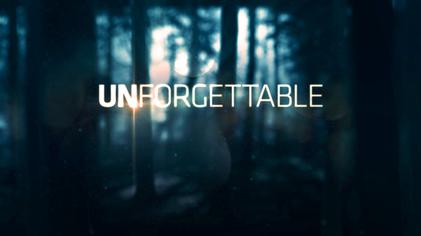
Canceled Shows: Revisiting Pan Am and Unforgettable

Long-time readers of this blog know that I'm not a fan of winter and one way I try to combat the anxiety about the coming cold and dark months is by appreciating the unique charms of fall. One of these is the traditional fall line-up of new TV shows. So far this year, however, I haven't seen any new shows advertised that sound compelling so I'll mostly be sticking with the tried and true. But that still means that fall will be an exciting time of seeing those shows come back with new story lines. 

However, you loyal readers may recall that last fall I did find some new shows to invest time in for a season. Those shows were Pan Am and Unforgettable. Unfortunately, both ended up being canceled, although apparently Unforgettable ended up becoming uncanceled. For some time now, I've been meaning to write up my closing thoughts on these shows after they had a full season to flesh out characters and story lines, so here at long last are those comments.

Pan Am 

The basic premise of this show revolved around the lives of four stewardesses and two pilots working at Pan Am during the 1960s. One reason the show interested me was for the historical context and the potential to open up discussion about women's rights and roles in society, then and now. In my opinion, the show succeeded to some degree with both.

However, the show became by and large an evening soap opera, which is not particularly my favorite genre of TV. While big issues were addressed (politics, civil rights, women's liberation, smuggling, etc.), these were frequently done in that over-the-top, dramatic kind of way rather than just focusing on the moral dilemmas and character development that resulted from these. There was also a huge focus on the romantic lives of each character, which is not a bad thing in and of itself if it is done well. However, it was not always done so well on this show, with characters falling in and out of relationships in what sometimes seemed like a willy-nilly fashion. For instance, in some cases, there was no build up showing how characters came to be interested in one another, such as Ted and Amanda's whirlwind romance. But in other cases, we do get to see a long and simmering tension heating up, such as Colette and Dean's on-and-off again relationship. 

Speaking of relationships, when I first wrote about Pan Am, I objected to the writers' attempt to push a relationship between Ted and Laura. By the end of the series, I was actually invested in this plot line and found the derailing of this by the Ted-Amanda relationship frustrating. So, hey, sometimes I'm wrong. ;) But, like I said then, one of the most appealing things about Ted's character was that he was basically an impulsive, immature person who needed to grow up and learn a bit more about the world, which gave him the most room to grow as a character. He did that in spades, even if sometimes falling a step backwards here and there, so he was a character I always enjoyed watching. Laura also grew as a character, even if somewhat unevenly, and perhaps she was still too naive and trusting by the end of the first season, but the idea of her in a new, committed relationship was no longer so absurd.

The show's flashbacks had been a major selling point for me in the earlier episodes of the season, as they provided the characters with rich back stories and motivations for their actions. As the show continued, however, these became less frequent and we were left with characters doing things that seemed uncharacteristic (i.e., much of Maggie's actions) without any explanation for the rationale behind these things. 

However, it is important to note that the ABC network also did end up airing one of the episodes out of order so some things, such as the relationships that seemed to drop off without explanation or other plot events that seemed to come out of nowhere, suddenly became much clearer with the new information that came from actually seeing an episode that should have been aired earlier. The network did the show a great disservice here -- in a series that has a definite arc where episodes can not be just stumbled upon at random, it is imperative that the story be told in order.

The season finale (and now series finale) certainly left many things open-ended with the potential for exploration in a later season (that was never to be). Still, the final scene of the episode has just enough happiness and togetherness amongst the main cast that it makes for a satisfying enough ending to the show.

Overall, I enjoyed the show enough that I might go back and re-watch this first season (with the episodes in order this time) sometime in the future, but not I wasn't so over the moon about it that I was crushed by news of its cancellation. After the show Ringer was canceled, my friend commented in a blog post, "I'll miss you. Sort of." That pretty much sums up my feelings on Pan Am.

Unforgettable 

My feelings about Unforgettable are more complicated. To me, it felt like this show had potential to be better than it was, but it kept dropping the ball. To recap, this show was about Carrie, a woman with hyperthymesia (the ability to remember everything) but can't recall the details of her sister's murder when they were children. At the show's start, Carrie picks up extra cash by basically counting cards at illegal gambling spots and spends her free time volunteering at the nursing home where her Alzheimer's-suffering mother lives. When a murder occurs in her apartment complex, Carrie is thrust into the police investigation, which is being run by Al, her former boss at the Syracuse police department and also her ex-boyfriend. By the next episode, Carrie is re-instated as a homicide detective, working with Al, Mike, Roe, and Nina on cases in which her ability to remember every little detail comes in handy and helps bring in criminals.

As a police procedural, Unforgettable picked up on every trope in the book - sexual/romantic tension between members of the crime-fighting team, a serial killer case where the killer becomes obsessed with a member of the police force, a mafia connection that leads to an ill-advised relationship, a growing expansion of the team to include the coroner and a tech-savvy lab worker, and the standard opening of each episode with a murdered corpse being found in an unlikely scenario. (This last one in particularly felt like a rip-off of Bones and NCIS and irked me to no end. Unforgettable, you're better than that. You have a fabulous main character who does interesting and exciting things. Let's see more of her personal life in the brief intro to each episode instead of the same old thing on every other crime procedural.) 

The problem with most of these was that Unforgettable try to cram all of that into one season. Rather than letting these be real hooks that keep the viewer coming back from week to week, they felt like simple ploys for attention. For instance, when Carrie becomes involved with Steve Cioffi, whose family has mafia ties, this felt like a subplot that could really develop and go somewhere. Instead, we hardly ever saw their relationship or heard about it except for their initial meeting and their ultimate break-up. Granted, these were both dramatic events, but it felt like there could have been much more build up and growth than there was in the end. Likewise, Carrie and Al's past as lovers should be something that's always in the back of the viewer's mind, but the execution of this is spotty as well. There are some really great moments where you are reminded of the sexual tension that did/does exist between the two, but these intense reminders are punctuated by lots of nothingness on their relationship. The introduction of Dr. Webster and Tanya at first felt forced and too much like the show was just trying to be like every other cop show on TV, but I eventually came to like these characters and wished to see more about them develop. Like I had said when the show originally came out, the supporting cast of characters needed to be better fleshed out for the show to succeed. Unforgettable certainly made some strides in that department, but I still felt like the personal lives and motivations of Mike, Roe, and Nina especially needed to be injected more into the show. Character-driven stories are always more compelling in my book than plot-driven ones, so I was constantly craving more about the characters' relationships with each other, their home lives, their back stories, how the cases were affecting them, and so on. We saw some of this, but never enough for my tastes.

The serial killer obsessed with matching wits with Carrie was one subplot that was done very well. This story line, along with the ongoing mystery of the murder of Carrie's sister Rachel when they were children, was one that kept me tuned into the show and wanting to see where it would go next. These were where Unforgettable shone and you saw how it could be compelling, even if not so very different from the myriad of other police procedurals on the air.

Otherwise, most weeks the show was just another cop show with a mystery to unravel by the end of the hour. I like a good mystery (although these ones weren't terribly hard to guess before the big reveal), so this isn't necessarily a bad thing; it's just not necessarily a good thing either. For that reason, I wasn't particularly surprised when the show was canceled, although I was disappointed that it was going to end without us knowing who murdered Carrie's sister, despite her coming closer to finding this out throughout the season. I was, however, surprised to find out it was renewed after being canceled, as that seems like an unusual move for TV executives. With the mystery of Rachel's murder still out there, I'll probably tune back in to the show. But it still has some work to do before it can become truly unforgettable.

Thursday, September 20, 2012

Quietly Watching Trains Go By with the Station Agent

Last night I sat down to the watch the movie, The Station Agent. I can't honestly recall now where it is I first heard about this movie, but I think it might have been in an article listing movies featuring librarians. At any rate, this seems like a movie that mostly flew under the radar, being a quiet, indie movie. That being said, that's a real disservice to many people, as this was a great movie.

The Station Agent follows the life of Fin (Peter Dinklage), a New Jerseyan dwarf whose quiet life is turned upside down when his employer, Henry, dies. The hobbyist train shop that Henry owned - and where Fin worked - is sold, but fortunately Henry has some property that he willed to Fin. It is thus that Fin ends up living in a train depot, the former place of employment for the town's station agent, in the sleepy town of Newfoundland, New Jersey. Here Fin tries to continue to have a quiet existence, bothering no one, but his attempts are confounded. First, there's Joe (Bobby Cannavale), the talkative hot dog vendor who sets up across the way from the train depot and desperately wants to make friends in this quiet town. Then there's Olivia (Patricia Clarkson), a free-spirited artist who has recently lost her son and separated from her husband. Rounding out the cast are Fin's young neighbor Cleo (Raven Goodwin), who is similarly obsessed with trains, and Emily (Michelle Williams), the flighty but sweet young woman who works at the library.

This film is one of those slice-of-life movies of which I am so fond. We catch only a small glimpse at the lives of these people, based on a brief period of time, but there is very much the feeling that these people existed before and after the credits rolled. That is to say, they don't feel like over-the-top fictional characters but instead resemble real people. In terms of plot, not a whole lot happens, but that does not mean the viewer walks away feeling nothing has changed. Indeed, the characters have grown throughout the film, most particularly Fin, who opens up and lets friendship into his life. One particularly poignant scene is when Olivia receives some bad news and shuts out Fin as a result, and you can see the hurt on his face and perhaps even the realization that her behavior mimics his when Joe, Olivia, and the others first tried to reach out to him and received no encouragement.

That all being said, a film like this really needs strong characters to carry it. After all, what is a movie about character development if the characters are dull and uninteresting or boorish and crass? Character-driven movies must have at least one likeable character, or I find that they fail miserably, at least for me. In this movie, that is not a problem. All of the characters are likeable in their own way. Joe was such a ridiculous character, trying so desperately to make friends, that I could not help laughing out loud several times when he could not contain his talkativeness or desire to build bridges. For instance, there is this gem of dialogue between him and Fin when he learns that Fin intends to stop by Olivia's house to drop off the cell phone she left behind:

Joe: Hey listen, if you guys do something later, can I join you?
Fin: We're not gonna do something.
Joe: No, I know, but if you do, can I join you?
Fin: We're not gonna do something later.
Joe [becoming more insistent]: Okay, but, if you do?
Fin [exasperated by this point]: Okay.
Joe [relieved]: Cool.

With Fin being the main focus of the movie, however, it's important that his character be likeable as well. As I mentioned above, he is at first cold to those who try to make friends with him. While this might make most characters seem less than likeable, in this case the viewer is sympathetic to Fin as the movie includes several scenes to indicate Fin's pathos and his desire to be alone. These largely revolve around Fin's dwarfism, which casts him in a light as "other" and evokes explicit and tacit mockery from new people. Fin later confides in Olivia about his feelings of being viewed in such a way, noting, "It's funny how people see me and treat me, since I'm really just a simple, boring person."

But even a simple, boring person could be interesting in the right light, which is exactly what The Station Agent shows. While the lives of these people are not exactly thrilling per se, the pacing, dialogue, music, and cinematography provide the perfect backdrop for drawing in the viewer.  It's a great understated movie that is well worth watching.

Monday, September 17, 2012

Grounds for Sculpture: The Garden State’s Garden of Art

Anyone reading this blog -- whether long-time followers or new readers -- knows that I am a big fan of art and can surmise that I also like gardens. But it’s rare that I get to combine these two interests. However, one place that can always be done is the magnificent Grounds for Sculpture in Hamilton, New Jersey. This place is a large sculpture park built on the former New Jersey Fairgrounds, which were bought and converted into this artistic space by Seward Johnson. Grounds for Sculpture was officially opened to the public as a sculpture park in 1992.

Although I’ve only been to Grounds for Sculpture only a handful of times in my life, it just so happens that three of those visits were between 2011 and 2012. It seems that every time I go, I end up gushing so much about it that I inspire another person to want to come visit it with me!

One of the things that I really like about Grounds for Sculpture is that it is not just an outdoor museum; there are others like that elsewhere, albeit Grounds for Sculpture is the nearest to me. But Grounds for Sculpture is more than that – it boasts a large collection of sculptures by Seward Johnson himself, who re-creates famous paintings in the landscape of the gardens. For instance, Monet’s Garden at Sainte-Adresse (a painting I know well for I have a copy hanging in my living room) is re-created on a grand scale here, placed before a lake. Visitors can stop by and physically plop themselves into a chair next to the seated lady and gentleman admiring the view. Elsewhere, there are re-creations of famous paintings by Manet, Rousseau, Matisse, and so on.

There’s also a fair amount of sculptures designed to appear like regular people about the park. Look out for a gardener trimming some bushes, a couple sleeping under the shade of some trees, a young girl reading on the grass, and so forth. These sculptures make you do a double-take to confirm that it’s really a piece of art and not a person.

Of course, there are also numerous other sculptures throughout the park that are not based either on other artists’ work or meant to be trompe l’oeil. These works vary from George Segal’s “Depression Bread Line” to more abstract and conceptual works. Whatever form the work takes, it is sure to be incorporated into the landscape in a most fitting way, whether that be within a bamboo forest, alongside a shady pathway, in a broad grassy area, or near the lakeside. All and all, this makes for a pleasant walking experience -- just remember to take a map with you and/or watch for some landmarks or you will find yourself lost on the property! But don’t be afraid to wander off the beaten path to find some hidden gems, like a quiet nook with a hammock for relaxing.

Some other features of Grounds for Sculpture worth mentioning are its Water Garden, peppered with still more sculptures but this time in the extra aura of mist and tinkling waterfalls; fine dining at its Rats restaurant (hearsay, as this blogger has never actually been); and its peacocks. Yes, its peacocks. Somehow these beautiful birds have taken up with art and live on the grounds. You will see them throughout the park, can buy stuffed animal versions of them in the museum shop, and can even dine at the Peacock Café on site (no peacocks served there, of course!). Be warned that at the Peacock Café, you might be hard pressed to find a seat on the outdoor patio as sculptures have their places here as well.

During my most recent visit to the grounds, we got some extra treats. The first was that the artists’ studios on the grounds were partially open to the public. One artist was unofficially giving visitors a tour of his work space. Another artist was working on a project and allowed viewers to stop in to see his progress and asks questions. This was a really exciting opportunity to see behind the scenes and get answers to any burning questions about technical details about sculpture and the artistic processes from concept to construction.

The second treat was that we found some exhibits on display in the grounds’ Domestic Arts Building, which had not been on our agenda per se. The bottom floor of the building featured the “E Pluribus Unum” exhibit of artist Willie Cole’s work, which largely focused on works made with recycled items. For instance, the thing that caught our collective eyes first was a chandelier made from plastic water bottles. There were also several sculptures that resembled cows, which took me a few moments to recognize as made up of parts of toilet bowls. When I found in the accompanying literature that this work was called “Two-Faced Bull Shitters,” I could not stifle a loud chuckle at the cleverness of this title. The top floor of the building was giving over to artist Marilyn Keating’s exhibit “Natural Curiosities.” As the name implies, many of her works focus on beauty in the natural world, including insects, animals, and plants. Several of her works were created with wood blocks, which is one of my favorite artistic mediums, if I have not mentioned that before somewhere in this blog.

Although we arrived too late in the day this last time to take advantage of this other great Grounds for Sculpture feature, on a previous visit we participated in the Tots on Tour event. This special tour is for 3- to 5-year-old children (and, of course, their accompanying adults!), who are treated to a story time, a craft time, and then a quick run of some of the park’s many art works, highlighting those that would be most exciting for children. These include a giant snake the kids could run on top of and an interactive musical sculpture. As soon as the tour began, the guide explained to the kids that if a sculpture had a green sign near it, they were allowed to touch it with care but if the sculpture had a red sign near it, they could admire it with their eyes only. The kids were thrilled to run around looking for green signs and have the opportunity of interacting with the sculptures tactically. I’ve now been to Grounds for Sculpture with young children of a variety of ages (younger than 1 year old; not quite 2 years old; age 3; age 4; and age 5) and they have all been delighted with visiting the sculpture park. All of the staff running the Tots on Tour feature were well-versed not only in art but in child development as well, making sure every part of the event was the appropriate amount of time and complexity for young ones’ attention spans.

If you are driving in or around Hamilton, no doubt you’ve noticed some of the giant sculptures scatted about the grassy areas near major roads. These are some of the greatest advertisements that could be given for Grounds of Sculpture -- pass near them, and you’ll get a sense of what it’s like to be in the sculpture park. But visit the park itself for the much grander scale of what that’s like. I’m sure you’ll enjoy it!

Sunday, September 2, 2012

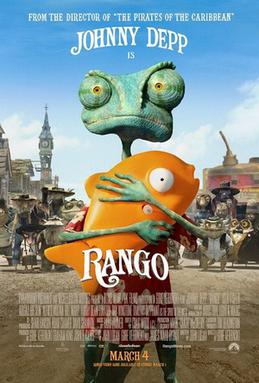
Rango, the Tiny Lizard with a Lot of Gumption

Rango is an animated film that tells the story of a little lizard who dreams up and acts out big adventures in his small glass tank. But when the moving van swerves unexpectedly on a highway through the big open country of the West, the tank flies out of the truck and shatters to pieces on the road. Our little lizard friend is abandoned and, after meeting with an armadillo on a spiritual journey to the other side of the road, he goes in quest of water to a town called Dirt. His first encounter, just outside of town, is with a girl lizard called Beans (so named because "My daddy plum loved baked beans."). Once in the town, he puts on his greatest act yet as Rango, a no-nonsense gun-slinger right out of an old Western movie. He quickly wins over the town with his tough-guy act and is appointed sheriff. But being sheriff isn't all about tough talk -- Rango has to figure out the mystery of the town's drought, stave off an impending rattlesnake attack, and track down some bank thieves. Of course, he has help along the way - including the feisty Beans and a host of humorous characters amongst the townsfolk, who are a hodgepodge of small animals.

This Nickelodeon movie came out last year and although I had wanted to see it at the time, I finally got around it to when some family from out of state was visiting. After having suggested the movie for our outdoor movie night (an annual favorite pastime), I was a little nervous at first as the movie was a bit slow going in the beginning. It picked up though and became very funny as well as action-packed and holding a mystery to be solved. Rango held the attention of both kids (of all ages) and adults alike, which probably isn't a huge surprise given that it won an Academy award for the best animated picture as well as numerous other awards. Like with many other animated features, Rango works on two levels - there's the basic storyline and slapstick jokes aimed at children while there are also a number of Easter eggs and quips that appeal only to adults. For instance, there are numerous references to classic Western movies, and I have to admit some of these probably went over my head as well as over the heads of the children and teens in our audience. However, a brief reference to Fear and Loathing in Las Vegas, in which Johnny Depp also starred, had me cracking up.

Rango boasts a considerable amount of Hollywood talent. For starters, it teams up director Gore Verbinski and actor Johnny Depp once again (as with the first three Pirates of the Caribbean), with Depp spot on as the voice of Rango. Amongst the other talented cast members are Alfred Molina, Abigail Breslin, Bill Nighy, and Ned Beatty. Several of the voice actors, including Depp, play more than one character, which can surely be no easy feat.

However, there are a few down sides to this movie. As I mentioned earlier, it started a bit slow but then picked up a great deal with additional comedy and also some adventurous moments. But to be honest, I actually got bored during some of these extended action-packed sequences. This is not a fault of Rango only; I find that as I age, I am much more interested in plot and characterization, resulting in me becoming bored with yet another long scene devoted to some sort of fight and/or chase, which will inevitably end with the good guys winning. A second problem, and one that I find more troubling, is that it's debatable whether Rango passes the Bechdel test - if it does, it's by the skin of its teeth, which isn't a great sign of a movie being female-empowering. Likewise, it has some troubling portrayals of non-white ethnicities as well. Both of these issues may be related to the fact that Rango is inspired by - and parodying - old Western movies. For instance, take a scene like the one in which Rango is leading a posse into the desert to search for the bank robbers. One member of the posse, named Wounded Bird, is very much meant to be playing the role of the mystical American Indian. I rifled at first at the idea of this character, but then these lines came out as Wounded Bird is releasing some feathers into the wind:

Rango: I see you're communicating with the great spirits.
Wounded Bird: No. I'm molting. It means I'm ready to mate.

It's incredibly clever and turns a stereotype on its head. Still, I'm not sure how much - and what exactly - young children are absorbing when they see and hear from characters such as these. There's also a framing device used in the movie, once which breaks down the fourth wall a bit, in the use of a mariachi band of owls. Again, perhaps it's a bit stereotypical, but it's also very funny as the mariachi band frequently employs dramatic irony that is quite wrong. For instance, they keep predicting Rango's demise and death at various points only to later have to shrug and say they were wrong that time. There's also this great scene:

Rango: Now... we ride!
[whip cracks; Rango stops and looks to his right, puzzled]
Rango: [the band of mariachi owls stands a ways away with their instruments, waiting; Rango shouts to them] That means we're riding now! This moment.
[another whip is heard and the owls start playing the background music; everyone is riding roadrunners in the next cut

All in all, I like the addition of the mariachi band, but I again wondering about what take-away children derive from their presence. And, of course, the entire West (or at least what we get to see in this film) is one giant stereotype based on old movies, with a saloon being the most crowded place in town, a main dirt road for shooting duels, and so forth and so on. Even though the rest of the world seems to be in the 21st century, the town of Dirt is stuck sometime in the 1800s or early 1900s at best.

Still, I found this movie entertaining enough to enjoy it at the time and I would not object to watching it again, especially to see if I caught more of the in-jokes and Western references a second time around.

Thursday, August 23, 2012

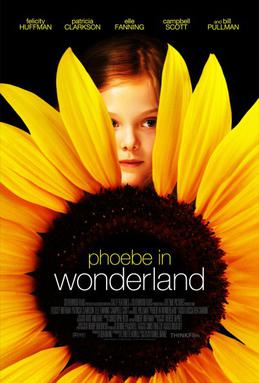
Down the Rabbit Hole: Phoebe in Wonderland

Some of you may know that I have a slight obsession with all things Alice in Wonderland, so when my cousin proposed that we watch the movie Phoebe in Wonderland, I was happy to comply. (I had been meaning to get around to it anyway, so this was as good a time as any.)

Phoebe in Wonderland is about a 9-year-old girl (the titular Phoebe) who is an outcast at her rigid, rule-bound school but feels things might change with the addition of Miss Dodger, a quirky new drama teacher who encourages everyone to sign up for the school play, Alice in Wonderland. After much debate, Phoebe signs up for auditions and wins the role of Alice. While all seems to be going well on the theater front, all is clearly not well with Phoebe at school and at home. She suffers from a severely debilitating case of OCD (her hands are raw from obsessive hand-washing and her knees are scrapped up from jumping up and down the stairs in a specific pattern instead of merely descending), she confesses she cannot help but say or do certain things, and she is having hallucinations (all of which are wrapped up in the Alice storyline in some way). Despite all this evidence, however, her mother Hillary is insistent that Phoebe is just a regular child and does not have any kind of disorder.

This film was very different from what I expected from the brief blurbs given about it. My thoughts were that the movie would be a quirky surrealistic film about a young girl's imagination. Instead, it was a dramatic look at a neurodevelopmental disorder and its effects not just on the sufferer but her family as well. Indeed, the movie belonged more to Hillary than Phoebe, even if Phoebe is the one on screen more. The movie's story arc is more about Hillary's coming to terms with the idea that her daughter is not just a typical child and finding the help she needs to cope with her disorder and still be herself. Some of the most poignant scenes in the film belong to her, such as when the psychiatrist Hillary hires first tells his diagnosis and she refuses to believe it outwardly, ranting about how doctors just want to prescribe medication instead of letting kids be kids while the tears on her distorted face indicate that on a deeper level, she knows he is right. Another powerful scene comes when her husband tries to apologize for an earlier insensitive remark and Hillary responds with a whole list of things that frustrate her, including her inability to understand what is wrong with her daughter or how to help her. Still another emotional scene occurs when Hillary goes to comfort a scared Phoebe waking up from a nightmare; Hillary notices Phoebe's battered knees and both mother and daughter cry for different reasons. There are plenty of other such scenes of Hillary's struggle with mothering a special needs child as well as her other daughter who sometimes wishes that she had another sibling that she didn't have to take care of and explain away her actions to others, despite being the younger one.

In addition to these deep scenes and themes, there are a number of other messages underlying in this movie. There's the power of art as a redemptive force, as seen in the play's ability to largely subsume Phoebe's symptoms. Likewise, theater - and especially Miss Dodger - encourages the school's children to be who they are and learn how to direct their own paths. Fitting in or rather, not fitting in, is a recurring element in the movie. It is not just Phoebe and her lack of friendships with most of her peers. There's her one and only true friend at school, Jamie, a young boy who happily plays with dolls and hopes for the role of the Queen of Hearts in the upcoming school musical. And, it's also her younger sister, who is wise beyond her years and dresses up as Karl Marx for Halloween, goes on a hunger strike when she learns their dinner was not made with cage-free poultry, and worries that at 7 years old she has not produced as much as the 6-year-old Mozart did.

There's some brilliant acting throughout the film, especially by young Elle Fanning as Phoebe and Felicity Huffman as Hillary. Miss Dodger, as played by Patricia Clarkson, was an interesting character as well, with some suspecting that she can relate so well to Phoebe because she, too, has a disorder - quite possibly she has Asperger's syndrome. In addition, the filmography is mostly well done, although there was an occasional scene that was too abrupt or seemed misplaced. Throughout, I found the dialogue to be very quiet while the music soared incredibly loudly, although this is not a problem unique to this movie alone. (It is a continual pet peeve of mine to have be continually changing the volume because filmmakers seem to think that the spoken word should be barely audible but the soundtrack should blast your eardrums off.)

All and all, this is a very interesting movie, but certainly a more serious one that I was expecting. Don't go into this one looking for some light-hearted, quirky fun -- but do go in to it to explore how difficult life could be for a child - and a family - going through the process of suffering from something unknown and finally learning - and making peace with - what this unknown factor is.

Saturday, August 18, 2012

Examining New Jersey's History at Covenhoven House

On a lovely, surprisingly cool August day, the Central New Jersey chapter of the Jane Austen Society of North America (CNJ-JASNA) met at the historic Covenhoven House in Freehold for our bi-monthly meeting. We feasted on a potluck lunch, complete with a surplus of sweet treats, while discussing good books everyone was reading lately.

Afterwards, we were treated to a docent-led tour of the house by our very own Jere, who wore a period dress of her own design and making. We learned a rich history about this little corner of our state, particularly its role in the Revolutionary War. And, of course, we learned a great deal about the Covenhovens, who after becoming flush with money when they inherited $500, built this grand house in 1752. Being of Dutch descent, the Covenhovens incorporated Dutch, British, and Roman (then very popular) styles into their home's architectural design. Their lovely home consists of a large kitchen, parlor, and downstairs guest room along with three bedrooms upstairs (only two of which are open to the public). One of these upstairs bedrooms has a unique aspect, but you'll have to visit to see this wonderful surprise for yourself! Along the way, Jere explained various aspects of Georgian life in general and particulars about the Covenhovens' lifestyle.

Bringing things back around to Jane Austen, Jere noted that the house was later owned by an American sea captain who lived there with his family. They were known to entertain and host dances, just like the ones we read about in Austen's novels. The Covenhovens were also known to entertain, but Jane was only a toddler when the Battle of Monmouth was ongoing, at which time the Covenhoven House was seized by General Clinton to become the British headquarters in the area. Again, you must visit the house to hear the story of how the feisty 80-year-old Mrs. Covenhoven fought against the British in her own way!

The entire CNJ-JASNA group so loved our visit to the Covenhoven House that we have resolved to spend more time visiting historical sites in Monmouth County!


(Cross-posted to CNJ-JASNA’s blog)

Friday, July 27, 2012

Bunheads: Swirling Toward Success?

Note: This post contains some spoilers for the first six episodes so far.


Being a huge fan of the show Gilmore Girls, I was excited when I heard Gilmore Girls writer and producer Amy Sherman-Palladino had a new show coming out. But if the name Bunheads wasn’t enough of a turn-off, the initial trailer did the show no favors. I wrote off the show before it even came out … that is, until I read some of the press about it. In particular, the Entertainment Weekly interview with Bunheads star Sutton Foster piqued my interest in what the show would have to offer, so in the end I checked out the show.

Now is a good time to give a quick summation of the first episode and, with it, the show’s premise. The pilot episode opens up with Las Vegas showgirl Michelle going to try out for a dream dance job and getting immediately rejected without even performing. Back home, her not-so-secret admirer Hubble is hanging around trying to go out with her yet again and this time she acquiesces. In her sorrow and self-pity party on not getting the part (or rather, not even getting the chance to get the part), Michelle gets drunk at dinner and agrees to marry Hubble. The next morning they come home to his quiet town of Paradise, California where Michelle finds Hubble lives with his mother Fanny, who runs the ballet studio on the property and does not take kindly to her new foisted-upon-her daughter-in-law.

To start off with, this initial premise is ridiculous. It’s quite frankly creepy. I know Las Vegas is known as the city where crazy stuff like ill-advised shotgun-type weddings occur, but if it isn’t illegal for a marriage to occur in which one party is drunk while the other is sober, it SHOULD be. That’s just not good for anyone and is to the detriment of society. I can empathizes with Michelle’s feelings of being stuck, of not ending up where you thought you would in life, in seeing dreams of getting out of a rut shot down cavalierly, but I cannot understand her reaction. When I’m feeling particularly low, I veg out and watch some TV, take short road trips out of the state to visit with family and friends, or make small changes like dying my hair for the first time. I don’t think to myself: ‘Oh, I know what will solve all my problems -- get married to some guy I hardly know and get the heck out of Dodge without even bothering to pack a suitcase or inform my job that I’m quitting.’ Absolutely not. There is no reasonable rationale here. This is not 1890 where a woman is dependent on a man to provide for her so she has to just get married already to whoever is available because she’s getting older and he’s the only viable option.

Furthermore, there are plenty of other premises that could get the show started off with Michelle being thrown in the culture shock of small town life. She could be driving home from her disastrous audition and her car breaks down in the small town and she’s stuck there for a few days while it’s being repaired and is wooed by the small town charm into staying there. OR, Michelle and Hubble could *actually* be dating and decide to get married and for whatever reason this is the first time she goes to his house, but at least he’s not a creepy semi-stalker. Or, one of Michelle’s dancer friends could wax poetically about her youth in the small town and her early days of dance at Fanny’s studio, making Michelle decide to go check out the place. Or, Michelle could apply to a job posting to teach at the dance studio. That’s just off the top of my head; there’s potentially tons of alternatives and I can’t believe that a creative genius like Amy Sherman-Palladino couldn’t come up with a premise that was less disturbing.

All that being said, the viewer can manage to somewhat get past the disturbing factor after Hubble has a few nice speeches that make him seem slightly less creepy and a little more endearing. Just as the viewer is started to acclimate to him and think it could be interesting to see the relationship between Hubble and Michelle change and grow, wham! the first episode ends with Hubble’s death. Yep, that’s right, he gets into a car accident and dies. So the whole getting married to Hubble premise is not only ridiculous, it’s also in the end completely unnecessary as the show isn’t going to explore that relationship or be about how love can grow out of a marriage of convenience. (One review I read after being shocked by the pilot episode’s ending suggested that perhaps Hubble was just in coma, which could have been a more interesting twist but alas the writers did not choose that option.)

The second episode ends with a whammy too, with Michelle and Fanny finding out that after the wedding, Hubble immediately got on the phone with his lawyer buddy and made sure to make Michelle a co-owner of everything he had. With Hubble’s death, this now means that Michelle owns Fanny’s home and business, making an already tense relationship all the more awkward and giving Michelle a reason to stay in town after the funeral. It still remains to be seen though if and how Michelle will get more involved in the ballet school besides occasionally popping by and talking to the girls in passing on her way to and from home. Episode five introduces the idea of Michelle teaching at the dance studio by having Fanny bring it up repeatedly while Michelle adamantly refuses to even consider the possibility. In this week’s episode, Fanny runs off for an impromptu vacation, forcing Michelle’s hand into teaching a weekend’s worth of classes. However, we don’t really get to see this happened; we just know that Michelle agrees to do so.

In the comments section of early reviews, some speculated that the scene in which Michelle and Hubble had sex upstairs during their wedding reception party was a set up for later announcing that Michelle is pregnant, but there’s been no evidence yet that the show is going to go in the direction; rather that fact is just something nosy neighbors throw up in Michelle’s face, particularly when people first meet her - ‘oh you’re the sex at the party girl’ is a refrain repeated throughout the early episodes.

There’s little but some inclination that the show is looking to set up a love interest for Michelle (for instance, there was the introduction of Grant, the fellow who lives in the private house on the hill), which is probably a good idea now that there’s no Hubble-Michelle relationship to explore and will probably add another level of tension to the Michelle-Fanny dynamic as I doubt Fanny would be happy to find her daughter-in-law moving on so quickly (even if intellectually acknowledging that there isn’t much for Michelle to move on from as she was only married a day or two. However, Hubble is hardly ever talked about after the second episode; even his mother and Truly, his overly devoted ex-girlfriend, seem to have forgotten about him quickly.)

Whether or not there’s a romance brewing for Michelle, the show is certainly interested in exploring her options and her relationships. There have been a few moments where Michelle contemplates what to do next and what her life is now. Besides her tense relationship with Fanny and her chatty but ultimately superficial one with the girls from the dance studio, Michelle and Truly have awkward interactions that seem to be trending toward a growing friendship between the two. With Truly being one of my favorite characters on the show, I’d love to see more of this.

Speaking of characters beyond the main ones, Paradise (like Stars Hollow in Gilmore Girls) is full of quirky locals who do such odd things as refuse to put up a sign about a private road but expect everyone to know that it’s a private road. Besides Truly, however, none of these characters really stand out as of now. Most of them have only been given a short scene or two to play and even these are few and far between. I suspect that we will see more of the locals over time, but right now we have valuable talent such as Ellen Greene (Aunt Vivian in Pushing Daisies) and Rose Abdoo (Gypsy on Gilmore Girls) wasted in characters that are hardly given a handful of lines.

Back to the main characters, the four girls from the ballet school that the show is focusing on are still not entirely fleshed out as characters, but it seems like we are getting more and more of that with each episode. There’s Boo, the insecure girl who worries that she doesn’t have the ballerina “look” and secretly crushes on her friend’s brother but is also sweet and full of empathy for those around her. Then there’s Sasha, the mean girl of the group who seems to have it all on the surface, including the perfect ballerina look and technique but has a less than ideal home life with parents too angry at each other to notice anything she does. The other two girls, Melanie and Ginny, are pretty nondescript right now, although Ginny strikes me as the fulfilling vapid airhead trope (similar to Madeline on Gilmore Girls, while Melanie isn’t far off from being Louise to round out the rest of that dynamic duo). Some reviewers pointing out the similarities between Gilmore Girls and this show note that Sasha is a stand-in for the Rory character. Here I have to disagree. Yes, the actor looks somewhat like Alexis Bledel, but the character is completely different. She has a lot of meanness and spite while Rory had been all sugar and spice. Her character is more akin to Paris Geller -- she's starts off as cruel but there's hope for some redemption as the series continues. Nor do we see shades of Rory in Boo as she is too insecure and worried to be a Rory stand-in. For the most part, the girls’ characters (the little we have seen so far) don’t seem terribly different from the stock of any standard show on the host network, ABC Family. If the show were only about them, I would have cut and run already.

Although I’ve touched on it a bit already, it’s now time to address the elephant in the room: In many ways, Bunheads is like Gilmore Girls but not. The similarities between the two shows include:
- Again, we are introduced to a very small town with a host of colorful characters and quirky scenarios. However, like with Gilmore Girls, the show suffers from a lack of diversity despite this large cast of characters. In particular, the main cast is pretty homogenous, as pointed out by fellow TV show creator Shonda Rhimes.
- The same actors are called upon to play new roles: the aforementioned Rose Abdoo, a cameo from Biff Yeager (Tom the contractor), Gregg Henry (Mitchum Huntzberger) has popped up repeatedly as Rico, Chris Eigeman (Jason Stiles) and Todd Lowe (Zach) are reportedly going to guest star in the future, and most notable of all, Kelly Bishop (Emily Gilmore) as Fanny.
- In many ways, Fanny is a similar character to Emily. While she may appear slightly more carefree as a Buddhist who collects tacky oddities to clutter her home with rather than the snooty, old money DAR member, Kelly Bishop is still playing a woman who is very controlling and wants things done her way or the highway and is apt to overreact and lash out at others when things don’t go as planned as a result. The most recent episode also points out how she can be manipulative when need be to get her plans to work out.
- Sutton Foster as Michelle even looks a bit like Lauren Graham as Lorelei (pretty, tall, trim, with long dark brown hair). However, she’s not the same caliber of actor as Lauren Graham, although I feel that’s improving somewhat. The first episode in particular felt very much like she was over-acting with her big reactions instead of subtle ones. It reminded me of Maureen O’Hara’s memoir describing her move from the stage to the silver screen; O’Hara noted how you act for the back row on stage while you act for the front row on the screen.
- There’s even one scene in an early episode where Michelle walks into a small bar/restaurant and the proprietor, Rico, is wiping down the counter and sharing in her woes in a very Lorelei-Luke way, except that Rico has some years on Michelle and is already married. Also, Michelle imbibes alcohol the way Lorelei guzzled coffee.
- We are treated to what is now considered Amy Sherman-Palladino’s “trademark” style of dialogue: fast-talking quips packed full of witty pop culture references. The show even calls attention to this in the pilot when an angry Fanny lashes out at Michelle and complains, "Oh my God, the quips, the chatter. Don't you ever just shut up?" Still, there haven’t yet been any great memorable lines like in Gilmore Girls’ “To me, you are the teacher in the Charlie Brown cartoon” or “Oy with the poodles already!” or any other number of fun quips.
- Sam Phillips is once again on the helm for musical interludes, so we hear a very similar “la la” type score for scene transitions.
– Likewise, Helen Pai returns as producer again, although I’m not sure that we necessarily see her influence in such obvious ways.
- Even the font used for the credits is the same (or if not, virtually the same) as the one used for Gilmore Girls!

All and all, there are enough similarities between the two shows that if anyone other than Amy Sherman-Palladino had been involved in this show, there would likely be cries of foul play in the copyright arena. As one reviewer put it, it’s as though Sherman-Palladino presented this show’s concept with the comment of: "Here is this thing everybody loved once upon a time, wrapped in a slightly different package.” This same reviewer also summed up some of my feelings by writing of the two shows’ similarities that “it's close enough to be reassuring — and, on occasion, distracting.”

Of course, there are some notable differences between the two shows as well. Most obviously, dance plays a much larger part in Bunheads and we get to see at least part of a ballet or other dance routine every week, unlike in Gilmore Girls where we only occasionally caught a glimpse of classes or performances at Miss Patty's. Bunheads does not examine family relations with the same intensity as Gilmore Girls, let alone generations of familial relationships. On the other hand, body image is a recurring theme as Boo, who is by no means large but isn't the stereotypical ballerina stick figure, is constantly worried about her size and her eating habits. And while Lorelei and Rory were very driven characters who knew exactly what they wanted out of life and (merely) had to overcome obstacles to their goals, Michelle is a lost and floundering character who is still examining her life choices and wondering what to do with herself. Instead of roadblocks to try to circumnavigate, Michelle is given opportunities and possessions that she doesn't know what to do with and only add to her confusion about what to do next. In some ways, this (along with the tragedy of Hubble's untimely death) creates a show that reflects a sadder world, one in which a person with even the best of starts and educations can still end up feeling unfulfilled and confused, not to mention lonely.

It might sound like I don’t like the show, and to be honest, I’m not really sure yet how I feel about it. Yet I keep watching it each week and was disappointed the week of July 4th when it was on temporary hiatus. With each week, it seems to grow on me a little more. Like my college statistics professor repeatedly lectured, “If you can’t be with the one you love, love the one you’re with” (somehow this was math related). Without any new Gilmore Girls episodes to watch, I’ll keep settling with this show for now.

Thursday, July 5, 2012

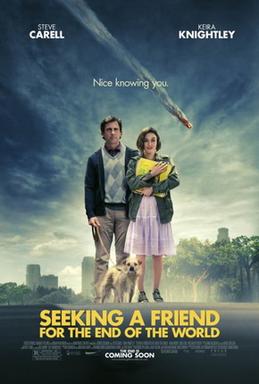
An Adventure Worthy of the Apocalypse: Seeking a Friend for the End of the World


Usually I’m far behind the curve on watching the movies I want to see (for example, I only recently saw a movie I wanted to see back in 2004!), so surprisingly I can actually write about a somewhat recent release. This evening I got the pleasure of viewing Seeking a Friend for the End of the World while it’s still out in theaters.

Seeking a Friend for the End of the World is set in the real-world of today across three states (New York, New Jersey, and Delaware). There’s only one twist – in this world, an asteroid is set to hit Earth in a few weeks and the last hope for stopping it has just failed massively. With this news in mind, Linda literally walks out on her husband Dodge (Steve Carell) without another word. Not sure what to do with the rest of his days on Earth, Dodge dutifully goes to work and then aimlessly sits about his apartment. That is, until he finds his neighbor Penny (Keira Knightley) weeping outside his window on the shared fire escape one night. When rioters begin taking to the streets and inciting violence outside their apartment building, Dodge grabs his newly acquired dog, Sorry, and Penny to escape. Once on the road, they decide to search for Dodge’s ex-girlfriend Olivia and various adventures occur along the way.

I was intrigued by the concept of Seeking a Friend for the End of the World when I began seeing previews for it and further enticed when Keira Knightley came on Late Night with Jimmy Fallon to promote the movie. I’ve generally liked Keira Knightley in the various roles she’s played in the past, and I’ve been entertained by Steve Carell in the few movies I’ve seen him in, so I thought this would be a good bet.

Setting a comedy amongst the despair and chaos that is the last few weeks of humanity is a bold move, but one that pays off in my opinion. There’s definitely a lot of humor in this movie – especially a lot of dark humor, given the nature of the situation the characters find themselves in. People’s reactions to the end of the world vary from the tragic (suicides) to the wild (parties that turn into drug-induced orgies) to the survivalist (an underground bunker outfitted with up to six months of gear). No matter what route people take though, this movie finds a way poke fun at it and still somehow get a chuckle out of the absurdity of the situation. The movie is also packed with some situational comedy, running jokes, and snappy quips, all contributing to the comedic effect. (One of my favorite quips was about how hybrid cars still need gas to run.)

Some of the comedy also comes from the very disparate character traits of Dodge and Penny. Dodge is a straight-laced insurance salesman and a very by-the-books kind of guy in every aspect of his life, who (despite his assertion otherwise) is very sympathetic and caring towards just about every living thing around him. Penny is more of a free spirit, who "dabbles" for a living and tries to sweet talk her way out of traffic violations. She is constantly moving from relationship to relationship, suffers from hypersomnia so smokes weed to supposedly combat it, and is apparently always running late for everything.  Throwing these two characters together would make any movie funny, but adding in the road trip from hell against the backdrop of the end of days is comedy gold.

While certainly amusing, these characters also felt a bit too much like typical movie tropes - the ho-hum everyman character we've seen often (i.e., Steve Carell in Dan in Real Life or Will Ferrell in Stranger than Fiction) and the quirky but ultimately charming woman who gives him a new perspective (i.e., Maggie Gyllenhaal in Stranger than Fiction or Zooey Deschanel in just about everything she's ever been in). All that needs updating is some basic facts of Everyman's background (never married, divorced, or widowed?) and swapping out one quirk for another for the vivacious lady. For Penny, her major quirks include collecting vinyl records and saving up piles of her neighbors' mail that mistakenly end up in her inbox instead of handing them over.

Despite all the comedic scenes, I was also surprised (and perhaps shouldn’t have been considering the premise) to find a lot of endearing and touching moments scattered throughout the movie, especially as the doomsday clock ticked nearer to its end. Without being too heavy-handed or preachy, the movie definitely had moments that give the viewer pause to chew some food for thought and consider what's important in their lives. For instance, at one point, Dodge and Penny discuss what they will miss and what they will not miss about life, thereby also subtly tasking the viewers to do the same and contemplate what they would prioritize if the world were to end in a few weeks' time. In addition, there's a fair amount of romantic leanings to the plot, which for the most part stayed away from becoming overly cheesy. In many ways, this movie defies easy categorization because it borrows elements from so many different genres.

Indeed, Seeking a Friend for the End of the World is not your garden variety movie. While there were a couple of plot points that were predictable, for the most part I found myself wondering where the movie would go next. This is usually a good thing, as predictable movies become dull fast and I prefer to be kept on my toes. Given the bind the writers/creators put themselves in by setting a mostly humorous movie at the eve of the apocalypse, I kept trying to figure out how they were going to come up with a satisfying conclusion. I’m not posting any specific spoilers here, but I will say that the entire movie theater audience appeared stunned at the ending.

Still, all in all, I found this movie very enjoyable and would recommend it if you like your humor dark and your movies anything but standard. The acting was superb, the soundtrack brilliant, and the story unique. What more could you ask for in a movie?

Tuesday, July 3, 2012

Laila’s Birthday: A Celebration of Absurdity?

Laila’s Birthday is a 2008 film set in Palestine that follows one day in the life of Abu Laila, a former judge who now drives a taxi cab for a living. This particular day is no ordinary day though – it is the seventh birthday of his only child, his daughter Laila. All Abu Laila wants to do is put in a day’s work, pick up a present and cake for his daughter, and arrive back home by 8 pm. But fate is not on Abu Laila’s side. After starting his day off with his usual Kafka-esque exercise in absurdity by visiting the Ministry of Justice in a feeble attempt to bring his judicial nomination up sooner, Abu Laila’s day gets worse when a customer leaves behind his cell phone in the taxi cab’s backseat. In a classic turn of “no good deed goes unpunished,” Abu Laila finds himself getting into all kinds of situations, as he puts it, in his attempt to return the cell phone to its rightful owner. Will he be able to make it back home in one piece in time for Laila’s birthday?

I’m not sure now how it is that I heard about Laila’s Birthday, but somehow its existence came into my knowledge in the past few weeks. I immediately watched the trailer for the movie and decided I had to watch the whole movie. The trailer seemed to promise a film filled with absurdly comic scenarios – just the kind of situational comedy that I find particularly funny. While this is certainly true at many points, the movie is also profoundly sad at times. Consider Abu Laila’s words when he snaps at one point and yells out in helpless frustration at the helicopters overhead: “And you…! Leave us alone!!! Leave us in peace!!! Leave us our breath!!! Leave us our rest!!! We know you have planes, tanks and very smart missiles.  You are the toughest occupiers in the world!!! But we, we want to live. We want to raise our children. We want to sleep. … We just want to live. Simply that. Just that.” But the beat marches on, and wars and occupiers continue to exist the world over, ad infinitum.

As the quote above suggests, the movie is of course laden with political overtones scattered throughout. No doubt it is difficult to write and produce a film set in present-day Palestine without doing so. As Abu Laila’s drives his taxi throughout the city, we hear political news on the radio and see protestors out in the streets. Some of these political situations are particularly poignant. For instance, one couple nearly jumps out of Abu Laila’s taxi when they see a line forming because, they reason, a line must mean someone is giving away some food or other necessary items. Later, a missile drops across the street from where Abu Laila is, and the aftermath is chaotic.

On the other hand, one moment that had me chuckle aloud was when a group of men in the cafĂ©, eager to condemn what a mess the occupation is making off their country, argue over whether the military officers they are watching on a newsreel are Israeli or Palestinian before someone shouts out: “It’s Iraq. And the army is American.”

Abu Laila’s politics also shine through as the movie progresses, and he refuses to bring passengers to checkpoints or take riders who are armed. He is persnickety in other ways also and, as a former judge, is a stickler for the law. He argues with one passenger about wearing a seat belt and asks another not to smoke, citing legal foundations for both requests.

As a slice of life kind of movie, we unfortunately don’t get a lot of Abu Laila’s back story, although we get enough to understand his frustration and sense of both righteous indignation and helplessness as he tries to navigate this new life he has. Another serious pitfall, in my opinion, is that the roles of Abu Laila’s wife and daughter are sidelined. Their appearances bookend the movie, but they have few lines or compelling characterizations. Instead, they function as the Victorian model of females as “the light of the home” – a home where men go to escape the hustle and bustle of the manly world of business and instead relax in the innocence of this womanly world of domesticity. This is perhaps somewhat hyperbolic in this particular situation as we are at least informed that Laila goes to school and his wife goes to work, although no further details are given about either’s daily routines.

What we do get to see a lot of, however, are city scenes as Abu Laila is out and about driving his taxi. The various landscapes show us a beautiful country (occupied territory) that has been battered by numerous problems, including military occupation and economic hardship, and is worse for the wear.

Still, despite all the chaos, the movie manages to end on a somewhat hopeful note, although its final line can also be interpreted as defeatist. I suppose how you take it all depends on whether you are glass half-empty or glass half-full kind of person (or what kind of day you’ve had). For better or worse, the feeling you leave with is that people are people everywhere, all of us with hopes and concerns that face us each day.

Laila’s Birthday was not a big blockbuster hit like all the summer movies recently out or on the horizon, but it’s certainly not a film to be missed. It is an absorbing movie, and you will be enriched by seeing it.