Showing posts with label French films. Show all posts

Sunday, February 23, 2014

It Came in the Night, Night, Night: Rabbit's Moon

All of the talk this past month about the Chinese lunar rover Jade Rabbit has been making me think about Rabbit's Moon, a brief avant-garde film from boundary-pushing filmmaker Kenneth Anger. I first came across this short several years ago at an "Art After Hours" event at the Zimmerli Art Museum, which featured a screening of several of Anger's films as part of the evening's showcase. The other two films (Fireworks and Scorpio Rising) were so full of sadomasochism that it's difficult for me to say I "enjoyed" them, and I also think they took these dark elements a bit too far to be truly good films. But Rabbit's Moon has stuck with me over the years, with its punchy yet haunting soundtrack and cheesy but effective visuals. Filmed under a blue filter, the other worldly quality of the images also leave a lasting impression.

From the outset of this post, I should note that Kenneth Anger played around with Rabbit's Moon several times over a nearly 30-year period, editing it for length and changing the background music. The version which I prefer over all others is the final cut from 1979, and that is the one I will focus on here. It happens to be the shortest of all the versions (boiled down from 16 minutes with the original 1950 version to just under seven minutes); I think the reduction of the source material to its core elements makes it more emotionally resonating. Sometimes less really is more. The 1950 and 1972 versions boast a soundtrack consisting mostly of 1950s popular love ballads such as "I Only Have Eyes for You" and "Oh, What a Night." In contrast, the 1979 version features the more obscure 1976 glam rock song "It Came in the Night" by A Raincoat, which plays twice in a row in order to accompany the entirety of the film. This song is addictively catchy, and I also thinks it mirrors the film's content in a supplementary way rather than some of the too obvious choices in the original version (i.e., "There's a Moon Out Tonight"). Also, it appears that Anger sped up some of the character's actions to fit the faster paced music; I'm thinking particularly of the final dance sequence on the makeshift stage but it's apparent in other scenes as well.

With Rabbit's Moon, Kenneth Anger plays around with common myths that continue to permeate over the years as well as elements of various cultures, choosing a mix of Western and Eastern influences to populate his film. For starters, he uses a combination of Italian commedia dell'arte, French mime, and Japanese kabuki theater techniques in the staging and choreography of his short. The title itself refers to a legend about a rabbit that lives in the moon - a mythical creature that appears in both East Asian folklore and tribal North American storytelling. In Rabbit's Moon, we see images of both a beautiful white rabbit and a glowing white full moon, with Anger perhaps over handedly ensuring that we make the connection between the two. The main character's repeatedly reaching for and missing the moon symbolizes the illusory nature of chasing after such myths and fairy tales.

Speaking of the characters, Anger draws his characters from the classic rotation of archetypes found in commedia dell'arte. In Rabbit's Moon, Anger features Pierrot as the main character with strong supporting roles from Harlequin and Columbine. In traditional commedia dell'arte, Pierrot is a pitiable, foolish character who loves Columbine, who in turn will almost always leave him eventually for Harlequin. Anger gives us the traditional Pierrot with a twist - he never seems to have Columbine from the outset, although of course he remains in his role of pining for her once he sets eyes on her. Nevertheless, Pierrot is still the "sad clown" stereotype here that he usually is, with his yearning and grasping for a moon that is never in his reach anymore than Columbine is. Harlequin is typically known as the prankster who is willing to go to any lengths to dupe Pierrot and win Columbine's affections, and that's basically the role he plays here as well. And Columbine ... well, she's pretty much just the eye candy in this case. Unlike her traditional role of cheating on Pierrot with Harlequin, she doesn't work here to actively deceive Pierrot being as she isn't committed to him at any point. It is perhaps worth noting that the famous characters from commedia dell'arte, especially Pierrot, have been elevated to the level of myth themselves. (One of my favorite Pierrot-based tidbits is that Charlie Chaplin's own famous character of the Little Tramp is modeled on the Pierrot and was declared by fellow actor Harry Baur to be "the brother of Pierrot.") The characters being legendary ones themselves serves this film by further solidifying its place in playing with the role of myths in our lives.

When discussing the history of the commedia dell'arte, Wikipedia declares that "Audiences came to see the performers, with plot lines becoming secondary to the performance." The same can arguably be said of Rabbit's Moon, which is light in terms of plotting. The first half of the short shows a particularly down and out Pierrot, who is literally mooning over the moon as he tries to jump up and reach it but repeatedly misses. Nothing seems to make him happy and on repeated occasions, he simply lays himself down on the ground in the fetal position, signifying his unhappiness and seeming despair. As the soundtrack circles back to "It Came in the Night" for the second time with its ghoulish opening laugh, Harlequin appears on the scene attempting to entertain Pierrot with various antics, showing off his traditional attributes of agility and energy. Harlequin's finale includes showing the beautiful and ethereal Columbine to Pierrot, but then he steps in the way of Pierrot contacting Columbine. Harlequin and Columbine disappear, a lunar eclipse occurs, and Pierrot is once again left reaching for the moon unsuccessfully, eventually collapsing prostrate once more as the entire sequence ends.

But what happens - or doesn't happen as the case may be - in Rabbit's Moon is less important than the film's ability to broadcast universal emotions and touch upon important themes. Who amongst us cannot see ourselves in Pierrot's melancholic state at some point in our lives? Our fears and concerns may seem as foolish to an outsider as Pierrot reaching for the moon only to be disappointed over and over again. Pierrot may be pitiable but he is also identifiable in his grief. In the first half of the short, the main character's penchant for hanging his head despondently while holding his arms straight out horizontally creates a visual image reminiscent of the crucifixion of Jesus Christ. Here again Kenneth Anger shows that he's willing to play with iconic cultural references and is once more touching on the inability of myths to create fulfillment for certain people. This imagery has a historical root as well; the Wikipedia entry for Pierrot notes that in the late 19th century, "the Symbolists saw him as a lonely fellow-sufferer, crucified upon the rood of soulful sensitivity, his only friend the distant moon" and that this interpretation of the character led to a portrayal of a "Christ-like victim of the martyrdom that is Art." Indeed, the Symbolist movement seem to adopt Pierrot as their mascot, "[seeing] him as an emblem of suffering, with only the moon for a friend. Naturally, as Pierrot’s association with the moon (and thus, the night) deepened, it was easy to emphasize his darker qualities; eventually artists gave him a literally bleeding heart ... Since his sadness often caused his words to fail him, Pierrot is seen as the father of mime." These aspects of Pierrot's nature and legendary status are all - with the exception of the bloody heart - ones that Anger touches upon and tweaks as he presents the Pierrot of Rabbit's Moon.

In the second half of Rabbit's Moon it seems that with myths being unable to cause joy, Pierrot (and the viewer with him) turns to entertainment as a source of temporary happiness. Pierrot is indeed at least momentarily distracted by the show put on by Harlequin. But this is also seen to be illusory and unfulfilling. Harlequin has only two physical props - a lamp projector and a slapstick. (According to the Oxford Encyclopedia of Theatre and Performance, Harlequin's slapstick is a kind of magic wand that allows him to change the scenery so that the characters appear in a new locale as well as providing a way for him to make objects into different ones.) His other entertainments are pantomimed, with Harlequin hypnotizing and delighting Pierrot using an imaginary balance beam, juggling with nothing, and other parlor tricks reenacted out of thin air. The pantomime can be seen literally, for the vast majority of Rabbit's Moon action is done in exaggerated choreography, but I think it can also be viewed metaphorically. Harlequin's antics are empty actions, simple illusions used to pull the wool over Pierrot's eyes yet again, as these two characters are destined to fulfill their roles of prankster/cheat and fool/cuckold respectively over and over throughout time.

The lamp projector also serves to metaphorically bring these characters forward into the modern day (or at least the modern day of the 1950s-70s). Harlequin uses the projector to shine a light onto Columbine as she dances on a makeshift stage, performing a simple ballet for Pierrot's enjoyment. In a way, the lamp projector can be seen as a stand-in for the movie projector and thus becomes a way to use the film to comment on films themselves. Pierrot approaches the stage and stands just at its brink, dancing as he watches Columbine dance, but his movements do not exactly mimic hers nor do the two ever physically interact. They literally dance around each other rather than with one another. Pierrot also tries once more to get the moon and to show off its wonders to Columbine, but she does not seem to quite grasp the significance of his interest in the full moon. Pierrot seemingly worships Columbine, literally falling to his knees before her, while she views him with disdain, waving a nonchalant hand at him and putting her nose up in the air. To me, this scene seems to comment on how no matter how much we as viewers may get amazed by and invested in our favorite characters on the stage/screen (and in some cases, the actors who portray them), we will always be just outside the realm of their world - perhaps thinking that we are interacting with them as we shadow their movements but never actually engaging with them. Once again, the theme of illusions - and their subsequent disappointments - emerges through the imagery of Rabbit's Moon.

The lamp projector spotlighting Columbine, with Pierrot gasping in delighted wonder as he views her for the first time. I love his expression in this scene and the fact that he literally gets bowled over with amazement seconds after this.
As I mentioned earlier, in this film it doesn't seem that Pierrot and Columbine are the ones to have the prior relationship with Harlequin coming in to steal her away, as is typical in the traditional story of these three characters. Pierrot seems to be viewing Columbine for the first time ever and his joy and wonder at that first glimpse are uncontainable. But as Pierrot becomes more and more fascinated with Columbine and her dance, Harlequin becomes like a strip club owner protective of his employees - you can look but you can't touch being the refrain. A popular theme for the commedia dell'arte stories is jealousy and it seems that Harlequin is the one to catch the green-eyed monster here, rather than Pierrot for a change. He goes from laughing at Pierrot's sad attempts to catch Columbine's affections to jumping in between the two of them to stake his claim on Columbine once again, guarding her from Pierrot's influence, and then whisking her away just before the lunar eclipse begins. The lunar eclipse can be seen as symbolic of Pierrot's further despair as the one bright spot in his life so far (Columbine) is taken away from him. Entertainment and distractions such as physical attraction are but brief flashes of momentary joys that end far too soon. They are bound to disappoint and depending on them for lasting happiness is as fruitless as trying to pull the moon down from the sky.

An interesting thought to consider is how several versions of the traditional legend of the moon rabbit note that the creature's immortalization upon the lunar surface is due to its self sacrifice. Love is a concept rooted in sacrificing one's self to another, of sublimating one's desires in order to promote the well-being of the loved one, of indeed subsuming one's very identity to become one with another human being. Thus, the moon that Pierrot is so desperately trying to reach can symbolize how this lonely person in the forest is seeking an all-fulfilling connection, an all-consuming loving relationship with another human being. The presence of Columbine further reinforces this, as she is the one meant to be Pierrot's partner in the traditional commedia dell'arte lore. Of course, as I've already mentioned several times, she is the one who will ultimately betray Pierrot's affections by leaving him for another man. Again, disappointment abounds in the landscape of Rabbit's Moon, and love is just one more thing that appears to disillusion Pierrot. To pull from Wikipedia's fountain of information on the Pierrot character again, that entry notes that in late 19th century pantomimes, Pierrot incarnations "would appear [as] sensitive moon-mad souls duped into criminality—usually by love of a fickle Columbine—and so inevitably marked for destruction." The self-sacrificing character aligned with the rabbit moon legend is Pierrot, but this sacrifice is not reciprocated nor does it gain him any reward as it does for the mythic rabbit. For a character who is seen almost always as a naïve fool, Pierrot is perhaps a warning to all of us when we view how myth, religion, entertainment, and love ultimately leave him abandoned to a wooded glen, once again alone in the world.

One thing I haven't touched upon yet is the appearance of the wood's children. Two small children emerge from the forest and onto the clearing twice during the film. I'm not quite sure what to make of the children or their place in the film. They appear from behind and underneath Pierrot's outstretched arms, suggesting that he somehow "births" them, but they are not recognizable characters to me. The first time they appear is during the first half of the film when Pierrot is flopping about sadly and all alone. One child holds a mirror to Pierrot and he turns away in disgust. The other child holds a shiny stringed instrument, which neither he nor Pierrot makes any attempt to play. Later when Columbine dances on the stage, the two children make a second appearance with the same props. They kneel where the footlights of the stage would be if it had any, and Columbine briefly admires herself in the mirror; the instrument again remains unused by anyone. The next cut back to the stage finds the children gone. Like I said earlier, I'm unsure of the significance of the children's appearance beyond that they indicate further in the first half how Pierrot won't be made happy by just anything and that in the second half they bolster Columbine's self-preening and vanity. It's also worth noting that in the longer original version, they appear a third time to entice Pierrot into a mystical place that becomes his ultimate undoing.

A final thing that I've neglected to mention up until this point is the introduction to the film. It opens with Pierrot lying on the ground in the forest's clearing as though sleeping. Indeed, it appears at first as though he is waking up and is unsure as to where he is and/or what is going on around him. As he arises and steps about gingerly, he seems to notice the moon for the first time and hence his fascination begins. Again, I'm not quite sure what to make of Pierrot seemingly dumped off in the woods by unknown forces and awakening to confusion followed by longing for the unattainable. It almost seems more explainable that Pierrot would go out seeking a way to get closer to the moon, but it could be argued that he is brought here by forces outside his control, symbolizing how life often brings us to unexpected places. Then again, it could also be argued that Pierrot picking himself up off the ground (where he lays at the end of the film after exhausting himself with his attempts to grasp illusions) is simply a cycle beginning all over again. We may think we are seeing Pierrot set his gaze upon the moon for the first time, but he may have simply been through this whole pantomime (literally and metaphorically) once or even many times before. Again, I think this is also symbolic of film itself. Anyone viewing a movie (well, a well-done movie) for the first time has fresh insights and feels like they are stumbling upon something raw and real; however, all they are seeing is something that was rehashed over and over again as the cast/crew made the finish product and as other audiences watched it in the past.

At any rate, those are my interpretations of the film's characters and scenes. Of course, as with all works of art, there can be many different schools of thought on the meaning. Indeed, one of the things I love about Rabbit's Moon is that despite its short length, I always catch something new in it upon re-viewing. To borrow from Wikipedia again in regards to the myriad interpretations of the Pierrot character over the years, one incarnation is "the narcissistic dreamer clutching at the moon, which could symbolize many things, from spiritual perfection to death." Perhaps my interpretation is completely off base and instead the moral takeaway of Rabbit's Moon is not a solemn dirge to make note of all life's disappointments but a celebratory melody of a character awakening to spiritual perfection by casting away previous distractions. Take a gander at Rabbit's Moon. Mull it over. What do you think Kenneth Anger is trying to say? Is your interpretation as bleak as mine?

Sunday, February 24, 2013

Holding Court with Marie-Antoniette

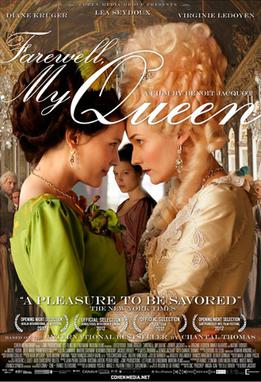
I'm not even sure of the context anymore, but I recently learned of a movie called Farewell, My Queen, which is set during the French revolution. The basic synopsis sounded interesting (though in retrospective, somewhat misleading), and I'm sucker for anything set at Versailles so I decided to give it a try.

Farewell, My Queen (Les Adieux a la Reine originally) is a French film based on a popular novel of the same name. Starring Lea Seydoux, Diane Kruger, and Virginie Ledoyen, the film picked up several prestigious awards when it was released last year. The movie tells the story of Sidonie Laborde, who is the official reader to the queen. Essentially, she is only a servant, but one of a slightly higher caste than, say, a chamber maid. Because of this, she holds some more privileges than her peers (notably a lavish gold clock that sits in her otherwise bare room) and shares a bit of intimacy with the queen, in that she gets to sit near her in the queen's private quarters while reading aloud to her.

The movie starts out on July 14, 1789, a day of infamy in French history for the Bastille was stormed that day, officially starting the revolution in France and years of bloodshed. Because news traveled slowly at that time, everything on this day is as normal. But by the following day, rumors are spreading about what has happened in Paris and fears are being stoked. The movie covers only a few days' time, so we don't see the Reign of Terror or anything more extreme than the dawning realizations of those at Versailles that their lives are about to be irrevocably changed. But the movie is not so much about history or its often attendant misery; indeed, The Independent's review of the movie notes that the director "doesn’t have any grand political statements to make. He is not trying to make a sweeping melodrama either. His approach is more like that of an anthropologist, studying a tribe in its death throes. The result is quietly fascinating." But perhaps most glaringly, the movie is rather the story of a love triangle. For Sidonie is in love with Marie-Antoinette, Marie-Antoinette is in love with the courtier Gabrielle (the Duchess of Polignac), and Gabrielle ... well, nobody really knows her feelings but let's just say she intends to curry favor with the queen for as long as possible.

We see all of this through the eyes of Sidonie, who gives us quite an insider's view of the palace of Versailles. Holding the position in the hierarchy that she does, she allows us to see the servants' quarters, with their rather drab existence and petty squabbles often based on things they've overheard from their masters and mistresses, as well as the inner chambers of the queen and her court, with their opulence, frippery, vanity, and still more rumors (although usually more substantiated at this point). Sidonie's place in the latter is certainly more uneasy though, and we frequently see her view of things from a position of eavesdropping while hiding in an opportune place. This dual perspective gives off a Upstairs, Downstairs sort of vibe, although the movie also reminded me a bit of The Girl with the Pearl Earring in terms of ambiance. Of course, the movie this one is more frequently compared to is Sofia Coppola's Marie Antoinette, and it should be noted this is a very different film. I don't want to pit one against the other as they both have their highlights, but they vary much in terms of style and substance.

Despite being a rather slim movie in terms of plot points, I found that I was totally engrossed in this film from beginning to end. Others have referred to it as a character study, but I think that explanation is a bit misleading also. As one of Sidonie's fellow servants notes at one point, Sidonie's life is mystery as she's held back all kinds of information about herself, including where she's from, who her parents are, etc. - and the viewer suddenly comes to realize the same thing. We know nothing about Sidonie beyond her love of books and her loyalty to Marie-Antoinette. The duchess is given comparatively so little screen time that we learn few details about her also and must surmise all of her motivations. Marie-Antoinette gives us a bit more, divulging some of her secret feelings to Sidonie at one point, and sharing knowing looks here and there that seem to indicate her frame of mind. But how much the queen really feels for Sidonie seems variable at a moment's notice and how much she's aware of Sidonie's love for her is something we're left guessing about, wondering if she's milked Sidonie's feelings for her own gain or if she is just completely unaware of them. If the former, this adds to the feeling that the movie left (for me at least) that the queen was a rather nasty person. History has been unkind to Marie-Antoinette, a woman who - no matter what her faults - was given an unfair amount of the blame for an entire country's myriad problems. Modern historians and others have been more sympathetic to the queen, and she did have her supporters even back in the 18th century, such as the artist Louise-Elisabeth Vigee-Lebrun. Vigee-Lebrun tells one of the most touching stories about Marie-Antoinette, in which the queen insisted on picking up Vigee-Lebrun's dropped paintbrushes for her, something quite unexpected for the lavish monarchy of 18th century France and not what you'd imagine for the Marie-Antoinette depicted here. This movie instead portrayed her as quite incapable of doing anything for herself and as rather self-absorbed, although admittedly she does have some slightly sympathetic moments.

Beyond the three main leads, there are numerous other characters who come in and out of the film from both the occupants of the royal court and the people who serve them. It was a bit tough at times to remember who all everyone was and how they related to one another, but it was manageable. One of the more notable side characters was Madame Campan, the head lady-in-waiting to Marie-Antoinette, who probably sees the most (both literally and metaphorically) of what is happening between the queen and those around her. She's a complicated woman who can seem both harsh and sympathetic to Sidonie at turns, but ultimately appears to be one of the most honest and moral people at Versailles. The mob of angry French people, although hardly seen, is a character in itself, causing all the other characters to worry and despair from a distance. Of course, the benefit of hindsight makes everything all the more ironic for the viewer who knows the fate of the royalty depicted here and all their court.

With such a female-heavy cast and focus, this movie is a rather interesting one to dissect in terms of its portrayal of women. We see three very different women here - one who appears to be obsessed with power and privilege (Gabrielle); another with love and loyalty (Sidonie); and another who is perhaps a mix of both (Marie-Antoinette). None of them seem to be sad stereotypes of frail and fragile women, but then again none of them seems to stand out as a particularly tough and independent woman. In a way, I rather like that for there is already no end of historical fiction out there in which someone tries to re-write history with a 21st-century ideal of a strong woman at the helm. These women seemed more realistic with a mix of good and bad about them. It's suggested that all of these women have at least some element of same-sex attraction within them, and it's worth noting that even in the 18th century Marie-Antoinette and the Duchess de Polignac were rumored to be lovers, despite no evidence supporting that beyond the queen's obvious fondness for the duchess, which very well may have been entirely platonic. For the most part in this movie, the erotic undercurrent of homosexuality isn't played too heavily or for the benefit of the male view, even if the (male) director told the press that he chose Lea Seydoux to play Sidonie because she "has incontrovertible sex appeal" and "brought this carnal dimension" to the film or if one reviewer thought the director took "a completely gratuitous interlude to let the camera ogle Ledoyen, lying in bed as God made her." I personally didn't find this scene gratuitous as it told us something about Sidonie's character and her envy, but there were other scenes where the director seemed to linger unnaturally long on a woman's body part - it wasn't just Sidonie's heaving bosom in a scene when she sits dangerously close to the queen as they take turns reading lines from a romantic play, but other odd choices like Marie-Antoinette's bare feet in a very serious scene that seals Sidonie's fate.

Otherwise, the cinematography of the film is excellently done without being overstated. Set in Versailles and filmed mainly on location, the palace feels like a character in itself -- or perhaps it just felt that way because I could recognize some of the areas, such as the Hall of Mirrors, from my visit there several years ago. Either way, the palace of Versailles leaves for stunning visuals with all its gold gilding, marble floors and columns, sparkling chandeliers and mirrors, and well-manicured extensive grounds. Of course, we also see the seedier side of Versailles (if you can call it that) with the tiny and sparsely decorated servants' quarters. The musical score was perfectly fitting to the tone of the movie, the period costumes were gorgeously lavish, and the acting was all top-notch, even in the minor characters. The ending of the movie was perhaps a bit "huh" rather than conclusive but as another blogger points out, "Because the film is a character study and not one of the climactic biopics to which some of us are accustomed, the story feels unfinished in the end, if only because the action ends where the action of most of these types of films begins." This was not necessarily the best movie I've seen regarding unrequited love or the French revolution or whatever element you want to pull out as the most relevant in this film, but I quite enjoyed it overall and would recommend it for those who are Francophiles, enjoy historical costume dramas, or who just like an understated movie that's more about characters interacting with one another than about non-stop action.

Sunday, February 17, 2013

Following the Red Balloon

Unintentionally color-themed, I'm following up my post on The Yellow Handkerchief with this post on the classic French film The Red Balloon. Arguably a children's movie, The Red Balloon is a 1956 film featuring the director's son Pascal Lamorisse in the lead as a young boy (around age 6) who encounters a red balloon on his way to school one day. He happily scurries off to the school with the balloon in tow, finding out soon afterwards that this is no ordinary balloon. The mischievous balloon has a mind of its own, so to speak, and definitely moves of its own accord. It becomes a constant companion to the young boy, following him about the streets of Paris on everyday adventures. Later, the two try to escape from the boy's mean classmates/peers who are clearly overwrought with envy about the balloon.

Besides that it is considered an iconic piece of work, I had absolutely no idea what this film was about before I watched it. Add that to the stereotype of French films being depressing, I was delightfully surprised to find this movie sweet and whimsical. There was a moment toward the end I was afraid this wouldn't be so, but everything righted itself onto a uplifting course (pun intended). However, I'm not sure how much children really delight in this short movie, especially given that modern audiences of youngsters are used to fast-paced, brightly colored movies that are usually animated and often peopled with outrageous characters.

The Red Balloon is almost entirely wordless, with only a few lines of dialogue given from the boy to the balloon, generally an admonishment to stay put. It is not, however, an entirely silent film. There is of course the requisite soundtrack but there are also numerous other sound effects heard like a doorbell ringing, cars whirring by, and quite frequently the sound of pounding feet hitting the pavement. These all serve to add to the film's ambiance and heighten the comedy or drama of any particular scene.

But mostly the film's story and atmosphere are captured with the cinematography. Of course, we see a lot of the boy in his gray outfits (and adorable school book bag that looks like a miniature briefcase in my mind, making him seem so grown up) and the balloon, which is vividly red and quite large. Throughout the film, there the cityscape of Paris, with its gray buildings, narrow alleyways, numerous stone steps, balconied apartment buildings, and blue street signs. It certainly carries one right into the city - not the tourist's city, with the Eiffel Tower glimpsed only once in the very far distance and no other major monuments featured, but the city of everyday life, with the boy stepping into a boulangerie and passing by outdoor fruit and vegetable stands. Most people on the streets are minding their own business, worried about their own concerns and hardly noticing the boy and his balloon. The cityscape scenery is a reminder that parts of Paris can be quite gray, which serves as a fitting backdrop for the brightly colored balloons that enter the scene in this film.

With hardly any words and a rather bizarre plot line, The Red Balloon allows for a myriad of interpretations of its appealing visuals. The original New York Times review said of it, "It is a thoroughly simple story of something incredible that could not occur except in the bright imagination of an artist such as Albert Lamorisse, the young Frenchman who made the memorable short 'White Mane' and who wrote, produced and directed this. Yet with the sensitive cooperation of his own beguiling son and with the gray-blue atmosphere of an old Paris quarter as the background for the shiny balloon, he has got here a tender, humorous drama of the ingenuousness of a child and, indeed, a poignant symbolization of dreams and the cruelty of those who puncture them." A more recent look by The New York Times of this movie and White Mane acknowledged, "The stories are simple, fablelike; the heroes are boys; the subject in each case is the purity and power of a child’s imagination; and the tone of both films is that of open-mouthed wonder. Yet these movies are also shot through with a very adult melancholy, an awareness that life tends not to measure up to the glorious pictures in our minds." Slant Magazine has a slightly different view, pointing out that, "The honeymoon is short-lived, but Lamorisse suggests that kids are always keenly attuned to the objects of the world around them: After the boy loses his red friend, a montage of balloons across the city shows them flying to his side and, in the final shot, launching him into the sky. For Lamorisse, then, the pleasures of childhood are as fleeting as they are ecstatic." Thus, a key debate to this film could be whether children are unaware of the bitter ironies of life or whether they are just more resilient than adults in getting back up after life delivers them a blow.

Meanwhile, Brian Gibson of Vue Weekly eschews the idea of capturing childhood innocence being the only goal of this movie or its counterpart White Mane, explaining, "These are post-war stories of innocence threatened—by arrogant, selfish gangs bent on proving their superiority. ... [T]his seems a post-Occupation France happy to forget the blood and death of Hitler’s war a decade earlier. But soon people’s occasional, playful efforts to grab the floating, carefree balloon become grasping and destructive. In a gorgeous sequence, light streaming down alleys as children’s shoes clack and clatter on the cobblestones, the red globe bouncing between the walls, Pascal is hunted down for his floating pet. The film’s ballooning sense of hope and freedom is deflated by a fierce, squabbling mass. Then, fortunately, Lamorisse’s film floats off, with the breeze of magic-realism, into a feeling of escape and peace, The Red Balloon taking hold of Pascal, lifting him out of this rigid, petty, earthbound life." Given the film's date, it is not absurd to read it as, at least in part, a reaction to the horrible war that the film's director undoubtedly lived through - though his son in the starring role obviously did not. Battered but cautiously optimistic and healing is probably a fitting description of Europe a decade after the horrors of World War II and Hitler's cruelties, and the film's young lead follows a similar path when his happiness is shattered by the balloon's bursting but is soon replaced with unimaginable joy when the other balloons of Paris come to his rescue. This final scene of vindication could be seen as symbolic of the dream of Europe ascending to even greater heights than before the war. (Decades later, this is arguably the goal of the European Union.)

After its musings on childhood purity versus adult melancholy, the 2007 New York Times article goes on to note, "When the film is over, you realize that although you’ve been entirely enveloped in little Pascal’s fantasy world, you’ve learned next to nothing about the boy himself. His parents are not in evidence. He lives with a stout, black-clad, rather fearsome-looking old woman who may or may not be his grandmother. We’re given no idea whether he’s a good, bad or indifferent student, or who his friends are. The intensity of his attachment to the balloon suggests that he’s a lonely, dreamy child, living in his own head, but we can’t be sure; the movie gives us nothing solid to go on." It is true that this movie is not a character-driven one like I usually enjoy, or at least it is not so in the traditional understanding of that terminology. Still, the young boy has a somewhat universal characterization about him - he is in some ways the epitome of the underdog that we can all sympathize with and root for through his (albeit brief) journey.

At any rate, this is not your standard classic Hollywood fare! Being so very different than all those rather formulaic 1950s movie gives this film the feeling of being a more modern movie that just happens to be set in the past. The special effects are particularly surprising given the film's date. If you haven't seen this short film yet, I suggest you do. It will delight you and cause you to think about its deeper meanings and themes for some time.

Monday, December 5, 2011

Creating a Fashion Icon: Coco Before Chanel

I only recently heard about the 2009 film Coco Before Chanel and decided to check it out, not least of all because it stars Amelie’s Audrey Tatou. This biopic of the famous fashion designer Gabrielle “Coco” Chanel looks at her early life, as perhaps implied by the title. It focuses mainly on the years in which she is the mistress first of Etienne Balsan and later Arthur “Boy” Capel, brushing over her childhood years in an orphanage and dedicating only a montage to the many, many years of her successful career. If there was one thing I did not like very much about the movie, it was that we saw so little of her actual success. However, as I already mentioned, the title of the movie should provide a clue that the movie is more about her life before coming a household name.

Due to the movie’s focus on Chanel’s years as a “kept woman,” another downside was the men’s treatment of Coco, particularly in a cringe-worthy scene in which Capel asks and receives permission to “borrow” Chanel from Balsan for a couple of days. There’s probably an element of truth-telling at work here (particularly keeping in mind the time period), but it doesn’t stop the feminist ire that boils up in me at the treatment of women as property – or worse than property, as most people aren’t willing to lend out their homes for a weekend with no questions asked. Still, throughout all this, we see Chanel becoming the person she will be. She chafes at having to ride sidesaddle, refuses to wear a corset at the sacrifice of comfort, and mocks the elaborate ornamentation on the pretentious women she sees around her.

Before seeing this movie, my entire knowledge of Chanel’s life was based on a slim picture book for children. Like with any biopic, it’s unclear how much is 100 percent true and how much is poetic license. For instance, some quick web searches tell me that Chanel had two brothers and two sisters, rather than only the one sister who is featured in the film (who, by the way, is named Adrienne – which was not the name of either of Chanel’s actual sisters). Interestingly, the movie created as many questions as it answered about Coco, including the origin of her unique nickname. In part, we are left puzzled by what’s actual true because Coco is constantly changing the story she tells – which is apparently something the real-life Chanel was known to do.

The movie also portrays Coco as witty and sarcastic, again characteristics of the actual woman. This captivating side of Coco is portrayed by the winsome Audrey Tatou who is always a delightful actor to see at work, and she even looks a bit like Chanel as an added bonus. (Tatou is also currently a spokesperson for Chanel perfumes.) All of the other players do fine jobs in their roles as well.

In addition, Coco Before Chanel is a movie well-aware of the visual aspect of the medium and contains many stunning shots. Cinematically speaking, there is never a dull moment, whether we are looking at a lush French chateau and estate, the simple and perpetual beauty of the sea, or the finery of fashion models descending a staircase. Overall, I’m not sure I would call Coco Before Chanel a “must-see” movie, but it certainly has its charms.

Monday, October 31, 2011

Just Singing in the Rain: The Umbrellas of Cherbourg

Just in time for a snow storm in October, I picked up a copy of The Umbrellas of Cherbourg, another French film evoking rain in the title.

It’s 1957 in France, and 17-year-old Genevieve, who works in her mother’s boutique shop “The Umbrellas of Cherbourg,” falls in love with 20-year-old Guy, who works in a garage across the street. But Genevieve’s mother doesn’t want to see her married that young and Guy is drafted into his two years of military service. How will their love story end?

The Umbrellas of Cherbourg is not a musical in the traditional sense where some is spoken with the occasional breaking out into song. Instead, every single word is sung. But it’s not an opera where everything is told in song because these aren’t really songs - they’re just regular dialogue that’s sung instead of spoken, which makes for some awkward lines like “a demain” or “merde” that is sung alone. I kept thinking while watching the movie how difficult it must have been for the actors to figure out how they would effectively sing one- or two-word lines without sounding ridiculous - or without sounding like they were simply speaking. But more so, I feel like something important is lost by having every single word sung like that. Typically, musicals, while yes being ridiculous and unrealistic (not a real criticism coming from me because I like them in part for this reason), use songs to convey that something that just happened and evokes some strong feelings - whether it’s excitement, anger, love, or what have you. But when you sing “see you tomorrow” in a scene of typical everyday events and then sing “I will wait for you” when tearfully departing from your lover, somehow the emotional impact of this second “song” is negated, or at least lessened. However, I will say that the instrumental music in the movie is absolutely beautiful, despite the lack of what I’d actually call song lyrics.

As for the story itself, it’s so predictable - not just the end outcome but every step along the way is easily and accurately guessed within the first half hour, if not sooner. The cinematography is beautiful, with some interesting shots, bright colors, and occasional scenic view, but that’s not enough to hold an entire movie. I’m missing how this movie received so much praise - “An instance classic” (New York Magazine); “An unmitigated triumph! A unique masterpiece! Inescapably addicting!” (New York Post); or “... A beam of movie heaven!” (Rolling Stone) - as I didn’t think it was that good. It was also listed in Steven Jay Schneider's book 1001 Movies You Must See Before You Die, but I think I could have lived without seeing it.

Sunday, October 23, 2011

In the Mood for Love: Giving Romance a Shot

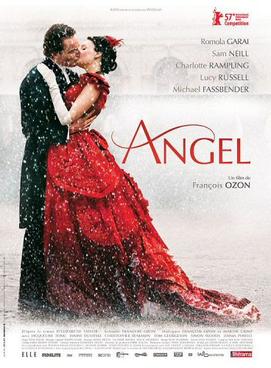
To preface this post, I’m going to point out that I’m rarely a fan of the romance genre in any medium – books, movies, what-have-you. That being said, I was still drawn to watch the 2007 movie Angel starring Romola Garai. Perhaps it was because I’ve liked Ms. Garai in past movies or because the period piece tends to pull me in, but I ignored my impulse against the romance. Although, after viewing the movie, I’m not entirely sure that “romance” is the greatest descriptor for this film, given that it in no way follows the formulaic romantic plot. But I’m getting ahead of myself; I should start with a brief description of the movie.

Schoolgirl Angel Deverell has her teacher, mother, and aunt concerned as she always has her head in the clouds, writing up fantastical melodramas. By a stroke of luck, without any study or research, she writes a novel that is picked up by a major London publisher. She becomes a smash hit and writes novel after melodramatic novel, raking in tons of money while she’s at, allowing her to move from living above her mother’s grocery store to Paradise House, the mansion of her dreams. She also wins the admiration of poet Nora, who becomes her personal secretary and biggest admirer. But Angel has no interest in the passionate love of Nora, instead pursuing Nora’s brother Esme – a cheater, gambler, alcoholic, failed artist, and all-around louse. (Yeah, she can really pick a winner.) In hardly any time, Angel convinces Esme to marry her, and it seems as though her dreams are complete. But is life in Paradise all she dreamed after all?

I honestly don’t know where to start to review or critique this movie. I’m still a bit puzzled as to whether I was to take it seriously or view it as a parody of bad melodramatic romances. Some of the dialogue was so stilted and poor that it came across badly even in the hands of decent actors who I’ve admired in the past. There were several scenes where characters were meant to be riding about town or visiting other countries where the background shots were clearly green-screened in. By clearly, I mean obviously so, in the style of 1940 and 1950 movies when they didn’t have the technology to do better. While I generally watch movies more for plot and characters than effects, a movie should at least attempt to transport me away into its reality without making obvious gaffes that remind me that this is just a movie. So again, I’m left wondering is this something intentional to poke fun at the movie’s melodramatic story? Yet no clear answer emerges. And, in terms of plot and characters, I found little to be appealing. The plot is kind of rambling at times (although some things do eventually end up coming full circle) and, as I mentioned above, Esme is a textbook cad while Angel isn’t really a character you can wholeheartedly root for – she’s shallow and completely self-absorbed. The only saving grace for this film was the lush costumes and interiors of the period piece. But with so many other period pieces out there that are so much better done, this isn’t one I would recommend.

Luckily, romances got a reprieve this weekend with 12 Reasons Why I Love Her, a delightful romance comic that I thoroughly enjoyed.

Sunday, August 28, 2011

Hurricane Irene: Let it Rain

With a big storm hovering over the Northeast this weekend, I did my best to prepare beforehand. I made the obligatory stops at the supermarket, the pet store, the gas station, etc. I also dropped into the library to grab a couple of extra books, you know, just in case we were stuck indoors with no power for days and the several dozen unread books I have at home wouldn't be enough. ;) I also considered grabbing a movie while I was there, which wouldn't be very helpful in the case of a power outage but would be good if we were just stuck indoors for a couple of days. As the latter turned out to be the case, it was a good idea that I had grabbed a movie at the last minute. When I was passing by the movie display at the library and still debating whether or not I wanted to spend the time rifling through them all in hopes of finding one I had both never seen before and was interested in seeing, my eyes fell on the one near the top of a pile, which was aptly named Let It Rain. I picked it up and thought the description sounded appealing, so away it came with me and I was happy to have found something without having wasted any time at all.

As Let It Rain is hardly a Hollywood blockbuster movie, I thought I would write about it here to make anyone interested aware of this little gem. This is a French film (subtitles available in English) directed by Agnes Jaoui and co-written by Jaoui and Jean-Pierre Bacri, a pair who, by the way, are married in real life. Jaoui and Bacri also co-star in the movie, along with Jamel Dabbouze (who played Lucien in a little film called Le Fabuleux Destin d'Amélie Poulain). Let It Rain is to some degree an example of metafilm, a movie which is about the process of making movies. Michel (Bacri) and Karim (Dabbouze) are local amateur filmmakers who decide to embark on a project filming successful women. The only successful woman they know is Agathe (Jaoui), a best-selling feminist author, a political candidate, and the employer of Karim's housekeeper mother. Supporting characters include Agathe's companion Antoine, her sister Florence and brother-in-law Stephane, Karim's wife Severine and his flirtatious co-worker Aurelie, and Michel's son Guillaume, in addition to the aforementioned mother of Karim.

Let me be clear from the outset. If you like movies that are plot-driven, this is not the movie for you. Materially, excepting perhaps Karim's mother, not much has changed for the characters from the beginning of the movie to the end. Perhaps this is rightly so, as the movie is supposed to take place over about 10 days only, so it would be quite a stretch of the imagination to see the entire lives of these people change dramatically in that time. Nevertheless, enough happens over those days to make the characters examine their motivations and perhaps re-consider some of their values. Therefore, if you like understated movies where you spend a lot of time getting to know the characters, then you might want to check this movie out.

All of the actors did a great job in this movie, but I have to say, I think Bacri stole the day when it came to comedy. There were several lines or scenes where his mishaps were downright hysterical. One of my favorite comic moments was when Karim and Agathe finally hit a good repartee during the interview only to find out that Michel had not been filming them that whole time as he was supposed to be doing. Another great scene was Michel's filming of the baptism towards the end. Comic genius.

Speaking of filming, the cinematography of Let It Rain was spot on. There were perhaps not as many rainy days in the movie as I might have expected given the title and description (or perhaps I was just biased by the deluge I had recently seen), but this wasn't necessarily a bad thing. The soundtrack was also great; I especially enjoyed the instrumental piece that played a few times during montage scenes. The various tensions seen between the characters makes the movie simultaneously comedic and dramatic. The relationship between sisters Agathe and Florence was particularly interesting to me; if there was anything I would change about the movie, it would perhaps be to see more of these two interacting and learning a bit more about their history, especially their childhood and their mother who clearly favored one daughter over the other for inexplicable reasons (or, perhaps it is more accurate to say, reasons not delved into in the movie). But that is something that makes a movie like Let It Rain so rich. It is a slice of life movie, the type of movie which makes you feel as though these characters had a life before this movie began and will continue to have one afterward. It's not as though a movie failed in giving you appropriate closure; it's that a movie succeeded in portraying characters so real that you forget they aren't actual people. For that reason, Let It Rain is a movie worth seeing - hurricane or no hurricane.

Monday, July 4, 2011

An Odd Coincidence


Just the other day I stumbled upon this video from Feminist Frequency: Women’s Stories, Movies and the Oscars.

I always find the Feminist Frequency videos interesting, not because they tell me something I don’t already know, but because of the way they present the information. Sure, I know that Hollywood is male-dominated; but when you see 50 years of “best picture” winners in a row and only a handful of female-centered ones, it really hits home.

(While this next bit seems unrelated, it’ll all come together in the end…wait and see.)

Today I picked up on a scrapbooking project I had previously started (in 2008!) If I’m scrapbooking alone, I always like to have TV or a movie on in the background, although it either has to be something I’m not terribly interested in or something I’ve seen numerous times so that I keep my concentration on the project at hand. Today, I went with tried-and-true movies as my background. On the table were Waitress, The Jane Austen Book Club, and Persuasion. Two others that I considered but ultimately nixed (and did not need in the end for I was done with my project) were Persepolis and Sense and Sensibility. These movies cover widely different locales and time periods but there is one thing they all have in common – they are all women’s stories. (See, I told you it would all come around!) I did not plan this – indeed, I did not even realize it until mid-way through Persuasion. So, if you ever find yourself frustrated with male-centered movies, you might want to try one of these on for size.

Waitress

Pregnant and living with an abusive husband, pie diner waitress Jenna dreams of winning a pie-baking contest and earning enough money to leave her husband.

- Related to my earlier post on food-related movies, this one makes you hunger for some of Jenna’s unique and interestingly-named pies. Ned’s pies at The Pie Hole, while appetizing, don’t hold a candle.
- One thing that always gets me wondering about this movie – does anyone know where it is supposed to be located? The town seems rural and the residents’ accents sound Southern, but I don’t think the locale is ever named. The only state I know they aren’t in is Connecticut, as that’s where Dr. Pomatter has relocated from at the beginning of the film.

The Jane Austen Book Club

Five women and one man deal with the ups and downs of life and love as they meet each month to discuss the six major novels of Jane Austen.

Persuasion

At age 19, Anne Eliot was talked out marrying Captain Wentworth because he had neither title nor fortune equivalent to her family’s. Eight years later, Captain Wentworth has returned from war prosperous with Anne still in love with him. But Captain Wentworth’s affections now seem to lie elsewhere.

Persepolis

This autobiographical tale, told here as an animated film, covers Marjane Satrapi’s life growing up in Tehran during the Iranian Revolution and its aftermath.

Sense and Sensibility

After their father’s death, Elinor and Marianne Dashwood are left in a precarious financial state and are forced to remove to the countryside. There, both deal with loss and love in their own way – Elinor with a practical outlook and Marianne all emotion and impulsivity.

The Feminist Frequency video notes that male-centered stories overshadow women’s stories because men dominate the movie-making process. It’s worth noting then that Waitress was directed by a woman and the other four movies are all based on books with female authors.