Showing posts with label understated movies. Show all posts

Monday, November 26, 2018

High Society in Metropolitan

Recently the 1990 film Metropolitan came across my radar. Although it received an Academy Award nomination for best screenplay and is now part of the Criterion Collection, this movie isn't one I've heard anything about before and it was a bit difficult to track down a copy. However, it seems to have a bit of 'cult following' and has good critical and audience reviews. The movie is written and directed by Whit Stillman, who I am familiar with by and large because he wrote the screenplay for the movie Love & Friendship*, based on Jane Austen's novella Lady Susan.**

In many respects, Metropolitan feels the influence of Austen's stories.*** The film concerns itself with a handful of young men and women recently out of college or finishing up school (it was a bit unclear which) who are members of the mid- to upper classes. During winter break, they attend dances, play games, discuss letters written to each other, and sit around in living rooms expounding their thoughts on such high-brow topics as the classics of literature, class and political systems, personal fulfillment, the effects of divorce and blended families on adult children, and the meaning of romance as well as such low-brow gossip as who is sleeping with whom. There is also the obligatory 'concern' about women's 'virtue,' which felt rather out of place and bordering on sexist (if not downright there). This is definitely a "slice of life" style movie as we see only a limited timeframe and it doesn't seem that much changes for any one character in terms of big life decisions. Arguably the most character development we see is in Tom Townsend, who comes from a less rich background and meets the main group of friends rather by chance, but even he makes only incremental adjustments to his thoughts.

First after-party with interloper Tom at the far right

To get a sense of the dialogue and Stillman's wit, here are some quotes regarding the topics discussed by the characters in their various social forays:

"Broken" Families
Charlie: But that's the exception though. I mean, divorce is actually comparatively rare among standard New York social types, contrary to what people might think.
Nick: Well, usually there's something wrong though. Dead fathers are a common problem. Jane's father is dead. Very suddenly last year.
Tom: That must have been awful for her.
Nick: Yes. It was tough on him, too.
Charlie: That's different though; that doesn't mean a broken home.
Nick: Well, it's still means having your mother go out on dates.
Charlie: My point was that the common image of divorce and decadent behavior being prevalent among New York social types is not really accurate. That's more South Hampton.

Class
Nick: Oh you mean because of his title? We're supposed to be impressed by that? On the contrary, the titled aristocracy are the scum of the earth.
(later)
Sally: You always say "titled" aristocrats. What about "untitled" aristocrats?
Nick: Well, I could hardly despise them, could I? That would be self-hatred.

Literature
Audrey: What Jane Austen novels have you read?

Tom: None. I don't read novels. I prefer good literary criticism. That way you get both the novelists' ideas as well as the critics' thinking. With fiction I can never forget that none of it really happened, that it's all just made up by the author.

Personal Fulfillment
Businessman at bar: The acid test is whether you take any pleasure in responding to the question "What do you do?" I can't bear it.

Politics
Charlie: Fourierism was tried in the late nineteenth century... and it failed. Wasn't Brookfarm Fourierist? It failed.
Tom: That's debatable.
Charlie: Whether Brookfarm failed?
Tom: That it ceased to exist, I'll grant you, but whether or not it failed cannot be definitively said.
Charlie: Well, for me, ceasing to exist is - is failure. I mean, that's pretty definitive.

Tom: Well, everyone ceases to exist. Doesn't mean everyone's a failure.

Romantic Relationships
Tom: I haven't been giving you the silent treatment. I just haven't been talking to you.

Note the white debutante gowns!

In various articles posted online, people refer to this movie as a "comedy." Indeed, the rapid-fire repartee contains many witty lines as evidenced above; nevertheless, I have a difficult time classifying this movie as a comedy. Yes, there is humor in the earnest conversations and contradictory attitudes held oftentimes by the same character, but I felt an overwhelming current of hopelessness in the film. This is undercut by the lack of any resolution as well as by the distance of time -- we now know that the "downward mobility" mentioned by Charlie and almost immediately dismissed by the others is in fact a real thing. Since 1990, the U.S. economy has crashed spectacularly and we are still reeling from the effects. Perhaps those in the upper class seen here were cushioned to some degree, but the characters depicted don't seem to be among the extremely wealthy (the 1% who hold so much clout) but appear to be more of the upper middle class -- a group rapidly dwindling away to near extinction.

Concern about having enough players for bridge seems very Austen-esque

An interesting thing about the cast was that it was filled with actors just starting out in their careers. Furthermore, some quick internet searching found that many of those actors have abandoned the field altogether and pursued careers outside of film. Others have gone on to appear in TV roles and a few appeared in other films by Stillman. Apparently Metropolitan is considered the first in a loose trilogy of films by Stillman, with the other two titles being Barcelona and The Last Days of Disco. (I suspect that perhaps this is a trilogy in the way that Baz Luhrmann's Strictly BallroomRomeo + Juliet, and Moulin Rouge are a "trilogy," but I don't plan on watching the other two Stillman films to confirm that.) The one standout in this film (who went on play roles in the other two movies in this trilogy as well) was Chris Eigeman, who after a bit of time I recognized from his role as Jason Stiles in Gilmore Girls. This is not to say that the other cast did not perform well also, but rather that his character Nick stole the show a little more than the others. As the characters were all introduced at the same time as each other, it took a bit of time before it became clear exactly who was who and what their story was.

Other research revealed that Whit Stillman apparently completed this first film of his on a tight budget. This is rather understandable and can be seen in the final version of the movie; as I already mentioned, the cast was full of unknowns. The musical score is mostly instrumental songs in the common domain, and there is very little action. Most of the movie takes place in living rooms or ballrooms where groups of peers speak to one another. The staging of the people on screen often reminded me of plays, where dialogue is king and set pieces are a side note (although stunning when done well). Occasionally we see scenes of characters walking outdoors and some shots feature quick looks at windows or shops along the streets of New York City. However, I did keep thinking that this movie could easily work nicely as a theater piece as well.

Who is dancing with whom is also very Austen-esque

Stray Observations


  • Despite many mentions of characters' parents, we never see any besides Tom's mother. Supposedly these young adults live with their parents, but none of their parental figures seem to care about the group dropping by unexpectedly and staying until all hours of the night/morning while drinking, doing drugs, and/or stripping out of their clothes.
  • The movie does not have closed captioning options, which is a real shame. I am sure that I missed bits and pieces of dialogue as a result.
  • One article online mentioned that Stillman based the characters and social scene on his own life experiences, but I have yet to find additional verification for that; however, it would seem that at least some of the content is based on razor-sharp, first-hand scrutiny of the bourgeois class and their foibles. 

The Final Word

This movie is obviously not going to be for everyone. The action is limited and there is no concrete resolution. If you want a movie with adventure or romance, you'll get little of either here. However, if you like sharp social commentary, understated humor, and "slice of life" movies, then this film just might be your cup of tea.


*Side note: I once started a blog post for that movie after viewing it in theaters but only got as far as writing a title. Whoops.
**Second side note: Another screenwriter had previously toyed with the idea of presenting Lady Susan as play, which I saw a reading preview of at the Shakespeare Theatre of New Jersey.
***Full disclosure note: I am not the first person to argue this; a rather more scholarly criticism draws parallels between Metropolitan and Austen's novel Mansfield Park.

Monday, May 26, 2014

Don't Trust Your Safety in the Hands of The Lifeguard

Memorial Day weekend is the traditional unofficial start of summer, replete with barbeques and other outdoor soirees. Having been rushing from place to place all weekend, when I woke up early this morning, I just wanted to relax and sit back to watch something unexpected. I chose The Lifeguard, a 2013 film starring Kristen Bell. When this movie initially came out, I was excited to see Bell in a feature film that wasn't a B-level comedy and thus something very different for her that might show off the fabulous dramatic acting chops all we Veronica Mars fans know she has in her. But when I heard more about the film's premise, I wasn't sure if I'd want to watch if after all. In the end, when the movie showed up on Netflix, I decided to add it to my queue and today it seemed like the best candidate for my mood.

The Lifeguard is a slow moving but engrossing film about Leigh London, an almost 30-year-old ("29 and 10 months" as her mother points out early on) Associated Press journalist living in New York City and having an affair with her supervisor. When the latter gets engaged to someone else and seems to be dismissing what Leigh considers an important story by relegating it to a lesser section, she has a bit of crisis and decides to take a leave of absence. Leigh grabs up a duffle bag and her cat Moose before returning to her parents' house in Connecticut, where she picks up right where she left off. She gets a job as a summer lifeguard at the community pool and starts socializing with her former high school chums Mel and Todd. The trio end up spending a lot of their free time hanging out with a trio of current high school students, wannabe drop-outs who join the older crew in drinking and smoking weed out in the woods. And that's when things start to heat up between Leigh and 16-year-old "Little Jason," in a situation that every viewer knows will never end well.

It's hard to know where to even begin with discussing The Lifeguard. As I mentioned above, it definitely held my attention despite being a movie without any big special effects or honestly even a huge amount of backstory (the short time frame of an hour and an half meant that a lot of the past lives of these characters was mentioned in passing only or not fully explained). There is, however, a decent amount of time invested in exploring these characters right now and trying to elucidate their complicated feelings. The Lifeguard is one of those rare pieces of art in which you can enjoy the product without actually liking a single character. For instance, Leigh is the film's main focus and she's hardly someone you can root for, especially as her actions take her down more and more twisted paths. As the movie unfolds, you learn more about Leigh's past as the perpetual "good girl" - the school valedictorian who made all the right choices and never once before questioned where she was going. You can feel a little bit of sympathy for her as she starts to unravel and wonders what's next for her life; for instance, you can really see her conflicted feelings as she tries to council Jason about staying in high school and getting a college degree as she herself is back in her high school job making barely above minimum wage after years of pushing herself to do her best in school. At the same time, however, the rushed introduction to the movie leaves you wondering what exactly caused Leigh to have this un-epiphany that left her feeling so unfocused. The story that she wrote was certainly something to bother and unnerve her, but it was hardly something to make her abandon everything on seemingly a whim. As for her relationship with her supervisor, it should hardly have come to a shock to anyone that a person who is cheating is going to eventually disappoint. Meanwhile, Leigh seemingly doesn't use any of her time in Connecticut to reflect or mature. Instead, she reverts to becoming a rebellious teen, spending her time being completely inconsiderate to her parents, working in a dead-end job, drinking and smoking in the woods, and literally hanging out with teenagers. As someone roughly the same age as Leigh and her friends, I honestly can't see the appeal of many of their actions even if I can understand some of their philosophical concerns. Things finally hit bottom in terms of the viewer's ability to empathize with Leigh when she becomes involved statutory rape. She may be lost and confused, but that doesn't make it even remotely right for her to take up a sexual relationship with a 16-year-old boy. The fact that nearly ever other character is unfazed by this turn of events may tamp down the outrage factor a bit, but no viewer is giving Leigh the person of the year award by the end of the movie.

The other characters are similarly unlikeable, if not quite at the same level. Leigh's father is the only exception to the rule in the movie; he seems like a genuinely jovial guy that anyone would like to spend time with for a friendly brunch or something. However, he's so little seen in the movie that his presence is negligible. Leigh's mother is so wrapped up in her own affairs that she can provide absolutely no anchor or guidance for Leigh as she flounders about pathetically. Again, there's a little bit of sympathy as her mother tries to explain how for years she felt like her existence was tied up with Leigh's and now is the time in her life to do something for herself, but she is so cold and harsh throughout that it's not hard to see how Leigh could turn out the way she did. Mel is a hot mess - she was apparently the one who was the antithesis of the "good girl" in high school but now she's turned her life around and seems to have all the markers of success - she's married and holds a good, steady job as the high school vice principal. But with Leigh back in her life and her own fears about not getting pregnant - or about getting pregnant and not being a good mother - rearing their ugly head, Mel backslides and becomes involved in these stupid delinquent behaviors. Her relationship with her husband seems anything but happy for the majority of the movie, and Mel just seems to be floundering as well. Todd is unhappy with his small-town life but doesn't want to take the initiative to change anything about his life, hiding behind thin excuses and choosing to forget his troubles by drowning them in alcohol and drugs. Jason and his friends are typical conflicted teenagers but are arguably more on the "bad kid" side than most; they all appear to have a lot of baggage in their lives but most of that is explored only peripherally. For example, "Big Jason," the father of the teen, refers obliquely to some rough things that happened in his son's life but doesn't expand on this at all. Big Jason, although playing but a small part in the movie, is also a character you can't get behind. He seems to pay little to no attention to his son, despite professing that the child has had major challenges to get through, and doesn't have the slightest concern about a woman nearly twice Jason's age striking up a relationship with him.

One thing I could definitely say was of interest about the movie is that it certainly makes you think. You could argue after watching this movie that the film isn't just about a generation (specifically, my generation) of unfocused and confused people - those who are adults in name and age but haven't quite figured out what that really means yet. It's also about exposing this myth that small towns are full of wholesome goodness while big cities are where the filth lives. Leigh finds something horrific in her story at the beginning of the movie (and let's not even go in the symbolism of that story, as the movie does expound on this pretty well on its own) and leaves the city, but she doesn't find solace in her hometown. There is tragedy awaiting her in the small town, and no one there seems to be completely free of baggage or fears of some sort. Everyone seems to be in some sort of crisis, whether it's the agony of being a teenager and hating everything in your life, the confusion of being a young adult who is trying to figure out where life goes next, or the disappointment of being a middle-aged person having to re-invent yourself after a big chunk of your life has changed. It's like someone was illustrating Erik Erikson's stages of psychosocial development by showing only the negative crises.

The movie can also be seen as a commentary of gender roles and inequality in so many different aspects. While a small part of the movie, the crisis that Leigh's mother seems to be having after her daughter grows up and arguably doesn't need her any more is contrasted by her father being perfectly okay with her coming or going. Motherhood is an all-encompassing identity in a way that fatherhood isn't. This is reflected in the younger generation with Mel reacting extremely - and poorly - to the theoretical idea of becoming a parent while her husband seems completely unfazed by it. There's also the relationship between Leigh and Little Jason to consider. Early on, it's hinted that Todd is gay and Mel suggests that he may be interested in one of the boys. This seems to be condoned far more than her initial suspicions of Leigh and Little Jason's attraction to one another. Combine this with Big Jason's reaction upon hearing the news, and it's really not a pretty picture. It reflects real-life courts of opinion where older men having sex with teen-aged girls are consider perverts at best and rapists at worst while older women having sex with teen-aged boys is sadly brushed off by many as a sort of great achievement for the boys. It's a scary example of cognitive dissonance in which an age differential between sexual partners is both damaging and enviable, depending on the gender reversal. It was interesting to learn that this movie was written and directed by a woman; as I've noted before and many more articulate people than I have stated, when women get a voice in the arena everyone benefits from hearing their stories. In Hollywood, this means we get more than the standard fare of "chick flicks" that are simply romantic fantasies just as much about the leading man as the woman nominally at the heart of it. We get thought-provoking stories about all kinds of things beyond just romantic relationships and true female leads - sometimes strong and independent ones who we'd love to emulate, sometimes messy and confused ones who we vow never to become like.

Some final bits and pieces about the movie include a compelling soundtrack that meshed nicely with the cinematography and the overt themes. The cinematography was overall done very well, although there were a few scenes here and there with shaky camera work. I know this is a darling technique of filmmaker to symbolize any number of things including the characters' confused and hence shaken states of mind, but it's a pet peeve that I find distracting. When it's used too much, I feel like reprimanding the cameraperson with a stern "Just focus already!" With the pool and water being used as background - and symbols - a great deal, there's also a few times where we get the water on the camera lens issue also; this is another pet peeve of mine as I feel it serves to remind you of the fourth wall and thus takes you out of the experience of the movie's actions and into the experience of being a viewer. As I mentioned earlier, the beginning with Leigh's life in New York City was a little rushed with short clips of different situations all being sliced together in rapid succession. Perhaps the argument could be made that this was to give the viewer a sense of Leigh's confusion during this time period but I think it ended up providing a very incomplete view of what was going on at this point.

With all that mind, I'd recommend The Lifeguard for people who enjoy movies that make them think and provide slice-of-life portrayals of characters who resemble real people more than stock stereotypes. If you want action and characters you can love, don't even think about checking out this movie. But if you don't mind a messy set of characters struggling with life choices, you might just get pulled in to the pool alongside The Lifeguard.

Sunday, February 23, 2014

It Came in the Night, Night, Night: Rabbit's Moon

All of the talk this past month about the Chinese lunar rover Jade Rabbit has been making me think about Rabbit's Moon, a brief avant-garde film from boundary-pushing filmmaker Kenneth Anger. I first came across this short several years ago at an "Art After Hours" event at the Zimmerli Art Museum, which featured a screening of several of Anger's films as part of the evening's showcase. The other two films (Fireworks and Scorpio Rising) were so full of sadomasochism that it's difficult for me to say I "enjoyed" them, and I also think they took these dark elements a bit too far to be truly good films. But Rabbit's Moon has stuck with me over the years, with its punchy yet haunting soundtrack and cheesy but effective visuals. Filmed under a blue filter, the other worldly quality of the images also leave a lasting impression.

From the outset of this post, I should note that Kenneth Anger played around with Rabbit's Moon several times over a nearly 30-year period, editing it for length and changing the background music. The version which I prefer over all others is the final cut from 1979, and that is the one I will focus on here. It happens to be the shortest of all the versions (boiled down from 16 minutes with the original 1950 version to just under seven minutes); I think the reduction of the source material to its core elements makes it more emotionally resonating. Sometimes less really is more. The 1950 and 1972 versions boast a soundtrack consisting mostly of 1950s popular love ballads such as "I Only Have Eyes for You" and "Oh, What a Night." In contrast, the 1979 version features the more obscure 1976 glam rock song "It Came in the Night" by A Raincoat, which plays twice in a row in order to accompany the entirety of the film. This song is addictively catchy, and I also thinks it mirrors the film's content in a supplementary way rather than some of the too obvious choices in the original version (i.e., "There's a Moon Out Tonight"). Also, it appears that Anger sped up some of the character's actions to fit the faster paced music; I'm thinking particularly of the final dance sequence on the makeshift stage but it's apparent in other scenes as well.

With Rabbit's Moon, Kenneth Anger plays around with common myths that continue to permeate over the years as well as elements of various cultures, choosing a mix of Western and Eastern influences to populate his film. For starters, he uses a combination of Italian commedia dell'arte, French mime, and Japanese kabuki theater techniques in the staging and choreography of his short. The title itself refers to a legend about a rabbit that lives in the moon - a mythical creature that appears in both East Asian folklore and tribal North American storytelling. In Rabbit's Moon, we see images of both a beautiful white rabbit and a glowing white full moon, with Anger perhaps over handedly ensuring that we make the connection between the two. The main character's repeatedly reaching for and missing the moon symbolizes the illusory nature of chasing after such myths and fairy tales.

Speaking of the characters, Anger draws his characters from the classic rotation of archetypes found in commedia dell'arte. In Rabbit's Moon, Anger features Pierrot as the main character with strong supporting roles from Harlequin and Columbine. In traditional commedia dell'arte, Pierrot is a pitiable, foolish character who loves Columbine, who in turn will almost always leave him eventually for Harlequin. Anger gives us the traditional Pierrot with a twist - he never seems to have Columbine from the outset, although of course he remains in his role of pining for her once he sets eyes on her. Nevertheless, Pierrot is still the "sad clown" stereotype here that he usually is, with his yearning and grasping for a moon that is never in his reach anymore than Columbine is. Harlequin is typically known as the prankster who is willing to go to any lengths to dupe Pierrot and win Columbine's affections, and that's basically the role he plays here as well. And Columbine ... well, she's pretty much just the eye candy in this case. Unlike her traditional role of cheating on Pierrot with Harlequin, she doesn't work here to actively deceive Pierrot being as she isn't committed to him at any point. It is perhaps worth noting that the famous characters from commedia dell'arte, especially Pierrot, have been elevated to the level of myth themselves. (One of my favorite Pierrot-based tidbits is that Charlie Chaplin's own famous character of the Little Tramp is modeled on the Pierrot and was declared by fellow actor Harry Baur to be "the brother of Pierrot.") The characters being legendary ones themselves serves this film by further solidifying its place in playing with the role of myths in our lives.

When discussing the history of the commedia dell'arte, Wikipedia declares that "Audiences came to see the performers, with plot lines becoming secondary to the performance." The same can arguably be said of Rabbit's Moon, which is light in terms of plotting. The first half of the short shows a particularly down and out Pierrot, who is literally mooning over the moon as he tries to jump up and reach it but repeatedly misses. Nothing seems to make him happy and on repeated occasions, he simply lays himself down on the ground in the fetal position, signifying his unhappiness and seeming despair. As the soundtrack circles back to "It Came in the Night" for the second time with its ghoulish opening laugh, Harlequin appears on the scene attempting to entertain Pierrot with various antics, showing off his traditional attributes of agility and energy. Harlequin's finale includes showing the beautiful and ethereal Columbine to Pierrot, but then he steps in the way of Pierrot contacting Columbine. Harlequin and Columbine disappear, a lunar eclipse occurs, and Pierrot is once again left reaching for the moon unsuccessfully, eventually collapsing prostrate once more as the entire sequence ends.

But what happens - or doesn't happen as the case may be - in Rabbit's Moon is less important than the film's ability to broadcast universal emotions and touch upon important themes. Who amongst us cannot see ourselves in Pierrot's melancholic state at some point in our lives? Our fears and concerns may seem as foolish to an outsider as Pierrot reaching for the moon only to be disappointed over and over again. Pierrot may be pitiable but he is also identifiable in his grief. In the first half of the short, the main character's penchant for hanging his head despondently while holding his arms straight out horizontally creates a visual image reminiscent of the crucifixion of Jesus Christ. Here again Kenneth Anger shows that he's willing to play with iconic cultural references and is once more touching on the inability of myths to create fulfillment for certain people. This imagery has a historical root as well; the Wikipedia entry for Pierrot notes that in the late 19th century, "the Symbolists saw him as a lonely fellow-sufferer, crucified upon the rood of soulful sensitivity, his only friend the distant moon" and that this interpretation of the character led to a portrayal of a "Christ-like victim of the martyrdom that is Art." Indeed, the Symbolist movement seem to adopt Pierrot as their mascot, "[seeing] him as an emblem of suffering, with only the moon for a friend. Naturally, as Pierrot’s association with the moon (and thus, the night) deepened, it was easy to emphasize his darker qualities; eventually artists gave him a literally bleeding heart ... Since his sadness often caused his words to fail him, Pierrot is seen as the father of mime." These aspects of Pierrot's nature and legendary status are all - with the exception of the bloody heart - ones that Anger touches upon and tweaks as he presents the Pierrot of Rabbit's Moon.

In the second half of Rabbit's Moon it seems that with myths being unable to cause joy, Pierrot (and the viewer with him) turns to entertainment as a source of temporary happiness. Pierrot is indeed at least momentarily distracted by the show put on by Harlequin. But this is also seen to be illusory and unfulfilling. Harlequin has only two physical props - a lamp projector and a slapstick. (According to the Oxford Encyclopedia of Theatre and Performance, Harlequin's slapstick is a kind of magic wand that allows him to change the scenery so that the characters appear in a new locale as well as providing a way for him to make objects into different ones.) His other entertainments are pantomimed, with Harlequin hypnotizing and delighting Pierrot using an imaginary balance beam, juggling with nothing, and other parlor tricks reenacted out of thin air. The pantomime can be seen literally, for the vast majority of Rabbit's Moon action is done in exaggerated choreography, but I think it can also be viewed metaphorically. Harlequin's antics are empty actions, simple illusions used to pull the wool over Pierrot's eyes yet again, as these two characters are destined to fulfill their roles of prankster/cheat and fool/cuckold respectively over and over throughout time.

The lamp projector also serves to metaphorically bring these characters forward into the modern day (or at least the modern day of the 1950s-70s). Harlequin uses the projector to shine a light onto Columbine as she dances on a makeshift stage, performing a simple ballet for Pierrot's enjoyment. In a way, the lamp projector can be seen as a stand-in for the movie projector and thus becomes a way to use the film to comment on films themselves. Pierrot approaches the stage and stands just at its brink, dancing as he watches Columbine dance, but his movements do not exactly mimic hers nor do the two ever physically interact. They literally dance around each other rather than with one another. Pierrot also tries once more to get the moon and to show off its wonders to Columbine, but she does not seem to quite grasp the significance of his interest in the full moon. Pierrot seemingly worships Columbine, literally falling to his knees before her, while she views him with disdain, waving a nonchalant hand at him and putting her nose up in the air. To me, this scene seems to comment on how no matter how much we as viewers may get amazed by and invested in our favorite characters on the stage/screen (and in some cases, the actors who portray them), we will always be just outside the realm of their world - perhaps thinking that we are interacting with them as we shadow their movements but never actually engaging with them. Once again, the theme of illusions - and their subsequent disappointments - emerges through the imagery of Rabbit's Moon.

The lamp projector spotlighting Columbine, with Pierrot gasping in delighted wonder as he views her for the first time. I love his expression in this scene and the fact that he literally gets bowled over with amazement seconds after this.
As I mentioned earlier, in this film it doesn't seem that Pierrot and Columbine are the ones to have the prior relationship with Harlequin coming in to steal her away, as is typical in the traditional story of these three characters. Pierrot seems to be viewing Columbine for the first time ever and his joy and wonder at that first glimpse are uncontainable. But as Pierrot becomes more and more fascinated with Columbine and her dance, Harlequin becomes like a strip club owner protective of his employees - you can look but you can't touch being the refrain. A popular theme for the commedia dell'arte stories is jealousy and it seems that Harlequin is the one to catch the green-eyed monster here, rather than Pierrot for a change. He goes from laughing at Pierrot's sad attempts to catch Columbine's affections to jumping in between the two of them to stake his claim on Columbine once again, guarding her from Pierrot's influence, and then whisking her away just before the lunar eclipse begins. The lunar eclipse can be seen as symbolic of Pierrot's further despair as the one bright spot in his life so far (Columbine) is taken away from him. Entertainment and distractions such as physical attraction are but brief flashes of momentary joys that end far too soon. They are bound to disappoint and depending on them for lasting happiness is as fruitless as trying to pull the moon down from the sky.

An interesting thought to consider is how several versions of the traditional legend of the moon rabbit note that the creature's immortalization upon the lunar surface is due to its self sacrifice. Love is a concept rooted in sacrificing one's self to another, of sublimating one's desires in order to promote the well-being of the loved one, of indeed subsuming one's very identity to become one with another human being. Thus, the moon that Pierrot is so desperately trying to reach can symbolize how this lonely person in the forest is seeking an all-fulfilling connection, an all-consuming loving relationship with another human being. The presence of Columbine further reinforces this, as she is the one meant to be Pierrot's partner in the traditional commedia dell'arte lore. Of course, as I've already mentioned several times, she is the one who will ultimately betray Pierrot's affections by leaving him for another man. Again, disappointment abounds in the landscape of Rabbit's Moon, and love is just one more thing that appears to disillusion Pierrot. To pull from Wikipedia's fountain of information on the Pierrot character again, that entry notes that in late 19th century pantomimes, Pierrot incarnations "would appear [as] sensitive moon-mad souls duped into criminality—usually by love of a fickle Columbine—and so inevitably marked for destruction." The self-sacrificing character aligned with the rabbit moon legend is Pierrot, but this sacrifice is not reciprocated nor does it gain him any reward as it does for the mythic rabbit. For a character who is seen almost always as a naïve fool, Pierrot is perhaps a warning to all of us when we view how myth, religion, entertainment, and love ultimately leave him abandoned to a wooded glen, once again alone in the world.

One thing I haven't touched upon yet is the appearance of the wood's children. Two small children emerge from the forest and onto the clearing twice during the film. I'm not quite sure what to make of the children or their place in the film. They appear from behind and underneath Pierrot's outstretched arms, suggesting that he somehow "births" them, but they are not recognizable characters to me. The first time they appear is during the first half of the film when Pierrot is flopping about sadly and all alone. One child holds a mirror to Pierrot and he turns away in disgust. The other child holds a shiny stringed instrument, which neither he nor Pierrot makes any attempt to play. Later when Columbine dances on the stage, the two children make a second appearance with the same props. They kneel where the footlights of the stage would be if it had any, and Columbine briefly admires herself in the mirror; the instrument again remains unused by anyone. The next cut back to the stage finds the children gone. Like I said earlier, I'm unsure of the significance of the children's appearance beyond that they indicate further in the first half how Pierrot won't be made happy by just anything and that in the second half they bolster Columbine's self-preening and vanity. It's also worth noting that in the longer original version, they appear a third time to entice Pierrot into a mystical place that becomes his ultimate undoing.

A final thing that I've neglected to mention up until this point is the introduction to the film. It opens with Pierrot lying on the ground in the forest's clearing as though sleeping. Indeed, it appears at first as though he is waking up and is unsure as to where he is and/or what is going on around him. As he arises and steps about gingerly, he seems to notice the moon for the first time and hence his fascination begins. Again, I'm not quite sure what to make of Pierrot seemingly dumped off in the woods by unknown forces and awakening to confusion followed by longing for the unattainable. It almost seems more explainable that Pierrot would go out seeking a way to get closer to the moon, but it could be argued that he is brought here by forces outside his control, symbolizing how life often brings us to unexpected places. Then again, it could also be argued that Pierrot picking himself up off the ground (where he lays at the end of the film after exhausting himself with his attempts to grasp illusions) is simply a cycle beginning all over again. We may think we are seeing Pierrot set his gaze upon the moon for the first time, but he may have simply been through this whole pantomime (literally and metaphorically) once or even many times before. Again, I think this is also symbolic of film itself. Anyone viewing a movie (well, a well-done movie) for the first time has fresh insights and feels like they are stumbling upon something raw and real; however, all they are seeing is something that was rehashed over and over again as the cast/crew made the finish product and as other audiences watched it in the past.

At any rate, those are my interpretations of the film's characters and scenes. Of course, as with all works of art, there can be many different schools of thought on the meaning. Indeed, one of the things I love about Rabbit's Moon is that despite its short length, I always catch something new in it upon re-viewing. To borrow from Wikipedia again in regards to the myriad interpretations of the Pierrot character over the years, one incarnation is "the narcissistic dreamer clutching at the moon, which could symbolize many things, from spiritual perfection to death." Perhaps my interpretation is completely off base and instead the moral takeaway of Rabbit's Moon is not a solemn dirge to make note of all life's disappointments but a celebratory melody of a character awakening to spiritual perfection by casting away previous distractions. Take a gander at Rabbit's Moon. Mull it over. What do you think Kenneth Anger is trying to say? Is your interpretation as bleak as mine?

Wednesday, February 19, 2014

Marty Quietly Steals Hearts ... and Lots of Awards

At a recent civic meeting, someone brought up the movie Marty (I forget the context) with the comment, "Everybody knows Marty," and everyone there did nod their heads in agreement. That is, everyone there except me. Not only had I never seen Marty, I had never even heard of it prior to this local meeting. Normally I would brush that off as a different generations type thing, but I actually happen to be a fan of old movies so it's surprising that I wouldn't have at least heard something about this movie in the past. Naturally then, I had to go look up this movie and when  I heard that it had won the 1955 Academy Award for Best Picture, I was even more intrigued (and additionally stunned that this movie hadn't been on my radar previously). I was delighted to find that a copy of the movie was in my library and immediately checked it out.

Marty is the story of a 34-year-old Italian-American butcher living a quiet life with his mother in the Bronx. He goes to work and then meets up a with a handful of other bachelors at their favorite watering hole. Simple enough. But everyone - from his family to his random customers at the butcher shop - is hounding him about why he isn't married yet. Even his younger brothers and sisters are already married, so what's wrong with him? Pestered with all these questions daily, Marty decides to take his married cousin's advice and go to the Stardust Ballroom to look for women. While there, he comes across Clara, a chemistry teacher whose has just been stood up by her blind date when he saw another woman he found more attractive. Marty and Clara find in each other kindred lonely spirits and have a delightful evening together.

As (mis)fortune would have it though, on that very same evening, Marty's mother Theresa visits her sister Caterina who is going through a rough patch. Caterina's daughter-in-law is beyond frustrated with her meddling and has asked Marty and his mother to take in Caterina. Theresa must break the news to her sister that she is no longer wanted as a live-in companion to her son and his family. Caterina moans about how it's so difficult to be a mother after all of your children have flown the coop and no longer need you. She plants a seed in Theresa's mind about how terrible her life will be if Marty gets married and leaves her, and thus for the first time in her life, Theresa is completely against the idea of Marty finding someone. Meanwhile, Marty's friends look down their noses at Clara because she is a "dog" - aka an unattractive woman (it doesn't seem to matter that Marty isn't particularly leading man handsome himself) - and try to convince Marty to stay away from her.

After watching Marty, I am rather surprised that it won for best picture - especially considering that it came out at the same time as several movies that have become a larger part of the popular culture and/or tackled tougher topics, such as East of Eden, Rebel Without a Cause, The Seven Year Itch, Lady and the Tramp, Picnic, The Man with the Golden Arm, and even Blackboard Jungle. Still, Marty is atypical Hollywood - especially 1950s Hollywood - so I could see how the Academy might have wanted to give a nod to something out of the ordinary. Neither of the leads are Hollywood glamorous nor are they particularly suave or charming. The story is albeit a love one, but it's a nontraditional one with a slow buildup. Indeed, this movie is far more focused on constructing characters than it is on an action-filled plot. The majority of the movie is made up of various conversations held between the characters. In fact, the whole movie takes place over only one weekend, meaning that there isn't a whole lot of time for much of anything to happen. And yet the movie shows how just a couple of days can do a lot to change one's perspective and life.

One of the things that I appreciate about the movie is that while it is ultimately about setting up a conventional marriage, it raises important questions. Marty notes in the beginning that if you're going to be spending 40 or 50 years in a marriage with someone (this being before today's staggeringly high divorce rates), that person had better be more than just a pretty face. It's certainly a smart idea, but not one that his girl-chasing friends - or those who just want to push him into marriage already - seem to be interested in considering. As I noted earlier, Marty is 34 years old at the movie's open and Clara is ::shock:: 29 years old already! While his age is perhaps less damning, she's heading dangerously close to spinsterhood. But the movie doesn't condemn either of them too much for waiting to get married beyond the expected age. What I can't stand is the final scene of the movie when Marty gets on his best friend's case, telling him he should be ashamed of himself for not being married yet when all his younger siblings have already found someone to wed. Doesn't Marty recall the hurt and rejection he felt when people said the same thing to him literally the day before?

Whether the movie intended to do this or not, for all it's talk of getting married and settling down, it doesn't paint a rosy picture of wedded bliss. Marty's cousin Tommy and his wife Virginia start out the movie miserable because of Caterina's presence in their tiny apartment and her constant nagging of how Virginia runs the household and cares for the baby. But when they drop off Caterina to live with Marty and his mother, Tommy and Virginia instantly turn on one another, fighting about everything from being a mama's boy to not preparing a decent dinner. Meanwhile, Caterina's laments about old age exceed just aches and pains - she says it's a terrible time of life because with grown children out of the house, there's no longer anyone to cook for or clean up after. With a woman's whole life expected to be wrapped up in caring for her husband and children, she has nothing left to do with herself when she's widowed and her children are married. When Clara suggests a hobby might help, her advice is pooh-poohed as though it's crazy talk; there simply is no hobby for a woman beyond cooking and cleaning. The movie may try to paint a warm and fuzzy picture with Marty and Clara meeting after years of loneliness but around the corner it promises nagging arguments and eventual despair when this so carefully crafted life no longer has meaning. It's not exactly uplifting. But that may all be me simply reading too much into this short black-and-white film about an aging bachelor. And given that Marty and Clara are going about things in slightly less traditional way (and knowing that Clara is college educated with a career of her own), perhaps they will have a much happier fate.

One thing I can definitely say is that this movie is finely acted with characters that felt realistic. Tommy turning on a dime from relieved that his mother is moving out of his home to guilt that manifests itself as anger toward his wife feels very true to life. Even though he's a side character, Tommy comes across as having complex emotions and motivations. His wife Virginia likewise shows a multitude of emotions in the few scenes in which she appears. Marty is the nominal hero and you're mostly rooting for him, even he is so socially awkward at times that he comes across saying rather rude things to Clara when he means to be complimenting. For instance, more than once he basically says she isn't pretty but that's not the most important thing for a relationship. This is not exactly the line to woo most women over. Clara is similarly nervous and shy but has her own moments of honesty and surprising spunk (i.e., when she refutes Theresa's lament that Caterina is placed in an unfair position because of Virginia). Marty's single male friends are kind of lame and borderline misogynistic, but they are sadly all too recognizable.

My absolute favorite characters in the movie had to be Theresa and Caterina. With their old world sensibilities, their complaints about old age, their personal triumphs as seen through their children's lives, their talk of who's passed away now, and their desire to feed people no matter their protest, I felt like I was eavesdropping in on conversations between my late grandmother and her sister. Indeed, the whole movie with its close-knit Italian-American multi-generational extended family living together in tiny New York apartments felt like I was given a glimpse into the early married life that my grandparents had together and always talked about when they reminisced. It made me feel happy, sad, and nostalgic all at once.

The efforts of all these fine actors did not go unnoticed by the Academy. In addition to the nomination and win for best picture, this movie was nominated for best actor (Ernest Borgnine as Marty), best supporting actor (Joe Mantell as Marty's best friend), and best supporting actress (Betsy Blair as Clara, though it's a mystery to me why she's considered supporting when she's one of the movie's leads). However, only Ernest Borgnine took home the golden statuette for his acting in this movie. The movie was also up for best cinematography, art direction/set decoration, director, and screenplay, winning the last two. Marty was also the first movie to win both the Best Picture award and the Cannes Film Festival's highest award. So this was definitely a movie that made a big splash at the time of its arrival, although I'm not sure that it continues to stand the test of time with its portrayal of old world values and gender stereotypes. However, that's just my opinion - 20 years ago it was still considered significant enough to warrant a place in the National Film Registry.

Saturday, September 21, 2013

"Great Expectations, We Had the Greatest Expectations"

For a week now, I've not been feeling particularly well so I've been spending my spare time resting as much as possible. Mostly, this has meant laying down and watching something or other that I've already seen so that I'll fall asleep sooner rather than later. But last night I was getting a little bored of just re-watching TV episodes I'd had seen once or twice already. So I scrolled through my Netflix queue looking for something to lift my spirits a little and ended up choosing the most recent TV adaptation of Charles Dickens's classic novel Great Expectations from the BBC and PBS's Masterpiece Theatre - I know, super cheery, right?

Going into viewing the 2011 version of Great Expectations, I didn't have much by way of expectations actually. Somehow, despite my love of costume dramas based on great literature (and in this case, based on a beloved book by one of my favorite authors), I hadn't really heard any buzz about this adaptation. Basically, the only reason it was on my radar at all was because I had heard that Gillian Anderson played the character of the eccentric Miss Havisham. Based on the strength of Ms. Anderson's previous acting chops alone (okay, and my love of Dickens), I decided to check this version out. Almost immediately, I was blown away on how well done this adaptation was and enjoyed this fresh look at the work. Stunning cinematography, haunting music that enhanced the ambiance, authentic settings, and excellent costuming and make-up were just the beginning of great elements brought together for this adaptation.

I'd be the first to admit that Dickens can be melodramatic at times (hey, it was the Victorian era he was writing in), and it seems that previous adaptations of Great Expectations liked to yuk this up. Instantly, the viewer sees that's not going to be the case in this version. Instead, we have a realistic view of Victorian England, the gritty underside to all those beautiful costume dramas to which we've become accustomed. The miniseries opens - as the book does - with Magwitch escaping a prison ship and coming across the young Pip on the marshes on his way back home after visiting his parents' graves in the little churchyard nearby. Dickens describes Magwitch as "A fearful man, all in coarse gray, with a great iron on his leg. A man with no hat, and with broken shoes, and with an old rag tied round his head. A man who had been soaked in water, and smothered in mud, and lamed by stones, and cut by flints, and stung by nettles, and torn by briars; who limped, and shivered, and glared, and growled; and whose teeth chattered in his head as he seized me by the chin." In past versions, Magwitch seems only frightful to a young boy like Pip and perhaps has a smudge of dirt on his face and some unkempt hair. But this Magwitch is terrifying on first sight and shocks the viewer as much as he does Pip. He is covered in mud and blood and is more than menacing (nearly savage) when he happens upon Pip along the dreary and isolated marshes, and that's when the viewer immediately knows this is going to be a different kind of adaptation. Everywhere you look, there is something realistic about the characters and settings, down to the minutest details like the peeling paint on the Gargerys' house and the constant mud holes in the lane leading up to their home. It doesn't matter if some of those attempts for realism involve grit and grime: this is the England that Dickens knew and wrote about and not all of it is pretty.

And it's not just in appearances alone that we have a different take on the classic novel - it's also in the characters. Two of the most iconic characters from Great Expectations are that of Miss Havisham and her adopted daughter Estella. Miss Havisham is perhaps best described as the melodramatic extreme of the scorned spinster. After having been jilted on her wedding day, time just stops for Miss Havisham and she never picks up her life again. When introducing this character for the first time, Dickens describes her as thus:

In an arm-chair, with an elbow resting on the table and her head leaning on that hand, sat the strangest lady I have ever seen, or shall ever see. She was dressed in rich materials,—satins, and lace, and silks,—all of white. Her shoes were white. And she had a long white veil dependent from her hair, and she had bridal flowers in her hair, but her hair was white. Some bright jewels sparkled on her neck and on her hands, and some other jewels lay sparkling on the table. Dresses, less splendid than the dress she wore, and half-packed trunks, were scattered about. She had not quite finished dressing, for she had but one shoe on,—the other was on the table near her hand,—her veil was but half arranged, her watch and chain were not put on, and some lace for her bosom lay with those trinkets, and with her handkerchief, and gloves, and some flowers, and a Prayer-Book all confusedly heaped about the looking-glass. It was not in the first few moments that I saw all these things, though I saw more of them in the first moments than might be supposed. But I saw that everything within my view which ought to be white, had been white long ago, and had lost its lustre and was faded and yellow. I saw that the bride within the bridal dress had withered like the dress, and like the flowers, and had no brightness left but the brightness of her sunken eyes. I saw that the dress had been put upon the rounded figure of a young woman, and that the figure upon which it now hung loose had shrunk to skin and bone. Once, I had been taken to see some ghastly waxwork at the Fair, representing I know not what impossible personage lying in state. Once, I had been taken to one of our old marsh churches to see a skeleton in the ashes of a rich dress that had been dug out of a vault under the church pavement. Now, waxwork and skeleton seemed to have dark eyes that moved and looked at me. I should have cried out, if I could.
...
It was then I began to understand that everything in the room had stopped, like the watch and the clock, a long time ago. I noticed that Miss Havisham put down the jewel exactly on the spot from which she had taken it up. As Estella dealt the cards, I glanced at the dressing-table again, and saw that the shoe upon it, once white, now yellow, had never been worn. I glanced down at the foot from which the shoe was absent, and saw that the silk stocking on it, once white, now yellow, had been trodden ragged. Without this arrest of everything, this standing still of all the pale decayed objects, not even the withered bridal dress on the collapsed form could have looked so like grave-clothes, or the long veil so like a shroud.
So she sat, corpse-like, as we played at cards; the frillings and trimmings on her bridal dress, looking like earthy paper. I knew nothing then of the discoveries that are occasionally made of bodies buried in ancient times, which fall to powder in the moment of being distinctly seen; but, I have often thought since, that she must have looked as if the admission of the natural light of day would have struck her to dust. 
In previous adaptations, Miss Havisham is presented almost as a quaintly eccentric woman who doesn't leave her house much and occasionally dons her would-be wedding dress but otherwise seems to hold it together. In this adaptation, Gillian Anderson plumbs much deeper psychological depths to bring to the screen a truly pathetic - and in turn, frightening - Miss Havisham. This Miss Havisham is fragile both psychologically and physically. She has a deep fear of abandonment - a self-fulfilling complex of abandonment, actually - and hungers desperately for the little companionship she has in Estella. She stands with her head tilted toward her listeners and eagerly awaits to see how her words will impact the listener: 'Am I getting the desired result or not?' she seems to worry.
Anderson as Miss Havisham
Her hair is not brushed and coming more undone and wild over time, her feet are bare and dirty, her lips are severely chapped, and her skin is unearthly in its paleness. Miss Havisham still carries herself as a lady in her posture and gait, but her mental illness manifests itself clearly - and outside of her control when she is nervous - in a self-mutilating tic of picking at her hand in the same spot until it festers. To play Miss Havisham, Anderson adjusted her voice to a breathy falsetto, which serves to reinforce the idea of her being fragile while also giving her an otherworldly eeriness. She is truly an object of pity mixed with a frightful glimpse at what mental illness can do to a person. This Miss Havisham makes you wonder what she was like before being jilted and how stable she would have been even if she had married Compeyson as she wished.

Again, the setting for Miss Havisham doesn't shy away from the grime and it's through this disturbing lens that we gain further insight into Miss Havisham's clouded state of mind. Other adaptations have shown a house that looks more or less pristine with some items related to Miss Havisham's planned wedding remaining untouched like a monument of woe. Not so here. Satis House is crumbling beneath Miss Havisham's feet, and she is doing nothing to fix it. If anything, she is actively working against its upkeep. Everything is covered in a layer of dust, nay, layers of dust. A banquet hall with a set table - complete with a three-tiered wedding cake - falls further into decay as time passes. The house, not terribly far from the damp marshes, suffers other decomposition as well, including moldy, rotten walls and moth-eaten curtains. As the years pass and Miss Havisham increasingly unravels, her mansion follows suit. In this respect, Satis House becomes a character of its own and like its mistress, it is a fascinating train wreck: you can't tear your eyes away from it, but it is terrible to behold.

With her addled mind, Miss Havisham has extrapolated from her experience with Compeyson that all men are evil and must be punished for their eventual betrayal of the women who love them. She plans to enact her revenge through Estella, the little girl she adopted for the purpose of raising up to be a heartbreaker, although her exact means of achieving this are unclear (i.e., she intends for Estella to marry well, which seems an odd means of breaking hearts and manipulating men. This is the Victorian era after all and married women have basically no rights over their husbands; far better for Estella to enter and break engagements if Miss Havisham's goal is to punish men). As such, Miss Havisham sends for Pip to become Estella's occasional playmate when they are both children for Estella to practice on and perfect her skill of making men love her. Poor Pip, an innocent young boy unused to such mind games, is completely unaware of this and his money-grubbing sister and uncle see nothing but dollar signs in the arrangement so they do not stop to consider the motives behind such a request.

With this unhealthy arrangement and upbringing by a such a sad character as Miss Havisham, Estella is generally portrayed as a cold and cruel; in fact, she says as much in the source material: "do you reproach me for being cold? ...  You should know," said Estella. "I am what you have made me." But here both actresses who play Estella (Izzy Meikle-Small as a child and Vanessa Kirby as an adult) add another dimension. This Estella is clearly damaged by her life experiences, emotionally as well as psychologically. When she says the line above, it is not merely a statement of fact as some actors deliver the line, it is also a haughty payback meant to wound Miss Havisham as well as an expression of regret. This is an Estella you can empathize with and one that allows you to see why Pip has loved her for so many years. She is someone who has no concept of how to interact naturally with other human beings, whose manipulations are perhaps just as much a product of not understanding the workings of a sane person as they are an enactment of Miss Havisham's wishes for vengeance.

This new interpretation of Estella made me start really thinking about the female characters of Great Expectations. Perhaps because this was the first full Dickens novel I ever read (after first being exposed to his arguably most famous work, the novella A Christmas Carol), it hadn't occurred to me before how unlike a typical Dickensian heroine Estella is. As much as I love Dickens, he was a product of his era and as such, his female characters - when they aren't throwaway characters of little consequence or evil villains like Madame DeFarge of A Tale of Two Cities - are mostly the Victorian stereotype of "the light of the home." Think of sweet little angel characters with no personality of their own who make a welcoming home that shelters the men in their lives from the cruel outside world, and you've got the main idea. You've got your Lucie Manettes (A Tale of Two Cities), your Agnes Wickfields (David Copperfield), even your Mrs. Micawbers (also David Copperfield), etc. Estella, however, does not fit this mold - she's a far more complex heroine and perhaps that's why she's one of the few female characters in Dickens's novels to have such appeal that even contemporary songwriters are sitting "by my bedside with papers and poetry about Estella" ("Great Expectations" by The Gaslight Anthem; the title for this blog post also comes from this song's lyrics). And, even though she clearly inflicts emotional and psychological damage on both Estella and Pip, Miss Havisham is by no means an unredeemable villain like Madame DeFarge or even Miss Murdstone from David Copperfield. As I explained above, she is at times a pitiable character and when it starts to dawn on her what monsters she has created out of her own unquenchable grief, there is nothing left to do but forgive her for her role in creating turmoil in the young people's lives.

And then there's Mrs. Joe - another complicated character. Mostly she's a character you like to hate, or at least dislike, and that's the quality most picked up in this TV adaptation. Despite being Pip's first guardian and his sister, she's always referred to in reference to her husband, as it is the lovable Joe who cares the most for Pip emotionally. But despite Mrs. Joe's "rampages" against both her husband and Pip and her frequent desire to see herself "raised up" above her station by any means possible (even if it means selling out her younger brother), she is the one who raises young Pips and cares for his physical needs. In this way, she is still a variation of the light of the home stereotype. When she is later bludgeoned and turned into a vegetable, there is nothing left but pity for her unenviable life. Meanwhile, because there apparently needs to be the obligatory light of the home stereotype from Mr. Dickens, we also have here some perfect examples of that character. We occasional hear of and see the perfectly amiable, lovely, and complete forgettable character of Clara, the fiancé of Pip's friend Herbert Pocket. Not seen in this TV adaptation (because even with a three-hour miniseries, Dickens needs to be condensed) is the character of Miss Skiffins who also exemplifies this stereotype.
 
Having thoroughly examined the female characters, now it's time to explore the men of Great Expectations. Of course, we have to start with the hero - and narrator, in the book - of our story, young Philip Pirrip, known to all simply as Pip. I absolutely loved Oscar Kennedy, the actor who played Pip as a child. He so perfectly captured Pip's many emotions from fear of the escaped convicts to enraptures with Estella. His tour de force is most likely in the scene in which he and Joe travel on special request to Miss Havisham's estate to discuss his future. Pip is all smiles as he listens to Miss Havisham's praise of his exceptionalism, expecting to be given something to make him a gentleman worthy of Estella. Instead she offers to pay for his apprenticeship to become a blacksmith like Joe. Instantly, the light goes out of Pip's eyes and the smile fades as he realizes that Miss Havisham means for him to be shamed with this proposal, that she is reminding him of his place as a tradesman. Still, Pip realizes that this is gift should be recognized as generous and one that will please Joe especially. So he holds his tongue and tries to show appreciation for Miss Havisham's deed. But it is indeed a struggle to do so, and we see this in a look he gives Miss Havisham that seems to convey that he could murder her in that moment. It is a magnificent, albeit heartbreaking, scene.

Booth as Pip
Compare this to the rather emotionless expression we see on the older Pip's face when he reacts to the news that he has a benefactor and will receive a fortune. As you might gather then, I was less endeared to Douglas Booth as the older Pip, who seemed miscast to me. Something about him - perhaps his "pretty boy" looks - did not seem fitting with the "boy from the forge," even if most of adult years on screen are part of his life after he receives a gift from an anonymous donor (who he presumes to be Miss Havisham come around on the idea that he and Estella are meant for one another) to make a gentleman of him and send him off to London. Nonetheless, there is nothing I can say that was technically wrong with Booth's performance in the final two episodes of the series in which he stars. He did a fine job of conveying all of Pip's emotions during his roller-coaster London years, which include such scenes as: embarrassment at Joe's arrival to Pip's fancy club in London; jealousy of Mr. Drummle's attention to Estella; betrayal and anger on so many occasions; and many others bundled up together over the course of a dramatic denouement.

Rounding out the male cast is Shaun Dooley as Joe, who does an excellent job portraying the long-suffering blacksmith married to a woman who is first argumentative and then severely disabled while being guardian to her rather ungrateful brother. Dooley's portrayal makes your heart say "aww, poor Joe" or "yeah, good old Joe" every time he is on screen, depending on the situation. Joe is the linchpin in Pip's life and he is undoubtedly one of the most endearing characters in Great Expectations. Another very likable character is Herbert Pocket, who becomes Pip's mentor in gentlemanly ways and closest friend in London. Herbert is ever cheerful and optimistic, with a smile on his face whether he's talking about how his family cut him off financially or an escaped convict is literally holding a knife to his throat. Herbert is played expertly by Harry Lloyd, who is apparently a direct descendent of Dickens (an interesting turn of events given that the character was most likely originally based at least in part on Dickens's son Charley).

Pip's other notable London acquaintances include his solicitor Mr. Jaggers (a slippery character of questionable morals who holds nearly all the secrets of Great Expectations close to his vest); Jaggers's chief clerk Wemmick (outwardly rough but with a kind heart); and Mr. Drummle (a cretinous son of a baronet who is attracted to Estella). And, of course, we have the two escaped convicts - Magwitch and Compeyson. Magwitch is well played by Ray Winstone, who does excellent work convincingly changing Magwitch from savagely aggressive to fatherly compassionate at a moment's notice. Compeyson's bit role is played by Paul Rhys, who perfectly embodies the stereotypical Victorian gentleman villain. I leave it up to the viewer to decide whether that it is a good thing or something irksome. Back home, we have Uncle Pumblechook who is always looking for an angle to increase his stature or wallet and Orlick, Joe's assistant at the forge who stops at nothing to bring down those who he feels threaten him - namely, Mrs. Joe and Pip. For the most part, these characters are all well cast in this adaptation, although I felt that Orlick was perhaps over the top in looking the role of a villainous character. (That being said though, I think that if he were cleaned up a little bit, he would make a really great Uriah Heep if someone were to adapt that classic Dickens novel.) Wemmick also seemed perhaps a bit older than I expected for that role and sadly, his part was so condensed in this version that we saw little of the great friendship that ended up existing between him and Pip.

Indeed, as I've mentioned already, this adaptation did take some liberties with the original text. Because in the book we are told the story through Pip's narration, we never see anything outside of his perspective. The TV adaptation is not tied to this literary device, however, and occasionally makes use of seeing things outside of Pip's limited view. More than once, we see shared moments between Miss Havisham and Estella, which further reinforces how twisted Estella's upbringing is. (However, these seemed to come at the expense of seeing more scenes between young Pip and young Estella, which was regrettable. I felt their childhood spent together was rushed over and thus the roots of Pip's unshakable obsession with Estella were not given a great foundation, to mix metaphors a bit.) A later scene shows Miss Havisham writing yet another letter to a now distant Estella asking why she is so silent only to receive at that moment a stack of returned, unopened letters. In her grief Miss Havisham screams Estella's name and in the process ruins that scene for me. As the camera panned to the outside of Satis House with us hearing Miss Havisham belting "Estella!" from inside, my mind immediately went to A Streetcar Named Desire and I was pulled out of the moment into an entirely different literary work.

Although having to condense the lengthy novel into a three-hour miniseries probably plays a part, other changes are not merely a question of eliminating some "extraneous" scenes or reducing some characters' time on screen. The fire at Satis House becomes a far more dramatic - one might even say, melodramatic - moment in this version, although it seems to be fitting with the entirety of Miss Havisham's self-absorbed and ever-grieving persona. Likewise, Magwitch and Compeyson's fights are far more extreme and gritty on screen than in the book. I think changes like these ones work well actually, but the purists will not be pleased with them. There are other times when this modern production seems to think that sexing things up a little bit will make this series more of a hit with today's audience. (I will never understand why producers and/or writers think that fans of Austen, Dickens, Gaskell, etc. will want their classic literature to become more like the sex-filled stories that already everywhere else on TV and in movies.) So here we end up with a very awkward scene in which Drummle takes Pip to a brothel and offers him a pick amongst several women of various ethnic backgrounds. (Sidebar: Drummle is far more antagonistic toward Pip in this version than I recall him being in the book. One can only presume this was to make him an even more an unlikeable character - and I do believe Dickens did not want us to like him - but perhaps this was a bit over the top at times in this production.) There's also a more touching but still out of place scene in which Estella and Pip engage in a Victorian version of skinny-dipping. The ending is rushed along much faster than the decades that drag on in the novel, but I find it difficult to think of any screen adaptation that would not try to speed along that conclusion.

Besides characters and/or events being rushed over or bypassed altogether, there is one other key thing missing from this adaptation: humor. Dickens was a master wordsmith who could write a witty remark into just about any scene (except, of course, for apparently the entirety of the novel A Tale of Two Cities) and he himself noted of Great Expectations, "You will not have to complain of the want of humour as in the Tale of Two Cities." But as most of that comedy comes from narration (although sometimes it's present in dialogue), there's little room left for it on the screen. And this adaptation seemed to like to highlight the more macabre and dark moments of the novel, creating suspense and drama to pull viewers in to the story. But this is not a problem with this adaptation only; indeed, I find it sad that anyone who only watches adaptations of Dickens's work will never know how funny he was, for it seems that none of that ever translates to the screen. Hopefully this adaptation will be intriguing enough to draw in new readers to the original novel and perhaps other works by Dickens; I know that I for one am now eager to re-read Great Expectations yet again after watching this production.

Sunday, February 24, 2013

Holding Court with Marie-Antoniette

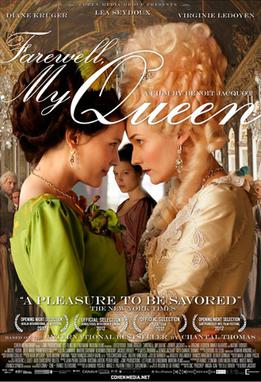
I'm not even sure of the context anymore, but I recently learned of a movie called Farewell, My Queen, which is set during the French revolution. The basic synopsis sounded interesting (though in retrospective, somewhat misleading), and I'm sucker for anything set at Versailles so I decided to give it a try.

Farewell, My Queen (Les Adieux a la Reine originally) is a French film based on a popular novel of the same name. Starring Lea Seydoux, Diane Kruger, and Virginie Ledoyen, the film picked up several prestigious awards when it was released last year. The movie tells the story of Sidonie Laborde, who is the official reader to the queen. Essentially, she is only a servant, but one of a slightly higher caste than, say, a chamber maid. Because of this, she holds some more privileges than her peers (notably a lavish gold clock that sits in her otherwise bare room) and shares a bit of intimacy with the queen, in that she gets to sit near her in the queen's private quarters while reading aloud to her.

The movie starts out on July 14, 1789, a day of infamy in French history for the Bastille was stormed that day, officially starting the revolution in France and years of bloodshed. Because news traveled slowly at that time, everything on this day is as normal. But by the following day, rumors are spreading about what has happened in Paris and fears are being stoked. The movie covers only a few days' time, so we don't see the Reign of Terror or anything more extreme than the dawning realizations of those at Versailles that their lives are about to be irrevocably changed. But the movie is not so much about history or its often attendant misery; indeed, The Independent's review of the movie notes that the director "doesn’t have any grand political statements to make. He is not trying to make a sweeping melodrama either. His approach is more like that of an anthropologist, studying a tribe in its death throes. The result is quietly fascinating." But perhaps most glaringly, the movie is rather the story of a love triangle. For Sidonie is in love with Marie-Antoinette, Marie-Antoinette is in love with the courtier Gabrielle (the Duchess of Polignac), and Gabrielle ... well, nobody really knows her feelings but let's just say she intends to curry favor with the queen for as long as possible.

We see all of this through the eyes of Sidonie, who gives us quite an insider's view of the palace of Versailles. Holding the position in the hierarchy that she does, she allows us to see the servants' quarters, with their rather drab existence and petty squabbles often based on things they've overheard from their masters and mistresses, as well as the inner chambers of the queen and her court, with their opulence, frippery, vanity, and still more rumors (although usually more substantiated at this point). Sidonie's place in the latter is certainly more uneasy though, and we frequently see her view of things from a position of eavesdropping while hiding in an opportune place. This dual perspective gives off a Upstairs, Downstairs sort of vibe, although the movie also reminded me a bit of The Girl with the Pearl Earring in terms of ambiance. Of course, the movie this one is more frequently compared to is Sofia Coppola's Marie Antoinette, and it should be noted this is a very different film. I don't want to pit one against the other as they both have their highlights, but they vary much in terms of style and substance.

Despite being a rather slim movie in terms of plot points, I found that I was totally engrossed in this film from beginning to end. Others have referred to it as a character study, but I think that explanation is a bit misleading also. As one of Sidonie's fellow servants notes at one point, Sidonie's life is mystery as she's held back all kinds of information about herself, including where she's from, who her parents are, etc. - and the viewer suddenly comes to realize the same thing. We know nothing about Sidonie beyond her love of books and her loyalty to Marie-Antoinette. The duchess is given comparatively so little screen time that we learn few details about her also and must surmise all of her motivations. Marie-Antoinette gives us a bit more, divulging some of her secret feelings to Sidonie at one point, and sharing knowing looks here and there that seem to indicate her frame of mind. But how much the queen really feels for Sidonie seems variable at a moment's notice and how much she's aware of Sidonie's love for her is something we're left guessing about, wondering if she's milked Sidonie's feelings for her own gain or if she is just completely unaware of them. If the former, this adds to the feeling that the movie left (for me at least) that the queen was a rather nasty person. History has been unkind to Marie-Antoinette, a woman who - no matter what her faults - was given an unfair amount of the blame for an entire country's myriad problems. Modern historians and others have been more sympathetic to the queen, and she did have her supporters even back in the 18th century, such as the artist Louise-Elisabeth Vigee-Lebrun. Vigee-Lebrun tells one of the most touching stories about Marie-Antoinette, in which the queen insisted on picking up Vigee-Lebrun's dropped paintbrushes for her, something quite unexpected for the lavish monarchy of 18th century France and not what you'd imagine for the Marie-Antoinette depicted here. This movie instead portrayed her as quite incapable of doing anything for herself and as rather self-absorbed, although admittedly she does have some slightly sympathetic moments.

Beyond the three main leads, there are numerous other characters who come in and out of the film from both the occupants of the royal court and the people who serve them. It was a bit tough at times to remember who all everyone was and how they related to one another, but it was manageable. One of the more notable side characters was Madame Campan, the head lady-in-waiting to Marie-Antoinette, who probably sees the most (both literally and metaphorically) of what is happening between the queen and those around her. She's a complicated woman who can seem both harsh and sympathetic to Sidonie at turns, but ultimately appears to be one of the most honest and moral people at Versailles. The mob of angry French people, although hardly seen, is a character in itself, causing all the other characters to worry and despair from a distance. Of course, the benefit of hindsight makes everything all the more ironic for the viewer who knows the fate of the royalty depicted here and all their court.

With such a female-heavy cast and focus, this movie is a rather interesting one to dissect in terms of its portrayal of women. We see three very different women here - one who appears to be obsessed with power and privilege (Gabrielle); another with love and loyalty (Sidonie); and another who is perhaps a mix of both (Marie-Antoinette). None of them seem to be sad stereotypes of frail and fragile women, but then again none of them seems to stand out as a particularly tough and independent woman. In a way, I rather like that for there is already no end of historical fiction out there in which someone tries to re-write history with a 21st-century ideal of a strong woman at the helm. These women seemed more realistic with a mix of good and bad about them. It's suggested that all of these women have at least some element of same-sex attraction within them, and it's worth noting that even in the 18th century Marie-Antoinette and the Duchess de Polignac were rumored to be lovers, despite no evidence supporting that beyond the queen's obvious fondness for the duchess, which very well may have been entirely platonic. For the most part in this movie, the erotic undercurrent of homosexuality isn't played too heavily or for the benefit of the male view, even if the (male) director told the press that he chose Lea Seydoux to play Sidonie because she "has incontrovertible sex appeal" and "brought this carnal dimension" to the film or if one reviewer thought the director took "a completely gratuitous interlude to let the camera ogle Ledoyen, lying in bed as God made her." I personally didn't find this scene gratuitous as it told us something about Sidonie's character and her envy, but there were other scenes where the director seemed to linger unnaturally long on a woman's body part - it wasn't just Sidonie's heaving bosom in a scene when she sits dangerously close to the queen as they take turns reading lines from a romantic play, but other odd choices like Marie-Antoinette's bare feet in a very serious scene that seals Sidonie's fate.

Otherwise, the cinematography of the film is excellently done without being overstated. Set in Versailles and filmed mainly on location, the palace feels like a character in itself -- or perhaps it just felt that way because I could recognize some of the areas, such as the Hall of Mirrors, from my visit there several years ago. Either way, the palace of Versailles leaves for stunning visuals with all its gold gilding, marble floors and columns, sparkling chandeliers and mirrors, and well-manicured extensive grounds. Of course, we also see the seedier side of Versailles (if you can call it that) with the tiny and sparsely decorated servants' quarters. The musical score was perfectly fitting to the tone of the movie, the period costumes were gorgeously lavish, and the acting was all top-notch, even in the minor characters. The ending of the movie was perhaps a bit "huh" rather than conclusive but as another blogger points out, "Because the film is a character study and not one of the climactic biopics to which some of us are accustomed, the story feels unfinished in the end, if only because the action ends where the action of most of these types of films begins." This was not necessarily the best movie I've seen regarding unrequited love or the French revolution or whatever element you want to pull out as the most relevant in this film, but I quite enjoyed it overall and would recommend it for those who are Francophiles, enjoy historical costume dramas, or who just like an understated movie that's more about characters interacting with one another than about non-stop action.

Sunday, February 17, 2013

Following the Red Balloon

Unintentionally color-themed, I'm following up my post on The Yellow Handkerchief with this post on the classic French film The Red Balloon. Arguably a children's movie, The Red Balloon is a 1956 film featuring the director's son Pascal Lamorisse in the lead as a young boy (around age 6) who encounters a red balloon on his way to school one day. He happily scurries off to the school with the balloon in tow, finding out soon afterwards that this is no ordinary balloon. The mischievous balloon has a mind of its own, so to speak, and definitely moves of its own accord. It becomes a constant companion to the young boy, following him about the streets of Paris on everyday adventures. Later, the two try to escape from the boy's mean classmates/peers who are clearly overwrought with envy about the balloon.

Besides that it is considered an iconic piece of work, I had absolutely no idea what this film was about before I watched it. Add that to the stereotype of French films being depressing, I was delightfully surprised to find this movie sweet and whimsical. There was a moment toward the end I was afraid this wouldn't be so, but everything righted itself onto a uplifting course (pun intended). However, I'm not sure how much children really delight in this short movie, especially given that modern audiences of youngsters are used to fast-paced, brightly colored movies that are usually animated and often peopled with outrageous characters.

The Red Balloon is almost entirely wordless, with only a few lines of dialogue given from the boy to the balloon, generally an admonishment to stay put. It is not, however, an entirely silent film. There is of course the requisite soundtrack but there are also numerous other sound effects heard like a doorbell ringing, cars whirring by, and quite frequently the sound of pounding feet hitting the pavement. These all serve to add to the film's ambiance and heighten the comedy or drama of any particular scene.

But mostly the film's story and atmosphere are captured with the cinematography. Of course, we see a lot of the boy in his gray outfits (and adorable school book bag that looks like a miniature briefcase in my mind, making him seem so grown up) and the balloon, which is vividly red and quite large. Throughout the film, there the cityscape of Paris, with its gray buildings, narrow alleyways, numerous stone steps, balconied apartment buildings, and blue street signs. It certainly carries one right into the city - not the tourist's city, with the Eiffel Tower glimpsed only once in the very far distance and no other major monuments featured, but the city of everyday life, with the boy stepping into a boulangerie and passing by outdoor fruit and vegetable stands. Most people on the streets are minding their own business, worried about their own concerns and hardly noticing the boy and his balloon. The cityscape scenery is a reminder that parts of Paris can be quite gray, which serves as a fitting backdrop for the brightly colored balloons that enter the scene in this film.

With hardly any words and a rather bizarre plot line, The Red Balloon allows for a myriad of interpretations of its appealing visuals. The original New York Times review said of it, "It is a thoroughly simple story of something incredible that could not occur except in the bright imagination of an artist such as Albert Lamorisse, the young Frenchman who made the memorable short 'White Mane' and who wrote, produced and directed this. Yet with the sensitive cooperation of his own beguiling son and with the gray-blue atmosphere of an old Paris quarter as the background for the shiny balloon, he has got here a tender, humorous drama of the ingenuousness of a child and, indeed, a poignant symbolization of dreams and the cruelty of those who puncture them." A more recent look by The New York Times of this movie and White Mane acknowledged, "The stories are simple, fablelike; the heroes are boys; the subject in each case is the purity and power of a child’s imagination; and the tone of both films is that of open-mouthed wonder. Yet these movies are also shot through with a very adult melancholy, an awareness that life tends not to measure up to the glorious pictures in our minds." Slant Magazine has a slightly different view, pointing out that, "The honeymoon is short-lived, but Lamorisse suggests that kids are always keenly attuned to the objects of the world around them: After the boy loses his red friend, a montage of balloons across the city shows them flying to his side and, in the final shot, launching him into the sky. For Lamorisse, then, the pleasures of childhood are as fleeting as they are ecstatic." Thus, a key debate to this film could be whether children are unaware of the bitter ironies of life or whether they are just more resilient than adults in getting back up after life delivers them a blow.

Meanwhile, Brian Gibson of Vue Weekly eschews the idea of capturing childhood innocence being the only goal of this movie or its counterpart White Mane, explaining, "These are post-war stories of innocence threatened—by arrogant, selfish gangs bent on proving their superiority. ... [T]his seems a post-Occupation France happy to forget the blood and death of Hitler’s war a decade earlier. But soon people’s occasional, playful efforts to grab the floating, carefree balloon become grasping and destructive. In a gorgeous sequence, light streaming down alleys as children’s shoes clack and clatter on the cobblestones, the red globe bouncing between the walls, Pascal is hunted down for his floating pet. The film’s ballooning sense of hope and freedom is deflated by a fierce, squabbling mass. Then, fortunately, Lamorisse’s film floats off, with the breeze of magic-realism, into a feeling of escape and peace, The Red Balloon taking hold of Pascal, lifting him out of this rigid, petty, earthbound life." Given the film's date, it is not absurd to read it as, at least in part, a reaction to the horrible war that the film's director undoubtedly lived through - though his son in the starring role obviously did not. Battered but cautiously optimistic and healing is probably a fitting description of Europe a decade after the horrors of World War II and Hitler's cruelties, and the film's young lead follows a similar path when his happiness is shattered by the balloon's bursting but is soon replaced with unimaginable joy when the other balloons of Paris come to his rescue. This final scene of vindication could be seen as symbolic of the dream of Europe ascending to even greater heights than before the war. (Decades later, this is arguably the goal of the European Union.)

After its musings on childhood purity versus adult melancholy, the 2007 New York Times article goes on to note, "When the film is over, you realize that although you’ve been entirely enveloped in little Pascal’s fantasy world, you’ve learned next to nothing about the boy himself. His parents are not in evidence. He lives with a stout, black-clad, rather fearsome-looking old woman who may or may not be his grandmother. We’re given no idea whether he’s a good, bad or indifferent student, or who his friends are. The intensity of his attachment to the balloon suggests that he’s a lonely, dreamy child, living in his own head, but we can’t be sure; the movie gives us nothing solid to go on." It is true that this movie is not a character-driven one like I usually enjoy, or at least it is not so in the traditional understanding of that terminology. Still, the young boy has a somewhat universal characterization about him - he is in some ways the epitome of the underdog that we can all sympathize with and root for through his (albeit brief) journey.

At any rate, this is not your standard classic Hollywood fare! Being so very different than all those rather formulaic 1950s movie gives this film the feeling of being a more modern movie that just happens to be set in the past. The special effects are particularly surprising given the film's date. If you haven't seen this short film yet, I suggest you do. It will delight you and cause you to think about its deeper meanings and themes for some time.