Showing posts with label slapstick. Show all posts

Saturday, January 10, 2015

Way Behind the Curve: Partying with the Folks from Party Down

This post comes to you rather belatedly so I apologize in advanced for any mistakes in my memory. If I get my act together more in 2015, you'll be seeing some posts that really should be written sometime over the past two years or so instead of now. I'm hoping that it's, as the saying goes, "better late than never." With that said, let's proceed in to this post proper.

Some of you may know that I was a huge fan of the cult classic TV show Veronica Mars; it remains one of my go-to shows for when I've had a bad day and/or want something familiar. So when I heard that Veronica Mars creator Rob Thomas also had a short-lived Starz TV show titled Party Down, I knew I would sooner or later need to watch this show as well. Sooner arrived when I scored an incredible Black Friday steal on both seasons of the show on DVD and proceeded to watch the show (note: this was several years ago now and hence where memory issues may arise).

Party Down focuses on a catering business that employs a number of wannabe actors and, in one case, a burned out actor. Steering the helm - or more, accurately trying to steer the helm, is Ron, who desperately wants to do well in the food service industry after his recovery from drugs and alcohol. In addition to Rob Thomas, Party Down reunites Veronica Mars writers/producers John Enbom and Dan Etheridge on the creative team along with Paul Rudd, who once guest starred on Veronica Mars. The cast (encompassing for this purpose series regular, recurring guests, and one-time guests) also includes a veritable who's who of Veronica Mars alum: Ryan Hansen, Adam Scott, Jane Lynch, Ken Marino, Jason Dohring, Steve Guttenberg, Enrico Colantoni, Ed Begley, Ryan Devlin, and Kristen Bell herself. 
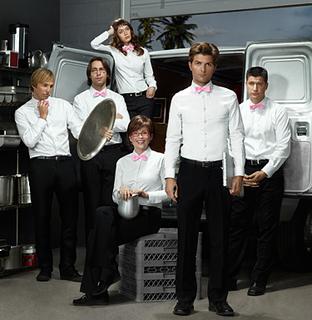

All this seems to be pointing in the direction of Party Down plus me really hitting it off, right? Wrong. Despite soldiering through both full seasons (albeit only 20 episodes in total between the two of them), I found I could not really get into Party Down. For starters, it's essentially a sitcom. Strike one. Sitcoms and I rarely do well together, as I ranted about in length in a previous post. Granted, Party Down is a somewhat atypical sitcom going to places that most network sitcoms wouldn't touch. But still, you can't really change a leopard's spots and Party Down is what it is: a sitcom. And unfortunately, Party Down's very absurdity was sometimes its downfall for me. The more ridiculous and, frankly, downright slapstick the situations became, the less invested I became. The show could occasionally make me chuckle, but more often it left me shaking my head in wonderment - and not the good kind.

The second strike against the show was its characters. In my opinion, characters make or break a show. They don't necessarily have to be identifiable and/or likable characters, but they definitely have to be interesting. The characters in Party Down were quirky, but not necessarily that interesting considering that most of them were fairly one note. And they certainly weren't likable - self-absorbed, narcissistic, downright nasty, immature, and irresponsible are more fitting adjectives to describe the majority of them. Sure, I could feel moments of sympathy certainly for Ron who is hampered down by such reckless team members. Henry, the faded out actor who is still occasionally getting recognized for his past fame as the speaker of a catchphrase in a beer ad, also could have times where he was relatable and sympathetic, although as the series progressed he seemed to be further sucked into the dysfunction of his co-workers. The rest of the characters were really a pretty dismal lot and it was difficult to root for them - or even care about them - for much of the action. And, sadly, there was little growth or change for these characters. Yes, specific events - whether big or small - did make an impact on their lives in terms of things like getting a new job or ending a relationship. But in terms of their character traits, they showed little difference from the pilot to the final episode for the most part and even less in terms of positive moves. While the characters were generally unpleasant, lots of kudos go to the actors who were all magnificent at being awful characters, totally embodying these people for the duration.

Strike three was what seems to be my usual complaint for premium cable TV shows: just because you don't have censors and can do whatever doesn't always mean you should do whatever. While Veronica Mars was smart, witty, and frequently said more with less, Party Down was foul, crude, and often gratuitous. Characters curse at the drop of a pin, nudity for no particular reason abounds, and situations occur that probably wouldn't show up on network TV (like the group catering an orgy party on one occasion and an adult entertainment party on another). I certainly don't mind shows that manage to escape from unnecessary sanitation, but I also think that the rules of good writing still apply. Simply throwing in a dick joke when you could have been clever, relevant, and funny isn't going to suffice. And I hoped for more from the creators of something so genuinely brilliant as Veronica Mars, which succeeded at being clever, relevant, and funny as well as engaging and populated with interesting, layered characters and compelling story lines. Meanwhile, Party Down had the barest of story lines, with it often feeling like there was little carryover from one seemingly self-contained episode to another. 

One thing that the writers did do an excellent job at, however, was creating a show where we looked at only one aspect of the characters' lives - their time at work - and yet managing to covering a lot of ground despite the self handicap. Granted, they did have two things going in their favor:
1) Most of us do spend a great deal of our time at work so it is something that focuses a lot of our energy as well as the place where we do end up talking about everything else going on in our lives. For better or worse, our co-workers become our de facto family members. 
2) While we don't see the cast outside of their workplace, given the nature of their catering job, we aren't stuck with the same physical set over and over again. The characters travel to different parties in a variety of locales where we get to meet new (albeit, equally dislikable) characters all the time. Still, that's not a compelling enough reason to make this show great.

In case the point wasn't obvious yet, this is not a show I would recommend, which is sad because I do really believe that this team of writers/producers/creators can do fabulous work. But this show just didn't do it for me. Part of that was undoubtedly the disappointment created by hoping for another Veronica Mars and getting something so remarkably different from it. But part of it is also because this show was never going to be my "thing." My limited research on the show found that it received some positive critical praise but had low ratings, leading to it be cancelled after two seasons. Let me know hear your thoughts about the show below. Did you watch all 20 episodes? What were your thoughts on the crew at Party Down?

Sunday, February 3, 2013

When Bad Guys are Good Guys

As I've mentioned before, I'm a big fan of Disney movies so when I started seeing previews for their latest offering, Wreck-It Ralph, I knew I'd want to see it. Originally I was fine with waiting until it was released on video, but then came along Superstorm Sandy. I had days without lights or heat and was feeling pretty down. Some of my other family members had power the whole time but were sick of being confided to their home. So we joined hordes of other people at the movie theater for the opening weekend of Wreck-It Ralph.

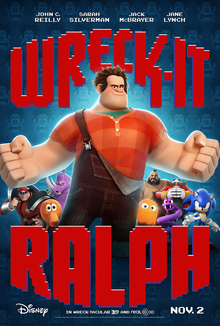
Wreck-It Ralph tells the story of the titular character, an arcade video game villain in the game Fix-It Felix, Jr. The thing is, Ralph doesn't like being a "bad guy" who does nothing but destroy things all day. When the arcade closes for the evening, all the other characters in his video game hang out together, congratulating Felix and making him pies, while Ralph goes to sleep in the city dump alone. Ralph becomes fixated on the idea of earning a medal, which he is convinced will make everyone like him. So one day he leaves the safety and security of Fix-It Felix, Jr. for the chaos of Hero's Duty in order to win himself a shiny gold medal. Unfortunately, a wild series of coincidences later means his medal ends up in the game Sugar Rush, where a go-kart racer hopeful named Vanellope has need of the medal also, and Ralph finds himself becoming involved in trying to sort out the problems found in this video game. Meanwhile, back in Fix-It Felix, Jr. everyone is worried because without Ralph, the game is meaningless. The arcade owner has placed an out-of-order sign on the game and the characters are worried that he'll soon unplug it - and them - if Ralph doesn't return soon. This leads to Felix venturing out after Ralph and embarking on adventures of his own, including falling in love with Sergeant Calhoun of Hero's Duty.

This movie has a little bit of everything for everyone - there's lots of action and adventures, tons of humor, a little bit of romance, and some great morals. At times, the action might be a little too much for the youngest members in the audience who might get a bit frightened, but the movie is otherwise up to family-friendly expectations. As is typical of Disney movies, the humor works on two levels to appeal to both the children and adults in the audience. For instance, when Ralph is in Hero’s Duty seeking that shiny medal to bring home to his life in Fix-It Felix, Jr., children will probably find his slapstick mistakes of falling and whatnot in the game humorous while adults will get a chuckle out his plaintive cry of “When did video games become so violent??” There are tons of references to games both classic and new so gamers of all ages will get a chuckle out of these. Like with the movie Brave (and some others), I'm glad that Disney movies seem to be moving away from romances (after all, what child is really all that interested in adult relationships?) with this movie. But there is still an element of the romantic in this film with Felix, Jr. smitten by Sergeant Calhoun, and I'm happy to see that the lovelorn one is Felix while Calhoun is all business and only concerned about romance when she has finished the task at hand. In fact, the thing that seems to appeal to Felix the most about Sergeant Calhoun is that she is a no-nonsense, tough character who has what it takes to be a leader. But the relationship we see more of in Wreck-It Ralph is the begrudging friendship that grows between Ralph and Vanellope. Despite differences of age, gender, and background, these two become close friends by the end of the movie who are willing to make sacrifices for each other's happiness. That they both ultimately end up happy is no small testament to the power of friendship (and the fairy tale like nature of Disney movies). The friendship plot is not the only moral that can be derived from the movie though. Much of the movie is also about Ralph's quest to become a "good guy" instead of his role as the villain of Fix-It Felix, Jr. He initially thinks that merely having the trappings of a good guy (i.e., the gold medal) will be enough to make him a hero, but as the movie progresses he learns that more is involved in becoming a hero and he steps up to the place. Not only is there the great lesson about what being a hero really means, it's also a good reflection on the idea not being confined to a script. Just because people grow up with certain expectations for them (not amounting to anything or following a traditional path or what-have-you), we are each responsible for our own path in life - and defying expectations and/or stereotypes may very well be a part of that. Ralph and his goal of becoming a good guy is a clarion call for anyone feeling stuck in an unfulfilling role. Take a chance at something new and you might find the right place for you after all.

Featuring the voice talents of John C. Reilly, Sarah Silverman, Jane Lynch, and Jack McBrayer and the artistic talents of doubtless numerous animators, Wreck-It Ralph is executed perfectly. There's tons of fun details everywhere, even the credits, that tie into the video game world. While the film arguably doesn't pass the Bechdel test, it does feature two very interesting and intrepid main female characters, which is a lot more than Disney has given in the past to the little girls in the audience. I'd definitely recommend this movie for young kids - or for those who are just young at heart!

Sunday, January 27, 2013

Good clean fun with Sherlock Jr.

Many of you may not know this as my entertainment choices have mostly lay elsewhere during the past year or so that I've been writing this blog, but I LOVE old movies. Not crappy 80s movies or trippy 70s movies, but mainly golden era 1940s-1950s movies, with a little crossover into the early 60s or late 30s. Too far into the 60s and things get too "groovy" while too early in the 30s and the production values are horrific, so I generally avoid these. One major exception to these general rules though is anything by Buster Keaton.

I hope I don't have to school anyone on the screen icon Buster Keaton, but just in case here's the basics about him: Buster Keaton was a film actor ala Charlie Chaplin, full of slapstick physical comedy in silent movies (although he did appear in some talkies later in his career, notably Sunset Boulevard and In the Good Old Summertime). Although he didn't have the typical "leading man" qualities of being stunningly handsome and dashing, Keaton always landed a starring role, often in film endeavors in which he also wrote and/or directed. While it's inevitable that he will be compared to Charlie Chaplin (just as I did above), when it comes to physical comedy, Buster Keaton has my vote as the absolute best, bar none. (When we look at their later films outside the silent era, however, Chaplin's dark humor absolutely steals the show for me. Seriously. Go watch Limelight, Monsieur Verdoux, and/or The Great Dictator and then tell me Chaplin wasn't a genius.) What astounds me about Keaton's physical comedy isn't just how purely good it is, but the risks he took to get a laugh. Potential - and actual - injury to himself didn't stop Keaton from any gag that would entertain. And did I mention just how good his comedy is? I'm not usually a fan of the slapstick - I generally find it puerile and often crass. And, some comedic actors will beat a dead horse, with a particular running gag continuing on for so long that it ceases to be funny. But Keaton had perfect timing and acts of physicality that could not help but produce a laugh. His The Cameraman is one of the funniest films I have ever seen, and the public pool scene is perhaps the most hilarious example of physical comedy out there, although Keaton and a monkey filming a shootout in Chinatown together in that same movie is a close contender. And while the physical comedy and slapstick routines are the hallmarks of any Buster Keaton movie from the 1920s, his films don't forget about storytelling and provide a sustainable and interesting storyline (usually a romantic plot), which is no small feat for a silent movie.


What I'm trying to say with that very long introduction is that today I had the pleasure of watching a new-to-me Buster Keaton movie called Sherlock Jr. Like many a Buster Keaton film, it stars him as a down-on-his-luck, sort of clueless but incredibly kind man who is head over heels in love with a pretty young woman who another more polished man tries to woo. In Sherlock Jr., Keaton's nameless protagonist wants to become a detective but currently works as a projectionist in a movie theater. When he falls asleep there one day while a movie plays in the background, he dreams himself into the movie. The movie-within-the-movie is called Hearts and Pearls and involves a woman's pearl necklace being stolen by a pair of thieves, one of whom is pretending to court her. Keaton's character arrives on the scene as famed criminologist Sherlock Jr. whose trusty sidekick is a fellow named Gillette. Sherlock Jr. and Gillette elude the criminals' attacks and manage to save the pearls and the girl by the end of the film-within-the-film. Of course, this being a Buster Keaton movie, all of this happens with numerous ridiculous - but funny - gags along the way, including a cross-dressing Keaton, a driver-less motorcycle, and a booby-trapped house.

Meanwhile, in the real world, Keaton's character is barely scrapping together enough money to present gifts for his girlfriend and is eventually accused of a theft he didn't commit. The initial evidence is against him, but his intrepid girlfriend figuratively takes a page out of his detective's handbook and tracks down additional evidence to clear his name. And, of course, this second plot includes some running jokes involving a sticky newspaper, a slippery banana peel, and one lost dollar that several people try to claim, to name a few.

All in all, Sherlock Jr. has so many different jokes and comedic situations that it's bound to hit the mark with the audience at least some of the time. There were a few gags, like the sticky newspaper, that fell a little flat for me, but mostly I was thoroughly entertained by this movie. It didn't reach The Cameraman heights of ridiculously hysterical, laugh-out-loud funny, but it was more than capable of producing plenty of laughs.

The movie is also notable for its use of special effects. As per usual with Buster Keaton, many of the gags ran the risk of physical injury and apparently Keaton actually broke his neck in the production of this film during one of his physical comedy routines. Some other scenes also left me feeling a bit squirmy, worried about the actor's safety. (However, the fact that this actor is long dead and that I knew he survived the silent film era allowed me to enjoy the physical comedy rather than be made too uncomfortable.) But even more notable to me were the scenes involving Keaton's movie-within-the-movie. This sequence starts off with us seeing Keaton's character asleep in the projectionist's booth and then we watch his dream self rise up out of his body, put on his hat, and head out the door. Did I mention this movie came out in 1924?! I had no idea the kind of technology needed for such a scene was available. (C'mon, they couldn't figure out how to add sound to movies yet.) After this amazing feat, we watch his character travel down the movie theater aisle and up on to the stage before walking into the screen itself. Again, this in in 1924. Keaton, who directed this movie as well as starred in it, was apparently not only a comedic genius but also incredibly talented at making movie magic.

I'm not sure if I've emphasized enough yet that this movie was made in 1924. ;) While the humor certainly transcends the time period, there were so many elements that made this movie feel almost stereotypically old-timey. The movie-within-the-movie's female lead has flapper fashion chic, the men's everyday wear includes cravats and spats, steam engine locomotives seem almost ubiquitous in the background, and Tin Lizzies rattle by on the streets. At one point there's even gangsters standing on the car's sideboards, hanging on to the "speeding" car while trying to shoot down the protagonist ahead of them, in what feels like a classic old-fashioned movie scene.

All in all, Sherlock Jr. is a great movie for good clean humor, a sweet romantic story, old-timey fun, and mind-boggling special effects given the time period. And all this is just under 45 minutes. Did I mention that Buster Keaton was a genius?

Sunday, November 4, 2012

Brave Enough to Say No


I’ve been a huge fan of Disney and Pixar movies in the past, even the princess movies that rankle many. Yes, as a feminist I understand the many problems inherent in these movies with their troubling portrayals of women, but I grew up on them and they hold nostalgic memories for me. I am not pining away, waiting for my prince to come and make my happily ever after come true, but I still enjoy the music, animation, and cinematography of these movies.

So when Disney/Pixar started advertising its latest princess offering, Brave, there was a good chance I was going to check it out. And then when I read this article detailing the co-director’s inspiration for the movie and describing how this film with a strong female lead came into being, I was hooked. Last month I finally got the chance to sit down and watch this movie – while I was on a plane and this was luckily one of the choices. (It might be worth noting that I wasn’t the only childless adult watching this movie; I even noticed a couple of adult men picking this movie out of the many options available. So much for Disney’s concerns that only young girls will view princess movies.)

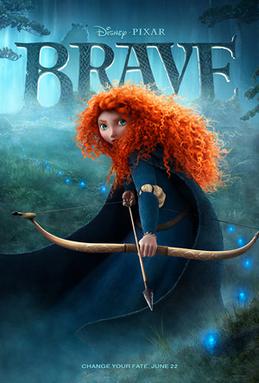
Brave tells the story of Merida, a Scottish princess who loves archery and horseback riding but is often forced indoors by her mother to practice the etiquette of being royalty. Merida dislikes this but does as she told – until one day her parents tell her it is time to be wed and three princes arrive to contest each other for her hand. Merida rebels and runs off into the woods, where she stumbles upon a witch who concocts a potion that will help Merida change her mother. Well, change her it does – right from a human being into a giant grizzly bear. Now Merida has even bigger problems on her hands than just convincing her mother not to marry her off – will she be able to hide her mother from her bear-hunting father long enough to reverse the spell?

There were a lot of things to like about Brave. Of course, as we’ve come to expect from Disney and Pixar, the animation is top-notch. As in many other Disney/Pixar movies, the movie includes a few sweet songs as sung by Merida, which are quite nice and I’d probably listen to just as regular songs without the context of a movie. Personally, hearing the Scottish accent of all the characters was a fun change of pace from the non-accent of most Hollywood casts, even when the movie is supposedly set outside of the California hills. The movie is also good at putting forth some moral lessons without being overly didactic.

Furthermore, this is a very female-centric movie, which sadly cannot actually be said about all princess movies. There is the strong mother-daughter relationship, unlike in many fairy tale-based movies where the mother is absent and/or the mother figure is evil. In fact, what we have here is rare in many Disney/Pixar movies – an entire intact family of mother, father, daughter, and two sons. (This may be a bit ironic – or something – that Disney finally releases a movie with a traditional family of two parents and 2.5 children when the traditional family is morphing into something else altogether.) One thing I really enjoyed about the movie focusing not just on Merida but also on her mother was that it gave the opportunity to show two kinds of female strength. Merida is portrayed as strong and brave in part because she is something of a tomboy, who prefers archery and traditional male hobbies. But – and this is more subtle – her mother is also portrayed as strong in a more traditional female role. She is able to subdue a room full of rowdy men with her stately and elegant appearance combined with a calming speech.

And, I really appreciate that the movie is actually an anti-romance – given the movie’s target audience of young children, I think that is quite appropriate for a change. Merida does not give up on the idea of marriage entirely or denigrate it at all, but she simply refuses to get married at a time in which she is not ready to a person who is not of her own choosing. Spoiler alert!: The film does not end with her falling for one of the three princes or meeting a fourth prince who sweeps her off her feet, but it is open-ended enough that the viewer can believe Merida will eventually fall in love and marry or that she will remain single and happy that way. I had been concerned that the movie would go the route of Aladdin where Princess Jasmine refuses all her potential suitors but then changes her mind eventually when Aladdin arrives on the scene. That’s a fine storyline also as it introduces the idea of choosing one’s own path rather than having it chosen by others, but I’m glad that this movie took it one step further to suggest that Merida might still live happily ever after even without a husband on the horizon.

Like with many other Disney/Pixar films, there is a lot of humor is the movie. I’m sure kids in particular will find the many slapstick moments hysterical, especially the antics of Merida’s two younger brothers who can’t seem to keep themselves out of trouble. But a lot of the humor comes at the expense of the male characters, and this is the only real fault I find with the movie. For the most part, the male characters are seen as little more than barbarians – they are none of them particularly intelligent, and it takes little to have them all begin fighting with one another. If they are not fighting one another, then they are all mindlessly chasing down a bear that only one character has sensed or trying to show off their physical prowess is some other way. Albeit, the king does have some better moments, and it is clear that he is loving husband and doting father. But for the most part, this movie doesn’t give the best impression of men as a whole, especially when a lot of them are put together in the same room. As a feminist, I rankle at this portrayal also – it’s a misconception that feminism believes or seeks to make women superior to men; most feminists simply wish us women to be on the same playing field as men and to stand there being treated equally and fairly, not judged to be either inferior or superior based solely on the existence of a second X chromosome. It’s harmful to everyone – but probably most especially children – to portray one sex as somehow inferior to another in any aspect.

Still, all and all, I enjoyed this movie and appreciated this twist on the traditional princess movie. For that reason, I highly recommend it for all of us who grew up on princess movies because I think we would most appreciate its subversion of the genre. Of course, I’d also recommend it for its target audience of young children but with the caveat that parents co-view with their kids and point out some of the harmful representations of male characters in addition to pointing out the helpful representations of female characters.