Showing posts with label ballet. Show all posts

Thursday, August 21, 2014

Dear Old Daddy Longlegs

It may not be super obvious based on my past posts here, but I have a penchant for old movies made in the 1950s or roughly around then. Sadly, it's an age fraught with a variety of problems around representations of women and racial minorities, but I still look on it as a golden age of film in many respects (and I'm not alone). This time period saw the heyday of iconic actors including but not limited to Audrey Hepburn, Grace Kelly, Humphrey Bogart, Lauren Bacall, Marilyn Monroe, and so many others that I love. It's also a time filled with spectacular directors such as the great Billy Wilder, whose movies are all worth watching for one reason or another. And it's also the era of the big studio musicals, movies designed to show off the various singing and dancing talents of the main stars and churned out with some regularity. Think of such classics as White Christmas, Easter Parade, and Singin' in the Rain multiplied several times a year per studio, and you've got the idea. Nowadays, musicals seem mostly relegated to the realm of children, specifically for Disney movies. There are still some musical movies for adults hitting it big today (Les Miserables being a recent example), but these tend to be few and far between, nothing like the days of old when you couldn't swing a dead cat without hitting into another musical.

All that long introduction is to say that when Netflix recommended I watch Daddy Long Legs, a musical starring Fred Astaire that I hadn't seen yet, I jumped on the opportunity. Fred Astaire isn't a name I feel like I have to explain, but I will note that he starred in some of my favorite old movies to watch over and over again - 1957's Funny Face in which he co-starred with Audrey Hepburn (and the movie that first got me into watching older movies) and 1951's Royal Wedding where he shared the spotlight with Jane Powell, Sarah Churchill (daughter of Winston), and Peter Lawford (brother-in-law to JFK). As an interesting aside, it's worth noting the latter movie contains the famous scene of Astaire "dancing on the ceiling" because he is so in love with Churchill's character. Daddy Long Legs co-stars a young Leslie Caron, better known for her title role in 1958's Gigi as well as her breakout role in the 1951 musical An American in Paris.

Original movie poster for Daddy Long Legs
Like many of Astaire's films (and indeed 1950s musicals in general), the movie Daddy Long Legs seems to be built up around the musical numbers with the plot following as secondary, almost becoming a vehicle in place merely to hold together the singing and dancing in one handy location. This method is successful at times ... and other times, you end up with something like Daddy Long Legs. There are so many long song and dance numbers that they seem to crowd out the development of the characters into fully actualized beings who change over time in a way that at least slightly resembles realism. Meanwhile, literally years pass by in the movie without being explored in terms of characters or plot. If the movie were something scrapped together by hack screenwriters looking to expand upon some musical numbers by a big composer like Irving Berlin or George Gershwin, this would be more understandable. But there is actually a source material that the screenwriters could have used for a more fully fleshed out story. (Incidentally, the screenwriters in question were the husband-and-wife team Henry and Phoebe Ephron who wrote such classics as Desk Set and There's No Business Like Show Business. The pair also produced four daughters who turned to writing careers, including screenwriters Delia and Nora Ephron, who in turn wrote more modern romantic comedy standards such as Sleepless in Seattle and You've Got Mail.)

Daddy Long Legs is evidently based on a book published in 1912 by Jean Webster (great-niece of Mark Twain), written in the epistolary style, and designed for an audience of young women in high school and college. Hence the protagonist - Jerusha "Judy" Abbott in the novel and re-branded as Julie Andre in the movie - is a teen-aged girl entering into college at the beginning of the story. While I've never read the book, from what I can gather the novel Daddy-Long-Legs (note the hyphens in the book's title) and the movie Daddy Long Legs (sans hyphens) share a very similar plot but vary greatly in presentation and exploration of themes. As Astaire is the bigger star here, the perspective of the story of Daddy Long Legs shifts dramatically from that of Daddy-Long-Legs. Here the focus is largely on Astaire's character of Jervis Pendleton and we actually see very little from Julie, as opposed to the book being almost entirely from Judy's point of view and voice as she writes letters. Therefore, Webster's exploration of a young woman coming to age and learning about herself is nearly entirely obliterated. Apparently Webster was greatly interested in women's suffrage and chose to explore themes related to women's issues in her books - something that becomes completely irrelevant and untouched upon when the movie switches the narrative perspective to that of the middle-aged male Pendleton.

Before I get too much further ahead of myself, I'd like to take a step back and give you a brief overview of the plot of Daddy Long Legs before analyzing it in the terms of an entirely different movie's title, The Good, The Bad, and The Ugly. Daddy Long Legs opens with an irresponsible Jervis Pendleton III being far more interested in playing on his drums all day (literally) than in working for his family's company, which rakes in millions of dollars for him. Later on a trip to France, a mishap with the car leads Pendleton to an orphanage where he espies a pretty young girl working with the younger children. The matron of the orphanage explains that the 18-year-old woman, Miss Julie Andre, was herself raised in the orphanage and now has no where else to go. Although he doesn't meet her, Pendleton is struck by the grace of Julie and decides he wants to "adopt" her. When he approaches officials by this, they are shocked at the suggestion and presume that Pendleton is looking for a young mistress or some other nefarious purpose. When Pendleton says he merely wants to give her a chance at a college education in the United States (apparently there are no colleges for women in France?) and declares that he will be an anonymous donor who will not contact Miss Andre, a deal is struck. Miss Andre is packed off to a small all-girls college in Massachusetts and writes updates to her anonymous donor who she has dubbed "Daddy Long Legs" based on the orphanage children telling her that he was very tall when they caught a glimpse of his shadow retreating from the orphanage. Meanwhile, Pendleton is happy to go on living his carefree life until his business manager Griggs and his secretary Miss Prichard insist he read the letters written by Miss Andre that have been piling up in a filing cabinet. He does so and is touched by the young woman's desire to meet him, but he still remains aloof. As his niece attends the same college as Julie (and Griggs has arranged for them to be roommates), Pendleton decides to visit the school just in time for a dance, at which he woos Julie before almost immediately afterwards ditching her because of his continued concerns about appearances. Julie spends the rest of her college days ruing over her lost love of "Uncle Jervis." But eventually all's well that ends well ... Hey, I have to leave a little bit of mystery for anyone who actually wants to watch this movie after my not-so-glowing review of it. Now onwards to my interpretation of the movie's merits and demerits.

The Good
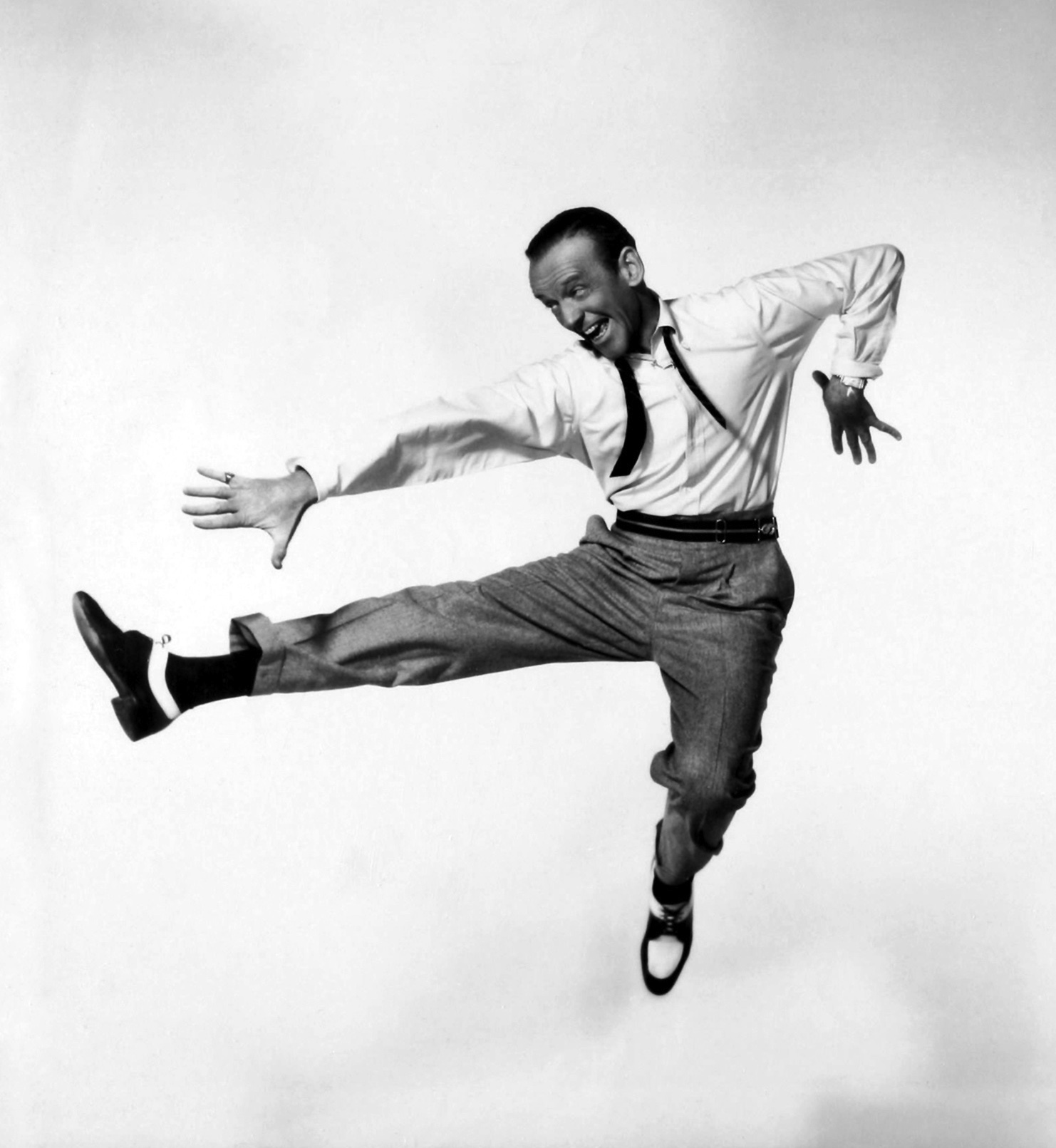
Publicity still from Daddy Long Legs
The movie succeeds best at delivering on its star quality. Astaire and Caron make for an interesting duo, with his talent lying more in tap and hers in ballet. There are a few notable sequences in Daddy Long Legs, particularly of interest for their exploration of dream-like states, which makes for a rather logical break from relative realism into a song/dance routine. (It is frequently a criticism of musicals that no one breaks out into song and dance during real-life day-to-day activities. Clearly these people never have any fun and don't "whistle while they work," so to speak. Also, I'm not sure if these people then only watch super-gritty and realistic movies and avoid all romantic comedies, superhero, science fiction, fantasy, and action movies altogether. If so, well, bully for them, but I think the rest of us prefer a little bit of entertaining escapism now and then. And some of us like that escapism to occasionally be expressed with song and dance.) These dream-like routines are a rather fascinating departure from many studio musicals and are rather avant-garde in that respect. They remind me of a musical version of Dali's dream sequence, which also seemed like an unusual - but fitting - inclusion in a classic Hollywood film. But back to the musical numbers of Daddy Long Legs. Namely, these sequences stand out amongst the pack:

- A long daydream sequence based on the fantasy musings of Andre regarding the personality of her anonymous patron. This is composed of three shorter sequences - "Texas Millionaire," a feisty tap dance sequence with a solo Astaire all fluid motion and making it look easy; "International Playboy," a brief sequence based more in the world of ballroom dance, in which Astaire dances about and with numerous amorous female partners (this is, however, the weakest part of this sequence as Astaire does very little dancing in here); and "Guardian Angel," a lengthier sequence with ballet influences featuring both Astaire and Caron together. This last one is especially interesting for introducing the stage-like scenery of storefronts, an art direction that will emerge again later in the movie as a secondary dream-like dance sequence also makes uses of stage scenery. These sets are beautifully done throughout the movie, showcasing various artistic styles with panache. Also, Caron's en pointe dancing here does the unthinkable in stealing the limelight away from Astaire for a change. As she twirls about, it is impossible not to watch her and Astaire seems to fade into the background with just a few swooshes of his own for good measure.

- The trendy new dance at Julie's college known as "Sluefoot." It starts off as a just so-so choreographed piece that turns into a thing of beauty when Astaire steps in and he and Caron end up as the only two left on the floor. Granted, it's packaged in a whole lot of cheesiness (not least of all the ending with everyone carrying the two dancers atop their shoulders), but this one also gets some bonus points for trying to make a logical insertion of a dance routine - into a college dance, of course! The Sluefoot never took off as a real dance craze and that's probably for the best, but Astaire and Caron do show off some seriously sweet steps here.

- Andre and Pendleton's somewhat accidental New York City trip leads to the introduction of the song "Something's Gotta Give," written by Johnny Mercer expressly for Fred Astaire to sing in this movie, although is now a love song standard covered by so many iconic artists. The initial blocking of the scene as Astaire sings is perhaps not the greatest, as it's always difficult in cinema to have a few minutes dedicated to just watching someone sing, but at least they try here to make it interesting. But the dance routine that follows is delightful and deceptively simple. Astaire and Caron are both so light on their feet that they appear weightless as they twirl and swirl about the hotel's balcony and out into the streets of New York. Apparently this final montage dance was never actually rehearsed, but it came out just fine nonetheless.

- The second lengthy dream sequence when Andre falls asleep to thoughts of how unhappy she is that Pendleton is traveling all over the world without her. In the first, known as "Nightmare Ballet," Caron is given a solo opportunity to show off her dancing skills in a fairly traditional ballet number, which is beautifully rendered and like a mini-trip to the ballet, giving just enough of a taste to whet the appetite for more. The second number is the "Hong Kong Cafe," a sultry and risque dance routine that is fully engaging to the eyes and ears, even if a little out of place with the rest of the movie. The final part, "Rio," is the weakest link in terms of the dance number itself, although it does illuminate Andre's state of mind and feelings regarding Pendleton even more so than the previous two segments. Part of that includes Julie dressed in the role of the sad clown Pierrot, a common trope I discussed in detail in a previous post. Apparently this three-part sequence, totaling to 12 minutes of purely dance routines, was not widely regarded as useful to the film's plotting or pace. I have to disagree as I think this part gives us more insight into Julie's mind than most of the rest of the movie! That may be a bit of hyperbole, but it certainly does lend itself to character development, which I enjoy. The surreal feel of this section of the movie is a bold move (although fitting with the other dream-like parts of the movie) that I personally loved as Surrealism is one of my favorite artistic styles. For the critics to this sequence, I'd also like to note that if watching 12 minutes of music and dance is too much for you, then maybe musicals aren't the genre for you.

- The brief sequence to the reprisal of the song "Dream" (also by Johnny Mercer) that closes out the movie. While it's a short piece with a relatively simple dance, it's again the graceful weightlessness of Astaire and Caron that steals the show.

Beyond the musical and dancing abilities of the two leads, this movie also brilliantly cast the roles of Pendleton's associates, Griggs and Miss Prichard. Played by character actors Fred Clark and Thelma Ritter respectively, these two characters breathe a little more life into the movie and serve as foils to Astaire's character. While they may seem stuffier at the movie's opening, they remind Pendleton of what it means to care for another human being. As Miss Prichard puts it (and later Griggs repeats), "a person is NOT a corporation! A person is flesh and blood ... and feelings!" It's a surprisingly modern quote as we are currently stuck in a political debate in which the idea of personhood is constantly being negotiated and corporations seemingly have it, even if they don't have flesh and blood and feelings.

The Bad

Despite actually owning copies of Gigi and An American in Paris, this is the first movie that I've seen starring Leslie Caron. I found that I'm rather surprised her name is often included in the same breath with some of Hollywood's elite classic actors, as I was disappointed with her performance. Her dancing was incredible in the finished product, as I've noted above, although rumor is that Astaire noted he had difficulty dancing with her. Her acting was only so-so at best, with her mostly wearing this placid "dumb" face (for lack of better terminology) throughout the movie. Think Kristen Stewart throughout the majority of the Twilight movies and you have the general idea. She also goes from playing the naive ingenue to throwing out saucy hints of innuendo far too quickly and then back again rapidly to innocence, although this may be a fault more of the script then of Caron's acting. At this stage in the game, it's hard to know. But what bothered me most about her was the awful accent. Perhaps the director asked her to ham up her accent, but Caron - a native Frenchwoman, mind you - has one of the worse overly dramatic nasally French accents I've ever heard. It was painful to listen to at times.

Caron's French girl is pretty much the only "other" character we see in the movie, which is jam packed solely with Caucasian characters. The movie is a product of the 1950s, so it's pretty much unsurprising that we don't see a single person of African, Latino, or Asian backgrounds, even when we enter a dream state taking place in Hong Kong. Given how badly 1950s movies could mess up depictions of racial minorities, it may end up being a good thing that Daddy Long Legs didn't even attempt to add in a character of color. The movie already struggles with troubling depictions of women, so why give it any more fodder for things we have to dismiss with a shrug and say, well, it's a product of its time? If you want to watch something with actual diversity in it, don't expect to find it here.

While most of the movie's song and dance numbers are the highlights of the film, there are some sequences that just seemed to drag to me. The first number is "History of the Beat," and it occurs early on in the film. Pendleton is right away introduced as a character who doesn't seem to have a lot of discipline and isn't particularly interested in making business decisions; he's much more fascinated with listening to music and playing the drums. Only thing is, we never again see this hobby again - sure, he dances a bunch later and sings a little because it's a musical, but it's no longer a key component of his personality that he plays the drums instead of working or that he has a large record collection. The dance routine here is in itself perfectly fine and Astaire once again shows off his amazing skills, but the song isn't that compelling. Moreover, the placement of this number early on in the movie when so little has been explained yet (and Julie hasn't even been on screen once at this point) leads to the feeling of this just being a fluff piece that does little to add to the movie. It did, however, add to my feeling of this being a dragging number. If a movie, even a musical, is going to lead early on with a song and dance number, it has to be a really compelling one that pushes the plot forward or does a lot to explain the characterization of a particular person or persons that isn't already explained through the dialogue or action. It can't just be a song that someone liked and couldn't seem to fit in elsewhere. There are a couple of other songs sung by Caron and others when her character is still in the orphanage and when she first enters college that also seem to be there for little purpose and seem to slow down the pacing of the movie.

The Ugly

While these complaints above are not exactly gold stars for the film, they are not enough to sink it either. But there is a much bigger problem with this film that is very difficult to overcome. And that's the fact that the movie's basic premise is just kind of creepy. Pendleton's age is never openly stated but Astaire was in his mid-fifties at the time this movie was filmed, and we can gather that his character is meant to be roughly his own age. Likewise, Caron was in her early 20s while making this film and is meant to play a character of college age, beginning the film at age 18 (specifically stated in the movie's dialogue) and ending roughly around age 22 (doing simple math gets us here). So we're talking about a 30-year age gap here. This kind of age gap in a romantic film can be done, and indeed has been done, without being as disquieting. In Funny Face, the movie I mentioned earlier as one of my favorite old movies, the age gap between Astaire and Hepburn is nearly 30 years as well; another of my favorite movies, Sabrina, pairs Hepburn with Humphrey Bogart, then several decades her senior. Those films manage to negotiate the age difference without giving the feeling that there are paedophiles just hanging all about old Hollywood. Many other films of this era also feature large age gaps between the male and female protagonists; indeed, this continues to be true today.

But there's something about this film that just adds such an ick factor to the romance. Pendleton being the guardian to Julie - even with it being done anonymously - definitely makes for an eerie incestuous vibe, especially when she addresses her letters to "Dear Daddy Long Legs." Her misconceptions of who her guardian is (since she has nothing to base her ideas of him on but her own imagination) add to this feeling as well. She describes an old, frail, bald man who she is going to care for when she gets out of college. Maybe this is meant to highlight that Pendleton is not as decrepit as all that and therefore it's okay for him and Julie to end up together, but for me it just lead to an ugly picture of a decade down the road when Julie is in her prime and Pendleton is ready for retirement. Given that Pendleton acts like a child most of the time and needs to have his feet held to the fire (metaphorically of course) by Griggs and Miss Prichard in order to accomplish anything, I can certainly picture an image of domestic life in which Julie is running about attending to all of Pendleton's needs and helping him to function like a normal person while she gets very little in return but his money. In essence, she is the definition of a trophy wife - young, pretty, and in this case, willing to do anything for her sponsor.

Another original movie poster

I feel like the movie does try to address the age differential in a meaningful way but in doing so, it just makes the situation worse. As one reviewer puts it, "Confronting the age problem head on, well, that's honest, but confronting the problem isn't quite the same as solving it. Fred's still old, and Leslie's still young." There just seems to be no fixing that. In fact, that Pendleton's initial attempt to "adopt" Julie is treated with disgust and disdain, with the idea that he could only want to do so for some sick purpose, ends up planting the idea in the viewer's head that Pendleton's intentions are perhaps less than honorable. After all, he has no interest in doing anything for any other child at the orphanage, though no doubt they are also in need just like Julie - or will be in the same boat as her a few years down the line. Pendleton may go on to forget completely about her for several years but once he reads her letters (again, remember these are written to a person she regards as a father figure), he finds himself fascinated by her. He has no qualms about visiting her at school under the guise of visiting his niece. Another creep factor is that Pendleton seems to have no problem - or even need to acknowledge - that his niece and his would-be lover are the same age and friends with each other. Indeed, no one else seems to be bothered by this either. It'd be one thing if there wasn't a large age gap between uncle and niece, but we've already established there's a roughly three decade difference between them.

One could argue that the disturbing factor is lessened by Julie falling in love with Pendleton unawares that he is her guardian, making the decision more hers than his, but I think that would be a weak argument. Pendleton is pretty relentless is pursuing her at the school dance, making overtures toward her under the nominal auspice of just wanting to learn more about his protegee. He even goes so far as to hire a rival boy from a local men's college so that he may employ him in another country and thus keep him far away from Julie. It's pretty hard to make an argument that Julie had much of choice but being interested in Pendleton when he put in extra effort to make sure any competition for the art of wooing was out of sight.

Eventually, Pendleton goes away after he realizes that his wooing of Julie is perhaps inappropriate. Of course, rather than address her like a fellow adult and explain the situation, he simply drops out of sight for months on end and has no contact with her as he globe trots instead, once again showing that despite his age, he really has zero maturity. Meanwhile, Julie becomes this rather annoying character who begins to sit around moping all day and collecting newspaper clippings of Pendleton's gallivants. She seems to have no plans for her future life once she graduates college (which is now an impending deadline), whether it be a job or even a place to live. Yes, the movie was made in the 1950s, based on novel written in the earliest decades of the 20th century, but one still desires a slightly more interesting female lead than this. And again, it doesn't help with the yuck factor that Pendleton returns into Julie's life just when she's at a point in which she has no where else to go and no one else to turn to as she looks to the future. One reviewer (who actually read the original source material, unlike me) notes that the creep factor can be somewhat lessened by the Judy character (here known as Julie) because of her ability to be "awesome" and purportedly hold her own against Pendleton. We see none of that here as Julie does virtually nothing to propel her own life forward, but just sits around waiting for things to happen to her. So there's absolutely nothing to offset the feeling of perverseness surrounding a love affair between a middle-aged man and his young guardian.

All of the actions taken by Pendleton, and the relative inaction from Julie, definitely leads to the overall feeling that this romance is anything but romantic. The fact that there is basically zero chemistry between Astaire and Caron doesn't help to sell it. At the time of this movie's making, Astaire had very recently lost his wife to lung cancer and had tried to back out of making this film, so that could certainly be an element at play here. Astaire reportedly went into his trailer between takes to cry, so this is obviously not him at his happiest or most cheerful, to say the least. (He was apparently also considering a retirement from musical pictures at this point in this life, but fortunately for us decided to move on from this film to co-starring with Hepburn in Funny Face just a year after this one.) It's really hard to have a successful romantic musical in which the romance is a hard sell.

While my modern sensibilities (and especially my strong feminist streak) may be influencing me here, it's worth noting that while this movie was not necessarily a flop, it was not a huge success at the time of its release either. Whether that was due to the lack of a romance that didn't leave viewers feeling kind of grossed out or another factor all together is now probably difficult to tell. The film did manage to garner three Academy Award nominations, proving once again that the Academy doesn't always know what it's doing. However, those nominations were for art direction, score, and original song, which are pretty much the highlights of this film. Nevertheless, this is one old movie that doesn't lend itself to the title "classic" at all and one that I think you're better off missing. Check out the dance sequences linked to above in "the good" section to get the highlights and save yourself from spending a full two hours on a movie not worth it.

Friday, July 27, 2012

Bunheads: Swirling Toward Success?

Note: This post contains some spoilers for the first six episodes so far.


Being a huge fan of the show Gilmore Girls, I was excited when I heard Gilmore Girls writer and producer Amy Sherman-Palladino had a new show coming out. But if the name Bunheads wasn’t enough of a turn-off, the initial trailer did the show no favors. I wrote off the show before it even came out … that is, until I read some of the press about it. In particular, the Entertainment Weekly interview with Bunheads star Sutton Foster piqued my interest in what the show would have to offer, so in the end I checked out the show.

Now is a good time to give a quick summation of the first episode and, with it, the show’s premise. The pilot episode opens up with Las Vegas showgirl Michelle going to try out for a dream dance job and getting immediately rejected without even performing. Back home, her not-so-secret admirer Hubble is hanging around trying to go out with her yet again and this time she acquiesces. In her sorrow and self-pity party on not getting the part (or rather, not even getting the chance to get the part), Michelle gets drunk at dinner and agrees to marry Hubble. The next morning they come home to his quiet town of Paradise, California where Michelle finds Hubble lives with his mother Fanny, who runs the ballet studio on the property and does not take kindly to her new foisted-upon-her daughter-in-law.

To start off with, this initial premise is ridiculous. It’s quite frankly creepy. I know Las Vegas is known as the city where crazy stuff like ill-advised shotgun-type weddings occur, but if it isn’t illegal for a marriage to occur in which one party is drunk while the other is sober, it SHOULD be. That’s just not good for anyone and is to the detriment of society. I can empathizes with Michelle’s feelings of being stuck, of not ending up where you thought you would in life, in seeing dreams of getting out of a rut shot down cavalierly, but I cannot understand her reaction. When I’m feeling particularly low, I veg out and watch some TV, take short road trips out of the state to visit with family and friends, or make small changes like dying my hair for the first time. I don’t think to myself: ‘Oh, I know what will solve all my problems -- get married to some guy I hardly know and get the heck out of Dodge without even bothering to pack a suitcase or inform my job that I’m quitting.’ Absolutely not. There is no reasonable rationale here. This is not 1890 where a woman is dependent on a man to provide for her so she has to just get married already to whoever is available because she’s getting older and he’s the only viable option.

Furthermore, there are plenty of other premises that could get the show started off with Michelle being thrown in the culture shock of small town life. She could be driving home from her disastrous audition and her car breaks down in the small town and she’s stuck there for a few days while it’s being repaired and is wooed by the small town charm into staying there. OR, Michelle and Hubble could *actually* be dating and decide to get married and for whatever reason this is the first time she goes to his house, but at least he’s not a creepy semi-stalker. Or, one of Michelle’s dancer friends could wax poetically about her youth in the small town and her early days of dance at Fanny’s studio, making Michelle decide to go check out the place. Or, Michelle could apply to a job posting to teach at the dance studio. That’s just off the top of my head; there’s potentially tons of alternatives and I can’t believe that a creative genius like Amy Sherman-Palladino couldn’t come up with a premise that was less disturbing.

All that being said, the viewer can manage to somewhat get past the disturbing factor after Hubble has a few nice speeches that make him seem slightly less creepy and a little more endearing. Just as the viewer is started to acclimate to him and think it could be interesting to see the relationship between Hubble and Michelle change and grow, wham! the first episode ends with Hubble’s death. Yep, that’s right, he gets into a car accident and dies. So the whole getting married to Hubble premise is not only ridiculous, it’s also in the end completely unnecessary as the show isn’t going to explore that relationship or be about how love can grow out of a marriage of convenience. (One review I read after being shocked by the pilot episode’s ending suggested that perhaps Hubble was just in coma, which could have been a more interesting twist but alas the writers did not choose that option.)

The second episode ends with a whammy too, with Michelle and Fanny finding out that after the wedding, Hubble immediately got on the phone with his lawyer buddy and made sure to make Michelle a co-owner of everything he had. With Hubble’s death, this now means that Michelle owns Fanny’s home and business, making an already tense relationship all the more awkward and giving Michelle a reason to stay in town after the funeral. It still remains to be seen though if and how Michelle will get more involved in the ballet school besides occasionally popping by and talking to the girls in passing on her way to and from home. Episode five introduces the idea of Michelle teaching at the dance studio by having Fanny bring it up repeatedly while Michelle adamantly refuses to even consider the possibility. In this week’s episode, Fanny runs off for an impromptu vacation, forcing Michelle’s hand into teaching a weekend’s worth of classes. However, we don’t really get to see this happened; we just know that Michelle agrees to do so.

In the comments section of early reviews, some speculated that the scene in which Michelle and Hubble had sex upstairs during their wedding reception party was a set up for later announcing that Michelle is pregnant, but there’s been no evidence yet that the show is going to go in the direction; rather that fact is just something nosy neighbors throw up in Michelle’s face, particularly when people first meet her - ‘oh you’re the sex at the party girl’ is a refrain repeated throughout the early episodes.

There’s little but some inclination that the show is looking to set up a love interest for Michelle (for instance, there was the introduction of Grant, the fellow who lives in the private house on the hill), which is probably a good idea now that there’s no Hubble-Michelle relationship to explore and will probably add another level of tension to the Michelle-Fanny dynamic as I doubt Fanny would be happy to find her daughter-in-law moving on so quickly (even if intellectually acknowledging that there isn’t much for Michelle to move on from as she was only married a day or two. However, Hubble is hardly ever talked about after the second episode; even his mother and Truly, his overly devoted ex-girlfriend, seem to have forgotten about him quickly.)

Whether or not there’s a romance brewing for Michelle, the show is certainly interested in exploring her options and her relationships. There have been a few moments where Michelle contemplates what to do next and what her life is now. Besides her tense relationship with Fanny and her chatty but ultimately superficial one with the girls from the dance studio, Michelle and Truly have awkward interactions that seem to be trending toward a growing friendship between the two. With Truly being one of my favorite characters on the show, I’d love to see more of this.

Speaking of characters beyond the main ones, Paradise (like Stars Hollow in Gilmore Girls) is full of quirky locals who do such odd things as refuse to put up a sign about a private road but expect everyone to know that it’s a private road. Besides Truly, however, none of these characters really stand out as of now. Most of them have only been given a short scene or two to play and even these are few and far between. I suspect that we will see more of the locals over time, but right now we have valuable talent such as Ellen Greene (Aunt Vivian in Pushing Daisies) and Rose Abdoo (Gypsy on Gilmore Girls) wasted in characters that are hardly given a handful of lines.

Back to the main characters, the four girls from the ballet school that the show is focusing on are still not entirely fleshed out as characters, but it seems like we are getting more and more of that with each episode. There’s Boo, the insecure girl who worries that she doesn’t have the ballerina “look” and secretly crushes on her friend’s brother but is also sweet and full of empathy for those around her. Then there’s Sasha, the mean girl of the group who seems to have it all on the surface, including the perfect ballerina look and technique but has a less than ideal home life with parents too angry at each other to notice anything she does. The other two girls, Melanie and Ginny, are pretty nondescript right now, although Ginny strikes me as the fulfilling vapid airhead trope (similar to Madeline on Gilmore Girls, while Melanie isn’t far off from being Louise to round out the rest of that dynamic duo). Some reviewers pointing out the similarities between Gilmore Girls and this show note that Sasha is a stand-in for the Rory character. Here I have to disagree. Yes, the actor looks somewhat like Alexis Bledel, but the character is completely different. She has a lot of meanness and spite while Rory had been all sugar and spice. Her character is more akin to Paris Geller -- she's starts off as cruel but there's hope for some redemption as the series continues. Nor do we see shades of Rory in Boo as she is too insecure and worried to be a Rory stand-in. For the most part, the girls’ characters (the little we have seen so far) don’t seem terribly different from the stock of any standard show on the host network, ABC Family. If the show were only about them, I would have cut and run already.

Although I’ve touched on it a bit already, it’s now time to address the elephant in the room: In many ways, Bunheads is like Gilmore Girls but not. The similarities between the two shows include:
- Again, we are introduced to a very small town with a host of colorful characters and quirky scenarios. However, like with Gilmore Girls, the show suffers from a lack of diversity despite this large cast of characters. In particular, the main cast is pretty homogenous, as pointed out by fellow TV show creator Shonda Rhimes.
- The same actors are called upon to play new roles: the aforementioned Rose Abdoo, a cameo from Biff Yeager (Tom the contractor), Gregg Henry (Mitchum Huntzberger) has popped up repeatedly as Rico, Chris Eigeman (Jason Stiles) and Todd Lowe (Zach) are reportedly going to guest star in the future, and most notable of all, Kelly Bishop (Emily Gilmore) as Fanny.
- In many ways, Fanny is a similar character to Emily. While she may appear slightly more carefree as a Buddhist who collects tacky oddities to clutter her home with rather than the snooty, old money DAR member, Kelly Bishop is still playing a woman who is very controlling and wants things done her way or the highway and is apt to overreact and lash out at others when things don’t go as planned as a result. The most recent episode also points out how she can be manipulative when need be to get her plans to work out.
- Sutton Foster as Michelle even looks a bit like Lauren Graham as Lorelei (pretty, tall, trim, with long dark brown hair). However, she’s not the same caliber of actor as Lauren Graham, although I feel that’s improving somewhat. The first episode in particular felt very much like she was over-acting with her big reactions instead of subtle ones. It reminded me of Maureen O’Hara’s memoir describing her move from the stage to the silver screen; O’Hara noted how you act for the back row on stage while you act for the front row on the screen.
- There’s even one scene in an early episode where Michelle walks into a small bar/restaurant and the proprietor, Rico, is wiping down the counter and sharing in her woes in a very Lorelei-Luke way, except that Rico has some years on Michelle and is already married. Also, Michelle imbibes alcohol the way Lorelei guzzled coffee.
- We are treated to what is now considered Amy Sherman-Palladino’s “trademark” style of dialogue: fast-talking quips packed full of witty pop culture references. The show even calls attention to this in the pilot when an angry Fanny lashes out at Michelle and complains, "Oh my God, the quips, the chatter. Don't you ever just shut up?" Still, there haven’t yet been any great memorable lines like in Gilmore Girls’ “To me, you are the teacher in the Charlie Brown cartoon” or “Oy with the poodles already!” or any other number of fun quips.
- Sam Phillips is once again on the helm for musical interludes, so we hear a very similar “la la” type score for scene transitions.
– Likewise, Helen Pai returns as producer again, although I’m not sure that we necessarily see her influence in such obvious ways.
- Even the font used for the credits is the same (or if not, virtually the same) as the one used for Gilmore Girls!

All and all, there are enough similarities between the two shows that if anyone other than Amy Sherman-Palladino had been involved in this show, there would likely be cries of foul play in the copyright arena. As one reviewer put it, it’s as though Sherman-Palladino presented this show’s concept with the comment of: "Here is this thing everybody loved once upon a time, wrapped in a slightly different package.” This same reviewer also summed up some of my feelings by writing of the two shows’ similarities that “it's close enough to be reassuring — and, on occasion, distracting.”

Of course, there are some notable differences between the two shows as well. Most obviously, dance plays a much larger part in Bunheads and we get to see at least part of a ballet or other dance routine every week, unlike in Gilmore Girls where we only occasionally caught a glimpse of classes or performances at Miss Patty's. Bunheads does not examine family relations with the same intensity as Gilmore Girls, let alone generations of familial relationships. On the other hand, body image is a recurring theme as Boo, who is by no means large but isn't the stereotypical ballerina stick figure, is constantly worried about her size and her eating habits. And while Lorelei and Rory were very driven characters who knew exactly what they wanted out of life and (merely) had to overcome obstacles to their goals, Michelle is a lost and floundering character who is still examining her life choices and wondering what to do with herself. Instead of roadblocks to try to circumnavigate, Michelle is given opportunities and possessions that she doesn't know what to do with and only add to her confusion about what to do next. In some ways, this (along with the tragedy of Hubble's untimely death) creates a show that reflects a sadder world, one in which a person with even the best of starts and educations can still end up feeling unfulfilled and confused, not to mention lonely.

It might sound like I don’t like the show, and to be honest, I’m not really sure yet how I feel about it. Yet I keep watching it each week and was disappointed the week of July 4th when it was on temporary hiatus. With each week, it seems to grow on me a little more. Like my college statistics professor repeatedly lectured, “If you can’t be with the one you love, love the one you’re with” (somehow this was math related). Without any new Gilmore Girls episodes to watch, I’ll keep settling with this show for now.

Sunday, January 15, 2012

From Russia with Love: Swan Lake

While many have speculated whether the success of the movie Black Swan would contribute to more spectators of the Swan Lake ballet, I have neither seen nor particularly wish to see Black Swan. I have just wanted to see Swan Lake for some time now, so I was intrigued when I saw The State Theatre would be live broadcasting a production of the Swan Lake from The Bolshoi Ballet in Moscow, Russia. A friend and I decided to check out this performance, with this far more friendly commuting option!

Very loosely, here’s the basic plot: Swan Lake opens with a birthday celebration for Prince Siegfried. Later that evening, the prince stumbles onto an enchanted lake. It appears to be populated with swans, but they are really young woman who are under a spell and only become their true selves at night. The prince spies Odette (the “white swan”), the most beautiful of these women, and immediately falls in love with her. The next day the queen presents various princesses from other countries to the prince, hoping he’ll pick a bride amongst them, but Siegfried is loyal to Odette. However, that’s when the evil Rothbart appears with his daughter Odile (the “black swan”) who looks remarkably like Odette and tricks the prince into believing that she is indeed Odette. From here, different productions diverge on the storyline so I won’t provide any more details or give away any spoilers.

The story of Swan Lake, like most fairy tales, is a bit silly. (If you don’t know this about me already, I’ll note for the record that I am not much of a fan of fairy tales). But the story is somewhat secondary here - the plot is just some weak glue to hold together a bunch of otherwise unrelated dance sequences. While many critics of musicals charge that the songs are unnecessary, they generally do help to further the plot, even if they make it more long drawn out and flowery. Here, however, many of the dance sequences do nothing to further the story along. Sure, it makes sense for Odette and Siegfried to have a clingy romantic dance together to indicate that they are attracted to one another. But everyone else in the story has their moment of dance also, even when they don’t seem to say anything more about the story. The black swans, the white swans, the courtiers, the prospective brides and their attendants, and so on, all have long dances to execute that don’t push the action forward. This is not a criticism of the ballet; this is just a statement. If you like strong plots, you will probably not like this ballet (and perhaps not any others). If you like to see beautiful dancers dancing beautiful, you will more than likely enjoy seeing this ballet performed.

Before I go into specifics about this particular production we saw, I should note that I’m treading into unknown waters here. Unlike art or theater, where I feel I have at least some background to bring to any critique or appreciation of a particular work, I have hardly any knowledge about ballet. I’ve only seen two other full ballet productions – The Nutcracker at a local dance studio and The Swineherd at the Tivoli Gardens in Copenhagen. I have very little awareness of what kind of training and work goes into a great ballet performance, let alone specific knowledge of technique. So, short of a dancer falling flat on his or her face, I’d be completely unaware of a performer’s flub. Also, because I am unaware of what is a more difficult move comparatively, I am awed by flashy, quick moves – which may or may not be the most difficult ones if you were to ask the ballet dancers.

That brings me to my one and only criticism of this production of Swan Lake – I was not overly impressed by the performance of the prince. For instance, he often appeared to be playing second fiddle to Odette/Odile. No doubt there’s tons of physical effort and talent on both parties’ parts whenever a lift is involved, but it looks far more difficult and interesting to the viewer to see a ballerina balancing on one leg mid-air than it does to see the man just holding her there. Again, this may be an issue with me not knowing what are the more complex steps, but I found the court jester to be a far more entertaining dancer to watch. His leaps, jumps, and quick successive pirouettes looked far more difficult and, as I said, more interesting to the spectator than anything from the prince. Indeed, I found the jester to be more impressive than either of the nominal male leads, although at least with Rothbart I got the impression that this was a very talented performer but the role did not call for an excess of stunning moves. That being said, overall I was mesmerized by the dancers and their skill. The visual feast is further spread with lavish scenery and costumes. I particularly liked the costumes for the white swans – basically the standard leotard and tutu in white but with a soft, fluffiness to them that really evoked the image of a swan’s down. A modest feathered headdress completed the look. And, the music, originally composed by Tchaikovsky, is absolutely stunning and fits perfectly with each and every dance step.

Watching the ballet on the big screen was an interesting experience and, as I mentioned somewhat flippantly earlier, is a good way to see a ballet you would not otherwise be able to see due to geographic distance. Another plus to see the ballet this way was that you could very clearly see the performers up close. Even if you were stuck in a back row, you’d still be able to see the expressions on the dancers’ faces. There were also a few behind the scenes moments, such as when we could see the orchestra in the pit warming up for an act or when the dancer performing as Rothbart was interviewed during the intermission. The only down side with this way of seeing the ballet was that you saw only what the videographer allowed you to see. There was a good mix of shots of the whole troupe versus panning into a lead character, but it’s different than being able to take in the stage in its entirety and choosing where you want to focus at each moment.

Before the ballet started, The State Theatre also provided a brief “Pre-Performance Insight” with Douglas Martin, who is a member of the American Repertory Ballet and has danced Siegfried to his wife’s Odette/Odile in a previous production of Swan Lake. Unfortunately, the pre-performance part made it a bit tricky as people kept piling into the theater looking for their seats prior to the ballet beginning and making quite a bit of noise in the process. Those already trying to listen to Mr. Martin and shushing the newcomers didn’t actually do much to help the auditory problem. However, all and all, this was an interesting talk, which really did provide some insights. Martin discussed the history of Swan Lake, illustrated some frequently used pantomimes that we might see in the production, and explained some of the very difficult training that went into his wife’s performance of Odette/Odile. This made me really appreciate even more the performance I saw later of this dual role. As he pointed out, the ballerina has to play very different personas in this one ballet – sweet, innocent Odette has soft, delicate movements that are sometimes skitterish like a nervous bird while cunning, duplicitous Odile has sharper, quicker movements that are determined. But Odile is also attempting to mimic Odette’s movements, so you see that as well. It is certainly quite an undertaking, and, as I mentioned, I appreciated the ballerina’s every movement all the more after Martin described how painstakingly his wife practiced and perfected every detail, down to every hand flutter. No doubt Mariya Aleksandrova, who played Odette/Odile in this production, did the same, for it showed in her performance.

While Swan Lake was only available to see at The State Theatre today, their broadcasts continue with three other ballets and three operas over the next few months, so there’s a good chance you might find something you’ll like. Already, my friend and I have decided to go back to see La Boheme there, so stay tuned here for more updates…