Showing posts with label theater. Show all posts

Sunday, August 30, 2015

Misallying Love Interests & Etc.

Hello, my beloved readers, if any of you are still here! I know that once again I've been neglectful in keeping up to date here, although I have so many things I'd like to share. One day...

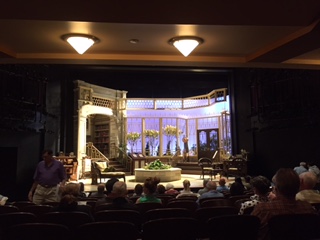
In the spirit of trying to write about things when they're fresh in my mind, I'd like to talk briefly about a play I saw this evening. Tonight I was in the audience for the play Misalliance at the Shakespeare Theater of New Jersey. Misalliance is a drawing room comedy written by George Bernard Shaw in the first decade of the 20th century. Unlike other Shaw plays, this one isn't particularly well known and apparently doesn't see the stage often these days. Reviews for this particular production were rather mixed, and I think I get why that is.

Misalliance is a play that seems to take a while to get started, but even after it did take off some, I still found myself a little puzzled as to what exactly the plot was. There just simply isn't much of a plot. The entire play takes place in one evening in one setting - the pavilion room of a wealthy businessman in the English countryside. The characters consist of a family of four as well as the daughter's fiancĂ©e and his father, and a few unexpected guests. Some of the themes explored include the parent-child relationship, education, the class system, speech versus action, politics, and feminism. While this is all well and good, there times here and there where the play was very speech-y and it was unclear what this all was leading to -- sometimes, it would loop back around to the general themes and flow of the play while other times it would just be there to be there. It also seemed like the characters were sometimes a bit contradictory in all their long-windedness.

On the plus side, there were definitely a lot of humorous parts to the play, which is what I was hoping for and expecting. Shaw makes more than a few meta-references to plays and all their trappings that had good tongue-in-cheek quality to them. The father's penchant for pushing books at everyone was a hilarious refrain in particular. After a plane crashes in the garden outside, things got a bit farcical, but that was in a good way. The introduction of Lina, the Polish acrobat, was refreshingly funny and added some physical comedy to the play. She also elicited a lot of laughs either through her own person or through the minor plot points she put into action. In addition, Lina brought home more of the feminist theme, with a rousing speech that was the only one to elicit applause from the audience mid-scene:

Oh, your Johnny! with his marriage.  He will do the straight thing by me.  He will give me a home, a position.  He tells me I must know that my present position is not one for a nice woman.  This to me, Lina Szczepanowska!  I am an honest woman.  I earn my living.  I am a free woman.  I live in my own house.  I am a woman of the world.  I have thousands of friends. Every night crowds of people applaud me, delight in me, buy my picture, pay hard-earned money to see me.  I am strong.  I am skillful. I am brave.  I am independent.  I am unbought.  I am all that a woman ought to be; and in my family there has not been a single drunkard for four generations. And this Englishman! this linendraper! he dares to ask me to come and live with him in this rrrrrrrabbit hutch, and take my bread from his hand, and ask him for pocket money, and wear soft clothes, and be his woman! his wife!  Sooner than that, I would stoop to the lowest depths of my profession.  I would stuff lions with food and pretend to tame them.  I would deceive honest people's eyes with conjuring tricks instead of real feats of strength and skill.  I would be a clown and set bad examples of conduct to little children.  I would sink yet lower and be an actress or an opera singer, imperiling my soul by the wicked lie of pretending to be somebody else. All this I would do sooner than take my bread from the hand of a man and make him the master of my body and soul. And so you may tell your Johnny to buy an Englishwoman: he shall not buy Lina Szczepanowska; and I will not stay in the house where such dishonor is offered me.

Similar sentiments are expressed by the 20-something daughter of the family, Hypatia, who feels trapped in her upper middle-class life:
  • "I don't want to be good; and I don't want to be bad. I just don't want to be bothered about either good or bad. I want to be an active verb."
  • "I want to be; I want to do; and I'm game to suffer if it costs that.  But stick here doing nothing but being good and nice and ladylike I simply won't."
  • "Men like conventions because men made them. I didn't make them. I don't like them. I won't keep them."

Of course, the feminist in me identified with a lot of this (but not necessarily with the way Hypatia went about her search for adventure ... although given the time period and her social situation, she really didn't have a ton of options available to her). So that specific theme as well as the humor really appealed to me. This particular production also had an absolutely beautiful and elaborately detailed set (see pictures above), excellent actors who were well cast, attractive costumes, and a lovely intimate setting in the relatively small theater. While there were some speeches that did drag and seemed a little pointless, overall I'm glad to have seen this play. Tomorrow is the last two showings of this production, so run - don't walk - to the box office to grab your tickets!

Thursday, August 23, 2012

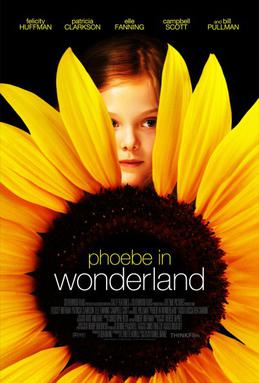
Down the Rabbit Hole: Phoebe in Wonderland

Some of you may know that I have a slight obsession with all things Alice in Wonderland, so when my cousin proposed that we watch the movie Phoebe in Wonderland, I was happy to comply. (I had been meaning to get around to it anyway, so this was as good a time as any.)

Phoebe in Wonderland is about a 9-year-old girl (the titular Phoebe) who is an outcast at her rigid, rule-bound school but feels things might change with the addition of Miss Dodger, a quirky new drama teacher who encourages everyone to sign up for the school play, Alice in Wonderland. After much debate, Phoebe signs up for auditions and wins the role of Alice. While all seems to be going well on the theater front, all is clearly not well with Phoebe at school and at home. She suffers from a severely debilitating case of OCD (her hands are raw from obsessive hand-washing and her knees are scrapped up from jumping up and down the stairs in a specific pattern instead of merely descending), she confesses she cannot help but say or do certain things, and she is having hallucinations (all of which are wrapped up in the Alice storyline in some way). Despite all this evidence, however, her mother Hillary is insistent that Phoebe is just a regular child and does not have any kind of disorder.

This film was very different from what I expected from the brief blurbs given about it. My thoughts were that the movie would be a quirky surrealistic film about a young girl's imagination. Instead, it was a dramatic look at a neurodevelopmental disorder and its effects not just on the sufferer but her family as well. Indeed, the movie belonged more to Hillary than Phoebe, even if Phoebe is the one on screen more. The movie's story arc is more about Hillary's coming to terms with the idea that her daughter is not just a typical child and finding the help she needs to cope with her disorder and still be herself. Some of the most poignant scenes in the film belong to her, such as when the psychiatrist Hillary hires first tells his diagnosis and she refuses to believe it outwardly, ranting about how doctors just want to prescribe medication instead of letting kids be kids while the tears on her distorted face indicate that on a deeper level, she knows he is right. Another powerful scene comes when her husband tries to apologize for an earlier insensitive remark and Hillary responds with a whole list of things that frustrate her, including her inability to understand what is wrong with her daughter or how to help her. Still another emotional scene occurs when Hillary goes to comfort a scared Phoebe waking up from a nightmare; Hillary notices Phoebe's battered knees and both mother and daughter cry for different reasons. There are plenty of other such scenes of Hillary's struggle with mothering a special needs child as well as her other daughter who sometimes wishes that she had another sibling that she didn't have to take care of and explain away her actions to others, despite being the younger one.

In addition to these deep scenes and themes, there are a number of other messages underlying in this movie. There's the power of art as a redemptive force, as seen in the play's ability to largely subsume Phoebe's symptoms. Likewise, theater - and especially Miss Dodger - encourages the school's children to be who they are and learn how to direct their own paths. Fitting in or rather, not fitting in, is a recurring element in the movie. It is not just Phoebe and her lack of friendships with most of her peers. There's her one and only true friend at school, Jamie, a young boy who happily plays with dolls and hopes for the role of the Queen of Hearts in the upcoming school musical. And, it's also her younger sister, who is wise beyond her years and dresses up as Karl Marx for Halloween, goes on a hunger strike when she learns their dinner was not made with cage-free poultry, and worries that at 7 years old she has not produced as much as the 6-year-old Mozart did.

There's some brilliant acting throughout the film, especially by young Elle Fanning as Phoebe and Felicity Huffman as Hillary. Miss Dodger, as played by Patricia Clarkson, was an interesting character as well, with some suspecting that she can relate so well to Phoebe because she, too, has a disorder - quite possibly she has Asperger's syndrome. In addition, the filmography is mostly well done, although there was an occasional scene that was too abrupt or seemed misplaced. Throughout, I found the dialogue to be very quiet while the music soared incredibly loudly, although this is not a problem unique to this movie alone. (It is a continual pet peeve of mine to have be continually changing the volume because filmmakers seem to think that the spoken word should be barely audible but the soundtrack should blast your eardrums off.)

All and all, this is a very interesting movie, but certainly a more serious one that I was expecting. Don't go into this one looking for some light-hearted, quirky fun -- but do go in to it to explore how difficult life could be for a child - and a family - going through the process of suffering from something unknown and finally learning - and making peace with - what this unknown factor is.

Sunday, February 26, 2012

Don't Try This at Home: The Peking Acrobats

For some time now, my dad has expressed an interesting in seeing Chinese acrobats. We were intending to go more than a year, but I intended up becoming quite ill the day before the performance so we were unable to go. But at last, we were able to make the trip to McCarter Theatre today and see The Peking Acrobats perform.

The Peking Acrobats consists of a troupe of 25 performers who dazzled the crowd with acrobatics, contortions, balancing acts, juggling, dancing, cycling, and so forth. As one little girl excitedly exclaimed at the performance today, seeing The Peking Acrobats is like a trip to the circus. In addition to the acrobatics the circus atmosphere was further reinforced with the live musicians that were on scene to set the tone. In addition, some of the performers played clownish roles with silly physical comedy jokes that I didn’t care for too much, but the children in the audience found hilarious. There was even one act that involved several of the performers dressed up like dragons that were more like big furry dogs, so even the animals aspects of a circus was covered despite the lack of pachyderms. (Of course, I’ve never actually been to a circus, so perhaps this performance is more like what I expect from the circus rather than what a circus is actually like.)

Considered a family event, the theater was full of all kinds of children – young and old – as everyone stared in childlike wonder at the feats displayed before them. (And the woman in front of me forgot adult manners and kept tapping on her husband’s shoulder with commentary and questions using her regular speaking voice.) I’ve never heard so many oohs and ahhs in one place before, along with astonished gasps, “wows!” and “amazing!” You’d be hard pressed to find a person in the crowd who wasn’t blown away by this performance, which received a standing ovation from a packed house. Just when the audience would think they had seen all the performers could do, the acrobats upped the ante. Think it’s amazing that a woman can balance a full wine glass on her nose? How about more than a dozen full wine glasses? How about if she stands atop a wobbly step while balancing the glasses? How about if she climbs a ladder while maintaining balance on her nose? How about if she then pulls out a ribbon for each hand and starts twirling without so much as sloshing one drop of liquid from those glasses?

Indeed, the acts on display were often so intense as to induce fear in me for the performers. In particular, one sequence required a man to continually stack chairs upon one another and then perform acrobatics from atop them all – some 20 feet in the air without a safety net and without a single person on stage with him. I was terrified he would fall and have no one there to catch him. He didn’t but still. There were a number of times I was afraid someone was going to break a bone in their attempt to entertain us all, especially considering how all of their equipment is pretty bare bones and intended to be taken apart easily. These performers showed not only bravery but extreme flexibility, strength, and stamina (the show was two hours long with only one brief intermission).

My only complaint about the performance was a subtle one that most people would not notice or be bothered by. Besides the opening and closing sequences, there were few acts that featured the male and female performers together. Instead, there would be a men’s act followed by a female’s act. That would be fine if it weren’t that the first several sequences seemed to be very disparate for the men and the women. The male acts featured thrilling, flashy acrobatics involving leaping onto poles and jumping through hoops while the female sequences involved juggling plates and expressive dances involving paper parasol twirling. Both were mesmerizing in their own right, but there seemed to be a subtext that male acrobats are daring while female ones are graceful. This was further reinforced by the men wearing brightly colored red or yellow costumes while the women were dressed in cooler blues and greens; even the music became softer when the women were on stage. As the show progressed, however, the differences between the male and female acrobatics lessened and the finale involved both set of acrobats performing virtually the same feats.

The Peking Acrobats were only at McCarter for this one night, but you might be able to catch them some other time. Or you can apparently buy a DVD of one of their performances and be wowed at home.

Saturday, February 11, 2012

Fly Me to the Moon: Boeing-Boeing

My sister and I have both been watching ABC’s drama Pan Am with some interest. So when the Paper Mill Playhouse sent out a brochure of their upcoming season including a comedy set in the 1960s and involving stewardesses, we thought this might be something worth checking out. Of course, Boeing-Boeing shares basically no features with Pan Am beyond the time period and the occupation of some of the characters, but it was a highly entertaining production that I would recommend.

As you may have guessed already, I knew basically nothing about Boeing-Boeing before seeing the play, although my wise cousin did mention that the play had been around since the 1960s. Indeed, she was right, as the playbill informs me that it was written by French playwright Marc Camoletti and premiered in Paris in 1960. It was soon after adapted into English by British playwright Beverley Cross and appeared on London (1962) and New York (1965) stages. In 1965, it was made into a movie starring Tony Curtis and Jerry Lewis. According to the playbill and Wikipedia, in 1991 the play was listed in the Guinness Book of Records as the most performed French play in the world with 19 years on the French stage and seven years on the London one, amongst others. (The success of the play even resulted in Camoletti writing a sequel called Don’t Dress for Dinner, which was also produced at Paper Mill Playhouse back in the 1990s.) In 2007, Boeing-Boeing was revived in London and by 2008, it had returned to New York. And for four weeks in 2012, Boeing-Boeing is on stage at the Paper Mill Playhouse.

Paper Mill’s production of Boeing-Boeing was top notch.* The atmosphere of the theater was exactly right from the beginning, with Frank Sinatra’s “Fly Me to the Moon” playing from the speakers before the curtain rose to the playhouse’s typical pre-show “fine print” (no photography, no smoking, there will be an intermission, etc.) being announced as though it were a flight attendant’s welcoming message (‘Thank you for flying with the Paper Mill Playhouse’). The costumes, makeup, and hair styles are all perfect for transporting the viewer back in to the 1960s. The set design was magnificent, with a detailed (but not too detailed) look at Bernard’s Parisian apartment – an apartment so elegant that my sister was jonesing after Bernard’s crown molding and split-level dining/living room.

But speaking of Bernard and his Parisian apartment reminds me that I have yet to give a basic run-down of the play. So here goes:

It’s 1960 and playboy Bernard has perfected his relationship status – he is engaged. To three women. This way, he reasons to his visiting friend Robert, he will never have to endure monotony. All three women are flight attendants – American Gloria with TWA, Italian Gabriella with Alitalia, and German Gretchen with Lufthansa – so they are never in town at the same time and thus never need to know about each other. Bernard invites Robert to sit back and kick up his heels while Gloria heads out after breakfast, Gabriella flies in for lunch and out again before dinner, and Gretchen wraps up the evening. But Bernard’s perfectly timed out plans quickly go awry when the time tables are changed on him, and he needs Robert’s help – along with the help of his own long-suffering French maid Berthe – to juggle all three women and keep them out of sight of one another.

Obviously, this play is meant to be a comedy (specifically a farce***). And it is certainly is. I can’t recall the last time I was in a theater where the whole audience was uncontrollably laughing for the vast majority of the play. In fact, if I had one complaint about the play, it would be that all that laughing was bad for me, as I was recovering from an illness and every time I laughed, I ended up coughing again. C’est la vie.

Beyond the situational comedy that arose from such an absurd plot, the play also has its fair share of physical comedy, which the actors all pulled off with perfect grace. At first I was a little put off by the exaggerated, over-the-top accents of the women (including Berthe), but then I realized that this was an intentional thing to add to the comedy and I went with it. Paper Mill has been marketing the play with the tagline “Hijinks are in the air!” and that is certainly a fitting summation.

For a feel of the play, Paper Mill has released a video montage of scenes from the play. To be honest, I wasn’t thrilled with this montage on first view. I’m not sure if it’s the scenes chosen or if it’s the absence of audience laughter for the great one-liners, but seeing this video certainly was not as appealing as seeing the play. I’ve included here for some context, but I’m more inclined to say: Go out and see the play for yourself! And hurry, because the production is only ongoing for two more days (and that’s including today!).

----------

*This should be no surprise. Whether it was The Secret Garden with our aunt when we were kids, Cinderella as a birthday treat for my sister, or Steel Magnolias to satisfy our Gilmore Girls fangirl** yearnings by seeing Kelly Bishop live, my sister and I have never been disappointed with a Paper Mill Playhouse production.

**Did you know that no less an authority than Merriam-Webster Dictionary considers “fanboy” a word but not “fangirl”? I could go into a feminist diatribe here but I’ll just leave it at that. Make of it what you will…

***An audience guide provided by Paper Mill Playhouse describes farces in detail, including some history of the form. Some tidbits include, “Farce differs from standard classical comedy in one major way: it is an exaggerated, broad form of comedy based on unlikely situations and highlighted by contrived and improbable plot twists. … The driving force behind a farce is fast action, brisk dialogue, visual effects, mistaken identities and convoluted and complicated plots. … It is a comedy that exists purely for the sake of generating laughter in the audience. … Like all good farces, the play invokes laughter by the violation of social taboos, but the characters and values under attacked are eventually restored to their conventional positions.” So, all’s well that ends well, although all is well throughout in a manner of speaking because it’s all meant for a laugh.

Sunday, January 29, 2012

We are the Champions: Medieval Times

I debated whether or not I should include this outing on this blog at it's cheesy compared to what I usually write about it, but I finally decided that this could qualify on the "and entertainment" component of the blog's mission. Today's outing was to Medieval Times, the entertainment chain that purports to bring spectators back to, you guessed it, the medieval times through a dinner feast and jousting tournament. As far as I can remember, not much has changed about the Medieval Times since I first went as a child, nor does it vary much from location to location. I guess when you have a good thing going, you stick with it. There's actually quite a bit of dinner theater to the spectacle, in that there is a whole story involving the king and his quest for peace, which is inevitably broken, but mostly it's the atmosphere and the clanking swords that we care about as viewers. There's also some fun moments where we get to see the effects of what must be months and months and months of animal training -- a falcon flying gracefully above the crowd and horses who do fancy trots and other fascinating movements. My friend and I were both seriously astounded by how magnificently these animals performed, especially given the noise and lights that came from the crowd.

Besides Americans' *entirely accurate* (read: not at all accurate) view of medieval Spain, one of the things I find most fascinating about Medieval Times is that you could easily convince me that it is actually an elaborate sociological experiment. We are all aware, at least on some level, of the psychological shortcuts that allow us to see the world in terms of "like us" and "not like us." Them against us often becomes the resulting attitude. This can be ill-applied when it comes to differences such as skin color or ethnicity, and racist attitudes prevail. We also see the "them against us" mentality in more trivial aspects of life, such as choosing a sports team to root for (although some people do get quite carried away with this as well), But Medieval Times brings this to a whole new level. The them vs. us mentality emerges simply by handing someone a colored paper crown.

See, there are several different knights in the Medieval Times tournament and to simplify matters, they are all referred to by their color (green knight, red knight, etc.). Spectators are seated in color-coded sections and given a corresponding paper crown to wear. And, amazingly, before the knights even appeared on the scene, people began getting wild fan attitudes about their knight. We were seated in the yellow section, right next to the blue section, and a bitter rivalry was soon struck up between the two colors. Blue and yellow spectators were shouting (and cursing) across to one another. And the tournament had yet to begin; likewise the knights still had not appeared, so there was absolutely nothing to base our undying fervor upon such as skill or even something trivial like looks. Right before the tournament was about to commence, our server came by and told us which knights were our allies -- all were on our side except the green knight, who we should boo. I then had to point out that we had apparently been wasting our time booing the blue knight for about half an hour, and our server replied that we could boo him, too, if we so desired. And so the bitter rivalry continued on the rest of the night.

Every time a knight came out into the arena, the crowd in his corresponding color went wild even before he started competing. Meanwhile, the poor princess, the only female character in the whole spectacle, had hardly anyone cheering for her as she had little to do but talk to the king, make a toast, and hand out roses to the winning knights. But when those same knights in turn tossed roses into their corresponding crowds, again their color's crown-wearing fans went wild. When it came down to one-on-one jousting tournaments after the all-in games, you could actually feel the crowd's enthusiasm waning when their knight wasn't amongst the two knights fighting. Seriously, it was amazing to me how quickly people could become invested in rooting for their "team" (so to speak) and thus I am convinced this is all some social experiment on racist attitudes, mob mentality, and etc.

Oh, and for the record, our yellow knight was ultimately named the champion, so clearly we had been on the winning team all along and our fervor was not without reason! ;)

Tuesday, January 3, 2012

Looking Back ... The Play's The Thing

As I’ve mentioned before, I really dislike winter. If I were the type to believe in past lives, I would be convinced that in a past life I was a grizzly bear or some other creature that hibernates all winter long. December is mostly bearable because it has all the holiday rush to make me forget somewhat that winter is coming/here. (This year had the added bonus of actually not being cold most days so it certainly could have been worse than it’s been.) But January, February, and March are the real terrible months with nothing to look forward to but miserably cold, dark, and snowy days. So instead of looking ahead to those dismal days, I’m choosing to look back with this post and talk about some plays that I saw in 2011 prior to when I started this blog. As my co-worker points out that today is one of the most depressing days of the year, hopefully this will bring some cheer to you also!

Crimes of the Heart

The McCarter Theatre in Princeton put on a production of this Beth Henley play, which has also been made into a movie apparently. This darkly humorous play introduces us to three sisters who are all home at their grandfather’s Mississippi house and facing different crises – Lenny has just turned 30 and doesn’t feel like she’s done anything with her life, Meg is trying to make it big as a singer, and Babe has just shot her husband under the weirdest of circumstances. While this sounds like a serious set-up (and indeed there are dramatic moments, such as when the women contemplate their mother’s suicide years earlier), it is mostly a madcap comedy with the unlikeliest of scenarios continuing to play out.

The first thing I noticed about this production was the great scenery, including props that were authentic. As we sat waiting for the play to start, I recognized a few 1960s items that I have at home after being passed down from my grandmother. The second thing I noticed was that, yes, there is such a thing as being too close to the stage, as we learned. Having ordered the tickets the day before the show, we were in the first row, which was very, very close to the stage. It was an interesting experience though to get to see that the actors, who appear to be looking right at you when you in the center of the audience, are actually looking over the audiences’ heads. It could also make for an awkward viewing experience being uncomfortably close to the actors, particularly when they did things like undress and change costumes right on the stage. Speaking of actors, everyone involved in this production was top-notch. Overall, this was a great play and, barring the ability to see it again any time soon, I might rent the movie to re-visit these wonderful characters and hilarious plot.

Sleeping Beauty Wakes

This was another production at the McCarter Theatre that was also funny in a dark humor kind of way, although it certainly had very serious moments as well. In this Rachel Sheinkin play, a heartbroken father brings his seemingly comatose daughter to a sleep disorder clinic, claiming that she’s been sleeping for centuries. In this setting, an orderly suffering from narcolepsy starts to fall for the mysterious beauty, while the four other patients reflect on their own sleeping and dreaming patterns since the young woman arrived. When “Sleeping Beauty” wakes up about half-way through the play, things become even more unpredictable.

In my opinion, the first half of this play was the more interesting part with a little bit in the second half starting drag, but overall, it was a good play. (I should also note that I ended up waking up incredibly sick the day I went to this play so perhaps any thing that felt like dragging could have been in part because I was resisting the urge to sleep off whatever sickness I had.) As a musical, this play had phenomenal music – both lyrically and instrumentally – and spectacular choreography to match it. The actors were all great at every aspect of their jobs – singing and dancing as well as believably portraying their individual roles. The use of fairy tale imagery in a contemporary setting and story was an interesting twist and one I think that speaks to modern sensibilities (and our building on previous generations, especially when it comes to common knowledge amongst people of different backgrounds).

Compared to Crimes of the Heart, this production had a set that looked underwhelming at first glance – just a line of austere beds for the patients and an office desk for the doctor – but these were in constant motion depending on the scene. There was also an artistic use of lighting depending on the context, making for a visual treat. Furthermore, the production made use of film images on the screens behind the beds, with these images containing things such as what the patients were supposed to be dreaming of at the time. As you might have gleaned by this point, this was a very different sort of play than the standard character-driven or even plot-driven one. For a sample of what it was like, you should check out the trailer available here. While I generally prefer things that are more character driven (such as Crimes of the Heart), I appreciated the different-ness of this musical as a change of pace and a truly artful experience.

A Midsummer Night’s Dream

Appropriately, The Shakespeare Theatre of New Jersey put on this production during the summer. (Okay, for you loyal readers who might point this out, I did actually see this play after I started this blog, but with family visiting from out of state, I didn’t have the leisure to write about it at the time.) I don’t think I need to provide a synopsis of this well-known Shakespeare play, but I will note that this is one of my favorite Shakespeare plays and my absolute favorite out of his comedies. (My other favorite is the drama Hamlet, from which I pulled the quote for this post’s title.)

Like with Crimes of the Heart, the first thing I that struck me with this production was the beautiful set. This play was performed at the outdoor amphitheater, and even though it was unbearably hot out of doors in July (ah, remember being too hot? it seems a luxury unheard of now), it was a really cool (no pun intended) experience to be at an outdoor play. Also, it gave the theater the opportunity of handing us all paper fans imprinted with the play’s design. The set itself was really beautiful (see the picture below for some idea of what a portion of the set looked like, although alas my photography skills aren’t very good and it was much better to see in person). The production also made good use of the set’s space, including having the Athenians sit down amongst the audience when watching the players put on the play within the play, Pyramus and Thisbe. Another great example was when Puck came out into the crowd to look for a man wearing “weeds of Athens” (per Oberon’s advice) by checking the tags on everyone’s clothes and saying to himself things like “The Gap, no, Old Navy, no, Tommy Hilfiger, no” until finally going up to the actor portraying the sleeping Lysander and looking at his clothing tag and saying “oh here, weeds of Athens.”

One thing I never quite understand is when Shakespeare’s plays are set in the modern day but the language is the original old English; here it was a bit unclear just when it was meant to be taking place. The fantasy world of the fairies helps in that it is timeless, but the original play also takes place in ancient Athens, which calls for an established time and place. In this production, the actors were clearly not clad in costumes authentic to either ancient Greece or Elizabethan England. However, they weren’t exactly toting the most modern of apparel either, but rather wearing clothes that were funky outfits you wouldn’t see on any ol’ person walking down the street. (I wish I had a better description but I’m lacking a good way to explain just how it looked.) Some scenes also employed the use of water guns, which a quick Google search tells me is not unique to this particular production. Go figure.

The cast was exceptional with a host of good actors, some in multiple roles. The only notable exception was the actor portraying Hippolyta and Titania, who always wore a look of confusion on her face even when she was supposed to be angry or defeated or in love. A special shout-out goes to those in the roles of the players (Bottom, Flute, Starveling, Snout, and Snug) as they were incredibly funny, really evoking the clownishness of these characters. They probably received the most laughs from the crowd watching this incredibly humorous and absurd comedy.

Now that I’m stuck indoors and won’t be seeing any other live, outdoors plays (although perhaps some live, indoor plays), I’m thinking about pulling out some printed copies of plays and reading them (or in some cases, re-reading them). Also, as winter progresses, you might see some other themed posts looking back....

Saturday, December 3, 2011

Airing Out Family Secrets: Nathan's Secret Girlfriend

It’s been a year since Nathan’s last been to his family home in Colorado, and this Christmas Eve he decides it’s time to finally bring his girlfriend to meet his family. But the family isn’t ready for Nathan’s choice, especially as his father and sisters are still reeling from the loss of his mother the year before. 

That’s the basic plot of Nathan’s Secret Girlfriend: A Christmas Play, a play by Brendon Votipka currently running at Mason Gross. Unlike when I saw Machinal at the same theater, I went into this performance blind, knowing nothing about it beyond the tiny blurb provided on the flyer I received in the mail about the upcoming season. That being said, I don’t want to spoil anyone else’s delight by revealing too many details, so I’ll just give a few impressions below.

One of my first thoughts on arriving at the theater was enjoying that Christmas music was playing even before the show started, priming the audience for what was to come. I also delighted in examining the stage set before me and appreciating the detail-oriented person(s) who took this job seriously.

When the play started, it was clear very early on that the four actors on the stage were all excellent at their craft. The bizarre storyline was ultimately touching, cueing viewers in to the strengths (as well as issues) of family togetherness. There’s also deeper themes addressed, such as the value of human relationships (that cannot be reproduced via technology), fitting into societal norms, the illusion of achieving perfection, and coping with loneliness. All this is mixed in with a fair dose of dark comedy, so that I was not the only one laughing out loud at parts. 

Nathan’s Secret Girlfriend: A Christmas Play will run for another week, so get in now for your dose of holiday drama and comedy! (And there’s a more than good chance your family’s holiday gatherings will seem tame in comparison…)

Thursday, October 6, 2011

Machinal: Life, Love, & Murder in the Era of Machines

As an undergraduate, I took three English courses specifically studying and analyzing literary works meant for the stage (well, technically five courses if you include those two semesters of Shakespeare but for the purposes of this post, we won’t count those!). Those three courses covered American writers, women writers, and 20th century writers. Only one playwright that we studied fit in all three categories. That playwright was Sophie Treadwell, and her play Machinal was required reading in all three courses. And while any normal college student (and myself under different circumstances) would have read Machinal once and then go on memory for the other two courses, I know I read the play at least twice, maybe even all three times. That’s how much I loved this play. I even went on to write my mid-term essay for one of those classes on Machinal.

In all my readings of the play, I kept trying to imagine how this wonderful work would be if presented as it was meant to be - not simply read off the page but seen and heard with a full cast, scenery, and most importantly, the right sound effects. I had never thought I would see it live, being as it is a relatively obscure play. And while it was revived briefly in the 1990s, it hasn’t seen the light of day much since its first premiere on Broadway in 1928.

So you could imagine my excitement when an otherwise ordinary brochure listing the upcoming productions of the Rutgers student theater had Machinal on the list. I tried to order tickets before they even went on sale. Yeah, that’s how excited I was.

Publicity still for Rutgers' Mason Gross performance of Machinal

After tickets actually went on sale and I procured a pair for my mother and I, I filled the time in between the ordering and the actual play-going by searching through my pile of old schoolwork (because I never throw anything out) to find my worn photocopied version of the play. I eventually found it (complete with handwritten notes in the margin taken down over three separate lectures on the play) and re-read it in one sitting a few days before going to see the play.

Having just read the play then, I can assure you that the Rutgers’s production was true to the play to the word, excepting one point that diverges from the written script – the Rutgers’s production included a bit more to the ending to make it even more chilling. 

I will admit that before going into the play I had some fears as to how the students would present it. I’ve been to my fair share of modernized Shakespeare plays to know that sometimes productions take bizarre twists on older plays. But as soon as I walked into the theater, I heard some jaunty period music and saw a couple of displays of the research that went into the costumes and props for the play. There was undoubtedly a fair amount of research done on the actors’ parts as well, as they got down the accent, rhythm, and pace of fast-talking 1930s movie characters when the moment called for it.

Another thing that let me know right away that this production would be exactly what I was hoping for was the set. The theater where Machinal is being played is relatively small and doesn’t have an actual stage, just a clear floor area. Throughout the play, the cast would wheel on the necessary props to the floor, including desks, a bed, tables and chairs, etc. But that wasn’t what I first saw. Instead, the audience is immediately faced with a back wall made up of a chain-link door/window combo with a silhouetted skyline across it --behind which is a massive cog and wheel display. During scene changes these would turn and whir accompanied by an ominous and menacing soundtrack. It could be actually frightening at times and was an awesome addition to the play’s ambiance. 

Speaking of the play’s ambiance, this play calls for lots of ambient noise – from typewriters clanging in an office to children playing outside. As Treadwell herself explains in the stage directions at the beginning of the play, “The hope is to create a stage production that will have ‘style’ … In the dialogue of these scenes there is the attempt to catch the rhythm of our common city speech, its brassy sound, its trick of repetition, etc. Then there is, also, the use of many different sounds chosen primarily for their inherent emotional effect (steel riveting, a priest chanting, a Negro singing, jazz band, etc.), but contributing also to the creation of a background, an atmosphere.” I think the Rutgers’s production could have let the background noises extend for a little longer in some scenes, but overall I was impressed by the way they included in all the sound effects, which did indeed have an emotional effect. Finally seeing this play in person solidified my love of Treadwell’s expressionistic play with its interest in the world outside of just the play’s dialogue. 

But the dialogue itself was also gripping. When reading the play to one’s self, there’s a tendency to just read the words all in one go without pause or stop, so right there was another benefit of seeing Machinal acted live. The actors breathed life into the words by using emphasis, inflection, a wink and a nudge, and all the other little things that give added meaning to speech. This was particularly useful in the protagonist Helen’s soliloquies, full of her short, rushed speech with hardly a coherent sentence within a long paragraph. The actor portraying her perfectly gave the audience the empathy her character cries out for, as who doesn’t feel for the protagonist and her desire to just rest? Or at least sometimes share her feeling of being just another cog in a wheel? Of course, she’s a little insane too but that’s another story…and one that the actor also captured.

Indeed, all of the actors did phenomenal jobs, especially given that all were playing multiple roles. And while having the same actor play more than one role might have the potential for confusion, this was well done on the whole to avoid that. (There was one scene where it was perhaps a bit unclear that the one actor was now playing a different role, but hopefully the audience who hadn’t already read the play numerous times could re-adjust and figure out that he was now in a new role.)

Overall, this play was so good that I would honestly consider seeing it again before the production closes on Saturday. And I’m definitely recommending that anyone in the area run, not walk, to go see it before it’s over.

Wednesday, September 7, 2011

“Peeling Off the Layers”: Venice in Art, Music, & Theater

As you could probably tell from my earlier gushing post, I really like the Zimmerli Art Museum in New Brunswick. After a summer-long hiatus, their popular Art After Hours program has returned, beginning this evening. Art After Hours is a monthly event where the museum stays open late one night and offers a wide variety of additional programming, including but not limited to film viewings, curator-led tours, classical concerts, opera scenes, and author and illustrator talks. There is sometimes (and appears to be increasingly more so) a theme that envelopes all the evening’s events.

This evening that theme was Venice. Yes, the romantic Italian city with its singing gondoliers. The impetus for this theme was undoubtedly a new exhibit featuring the works of two Venetian artists. The evening featured a curator-led tour, mandolin music accompanied by masked dancers, and a short version of Shakespeare’s play The Merchant of Venice.

"The surface of Venice is constantly metamorphosing. Painting Venice is almost like being a restorer, peeling off the layers to find the picture after picture underneath. Venice is inexhaustible because the shifting light and the drifting fog keep changing her face. In the winter, Venice is like an abandoned theater. The play is finished, but the echoes remain. When you walk in the winter fog, there seems to be no division between water and embankment. You feel that you can walk through walls, through sky, through time." - Arbit Blatas, artist

The first event of the evening was the tour of the new exhibit. However, while we waited in the lobby for everyone to arrive for the evening, a few of the masked dancers came out and danced interpretively to some recorded music. I’m not a huge fan of interpretive dance, but I liked that there was something going in the lobby while we waited. Otherwise, my restless nature gets fidgety waiting around for the curator to begin the tour, and I’m sorely tempted to go wander off into nearby exhibits but am too nervous that I’ll end up missing the tour then.

The curator-led tour was fairly brief, but I always love these given the opportunity. Generally, the curators say roughly the same things they have printed in the information about the exhibit (website summary, brochures, etc.) and have on display throughout the exhibit. Nevertheless, sometimes they add in fresh tidbits and they will answer questions that arise as they lead the tour.

How anyone can simply be on the tour and then leave feeling they have seen the whole exhibit is beyond me though. While the mandolin players started strumming, I went back to the beginning of the exhibit and went through it on my own at a much slower pace. It is certainly a different experience than simply walking through quickly on a tour with numerous other people. For instance, in the quick passing through of the tour, I thought I preferred the works of Tiepolo, the second artist featured, to the works of Canaletto. But on a second go-through, I found that I enjoyed Canaletto’s works far better.

As alluded to now twice, the new exhibit featured the works of two artists - Giovanni Antonio Canal (known as Canaletto, which is Italian for “little canal”) and Giovanni Domenico Tiepolo. Besides having the same first name and being from Venice, the two shared other similarities. Both were the sons of artists and both began their own artistic careers as painters before moving onto printmaking, specifically through etching. However, the two had very different approaches when it came to their choice of subject matter.

Canaletto practiced “vedute” – he was first a painter, and then an etcher, of the landscapes of Venice and its surrounding area. I enjoyed that his series of prints included landscapes both real and imaginary. He was gifted with the ability to clearly and accurately represent what was right before him as well as the ability to create something of his own imagining. Some of his prints fell into an in-between place where he was depicting an actual place but chose to rearrange some of the placement of objects in order to create a more scenic view.

While not one of his etchings, this painting by Canaletto gives a good idea of his typical subject matter and style.

Tiepolo, on the other hand, worked in a style known as “expressive heads.” His primary subjects were people. He etched all matter of characters in various poses indicative of their emotional state. His early works were often reproductions of his famous father’s paintings, but he would choose to focus on a minor character from a painting instead of etching the entire work. It was noted that these small-scale etchings could be used as a way of whetting the appetite for his father’s works by introducing the viewer to only a small portion of a larger painting.

Again, a painting not an etching, but this gives a view of Tiepolo's typical subject matter and style. Indeed, there was an etching on display that was very similar to this painting.

As I mentioned, at first Tiepolo’s works were the ones that struck me more. I was drawn by the idea of works that featured people and their emotional state as inferred by their expression more than a landscape of a touristy spot. But on the second time around, the level of detail in Canaletto’s works was what astounded me. The curator’s explanation of the etching process left me in awe of any one who does that kind of work by reinforcing how much effort goes into each print, but Canaletto’s skill was particularly impressive for his inclusion of such tiny details as a perched bird or a skyline receding so far into the distance that you need to be standing an inch away from the print to be able to notice it. And the beauty of his scenes left me ready to book the next flight to Venice and be swept up in its wonders! (Alas, reality would not allow that…) Tiepolo’s etchings of numerous faces, however, were surprisingly very similar on closer inspection and did not show much variety in expression after all.

In addition to the exhibit featuring the prints of both Canaletto and Tiepolo, a small nook was reserved for some other prints from the Zimmerli collection. This sampling included works from the 17th to the 20th centuries and featured artists such as Rembrandt (who was an influence on Tiepolo), Picasso, and Donald Judd. It also displayed some prints by Giovanni Battista Piranesi who also etched in the vedute style, but his landscapes were of Rome. The curator noted that there are some 100 prints of Piranesi’s in the Zimmerli’s collection, so my fingers are crossed for an exhibit featuring these!

Here is a sample of Piranesi's etchings of Rome.

When I was done exploring the exhibit in closer detail, I emerged to find that the mandolin players (whose music I could hear throughout the exhibit) were accompanied by the interpretative dancers (whose numbers had grown). Again, as I’m not a big fan of interpretative dance, I did not feel I had missed much.

After watching them wind down their performance, it was time for the brief version of The Merchant of Venice, which was acted by only two performers. This is one Shakespeare play that I actually have not read and have no knowledge of its basic story or characters. Because of this, the condensed version left me puzzled nearly the whole time trying to figure out what was going on, with the lack of such helpers as scenery, props, or even 100% distinguishable characters. The two actors valiantly portrayed all the characters by switching their outerwear (a vest, a jacket, etc.) but it was still a bit confusing as one character appeared to be shared between them. And, in several scenes, one actor was continually taking on and off the one jacket at such a rapid pace it was difficult to tell when was the end of one character’s lines and the beginning of the next character’s lines. But, the acting was well done, especially given the limitations, and I found it very funny (and fitting with the practice of Shakespeare’s time) that the male actor portrayed a woman in one scene by putting on a lacey top and speaking in a high falsetto voice. I’m now motivated to pull out my giant book of all of Shakespeare’s works to read through The Merchant of Venice and see what it’s all about.

Overall, an excellent evening of arts and entertainment was put on by the Zimmerli Art Museum. And while you might not be able to enjoy all the activities found there tonight, it’s still well worth checking out the new exhibit. Two Venetian Masters: Canaletto and Tiepolo Etchings from the Arthur Ross Foundation is on display until January 2012.