The facts that Hollywood
eschewed are replaced with a compelling story though and one that pulls on the viewer's heartstrings. I loved the story of how Kern becomes like family to the Hesslers and the easy repartee between him and Jim, especially in their early days as bachelor workaholics. The love story between Kern and Eva was also sweet, albeit rushed. Furthermore, the actors play the story of Kern's life well and do a convincing job of growing old and subtly changing as a result. Walker is
always compelling to watch, whether he’s being charming, funny, torn, heartbroken, or feeling
old and resigned, as the situation calls. The other actors in the domestic drama – Van Heflin as Jim,
Dorothy Patrick as Eva, Lucille Bremer as the adult Sally, and Joan Wells as
the young Sally – all play their parts perfectly as well.
But the real star power of this movie was in the music and
dance, with acts that could almost be described as over the top unless you’ve
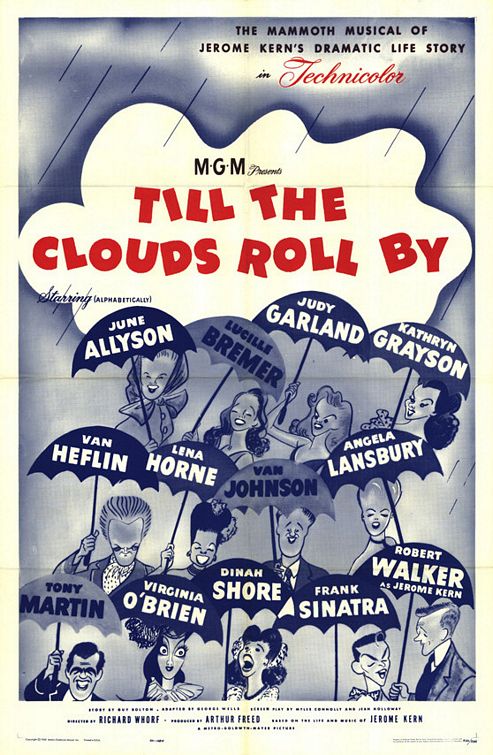
happened to watch a lot of musicals from this era. The cast of Till the Clouds Roll By reads like a
who’s who of Golden Age Hollywood elite, including Judy Garland, Van Johnson,
June Allyson, Lena Horne, and Frank Sinatra, just to name a few. With so many
heavy hitters, the producers didn’t even bother with first billing and just
listed all the stars’ names alphabetically in the opening credits. While a few of
the numbers in this movie were forgettable in my opinion, most of them were
lavish spectacles worth viewing more than once.
For starters, Judy Garland as Marilyn Miller was one of the
highlights in my book. Special guest director Vincent Minnelli (then married to
Garland) was
brought in to direct her musical scenes. The story goes that Garland
was pregnant with her daughter Liza Minnelli at the time so when it came to
staging her rendition of “Look for the Silver Lining,” Minnelli chose to put Garland behind a stage kitchen sink the whole
time. Garland’s
stunning voice carries the scene, even if it isn’t as action-filled as the
other numbers. But despite her pregnancy, Garland is seen more active in her
later musical numbers – dancing about to “Who?” and jumping onto a
bareback horse in “Sunny,”
with a sequence that I really, really hope is done by a stunt double. The
choreography throughout the movie is excellent, but a particular favorite scene
of mine is when Lucille Bremer and Van Johnson dance to “I Won’t Dance” in the Club
Elite. Another one worth noting is the titular “Till the Clouds Roll By,”
performed by June Allyson and Ray McDonald.
The movie both opens and ends with extended sequences acting
as a review of some of Kern’s more famous songs, particularly with an emphasis
on Showboat. The final song – and
scene - of the movie is a young Frank Sinatra’s rendition of “Old Man River.” This
choice rankles some contemporary viewers who feel that the song should be sung by an
African-American man, embodying the working black man the song is meant to
portray, rather than by a Caucasian-American man in spotless white tuxedo on a
white pedestal. While I understand their frustration, I’d like to point out
that:
1) This movie was made in 1946.
and
2) This movie was made in 1946!
The 1940s were hardly a time of racial equality in any sense
of the word. Nor was Hollywood at the time a bastion of cultural sensitivity –
this was the same entertainment machine that just 10 years earlier gave us Fred
Astaire in black face as a “tribute” to Bill “Bojangles” Robinson. And that’s hardly an
anomaly during that era. Furthermore, this movie was already filmed in such a
way that Lena Horne’s solo performance could be removed when the movie was shipped out to Southern
states who would refuse to air a sympathetic portrayal of an African-American
woman singing on screen. It’s not pretty, but you can see why the film’s
director and producers wouldn’t risk having their big finale stripped from the
movie in a large number of states.
A few other points to make on this topic: 1) In the
opening of the movie, “Old Man River” is also featured with African-American
singer/actor Caleb Peterson singing the song, so the movie did give a small nod
to the song’s origins there; 2) Italian-Americans like Sinatra were not
exactly beloved at the time (another not pretty but true fact); and 3) Sinatra was a big enough name already to be a selling point, and at the end of the day, Hollywood is about making money. And, on the note
about the ridiculousness of the dazzling white tuxedo and setting for this
number, it's worth pointing out that this song comes at the end of a review of songs all featuring singers dressed
in pure white settings. I don’t know why this is, perhaps to make some kind of
point about the pure/innocent/ethereal/eternal/transcendent/pick-your-adjective
quality of Kern’s works, but I do know that it would be odd if after all those numbers
increasingly ascending in an “into-the-clouds” feel, the final song was done in
a realistic style. One commentator makes the analysis that this whole grand
finale was meant to be an ironic look at how Kern’s songs were going to be
overblown and taken out of context by Hollywood and while this is an
interesting theory, I just don’t think 1940s Hollywood was that was self-aware
and tongue-in-cheek about itself. That’s my two cents.
All in all, my point is that you have to take a movie – or any
other artistic work for that matter – as part and parcel of its time period and
cultural milieu. If this movie came out today, I could understand that outrage more
and would be right there with these commentators. Not just on the whitewashing
of “Old Man River,” but also on the highly offensive “Cleopatterer” and some of
the portrayals of women, such as Eva’s rules for what a lady can and cannot do
or the fact that not a single woman in this movie ever wears pants (only skirts
and dresses). These things are all a product of the times, and it is what it
is. If you can take it with a grain of salt, this is a great movie from the Hollywood golden era of musicals. Fabulous performances
in music, choreography, and acting will steal the show.


