Showing posts with label drama. Show all posts

Monday, September 30, 2019

Dear Reader, I Watched Them All

In this post I'll be taking a brief break from my reviews of AFI Top 100 movies to discuss some other films I saw this year. Specifically, I finally got around to watching the various screen adaptations that exist of Charlotte Bronte's famous novel Jane Eyre. Many moons ago when I was still an undergrad, I took a course on Victorian literature and read Jane Eyre (alas, with the big reveal having been already spoiled for me by a too chatty classmate; I will be kind enough to tell you all that this post will indeed contain spoilers for the plot, so proceed at your own risk). After that I meant to watch some of the movie adaptations; I even recall seeing a trailer for one of them when it was new! But me being me, this kept getting pushed off to some later date when I would 'have free time' (cue laughter here).

Fast forward to the beginning of this year when I was trying to catch up on some podcasts and listened to Can I Just Say's episodes on Jane Eyre, both the novel and some of its adaptations. Of course, I couldn't simply listen to these episodes with no context though! While I didn't re-read Jane Eyre (too little time to read all the books I want to read as it is), I did make a point to finally watch the film adaptations -- the three discussed on the podcast before listening to it and then just to round everything out, I finally finished this little 'project' of mine but watching one more, which is where I'll start my reviews, as it's freshest in my mind.

Jane Eyre (1944)

This little 'project' of mine ended with the earliest of all these adaptations, which perhaps wasn't entirely fair to save for last, but that is what happened. This wasn't my favorite of all the adaptations; indeed, I found the pacing a bit slow at times. But it was certainly a solid addition to the list of Jane Eyre films and must have been so even more when it first came out to viewers who hadn't seen many previous screen adaptations of the novel, particularly as a "talkie."

The film opens with a young Jane Eyre being interviewed by Mr. Brocklehurst concerning her so-called bad behavior. Peggy Ann Gardner was the most spirited of all the young Janes I saw and was delightful as a result. Agnes Moorhead, best known for her role as Samantha's mother on Bewitched, was absolutely fantastic as Jane's Aunt Reed. She manage to convey in a few facial expressions just how awful this character was, which was necessary for this adaptation as we don't see any of her earlier abominable treatment of Jane. Young Jane's hope of a wonderful new life at school is quickly tamped out when she arrives at the dour Lowood School. But here she makes a friend in Helen, another school child who is played by a shockingly uncredited young Elizabeth Taylor!

Jane quickly ages into a young woman and the role is taken over by Joan Fontaine; I cannot recall having seen Fontaine in any other movie before, but I was immediately struck by how much she looked and sounded like her sister, the actor Olivia de Havilland, probably best known for her role as Melanie in Gone with the Wind. The role of adult Jane is incredibly difficult because she is quiet and deferential while having a very vivid interiority; the reader of Jane Eyre knows this, but the viewer isn't always as lucky. Fontaine certainly does show at times that something else is going on in the character's mind, but other times her face is just too placid to read anything more into it. This movie does have a gimmick in which lines of the book are shown and Fontaine reads them in a voice-over, but this felt like it took the viewer further out of the narrative as opposed to deeper into it, which I think was what the screenwriters were going for with this device. (Side note: A fun fact with this movie is that one of the screenwriters was none other than Aldous Huxley, author of Brave New World.)

Jane moves on from the Lowood School to become a governess at a private estate. Her charge is the young Adele, played by Margaret O'Brien; it is my understanding that O'Brien was a popular child actor in Hollywood at the time but if this movie is any evidence, I cannot understand why. Her French accent was atrocious and the rest of her performance didn't make up the difference. The lord of the estate is Mr. Rochester, played by Orson Welles, whose interpretation of Rochester seems to be more grumpy and stern than brooding and mysterious, but it works well enough. Sadly, I don't think Fontaine and Welles had particularly good chemistry, which is such an essential part to this story. I think that is partially to blame for some of the movie seeming to drag a bit.

The estate itself, Thornfield, is presented here as a perfect setting for the more Gothic elements of this tale; the black-and-white filming and the gloomy shadows are appropriate. However, the exterior shots are all so clearly sound stages, and that takes away a bit from the effect they have. Other characters come and go at Thornfield, but the only actor who stands out is Hillary Brooke, who perfectly captures the haughtiness of Blanche Ingram.

Being as this movie is on the shorter side (only about an hour and a half), it straight up cuts out everything regarding St. John and his sisters, which is just fine with me. All in all, this is a fine-enough adaptation of the book, but it's not the one I would recommend as best.

Jane Eyre (2011)

So this is the one I recall seeing a trailer for before it came out in theaters, and then it languished on the 'I-should-watch-that-one-of-these-days' list for eight more years before I finally did. In keeping with my procrastination tendencies, it's been long enough since I watched it that my review will be perforce shorter and to the point.

This movie started in the middle (really towards the end) with a distraught Jane wandering the moors in hysterics. It then goes backwards through Jane's life from childhood up until this moment, before carrying onwards to St. John and his sisters taking her in off the moors. This device of starting somewhere in the middle can often draw viewers into a movie, but I think it's an odd choice for one based on such a well-known story. Furthermore, I really did not like that Jane was being portrayed as so hysterically emotional as that seems counter to her character; it was probably to draw more of a contrast to how dully placid she was in nearly all the rest of the film. Indeed, on the whole, I did not like Mia Wasikowska's portrayal of Jane as it seem to lack any depth for the character; she is at either extreme of being unreadable or far too passionate for how Jane acts in the novel. Again, Jane is a difficult character to be viewed on screen because so much of her personality is kept hidden to outsiders, but this portrayal seemed so off from how I pictured Jane Eyre to be.

On the flip side, Michael Fassbender was a very compelling Edward Rochester. His interpretation of the character came off as creepy -- not in a horror sense, but in the vibe you get from certain men to stay clear. That is how I feel about the character in the book so I was glad to see it on screen as well! The chemistry between the two leads was missing here as well, which is again unfortunate.

The supporting cast, including an underused Dame Judi Dench as Mrs. Fairfax, do just fine in their roles. The scenery is well done, both exterior and interior. Costumes are equally lovely. Clocking in at just about two hours, the film cuts little of the major points from the book. That all being said, that je ne sais quoi was missing from this film; I wouldn't necessarily recommend it either.

Jane Eyre (1996)

This version was directed by Franco Zeffirelli and also lived on my 'should-get-around-to-watching' list for a very long time. Incidentally, after finally watching this one, I felt there were some cinematographic similarities with the only other Zeffirelli film I've seen, namely Romeo and Juliet (1968), despite the many year gap between the two movies.

Once again, we open with Jane Eyre at her Aunt Reed's house; the young Jane is played by Anna Paquin, who seems a bit overly emotional for the role, but I'll allow it because Jane at this point is more open about her feelings. As Jane grows in to a young woman, Paquin is replaced by Charlotte Gainsbourg. She isn't my favorite Jane Eyre actor and she occasionally slips into her French accent, but I still preferred her to Mia Wasikowska.

Rochester, meanwhile, is played by William Hurt, who gives the character a little more softness and humanity than he has in the book (perhaps a little more than he deserves?). In my opinion, Hurt and Gainsbourg had the best romantic chemistry of any of the Eyre-Rochester pairings. So that's a big bonus point for this particular adaptation. The supporting actors were by-and-large well cast, particularly Joan Plowright as Mrs. Fairfax and Elle Macpherson as Blanche Ingram.

With roughly two hours of film, this movie is comparable to the 2011 version, but it somehow manages to reduce the screen time devoted to the St. John subplot. That works for me! There's lovely outdoors scenery and the interiors are not bad either, although -- credit where credit is due -- I do think the 2011 version has the loveliest interiors and costumes. In the end, this is a decent enough adaptation that I would recommend if you've read the novel and are looking for a screen version (or if you're just looking for a screen version period).

Jane Eyre (2006)

It's perhaps not 100 percent fair to compare this to the others as this is a miniseries version; whereas the others condensed the book to no more than two hours worth of film time, this one devoted four hours to getting the novel from page to screen, thus allowing it to include more scenes from the book or to explore others more deeply. For instance, this was the only one of the adaptations that managed to put in the "gypsy" scene, even if it was altered from the book.

Notably, this was the only one of these four adaptations to be directed by a woman and to have a screenplay written by a woman. And, I hadn't realized when I watched it that this adaptation actually pre-dates the 2011 film; after seeing this one, I wonder why they even bothered with making that one.

As you might guess from that last statement, this was my favorite of all the adaptations. It started out a little rough with a rather strange "red room" scene, and I was prepared to dislike it. Then when I saw Ruth Wilson -- who I knew previously only for playing a homicidal sociopath on Luther -- was playing Jane Eyre, I almost chuckled to myself, convinced this was the absolute wrong choice for the role. But Wilson soon blew me away. She was the absolute best at presenting Jane's many emotions underneath a calm exterior; I swear she even blushed in one scene, which something I have never seen any other actor do in any other movie or TV show (period drama or otherwise).

Toby Stephens, who I had never seen in anything else previously, was an excellent Rochester. Like Hurt, he toned the character's darker side down a bit so that he's not quite as terrible, but he still keeps a slightly sinister edge. (Is sinister too strong a word for Mr. Rochester? Perhaps, but it's one that keeps popping into my head when I think of him.) The romantic chemistry between Rochester and Eyre is more muted here, but their rapport is so much better; they seem like true equals and you can finally get a sense of why the two are attracted to each other.

Christina Cole is a fine actor in many a period film, so it was fun to see her here as Blanche Ingram. The rest of the supporting cast did satisfactory jobs as well. Also, interior and exterior scenery is done well on the whole, although I still find that "red room" scene a bit over the top.

If you're willing to devote the time, this is the adaptation that I think is best worth watching. Wilson cannot be beat as Eyre, and the miniseries as a whole is a good interpretation of the novel.

--

Note: When I say "I watched them all" in my title to this post, that was more for the fun of having something to follow up "Dear Reader;" this comprehensive list shows that there are many, many, many other Jane Eyre adaptations that I haven't seen. However, I think five times around with this story (the book plus the four screen adaptations) is perhaps just as much Mr. Rochester as I can handle.

Tuesday, September 3, 2019

Jackie Robinson, or The Meaning of Life the Universe and Everything

Despite the pretentious title, this blog post actually has nothing to do with baseball or The Hitchhiker's Guide to the Galaxy. But the two things both tie in with the number 42, which is a component of this entry's content.

Several months ago, I decided that I should finally hunker down and start making an effort to watch all the movies on the American Film Institute's list of "the 100 greatest American movies of all time" (hereafter referred to by me simply as "AFI's Top 100"). In the past I would occasionally give the list a once over and see how many I had seen and how many more I had NOT seen, but it didn't get much further than that. Realizing that method meant I still had seen less than half of them (a dismal 38 in total), I made it a goal to start watching them in earnest and am now up to a whopping 42 in total. Hey, progress is progress, no matter how slow it is...

Since one of my problems with the list is that for some of the movies, I cannot recall if I actually did see them in their entirety or not, I also made a decision to write up a quick review of each movie after watching it and will be posting those here, probably in batches of three or four movie reviews at a time.

Without any further ado, here are my random thoughts on the first four movies I've intentionally watched just for being on AFI's Top 100 list. (FYI, there really is no order to the way I am watching the movies from the list; it's whatever happens to be accessible at the time.)

Easy Rider
(released 1969, #88 of 100)

What a start to this project; this movie was practically unwatchable. I know it has its fans, but I am certainly not one of them, nor was my friend who watched it with me. It's as if Kenneth Anger made Fear & Loathing in Las Vegas and then amped up the trippy factor by about a thousand.

This movie opens with dullest drug deal scene ever depicted (and that’s saying a lot) before two guys embark on a road trip across America for Mardi Gras in New Orleans. Along the way, they cross paths with some unusual characters from hippies to bigots to farmers. I would have loved to hear more about the women they encounter and their lives, but this is a "bro" sort of movie so that would never happen.

The movie starts out with some rather weird cinematography choices that only get weirder as the movie progresses (and as the characters get higher from all the cocaine and other drugs they are doing). All along the "plot" is slow moving, the dialogue is mostly rather poor and uninteresting, and there is literally zero character development. On top of that all, the ending is really bizarre to the point that my friend and I were both kind of like 'was that the end? what were they even trying to say with this movie???' This may have been the movie I did the most research on after watching it, because it was absolutely puzzling to me what its purpose was or why it was on AFI's Top 100 list. While I do enjoy when I read or watch something that has so many layers that a critical analysis might help me learn more, a film should stand up well enough on its own that you don't have to see what critics are saying in order to "get it." (And quite frankly, it still doesn't seem like there was much to "get.")

The handful of highlights were good music to fill the soundtrack while the guys ride along the highways and byways, which then of course included some nice shots of American landscapes (mostly deserts but also some small towns in Louisiana). The very earnest definition of the slang version of the word "dude" (I guess it was still new enough in 1969?) was humorous. And finally, the real star of the movie was a very young Jack Nicholson, who put in a stellar performance as the day-drunk ACLU lawyer, a role fittingly quirky enough for him. I have to agree with The New York Times critic whose review of the movie at its release noted, "Nicholson is so good, in fact, that 'Easy Rider' never quite recovers from his loss." I am resigned to the fact that I will never understand why this movie is on AFI's Top 100 list.


The Third Man
(released 1950, #57 of 100)

Thankfully, AFI's Top 100 list quickly redeemed itself with this selection. This is the kind of movie that I really enjoy -- an older noir film that immediately grabs you and is compelling from start to finish.

This movie takes place in Vienna after World War II, with the main character looking into the mystery of a friend's death, supposedly an accident but surrounded by a few pesky details that just don't add up -- including the rumor of a third man at the site of the accident but not listed in the official report. There is definitely a lot of intrigue, with every character having some piece of the mystery but refusing to reveal more.

The ambiance of the film throughout is wonderful. Filmed in black and white, it plays with lighting and shadows. There are long shots, unusual angles, and other cinematography reminiscent of Citizen Kane (not surprising, considering Orson Welles was associated with both projects). The dark lighting and unusual camera angles add to the sense of unease the film is trying to portray for its main character, especially when coupled with some dialogue in untranslated German (unless you happen to understand German, it further solidifies your sense of unknowing). There are several scenes of characters running around Vienna's cobblestone streets, complete with echoey footsteps, which further adds to the mysterious tone.

But the movie isn't all seriousness at all times. There are little jokes here and there, and throughout the movie, a jaunty jazzy tune plays its soundtrack. This fun instrumental music is all played on the zither, which is an unique choice that made a distinct impact. The storyline also has a romantic subplot underneath all the mystery and intrigue. Joseph Cotton as the protagonist put in an A+ performance. Alida Valli as Anna was also excellent as were some of the supporting cast (some others of the supporting cast were a little too campy, e.g., the fellow with the dog).

Overall, this was definitely an enjoyable film and I could see why it was on the list. (A fun side note -- there is actually a small curiosity museum in Vienna dedicated specifically to this film.) Those who like film noir mysteries and/or spy-type thrillers would probably enjoy this one.


The Apartment 
(released 1960, #93 of 100)

Like The Third Man, this movie is one I'm surprised I hadn't watched before actually, given it's up my alley of movies from the late 40s to early 60s. Once the opening credits showed Billy Wilder's name, I knew I was in for a treat; there’s a reason he was referred to as "the world's greatest movie director."

The Apartment has many similarities with Wilder's other movies, including elements such as:

  • a voice-over introduction (but further narration is never heard),
  • a New York City setting,
  • a perfectly fitting instrumental soundtrack,
  • snappy dialogue,
  • black and white filming despite color being available,
  • an overall comic tone but serious at turns, and
  • issues like infidelity and suicide that can't exactly be shown on the screen (in 1960) but which are nevertheless artfully portrayed.

However, this movie has a rather different storyline from the other Wilder films I've seen in the past. A hard-working, ambitious accountant nicknamed Bud wants to succeed at his corporate life insurance job and therefore finds himself trying to curry favors with the higher-up suits. Unfortunately, the favor these men want the most from him is use of his apartment to carry on their extramarital trysts. Things only devolve further when the top boss finds out about this and wants to meet his mistress there -- a woman whom Bud has secretly had a crush on himself.

The late 50s/60s corporate culture highlighted in this film might make it of interest to fans of Mad Men, with similar explorations of gender, sex, power, and money, although with a far less serious tone. This movie has excellent performances from Jack Lemmon (indeed, he carries many scenes where it’s just him puttering around the apartment alone with no dialogue or only some mutterings to himself) as well as from Shirley MacLaine and Fred MacMurray. The happy ending feels a little tacked on / rushed, but otherwise this was an engaging watch. This wasn't my favorite movie of all time (it's not even my favorite Billy Wilder comedy; Sabrina tops that list, followed by Some Like It Hot) but it's a solid addition to AFI's Top 100 list.


Fargo 
(released 1996; #84 of 100)

This movie I went into expecting NOT to like, especially because I disliked the only other two Coen brothers' movies I had previously seen (The Big Lebowski and Intolerable Cruelty). While quirky movies hold a special place in my heart, the Coen brothers tend to operate in a zone of oddness that just isn't my cup of tea. However, this movie turned out to be weird in an acceptable sort of way for me.

The movie takes place in the dead of winter in Minnesota and North Dakota, where a car salesman with ambition pays a couple of criminals to kidnap his wife so that his wealthy father-in-law will pay the ransom. The trio assume no one will be the wiser and they will all walk away a little richer. But, of course, Murphy's law comes into play and things quickly escalate from bad to worse.

Despite the film's opening screen-cap claiming to be "based on true story," this is a work of fiction. But it is not outside the realm of possibility, which does give the film's absurdity a ring of truth. The actors in the movie -- from the leads to the supports -- are all excellent in their roles. The repartee between the two criminals, played by Steve Buscemi and Peter Stormare, is definitely a highlight of the film, along with Frances McDormand's award-winning performance as the police chief working to catch them. And, William H. Macy is almost *too* good as the slimy salesman, convincing me 100 percent to hate that character.

Despite the violence at the heart of the movie, it really isn't overly gory (especially in light of what's considered acceptable in film and television today). Also, McDormand's character is a refreshingly independent and strong woman, which had been missing in the other three films reviewed above. (The Third Man and The Apartment get points for at least featuring women more so than Easy Rider, but they're not exactly going to be held up as feminist standards. I'm not doing the statistical breakdown because that's more effort than I want to put into this project, but I wouldn't be surprised to see if a great number of the movies on AFI's Top 100 list are unable to pass the Bechdel Test.) Also, the one Asian character seen in the movie is surprisingly not just stereotype after stereotype, which is sadly saying a lot for 1996. (Unfortunately, the one American Indian character in the movie doesn't quite pass the same low bar. His character is way too much the strong, silent, proud 'native' stereotype -- his last name is even Proudfoot.)

That all being said, I cannot see this being a movie I would purposefully view again, nor do I have any interest in watching the new series of the same name. However, I do understand why it made the list, if for no other reason than that it's a movie that is often referenced in pop culture.

***

Well, that's all for now folks. Catch up with you again when I have a few more movie reviews to add.

Saturday, April 8, 2017

Hearty Rom-Coms

Generally speaking, I'm not the hugest fan of romantic comedies ... or romantic movies ... or most of the ones that pass for "comedic" these days. But there were a couple of movies that were on my "to watch" list for quite some time that I finally got around to, which both are purportedly part of the rom-com genre.

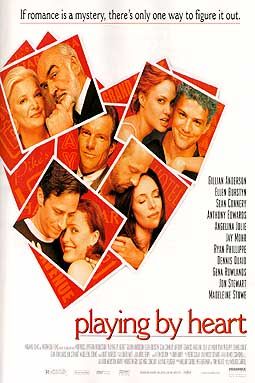
First up, a movie called Playing by the Heart. Never heard of? I'm not surprised, because it didn't seem to win much critical or box office love when it came out back in 1998. What is surprising is how so many talented actors were convinced to take part in this unexceptional film. The movie opens with a number of unconnected couples in various stages of relationships: 
- Hannah (Gena Rowlands) and Paul (Sean Connery) are an older couple facing the end of their relationship now that Paul's been diagnosed with a life-threatening tumor. One shocking revelation still remains though: An old affair that Paul had is discovered by Hannah. "Fun" note: watching how Paul tries to explain away this affair is pathetic. Second "fun" note: Paul's terminal illness no longer seems to be an issue at the tacked-on "happy" ending.
- Joan (Angelia Jolie) just got out of a terrible and ridiculous relationship but after breaking up with her boyfriend via a payphone in a club, she immediately turns upon the stranger (Ryan Phillippe) standing next to the phone and tries to pick him up. This happens repeatedly, night after night, despite his unwillingness to be in a relationship. "Fun" note: Ryan Phillippe's angsty portrayal is just him looking sullen all the time. 
- Meredith (Gillian Anderson) is a workaholic divorcee whose "meet cute" with an architect (Jon Stewart) involves a wall-sized bookcase falling over on her tiny self. "Fun" note: Jon Stewart's character is basically an asshole masquerading as a "nice guy." Yet I'm 99% sure the audience is supposed to think he really is a nice guy. Nope.
- Gracie (Madeleine Stowe) is having an affair because the "mystique" of it is so much better than her "boring" husband. "Fun" note: Shut up, Gracie. Second "fun" note: Even she seems to be have a more or less optimistic ending, despite all odds.
- Hugh (Dennis Quaid) keeps trying to tell a different sob story to whatever woman will listen to in bars across town. "Fun" note: Hugh could probably save himself a lot of grief by being more honest.
- And last but not least is the only non-romantic couple in the cast: Mark (Jay Mohr) is dying of AIDS and now has to open up to his mother (Ellen Burstyn) about his homosexuality. "Fun" note: The movie tries so hard to be open-minded and modern, but its handling of this topic feels both so preachy and so dated. 

These disparate characters and storylines eventually come together in an ending that I *think* is supposed to surprise the viewer, although it is easily predictable early enough into the movie. As you can probably gather from my sarcastic comments above, I wasn't a big fan of this movie. Almost everything about it felt contrived and/or saccharine, and the relationships depicted were all so unhealthy, yet we're clearly supposed to be happy at the ending. No thank you. And despite having such a talented cast, the performances were mostly pretty shoddy, although I can't help to think that a lot of that has to do with a corny plot and terrible dialogue. The only real standout is Ellen Burstyn as the grieving mother of a dying son, but even that is just a small part of the movie. There are a few funny moments scattered here and there in the movie, but honestly even those aren't that good.

Final word: Do yourself a favor and save your time by staying away from this title. I didn't believe Jon Stewart when he made fun of his movie career by holding this movie up as an example of wretchedness. No wonder this movie was hard to get a copy of -- it's not worth watching.

Next up was In Her Shoes, starring Cameron Diaz, Toni Collette, and Shirley MacLaine, and based on the book of the same name. Rose (Collette) and Maggie (Diaz) are two sisters who couldn't be more dissimilar -- Rose is practical and plain; Maggie is flighty and primped. When a particularly painful betrayal happens, Rose kicks Maggie out. Forced to find her way on her own, Maggie discovers a grandmother (MacLaine) the girls never knew they had.

So I read the book this movie was based on way back when and loved it. When the movie came out, I wanted to see it but for some reason I just never got around to it. Recently, I read a memoir by Jennifer Weiner (the author of In Her Shoes) and her mentioning the movie in that memoir renewed my interest in watching it. Luckily my library had a copy, so I grabbed it right up. 

It's hard to review this movie 100% fairly. It's been so long since I've read the book now that I can't accurately compare the two -- the only glaringly "wrong" thing to me was that Maggie's time in Princeton (a part which for some reason sticks out to me more than any other part of the book) is completely missing from the movie. I guess it just wouldn't have filmed as well perhaps, but I felt like it was a crucial part to her story. 

Other than that, the movie seemed to jive more or less with the overall message of the book. Somehow though -- the condensed time perhaps -- the movie lacked some of the emotional impact of the book. Although I've loved Toni Collette in many other things before (including but not limited to United States of Tara), her story seemed the most lacking in emotional "realness" -- so often, her character just burst out with something that didn't seem to mesh with anything else, or else other characters referred to changes in her emotional state that just didn't seem to be there. Mostly I chalk that up to the shortened storytelling time more than on Collette's performance, but it was still a bit disappointing. (Also, it was terribly hard to believe that her character was so insecure about being overweight when she looks like she's about a size 4.)

On the other hand, I was pleasantly surprised with Cameron Diaz's performance. It is probably biased of me, but I didn't expect much from the star of There's Something About Mary and The Sweetest Thing (two movies I wish I had never wasted my time on). However, she really embodied the role of Maggie and brought an impressive range to the character. Shirley MacLaine also did a fine job in her role as a grandmother long estranged from her grandchildren and dealing with some heavy emotional baggage of her own.

While both the book and the movie have been cast in the ghetto of "chick lit" and "rom-com," respectively, the story of In Her Shoes is so much more than your standard romantic storyline (girl meets boy, they have a falling out of some sort, girl and boy end up back together when everything is cleared up). Deep and varied issues are addressed, ranging from mental illness and death to forgiveness and acceptance. It is not necessarily a strictly "feel good" movie, although it does end on uplifting notes.

Final word: Hard to say with this one, actually. If at all possible for you to do so, I'd recommend you read the book, which was so thoroughly good. Barring that, then maybe watching the movie is a worthwhile use of your time. It's a decent choice for when you don't want something too fluffy, but you also don't want to be slammed by something unremittingly depressing with no hope whatsoever.


Saturday, July 16, 2016

Who Murdered Laura?

Recently I read The Feminist Press's re-issue of the mystery novel Laura by Vera Caspary. I greatly enjoyed reading the book, including the editor's afterword that discussed Caspary's life and successes. Among those successes was having her novels and screenplays adapted into Hollywood flicks, with Laura being notable on that list. I decided to track down the film version of the story and found that easy to do with it being right on Netflix for instant streaming.

Laura is the story of a young socialite who is murdered in her apartment late one night, just days before her upcoming wedding. In the wake of this event, her friends and acquaintances are shocked while her fiancé starts acting a bit suspicious. Added into the mix is a tough, street-smart detective who is determined to find Laura's murderer and won't be belittled by her society crowd. He soon finds himself obsessed with the dead woman.

The afterword of the novel primed me for the possibility of significant changes between the book and the film by noting that Caspary was appreciative of some of the changes made by Otto Preminger, the film's director, and critical of others -- to the point of getting in a shouting match with Preminger at a restaurant. With that being said though, the changes were actually not hugely dramatic in the end. Those changes include:
  • The viewer gets to see a glimpse of what Laura's life was like with the party scene that was absent in the book but added to the movie. This is undoubtedly a bonus.
  • There is a significant change in the murder weapon from novel to film, which Caspary apparently objected to greatly and lost that battle. The symbolism therefore changes, but in the end, I don't think this was a huge detractor to the story being told.
  • Lydecker is vividly described in the book as an overweight man with a van Dyck beard and a walking cane (which is most likely just an affectation). This person is transformed into a svelte, mustachioed gentleman. Classic Hollywood for you -- everyone has to be pretty, even if they are specifically described as otherwise.
Why?? At least keep the van Dyck beard, if nothing else...

  • Lydecker has a radio program rather than a column. This is quite fitting with the audio-visual medium and is thus a logical change. It also makes for a very haunting scene towards the end when we hear Lydecker's spoken essay on love voiced over a very dramatic moment.
  • Laura's aunt is less of an invalid and more of a fiancé snatcher. She seriously throws herself at Shelby way too much; it's rather disturbing how blithe she is about telling her niece that she's no good for her own fiancé who would be better off with her instead. (Side note: How strange is it to think of Vincent Price as "leading man" material instead of the king of horror??)
Unexpected but ultimately believable --
Vincent Price as old money, handsome "keeper" Shelby
The biggest change, which is the hardest to exactly point how or why it's different, is in the character of Laura herself. She seems like more a damsel in distress or naïve ingénue than the driven and successful career woman of the novel. Again, it's hard to place a finger on exactly what's wrong or different, but there's a je ne sais quoi about Gene Tierney's performance as the titular character that is just off a little. A reviewer for The New York Times back in 1944 says it best:

"Yes, you get the idea that this Laura must have been something truly wonderful. Now, at the risk of being unchivalrous, we venture to say that when the lady herself appears upon the scene via a flashback of events leading up to the tragedy, she is a disappointment. For Gene Tierney simply doesn't measure up to the word-portrait of her character. Pretty, indeed, but hardly the type of girl we had expected to meet. For Miss Tierney plays at being a brilliant and sophisticated advertising executive with the wild-eyed innocence of a college junior." (emphasis mine)

All in all, this is a solid adaptation of the novel that gets the basic story right and has a fantastic noir look to all its scenes, including the ominous black-and-white shadows present in numerous moments. Indeed, all of the lighting works to create beautiful effects. In addition, the moody atmospheric music seals the noir feel, even the romantic titular song written by Johnny Mercer for the movie. But unfortunately the characters are just a *little* wrong, which detracted somewhat from the viewing after readering the book. I'd recommend the novel over the film, unless you're the type who prefers movie watching to book reading. However, it's worth pointing out that, as always, this is just my opinion -- the novel has faded in to relative obscurity while the movie has been put on numerous "best of" lists and important histories of film.

For a Good Time, Call BUtterfield 8

For some reason, within the past month of so the movie BUtterfield 8 came up a couple of times. The first time I came across it (while researching ambiance and facts for a 1960s party I was throwing), it piqued my interest a bit after I heard that Elizabeth Taylor won a Best Actress Oscar for it. The second time it came up (when reading a book that mentioned several infamous cases involving the disappearance, death, and/or murder of young women in the 1940s), I decided I really had to check it out. So I found a copy through my local library and popped it in my DVD player.

Note: This review is going to have spoilers, so beware. But, hey, you've had 50+ years to watch this movie. ;)

BUtterfield 8 starts with Gloria waking up alone in the luxurious apartment suite of Liggett, a man she met the night before. At first, she slowly and seemingly happily wanders about the apartment, admiring the fancy clothes and sundry niceties belonging to Liggett's absent wife. But when she spies a note from him asking if $250 is enough, she goes into a rage and writes "No Sale" across the ornate mirror with lipstick before storming out of the apartment with his wife's mink coat as a revenge. This beginning is veeeery slow and feels like the type that wouldn't fly with modern audiences at all who expect an explosion or a plane crash or a murder in the first scene of any movie or TV show. It's only in retrospect that the viewer actually realizes what is going on, as we are unaware in the long, dialogue-free introduction who Gloria is, where she's waking up, or why she's there. This is not the kind of draw we're used to nowadays.

Gloria then waltzes her way over to the cramped and less refined apartment belonging to her childhood friend and current struggling musician Steve, where she shows off her new coat and whines that the man dared to actually pay her, which confuses Steve -- and frankly, the audience as well at this point -- because he doesn't quite understand what she wants from these meaningless relationships she starts with men. He worries about her future, which she pooh-poohs before getting his girlfriend to come over and lend her a more appropriate outfit to go home to her mother in, as she doesn't want her mother to know who she really is and what she does with her time. The girlfriend is furious at Gloria but complies while she is present, later giving her boyfriend an ultimatum to choose between her and Gloria, to which he sighs that he can't give up on Gloria because he has such a strong bond with her and feels it is his "brotherly" duty to watch out for her. (Although it's difficult to see what exactly he's doing to help Gloria, for it seems that he is only enabling the very behaviors in Gloria that he says he worries about. Also, their "brother-sister" relationship seems to have far more sexual tension than the one between Gloria and Liggett, perhaps not unsurprising given that the actors playing Gloria and Steve - Elizabeth Taylor and Eddie Fisher, respectively - were newlyweds.)

Eventually Liggett and Gloria make up when she gets him to understand that she chooses and drops men as she pleases and she refuses to accept money or any goods from these men, no matter how wealthy they are or how much they offer her. The two then run off together for days on end without telling anyone where they are or when they'll be back -- a particularly cruel move on Gloria's part as her poor mother sits at home worrying if Gloria is alive or dead. (Liggett's wife meanwhile is safely ensconced with her sick mother and unaware of what her husband is doing back in New York anyway.) Gloria comes to believe she is in love, even though the "romance" between the two is hardly shown and it doesn't seem that they share anything beyond a sexual attraction. This is not helped by a rather wooden performance from Laurence Harvey as Liggett, who always seems rather bored by Gloria except in later scenes when he comes alive with anger. Gloria happily returns to New York and starts bearing her soul to everyone -- from discharging herself from psychiatriatic help because she is "cured" now with her newfound love to finally confessing to her mother about her past indiscretions only to let her know that is in the past now that she's found someone permanent.

However, as someone wise said, karma's a bitch. When Liggett's wife returns home and notices her mink is missing, he immediately (and correctly) suspects that Gloria stole it. A huge and public fight ensues and ends with the two parting ways. A distraught Gloria ends up at Steve's apartment again, truly bearing her soul this time when she confesses to him that she was sexually molested by her mother's boyfriend when in her early teens, a scene that transforms her from a hedonistic character to simply a hurt one. Somehow this confession awakens some sort of bizarre sympathy transference in Steve that causes him to propose to his girlfriend, at which point Gloria quietly sneaks back home to her mother. Gloria decides to start life anew and move away from New York to Boston. But early en route, she is tracked down by a now remorseful Liggett who refuses to let her go. She dashes into her car without him and drives speedily away, but Liggett is just not the kind of guy to take no for an answer. He pursues her in his own car until, in her desperation, she unwittingly drives into a construction pit, her car wretchedly tumbling over and over again with fatal results for Gloria.

Talk about an ending. There is clearly no going back and starting again for a "bad girl" in the late 50s/early 60s. But for a cheating husband? Liggett returns home to his wife and the final lines of the movie are given to him expressing hope that they'll work on their marriage. Wow. Truly, despite all the times that Gloria is referred to as a "call girl" or "high-class prostitute" by other reviewers, the Gloria depicted in the movie makes it clear she doesn't take money from men, although she is happy to flirt with or sleep with whomever she likes. Clearly she has a broken past and her current relationships are in shambles (whether it's lying to her mother, provoking the anger of her only friend's girlfriend, or getting involved with already married men), but her life is not nearly so scandalous or salacious as the movie posters would have you believe. Nevertheless, she pays the ultimate price - her very existence - for living the life of a single woman making her own decisions. For a modern audience, this is a very bitter pill to swallow. It's not surprising to learn that, according to Taylor biographer Alexander Walker, Taylor herself was opposed to doing this movie as it cast in her such a negative role, but alas was under contract with the film's studio, MGM, to make this movie whether she wanted to or not.

The film is based on a novel of the same name by John O'Hara. Never having read that title, I'm not sure how this movie lines up with the book, particularly whether or not the portrayal of Gloria is any different. I suspect that like with many movies that came out in this time period, much had to be left unsaid -- for instance, Holly Golightly's call girl status in Breakfast at Tiffany's. However, as I previously mentioned, I can't say that for certain, not having read the book. It's worth noting that the book was based partially on a real-life drama concerning the mysterious death of Starr Faithfull, which occurred nearly 30 years before this movie was released. I wonder if that contributes even more to the feeling that this movie is very dated.

Indeed, this movie's biggest criticism these days is just how very old-fashioned melodramatic it is. Contemporary audiences give it pretty low rates for being dated and too much of a soap opera. I hate to be one more voice piling on, but these critiques seem fair. This movie is worth watching for a steamy and emotional performance by Taylor, but otherwise it falls flat and rankles with modern-day conceptions of women's autonomy rather than scandalizing viewers with the idea that people have sex outside of marriage.

Saturday, April 23, 2016

How Do We Measure Greatness? On Watching The Great Gatsby

It's a story everyone knows. Boy meets girl, girl rejects boy due to lack of money, boy makes lots of money and comes back looking for the girl who has since married. Even if you haven't read or seen The Great Gatsby, this very basic outline of the story is probably is familiar to you in one form or another in some other book or movie. But chances are you have read The Great Gatsby for in the nearly 100 years since Gatsby's original publication, it's become a staple in nearly every high school curriculum and several college courses as well. A popular movie in the 1970s brought the story to a wide audience as well.

But Hollywood is Hollywood and even if everyone already knows a story, that doesn't stop big movie studios from taking another stab at it. So it really shouldn't be a surprise that Warner Brothers would reboot the story for a 2013 film version of it. But on the plus side, this latest version was helmed by director Baz Luhrman, whose name should be a clue that we'd be getting something completely different this time around. When I saw the previews for this version of The Great Gatsby, the visual look and feel of the movie seemed very appealing and right up my alley, so I knew it would only be a matter of time before I saw it.

Of course, then as usual, time got away from me and I didn't see the movie. But when the movie came up as part of my book group's discussion of Z: A Novel of Zelda Fitzgerald this week, I decided it was time to finally check it out. After watching the film, these are my thoughts on it.

This latest incarnation of The Great Gatsby is indeed a visual spectacle, from Gatsby's lavish song-and-dance parties full of glitter and glam to the imposing and divergent domiciles of Gatsby and the Buchanans to the shining gleam coming off of racing cars to the bright colors of Long Island and Manhattan set against the stark gritty, gray reality of the ash heaps in between them both. Indeed, this last part hit a surreal level of hyper-reality with Long Island and Manhattan nearly jumping off the screen with their luminosity while the valley of ashes doesn't have a lick of color beyond the ever-present blue eyes of Dr. T.J. Eckleburg's billboard looming over everything as 'the eyes of God,'  and even these are faded and muted. (Up close we get a tad bit of color in the ash heaps in the form of Myrtle's all-red ensemble, a visual reminder of how she clearly doesn't fit in here .. and of course a reminder that she's 'the other woman' wearing the scarlet letter, so to speak.)

All of the visual beauty in this movie might make it seem like it's a case of style over substance, yet the movie stays largely true to the original work and, using Nick Carraway as the voice-over narrator throughout the film, makes liberal use of direct lines of text from the book. It clearly hits all the most important symbolism of the book, including the aforementioned billboard as well as the green light at the end of Daisy's dock, which almost comes off the screen with the close-up effects. In fact, it almost gets to the point where it feels like Luhrman is hitting the viewer over the head and saying, 'hey, look at the symbolism already, won't you?' In addition, the story isn't given a Hollywood happy ending but retains its original pessimism; any happiness seen in this plot is quickly fleeting.

Still, something felt a little off in this adaptation, even if I can't quite place my finger on what exactly that is. The first major issue I had was in casting Nick in a role that was more Fitzgerald than Carraway -- the framing device placed Nick in a mental institution of some sort writing away his troubles to get a grip on how he felt about that whole summer of Gatsby. I'm never a fan of when movies try to interject more of the author into a character than the author originally did. (I'm looking at you, 1999 adaptation of Mansfield Park, which tried to convert Fanny Price into Jane Austen herself.) Tobey Maguire as Nick seemed all wrong as a casting decision, and his habit of stretching out words and sentences to impossible lengths when narrating very, very quickly got old. I was holding back from shouting 'spit it out already!' at the screen.

The second thing that I found very bizarre was the use of modern-day pop songs alongside the period pieces, set, and costumes. It was one thing in Luhrman's Moulin Rouge, which was a musical and used variations of modern songs as sung by the film's characters to interject some levity to an otherwise very serious and depressing movie as well as to heighten the mood and/or atmosphere of certain scenes. But here, in a film trying to be dramatic, serious, and important while maintaining a decent amount of accuracy to the source material and time period, it just seemed wrong to be hearing Fergie in the background. Perhaps when Jay-Z is a film's producer, it becomes a prerequisite to play his and his wife's songs, regardless of the anachronism it presents; all I know is it seemed all kinds of jarring and took away from the storytelling going on in the film.

Back to the plus sides, with the exception of Maguire, the casting was superb. Everyone fit into their roles like a glove, but I think that Carey Mulligan as Daisy was the stand-out performance. I had never been a fan of the 1974 movie version of The Great Gatsby, and Mia Farrow as Daisy had been a large part of that, so I was very pleased to see Mulligan embodying Daisy in such a fantastic way. I also liked that even though it's hard with older source material like this, there were some attempts at diversity done; in particular, there's a very brief moment in a scene when Nick comments on how everything is changing as they speed past a car full of clearly wealthy African-American people with a Caucasian chauffeur. It's not much, but it's a little step in the right direction of more diversely cast movies and TV shows.

Overall, I did enjoy this movie as an entertaining break from the everyday and a new twist on a classic novel. I'm glad to have seen it at last, but it's not a movie I feel like I'd ever need to re-visit, which for me is the true test of a movie's greatness.

Sunday, February 1, 2015

The Killing's Intensely Focused, Dark Drama

Some time ago, a member of my book club recommended the show The Killing to me, guessing that I would like it given its slower pace and psychological focus after I talked about how much I enjoyed the first season of BBC's The Fall. On her suggestion, I began watching the show and was immediately absorbed in its world.


Rather than the usual procedural TV show wherein a new case is tackled each week, The Killing's first two seasons are focused on a single mystery: the murder of 17-year-old Rosie Larsen. The daughter of a working-class family, Rosie's drowning death doesn't seem like a high-profile case but various leads soon (possibly) connect her murder to terrorism, city politics, and organized crime. As the investigation delves deeper, Rosie's death incites family tension, hate-based racial violence, and political corruption. This one case certainly has more than enough to grip the viewer for week after week with a total of 26 episodes devoted to the Larsen files.

While the case itself is plenty interesting, it's not the only thing holding the viewer's attention: that task falls on our leads. The Larsen case first appears on the desk of Sarah Linden, a veteran homicide detective who is about to retire when some of Rosie's effects show up in an empty field, and the police force must begin looking for a missing girl. Linden is joined by Stephen Holder, her soon-to-be replacement, who has just been promoted from County Narcotics to City Homicide. Holder, a former undercover cop who ended up getting hooked on meth, is willing to play hard and fast a little with the regular police rules and protocols, having no problem with roughing up a suspect or witness some or using rather indelicate language (to put it lightly) during interrogations. Detective Holder also seems to be channeling Breaking Bad's Jesse Pinkman to some degree, slumming about in hoodies and jeans, employing colorful ghettoized speech patterns, and in general belying his intelligence behind the charade of a stereotypical junkie.

Linden herself is another minefield of emotional and psychological depth. She's a single mother who is willing to do anything for her 13-year-old son Jack ... except put his well-being above her relentless pursuit of solving her latest case. In general, Linden seems to be hellbent on getting in the way of her own happiness. When the show opens, it is her last day of work before she heads down to Sonoma, where she and Jack will meet up with her fiance and presumably have a "happily ever after" life in sunny California. Rosie Larsen's murder changes her plans a little bit when her boss asks her to stay on an extra 24 hours to help Holder jump start the case. But soon it is Linden who is repeatedly missing her flights to California and choosing to stay for just a few more hours or days so that she can wrap up the case, despite her fiance's repeated protestations that there will always be another case, so she needs to learn to let go already. There are repeated hints from the fiance and others that a past case slammed Linden hard, and she suffered a huge emotional toll as a result. The unraveling of that mystery is another piece that keeps the viewer entirely absorbed in the show and wondering if Linden will get too involved in this case as well.

While Linden isn't the feminist icon that many see in The Fall's Stella Gibson, I found her to be an exceptional female lead in a crime drama. Linden's presence is so unlike characters in some TV shows where it feels like the female detective there is only to be a looker or simply to fill a quota (even though she does appear to be the only woman in the Seattle police force, though luckily not the only woman of substance on the show). She doesn't fall into traditional depictions of she's a good detective because she uses her female intuition and/or because she's more in tune with the emotions of the victims. Nor do the creators/writers swing to the other extreme and make her such a badass, almost despite her femininity (e.g., Ziva David on CBS's NCIS). Linden's characterization does fall a little bit into the stereotypical trap of she's a career woman so she doesn't have any other life, but to be honest this seems to be largely true of Holder as well. At any rate, Linden is not in any way one-dimensional nor does anything about her seem to be a reflection of her gender, any more than anything about Holder is a reflection of his gender. They come across as complex characters with complicated backstories and motivations trying to do their best in a troubling world.

Holder and Linden are both interesting characters in their own right but adding them together makes for an infinitely more compelling show. The pair in many ways seem like opposites to being with - beyond obvious physicalities (e.g., female v. male, short v. tall), Sarah is quiet and withdrawn while Holder is nonstop with the verbal diarrhea and seems to open up pretty quickly; Linden seems to initially have her life in order while Holder is a little more in flux; and so on. But these somewhat superficial details hide what the two do have in common: painful secrets in their past, abandonment issues, and feelings of inferiority and worthlessness. It's these deeper selves that allow Linden and Holder to find kindred spirits in each other, even if they butt heads often and occasionally lose sight of the trust they have in each other. In many respects, the two have a Scully and Mulder-type relationship that is endearing, with the way they look out for one another and each puts their trust fully in the other when no one else can be trusted. To go back to physicalities for a moment, they even look a little like Scully and Mulder with a short, red-headed female officer paired with a lanky male officer. And, of course, there's enough tension around the main characters to give plenty of fodder for shippers, who just can't have a man and a woman both be in a show without wanting something romantic to come out of it.

Besides the two leads, the show spends a lot of time focusing in on Rosie's family as they deal with the painful reality of losing a daughter/sister/niece. In your typical crime procedural, there's a maybe a minute or two where you get to see the family react to hearing the news of their loss. They cry, they wonder who would want to hurt their wife/child/aunt/brother/father/etc., and they provide one useful clue that the fearless crime fighters use to track down the killer. With The Killing, the Larsens are fully developed characters in their own right, who are layered with complex backstories and emotional epiphanies. While the Larsens aren't perfect, I really enjoyed getting to know all the family members and seeing how each chose to deal with their grief. This could change alternately from person to person (and day to day) from abandoning everything, expressing rage and violence, bargaining, revenge-seeking, questioning, and overcompensating trying to make everything wonderful for Rosie's younger brothers. Seeing the Larsens and how they tried to move forward with their lives from the day the teenaged Rosie disappeared was a huge part of what made The Killing's first two seasons such a success for me.

In addition to the police and the family, The Killing also spends a lot of time with the first good suspect that the police have. Rosie's body is found in the trunk of a car belonging to the mayoral campaign of Seattle City Council's president Darren Richmond. Even though it's quickly ascertained that the car was previously reported stolen, from this point on, we become intimately involved with Richmond and close members of his campaign staff. The politics of the race for Seattle's next mayor become inextricably interwoven into the fabric of the show and become one more reason to be invested in the series. These campaign characters are also given involved back stories and complex motivations, which are constantly causing the viewers to re-evaluate their opinions about them.

Although many were unhappy that the murder of Rosie Lawson was not solved by the end of the first season, I for one thought it was appropriate to extend that mystery and let the writers fully delve the deep of all those characters and the various plotlines that were presented throughout the course of the case. When the mystery was finally solved, I have to admit to being entirely shocked at finding out the identity of Rosie's killer. It was such an emotional rollercoaster all along and the ultimate reveal was like a gut punch on top of that all. A few loose ends are tied up with the remaining characters as we see everyone move forward after this traumatic murder. The show could have ended there on a high note and been a short-lived but fantastic drama.

But unfortunately, it didn't do that. Sometimes quitting while you're ahead is not understood by TV creators/writers/execs. The Killing went on for another two seasons, with each worse than the previous one. Season 3 starts out reasonably enough, with a year having past between Rosie's murder and the current events, giving Linden and Holder enough time to get a handle on their lives. Holder is in a serious relationship and doing well in the homicide department paired with a new partner. Linden has left the force and settled into a quiet job, has a new home, and is in a romantic relationship of her own. This all changes when a series of murders start occurring with links to a past homicide investigated by Linden. Of course, she has to get involved and once again becomes completely absorbed in her work to the point of losing everything she gained in the last year.

Season 3 lost a lot of the charm of the previous two seasons. The Larsens are gone as are all the members of the Richmond campaign. While this makes sense, I had been so invested in these characters and come to enjoy their part of the show so much that it was disappointing to hear nothing of them again. (We do have one brief cameo of Richmond eventually, but it would have been nice to have been given a few more Easter eggs, like a Larsen moving van in the background on the street somewhere at the very least.) This season presented new characters, but I didn't find them as compelling, complex, or interesting. For starters, there's the significant others of Linden and Holder, although Linden's would-be lover is hardly even given the time of day in terms of characterization. Holder's girlfriend is a little more involved in terms of characterization, although it's hard to see the attraction between the two of them without fully exploring her past. On the police home front, we meet Holder's new partner, the seemingly chump-like Carl Reddick who has manages to have quite the nose for investigations once his suspicions are aroused, as well as a new boss in James Skinner, who Linden apparently had an affair with years ago, although it's somewhat hard to buy the supposed chemistry between them.

Meanwhile, the original similar case that Linden had worked on had resulted in a conviction with a death row sentence, which seems a rather unlikely result to a case of spousal murder. The show spends a long time lingering on the wrongly convicted man's time in jail on the death row watch, including spiraling off to learn more about the prison wardens and their personal lives. It was interesting to see how the show could go off on these divergent storylines again and still keep the viewer gripped. However, it once again didn't work as well. While well played by Peter Sarsgaard, the character of Ray Seward, the man accused of brutally murdering his wife, was such an arrogant bastard in jail that you could only rarely sympathize with him. This may have been an effort to keep the viewer guessing as to whether his wife's death was truly part of the serial murders occurring now or not, but the end result was spending a lot of time with a character that just wasn't as compelling as those we had seen in the first two seasons. In addition, some je ne sais quoi about these long prison sequences often felt like they belonged to an entirely different show.

The serial murders are largely of young teenagers living on the streets, so we start to meet a number of homeless youth in this season, including characters with names like Bullet, Lyric, and Twitch. While it would seem like this would be a fertile ground for creating characters even more complex than those we saw in the first two seasons, this turned out not to be the case. Lyric and Twitch were largely one-note characters caught up in their personal teenaged angst dramas and occasionally remembering to be afraid of the serial killer prowling in their area. Bullet was more developed than the others and yet still somehow lacking. For myself, I think it would have been more interesting to learn more about how and why these kids ended up in the streets to begin with than in, say, needlessly having Bullet raped and seeing her react to that only briefly before acting like nothing happened.

By following the lives of these teens, the show took on an even darker underbelly of the city than that seen in the first season, introducing us to abusive/neglectful parents, drug dens, and child pornographers/rapists. While it was certainly disconcerting, there was nothing surprising about this. Youth with no support systems are taken advantage of in horrible ways; we see this play out across the globe in the real world every day. It's doesn't have the unexpected twists that the Rosie Larsen case took and it's just a reminder of how awful the world can be toward those that are considered easy prey. When the murderer was revealed for this mystery, not only was I not surprised, but I had pretty much predicted it early on in the season.

Season 4 picks up with the fallout of Linden shooting the unarmed murderer of the homeless teenagers and Holder deciding to help her cover it up. This was probably the weakest of the storylines as I just couldn't buy it. It seemed to me like they could have explained away the shooting (i.e., claimed that the murderer was in fact armed at the time) and moved on without it becoming a huge thing they needed to hide. The cover-up resulted in the two characters becoming so paranoid that they started mistrusting one another and turning their backs on each other. As the relationship between the two of them was such a vital part of the show previously, this development was incredibly frustrating. At this point, the show was becoming like the proverbial train wreck - horrible to see but somehow you just had to keep looking at it to see how it all plays out.

Even with all this going on, the creators/writers decided to also introduce yet another mystery - that of the murder of a wealthy family in which only the teenaged son survives. This story was so half-baked that it really was not only uninteresting, but it was also entirely bizarre, and yet the conclusion was so obvious that it was hardly worth calling it a mystery. This would not be a bad thing if the characters were interesting, but all of the new characters introduced were so lacking in any depth that they're wasn't anything worth noting about them. Add in that Holder and Linden were a mess, and there really wasn't anything redeemable about this season.

And, now that the show moved off of cable and on to a streaming format solely, the creators/writers decided to let lose with the language. As I've said before, I'm not a fan of when shows decide that the best way to push the envelope is to throw in a bunch of choice four-letter words. I'm not a prude, I'm not a saint, and I certainly don't have any beef with the occasional foul language. The Killing presents a dark world that is constantly full of abandonment and brutality, so it's reasonable that Linden, Holder, and others would spew out invectives some of the time. But when your finely tuned writing turns into scenes in which literally the two main characters just hurl "f--- you"s at each other, it's hard to argue that the quality of the show has improved by the lack of inhibition.

After everything shakes out with the season four cases, we get a flash forward to five years in the future, and the show ends with a tacked-on happy ending, which is so out of touch with the rest of the series that it's almost comical. Sure, it's nice to have the characters you've come to care about have a ending has some uplifting potential. But that would have been appropriate at the end of season 2 when there was more hope to spread around amongst the various characters. But by this time, so much more has gone on and happened between the lead characters that it doesn't seem in the least bit realistic, a damning charge for a show that was built on being tough, gritty, and no holds barred. It's almost like an element of magical realism being added in at the last minute.

In conclusion, watch the first two seasons of The Killing if you're interested in a tightly wound mystery packed into divergent storylines, replete with complicated, compelling, and deeply human characters. Then do yourself a favor and leave well enough alone but not wasting your time with the latter two seasons. You'll thank me later.

A Look at the Darkest Side of Humanity with BBC's The Fall

The Fall is a powerful, intense, challenging, and disturbing show that is most definitely worth the watch. In a world where there seems to be a police procedural and/or crime drama on every night on every station, it may seem redundant to have yet another show about a serial killer and the police search to capture him. And while boiled down this is exactly what The Fall is about, the show is far more artistic and serious than the many more sensationalist cookie cutter criminal-based programs out there already.


To step back a moment, The Fall is a BBC-produced drama taking place in recent years in Belfast, Northern Ireland. When the daughter of a prominent (and wealthy) businessman is brutally murdered, the local police launch a ramped-up investigation to catch her killer. To head up this task force, they bring in Stella Gibson, a detective inspector from London with a stellar (couldn't resist the pun!) track record for understanding and thus bringing in criminals. Gibson almost immediately sees a link between this murder and those of other women in Belfast who share similar characteristics (although, alas, the rest don't have the moneyed fame so their deaths weren't originally given the same high status treatment). Behavioral profiling of the murderer, painstakingly intensive forensic studies, and round-the-clock monitoring of tip lines and potential suspects' movements consume the task force's time as they pursue the serial killings.

Meanwhile, the viewers are given the position of knowing far more than the police as we soon enter into the world of the killer himself. A grief counselor with a wife and two young children, Paul Spector is mundane enough for most people to not notice him or suspect him of being guilty of anything more egregious than perhaps a speeding ticket. But underneath this calm demeanor lies a troubled psyche that finds fulfillment in others' misery and feels powerful only by destroying lives. Besides his unrepentant need to stalk and murder pretty women, Spector has a host of various other problems to deal with in his life, ranging from fairly typical parenting issues to a teenaged babysitter who is infatuated with him to a client case in which an extremely violent man is abusing his wife.

This last issue brings up an important part about what makes The Fall such a fascinating show. The cat-and-mouse between the police and the killer makes for plot-driven suspense and, as always for me, well-developed characters finish the job of sucking the viewer into the drama. But The Fall goes a step further by looking into a major cultural issue of times - and one that is sadly, often rather divisive - that of gender roles and gender equality/inequality. The issue of violence against women in particular is a large part of The Fall, and the show explores it in a number of ways, while also examining women's implicit and explicit roles in combating both crime and cultural stereotypes about their gender.

The Fall starts with presenting a female main character that is a wonderful example of a feminist hero. Stella Gibson is certainly not perfect and she's not necessarily "kick ass" in a superhero sort of way (although you wouldn't want to get on her wrong side either), but she's tough, smart, and confident. Her personality at first appears a bit cold because she isn't passionate in terms of raising up a fuss or otherwise getting bowled over by her emotions. But it's soon obvious that Gibson does indeed feel strongly at appropriate moments and while she is guided mainly by her intellect and sense of morality, her emotions also play a role in why she does what she does. She feels deep empathy for the victims and their families and is remorseful when she fears she's made a mistake that comprises a woman's safety.

Just like she is not devoid of emotion, she is also not a nun despite not being in a traditional relationship. Gibson has no problem clearly and plainly putting out her intentions when she finds someone of sexual interest - and when she does not. No part of Gibson's personality is tied up in any particular man or even in proving herself in a workplace historically populated by men. The show thankfully does not fall into the trap of turning Gibson into a "bitch" because she is a woman in a supervisory capacity or of making strong assertions about how Gibson has chosen being a career woman rather than a wife or mother, as thought it always needs to be an either/or choice. Clearly, the creators/writers here were not interested in presenting a stereotypical "women's intuition" type of female police detective who will inevitably end up in a long-term romantic relationship with her male partner. Gibson is simply living her life - sometimes making mistakes, sometimes shining (again, can't resist the puns based on her first name!) with insights not picked up by anyone else.

While The Fall certainly isn't alone in presenting a female lead - or even a strong female lead at that, the show doesn't just stop there. Gibson isn't a lone voice in the wilderness; the Belfast police and their attendant associates have a fairly equal amount of male and female employees. Even though she has a previous relationship with Assistant Chief Constable Jim Burns, on reaching Belfast, Gibson quickly aligns herself with two other women in particular - Dani Ferrington, a beat cop who becomes the right-hand woman to Gibson, and Professor Reed Smith, a pathologist who reports various insights to Gibson. In the world outside of the police force, we also get to know an array of female characters of various importance (and ensuing screen time) from Spector's wife to his victims to victims' family members and so on. The Fall presents women of all kinds: from the fiercely tough and professional detective constable Gail McNally to the busy and rather clueless (and thus, in a way, very sympathetic) Sally-Ann Spector to the clearly emotionally needy/disturbed young babysitter for the Spectors. With the exception of the babysitter Katie, who is a little one-note in terms of her motivations, all of the women - and indeed, all of the characters - are believable, well-rounded characters who have their individuals highs and lows.

But The Fall does more than simply present strong and believable female characters (not to say that isn't an accomplishment enough in a world where plenty of other shows and films struggle to have even a fair number of women in prominent roles). It also delves deep into a variety of issues surrounding women and how our culture treats women. It touches on how women are objectified, thus dehumanizing them to predators, specifically stating this through Gibson's words, but also showing it in other ways (i.e., using the visual medium of TV well to make the point). At one point when Spector tapes the torture of a victim, he ends his homemade video by asking why it's being watched. It's an uncomfortable moment of pointing out the viewer's own voyeurism and implicit role in this cultural problem of allowing women's rapes and murders to become lazy plot points to propel forward male heroes.

Nevertheless, the show is not without its detractors who criticize it for being misogynistic because of the female murder victims and for seeing from the killer's point of view. While I see their point about how displaying the corpses of dead women is troubling (it's something I felt with other crime shows), I don't find that to be the case here. Even though we see from the killer's eyes frequently, at no point are his actions condoned or held up as something to model/mimic. Meanwhile, there is so much empathy put out for the victims, the families, and even the community at large, that I don't feel like the dead women are simply props held up for their shocking entertainment value.

(Speaking of sensationalist shock value entertainment, I could not help thinking about the upcoming Fifty Shades of Grey movie, which stars Jamie Dornan as the BDSM-loving protagonist Christian Grey. I'm not sure how anyone could watch Jamie Dornan as Paul Spector subjecting a teenaged girl to bondage and other "grooming" acts, stalking women in his neighborhood, holding a woman hostage, violently murdering women, etc. and still come away thinking that a book series/movie about a dominant wealthy businessman introducing a young, naïve college student to sadomasochism is romantic.)

The Fall also has gained some critics because of its pacing; the show is certainly slow moving and lingers where other shows rush full speed ahead. Unlike the myriad of procedural shows on the air that fill up 20-plus episodes a year with largely one-off mysteries with sometimes poorly explained motivations, The Fall has chosen to focus the first two seasons (a total of 11 episodes) to this one case. Viewers come to intimately know all the characters and see the continuing effects of the crime on the police members tracking the killer, the killer's family, the surviving victims, and the victims' families. While there are still some motivations that could be more fully explored (e.g., the babysitter), it's a good change of pace to be reminded of the humanity (and lack of it in the killer's case) behind crimes rather than just the next thrilling plot move. For me (and many other viewers), the slower pace was not an impairment to appreciating in the show; in fact, it in many ways made it a more suspenseful watch. As a viewer, you care much more about the fate of a character once you've become invested in that person's life.

The breadcrumbs thrown out about whether nature or nurture created the psychopathic killer is another interesting component to the show. As the story develops and we learn more about Spector's troubled past, there are plenty of opportunities to reflect on how and why this man became a narcissistic sociopath turned violent offender, even if the script doesn't always explicitly state his motivations. And while there are certainly many references to Spector and his deeds as monstrous, the show through Gibson often reminds viewers how life exists on a continuum and everyone has elements of good and bad in them. In one scene I found particularly poignant in this regard, Gibson takes Burns to task for trying to weasel his way into her bed after she repeatedly says no. While she does make certain to maintain a distinction between him and the killer, she still manages to remind Burns (and the audience) that the treatment of women as mere sex objects is an easy trap to fall into that quickly becomes a slippery slope.

Like any TV show or other artistic expression, The Fall is of course not perfect. There is a secondary plot about police corruption that almost entirely fades in the background of the serial killing storyline. At times, there are scenes that feel unnecessary or not fully explained. On occasion, the police seem woefully behind the serial killer despite the tremendous amount of money and effort being spent on this case, including some scenes that just seemed ridiculous in how slow the police were responding, which hurt some of the credibility of the show. But overall, I found the first two seasons of the show to be fully engaging and thought-provoking in terms of plot and themes. They were also all extremely well acted, with an array of interesting, complex characters being presented and explored. The end of the season two finale was a bit bizarre in my opinion (and I am not alone), but I'm hoping that the third season slated for release in fall 2015 will help to smooth over those ragged edges and provide a satisfying conclusion to this thoroughly captivating show.

Monday, May 26, 2014

Don't Trust Your Safety in the Hands of The Lifeguard

Memorial Day weekend is the traditional unofficial start of summer, replete with barbeques and other outdoor soirees. Having been rushing from place to place all weekend, when I woke up early this morning, I just wanted to relax and sit back to watch something unexpected. I chose The Lifeguard, a 2013 film starring Kristen Bell. When this movie initially came out, I was excited to see Bell in a feature film that wasn't a B-level comedy and thus something very different for her that might show off the fabulous dramatic acting chops all we Veronica Mars fans know she has in her. But when I heard more about the film's premise, I wasn't sure if I'd want to watch if after all. In the end, when the movie showed up on Netflix, I decided to add it to my queue and today it seemed like the best candidate for my mood.

The Lifeguard is a slow moving but engrossing film about Leigh London, an almost 30-year-old ("29 and 10 months" as her mother points out early on) Associated Press journalist living in New York City and having an affair with her supervisor. When the latter gets engaged to someone else and seems to be dismissing what Leigh considers an important story by relegating it to a lesser section, she has a bit of crisis and decides to take a leave of absence. Leigh grabs up a duffle bag and her cat Moose before returning to her parents' house in Connecticut, where she picks up right where she left off. She gets a job as a summer lifeguard at the community pool and starts socializing with her former high school chums Mel and Todd. The trio end up spending a lot of their free time hanging out with a trio of current high school students, wannabe drop-outs who join the older crew in drinking and smoking weed out in the woods. And that's when things start to heat up between Leigh and 16-year-old "Little Jason," in a situation that every viewer knows will never end well.

It's hard to know where to even begin with discussing The Lifeguard. As I mentioned above, it definitely held my attention despite being a movie without any big special effects or honestly even a huge amount of backstory (the short time frame of an hour and an half meant that a lot of the past lives of these characters was mentioned in passing only or not fully explained). There is, however, a decent amount of time invested in exploring these characters right now and trying to elucidate their complicated feelings. The Lifeguard is one of those rare pieces of art in which you can enjoy the product without actually liking a single character. For instance, Leigh is the film's main focus and she's hardly someone you can root for, especially as her actions take her down more and more twisted paths. As the movie unfolds, you learn more about Leigh's past as the perpetual "good girl" - the school valedictorian who made all the right choices and never once before questioned where she was going. You can feel a little bit of sympathy for her as she starts to unravel and wonders what's next for her life; for instance, you can really see her conflicted feelings as she tries to council Jason about staying in high school and getting a college degree as she herself is back in her high school job making barely above minimum wage after years of pushing herself to do her best in school. At the same time, however, the rushed introduction to the movie leaves you wondering what exactly caused Leigh to have this un-epiphany that left her feeling so unfocused. The story that she wrote was certainly something to bother and unnerve her, but it was hardly something to make her abandon everything on seemingly a whim. As for her relationship with her supervisor, it should hardly have come to a shock to anyone that a person who is cheating is going to eventually disappoint. Meanwhile, Leigh seemingly doesn't use any of her time in Connecticut to reflect or mature. Instead, she reverts to becoming a rebellious teen, spending her time being completely inconsiderate to her parents, working in a dead-end job, drinking and smoking in the woods, and literally hanging out with teenagers. As someone roughly the same age as Leigh and her friends, I honestly can't see the appeal of many of their actions even if I can understand some of their philosophical concerns. Things finally hit bottom in terms of the viewer's ability to empathize with Leigh when she becomes involved statutory rape. She may be lost and confused, but that doesn't make it even remotely right for her to take up a sexual relationship with a 16-year-old boy. The fact that nearly ever other character is unfazed by this turn of events may tamp down the outrage factor a bit, but no viewer is giving Leigh the person of the year award by the end of the movie.

The other characters are similarly unlikeable, if not quite at the same level. Leigh's father is the only exception to the rule in the movie; he seems like a genuinely jovial guy that anyone would like to spend time with for a friendly brunch or something. However, he's so little seen in the movie that his presence is negligible. Leigh's mother is so wrapped up in her own affairs that she can provide absolutely no anchor or guidance for Leigh as she flounders about pathetically. Again, there's a little bit of sympathy as her mother tries to explain how for years she felt like her existence was tied up with Leigh's and now is the time in her life to do something for herself, but she is so cold and harsh throughout that it's not hard to see how Leigh could turn out the way she did. Mel is a hot mess - she was apparently the one who was the antithesis of the "good girl" in high school but now she's turned her life around and seems to have all the markers of success - she's married and holds a good, steady job as the high school vice principal. But with Leigh back in her life and her own fears about not getting pregnant - or about getting pregnant and not being a good mother - rearing their ugly head, Mel backslides and becomes involved in these stupid delinquent behaviors. Her relationship with her husband seems anything but happy for the majority of the movie, and Mel just seems to be floundering as well. Todd is unhappy with his small-town life but doesn't want to take the initiative to change anything about his life, hiding behind thin excuses and choosing to forget his troubles by drowning them in alcohol and drugs. Jason and his friends are typical conflicted teenagers but are arguably more on the "bad kid" side than most; they all appear to have a lot of baggage in their lives but most of that is explored only peripherally. For example, "Big Jason," the father of the teen, refers obliquely to some rough things that happened in his son's life but doesn't expand on this at all. Big Jason, although playing but a small part in the movie, is also a character you can't get behind. He seems to pay little to no attention to his son, despite professing that the child has had major challenges to get through, and doesn't have the slightest concern about a woman nearly twice Jason's age striking up a relationship with him.

One thing I could definitely say was of interest about the movie is that it certainly makes you think. You could argue after watching this movie that the film isn't just about a generation (specifically, my generation) of unfocused and confused people - those who are adults in name and age but haven't quite figured out what that really means yet. It's also about exposing this myth that small towns are full of wholesome goodness while big cities are where the filth lives. Leigh finds something horrific in her story at the beginning of the movie (and let's not even go in the symbolism of that story, as the movie does expound on this pretty well on its own) and leaves the city, but she doesn't find solace in her hometown. There is tragedy awaiting her in the small town, and no one there seems to be completely free of baggage or fears of some sort. Everyone seems to be in some sort of crisis, whether it's the agony of being a teenager and hating everything in your life, the confusion of being a young adult who is trying to figure out where life goes next, or the disappointment of being a middle-aged person having to re-invent yourself after a big chunk of your life has changed. It's like someone was illustrating Erik Erikson's stages of psychosocial development by showing only the negative crises.

The movie can also be seen as a commentary of gender roles and inequality in so many different aspects. While a small part of the movie, the crisis that Leigh's mother seems to be having after her daughter grows up and arguably doesn't need her any more is contrasted by her father being perfectly okay with her coming or going. Motherhood is an all-encompassing identity in a way that fatherhood isn't. This is reflected in the younger generation with Mel reacting extremely - and poorly - to the theoretical idea of becoming a parent while her husband seems completely unfazed by it. There's also the relationship between Leigh and Little Jason to consider. Early on, it's hinted that Todd is gay and Mel suggests that he may be interested in one of the boys. This seems to be condoned far more than her initial suspicions of Leigh and Little Jason's attraction to one another. Combine this with Big Jason's reaction upon hearing the news, and it's really not a pretty picture. It reflects real-life courts of opinion where older men having sex with teen-aged girls are consider perverts at best and rapists at worst while older women having sex with teen-aged boys is sadly brushed off by many as a sort of great achievement for the boys. It's a scary example of cognitive dissonance in which an age differential between sexual partners is both damaging and enviable, depending on the gender reversal. It was interesting to learn that this movie was written and directed by a woman; as I've noted before and many more articulate people than I have stated, when women get a voice in the arena everyone benefits from hearing their stories. In Hollywood, this means we get more than the standard fare of "chick flicks" that are simply romantic fantasies just as much about the leading man as the woman nominally at the heart of it. We get thought-provoking stories about all kinds of things beyond just romantic relationships and true female leads - sometimes strong and independent ones who we'd love to emulate, sometimes messy and confused ones who we vow never to become like.

Some final bits and pieces about the movie include a compelling soundtrack that meshed nicely with the cinematography and the overt themes. The cinematography was overall done very well, although there were a few scenes here and there with shaky camera work. I know this is a darling technique of filmmaker to symbolize any number of things including the characters' confused and hence shaken states of mind, but it's a pet peeve that I find distracting. When it's used too much, I feel like reprimanding the cameraperson with a stern "Just focus already!" With the pool and water being used as background - and symbols - a great deal, there's also a few times where we get the water on the camera lens issue also; this is another pet peeve of mine as I feel it serves to remind you of the fourth wall and thus takes you out of the experience of the movie's actions and into the experience of being a viewer. As I mentioned earlier, the beginning with Leigh's life in New York City was a little rushed with short clips of different situations all being sliced together in rapid succession. Perhaps the argument could be made that this was to give the viewer a sense of Leigh's confusion during this time period but I think it ended up providing a very incomplete view of what was going on at this point.

With all that mind, I'd recommend The Lifeguard for people who enjoy movies that make them think and provide slice-of-life portrayals of characters who resemble real people more than stock stereotypes. If you want action and characters you can love, don't even think about checking out this movie. But if you don't mind a messy set of characters struggling with life choices, you might just get pulled in to the pool alongside The Lifeguard.