Monday, September 17, 2012
Grounds for Sculpture: The Garden State’s Garden of Art
Sunday, January 15, 2012
From Russia with Love: Swan Lake
While many have speculated whether the success of the movie Black Swan would contribute to more spectators of the Swan Lake ballet, I have neither seen nor particularly wish to see Black Swan. I have just wanted to see Swan Lake for some time now, so I was intrigued when I saw The State Theatre would be live broadcasting a production of the Swan Lake from The Bolshoi Ballet in Moscow, Russia. A friend and I decided to check out this performance, with this far more friendly commuting option!
Very loosely, here’s the basic plot: Swan Lake opens with a birthday celebration for Prince Siegfried. Later that evening, the prince stumbles onto an enchanted lake. It appears to be populated with swans, but they are really young woman who are under a spell and only become their true selves at night. The prince spies Odette (the “white swan”), the most beautiful of these women, and immediately falls in love with her. The next day the queen presents various princesses from other countries to the prince, hoping he’ll pick a bride amongst them, but Siegfried is loyal to Odette. However, that’s when the evil Rothbart appears with his daughter Odile (the “black swan”) who looks remarkably like Odette and tricks the prince into believing that she is indeed Odette. From here, different productions diverge on the storyline so I won’t provide any more details or give away any spoilers.
The story of Swan Lake, like most fairy tales, is a bit silly. (If you don’t know this about me already, I’ll note for the record that I am not much of a fan of fairy tales). But the story is somewhat secondary here - the plot is just some weak glue to hold together a bunch of otherwise unrelated dance sequences. While many critics of musicals charge that the songs are unnecessary, they generally do help to further the plot, even if they make it more long drawn out and flowery. Here, however, many of the dance sequences do nothing to further the story along. Sure, it makes sense for Odette and Siegfried to have a clingy romantic dance together to indicate that they are attracted to one another. But everyone else in the story has their moment of dance also, even when they don’t seem to say anything more about the story. The black swans, the white swans, the courtiers, the prospective brides and their attendants, and so on, all have long dances to execute that don’t push the action forward. This is not a criticism of the ballet; this is just a statement. If you like strong plots, you will probably not like this ballet (and perhaps not any others). If you like to see beautiful dancers dancing beautiful, you will more than likely enjoy seeing this ballet performed.
Before I go into specifics about this particular production we saw, I should note that I’m treading into unknown waters here. Unlike art or theater, where I feel I have at least some background to bring to any critique or appreciation of a particular work, I have hardly any knowledge about ballet. I’ve only seen two other full ballet productions – The Nutcracker at a local dance studio and The Swineherd at the Tivoli Gardens in Copenhagen. I have very little awareness of what kind of training and work goes into a great ballet performance, let alone specific knowledge of technique. So, short of a dancer falling flat on his or her face, I’d be completely unaware of a performer’s flub. Also, because I am unaware of what is a more difficult move comparatively, I am awed by flashy, quick moves – which may or may not be the most difficult ones if you were to ask the ballet dancers.
That brings me to my one and only criticism of this production of Swan Lake – I was not overly impressed by the performance of the prince. For instance, he often appeared to be playing second fiddle to Odette/Odile. No doubt there’s tons of physical effort and talent on both parties’ parts whenever a lift is involved, but it looks far more difficult and interesting to the viewer to see a ballerina balancing on one leg mid-air than it does to see the man just holding her there. Again, this may be an issue with me not knowing what are the more complex steps, but I found the court jester to be a far more entertaining dancer to watch. His leaps, jumps, and quick successive pirouettes looked far more difficult and, as I said, more interesting to the spectator than anything from the prince. Indeed, I found the jester to be more impressive than either of the nominal male leads, although at least with Rothbart I got the impression that this was a very talented performer but the role did not call for an excess of stunning moves. That being said, overall I was mesmerized by the dancers and their skill. The visual feast is further spread with lavish scenery and costumes. I particularly liked the costumes for the white swans – basically the standard leotard and tutu in white but with a soft, fluffiness to them that really evoked the image of a swan’s down. A modest feathered headdress completed the look. And, the music, originally composed by Tchaikovsky, is absolutely stunning and fits perfectly with each and every dance step.
Watching the ballet on the big screen was an interesting experience and, as I mentioned somewhat flippantly earlier, is a good way to see a ballet you would not otherwise be able to see due to geographic distance. Another plus to see the ballet this way was that you could very clearly see the performers up close. Even if you were stuck in a back row, you’d still be able to see the expressions on the dancers’ faces. There were also a few behind the scenes moments, such as when we could see the orchestra in the pit warming up for an act or when the dancer performing as Rothbart was interviewed during the intermission. The only down side with this way of seeing the ballet was that you saw only what the videographer allowed you to see. There was a good mix of shots of the whole troupe versus panning into a lead character, but it’s different than being able to take in the stage in its entirety and choosing where you want to focus at each moment.
Before the ballet started, The State Theatre also provided a brief “Pre-Performance Insight” with Douglas Martin, who is a member of the American Repertory Ballet and has danced Siegfried to his wife’s Odette/Odile in a previous production of Swan Lake. Unfortunately, the pre-performance part made it a bit tricky as people kept piling into the theater looking for their seats prior to the ballet beginning and making quite a bit of noise in the process. Those already trying to listen to Mr. Martin and shushing the newcomers didn’t actually do much to help the auditory problem. However, all and all, this was an interesting talk, which really did provide some insights. Martin discussed the history of Swan Lake, illustrated some frequently used pantomimes that we might see in the production, and explained some of the very difficult training that went into his wife’s performance of Odette/Odile. This made me really appreciate even more the performance I saw later of this dual role. As he pointed out, the ballerina has to play very different personas in this one ballet – sweet, innocent Odette has soft, delicate movements that are sometimes skitterish like a nervous bird while cunning, duplicitous Odile has sharper, quicker movements that are determined. But Odile is also attempting to mimic Odette’s movements, so you see that as well. It is certainly quite an undertaking, and, as I mentioned, I appreciated the ballerina’s every movement all the more after Martin described how painstakingly his wife practiced and perfected every detail, down to every hand flutter. No doubt Mariya Aleksandrova, who played Odette/Odile in this production, did the same, for it showed in her performance.
While Swan Lake was only available to see at The State Theatre today, their broadcasts continue with three other ballets and three operas over the next few months, so there’s a good chance you might find something you’ll like. Already, my friend and I have decided to go back to see La Boheme there, so stay tuned here for more updates…
Friday, December 30, 2011
Princeton: Where London, New Jersey, & Worlds of Play Meet
It’s been a while since my niece and I last visited a museum or other cultural institution, so when I was watching her for the day yesterday, I decided take us down to Princeton for a semi-artistic visit. When we first got there, my niece had just woken up from a nap so I decided that while she was still perking up, it was a good time to check out a couple of exhibits on campus. (Now that she’s older and more mobile – and more vocal – I wasn’t sure if she would be as good as long as she had been when we visited the Zimmerli museum over the summer.)
We headed over to Princeton University’s Firestone Library and took in our first exhibit, “Sin & the City: William Hogarth’s London.” This exhibit contained some 70 engravings from the 18th century British artist William Hogarth, along with a sampling of some contemporaries’ works. Last month, I read Charles Dickens and the Street Children of London and found out about how Hogarth was also a philanthropist who, like Dickens, used his artistic work not only to donate proceeds to the needy but also as an outlet to lambast the poor societal conditions of the time. In particular, the book talked about Hogarth’s famous work Gin Lane and how it depicted the overabundance of alcohol, even when little else was available – including clean drinking water. So walking in to the exhibit and seeing Hogarth’s work in general, and Gin Lane in particular, was certainly fitting to this recent acquisition of knowledge. Likewise, the accompanying literature from the exhibit describes Hogarth as “creat[ing] a new, moralizing role for the artist, forcing viewers not only to look but then to act on what they had seen.” The brief biography on the exhibit’s website also notes, “Hogarth’s work took on a distinctly propagandist tone, directed at the urbanization of London and the city’s problems with crime, prostitution, gambling, and alcoholism. …Hogarth strived to create works of great aesthetic beauty but also ones that would help to make London a better city for future generations.” Talk about reinforcing your learning.
I mostly brushed through looking at the prints pretty quickly without reading the majority of the accompanying information, but it appeared that the staff also included a fair amount of explanations with each piece as well as an introduction to Hogarth and 18th century London. Overall, I found this exhibit very interesting and would have spent more time examining the individual works had I been on my own or with an adult companion. The exhibit goes on until the end of January, and I would recommend it to anyone with an interest in prints, London, history, and/or satirical works. My niece’s reaction to this exhibit was mostly playing with my gloves, watching with interest two women talking to each other about the works, and looking up at the light fixtures. Hey, at least she was happy.
The second exhibit, also at the Firestone Library, was “George Segal: Sculptor as Photographer.” Best known as a sculptor, this small exhibit featured some of his lesser known works of photography, as is all implied by the exhibit’s title. The subjects of these works, at least those on display here, were often family members or friends as well as local scenery (such as the boardwalk at Asbury Park or the Keansburg amusement park). While seeing the nearby locales as they looked in the not-so-long-ago past was interesting and I’ve always loved the picture of Segal and his friend Donald Lokuta photographing each other (scroll down to the second picture), I was not overly thrilled by this exhibit. Segal’s sculpture works are far more interesting and compelling to me, most especially the ones I’ve been able to view up close both at the Zimmerli museum and at Grounds for Sculpture. I would not have recommended making the trip for this exhibit alone, although that point is now moot as the exhibit closed today. My niece’s reaction to this exhibit was … playing with my gloves. So this one was not a real winner all around.
We then moved on the lovely Cotsen Children’s Library located within the Firestone Library. Here my niece got to explore and play in the Bookscape gallery, which is a delightful space for kids to read, hang out, and use their imaginations. We both liked the tree house with its upper and lower nooks for reading and looking out on the world. Later in the day, we also visited the vast public library of Princeton, which has an entire floor just for children. The countless books and toys as well as the kid-sized furniture and giant fish tank with steps leading up to it make this a great place for young children to just hang out for a long time while they read, play, and make friends – indeed, my nephew and I have also spent a good chunk of the day here before. All in all we had a good day with some slightly out-of-the-ordinary things for the both of us.
Sunday, October 2, 2011
Somewhat Sunny in Philadelphia
We began the day by taking a trip over to the Philadelphia Museum of Art, a building of such grand architecture as to make its exterior an art exhibit in itself. The museum's current big hit exhibit is titled "Rembrandt and the Face of Jesus." As you can imagine from the title, this exhibit features the many, many portraits of Jesus painted by the Dutch master Rembrandt van Rijn. This exhibit was popular with our little group and based on the huge lines, many others who were at the museum. But I have to confess, it held no appeal for me. For starters, while I can appreciate Rembrandt's work considering the time in which it came, I am but very rarely a fan of dark and shadowy works in any medium. Furthermore, after years of visiting art museums, I've seen more than my fair share of paintings based on biblical stories, which let's admit it, is a limited palate when you consider the hundreds of artists over hundreds of years painting these scenes. To further limit that to only portraits of Jesus himself, you can imagine that this exhibit was rife with redundancy. I'm sure for major fans of Rembrandt, portraits, or religious iconography, this was a great exhibit. But for me, it was enough to breeze by quickly and then say, what next?
So while the rest of our group meandered and spent a while in this exhibit, I moved on to what was a far more interesting exhibit for my tastes, "Here and Now: Prints, Drawings and Photographs by Ten Philadelphia Artists." This seemed like a particularly fitting exhibit for me to see while visiting Philadelphia as I'd be unlikely to see it anywhere else. As you can probably gather from the name, there was no particular theme tying together the works of this exhibit, but rather the locality of the artists. But while there was no overarching theme in the works, I would say that a combining element, beyond just the city where the artists work, was a feeling of weightiness to the art. The artists all tackled serious issues, such as the feelings of being an outsider due to a multiracial background. That isn't too say that these subjects were all treated with a doom-and-gloom attitude. Some of the works did have an ironic or downright funny effect despite - or perhaps because of - their serious nature. While I enjoyed nearly all the works on display, two artists and their art particularly stood out. Daniel Heyman was on hand for interviews with Abu Ghraib detainees and displayed their portraits and their stories together. These were heart-breaking to read, yet very necessary works to have to remind us of atrocities around the world. Serena Perrone's woodcuts were haunting, even surreal at times. In particular, I liked her works "Phantom Vessels and the Bastion of Memory V,""A Day in November: Impending Loss," and "In the Realm of Reverie." There is some quality about these works that I can't quite put a finger on that somehow allows them to be both childlike and innocent yet have an undercurrent of dread lurking just beneath the surface. Of course, I love woodcuts (so much so that one of my favorite books is Lynd Ward's Gods' Man, a wordless novel entirely made up of woodcuts) so you'd be hard-pressed to find an exhibit featuring woodcuts that I wouldn't like.
I then wandered up to the section of the museum dedicated to European art from 1500 to 1850. What I really enjoyed here was the broad view of the term art. Yes, there were paintings and other traditional art works, but there were also porcelains, furniture, and other everyday items. It was fun to stumble upon such objects as a baby's cradle and be able to compare something hundreds of years old to what we use today. There was even a fully furnished 17th century Dutch room, which is pretty cool to view. I barely scratched the surface of this permanent exhibit when the rest of our group was finished with the Rembrandt exhibit and we all decided to trek over to the museum's auxiliary Perelman Building.
Across the street at the Perelman Building, we took in another current exhibit, "Zaha Hadid: Form in Motion." The exhibit featured the sleek designs for furniture, a car, and even shoes by architect Zaha Hadid. As a woman in a predominantly male field who has done particularly well, Zaha Hadid seems like an interesting person and I would have liked to learn even more about her as a part of the exhibit. Indeed, the only thing we all agreed we did not like about the exhibit was that there was not more of it. It was rather small and featured only a limited number of works. However, given the amount of work that went into this exhibit (Hadid also re-designed the exhibit space to create flows and contours to complement the works featured), I understand why that would be.
By this time, the museum was closing but it was still a little early for dinner. To kill some time, we went back to my friend's apartment and were flipping channels until we landed on the reality TV series, "Sister Wives," which ended up being fuel for the fire of us discussing various things. All I'm going to say here is that the show itself was like a train wreck - you know you shouldn't keep watching but you can't peel your eyes away.
After dinner, with storm clouds still threatening, we again returned to watching the tube, but this time selected a movie. I was actually the decider in choosing Sunshine Cleaning, which no one else in the group had seen yet and I didn't mind re-watching myself. I'm always a little bit nervous about zealously suggesting something for fear it won't live up to everyone else's then-heightened expectations or that my quirky brand of humor won't appeal to others, but everyone agreed at the end that they enjoyed the movie. My one friend expressed it perfectly by saying that it was one movie where the characters actually felt "real." However, before I go too far in editorializing about the movie, I should provide a brief summary. Rose (Amy Adams) is a single mother with a child who needs special attention at school. Even working as hard as she does, cleaning houses doesn't pay enough for the school she wants her son to attend. When her boyfriend (Steve Zahn) finds out how much a crime scene clean-up crew makes, he suggests he takes her cleaning skills in a different direction. Rose enlists her slacker sister Norah (Emily Blunt) into starting a business with her, Sunshine Cleaning, to invest in this lucrative field. The film also co-stars Clifton Collins, Jr. as a helpful cleaning supply store owner who steers the sisters in the right direction as they start their business, Alan Arkin as the unreliable father of Rose and Norah, and Mary Lynn Rajskub as the woman Norah finds herself befriending.
There are so many things I like about this movie and viewing it a second time only made that more abundantly clear. The movie had originally been recommended to me by a friend when we realized we both liked Amy Adams and Emily Blunt, and she pointed out that they starred together in Sunshine Cleaning. And, indeed, both did an excellent job in this movie (and actually look as though they could be sisters). Alan Arkin doesn't disappoint as the quirky grandfather, and young Jason Spevack, who plays Rose's son Oscar, is absolutely adorable. Clifton Collins, Jr., who I couldn't stand as Perry Smith in Capote, redeems himself in my eyes as the subtly played Winston. Actually, I feel that most of the characterizations were understated, adding to the feeling that the characters were indeed "real." After the movie ended, we actually spent some time wondering about the pasts and futures of these characters, including their motivations, as though they were actual people we were trying to learn more about and analyze. I love that the movie provided that kind of fodder.
Likewise, while the movie is nominally a comedy (and has many funny moments, especially of the darkly humorous type that I like), it had plenty of serious undertones and opened the conversation around it up to death and dying, marriage and relationships, family relations, middle-class working families and their unique troubles, etc. The next time you're looking for an alternative to your latest run-of-the-mill Hollywood churn-out, Sunshine Cleaning fits the bill.
Wednesday, September 7, 2011
“Peeling Off the Layers”: Venice in Art, Music, & Theater
This evening that theme was Venice. Yes, the romantic Italian city with its singing gondoliers. The impetus for this theme was undoubtedly a new exhibit featuring the works of two Venetian artists. The evening featured a curator-led tour, mandolin music accompanied by masked dancers, and a short version of Shakespeare’s play The Merchant of Venice.
"The surface of Venice is constantly metamorphosing. Painting Venice is almost like being a restorer, peeling off the layers to find the picture after picture underneath. Venice is inexhaustible because the shifting light and the drifting fog keep changing her face. In the winter, Venice is like an abandoned theater. The play is finished, but the echoes remain. When you walk in the winter fog, there seems to be no division between water and embankment. You feel that you can walk through walls, through sky, through time." - Arbit Blatas, artist
The first event of the evening was the tour of the new exhibit. However, while we waited in the lobby for everyone to arrive for the evening, a few of the masked dancers came out and danced interpretively to some recorded music. I’m not a huge fan of interpretive dance, but I liked that there was something going in the lobby while we waited. Otherwise, my restless nature gets fidgety waiting around for the curator to begin the tour, and I’m sorely tempted to go wander off into nearby exhibits but am too nervous that I’ll end up missing the tour then.
The curator-led tour was fairly brief, but I always love these given the opportunity. Generally, the curators say roughly the same things they have printed in the information about the exhibit (website summary, brochures, etc.) and have on display throughout the exhibit. Nevertheless, sometimes they add in fresh tidbits and they will answer questions that arise as they lead the tour.
How anyone can simply be on the tour and then leave feeling they have seen the whole exhibit is beyond me though. While the mandolin players started strumming, I went back to the beginning of the exhibit and went through it on my own at a much slower pace. It is certainly a different experience than simply walking through quickly on a tour with numerous other people. For instance, in the quick passing through of the tour, I thought I preferred the works of Tiepolo, the second artist featured, to the works of Canaletto. But on a second go-through, I found that I enjoyed Canaletto’s works far better.
As alluded to now twice, the new exhibit featured the works of two artists - Giovanni Antonio Canal (known as Canaletto, which is Italian for “little canal”) and Giovanni Domenico Tiepolo. Besides having the same first name and being from Venice, the two shared other similarities. Both were the sons of artists and both began their own artistic careers as painters before moving onto printmaking, specifically through etching. However, the two had very different approaches when it came to their choice of subject matter.
Canaletto practiced “vedute” – he was first a painter, and then an etcher, of the landscapes of Venice and its surrounding area. I enjoyed that his series of prints included landscapes both real and imaginary. He was gifted with the ability to clearly and accurately represent what was right before him as well as the ability to create something of his own imagining. Some of his prints fell into an in-between place where he was depicting an actual place but chose to rearrange some of the placement of objects in order to create a more scenic view.
While not one of his etchings, this painting by Canaletto gives a good idea of his typical subject matter and style.
Tiepolo, on the other hand, worked in a style known as “expressive heads.” His primary subjects were people. He etched all matter of characters in various poses indicative of their emotional state. His early works were often reproductions of his famous father’s paintings, but he would choose to focus on a minor character from a painting instead of etching the entire work. It was noted that these small-scale etchings could be used as a way of whetting the appetite for his father’s works by introducing the viewer to only a small portion of a larger painting.
Again, a painting not an etching, but this gives a view of Tiepolo's typical subject matter and style. Indeed, there was an etching on display that was very similar to this painting.
As I mentioned, at first Tiepolo’s works were the ones that struck me more. I was drawn by the idea of works that featured people and their emotional state as inferred by their expression more than a landscape of a touristy spot. But on the second time around, the level of detail in Canaletto’s works was what astounded me. The curator’s explanation of the etching process left me in awe of any one who does that kind of work by reinforcing how much effort goes into each print, but Canaletto’s skill was particularly impressive for his inclusion of such tiny details as a perched bird or a skyline receding so far into the distance that you need to be standing an inch away from the print to be able to notice it. And the beauty of his scenes left me ready to book the next flight to Venice and be swept up in its wonders! (Alas, reality would not allow that…) Tiepolo’s etchings of numerous faces, however, were surprisingly very similar on closer inspection and did not show much variety in expression after all.
In addition to the exhibit featuring the prints of both Canaletto and Tiepolo, a small nook was reserved for some other prints from the Zimmerli collection. This sampling included works from the 17th to the 20th centuries and featured artists such as Rembrandt (who was an influence on Tiepolo), Picasso, and Donald Judd. It also displayed some prints by Giovanni Battista Piranesi who also etched in the vedute style, but his landscapes were of Rome. The curator noted that there are some 100 prints of Piranesi’s in the Zimmerli’s collection, so my fingers are crossed for an exhibit featuring these!
Here is a sample of Piranesi's etchings of Rome.
When I was done exploring the exhibit in closer detail, I emerged to find that the mandolin players (whose music I could hear throughout the exhibit) were accompanied by the interpretative dancers (whose numbers had grown). Again, as I’m not a big fan of interpretative dance, I did not feel I had missed much.
After watching them wind down their performance, it was time for the brief version of The Merchant of Venice, which was acted by only two performers. This is one Shakespeare play that I actually have not read and have no knowledge of its basic story or characters. Because of this, the condensed version left me puzzled nearly the whole time trying to figure out what was going on, with the lack of such helpers as scenery, props, or even 100% distinguishable characters. The two actors valiantly portrayed all the characters by switching their outerwear (a vest, a jacket, etc.) but it was still a bit confusing as one character appeared to be shared between them. And, in several scenes, one actor was continually taking on and off the one jacket at such a rapid pace it was difficult to tell when was the end of one character’s lines and the beginning of the next character’s lines. But, the acting was well done, especially given the limitations, and I found it very funny (and fitting with the practice of Shakespeare’s time) that the male actor portrayed a woman in one scene by putting on a lacey top and speaking in a high falsetto voice. I’m now motivated to pull out my giant book of all of Shakespeare’s works to read through The Merchant of Venice and see what it’s all about.
Overall, an excellent evening of arts and entertainment was put on by the Zimmerli Art Museum. And while you might not be able to enjoy all the activities found there tonight, it’s still well worth checking out the new exhibit. Two Venetian Masters: Canaletto and Tiepolo Etchings from the Arthur Ross Foundation is on display until January 2012.
Monday, August 22, 2011
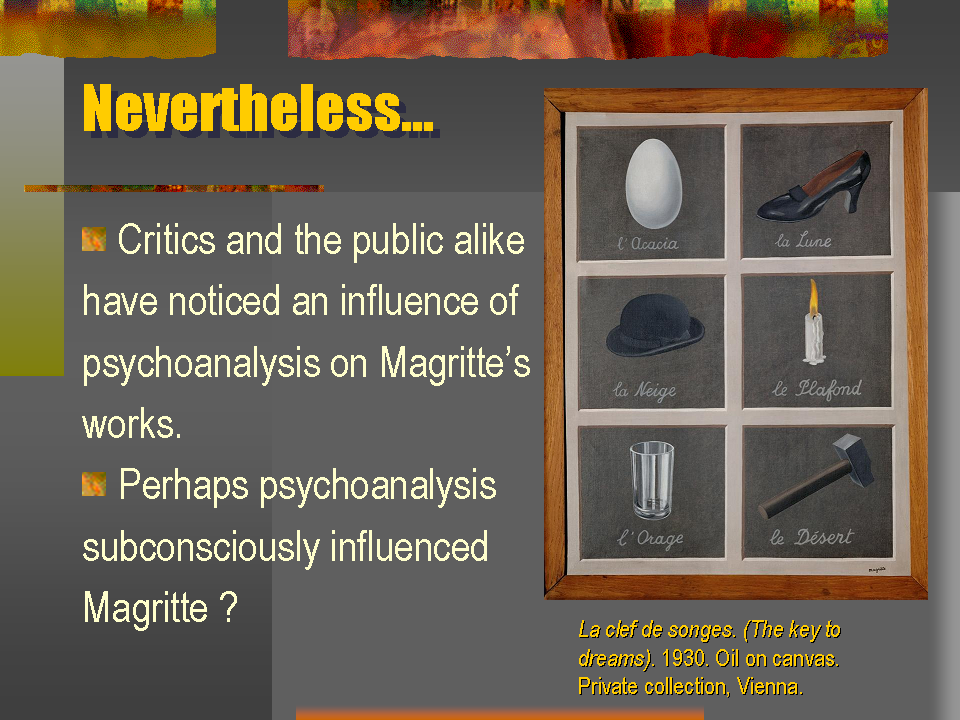
Surrealist Presentations: The Intersection of Art, Freud, and Women
Beneath that is an earlier presentation I did on the representation of women in Surrealist art. (Magritte is included in that one as well, but so are other artists.)
You can click on any of the slides to make them larger to read the sometimes itty bitty text I used.
Sunday, August 21, 2011
“That is modern art”: MoMA and South African art
Today, a friend and I made the trek into New York City to check out the current special exhibit at the Museum of Modern Art (MoMA). I’d been interested in exploring Impressions from South Africa, 1965 to Now from the minute I heard about it, but predictably I made it in just under the wire (the exhibit closes next week). A complex look at race and power, the exhibit is made up entirely of works from MoMA’s own collections. The curator of the exhibit did a fairly good job of explaining the technical aspects of the prints, which was an added bonus. Nearly all of the artists featured were names unknown to me but I was quickly intrigued and absorbed by them all. Of particular interest were the political posters as well as the pages from Bitterkomix on display. (Here is the basic idea – with a slogan I love – of one of the former. The latter cracked me up with their satirical interplay of text and images).
The exhibit featured one artist who I know (and am appreciating more and more all the time) – William Kentridge. I had first learned of him at another trip to the MoMA (to see the excellent but incredibly crowded exhibit on Tim Burton) and then also found his works on display at the Zimmerli Art Museum and the Jewish Museum (where I went last summer for an exhibit on Curious George). I found out about his production of The Nose at the Metropolitan Opera far too late to even consider going, but that looked like an amazing treat for the eyes and ears! Check out the short clip available here to see what I mean. Unfortunately, even though Kentridge’s films had been at the MoMA in the past, they were not on display while we were there today (at least not anywhere that I noticed). While not an example of printmaking, they still would have been a fitting companion to the Impressions from South Africa exhibit.
Altogether, Impressions from South Africa, 1965 to Now wasn’t a very large exhibit but it had some real gems. If you have the time and access, I would definitely recommend checking it out!
While we were there, we also checked out another special exhibit entitled Talk to Me: Design and Communication between People and Objects. This quirky exhibit looks at the various ways humans and technology interact. One interesting piece was a video about the installation Double-Taker (Snout) at the Pittsburgh Center for Arts. Its ‘curious but shy’ motions reminded me to the movements of a cat and the concept of an emotionally interactive robot reminded me of the Kismet robot I learned about at the MIT museum last month. (Perhaps a post about my recent trip to Boston is forthcoming….) But the take-away piece from this exhibit for me was this hilarious and charming video by a group of Spanish artists: Hi, a real human interface. I challenge you to watch it and not laugh…or at least be amused!
We had a lot of time at the museum today so we also checked out some of the permanent collections, which display works by such greats as Vincent van Gogh, Pablo Picasso, Claude Monet, Jasper Johns, Jackson Pollock, Henri Matisse, Andy Warhol, Roy Lichtenstein, Paul Gauguin, Henri Rousseau, and my all-time favorite, Rene Magritte. There are also a number of Salvador Dali paintings, including his famous The Persistence of Memory. I always find Dali’s works mind-blowing, especially his Destino short for Walt Disney (beautiful!) and his dream sequence for Alfred Hitchcock’s Spellbound (so fitting to a psychological thriller that pivots around psychoanalysis).
If you can’t find your way out to the MoMA, check out the Great Museums episode about it (video starts loading immediately). It’ll give you a great overview of the history of the museum and a look at its permanent collections.
Update: I forgot to mention that we also saw this small exhibit entitled Harun Farocki: Images of War (at a Distance). It was a bit odd, and not exactly what I was expecting, but interesting nonetheless.
Monday, July 11, 2011
Zimmerli Art Museum: A Tardis Treasure Trove
Here are my niece’s thoughts on the trip:
Well, since she’s a baby, she can’t really say. So here’s what I inferred from her reactions:
- The children’s book illustrations exhibit did not excite her too much either, which is a bit funny considering this exhibit was the reason I took her to the museum. She spent a good deal of the time watching me reading the story to her instead of looking at the illustrations at all. Toward the end she got a bit fussy as if done with this room. Then I sat her down a stool where the museum staff had a few coloring/drawing pages set out related to the books. She was very excited to scrunch up a piece a paper in one hand and hold a colored pencil in the other one. (She has a very good grip on crayons/colored pencils/etc. but isn’t really interested when I try to show how to color.)
- She wasn’t very interested the Cast Me Not Away exhibit either. She didn’t really look at the photos much but instead looked down on the floor in that room as though she wanted to crawl around on it. (Not that I let her!)
- However, she did like: the stained glass pieces found in a small corridor; sculpture in the European art section (the Figaro sculpture was particularly interesting); Pre-Colombian ceramics (having seen these many times, I was going to walk right past them but she turned her head this way and that to look at them all so I slowed down so she could take them in); a video on spindle fires in the Estonian art exhibit (I had only stayed for a moment on this one and started to walk away but she gave her I’m-not-a-happy-baby-with-that-decision grunt, so we went back and watched the whole thing); and any room with high ceilings and lots of lights that she could look up at in wonder. Well, with that last one, I examined some of the architecture of the building that I never noticed before in all the times I had been there. Understandably, as a baby, she was much more interested in anything that was more three-dimensional than flat. But, overall, she seemed quite interested in the museum and gave me a look that seemed to say, where on earth did you bring me?
As I noted earlier, this was by no means the first trip I’ve taken to Zimmerli. Just last month, a friend and I stopped by briefly for the current exhibit Jolan Gross-Bettelheim: An American Printmaker in an Age of Progress. Prior to our visit, Deb had found this review from The New York Times, which gives a pretty good overview of the exhibit as well as some questions to consider. We both liked that the exhibit was set up chronologically so that the viewer could easily see the artist’s progress over the years, especially as she re-visited themes or similar visuals. However, we both thought it would have been helpful if the exhibit had explained a bit more on the technical details, such as the difference between lithograph and drypoint prints. (For the record, here’s the Wikipedia articles on both: Lithography and Drypoint.) Personally, I liked that the prints very much had the feel of Works Progress Era art.
While we were there, we also stopped in another current exhibit, A View of Caring: Johnson & Johnson/International Center of Photography Fellowship Exhibition. While this marries two things near my heart (social justice and fine arts), we both felt it functioned as a giant advertising scheme for Johnson & Johnson. That’s not to say there weren’t some fantastic photographs included in the exhibit (such as the one of Irish school children playing seen in the link above), but it just seemed a bit odd and out of place.
We also made a short trip into the museum store where I noticed that one of my favorite professor’s in graduate school has a book out (Visible Writings: Cultures, Forms, Readings), which sounds interesting. I also stumbled upon a notecard print of a painting by James Tissot that I found appealing. I had never heard of Tissot before so I looked him when I came home and found that he has a wealth of beautiful paintings. (Check out the gallery of his works found here.) Here is the painting that called out to me at the store:
Source: Wikimedia Commons
For some reason I can’t quite recall, I mentioned to Deb another special exhibit I had seen at the Zimmerli museum some time ago – Lalla Essaydi: Les Femmes du Maroc. This was such a great exhibit that I felt the need to mention it here as well. If you ever get a chance to see Ms. Essaydi’s works, I recommend it without hesitation. Granted, they are probably more interesting to those with a bit of an art history background, but they are so good that I would recommend them for anyone. (Plus, to be honest, I don’t have that much of an art history background, and I could enjoy them wholeheartedly!)
I could go on and on about exciting and interesting exhibits I’ve seen at the Zimmerli Art Museum, but I’ll end with one last event that I went to a few months ago. The first Wednesday of every month (excepting August when the museum is closed), Zimmerli hosts “Art After Hours,” an event in which the museum stays open late and offers a myriad of art-related activities. In the past, I have been to Art After Hours events featuring children’s illustrators speaking on their craft; the viewing of avant garde films; open-mic poetry; and so on. The Art After Hours that I most recently attended was a night dedicated to Estonian art. It began with a curator-led tour of the current exhibit Mystics and Moderns: Painting in Estonia before Glasnost, moved on to a violin/cello/piano concert of Estonian music, and ended with a viewing of the documentary film, The Singing Revolution. If you can find it, definitely check out this film. (It is supposed to be airing on PBS some time this year.) It was excellently done with a can’t-be-beat true story at the heart of it. Chances are good that you’ll walk away having learned something from it. If not, at the very least, you’ll walk away being inspired by it.
It probably goes without saying at this point, but here goes. If you ever find yourself in the New Brunswick area looking for something to do, I’m highly recommending that you stop by the Zimmerli Art Museum for a visit.