Showing posts with label feminism. Show all posts

Sunday, August 30, 2015

Misallying Love Interests & Etc.

Hello, my beloved readers, if any of you are still here! I know that once again I've been neglectful in keeping up to date here, although I have so many things I'd like to share. One day...

In the spirit of trying to write about things when they're fresh in my mind, I'd like to talk briefly about a play I saw this evening. Tonight I was in the audience for the play Misalliance at the Shakespeare Theater of New Jersey. Misalliance is a drawing room comedy written by George Bernard Shaw in the first decade of the 20th century. Unlike other Shaw plays, this one isn't particularly well known and apparently doesn't see the stage often these days. Reviews for this particular production were rather mixed, and I think I get why that is.

Misalliance is a play that seems to take a while to get started, but even after it did take off some, I still found myself a little puzzled as to what exactly the plot was. There just simply isn't much of a plot. The entire play takes place in one evening in one setting - the pavilion room of a wealthy businessman in the English countryside. The characters consist of a family of four as well as the daughter's fiancée and his father, and a few unexpected guests. Some of the themes explored include the parent-child relationship, education, the class system, speech versus action, politics, and feminism. While this is all well and good, there times here and there where the play was very speech-y and it was unclear what this all was leading to -- sometimes, it would loop back around to the general themes and flow of the play while other times it would just be there to be there. It also seemed like the characters were sometimes a bit contradictory in all their long-windedness.

On the plus side, there were definitely a lot of humorous parts to the play, which is what I was hoping for and expecting. Shaw makes more than a few meta-references to plays and all their trappings that had good tongue-in-cheek quality to them. The father's penchant for pushing books at everyone was a hilarious refrain in particular. After a plane crashes in the garden outside, things got a bit farcical, but that was in a good way. The introduction of Lina, the Polish acrobat, was refreshingly funny and added some physical comedy to the play. She also elicited a lot of laughs either through her own person or through the minor plot points she put into action. In addition, Lina brought home more of the feminist theme, with a rousing speech that was the only one to elicit applause from the audience mid-scene:

Oh, your Johnny! with his marriage.  He will do the straight thing by me.  He will give me a home, a position.  He tells me I must know that my present position is not one for a nice woman.  This to me, Lina Szczepanowska!  I am an honest woman.  I earn my living.  I am a free woman.  I live in my own house.  I am a woman of the world.  I have thousands of friends. Every night crowds of people applaud me, delight in me, buy my picture, pay hard-earned money to see me.  I am strong.  I am skillful. I am brave.  I am independent.  I am unbought.  I am all that a woman ought to be; and in my family there has not been a single drunkard for four generations. And this Englishman! this linendraper! he dares to ask me to come and live with him in this rrrrrrrabbit hutch, and take my bread from his hand, and ask him for pocket money, and wear soft clothes, and be his woman! his wife!  Sooner than that, I would stoop to the lowest depths of my profession.  I would stuff lions with food and pretend to tame them.  I would deceive honest people's eyes with conjuring tricks instead of real feats of strength and skill.  I would be a clown and set bad examples of conduct to little children.  I would sink yet lower and be an actress or an opera singer, imperiling my soul by the wicked lie of pretending to be somebody else. All this I would do sooner than take my bread from the hand of a man and make him the master of my body and soul. And so you may tell your Johnny to buy an Englishwoman: he shall not buy Lina Szczepanowska; and I will not stay in the house where such dishonor is offered me.

Similar sentiments are expressed by the 20-something daughter of the family, Hypatia, who feels trapped in her upper middle-class life:
  • "I don't want to be good; and I don't want to be bad. I just don't want to be bothered about either good or bad. I want to be an active verb."
  • "I want to be; I want to do; and I'm game to suffer if it costs that.  But stick here doing nothing but being good and nice and ladylike I simply won't."
  • "Men like conventions because men made them. I didn't make them. I don't like them. I won't keep them."

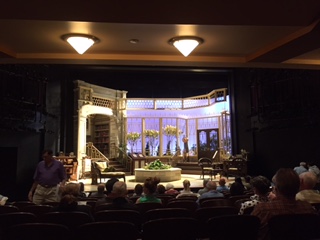
Of course, the feminist in me identified with a lot of this (but not necessarily with the way Hypatia went about her search for adventure ... although given the time period and her social situation, she really didn't have a ton of options available to her). So that specific theme as well as the humor really appealed to me. This particular production also had an absolutely beautiful and elaborately detailed set (see pictures above), excellent actors who were well cast, attractive costumes, and a lovely intimate setting in the relatively small theater. While there were some speeches that did drag and seemed a little pointless, overall I'm glad to have seen this play. Tomorrow is the last two showings of this production, so run - don't walk - to the box office to grab your tickets!

Sunday, February 1, 2015

A Look at the Darkest Side of Humanity with BBC's The Fall

The Fall is a powerful, intense, challenging, and disturbing show that is most definitely worth the watch. In a world where there seems to be a police procedural and/or crime drama on every night on every station, it may seem redundant to have yet another show about a serial killer and the police search to capture him. And while boiled down this is exactly what The Fall is about, the show is far more artistic and serious than the many more sensationalist cookie cutter criminal-based programs out there already.


To step back a moment, The Fall is a BBC-produced drama taking place in recent years in Belfast, Northern Ireland. When the daughter of a prominent (and wealthy) businessman is brutally murdered, the local police launch a ramped-up investigation to catch her killer. To head up this task force, they bring in Stella Gibson, a detective inspector from London with a stellar (couldn't resist the pun!) track record for understanding and thus bringing in criminals. Gibson almost immediately sees a link between this murder and those of other women in Belfast who share similar characteristics (although, alas, the rest don't have the moneyed fame so their deaths weren't originally given the same high status treatment). Behavioral profiling of the murderer, painstakingly intensive forensic studies, and round-the-clock monitoring of tip lines and potential suspects' movements consume the task force's time as they pursue the serial killings.

Meanwhile, the viewers are given the position of knowing far more than the police as we soon enter into the world of the killer himself. A grief counselor with a wife and two young children, Paul Spector is mundane enough for most people to not notice him or suspect him of being guilty of anything more egregious than perhaps a speeding ticket. But underneath this calm demeanor lies a troubled psyche that finds fulfillment in others' misery and feels powerful only by destroying lives. Besides his unrepentant need to stalk and murder pretty women, Spector has a host of various other problems to deal with in his life, ranging from fairly typical parenting issues to a teenaged babysitter who is infatuated with him to a client case in which an extremely violent man is abusing his wife.

This last issue brings up an important part about what makes The Fall such a fascinating show. The cat-and-mouse between the police and the killer makes for plot-driven suspense and, as always for me, well-developed characters finish the job of sucking the viewer into the drama. But The Fall goes a step further by looking into a major cultural issue of times - and one that is sadly, often rather divisive - that of gender roles and gender equality/inequality. The issue of violence against women in particular is a large part of The Fall, and the show explores it in a number of ways, while also examining women's implicit and explicit roles in combating both crime and cultural stereotypes about their gender.

The Fall starts with presenting a female main character that is a wonderful example of a feminist hero. Stella Gibson is certainly not perfect and she's not necessarily "kick ass" in a superhero sort of way (although you wouldn't want to get on her wrong side either), but she's tough, smart, and confident. Her personality at first appears a bit cold because she isn't passionate in terms of raising up a fuss or otherwise getting bowled over by her emotions. But it's soon obvious that Gibson does indeed feel strongly at appropriate moments and while she is guided mainly by her intellect and sense of morality, her emotions also play a role in why she does what she does. She feels deep empathy for the victims and their families and is remorseful when she fears she's made a mistake that comprises a woman's safety.

Just like she is not devoid of emotion, she is also not a nun despite not being in a traditional relationship. Gibson has no problem clearly and plainly putting out her intentions when she finds someone of sexual interest - and when she does not. No part of Gibson's personality is tied up in any particular man or even in proving herself in a workplace historically populated by men. The show thankfully does not fall into the trap of turning Gibson into a "bitch" because she is a woman in a supervisory capacity or of making strong assertions about how Gibson has chosen being a career woman rather than a wife or mother, as thought it always needs to be an either/or choice. Clearly, the creators/writers here were not interested in presenting a stereotypical "women's intuition" type of female police detective who will inevitably end up in a long-term romantic relationship with her male partner. Gibson is simply living her life - sometimes making mistakes, sometimes shining (again, can't resist the puns based on her first name!) with insights not picked up by anyone else.

While The Fall certainly isn't alone in presenting a female lead - or even a strong female lead at that, the show doesn't just stop there. Gibson isn't a lone voice in the wilderness; the Belfast police and their attendant associates have a fairly equal amount of male and female employees. Even though she has a previous relationship with Assistant Chief Constable Jim Burns, on reaching Belfast, Gibson quickly aligns herself with two other women in particular - Dani Ferrington, a beat cop who becomes the right-hand woman to Gibson, and Professor Reed Smith, a pathologist who reports various insights to Gibson. In the world outside of the police force, we also get to know an array of female characters of various importance (and ensuing screen time) from Spector's wife to his victims to victims' family members and so on. The Fall presents women of all kinds: from the fiercely tough and professional detective constable Gail McNally to the busy and rather clueless (and thus, in a way, very sympathetic) Sally-Ann Spector to the clearly emotionally needy/disturbed young babysitter for the Spectors. With the exception of the babysitter Katie, who is a little one-note in terms of her motivations, all of the women - and indeed, all of the characters - are believable, well-rounded characters who have their individuals highs and lows.

But The Fall does more than simply present strong and believable female characters (not to say that isn't an accomplishment enough in a world where plenty of other shows and films struggle to have even a fair number of women in prominent roles). It also delves deep into a variety of issues surrounding women and how our culture treats women. It touches on how women are objectified, thus dehumanizing them to predators, specifically stating this through Gibson's words, but also showing it in other ways (i.e., using the visual medium of TV well to make the point). At one point when Spector tapes the torture of a victim, he ends his homemade video by asking why it's being watched. It's an uncomfortable moment of pointing out the viewer's own voyeurism and implicit role in this cultural problem of allowing women's rapes and murders to become lazy plot points to propel forward male heroes.

Nevertheless, the show is not without its detractors who criticize it for being misogynistic because of the female murder victims and for seeing from the killer's point of view. While I see their point about how displaying the corpses of dead women is troubling (it's something I felt with other crime shows), I don't find that to be the case here. Even though we see from the killer's eyes frequently, at no point are his actions condoned or held up as something to model/mimic. Meanwhile, there is so much empathy put out for the victims, the families, and even the community at large, that I don't feel like the dead women are simply props held up for their shocking entertainment value.

(Speaking of sensationalist shock value entertainment, I could not help thinking about the upcoming Fifty Shades of Grey movie, which stars Jamie Dornan as the BDSM-loving protagonist Christian Grey. I'm not sure how anyone could watch Jamie Dornan as Paul Spector subjecting a teenaged girl to bondage and other "grooming" acts, stalking women in his neighborhood, holding a woman hostage, violently murdering women, etc. and still come away thinking that a book series/movie about a dominant wealthy businessman introducing a young, naïve college student to sadomasochism is romantic.)

The Fall also has gained some critics because of its pacing; the show is certainly slow moving and lingers where other shows rush full speed ahead. Unlike the myriad of procedural shows on the air that fill up 20-plus episodes a year with largely one-off mysteries with sometimes poorly explained motivations, The Fall has chosen to focus the first two seasons (a total of 11 episodes) to this one case. Viewers come to intimately know all the characters and see the continuing effects of the crime on the police members tracking the killer, the killer's family, the surviving victims, and the victims' families. While there are still some motivations that could be more fully explored (e.g., the babysitter), it's a good change of pace to be reminded of the humanity (and lack of it in the killer's case) behind crimes rather than just the next thrilling plot move. For me (and many other viewers), the slower pace was not an impairment to appreciating in the show; in fact, it in many ways made it a more suspenseful watch. As a viewer, you care much more about the fate of a character once you've become invested in that person's life.

The breadcrumbs thrown out about whether nature or nurture created the psychopathic killer is another interesting component to the show. As the story develops and we learn more about Spector's troubled past, there are plenty of opportunities to reflect on how and why this man became a narcissistic sociopath turned violent offender, even if the script doesn't always explicitly state his motivations. And while there are certainly many references to Spector and his deeds as monstrous, the show through Gibson often reminds viewers how life exists on a continuum and everyone has elements of good and bad in them. In one scene I found particularly poignant in this regard, Gibson takes Burns to task for trying to weasel his way into her bed after she repeatedly says no. While she does make certain to maintain a distinction between him and the killer, she still manages to remind Burns (and the audience) that the treatment of women as mere sex objects is an easy trap to fall into that quickly becomes a slippery slope.

Like any TV show or other artistic expression, The Fall is of course not perfect. There is a secondary plot about police corruption that almost entirely fades in the background of the serial killing storyline. At times, there are scenes that feel unnecessary or not fully explained. On occasion, the police seem woefully behind the serial killer despite the tremendous amount of money and effort being spent on this case, including some scenes that just seemed ridiculous in how slow the police were responding, which hurt some of the credibility of the show. But overall, I found the first two seasons of the show to be fully engaging and thought-provoking in terms of plot and themes. They were also all extremely well acted, with an array of interesting, complex characters being presented and explored. The end of the season two finale was a bit bizarre in my opinion (and I am not alone), but I'm hoping that the third season slated for release in fall 2015 will help to smooth over those ragged edges and provide a satisfying conclusion to this thoroughly captivating show.

Sunday, November 4, 2012

Brave Enough to Say No


I’ve been a huge fan of Disney and Pixar movies in the past, even the princess movies that rankle many. Yes, as a feminist I understand the many problems inherent in these movies with their troubling portrayals of women, but I grew up on them and they hold nostalgic memories for me. I am not pining away, waiting for my prince to come and make my happily ever after come true, but I still enjoy the music, animation, and cinematography of these movies.

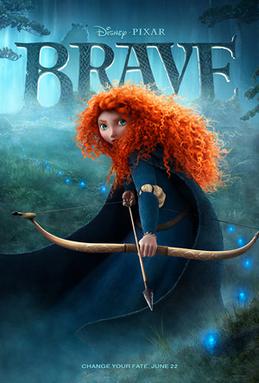
So when Disney/Pixar started advertising its latest princess offering, Brave, there was a good chance I was going to check it out. And then when I read this article detailing the co-director’s inspiration for the movie and describing how this film with a strong female lead came into being, I was hooked. Last month I finally got the chance to sit down and watch this movie – while I was on a plane and this was luckily one of the choices. (It might be worth noting that I wasn’t the only childless adult watching this movie; I even noticed a couple of adult men picking this movie out of the many options available. So much for Disney’s concerns that only young girls will view princess movies.)

Brave tells the story of Merida, a Scottish princess who loves archery and horseback riding but is often forced indoors by her mother to practice the etiquette of being royalty. Merida dislikes this but does as she told – until one day her parents tell her it is time to be wed and three princes arrive to contest each other for her hand. Merida rebels and runs off into the woods, where she stumbles upon a witch who concocts a potion that will help Merida change her mother. Well, change her it does – right from a human being into a giant grizzly bear. Now Merida has even bigger problems on her hands than just convincing her mother not to marry her off – will she be able to hide her mother from her bear-hunting father long enough to reverse the spell?

There were a lot of things to like about Brave. Of course, as we’ve come to expect from Disney and Pixar, the animation is top-notch. As in many other Disney/Pixar movies, the movie includes a few sweet songs as sung by Merida, which are quite nice and I’d probably listen to just as regular songs without the context of a movie. Personally, hearing the Scottish accent of all the characters was a fun change of pace from the non-accent of most Hollywood casts, even when the movie is supposedly set outside of the California hills. The movie is also good at putting forth some moral lessons without being overly didactic.

Furthermore, this is a very female-centric movie, which sadly cannot actually be said about all princess movies. There is the strong mother-daughter relationship, unlike in many fairy tale-based movies where the mother is absent and/or the mother figure is evil. In fact, what we have here is rare in many Disney/Pixar movies – an entire intact family of mother, father, daughter, and two sons. (This may be a bit ironic – or something – that Disney finally releases a movie with a traditional family of two parents and 2.5 children when the traditional family is morphing into something else altogether.) One thing I really enjoyed about the movie focusing not just on Merida but also on her mother was that it gave the opportunity to show two kinds of female strength. Merida is portrayed as strong and brave in part because she is something of a tomboy, who prefers archery and traditional male hobbies. But – and this is more subtle – her mother is also portrayed as strong in a more traditional female role. She is able to subdue a room full of rowdy men with her stately and elegant appearance combined with a calming speech.

And, I really appreciate that the movie is actually an anti-romance – given the movie’s target audience of young children, I think that is quite appropriate for a change. Merida does not give up on the idea of marriage entirely or denigrate it at all, but she simply refuses to get married at a time in which she is not ready to a person who is not of her own choosing. Spoiler alert!: The film does not end with her falling for one of the three princes or meeting a fourth prince who sweeps her off her feet, but it is open-ended enough that the viewer can believe Merida will eventually fall in love and marry or that she will remain single and happy that way. I had been concerned that the movie would go the route of Aladdin where Princess Jasmine refuses all her potential suitors but then changes her mind eventually when Aladdin arrives on the scene. That’s a fine storyline also as it introduces the idea of choosing one’s own path rather than having it chosen by others, but I’m glad that this movie took it one step further to suggest that Merida might still live happily ever after even without a husband on the horizon.

Like with many other Disney/Pixar films, there is a lot of humor is the movie. I’m sure kids in particular will find the many slapstick moments hysterical, especially the antics of Merida’s two younger brothers who can’t seem to keep themselves out of trouble. But a lot of the humor comes at the expense of the male characters, and this is the only real fault I find with the movie. For the most part, the male characters are seen as little more than barbarians – they are none of them particularly intelligent, and it takes little to have them all begin fighting with one another. If they are not fighting one another, then they are all mindlessly chasing down a bear that only one character has sensed or trying to show off their physical prowess is some other way. Albeit, the king does have some better moments, and it is clear that he is loving husband and doting father. But for the most part, this movie doesn’t give the best impression of men as a whole, especially when a lot of them are put together in the same room. As a feminist, I rankle at this portrayal also – it’s a misconception that feminism believes or seeks to make women superior to men; most feminists simply wish us women to be on the same playing field as men and to stand there being treated equally and fairly, not judged to be either inferior or superior based solely on the existence of a second X chromosome. It’s harmful to everyone – but probably most especially children – to portray one sex as somehow inferior to another in any aspect.

Still, all and all, I enjoyed this movie and appreciated this twist on the traditional princess movie. For that reason, I highly recommend it for all of us who grew up on princess movies because I think we would most appreciate its subversion of the genre. Of course, I’d also recommend it for its target audience of young children but with the caveat that parents co-view with their kids and point out some of the harmful representations of male characters in addition to pointing out the helpful representations of female characters.

Wednesday, September 7, 2011

Guerrilla Warfare: Tackling Misogyny and Racism through Art

In case I’m starting to sound like a one-trick pony with my praise of Zimmerli’s programming, I’ll let it be known that the Venetian Masters wasn’t the only exhibit I took in today. (Yes, today was a rare but beautiful day where I went to work and still managed to squeeze in two art exhibits viewing.) Thanks to the Rutgers Institute for Women and Art, artwork from the Guerrilla Girls was on display at the Mason Gross gallery not terribly far from the Zimmerli Art Museum.

If you don’t know about Guerrilla Girls yet, you should definitely check them out. In 2009, I saw a (smaller) exhibit of theirs on display at the Centre Pompidou in Paris and their works instantly resonated with me. In a nutshell, Guerrilla Girls aim to combat misogyny and racism through witty and irreverent art. They’ll use anything to get their message across - banners, posters, stickers, erasers, etc. In fact, the original Guerrilla Girls has sprouted two offshoots – Guerrilla Girls on Tour! and Guerrilla Girls BroadBand – to expand their reach to theatrical performances and web-based and interactive multimedia productions. Like any good vigilantes, the Guerrilla Girls are an anonymous set of women who take on the names of dead female artists and wear gorilla masks in public to hide their identities. One (somewhat ominous) explanation of the rationale for this read: “They could be anywhere; they are everywhere.”

But what I like about Guerrilla Girls is that it’s not all just stunts and catchy visuals. Their work frequently gives the viewer a number of startling statistics such as this one:

And, it is not a static group or collection of artworks. Guerrilla Girls are constantly updating their works and tailoring them to the specific places where they are exhibiting. One interesting project (of which part of was displayed at the Rutgers’ exhibit) involved asking various groups of women what issues they wanted to see Guerrilla Girls address next. Sadly indicative of our culture and what kinds of uphill battles women have to face, the top responses were rape and domestic violence. As this might suggest, the Guerrilla Girls have long since moved from merely discussing misogyny in the art world to discussing all kinds of issues facing women from unequal pay to abortion rights to the negative impact of advertising on women’s body image.

Walking through the rooms of the exhibit was a rather remarkable experience as I began in a room with the oldest works and made my way up to the newest ones. It was both interesting and sad to see that over time most of the issues remained still the same and some of the statistics had improved only the slightest bit if at all. One set of posters dealt with the politics of George Bush and the Gulf War and I had to do a double-take before I realized they weren’t discussing George W. Bush and the war in Iraq. (Funny how we don’t seem to learn from the mistakes of the past…)

Unfortunately, today was the last day for the Guerrilla Girls exhibit at Rutgers, but undoubtedly you’ll be able to catch them somewhere around here soon. In the meantime you, like me, might be interested in checking out some of their books, such as The Guerrilla Girls’ Bedside Companion to the History of Western Art. In addition, the Institute for Women and Art provided a handy flyer at the exhibit listing some related resources at Rutgers including the Mary H. Dana Women Artists Series, the Women Artists Archives National Directory, the Feminist Art Project, and Signs: Journal of Women in Culture & Society. Happy reading!