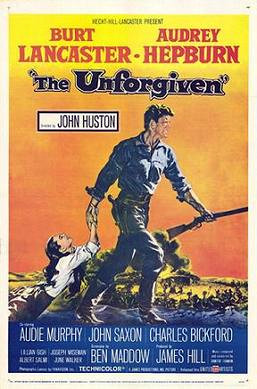
Despite having Burt Lancaster and Audrey Hepburn in starring roles (as Ben and Rachel, respectively) and John Huston at the helm as director, it seems like this movie hasn't survived the years as well as some other classic films. Note "seems" is the operative word in that sentence. I could be completely off base and it could remain very popular, but I only heard about it when I watched a biography of Audie Murphy, who played Cash in the film. However, both Hepburn and Huston had reasons for distancing themselves from this movie, which I'll talk about below, with Huston reportedly saying it was the only one of his films that he found dissatisfying.
Right off the bat, I should say that I'm not really a huge fan of Westerns. There are some notable exceptions but for the most part I find them rather dull. (The only time I ever fell asleep in a movie theater was while watching 3:10 to Yuma, a movie which pretty much epitomizes everything I dislike about badly done Westerns.) But this movie was very different. Like Marlon Brando's One-Eyed Jacks, this movie was more of a drama that happens to be set in the Wild West and concerns itself more with the pathos of the story and characters than with stereotypical Western machismo and shootouts. However, there was some of the latter in this movie (and in One-Eyed Jacks as well), as I'll discuss later on in this blog post.
One reason this movie was more dramatic than some other Westerns was because Huston, a veteran film director of critical acclaim (and incidentally, the father of actor Anjelica Huston), wanted to make a movie to explore racism in America - a very noble goal. Indeed, the movie is based on a book of the same name by Alan Le May, in which the author apparently discussed white America's hatred of its native people at length. However, the movie's producers were purportedly more interested in profit and desired a more traditional - and less controversial - Western. I presume this is the reason behind the movie definitely being interesting for beginning to shine a light on racism in America - specifically Caucasian Americans' fear and hatred of American Indians - yet leaving the viewer with the feeling that it didn't dig deep enough. It also seemed to undermine its own points at times by containing some rather stereotypical portrayals of the Kiowa tribe.
Nevertheless, I really enjoyed that this movie wasn't just surface level plotting but also contained numerous deeper themes. Besides examining racism and prejudices and their causes, the film is a thoughtful exploration of the meaning of family and family values (i.e., blood vs. adopted family, standing by one's family despite difficult truths, etc.). It also pits community and togetherness versus the questionable ideal of rugged American individualism, a quintessential Western standby. The movie portrays kangaroo courts and the idea of taking justice into one's own hands, which is also a frequently referenced thing in Westerns. And, The Unforgiven also pits against each other two different gender stereotypes: the hyper-masculine response of resorting to violence and death instead of letting quarrels die out naturally versus the nurturing feminine reaction of sheltering a baby and raising her despite past rivalries. It's worth noting that these two "gendered" reactions are not always exclusively the abode of the corresponding sex. Pa Zachary, when he was still alive, was initially the one to take Rachel in to the family fold, and her brothers, especially Ben and Andy, love her unconditionally. And as we see as the movie progresses, Ma Zachary will take her vengeance and is more than capable of handling a gun. (Fun fact: Lillian Gish, the actor playing Ma Zachary, was apparently a remarkable markswoman, more so than the men involved in the project.) Spoiler! Even Rachel totes a gun by the end of the movie and chooses her place alongside her adopted brothers by killing her biological brother in cold blood. All of these themes are presented not in a hit-you-over-the-head kind of way, but in an understated manner throughout the unraveling of the plot.
Likewise, a lot of the character development is unfolded quietly and over time in most cases. The romance between Ben and Rachel was a bit odd considering how they were raised as siblings, but the simmering chemistry between Lancaster and Hepburn was undeniable. And this romance didn't feel entirely tacked on, like in some movies where the hero and the heroine getting together just feels like the cherry on top that came out of the blue, if you pardon the mixed metaphors. Again, it was understated and slowly built over time. It started out innocently enough with Rachel seemingly especially excited by seeing Ben after his return from a long journey to Wichita and back, but the viewer might brush that off as simply a particularly close pair of siblings. The idea of such a romance then is brought up by and laughed off by Rachel and Ben when she says, "I could marry that handsome, winsome Charlie or that baby Jude. I could even marry you. ... Well, why not? We're not cousins. We're not even relatives." to which Ben retorts, "We're not even friends." in a joking manner. Things become more serious when the cattle hand Johnny Portugal reaches up to pull a nettle out from Rachel's hair and Ben's reacts with uncharacteristic anger, leaving the rest of the crowd to mutter that he sure is protective of his sister. The tension is palpable at points like this one.
The characters of Rachel and Ben were particularly compelling as Hepburn and Lancaster displayed excellent acting in this film. Hepburn developed Rachel from a carefree, joyful young girl to a burdened woman filled with pathos and self-sacrificial leanings, making this transformation completely believable along the way. Of course, she sounded more like Holly Golightly than the adopted daughter of a Texas cattle rancher and she seems far too fair-skinned to have anyone question her lineage as being native to the American West, but those things are what they are and the viewer soon gets pulled into the movie enough to overlook them. Like Hepburn, Lancaster expertly took Ben from a joking and loving brother, somewhat burdened by being the family patriarch and main breadwinner, to a torn man making tough decisions with heavy consequences. At the risk of overusing the word, pathos best describes the audience's feeling toward Ben and his actions by the end of the movie. Occasionally, Lancaster mumbled a bit and was thus difficult to understand - especially with his zingers in the beginning of the movie - but this also wasn't enough of a problem to seriously hinder my enjoyment of the film.
As Ben and Rachel were the main focus on the movie, their characters got to be the most fully developed but other characters also had their share of growth as well as a sometimes unclear set of motivations, making them three-dimensional beings. Cash, who started out as the most blatantly racist character of all, gets his chance for redemption and to look beyond his own fears and prejudices. Ma Zachary is a complicated character, as I've already mentioned, who can go from entirely sweet and nurturing to tough as tacks and violent at a moment's notice. She holds the family secret for a long time, managing to lie to her younger children for years in a way that still makes her seem loving and redeemable. (I say her younger children because it's more than obvious that Rachel's past in a complete mystery to Cash, Andy and Rachel herself. But it's unclear how much Ben knew all along; sometimes it seems like he knows all and other times it's possible he was in the dark as well.) Even Abe Kelsey, the saber-toting "villain" of the movie, has a tragic back story that leaves the viewer feeling somewhat sympathetic towards him.
Then, of course, there are times when the movie completely fails at character development. Most notably, there's the absolutely ridiculous character of Georgia Rawlins who all put throws herself at Cash's feet in her efforts to get married to him because that is her one and only goal in life. The other members of the Rawlins family are not well defined, and the relationship between Rachel and Charlie Rawlins never felt like something to be taken seriously as we knew so little about Charlie. His existence seemed more like a way to push the plot forward than anything else. And, as I've mentioned earlier in this post, the characterization of the Kiowa tribe members was anything but fleshed out or three-dimensional. They come in peace but briefly and are otherwise the "savages" of any other stereotypical Western movie.
Still, the movie's promising parts outweigh its flaws. One thing I can't stand is a Western that doesn't take the time to bother showing off the amazing landscapes of the American West. The Unforgiven, while studying complex characters and exploring deep themes, also stops to show off the beauty of the land with sweeping panoramas of gorgeous Western vistas. And, it's not just breathtaking beautiful scenery for its own sake -- the imagery is there to help tell the story in Huston's cinematography. For instance, there is one particularly poignant scene in which we stop and watch an abandoned piano set against a desolate backdrop of dusty land littered with dead bodies. It's an incredibly powerful image and gets to those deeper themes of culture and family versus violence and being alone. I will admit there were a few scenes of cattle and horses that seemed to go on a little longer that I would prefer, but they were also there to help further the story and its characters. In addition, they served to show off the various talents of the actors and extras, although they ended up leading to some personal injuries. While filming, Hepburn broke her back after being thrown from a horse and it's possible this injury later led to a miscarriage. Art has its casualties, too, and it's not pretty.
Being a Hollywood Western film, it's not enough for The Unforgiven to simmer with chemistry and fester with racism. It's almost obligatory that a Western end with a bang - quite literally - and thus we get the climactic ending to this movie. So if extended sequences of gun battles are not your thing, it's at this point that you might want to jump ship on this movie. Spoilers! Granted, this big finale of a final stand-off between the Zacharys and the Kiowa tribe allows for all the family members to show their true colors. But it also leaves all the tribal members dead, which is hardly the ending one would hope for in a movie designed to examine why American settlers and native tribes can't just get along. Considering that the Zacharys' bigger gripe seems to be with the community that refuses to accept Rachel now that they know the truth of her genetics, it seems odd that the family would be forced to fight off the tribe rather than their former friends. The latter might have been the truly controversial end to get audiences in 1960 to start thinking long and hard about prejudices. But instead we have a pretty much stereotypical ending to a Western movie, which is a bit of a letdown after everything else this film has offered.
Still, all in all, I was really rather riveted by this movie and quite enjoyed it. It definitely provides some food for thought, and those are the best kinds of movies in my opinion. (Even if an occasional light-hearted piece is necessary after a long and/or bad day.) I'm now considering watching John Ford's The Searchers, another Western film based on an Alan Le May novel concerning itself with prejudices directed at American Indian tribal members. But meanwhile I will simply say The Unforgiven is a movie that may have gotten dusty on the shelves over the years, but it should definitely be revisited and given a proper place in Hollywood history.
