At the end of my last post, I mentioned that The Thrilling Adventure Hour podcast had a number of cross-overs in its line-up, which I'm going to discuss here in part three of this blog entry.
War of Two Worlds
This was an ongoing collaboration between The Thrilling Adventure Hour and the podcast SuperEgo. Honestly, this was absolutely without exception, the least interesting thing put out by The Thrilling Adventure Hour. The different styles of the two podcasts means that these episodes were both written and improvised, making for a rather interesting show - in theory. In practice, they were sort of weird and incoherent, with thin plot lines and poorly drawn one-dimensional characters. I was glad when this series ended, and a bit disappointed to hear in a recent Q&A episode that members of The Thrilling Adventure Hour ensemble hope to do more collaborations with SuperEgo in the future. I for one am not looking forward to that.
This American Wife
This American Wife is a podcast that spoofs on the public radio show This American Life (although, at least regarding the cross-overs done with The Thrilling Adventure Hour, the NPR show it most seemed to parody was Fresh Air). The cross-overs done here consisted of interviews with various actors - speaking in character - from The Thrilling Adventure Hour segments. These were pretty funny, and I enjoyed hearing some more about the characters' back stories as well as their interactions with each other. If these two podcasts chose to collaborate again, I certainly wouldn't mind that. However, there was nothing so very compelling about the concept of This American Wife that made me want to go check out that series on its own.
The Dead Authors Podcast
This was less of a cross-over than it was a plug for another project from one the show's actors, that project being the ongoing improv comedy podcast known as The Dead Authors Podcast. The episode of The Dead Authors Podcast featured in The Thrilling Adventure Hour line-up was the December 2012 feature with the authors of the Gospels, which happened to be one replete with actors and guest stars from The Thrilling Adventure Hour: Paul F. Topkins, Craig Cackowski, Mark Gagliardi, Matt Gourley, and Hal Lublin. This episode was so hilarious that I ended up going back and listening to all the past issues of The Dead Authors Podcast -- and subscribing to the podcast for all future episodes.
But let me step back a moment here and explain the basic premise of the show. Like The Thrilling Adventure Hour, the podcast is a recording of a live show but unlike The Thrilling Adventure Hour, The Dead Authors Podcast is not a staged reading but a work of improvisational comedy. Paul F. Tompkins is the host of the show, and he plays it in the role of H.G. Wells, the British author known as one of the fathers of science fiction. The show's conceit is that Wells owns and operates a functional time machine, which Wells uses to go back in time and transport now-dead authors into the present where he interviews them regarding their lives and works. The author changes from month to month and is always played by a different comedian who comes up with answers to Tompkins's/Wells's interview questions on the spot. The result is always something hilarious, although there are some episodes that are even better than others. For instance, John Hodgman as Ayn Rand was one of the most hysterically funny things I've ever heard, Kristen Schaal as Tennessee Williams was also laugh-out-loud funny, and Brian Stack as Brendan Behan had me in stitches. James Adomian as Walt Whitman responding to every question in a Leaves of Grass-style rambling poem (remember, these were all invented on the spot) was another recent highlight.
So to recap, The Dead Authors Podcast is an absolutely hilarious romp through literature in a improvisational sketch matter, although of course with some historical background done in advance by the participants and Paul F. Tompkins as the interviewer. Of course, both the "author"/comedian du jour and Tompkins roll with the punches and come up with new answers/questions as that night's show progresses and goes in different directions than one might expect. I definitely recommend this podcast for fans of literary humor as it does not fail. But even if you haven't read all the authors featured on this podcast, it will still be funny and you won't be lost. In fact, with Tompkins providing some details of the author's life via his interview questions, you might even learn something in between your peals of laughter!
Speaking of Paul F. Tompkins, The Dead Authors Podcast was not the only trip down the rabbit hole I took as I delved into the world of comedic podcasts over the past year or so. But that's a story saved for the fourth and final part of this blog post ...
Showing posts with label action/adventure. Show all posts
Showing posts with label action/adventure. Show all posts
Tuesday, February 11, 2014

Monday, February 10, 2014
The Podcast's the Thing Wherein I'll Catch a Laugh ... (Part 2)
In my last post, I wrote about a podcast that I have been enjoying over the past year, which is recorded from a live monthly show called The Thrilling Adventure. Short recap: The Thrilling Adventure Hour is a humorous staged reading done in the style of old-time radio programs, complete with music and campy sound effects. The show always begins with the segment "Sparks Nevada, Marshal on Mars" and ends with the segment "Beyond Belief." The middle show varies from month to month, although it is usually one of the segments listed below.
The Adventures of Captain Laserbeam
After "Beyond Belief," this is my favorite segment from The Thrilling Adventure Hour. "Captain Laserbeam" is a goofy superhero story featuring a campy Superman/Ironman-type protagonist who is helped out by a bunch of teenagers known as the Adventurekateers. As with "Beyond Belief," the stories of "Captain Laserbeam" as not serialized in the way that "Sparks Nevada" is; nonetheless, there is some development over the years in terms of character arcs, and I think it would be wiser to start listening to this segment from the beginning rather than trying to catch on now. Captain Laserbeam gets himself in all kinds of jams involving the various villains that plague his hometown of Apex City. He ranks this villains in order and like any good superhero, his villains are all ridiculously named and themed characters of their own. My particular favorite has been the Die-brarian (along with his henchman, Papercut), as his presence is a golden opportunity for a ton of bookish-based jokes. (I should have mentioned this in my earlier post: The Thrilling Adventure Hour isn't funny just because of situational comedies or witty repartee; it's also rife with tons of intellectual/nerdy jokes.)
Like with most of the other segments on The Thrilling Adventure Hour, part of the comedy comes from establishing regular catchphrases, but then "Captain Laserbeam" takes it a step further by eventually messing with the now-familiar phrases. Unlike most of the other segments, there isn't really a duo central to "Captain Laserbeam." Captain Laserbeam is more or less on his own, with an occasional bit of information supplied by the ever-rotating cast of Adventurekateers. That means there isn't the same tension of two opposites like Sparks and Croach in "Sparks Nevada" or a symbiotic working relationship like that of Frank and Sadie in "Beyond Belief." Still, Captain Laserbeam's short adventures usually do just fine with him more or less on his own.
Over time, however, the writers ingeniously introduced a new character as a great foil to Captain Laserbeam. The ever upbeat and optimistic Captain Laserbeam found an unlikely alliance with the darker, more pessimistic vigilante known as Phillip Fathom, the deep-sea detective. In one of the behind-the-scenes interviews released on the podcast, Hal Lublin (the voice behind Phillip Fathom, as well as a variety of other characters on The Thrilling Adventure Hour) discussed his process in coming up with an appropriate sound for the deep-sea detective: Lublin noted that the writers were clearly riffing on The Batman character with Phillip Fathom, causing Lublin to contemplate which Batman portrayer he should seek to imitate. Would it be Adam West? Michael Keaton? George Clooney? No, Lublin decided Phillip Fathom should be voiced like Christian Bale as Batman. Nothing is more hilarious than hearing Phillip Fathom on stage shouting something like "My parents were murdered at sea!" in that deep, gravelly voice. In fact, one of my absolute favorite episodes of "Captain Laserbeam" is the one in which Fathom is introduced; hearing him shout "I'M NOT A GOSSIP!" cracks me up every time I hear it. I would love to hear more from Phillip Fathom in the further (and I suspect we will), and I think a spin-off of "Captain Laserbeam" with Phillip Fathom's solo adventures would be a great addition to the current rotation of segments.
One of the compelling things about Captain Laserbeam is that his mythology is not completely fixed yet, and the audience is slowly learning things about his alter ego and history, including his relationship with fellow superhero Dream Girl. Between this and the possibly of exploring Phillip Fathom's background further, there is plenty of fodder for new "Captain Laserbeam" episodes in the future.
Tales from the Black Lagoon
"Tales from the Black Lagoon" is the one anomaly in The Thrilling Adventure Hour cannon. Unlike all the other segments, it is not read live in front of an audience and it's got a much darker vibe. It's certainly still funny, but in a far less obvious way than the other segments. "Tales from the Black Lagoon" plays like a 1940s film noir with the characters all pulled from the Golden Age studio lot, although of course all with some new twist for comedic effect. We've got a cannibalistic Cary Grant, a dope-dealing Shirley Temple, an opium-using Jimmy Stewart, and so forth. This segment challenges the vocal actors in a different way than all the others - it's not just a matter of creating a new tone or accent, it's taking on a well-known personality and voice. The smooth jazzy music, the narrative structure, and the storylines all fit the noir mystery tropes; in sum, this is a great comedy version of old detective stories and very fitting with the idea of an old-time radio program. Unfortunately, this segment hasn't been on the podcast in recent years; the muted comedy may have been less popular than some of the other segments, although the likelier explanation is that the technical aspects of this one made it more difficult to execute.
Jefferson Reid, Ace American / Amelia Earhart, Fearless Flyer
These two segments are similar enough for me to feel okay with wrapping them up together. Like "Tales from the Black Lagoon," the "Jefferson Reid" segment hasn't been on in several years. In this case, it's likely because the usual actor behind Jefferson Reid was Nathan Fillion who has since been tapped to play Cactoid Jim when he's available for a show. "Jefferson Reid" and "Amelia Earhart" are both set in an alternate reality World War II, with Jefferson Reid acting as a sort of super solider and Amelia Earhart a time-traveling pilot (who did not actually disappear without trace over the Bermuda Triangle, rather hiding herself so that she could take part in clandestine operations to stop Nazi victories before they happen). These two segments are my least favorite on the show; the stories seem to be the same thing over and over again, and there's only so many times I can hear Jefferson Reid, Amelia Earhart, or one of their compatriots talk about "dirty Krauts" before I get tired of it. Basically, unlike the other segments in The Thrilling Adventure Hour, these two programs seem unoriginal. Also, despite having two female leads, "Amelia Earhart" tends to annoy me by suggesting that the two women are lesbians. Because of course two women trying to be patriotic during a world war have to be homosexual. Otherwise, they'd be home tending to their Victory gardens and adjusting their cake recipes to account for sugar rations.
The Cross-Time Adventures of Colonel Tick-Tock / The Algonquin Four
"Colonel Tick-Tock" is one of the weaker segments on the show, although it's definitely grown on me over numerous episodes. Colonel Tick-Tock is a member of the Queen's Royal Chrono Patrol, meaning that his job is to police the timeline and time travel at a moment's notice if something goes wrong (i.e., a dinosaur shows up in the modern day). "Colonel Tick-Tock" is notable for its clever use of language/wordplay around time and time travel, and sometimes for coming up with some rather ridiculous historical mash-ups. For some reason, Colonel Tick-Tock is rather effeminate and hinted at being gay, even though he is married to a woman. Another odd thing is that the Queen of England is voiced by a male actor, although that ends up being rather funny (think Jon Stewart's impression of Queen Elizabeth II).
"Colonel Tick-Tock" has earned its own spin-off in "The Algonquin Four," although as I far as I can recall, they have had only one or perhaps two solo episodes. The Algonquin Four consists of a quadruple of historical figures who have been given superhero qualities via a cosmic event: Harry Houdini has an elastic body, Woodrow Wilson can make things invisible, Robert Benchley "has dominion over flames," and Dorothy Parker is more or less the female version of The Incredible Hulk (She literally shouts "Dorothy Parker smash!!" at a moment's notice. In the behind-the-scenes interviews, Annie Savage who voices Dorothy Parker notes that the writers' helpful description of how to play this character was simply "dumber.") The four characters find themselves having to battle various enemies at times. "The Algonquin Four" is not one of my favorite segments either, but it's entertaining enough as an occasional episode.
Down in Moonshine Holler
"Moonshine Holler" is the "fairy tale" of The Thrilling Adventure Hour, but also is the most realistic (if you can actually call it that) out of the selection of segments. "Moonshine Holler" is about a rich man who met a woman at a party and found out she was the "Hobo Princess" when she left behind a fingerless glove. He immediately gave us his riches, changed his name to "Banjo Bindlestuff," and began traipsing the Depression Era-landscape in search of the "hobo paradise" named Moonshine Holler, where he hopes to be reunited with the woman he loves. On the road, Banjo finds a mentor in fellow homeless wanderer Gummy, and they navigate the world of hard luck together.
As with "Sparks Nevada" and "Beyond Belief," we have a comedy that works well because of the two leads and how they play off of each other. One of my favorite running jokes is when Gummy tells Banjo to do something like say hello or thank you, noting "It's the hobo way!!" and Banjo sighs, pointing out that it's actually "the regular people way also." Gummy (who is unbelievably voiced by Hal Lublin, the force behind Phillip Fathom) is a fan of shivving people and eating pie, although not necessarily in that order. In fact, Gummy's favorite exclamation is "Apple pie!," which somehow never fails to make me laugh.
"Moonshine Holler" also works by having a number of situational comedies arise. Most episodes follow a standard format in which Banjo and Gummy come across someone(s) who Banjo hopes either is the Hobo Princess or has information about her. Instead, this person(s) has a problem of their own, which Banjo could solve but only if he reveals his true identity as a millionaire. In the nick of time and with Gummy's encouragement, Banjo thinks up a solution that will solve the current crisis without blowing his cover. Despite being rather formulaic like this, I always find the story in "Moonshine Holler" to be hilarious. The combination of the new and interesting characters, the absurdity of yet another situation, and the funny jokes always leave each episode feeling fresh. This segment feels the most like it could have an end date though, as there is clearly a conclusion coming at some point when Banjo at last finds the Hobo Princess. Still, it's been some time since there was a "Moonshine Holler" episode released on the podcast, so I feel like there's potential for plenty more adventures in store for Banjo and Gummy.
I do have to note on "Moonshine Holler" that this is the segment that most walks the dangerous border between comedy and insult. Personally, I find it very funny because it's all meant in good, ridiculous humor and obviously no one out there currently (or during the Depression) is giving up millions to chase after a Cinderella-like character to a place that may or may not exist. Still, homelessness is a real problem and using these old stereotypes of jumping trains, making stone soup, and warming oneself by trashcan fires is not a flattering (or accurate) portrayal. I try to take it in stride and just go with the humorous aspects, but I could definitely see how some might find this offensive. It's not going to be everyone's cup of tea.
Jumbo the Elephant Saves ... [insert appropriate holiday here]
"Jumbo" is a rather sporadic segment that only appears around certain holidays. In fact, the writers have noted that it's unlikely we'll hear from Jumbo again, although there are still other holidays that could use a little elephantine cheer. Jumbo is a jazz band-playing elephant of Cuban descent living in Miami. Yes, he's an elephant from Cuba, because that makes geographical sense. However, it does mean that he pronounces his name as "Yumbo," which absolutely kills me for no good reason. It's just hilarious every time I hear it. Jumbo's main function is to tell holiday stories and talk about how he manages, against all odds, to make holidays run smoothly. There isn't too much to say about Jumbo, being as he's only been featured on two episodes, but they were very funny episodes, and I hope that he might appear for another holiday special in the future.
That covers all of the recurring segments featured on The Thrilling Adventure Hour, minus a couple of cross-over podcast episodes, which I will cover in part 3 of this (never-ending?) blog post. Stay tuned, solid citizens*!
* Don't get that reference? I suggest you crack in to those "Captain Laserbeam" episodes right away! :)
The Adventures of Captain Laserbeam
After "Beyond Belief," this is my favorite segment from The Thrilling Adventure Hour. "Captain Laserbeam" is a goofy superhero story featuring a campy Superman/Ironman-type protagonist who is helped out by a bunch of teenagers known as the Adventurekateers. As with "Beyond Belief," the stories of "Captain Laserbeam" as not serialized in the way that "Sparks Nevada" is; nonetheless, there is some development over the years in terms of character arcs, and I think it would be wiser to start listening to this segment from the beginning rather than trying to catch on now. Captain Laserbeam gets himself in all kinds of jams involving the various villains that plague his hometown of Apex City. He ranks this villains in order and like any good superhero, his villains are all ridiculously named and themed characters of their own. My particular favorite has been the Die-brarian (along with his henchman, Papercut), as his presence is a golden opportunity for a ton of bookish-based jokes. (I should have mentioned this in my earlier post: The Thrilling Adventure Hour isn't funny just because of situational comedies or witty repartee; it's also rife with tons of intellectual/nerdy jokes.)
Like with most of the other segments on The Thrilling Adventure Hour, part of the comedy comes from establishing regular catchphrases, but then "Captain Laserbeam" takes it a step further by eventually messing with the now-familiar phrases. Unlike most of the other segments, there isn't really a duo central to "Captain Laserbeam." Captain Laserbeam is more or less on his own, with an occasional bit of information supplied by the ever-rotating cast of Adventurekateers. That means there isn't the same tension of two opposites like Sparks and Croach in "Sparks Nevada" or a symbiotic working relationship like that of Frank and Sadie in "Beyond Belief." Still, Captain Laserbeam's short adventures usually do just fine with him more or less on his own.
Over time, however, the writers ingeniously introduced a new character as a great foil to Captain Laserbeam. The ever upbeat and optimistic Captain Laserbeam found an unlikely alliance with the darker, more pessimistic vigilante known as Phillip Fathom, the deep-sea detective. In one of the behind-the-scenes interviews released on the podcast, Hal Lublin (the voice behind Phillip Fathom, as well as a variety of other characters on The Thrilling Adventure Hour) discussed his process in coming up with an appropriate sound for the deep-sea detective: Lublin noted that the writers were clearly riffing on The Batman character with Phillip Fathom, causing Lublin to contemplate which Batman portrayer he should seek to imitate. Would it be Adam West? Michael Keaton? George Clooney? No, Lublin decided Phillip Fathom should be voiced like Christian Bale as Batman. Nothing is more hilarious than hearing Phillip Fathom on stage shouting something like "My parents were murdered at sea!" in that deep, gravelly voice. In fact, one of my absolute favorite episodes of "Captain Laserbeam" is the one in which Fathom is introduced; hearing him shout "I'M NOT A GOSSIP!" cracks me up every time I hear it. I would love to hear more from Phillip Fathom in the further (and I suspect we will), and I think a spin-off of "Captain Laserbeam" with Phillip Fathom's solo adventures would be a great addition to the current rotation of segments.
One of the compelling things about Captain Laserbeam is that his mythology is not completely fixed yet, and the audience is slowly learning things about his alter ego and history, including his relationship with fellow superhero Dream Girl. Between this and the possibly of exploring Phillip Fathom's background further, there is plenty of fodder for new "Captain Laserbeam" episodes in the future.
Tales from the Black Lagoon
"Tales from the Black Lagoon" is the one anomaly in The Thrilling Adventure Hour cannon. Unlike all the other segments, it is not read live in front of an audience and it's got a much darker vibe. It's certainly still funny, but in a far less obvious way than the other segments. "Tales from the Black Lagoon" plays like a 1940s film noir with the characters all pulled from the Golden Age studio lot, although of course all with some new twist for comedic effect. We've got a cannibalistic Cary Grant, a dope-dealing Shirley Temple, an opium-using Jimmy Stewart, and so forth. This segment challenges the vocal actors in a different way than all the others - it's not just a matter of creating a new tone or accent, it's taking on a well-known personality and voice. The smooth jazzy music, the narrative structure, and the storylines all fit the noir mystery tropes; in sum, this is a great comedy version of old detective stories and very fitting with the idea of an old-time radio program. Unfortunately, this segment hasn't been on the podcast in recent years; the muted comedy may have been less popular than some of the other segments, although the likelier explanation is that the technical aspects of this one made it more difficult to execute.
Jefferson Reid, Ace American / Amelia Earhart, Fearless Flyer
These two segments are similar enough for me to feel okay with wrapping them up together. Like "Tales from the Black Lagoon," the "Jefferson Reid" segment hasn't been on in several years. In this case, it's likely because the usual actor behind Jefferson Reid was Nathan Fillion who has since been tapped to play Cactoid Jim when he's available for a show. "Jefferson Reid" and "Amelia Earhart" are both set in an alternate reality World War II, with Jefferson Reid acting as a sort of super solider and Amelia Earhart a time-traveling pilot (who did not actually disappear without trace over the Bermuda Triangle, rather hiding herself so that she could take part in clandestine operations to stop Nazi victories before they happen). These two segments are my least favorite on the show; the stories seem to be the same thing over and over again, and there's only so many times I can hear Jefferson Reid, Amelia Earhart, or one of their compatriots talk about "dirty Krauts" before I get tired of it. Basically, unlike the other segments in The Thrilling Adventure Hour, these two programs seem unoriginal. Also, despite having two female leads, "Amelia Earhart" tends to annoy me by suggesting that the two women are lesbians. Because of course two women trying to be patriotic during a world war have to be homosexual. Otherwise, they'd be home tending to their Victory gardens and adjusting their cake recipes to account for sugar rations.
The Cross-Time Adventures of Colonel Tick-Tock / The Algonquin Four
"Colonel Tick-Tock" is one of the weaker segments on the show, although it's definitely grown on me over numerous episodes. Colonel Tick-Tock is a member of the Queen's Royal Chrono Patrol, meaning that his job is to police the timeline and time travel at a moment's notice if something goes wrong (i.e., a dinosaur shows up in the modern day). "Colonel Tick-Tock" is notable for its clever use of language/wordplay around time and time travel, and sometimes for coming up with some rather ridiculous historical mash-ups. For some reason, Colonel Tick-Tock is rather effeminate and hinted at being gay, even though he is married to a woman. Another odd thing is that the Queen of England is voiced by a male actor, although that ends up being rather funny (think Jon Stewart's impression of Queen Elizabeth II).
"Colonel Tick-Tock" has earned its own spin-off in "The Algonquin Four," although as I far as I can recall, they have had only one or perhaps two solo episodes. The Algonquin Four consists of a quadruple of historical figures who have been given superhero qualities via a cosmic event: Harry Houdini has an elastic body, Woodrow Wilson can make things invisible, Robert Benchley "has dominion over flames," and Dorothy Parker is more or less the female version of The Incredible Hulk (She literally shouts "Dorothy Parker smash!!" at a moment's notice. In the behind-the-scenes interviews, Annie Savage who voices Dorothy Parker notes that the writers' helpful description of how to play this character was simply "dumber.") The four characters find themselves having to battle various enemies at times. "The Algonquin Four" is not one of my favorite segments either, but it's entertaining enough as an occasional episode.
Down in Moonshine Holler
"Moonshine Holler" is the "fairy tale" of The Thrilling Adventure Hour, but also is the most realistic (if you can actually call it that) out of the selection of segments. "Moonshine Holler" is about a rich man who met a woman at a party and found out she was the "Hobo Princess" when she left behind a fingerless glove. He immediately gave us his riches, changed his name to "Banjo Bindlestuff," and began traipsing the Depression Era-landscape in search of the "hobo paradise" named Moonshine Holler, where he hopes to be reunited with the woman he loves. On the road, Banjo finds a mentor in fellow homeless wanderer Gummy, and they navigate the world of hard luck together.
As with "Sparks Nevada" and "Beyond Belief," we have a comedy that works well because of the two leads and how they play off of each other. One of my favorite running jokes is when Gummy tells Banjo to do something like say hello or thank you, noting "It's the hobo way!!" and Banjo sighs, pointing out that it's actually "the regular people way also." Gummy (who is unbelievably voiced by Hal Lublin, the force behind Phillip Fathom) is a fan of shivving people and eating pie, although not necessarily in that order. In fact, Gummy's favorite exclamation is "Apple pie!," which somehow never fails to make me laugh.
"Moonshine Holler" also works by having a number of situational comedies arise. Most episodes follow a standard format in which Banjo and Gummy come across someone(s) who Banjo hopes either is the Hobo Princess or has information about her. Instead, this person(s) has a problem of their own, which Banjo could solve but only if he reveals his true identity as a millionaire. In the nick of time and with Gummy's encouragement, Banjo thinks up a solution that will solve the current crisis without blowing his cover. Despite being rather formulaic like this, I always find the story in "Moonshine Holler" to be hilarious. The combination of the new and interesting characters, the absurdity of yet another situation, and the funny jokes always leave each episode feeling fresh. This segment feels the most like it could have an end date though, as there is clearly a conclusion coming at some point when Banjo at last finds the Hobo Princess. Still, it's been some time since there was a "Moonshine Holler" episode released on the podcast, so I feel like there's potential for plenty more adventures in store for Banjo and Gummy.
I do have to note on "Moonshine Holler" that this is the segment that most walks the dangerous border between comedy and insult. Personally, I find it very funny because it's all meant in good, ridiculous humor and obviously no one out there currently (or during the Depression) is giving up millions to chase after a Cinderella-like character to a place that may or may not exist. Still, homelessness is a real problem and using these old stereotypes of jumping trains, making stone soup, and warming oneself by trashcan fires is not a flattering (or accurate) portrayal. I try to take it in stride and just go with the humorous aspects, but I could definitely see how some might find this offensive. It's not going to be everyone's cup of tea.
Jumbo the Elephant Saves ... [insert appropriate holiday here]
"Jumbo" is a rather sporadic segment that only appears around certain holidays. In fact, the writers have noted that it's unlikely we'll hear from Jumbo again, although there are still other holidays that could use a little elephantine cheer. Jumbo is a jazz band-playing elephant of Cuban descent living in Miami. Yes, he's an elephant from Cuba, because that makes geographical sense. However, it does mean that he pronounces his name as "Yumbo," which absolutely kills me for no good reason. It's just hilarious every time I hear it. Jumbo's main function is to tell holiday stories and talk about how he manages, against all odds, to make holidays run smoothly. There isn't too much to say about Jumbo, being as he's only been featured on two episodes, but they were very funny episodes, and I hope that he might appear for another holiday special in the future.
That covers all of the recurring segments featured on The Thrilling Adventure Hour, minus a couple of cross-over podcast episodes, which I will cover in part 3 of this (never-ending?) blog post. Stay tuned, solid citizens*!
* Don't get that reference? I suggest you crack in to those "Captain Laserbeam" episodes right away! :)
Sunday, February 9, 2014
The Podcast's the Thing Wherein I'll Catch a Laugh ... (Part 1)
As I've mentioned before, I absolutely love Paget Brewster as an actor. So much so in fact that I follow her account on Twitter because she posts funny and random things and just generally sounds so down to earth. Frequently, she would mention on Twitter a podcast that she participates in, and I wouldn't even bother to click on the link because I had given up on podcasts years earlier. (When I first got an Ipod, I was obsessed with the idea of podcasts and downloaded so many different ones, including a great too many news ones that released an episode every day, that I soon became overwhelmed with the number of unheard episodes I'd have queuing up at any given moment. So then rather than being a reasonable person who weeded out only some of the podcasts I was subscribed to, I simply deleted them all.) Eventually though, repeatedly seeing Brewster make reference to her role in the podcast compelled me to finally check out the premise of this particular podcast. When I found out that the podcast in question was The Thrilling Adventure Hour, a self-declared "new-time podcast in the style of old-time radio," I knew I'd have to check it out. Having spent a great deal of time with my grandparents when I was growing up, I had developed a love for classic movies, old-time crooners, and even Golden Age radio programs. The Thrilling Adventure Hour started as a staged reading out in Los Angeles and was eventually recorded to be shared with a listening audience throughout the country (perhaps even world?).
From that point on, I downloaded all the old episodes of The Thrilling Adventure Hour and would listen to them while doing all kinds of mundane tasks - usually housework like laundry or dishes. It's amazing how much faster and cheerfully these tedious tasks go when you're listening to something that grips your imagination and makes you laugh. The episodes are generally fairly short (about 20-30 minutes on average, with some exceptions) and come out with just the right frequency so that you are neither up to your elbows in backlog nor sitting around waiting impatiently for the next one to arrive. The monthly staged show is roughly one hour (hence the name) with three segments and some interstitial materials including advertisements for made-up products (WorkJuice Brand Coffee and Patriot Cigarettes, with the former eventually becoming an actual product). The podcast breaks each of the three segments down into its own episode, releasing them one at a time. (In the past, it occasionally had separate very brief episodes for the interstitials as well but those have not surfaced in quite some time.) The staged show always opens with the segment "Sparks Nevada, Marshal on Mars" and ends with the program "Beyond Belief." The middle show changes from month to month, although there is a limited universe of available choices at the moment (of course, the writers could keep on inventing new programs, or spin-offs of the other segments, to fill this time slot). Lately, podcast episodes have also included behind-the-scenes interviews with the show's writers, creative team, and actors as well as an ongoing Q&A session with two of the actors.
The show is written monthly by television writers Ben Acker and Ben Blacker (writers of the show Supernatural, amongst other things) with other members of the creative team including a director, composer, and live orchestra. The staged show is performed by a standard cast known as the WorkJuice Players (who all play a set role in one or two segments as well as guest spots on other segments) in addition to a variety of guest stars (some recurring). The Thrilling Adventure Hour attracts incredible talent, many of whom are well-known television actors. As the show has gotten increasingly popular, the guests have become bigger "names" in the business. The Thrilling Adventure Hour has become so popular that it's branched out to other media, including a graphic novel that tells the further stories of the characters introduced in the staged show/podcast. In this blog entry, I'd like to talk a little bit further about the main two segments of the show, "Sparks Nevada, Marshal on Mars" and "Beyond Belief." In a follow-up post, I will explore the other programs as well.
Sparks Nevada, Marshal on Mars
"Sparks Nevada" is a segment that is basically a Western-themed space opera. As the name implies, it takes place on Mars, where for some reason Earthling Sparks Nevada has been put in charge of all law enforcement. His deputy-of-sorts is a Martian named Croach the Tracker who feels he must re-pay his debt of onus to Nevada (with the onus constantly being added to or subtracted from in a balance that only Croach maintains). Each episode sees Sparks and Croach battling some new enemy of sorts, whether a literal attack by robots or something more metaphysical such as Nevada's depression when the woman he loves chooses someone else over him. "Sparks Nevada" is the most serialized of all the segments on The Thrilling Adventure Hour; therefore, this is the one that is best to start with from the beginning rather than trying to jump in now and hope to catch on to all the character arcs and in-jokes.
One of the funniest things about "Sparks Nevada" is the interaction between Sparks and Croach. Sparks is more of a "go with your guts" kind of guy while Croach tries to rationalize and reason through everything. Both have hilarious speech patterns with Sparks spluttering along and Croach coming across rather stilted. As I mentioned, there are numerous in-jokes, including oft-repeated lines and variations of them - for example, Nevada's famous catchphrase "I'm from ... Earth" and Croach constantly explaining Martian things to Sparks with "which you designate [insert English word here]." But as Marc Evan Jackson, the voice talent behind Sparks Nevada, noted in a recent Q&A session about the show, the characters in this show are more than they seem - and they are certainly growing. Jackson pointed this out particularly in the context of Croach, who can seem rather robotic, especially when the show first began, but who has come to developing a wider range of emotions.
However, the "Sparks Nevada" universe is more than just these two characters. There is a host of interesting recurring characters, including the Barkeep (who doesn't want trouble in his place), the artificial intelligence that operates Barkeep's space saloon (and does a lot of thinking on her own), Felton (an everyday citizen who is like the hypochondriac of trouble: he thinks it's there no matter what), the Red Plains Rider (potential love interest of both Sparks and Croach as well as a gunslinger in her own right), Cactoid Jim (a helpful and handsome vigilante; Sparks is often as jealous of Jim as he is grateful to him), Pemilly Stalwark (winner of the Earth's Moon's punishment soccer tournament, a riff on the very popular series The Hunger Games), Rebecca Rose Rushmore (an author of universal acclaim), not to mention all the outlaws that Nevada comes across as a matter of routine in his professional life. These outlaws and the hijinks that they cause add to the hilarity of the show; for instance, the mere entrance of Los Banditos Mutantes causes a ripple of laughter to ensue. The show is a good mix of hilarious situations caused via Nevada's work and those created by the issues in his social life. One of the funniest - and most touching - episodes of all combines both perfectly, in a musical format to boot.
Another thing that I appreciate about this program is that while Westerns as a genre (and to a lesser extent, science fiction as well) tend to be light on female characters, let alone ones that are more than just "damsels in distress" stereotypes, that is not the case here. "Sparks Nevada" may have more men than women on the show, but the female characters that are present are strong and independent. Red is a feisty character with her wits about her who seems to be faster at taking out the bad guys than Nevada is. Of course, the downside is every once in a while due to the fast pace of the show and the need to always create new tensions, Red can sometimes seem a little wishy-washy with her affections - she loves Nevada, she loves Croach, she loves Nevada, she loves Jim, she loves Nevada, she loves Jim. Sometimes it gets hard to remember from episode to episode where her affections lie. Pemilly Stalwak, as the character inspired by The Hunger Games's tough-as-nails protagonist Katniss Everdeen, is a complicated character who is physically tough and learning to become emotionally strong. Rebecca Rose Rushmore is the most stereotypical relationship-hungry woman, but she also has a steady backbone as well as a successful career of her own.
"Sparks Nevada, Marshal on Mars" is the story that started the whole production and is one of the most popular segments on the show. For that reason, the segment has spawned various spin-offs, including "Cactoid Jim, King of the Martian Frontier" about the further adventures of Cactoid Jim sans Nevada and crew, "Tales of the United Solar System Alliance" about a spaceship crew navigating the same universe and occasionally crossing into a "Sparks Nevada" episode, and most recently a segment featuring the Red Plains Rider in a solo adventure. As the show and the podcast both continue, no doubt we will see (read: hear) more growth in the characters populating the "Sparks Nevada" universe, other ridiculous antics, and perhaps additional spin-offs from the first thrilling adventure of the hour.
Beyond Belief
The Thrilling Adventure Hour always concludes with an episode of "Beyond Belief," which the creators refer to as a supernatural Nick and Nora. This segment's protagonists are the married couple Frank and Sadie Doyle, who'd gladly do nothing more than spend all their time locked up together in their Fifth Avenue penthouse apartment tossing back drink after drink. Sadly for the Doyles (but luckily for us), all manner of supernatural creatures have a knack for finding their way into Frank and Sadie's life. It probably doesn't help that Sadie's best friend is a vampire married to a werewolf and than Frank spent at least some of his orphaned childhood growing up in a church full of exorcists. Still, the Doyles have managed to encountered all types of unpleasant monsters and weird situations even when they don't bother to leave their apartment at all. Evil seeks them out. As the show continues, the "Beyond Belief" monsters have segued from ones we've all heard of such as vampires, genies, and so on to more obscure ones like a possessed gingerbread man, a Pinocchio-inspired boy trying to convince Frank and Sadie that they are his parents, etc. The show is never frightening though (nor is it meant to be) and despite usually being drunk at the time, the Doyles always manage to know exactly what to do in any given situation to eliminate the threat. They do this all while swigging back yet another drink ("clink!" being their catchphrase) and swapping turns on supplying the snappy sarcastic one-liners. The Doyles, especially Frank, also have a habit of lamenting about their desire to be alone with one another rather than actually being worried about the impending threat of whatever latest monster(s) they are facing.
Like with "Sparks Nevada," one of the most compelling things about "Beyond Belief" is the relationship between the two leads. The Doyles' love for each other and complete antipathy for just about everyone else they encounter would be horrible if you met them in real life, but here it's comedy gold. Paul F. Tompkins and Paget Brewster shine in the roles of Frank and Sadie Doyle, and their accents for these two characters are some of the most fun ones on The Thrilling Adventure. Unlike in "Sparks Nevada," these two characters are basically static and you could jump in on any random episode and probably not be missing much. (There are, however, a few episodes that make reference to an earlier one in an important way, such as the recent "Basil's Day" one.) Nevertheless, the characters and their witty repartee (not to mention whatever antics will occur with their latest nemesis) make the show interesting and compelling enough that I actually prefer this one to "Sparks Nevada" (indeed, it's my favorite segment of The Thrilling Adventure Hour, hands down). And while Frank and Sadie don't really change over the life of the show/podcast, that doesn't mean they are always the same from episode to episode. Over time, we learn more about their past lives, their friends, and their few hobbies outside of imbibing alcohol nonstop. Each episode brings a fresh new adventure full of laughs so even without a serialized nature for this segment, I still can't wait for the next one to show up in my queue. "Beyond Belief" is certainly the perfect nightcap to conclude The Thrilling Adventure Hour.
That's all for this post, readers. Stay tuned for part 2, in which I'll discuss the other segments found in The Thrilling Adventure Hour.
From that point on, I downloaded all the old episodes of The Thrilling Adventure Hour and would listen to them while doing all kinds of mundane tasks - usually housework like laundry or dishes. It's amazing how much faster and cheerfully these tedious tasks go when you're listening to something that grips your imagination and makes you laugh. The episodes are generally fairly short (about 20-30 minutes on average, with some exceptions) and come out with just the right frequency so that you are neither up to your elbows in backlog nor sitting around waiting impatiently for the next one to arrive. The monthly staged show is roughly one hour (hence the name) with three segments and some interstitial materials including advertisements for made-up products (WorkJuice Brand Coffee and Patriot Cigarettes, with the former eventually becoming an actual product). The podcast breaks each of the three segments down into its own episode, releasing them one at a time. (In the past, it occasionally had separate very brief episodes for the interstitials as well but those have not surfaced in quite some time.) The staged show always opens with the segment "Sparks Nevada, Marshal on Mars" and ends with the program "Beyond Belief." The middle show changes from month to month, although there is a limited universe of available choices at the moment (of course, the writers could keep on inventing new programs, or spin-offs of the other segments, to fill this time slot). Lately, podcast episodes have also included behind-the-scenes interviews with the show's writers, creative team, and actors as well as an ongoing Q&A session with two of the actors.
The show is written monthly by television writers Ben Acker and Ben Blacker (writers of the show Supernatural, amongst other things) with other members of the creative team including a director, composer, and live orchestra. The staged show is performed by a standard cast known as the WorkJuice Players (who all play a set role in one or two segments as well as guest spots on other segments) in addition to a variety of guest stars (some recurring). The Thrilling Adventure Hour attracts incredible talent, many of whom are well-known television actors. As the show has gotten increasingly popular, the guests have become bigger "names" in the business. The Thrilling Adventure Hour has become so popular that it's branched out to other media, including a graphic novel that tells the further stories of the characters introduced in the staged show/podcast. In this blog entry, I'd like to talk a little bit further about the main two segments of the show, "Sparks Nevada, Marshal on Mars" and "Beyond Belief." In a follow-up post, I will explore the other programs as well.
Sparks Nevada, Marshal on Mars
"Sparks Nevada" is a segment that is basically a Western-themed space opera. As the name implies, it takes place on Mars, where for some reason Earthling Sparks Nevada has been put in charge of all law enforcement. His deputy-of-sorts is a Martian named Croach the Tracker who feels he must re-pay his debt of onus to Nevada (with the onus constantly being added to or subtracted from in a balance that only Croach maintains). Each episode sees Sparks and Croach battling some new enemy of sorts, whether a literal attack by robots or something more metaphysical such as Nevada's depression when the woman he loves chooses someone else over him. "Sparks Nevada" is the most serialized of all the segments on The Thrilling Adventure Hour; therefore, this is the one that is best to start with from the beginning rather than trying to jump in now and hope to catch on to all the character arcs and in-jokes.
One of the funniest things about "Sparks Nevada" is the interaction between Sparks and Croach. Sparks is more of a "go with your guts" kind of guy while Croach tries to rationalize and reason through everything. Both have hilarious speech patterns with Sparks spluttering along and Croach coming across rather stilted. As I mentioned, there are numerous in-jokes, including oft-repeated lines and variations of them - for example, Nevada's famous catchphrase "I'm from ... Earth" and Croach constantly explaining Martian things to Sparks with "which you designate [insert English word here]." But as Marc Evan Jackson, the voice talent behind Sparks Nevada, noted in a recent Q&A session about the show, the characters in this show are more than they seem - and they are certainly growing. Jackson pointed this out particularly in the context of Croach, who can seem rather robotic, especially when the show first began, but who has come to developing a wider range of emotions.
However, the "Sparks Nevada" universe is more than just these two characters. There is a host of interesting recurring characters, including the Barkeep (who doesn't want trouble in his place), the artificial intelligence that operates Barkeep's space saloon (and does a lot of thinking on her own), Felton (an everyday citizen who is like the hypochondriac of trouble: he thinks it's there no matter what), the Red Plains Rider (potential love interest of both Sparks and Croach as well as a gunslinger in her own right), Cactoid Jim (a helpful and handsome vigilante; Sparks is often as jealous of Jim as he is grateful to him), Pemilly Stalwark (winner of the Earth's Moon's punishment soccer tournament, a riff on the very popular series The Hunger Games), Rebecca Rose Rushmore (an author of universal acclaim), not to mention all the outlaws that Nevada comes across as a matter of routine in his professional life. These outlaws and the hijinks that they cause add to the hilarity of the show; for instance, the mere entrance of Los Banditos Mutantes causes a ripple of laughter to ensue. The show is a good mix of hilarious situations caused via Nevada's work and those created by the issues in his social life. One of the funniest - and most touching - episodes of all combines both perfectly, in a musical format to boot.
Another thing that I appreciate about this program is that while Westerns as a genre (and to a lesser extent, science fiction as well) tend to be light on female characters, let alone ones that are more than just "damsels in distress" stereotypes, that is not the case here. "Sparks Nevada" may have more men than women on the show, but the female characters that are present are strong and independent. Red is a feisty character with her wits about her who seems to be faster at taking out the bad guys than Nevada is. Of course, the downside is every once in a while due to the fast pace of the show and the need to always create new tensions, Red can sometimes seem a little wishy-washy with her affections - she loves Nevada, she loves Croach, she loves Nevada, she loves Jim, she loves Nevada, she loves Jim. Sometimes it gets hard to remember from episode to episode where her affections lie. Pemilly Stalwak, as the character inspired by The Hunger Games's tough-as-nails protagonist Katniss Everdeen, is a complicated character who is physically tough and learning to become emotionally strong. Rebecca Rose Rushmore is the most stereotypical relationship-hungry woman, but she also has a steady backbone as well as a successful career of her own.
"Sparks Nevada, Marshal on Mars" is the story that started the whole production and is one of the most popular segments on the show. For that reason, the segment has spawned various spin-offs, including "Cactoid Jim, King of the Martian Frontier" about the further adventures of Cactoid Jim sans Nevada and crew, "Tales of the United Solar System Alliance" about a spaceship crew navigating the same universe and occasionally crossing into a "Sparks Nevada" episode, and most recently a segment featuring the Red Plains Rider in a solo adventure. As the show and the podcast both continue, no doubt we will see (read: hear) more growth in the characters populating the "Sparks Nevada" universe, other ridiculous antics, and perhaps additional spin-offs from the first thrilling adventure of the hour.
Beyond Belief
The Thrilling Adventure Hour always concludes with an episode of "Beyond Belief," which the creators refer to as a supernatural Nick and Nora. This segment's protagonists are the married couple Frank and Sadie Doyle, who'd gladly do nothing more than spend all their time locked up together in their Fifth Avenue penthouse apartment tossing back drink after drink. Sadly for the Doyles (but luckily for us), all manner of supernatural creatures have a knack for finding their way into Frank and Sadie's life. It probably doesn't help that Sadie's best friend is a vampire married to a werewolf and than Frank spent at least some of his orphaned childhood growing up in a church full of exorcists. Still, the Doyles have managed to encountered all types of unpleasant monsters and weird situations even when they don't bother to leave their apartment at all. Evil seeks them out. As the show continues, the "Beyond Belief" monsters have segued from ones we've all heard of such as vampires, genies, and so on to more obscure ones like a possessed gingerbread man, a Pinocchio-inspired boy trying to convince Frank and Sadie that they are his parents, etc. The show is never frightening though (nor is it meant to be) and despite usually being drunk at the time, the Doyles always manage to know exactly what to do in any given situation to eliminate the threat. They do this all while swigging back yet another drink ("clink!" being their catchphrase) and swapping turns on supplying the snappy sarcastic one-liners. The Doyles, especially Frank, also have a habit of lamenting about their desire to be alone with one another rather than actually being worried about the impending threat of whatever latest monster(s) they are facing.
Like with "Sparks Nevada," one of the most compelling things about "Beyond Belief" is the relationship between the two leads. The Doyles' love for each other and complete antipathy for just about everyone else they encounter would be horrible if you met them in real life, but here it's comedy gold. Paul F. Tompkins and Paget Brewster shine in the roles of Frank and Sadie Doyle, and their accents for these two characters are some of the most fun ones on The Thrilling Adventure. Unlike in "Sparks Nevada," these two characters are basically static and you could jump in on any random episode and probably not be missing much. (There are, however, a few episodes that make reference to an earlier one in an important way, such as the recent "Basil's Day" one.) Nevertheless, the characters and their witty repartee (not to mention whatever antics will occur with their latest nemesis) make the show interesting and compelling enough that I actually prefer this one to "Sparks Nevada" (indeed, it's my favorite segment of The Thrilling Adventure Hour, hands down). And while Frank and Sadie don't really change over the life of the show/podcast, that doesn't mean they are always the same from episode to episode. Over time, we learn more about their past lives, their friends, and their few hobbies outside of imbibing alcohol nonstop. Each episode brings a fresh new adventure full of laughs so even without a serialized nature for this segment, I still can't wait for the next one to show up in my queue. "Beyond Belief" is certainly the perfect nightcap to conclude The Thrilling Adventure Hour.
That's all for this post, readers. Stay tuned for part 2, in which I'll discuss the other segments found in The Thrilling Adventure Hour.
Sunday, February 3, 2013
When Bad Guys are Good Guys
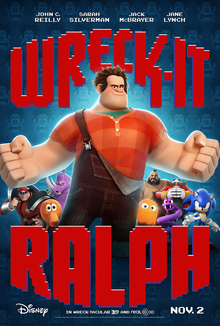
As I've mentioned before, I'm a big fan of Disney movies so when I started seeing previews for their latest offering, Wreck-It Ralph, I knew I'd want to see it. Originally I was fine with waiting until it was released on video, but then came along Superstorm Sandy. I had days without lights or heat and was feeling pretty down. Some of my other family members had power the whole time but were sick of being confided to their home. So we joined hordes of other people at the movie theater for the opening weekend of Wreck-It Ralph.
 Wreck-It Ralph tells the story of the titular character, an arcade video game villain in the game Fix-It Felix, Jr. The thing is, Ralph doesn't like being a "bad guy" who does nothing but destroy things all day. When the arcade closes for the evening, all the other characters in his video game hang out together, congratulating Felix and making him pies, while Ralph goes to sleep in the city dump alone. Ralph becomes fixated on the idea of earning a medal, which he is convinced will make everyone like him. So one day he leaves the safety and security of Fix-It Felix, Jr. for the chaos of Hero's Duty in order to win himself a shiny gold medal. Unfortunately, a wild series of coincidences later means his medal ends up in the game Sugar Rush, where a go-kart racer hopeful named Vanellope has need of the medal also, and Ralph finds himself becoming involved in trying to sort out the problems found in this video game. Meanwhile, back in Fix-It Felix, Jr. everyone is worried because without Ralph, the game is meaningless. The arcade owner has placed an out-of-order sign on the game and the characters are worried that he'll soon unplug it - and them - if Ralph doesn't return soon. This leads to Felix venturing out after Ralph and embarking on adventures of his own, including falling in love with Sergeant Calhoun of Hero's Duty.
This movie has a little bit of everything for everyone - there's lots of action and adventures, tons of humor, a little bit of romance, and some great morals. At times, the action might be a little too much for the youngest members in the audience who might get a bit frightened, but the movie is otherwise up to family-friendly expectations. As is typical of Disney movies, the humor works on two levels to appeal to both the children and adults in the audience. For instance, when Ralph is in Hero’s Duty seeking that shiny medal to bring home to his life in Fix-It Felix, Jr., children will probably find his slapstick mistakes of falling and whatnot in the game humorous while adults will get a chuckle out his plaintive cry of “When did video games become so violent??” There are tons of references to games both classic and new so gamers of all ages will get a chuckle out of these. Like with the movie Brave (and some others), I'm glad that Disney movies seem to be moving away from romances (after all, what child is really all that interested in adult relationships?) with this movie. But there is still an element of the romantic in this film with Felix, Jr. smitten by Sergeant Calhoun, and I'm happy to see that the lovelorn one is Felix while Calhoun is all business and only concerned about romance when she has finished the task at hand. In fact, the thing that seems to appeal to Felix the most about Sergeant Calhoun is that she is a no-nonsense, tough character who has what it takes to be a leader. But the relationship we see more of in Wreck-It Ralph is the begrudging friendship that grows between Ralph and Vanellope. Despite differences of age, gender, and background, these two become close friends by the end of the movie who are willing to make sacrifices for each other's happiness. That they both ultimately end up happy is no small testament to the power of friendship (and the fairy tale like nature of Disney movies). The friendship plot is not the only moral that can be derived from the movie though. Much of the movie is also about Ralph's quest to become a "good guy" instead of his role as the villain of Fix-It Felix, Jr. He initially thinks that merely having the trappings of a good guy (i.e., the gold medal) will be enough to make him a hero, but as the movie progresses he learns that more is involved in becoming a hero and he steps up to the place. Not only is there the great lesson about what being a hero really means, it's also a good reflection on the idea not being confined to a script. Just because people grow up with certain expectations for them (not amounting to anything or following a traditional path or what-have-you), we are each responsible for our own path in life - and defying expectations and/or stereotypes may very well be a part of that. Ralph and his goal of becoming a good guy is a clarion call for anyone feeling stuck in an unfulfilling role. Take a chance at something new and you might find the right place for you after all.
Featuring the voice talents of John C. Reilly, Sarah Silverman, Jane Lynch, and Jack McBrayer and the artistic talents of doubtless numerous animators, Wreck-It Ralph is executed perfectly. There's tons of fun details everywhere, even the credits, that tie into the video game world. While the film arguably doesn't pass the Bechdel test, it does feature two very interesting and intrepid main female characters, which is a lot more than Disney has given in the past to the little girls in the audience. I'd definitely recommend this movie for young kids - or for those who are just young at heart!
This movie has a little bit of everything for everyone - there's lots of action and adventures, tons of humor, a little bit of romance, and some great morals. At times, the action might be a little too much for the youngest members in the audience who might get a bit frightened, but the movie is otherwise up to family-friendly expectations. As is typical of Disney movies, the humor works on two levels to appeal to both the children and adults in the audience. For instance, when Ralph is in Hero’s Duty seeking that shiny medal to bring home to his life in Fix-It Felix, Jr., children will probably find his slapstick mistakes of falling and whatnot in the game humorous while adults will get a chuckle out his plaintive cry of “When did video games become so violent??” There are tons of references to games both classic and new so gamers of all ages will get a chuckle out of these. Like with the movie Brave (and some others), I'm glad that Disney movies seem to be moving away from romances (after all, what child is really all that interested in adult relationships?) with this movie. But there is still an element of the romantic in this film with Felix, Jr. smitten by Sergeant Calhoun, and I'm happy to see that the lovelorn one is Felix while Calhoun is all business and only concerned about romance when she has finished the task at hand. In fact, the thing that seems to appeal to Felix the most about Sergeant Calhoun is that she is a no-nonsense, tough character who has what it takes to be a leader. But the relationship we see more of in Wreck-It Ralph is the begrudging friendship that grows between Ralph and Vanellope. Despite differences of age, gender, and background, these two become close friends by the end of the movie who are willing to make sacrifices for each other's happiness. That they both ultimately end up happy is no small testament to the power of friendship (and the fairy tale like nature of Disney movies). The friendship plot is not the only moral that can be derived from the movie though. Much of the movie is also about Ralph's quest to become a "good guy" instead of his role as the villain of Fix-It Felix, Jr. He initially thinks that merely having the trappings of a good guy (i.e., the gold medal) will be enough to make him a hero, but as the movie progresses he learns that more is involved in becoming a hero and he steps up to the place. Not only is there the great lesson about what being a hero really means, it's also a good reflection on the idea not being confined to a script. Just because people grow up with certain expectations for them (not amounting to anything or following a traditional path or what-have-you), we are each responsible for our own path in life - and defying expectations and/or stereotypes may very well be a part of that. Ralph and his goal of becoming a good guy is a clarion call for anyone feeling stuck in an unfulfilling role. Take a chance at something new and you might find the right place for you after all.
Featuring the voice talents of John C. Reilly, Sarah Silverman, Jane Lynch, and Jack McBrayer and the artistic talents of doubtless numerous animators, Wreck-It Ralph is executed perfectly. There's tons of fun details everywhere, even the credits, that tie into the video game world. While the film arguably doesn't pass the Bechdel test, it does feature two very interesting and intrepid main female characters, which is a lot more than Disney has given in the past to the little girls in the audience. I'd definitely recommend this movie for young kids - or for those who are just young at heart!
Sunday, January 27, 2013
The Unforgiven: A Thoughtful Western with a Big Finish
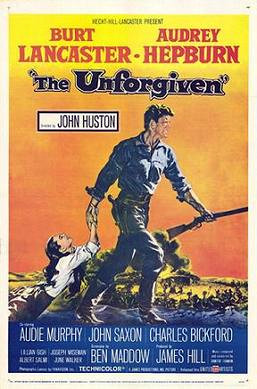
Despite having Burt Lancaster and Audrey Hepburn in starring roles (as Ben and Rachel, respectively) and John Huston at the helm as director, it seems like this movie hasn't survived the years as well as some other classic films. Note "seems" is the operative word in that sentence. I could be completely off base and it could remain very popular, but I only heard about it when I watched a biography of Audie Murphy, who played Cash in the film. However, both Hepburn and Huston had reasons for distancing themselves from this movie, which I'll talk about below, with Huston reportedly saying it was the only one of his films that he found dissatisfying.
Right off the bat, I should say that I'm not really a huge fan of Westerns. There are some notable exceptions but for the most part I find them rather dull. (The only time I ever fell asleep in a movie theater was while watching 3:10 to Yuma, a movie which pretty much epitomizes everything I dislike about badly done Westerns.) But this movie was very different. Like Marlon Brando's One-Eyed Jacks, this movie was more of a drama that happens to be set in the Wild West and concerns itself more with the pathos of the story and characters than with stereotypical Western machismo and shootouts. However, there was some of the latter in this movie (and in One-Eyed Jacks as well), as I'll discuss later on in this blog post.
One reason this movie was more dramatic than some other Westerns was because Huston, a veteran film director of critical acclaim (and incidentally, the father of actor Anjelica Huston), wanted to make a movie to explore racism in America - a very noble goal. Indeed, the movie is based on a book of the same name by Alan Le May, in which the author apparently discussed white America's hatred of its native people at length. However, the movie's producers were purportedly more interested in profit and desired a more traditional - and less controversial - Western. I presume this is the reason behind the movie definitely being interesting for beginning to shine a light on racism in America - specifically Caucasian Americans' fear and hatred of American Indians - yet leaving the viewer with the feeling that it didn't dig deep enough. It also seemed to undermine its own points at times by containing some rather stereotypical portrayals of the Kiowa tribe.
Nevertheless, I really enjoyed that this movie wasn't just surface level plotting but also contained numerous deeper themes. Besides examining racism and prejudices and their causes, the film is a thoughtful exploration of the meaning of family and family values (i.e., blood vs. adopted family, standing by one's family despite difficult truths, etc.). It also pits community and togetherness versus the questionable ideal of rugged American individualism, a quintessential Western standby. The movie portrays kangaroo courts and the idea of taking justice into one's own hands, which is also a frequently referenced thing in Westerns. And, The Unforgiven also pits against each other two different gender stereotypes: the hyper-masculine response of resorting to violence and death instead of letting quarrels die out naturally versus the nurturing feminine reaction of sheltering a baby and raising her despite past rivalries. It's worth noting that these two "gendered" reactions are not always exclusively the abode of the corresponding sex. Pa Zachary, when he was still alive, was initially the one to take Rachel in to the family fold, and her brothers, especially Ben and Andy, love her unconditionally. And as we see as the movie progresses, Ma Zachary will take her vengeance and is more than capable of handling a gun. (Fun fact: Lillian Gish, the actor playing Ma Zachary, was apparently a remarkable markswoman, more so than the men involved in the project.) Spoiler! Even Rachel totes a gun by the end of the movie and chooses her place alongside her adopted brothers by killing her biological brother in cold blood. All of these themes are presented not in a hit-you-over-the-head kind of way, but in an understated manner throughout the unraveling of the plot.
Likewise, a lot of the character development is unfolded quietly and over time in most cases. The romance between Ben and Rachel was a bit odd considering how they were raised as siblings, but the simmering chemistry between Lancaster and Hepburn was undeniable. And this romance didn't feel entirely tacked on, like in some movies where the hero and the heroine getting together just feels like the cherry on top that came out of the blue, if you pardon the mixed metaphors. Again, it was understated and slowly built over time. It started out innocently enough with Rachel seemingly especially excited by seeing Ben after his return from a long journey to Wichita and back, but the viewer might brush that off as simply a particularly close pair of siblings. The idea of such a romance then is brought up by and laughed off by Rachel and Ben when she says, "I could marry that handsome, winsome Charlie or that baby Jude. I could even marry you. ... Well, why not? We're not cousins. We're not even relatives." to which Ben retorts, "We're not even friends." in a joking manner. Things become more serious when the cattle hand Johnny Portugal reaches up to pull a nettle out from Rachel's hair and Ben's reacts with uncharacteristic anger, leaving the rest of the crowd to mutter that he sure is protective of his sister. The tension is palpable at points like this one.
The characters of Rachel and Ben were particularly compelling as Hepburn and Lancaster displayed excellent acting in this film. Hepburn developed Rachel from a carefree, joyful young girl to a burdened woman filled with pathos and self-sacrificial leanings, making this transformation completely believable along the way. Of course, she sounded more like Holly Golightly than the adopted daughter of a Texas cattle rancher and she seems far too fair-skinned to have anyone question her lineage as being native to the American West, but those things are what they are and the viewer soon gets pulled into the movie enough to overlook them. Like Hepburn, Lancaster expertly took Ben from a joking and loving brother, somewhat burdened by being the family patriarch and main breadwinner, to a torn man making tough decisions with heavy consequences. At the risk of overusing the word, pathos best describes the audience's feeling toward Ben and his actions by the end of the movie. Occasionally, Lancaster mumbled a bit and was thus difficult to understand - especially with his zingers in the beginning of the movie - but this also wasn't enough of a problem to seriously hinder my enjoyment of the film.
As Ben and Rachel were the main focus on the movie, their characters got to be the most fully developed but other characters also had their share of growth as well as a sometimes unclear set of motivations, making them three-dimensional beings. Cash, who started out as the most blatantly racist character of all, gets his chance for redemption and to look beyond his own fears and prejudices. Ma Zachary is a complicated character, as I've already mentioned, who can go from entirely sweet and nurturing to tough as tacks and violent at a moment's notice. She holds the family secret for a long time, managing to lie to her younger children for years in a way that still makes her seem loving and redeemable. (I say her younger children because it's more than obvious that Rachel's past in a complete mystery to Cash, Andy and Rachel herself. But it's unclear how much Ben knew all along; sometimes it seems like he knows all and other times it's possible he was in the dark as well.) Even Abe Kelsey, the saber-toting "villain" of the movie, has a tragic back story that leaves the viewer feeling somewhat sympathetic towards him.
Then, of course, there are times when the movie completely fails at character development. Most notably, there's the absolutely ridiculous character of Georgia Rawlins who all put throws herself at Cash's feet in her efforts to get married to him because that is her one and only goal in life. The other members of the Rawlins family are not well defined, and the relationship between Rachel and Charlie Rawlins never felt like something to be taken seriously as we knew so little about Charlie. His existence seemed more like a way to push the plot forward than anything else. And, as I've mentioned earlier in this post, the characterization of the Kiowa tribe members was anything but fleshed out or three-dimensional. They come in peace but briefly and are otherwise the "savages" of any other stereotypical Western movie.
Still, the movie's promising parts outweigh its flaws. One thing I can't stand is a Western that doesn't take the time to bother showing off the amazing landscapes of the American West. The Unforgiven, while studying complex characters and exploring deep themes, also stops to show off the beauty of the land with sweeping panoramas of gorgeous Western vistas. And, it's not just breathtaking beautiful scenery for its own sake -- the imagery is there to help tell the story in Huston's cinematography. For instance, there is one particularly poignant scene in which we stop and watch an abandoned piano set against a desolate backdrop of dusty land littered with dead bodies. It's an incredibly powerful image and gets to those deeper themes of culture and family versus violence and being alone. I will admit there were a few scenes of cattle and horses that seemed to go on a little longer that I would prefer, but they were also there to help further the story and its characters. In addition, they served to show off the various talents of the actors and extras, although they ended up leading to some personal injuries. While filming, Hepburn broke her back after being thrown from a horse and it's possible this injury later led to a miscarriage. Art has its casualties, too, and it's not pretty.
Being a Hollywood Western film, it's not enough for The Unforgiven to simmer with chemistry and fester with racism. It's almost obligatory that a Western end with a bang - quite literally - and thus we get the climactic ending to this movie. So if extended sequences of gun battles are not your thing, it's at this point that you might want to jump ship on this movie. Spoilers! Granted, this big finale of a final stand-off between the Zacharys and the Kiowa tribe allows for all the family members to show their true colors. But it also leaves all the tribal members dead, which is hardly the ending one would hope for in a movie designed to examine why American settlers and native tribes can't just get along. Considering that the Zacharys' bigger gripe seems to be with the community that refuses to accept Rachel now that they know the truth of her genetics, it seems odd that the family would be forced to fight off the tribe rather than their former friends. The latter might have been the truly controversial end to get audiences in 1960 to start thinking long and hard about prejudices. But instead we have a pretty much stereotypical ending to a Western movie, which is a bit of a letdown after everything else this film has offered.
Still, all in all, I was really rather riveted by this movie and quite enjoyed it. It definitely provides some food for thought, and those are the best kinds of movies in my opinion. (Even if an occasional light-hearted piece is necessary after a long and/or bad day.) I'm now considering watching John Ford's The Searchers, another Western film based on an Alan Le May novel concerning itself with prejudices directed at American Indian tribal members. But meanwhile I will simply say The Unforgiven is a movie that may have gotten dusty on the shelves over the years, but it should definitely be revisited and given a proper place in Hollywood history.
Monday, November 5, 2012
An Action-Packed Angelina Day
A while back, a friend and I decided to do a comic
book themed movie night, and among the movies on the table that night were Wanted and Salt. (Yes, I know this latter one isn’t actually based on a comic
book, but it felt in line enough with the other movies we’d selected to seem
appropriate, plus it helped even out the balance of male protagonists versus
female protagonists just a little bit.) We didn’t have time for these two
movies (and I suspect my friend, being not much of a fan of Angelina Jolie, did
not have them high on her list) but with my cable and Internet out for a couple
of days due to Hurricane Sandy, I decided to finally watch these two DVDs. The
basic plot of each, along with my thoughts on the movie, is below.
Wanted
Basic plot: Wesley Gibbons (James McAvoy) hates his life:
his low-level job with a terrible supervisor, his dwindling bank account, his
cheating girlfriend, and his best friend who is party to this affair all leave
him feeling used and useless. But this all changes when a routine trip to the
pharmacy ends up becoming a gun fight between a Cross (Thomas Kretschmann), a
man trying to kill him and Fox (Angelina Jolie), a woman trying to save him.
After a narrow escape, Fox takes Wesley to meet Sloan (Morgan Freeman) who
explains the situation: Wesley is the son of an assassin for an organization
known as the Fraternity. Wesley’s father has in turn been assassinated when Cross
left the Fraternity and went rogue. Now it is up to Wesley to train to become a
world-class assassin as well and revenge his father’s death by going after
Cross.
There was just way too much violence, obscenity, and
sexuality in this movie for me. As I’ve probably mentioned before, I’m not a
prude but I want a story and/or fleshed-out characterizations, not just
gratuitous examples of the above. There’s a twist near the end of Wanted that makes the plot a bit more
interesting but it’s kind of a case of too little too late. Like many action
movies, there’s a lot of ridiculousness in terms of completely unbelievable
scenarios – i.e., the hero of the film can single-handedly take out a room fill
of armed enemies without getting a scratch, or the hero is shot multiple times
but miraculously heals within hours to fight back again. This movie ups the
ante but defying gravity with bullets that shoot out of guns on a curved angle
instead of straight and cars that flip over gracefully without missing a beat
or harming a single passenger. It also features Jolie’s character in heels and
a dress in the first fight scene, which is such a you-got-to-be-kidding-me
moment (but sadly not that unusual for many action flicks). Later, she’s more
appropriately dressed for the most part although she’s still sometimes seen
roaming around in cutoff tees.
There’s very little in terms of characterizations to make
any character feel realistic in any sense. Fox is given a bit of a back story
that helps explains her and her motivations, but nearly everyone else has no
history. Indeed, many members of the Fraternity remain completely nameless
while others are simply known by code names such as “The Repairman” and “The
Gunsmith.” Even though he is the main character, Wesley does not have much in
terms of a full range of characterization either. His motivations to join the
Fraternity are pretty slim: He’s unhappy with his current life of being
metaphorically kicked around and punched in the face so he goes into a new life
of literally being kicked around and punched in the face??? Clearly, that’s a
very logical step in the right direction. Wesley’s motivation largely comes
from this fixation of becoming like his father and a belief that living in his father’s
footsteps is his destiny. This is despite the fact that his father abandoned Wesley
when he was just an infant, which wouldn’t seem endear a lot of familial pride for
many.
The mystery here is how such talented actors as Angelina Jolie,
James McAvoy, and Morgan Freeman were all convinced to make such a shoddy
movie. I give props to the film’s creators for being able to snag such a great
cast, finding a suitable soundtrack, and using some impressive visual effects.
But sadly those ingredients alone aren’t enough to make a good movie. Still, I
suppose the movie’s creators must have been doing something right for they
obviously made enough profit that they are considering making a Wanted 2.
Salt
Basic plot: Evelyn Salt (Angelina Jolie) is a CIA operative
having just another day at work when she goes in to interview a man who claims
to be a Russian defector. He tells her a story about a plot for a Russian
double agent to assassinate the Russian president while he is on U.S. soil, thus creating conflict between the United States and Russia. He then names the Russian
double agent: Evelyn Salt. Salt finds herself being held for questioning,
worried about her own future as well as the safety as her husband. She escapes
custody and while on the lam engages in a series of events that leaves the
audience questioning whether she really is a double agent and where her
allegiances lie.
Compared to Wanted, this was a much better movie. There’s still
a lot of violence and more action (versus plot) than I generally care for, but
there was enough of a story and a mystery (along with characterization,
motivation, etc.) to keep it interesting. While it’s not as stylized and heavy
on effects as Wanted, the
cinematography and visuals are still well done and even at times quite lovely. Like
Wanted, it has a good soundtrack that
appropriately fits the movie. And, it’s less of a mystery why Jolie took this
part, as it allows her to really show off her acting chops. The other actors –
particularly Liev Schreiber and Chiwetel Ejiofor as Salt’s CIA co-workers – all
do excellent work as well.
One thing I had found interesting about this movie from the
outset is that the role of Salt was originally
written for Tom Cruise, who was unavailable for filming, thus opening up
the role for Jolie instead. So, long before I watched this movie I had been
interested to see how a role created for a man became one for a woman and
whether this would get us any closer to gender equality in Hollywood
representations. For starters, I can say that this movie features a lot less of
the running around in tight dresses and heels like other action films with
female leads tend to do. Unlike other action films starring Jolie (i.e., Wanted, Lara Croft: Tomb Raider), the obligatory scene of her character
coming out the shower was also not present in this movie, providing a breath of
fresh air. All in all, there’s nothing about Salt’s character that makes her
feel like a stereotypically overly feminine character - or like a character
everyone has to point out is atypically tough “for a woman.” Instead, she is
just a character that poses a threat for various concerned groups while they
are doing their best to try and stay one step ahead of her. This is a movie I
would recommend if you are interested in strong female leads, action
movies with actual plots and characterizations, and/or a good mystery to try
and crack.
Sunday, November 4, 2012
Brave Enough to Say No
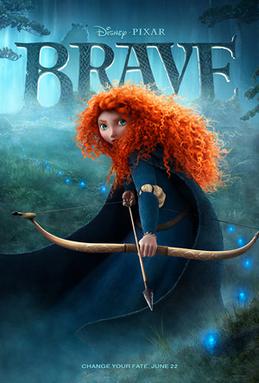
I’ve been a huge fan of Disney and Pixar movies in the past,
even the princess movies that rankle many. Yes, as a feminist I understand the
many problems inherent in these movies with their troubling
portrayals of women, but I grew up on them and they hold nostalgic memories
for me. I am not pining away, waiting for my prince to come and make my happily
ever after come true, but I still enjoy the music, animation, and
cinematography of these movies.
So when Disney/Pixar started advertising its latest princess
offering, Brave, there was a good
chance I was going to check it out. And then when I read this
article detailing the co-director’s inspiration for the movie and
describing how this film with a strong female lead came into being, I was
hooked. Last month I finally got the chance to sit down and watch this movie –
while I was on a plane and this was luckily one of the choices. (It might be
worth noting that I wasn’t the only childless adult watching this movie; I even
noticed a couple of adult men picking this movie out of the many options available.
So much for Disney’s concerns that only young girls will view princess movies.)
Brave tells the
story of Merida,
a Scottish princess who loves archery and horseback riding but is often forced
indoors by her mother to practice the etiquette of being royalty. Merida dislikes this but
does as she told – until one day her parents tell her it is time to be wed and
three princes arrive to contest each other for her hand. Merida
rebels and runs off into the woods, where she stumbles upon a witch who concocts
a potion that will help Merida
change her mother. Well, change her it does – right from a human being into a
giant grizzly bear. Now Merida
has even bigger problems on her hands than just convincing her mother not to
marry her off – will she be able to hide her mother from her bear-hunting
father long enough to reverse the spell?
There were a lot of things to like about Brave. Of course, as we’ve come to
expect from Disney and Pixar, the animation is top-notch. As in many other
Disney/Pixar movies, the movie includes a few sweet songs as sung by Merida, which are quite
nice and I’d probably listen to just as regular songs without the context of a
movie. Personally, hearing the Scottish accent of all the characters was a fun
change of pace from the non-accent of most Hollywood casts, even when the movie
is supposedly set outside of the California
hills. The movie is also good at putting forth some moral lessons without being
overly didactic.
Furthermore, this is a very female-centric movie, which sadly
cannot actually be said about all princess movies. There is the strong
mother-daughter relationship, unlike in many fairy tale-based movies where the
mother is absent and/or the mother figure is evil. In fact, what we have here
is rare in many Disney/Pixar movies – an entire intact family of mother,
father, daughter, and two sons. (This may be a bit ironic – or something – that
Disney finally releases a movie with a traditional family of two parents and
2.5 children when the traditional family is morphing into something else
altogether.) One thing I really enjoyed about the movie focusing not just on Merida but also on her
mother was that it gave the opportunity to show two kinds of female strength. Merida is portrayed as
strong and brave in part because she is something of a tomboy, who prefers
archery and traditional male hobbies. But – and this is more subtle – her
mother is also portrayed as strong in a more traditional female role. She is
able to subdue a room full of rowdy men with her stately and elegant appearance
combined with a calming speech.
And, I really appreciate that the movie is actually an anti-romance – given the movie’s target
audience of young children, I think that is quite appropriate for a change. Merida does not give up
on the idea of marriage entirely or denigrate it at all, but she simply refuses
to get married at a time in which she is not ready to a person who is not of
her own choosing. Spoiler alert!: The film does not end with her falling for one
of the three princes or meeting a fourth prince who sweeps her off her feet,
but it is open-ended enough that the viewer can believe Merida will eventually
fall in love and marry or that she will remain single and happy that way. I had
been concerned that the movie would go the route of Aladdin where Princess Jasmine refuses all her potential suitors
but then changes her mind eventually when Aladdin arrives on the scene. That’s
a fine storyline also as it introduces the idea of choosing one’s own path
rather than having it chosen by others, but I’m glad that this movie took it
one step further to suggest that Merida might still live happily ever after
even without a husband on the horizon.
Like with many other Disney/Pixar films, there is a lot of
humor is the movie. I’m sure kids in particular will find the many slapstick
moments hysterical, especially the antics of Merida’s two younger brothers who can’t seem
to keep themselves out of trouble. But a lot of the humor comes at the expense
of the male characters, and this is the only real fault I find with the movie.
For the most part, the male characters are seen as little more than barbarians
– they are none of them particularly intelligent, and it takes little to have
them all begin fighting with one another. If they are not fighting one another,
then they are all mindlessly chasing down a bear that only one character has
sensed or trying to show off their physical prowess is some other way. Albeit,
the king does have some better moments, and it is clear that he is loving
husband and doting father. But for the most part, this movie doesn’t give the
best impression of men as a whole, especially when a lot of them are put
together in the same room. As a feminist, I rankle at this portrayal also –
it’s a misconception that feminism believes or seeks to make women superior to
men; most feminists simply wish us women to be on the same playing field as men
and to stand there being treated equally and fairly, not judged to be either
inferior or superior based solely on the existence of a second X chromosome.
It’s harmful to everyone – but probably most especially children – to portray
one sex as somehow inferior to another in any aspect.
Still, all and all, I enjoyed this movie and appreciated
this twist on the traditional princess movie. For that reason, I highly
recommend it for all of us who grew up on princess movies because I think we
would most appreciate its subversion of the genre. Of course, I’d also
recommend it for its target audience of young children but with the caveat that
parents co-view
with their kids and point out some of the harmful representations of male
characters in addition to pointing out the helpful representations of female
characters.
Thursday, October 25, 2012
What’s Hiding in the Dark Shadows?

However, that all changed once I started seeing trailers for the Dark Shadows movie. It looked very
funny, albeit a bit cheesy, and I really liked the idea of a character
re-awakening nearly two centuries later and having to figure out the new
cultural milieu. And I learned that in addition to Depp, the movie featured a
cast of excellent actors including Jonny Lee Miller, Jackie Earle Harley,
Helena Bonham Carter, and Michelle Pfeiffer. While it still wasn’t super high
on my list of movies to see, I became interesting in viewing the movie at some
point. That point came when I was flying recently and Dark Shadows was one of the choices for the in-flight movie.
The basic plot of the movie is that the wealthy Collins
family settles into a small fishing town in Maine that they name Collinsport, back in
the 18th century. Their son Barnabas trifles with a servant,
Angelique, but then falls in love with another woman. In retribution, Angelique
– who of course is a witch – wreaks havoc on Barnabas’s life and ultimately
turns him into a vampire and has the town bury him in chains. When a group of
construction workers accidentally release Barnabas from his coffin, he returns
to the family home and learns the year – 1972. He meets the new members of the Collins
family and their household – Elizabeth, Roger, Carolyn, and David Collins in
addition to Dr. Hoffman (a psychiatrist), Willie Loomis (the groundskeeper) and
Victoria (a governess). The Collins family fortune has been much reduced and
Barnabas promises to help restore it. He learns that the family’s arch nemesis
is still Angelique, although she has changed her name/identity over the years to
avoid suspicion about how she never ages. Angelique – still in love with
Barnabas and angry at his betrayal – vows to make life hell for Barnabas all
over again if he refuses to love her in return.
As you can probably start to tell by how long my “basic plot”
summary is, this movie tried to pack way too much into a relatively short time.
It just wasn’t working, as there wasn’t enough time to develop all the plot
lines, let alone all the characters. There was so little known about many of
the characters and unfortunately, oftentimes the little that you did know made
you dislike them as there wasn’t enough time built in to include redeemable
characteristics. (I’m thinking in particular of Jonny Lee Miller’s character, Roger,
with this last remark.)
I didn’t mind so much the Angelique turns Barnabas into a
vampire storyline in the beginning, mainly because the plot has to start
somewhere and I’m guessing this is where knowledge of the original series comes
into play. But seriously centuries have gone by and Angelique is just pining
away for Barnabas still??? It’s this tired scorned woman
trope which relies on the idea that a woman cannot possibly move on from one
failed relationship to another more successful one. Seriously, let me
reiterated – nearly 200 years have passed and this beautiful, never-aging, spell-casting,
wealthy, business-savvy woman is incapable of finding someone better than the
guy who used her and then dumped her like a bad habit.
Meanwhile, Barnabas – while temporary distracted by
Angelique – is taken in by Victoria, who resembles his lost love. This
relationship blooms super quickly, I suppose a necessity in the crunched time
available for the movie to unfold, without the two interacting much. Because of
the whole past love resemblance thing, it’s not entirely unreasonable for Barnabas
to be smitten easily but the reciprocity of feelings is a bit of a stretch.
Seriously, has Victoria
looked at this man in a clear light ever? Or even in a murky light? There is clearly something off about him, on many different levels. Yet, for some
reason, when it becomes beyond apparent later that he’s a vampire, she is
surprised as though it wasn’t obvious that something was unusual about him.
Victoria
is one of those characters that suffers from the compressed time allotted for
the movie, as I mentioned earlier about characterizations in general. When she’s
introduced early on in the film, we know that she is lying about herself and
her background is unclear but by the time that she is able to explain some of
this, we’ve already lost interest in her as she’s seen so little screen time
since her introduction. The big reveal about her is definitely one of those “too little, too late” situations. Not dissimilar to Angelique’s lack of real characterization,
the rest of the time Victoria
is mostly a mash-up of two common tropes: the mysterious
waif and the ingénue.
Together, these two female characters do a pretty decent job of fulfilling yet another trope: the virgin-whore complex. Angelique, the scullery maid who owns her sexuality and freely gives her body to Barnabas, is an evil witch while Victoria, the sweet governess who never shares more than a kiss with Barnabas, is the perfect angel everyone adores. Don't believe me? Just take a look again at the promotional movie poster (picture above). That's Angelique, looking curvaceous and seductive in a revealing vibrant red dress. Victoria is the one in the background on the left, looking like a 12-year-old school girl in a staid, all-concealing dress with a large collar to doubly ensure that she's all covered up. Honestly, the black dress with a white collar practically screams nun in a sheltered convent, as though the girl has made vows of chastity. If this were the actual TV series from the 1960s-70s, I probably wouldn’t object so much to such a black/white dichotomy but a remake should not simply repeat the sins of the past and continue to evoke such damaging portrayals of women.
Together, these two female characters do a pretty decent job of fulfilling yet another trope: the virgin-whore complex. Angelique, the scullery maid who owns her sexuality and freely gives her body to Barnabas, is an evil witch while Victoria, the sweet governess who never shares more than a kiss with Barnabas, is the perfect angel everyone adores. Don't believe me? Just take a look again at the promotional movie poster (picture above). That's Angelique, looking curvaceous and seductive in a revealing vibrant red dress. Victoria is the one in the background on the left, looking like a 12-year-old school girl in a staid, all-concealing dress with a large collar to doubly ensure that she's all covered up. Honestly, the black dress with a white collar practically screams nun in a sheltered convent, as though the girl has made vows of chastity. If this were the actual TV series from the 1960s-70s, I probably wouldn’t object so much to such a black/white dichotomy but a remake should not simply repeat the sins of the past and continue to evoke such damaging portrayals of women.
Warning: Spoilers ahead!
To make matters worse, the ending of the movie becomes beyond absurd. Out
of the blue, teenager Carolyn Collins is revealed to be a werewolf, and young
David Collins’s belief that his mother is a ghost is confirmed, complete with visuals. Whereas earlier
Barnabas and Angelique could throw each other around the room and destroy the
place during their passionate love-making, when they fight at the end Angelique can suddenly be broken into tiny
glass pieces by the slightest touch of Barnabas’s hand. This kind of lack of
continuity makes me crazy. Please stick to the rules of the world you have
created.
My feelings about a lot of the extended and clearly-meant-to-be climactic fight scene between the Collinses and Angelique were, “oh, come on! You’ve got to be kidding me.” Later still, when Victoria – in a Bella Swan moment – suddenly insists that Barnabas turn her into a vampire so they can be together forever, there isn’t any sense that this is a logical next step for a character who hardly knows Barnabas at all. It’s just an attempt to tack a happy ending onto an otherwise fairly dark movie.
All and all, I found this movie incredibly disappointing. As I mentioned already, the characterizations were mostly weak and I felt like a hugely talented cast was largely wasted. Furthermore, the movie was not as funny as I’d hoped for, with the scenes of Barnabas re-acquainting himself with the world after centuries in a coffin largely covered in the trailer with no further expanding upon in the movie itself. I had expected a lot more of these funny sequences rather than what I got instead. There was a lot more violence and gruesomeness than I had anticipated, and the movie felt more dark with only an occasional hint of humor rather than the darkly funny that I’ve come to expect from Tim Burton’s movie.
My feelings about a lot of the extended and clearly-meant-to-be climactic fight scene between the Collinses and Angelique were, “oh, come on! You’ve got to be kidding me.” Later still, when Victoria – in a Bella Swan moment – suddenly insists that Barnabas turn her into a vampire so they can be together forever, there isn’t any sense that this is a logical next step for a character who hardly knows Barnabas at all. It’s just an attempt to tack a happy ending onto an otherwise fairly dark movie.
All and all, I found this movie incredibly disappointing. As I mentioned already, the characterizations were mostly weak and I felt like a hugely talented cast was largely wasted. Furthermore, the movie was not as funny as I’d hoped for, with the scenes of Barnabas re-acquainting himself with the world after centuries in a coffin largely covered in the trailer with no further expanding upon in the movie itself. I had expected a lot more of these funny sequences rather than what I got instead. There was a lot more violence and gruesomeness than I had anticipated, and the movie felt more dark with only an occasional hint of humor rather than the darkly funny that I’ve come to expect from Tim Burton’s movie.
In case you can’t tell, I’m not recommending this one. If
you are a huge Dark Shadows fan,
perhaps you’ll want to check it out to any similarities/dissimilarities with
the original series. But if like me, you are just looking for an entertaining
movie, look elsewhere.
Sunday, September 2, 2012
Rango, the Tiny Lizard with a Lot of Gumption
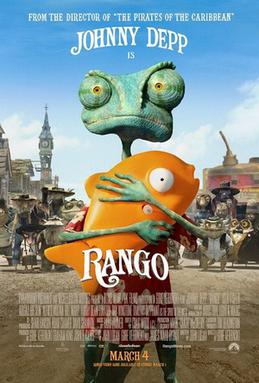
This Nickelodeon movie came out last year and although I had wanted to see it at the time, I finally got around it to when some family from out of state was visiting. After having suggested the movie for our outdoor movie night (an annual favorite pastime), I was a little nervous at first as the movie was a bit slow going in the beginning. It picked up though and became very funny as well as action-packed and holding a mystery to be solved. Rango held the attention of both kids (of all ages) and adults alike, which probably isn't a huge surprise given that it won an Academy award for the best animated picture as well as numerous other awards. Like with many other animated features, Rango works on two levels - there's the basic storyline and slapstick jokes aimed at children while there are also a number of Easter eggs and quips that appeal only to adults. For instance, there are numerous references to classic Western movies, and I have to admit some of these probably went over my head as well as over the heads of the children and teens in our audience. However, a brief reference to Fear and Loathing in Las Vegas, in which Johnny Depp also starred, had me cracking up.
Rango boasts a considerable amount of Hollywood talent. For starters, it teams up director Gore Verbinski and actor Johnny Depp once again (as with the first three Pirates of the Caribbean), with Depp spot on as the voice of Rango. Amongst the other talented cast members are Alfred Molina, Abigail Breslin, Bill Nighy, and Ned Beatty. Several of the voice actors, including Depp, play more than one character, which can surely be no easy feat.
However, there are a few down sides to this movie. As I mentioned earlier, it started a bit slow but then picked up a great deal with additional comedy and also some adventurous moments. But to be honest, I actually got bored during some of these extended action-packed sequences. This is not a fault of Rango only; I find that as I age, I am much more interested in plot and characterization, resulting in me becoming bored with yet another long scene devoted to some sort of fight and/or chase, which will inevitably end with the good guys winning. A second problem, and one that I find more troubling, is that it's debatable whether Rango passes the Bechdel test - if it does, it's by the skin of its teeth, which isn't a great sign of a movie being female-empowering. Likewise, it has some troubling portrayals of non-white ethnicities as well. Both of these issues may be related to the fact that Rango is inspired by - and parodying - old Western movies. For instance, take a scene like the one in which Rango is leading a posse into the desert to search for the bank robbers. One member of the posse, named Wounded Bird, is very much meant to be playing the role of the mystical American Indian. I rifled at first at the idea of this character, but then these lines came out as Wounded Bird is releasing some feathers into the wind:
Rango: I see you're communicating with the great spirits.
Wounded Bird: No. I'm molting. It means I'm ready to mate.
It's incredibly clever and turns a stereotype on its head. Still, I'm not sure how much - and what exactly - young children are absorbing when they see and hear from characters such as these. There's also a framing device used in the movie, once which breaks down the fourth wall a bit, in the use of a mariachi band of owls. Again, perhaps it's a bit stereotypical, but it's also very funny as the mariachi band frequently employs dramatic irony that is quite wrong. For instance, they keep predicting Rango's demise and death at various points only to later have to shrug and say they were wrong that time. There's also this great scene:
Rango: Now... we ride!
[whip cracks; Rango stops and looks to his right, puzzled]
Rango: [the band of mariachi owls stands a ways away with their instruments, waiting; Rango shouts to them] That means we're riding now! This moment.
[another whip is heard and the owls start playing the background music; everyone is riding roadrunners in the next cut]
All in all, I like the addition of the mariachi band, but I again wondering about what take-away children derive from their presence. And, of course, the entire West (or at least what we get to see in this film) is one giant stereotype based on old movies, with a saloon being the most crowded place in town, a main dirt road for shooting duels, and so forth and so on. Even though the rest of the world seems to be in the 21st century, the town of Dirt is stuck sometime in the 1800s or early 1900s at best.
Still, I found this movie entertaining enough to enjoy it at the time and I would not object to watching it again, especially to see if I caught more of the in-jokes and Western references a second time around.
Monday, July 2, 2012
Sky Captain and the Soaring World of CGI
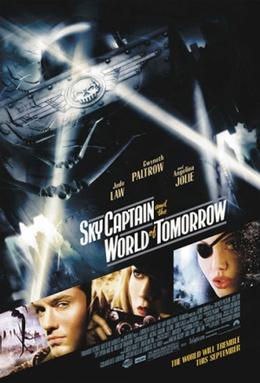
Sky Captain and the World of Tomorrow takes place in an alternate reality 1930s New York. Intrepid reporter Polly Perkins (played by Gwyneth Paltrow) is following up on a story about missing scientists when a group of gigantic robots invades the city, creating havoc. Polly decides to seek help from her daredevil ex-lover Joe Sullivan (Jude Law), also known as "Sky Captain" due to his line of work as a mercenary pilot. The two go a quest to find Dr. Totenkopf, a shadowy figure they know little about but suspect is behind both mysterious events. Along the way, they meet many adventures and call upon the help (and are called upon for help) of friends both new and old, including Franky Cook (Angelina Jolie) -- another ex-lover of Joe's and source of contention between Polly and Joe.
There are so many things wrong with Sky Captain and the World of Tomorrow that I'm not even sure where to begin. The characters lack real three-dimensionality and their back stories are weak. For instance, how and why did Joe become a pilot for hire? What kind of previous escapades had he participated in? What made him famous enough to be called upon in a pinch? How did he derive the nickname "Sky Captain"? When and how did he first meet and become involved with Polly? And so on. The movie does try somewhat in this respect, as there are numerous hints dropped about Joe and Polly's past (and Joe and Franky's past, to a lesser extent) but these are never fleshed out satisfactorily. Good characters are the most crucial part of most (if not all) movies, in my opinion, and I felt like the wonderful cast of actors assembled here was wasted by these one-dimensional characters. Polly felt like a combination of tropes - the stereotypical "girl Friday" meets Lois Lane - while Joe was any generic action film hero. Furthermore, the dialogue between these characters came across as very scripted and nothing memorable comes to mind. That is, except for the final line, which stands out because it is just plain ridiculous.
The plot is thin at best, and the ending (no spoilers) is cliched and anti-climatic. Rather than flesh out characters or plot, the nearly two-hour long movie is instead an almost non-stop action sequence. (I saw Lucasfilm scroll up during the credits, so now you are forewarned about what kind of movie this will be.) And this is not just any action -- it's almost entirely computer-generated action. Worse still, it's not even computer-generated images at its best or even mediocre as it's an absurdly unrealistic style of animation. The ridiculous robots add to the campy feel of the movie, along with the not-so-funny attempts at humor. The sepia color palette adds to the stylized look, but it is too dark a visual to sustain for nearly two hours.
Stylistic is definitely the adjective of choice for this movie. While sometimes this is novel or interesting, it does not make up for the lack of plot or interesting characters and relationships between them. As the USA Today review of the movie put it: "Sky Captain and the World of Tomorrow is all style over substance, a clever parlor trick but a dull movie." While the retro feel and the unique look of the movie is appealing for about 15 minutes or so, this appeal quickly wears off and the viewer is left debating whether or not to even bother continuing to watch the movie through to its end. (It's worth noting that I did keep continuing in the movie's favor with this debate, all the way to the grand finale, and was then regretting that I hadn't turned it off early on.) Another reviewer puts it this way: "Imagine you are in Starbucks and you are ordering a cappuccino, but your server puts the milk in and froths it up and serves it to you, forgetting entirely to put in any coffee. It couldn't be called a 'cappuccino', but it certainly could be called SKY CAPTAIN."
On the plus side, Paltrow and Law valiantly do their best at their roles. (Jolie's role in the movie is so brief as to render me unable to really comment on her acting.) In the hands of lesser actors, this could have been a far worse movie. As I mentioned earlier, the visual style of the movie can be appealing at times and does seem to capture a lot of the 1930s nostalgia, particularly as embodied in the look of Paltrow's character. (This still does not make up for lack of plot though!) An interesting use of technology in this movie is the cameo appearance of Laurence Olivier. Yes, THE Laurence Olivier who was already long-deceased when this movie was produced. With the use of computer programming, the movie was able to generate a brief speech from Olivier based on video and audio available from his heyday. Now that's putting CGI to a good use!
Subscribe to:
Posts (Atom)