Showing posts with label animated movies. Show all posts

Sunday, February 5, 2017

Come On, Get Happy

As I've lamented before on this blog many a time, winter is my least favorite season of all. It is looong, cold, dreary, and dark. It makes me wish I was a bear who could hibernate these months away and emerge well rested for spring. But since that's just a fantasy that won't happen, I've been trying to dispel my winter blues with fun and light-hearted movies -- not my usual fare but perfect for lifting my spirits, even if just temporarily. And as I've been away from this blog for a while, I thought I would try a quick summation of those movies in this one post. (It may get a little long though...)

To try to improve my mood, I watched these three movies in recent weeks: The Answer Man, Zootopia, and The Peanuts Movie. Two kids' movies and a romantic comedy -- this is how I roll in the winter, people.

The Answer Man

This is a romantic comedy from 2009 about a hermetic best-selling author and a single mom with a recently opened small business who meet almost by happenstance and decide to start dating. Literally, the entire rationale behind me watching this movie was "Lauren Graham is in it." The description sounded okay, and I was willing to give it a try, but I was not expecting much. With that attitude going in, I was surprisingly pleased. Sure, the romance part was pretty flat, but the acting was superb, the comedy was good, and it was really more of a story about the author becoming a more social and caring human being than it was a purely romantic comedy. I'll address each of those points a little more fully below.

Jeff Daniels as author Arlen Faber was comedy gold in a multi-faceted role. Faber is a character who is struggling with a number of things -- physical pain from a bad back, a crisis of faith, a desire to be left alone by the people who want to adulate him for his best-selling religious books, and coming to terms with being needed by others and finding himself wanting to be around other people as part of their lives. Lauren Graham was predictably wonderful, presenting her usual mixture of fun-loving comedy turning to fierce drama at a moment's notice. As she herself once noted, she does seem to be typecast into the single mom role, and there were a few moments in the opening of the movie that felt like the movie was trying to give us Lorelei Gilmore with a young son instead of teenaged daughter. But then the character of Elizabeth comes into her own, and we see her more as a dedicated chiropractor, determined to help patients and see her small clinic succeed, and as a friend/love interest to Arlen.  Lou Taylor Pucci as recovering drug addict and struggling independent bookstore owner played perfectly whether in humorous or serious scenes, in either case serving to further stretch Faber's growth and development. Smaller roles were well acted and rounded out the cast of quirky characters.

As I've probably mentioned in the past, I'm not the hugest comedy fan - especially sitcoms or romantic comedies, which tend to feel very predictable and, as a consequence, dull. But that being said, I found myself laughing quite a bit with this movie. A lot of that came from Faber's unexpectedly foul-mouthed or flippant sayings, but some of it was physical and situational humor as well (like Elizabeth trying to promote her business by having her assistant dress up as a giant spine outside their office or Faber being pulled unexpectedly into a parent-teacher conference for Elizabeth's son). There's also a bit of the "awkward first date (or three)" conversational humor, which is a somewhat stereotypical romantic comedy move, but that's usually the best part of any rom-com in my opinion. 

And, finally, I enjoyed this movie more than the standard fare romantic comedy because it was much more than just that. The movie addressed Arlen's need to get outside of himself and his worries to connect with other people and care about them. Sure, that included a potential romantic partner, but it also included her son and people in the community like Kris the bookseller. Faber doesn't completely change his personality or attitude but he does become more willing to embrace other people and help them on their course through life, in turn helping himself to be more compassionate. That may sound overly sentimental, but the movie manages to stay *just* above the rim of being truly sappy. 

Like I said at the beginning of this movie review, I was surprisingly amused and entertained by this movie. And I'm surprised to find myself recommending it as well if you want something on the cheery side for your next movie pick.

Zootopia

A good number of the little kids (and grown adults for that matter) in my life had already seen this movie when it came out in theaters and loved it. I figured I'd get around to it eventually, which turned out to be a day I was still in a down mood. Zootopia tells the story of Judy Hopps, a bunny from a small rural community who can't wait to become a police officer in the big city of Zootopia, despite the nay-saying she hears from literally everyone, ranging from the local bully to her own parents. She persists in her goals anyhow, passing all the hurdles to becoming a police officer and arriving in Zootopia to learn about an ongoing missing animals case, to which she is not assigned because, again, no one believes a small rabbit can accomplish much. But through a series of unexpected circumstances, she ends up partnering with Nick, a con-man (or con-fox, as the case is) to uncover a much bigger conspiracy that anyone expected.

As you might expect from a children's animated movie, there is all kinds of humor in Zootopia, ranging from very obvious slapstick bits for kids to references clearly meant for adults. My favorite two scenes that had me laughing out loud involved a DMV office run entirely by the slowest moving sloths and an introduction to the criminal boss, "Mr. Big," who mimicked several Godfather lines. The movie definitely hit the spot in improving my bad mood, even if it didn't succeed in doing so for a terribly long time. 

But Zootopia also succeeds in presenting a number of important issues to children in a digestible form without being overly didactic. There is soooo much about not judging people by their outside appearance but instead by their personal qualities, like commitment to righting wrongs and perseverance in the face of internal and external doubts. Yes, there are times when some of this lesson is a bit heavy handed, but it's never a "hit you over the head" morality tale. 

Like we've all come to expect with a Disney movie, this one features a lot of talented actors lending their voices to various characters, including Ginnifer Goodwin as Judy, Jason Bateman as Nick, Idris Elba as the police chief, Shakira as the pop star Gazelle (giving the film its catchy theme song), and many many more. As we've all come to expect with an animated film from Disney, the success of Zootopia has inevitably led to there being talks of a possible sequel, one which ::eye roll:: many hope will lead to Judy and Nick getting together as a romantic couple. Let's just hope that any follow-up movie is of as high a caliber as this first one was. 

The Peanuts Movie

Last, and let's admit it, least, I watched the new reincarnation of Charles Schulz's characters that is The Peanuts Movie. As a bit of background, I've never been the hugest Peanuts fan, though I do generally find some of the older short movies both funny and fun to have on around the appropriate holidays. This movie, written by Schulz's son and grandson, stays true to the original characters in interesting ways, but it is sometimes perhaps a little too true to them. Bear with me as I explain.

The Peanuts Movie is largely centered around Charlie Brown's crush on the new girl at school (known simply as The Little Red-Haired Girl) and his myriad attempts to do something great to get her to notice and like him. But because it's Charlie Brown, these attempts inevitably do not turn out as planned. Throughout his many endeavors, Charlie Brown's myriad friends, including his sister Sally and his loyal dog Snoopy, strive to help him out. At the end of the school year, when Charlie Brown finally manages to just talk directly to The Little Red-Haired Girl, she says that she admires all the good qualities he demonstrated when things went wrong, including his selflessness in advancing others before himself. 

Among many of the nods to the original comics include Lucy pulling the football away from Charlie Brown at the last moment, the kite-eating tree, Marcie inexplicably calling Patty "sir," the muffled voices of all adults (voiced here in a stroke of genius by Trombone Shorty), and Snoopy's dreams of being an ace war pilot battling the Red Baron for the skies. This last one has always been a bit of an odd one in my opinion, and some parts of the movie involving these scenes went on a little too long for my liking. There's also a love interest for Snoopy here, mirroring Charlie Brown's story back in the real life part of the movie. 

Also true to the original Peanuts were the many bizarrely romantic relationships seen among schoolchildren. Perhaps because Charlie's crush is the focus on this movie, I started noticing these relationships more than I usually do. Almost all of them involve girls who nag and borderline bully boys into liking them back (e.g., Lucy and Schroeder, Sally and Linus, Peppermint Patty and Charlie Brown). Meanwhile, Charlie Brown's entire basis for liking The Little Red-Haired Girl is that she's "pretty" and she chews on her pencil like he does. He never even learns her name. She is literally "The Little Red-Haired Girl" from beginning to end of the movie. The weird relationship dynamics were kind of unsettling as an adult, and it makes me wonder what kind of message is being sent to kids when they watch this movie. I understand that attempts were being made for continuity between the past Peanuts and the present, but some of this was just a bit too much. It could be left in the past.

It was interesting for me though when I went searching for the origins of the "sir" moniker for Peppermint Patty that I found this article explaining how this character was Charles Schulz's response to second-wave feminism. He chose to make a character that defied the stereotypical feminine traits, instead opting to make Patty a fan of sports who doesn't wear skirts. So that was nice to learn; I just wish that the new creators might have found some ways to bring the female characters of The Peanuts Movie past the 1960s. 

That all being said, there were pretty funny parts to this movie as well as some charming ones. Particularly hilarious to me was Charlie Brown's quest to write the perfect book report to impress The Little Red-Haired Girl, which ends up involving a mistaken search for the book "Leo's Toy Store" by Warren Peace. There was also plenty of slapstick and physical comedy to entertain those who really enjoy that kind of comedy, like the small children who are the target audience for this movie. I really did love the ending in which The Little Red-Haired Girl pointed out all the times Charlie Brown stood up and did the right thing, even if it didn't seem beneficial to him at the time. That was definitely a high note in this movie, teaching children important lessons about how being a good person is about helping others, not just promoting yourself and your achievements.

The animation style is different from the original Peanuts films, given the many changes in technology since then. I guess it could be off-putting for some, but I didn't mind it much after a few minutes of getting used to it. The look and feel of the characters was the same, even down to Lucy being a horrible bully, which I wish was addressed more. All in all, I found this movie an amusing diversion, especially for adults who grew up loving these characters. But I would be hesitant to share it with small children without discussing the problematic parts later.

Well, those are my two cents (and perhaps a little more) on these movies. Have you seen them and have any thoughts? What do you do to keep the winter blues at bay?

Sunday, February 3, 2013

Telling a Story Without Words in Under 10 Minutes

In my last post, I wrote about going to see Disney's animated film, Wreck-It Ralph. What I neglected to say was that before the movie started, we were all treated to a short film beforehand. Several Disney/Pixar movies have done this in the past and I just love it for a variety of reasons, such as the extra creativity it shows off. But one thing I really like about is how old-timey awesome it feels. If you're anything like me, you've hard your parents or grandparents talk about what an outing going to the movies used to be. Besides the main feature, there was a news reel and various shorts. Or other times the main features were short enough themselves to show two back to back. And all this for a nickel or a dime. What a deal!

The short featured before Wreck-It Ralph was entitled Paperman and featured a hapless office worker (a paper pusher, if you will) who is enamored with a woman he had a brief encounter with earlier in the day on the train platform. When he spies her again in an office building across the way, he desperately tries to get her attention with the clever use of some paper airplanes. But when that fails, he grows frustrated and gives up. That's when the wind and a little bit of magic kick in, and the paper airplanes work to bring the two back together again.

The concept of Paperman is very clever and sweet. It's absolutely amazing how the creators were able to executed a full film - with likeable characters, a coherent plot, and a bit of romance with a dash of humor - in only six minutes. (Being that succinct is clearly something I still need to work on as this blog post is rather long for something so short.) While the story will undoubtedly resonate more with adults than children, even the children in the audience didn't have trouble understanding the wordless plot. Without being over the top, the animators clearly captured the characters' emotions at any given moment. Based on the characters' clothing, the cars driving by, and other background details, this movie is obviously set in an earlier era, perhaps the 1940s or 1950s. Add this to the fact that it's a short, and it really did start to fill like I was in old-fashioned movie theater! Talking about how movies can transport you into a different time and place ...

Paperman is now up for an Oscar in the category of best animated short, so apparently I am not the only one who loved it. And if you don't believe me on how good it is, check it out for yourself - Disney has the whole thing up on their YouTube channel.

When Bad Guys are Good Guys

As I've mentioned before, I'm a big fan of Disney movies so when I started seeing previews for their latest offering, Wreck-It Ralph, I knew I'd want to see it. Originally I was fine with waiting until it was released on video, but then came along Superstorm Sandy. I had days without lights or heat and was feeling pretty down. Some of my other family members had power the whole time but were sick of being confided to their home. So we joined hordes of other people at the movie theater for the opening weekend of Wreck-It Ralph.

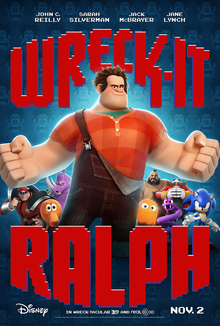
Wreck-It Ralph tells the story of the titular character, an arcade video game villain in the game Fix-It Felix, Jr. The thing is, Ralph doesn't like being a "bad guy" who does nothing but destroy things all day. When the arcade closes for the evening, all the other characters in his video game hang out together, congratulating Felix and making him pies, while Ralph goes to sleep in the city dump alone. Ralph becomes fixated on the idea of earning a medal, which he is convinced will make everyone like him. So one day he leaves the safety and security of Fix-It Felix, Jr. for the chaos of Hero's Duty in order to win himself a shiny gold medal. Unfortunately, a wild series of coincidences later means his medal ends up in the game Sugar Rush, where a go-kart racer hopeful named Vanellope has need of the medal also, and Ralph finds himself becoming involved in trying to sort out the problems found in this video game. Meanwhile, back in Fix-It Felix, Jr. everyone is worried because without Ralph, the game is meaningless. The arcade owner has placed an out-of-order sign on the game and the characters are worried that he'll soon unplug it - and them - if Ralph doesn't return soon. This leads to Felix venturing out after Ralph and embarking on adventures of his own, including falling in love with Sergeant Calhoun of Hero's Duty.

This movie has a little bit of everything for everyone - there's lots of action and adventures, tons of humor, a little bit of romance, and some great morals. At times, the action might be a little too much for the youngest members in the audience who might get a bit frightened, but the movie is otherwise up to family-friendly expectations. As is typical of Disney movies, the humor works on two levels to appeal to both the children and adults in the audience. For instance, when Ralph is in Hero’s Duty seeking that shiny medal to bring home to his life in Fix-It Felix, Jr., children will probably find his slapstick mistakes of falling and whatnot in the game humorous while adults will get a chuckle out his plaintive cry of “When did video games become so violent??” There are tons of references to games both classic and new so gamers of all ages will get a chuckle out of these. Like with the movie Brave (and some others), I'm glad that Disney movies seem to be moving away from romances (after all, what child is really all that interested in adult relationships?) with this movie. But there is still an element of the romantic in this film with Felix, Jr. smitten by Sergeant Calhoun, and I'm happy to see that the lovelorn one is Felix while Calhoun is all business and only concerned about romance when she has finished the task at hand. In fact, the thing that seems to appeal to Felix the most about Sergeant Calhoun is that she is a no-nonsense, tough character who has what it takes to be a leader. But the relationship we see more of in Wreck-It Ralph is the begrudging friendship that grows between Ralph and Vanellope. Despite differences of age, gender, and background, these two become close friends by the end of the movie who are willing to make sacrifices for each other's happiness. That they both ultimately end up happy is no small testament to the power of friendship (and the fairy tale like nature of Disney movies). The friendship plot is not the only moral that can be derived from the movie though. Much of the movie is also about Ralph's quest to become a "good guy" instead of his role as the villain of Fix-It Felix, Jr. He initially thinks that merely having the trappings of a good guy (i.e., the gold medal) will be enough to make him a hero, but as the movie progresses he learns that more is involved in becoming a hero and he steps up to the place. Not only is there the great lesson about what being a hero really means, it's also a good reflection on the idea not being confined to a script. Just because people grow up with certain expectations for them (not amounting to anything or following a traditional path or what-have-you), we are each responsible for our own path in life - and defying expectations and/or stereotypes may very well be a part of that. Ralph and his goal of becoming a good guy is a clarion call for anyone feeling stuck in an unfulfilling role. Take a chance at something new and you might find the right place for you after all.

Featuring the voice talents of John C. Reilly, Sarah Silverman, Jane Lynch, and Jack McBrayer and the artistic talents of doubtless numerous animators, Wreck-It Ralph is executed perfectly. There's tons of fun details everywhere, even the credits, that tie into the video game world. While the film arguably doesn't pass the Bechdel test, it does feature two very interesting and intrepid main female characters, which is a lot more than Disney has given in the past to the little girls in the audience. I'd definitely recommend this movie for young kids - or for those who are just young at heart!

Sunday, November 4, 2012

Brave Enough to Say No


I’ve been a huge fan of Disney and Pixar movies in the past, even the princess movies that rankle many. Yes, as a feminist I understand the many problems inherent in these movies with their troubling portrayals of women, but I grew up on them and they hold nostalgic memories for me. I am not pining away, waiting for my prince to come and make my happily ever after come true, but I still enjoy the music, animation, and cinematography of these movies.

So when Disney/Pixar started advertising its latest princess offering, Brave, there was a good chance I was going to check it out. And then when I read this article detailing the co-director’s inspiration for the movie and describing how this film with a strong female lead came into being, I was hooked. Last month I finally got the chance to sit down and watch this movie – while I was on a plane and this was luckily one of the choices. (It might be worth noting that I wasn’t the only childless adult watching this movie; I even noticed a couple of adult men picking this movie out of the many options available. So much for Disney’s concerns that only young girls will view princess movies.)

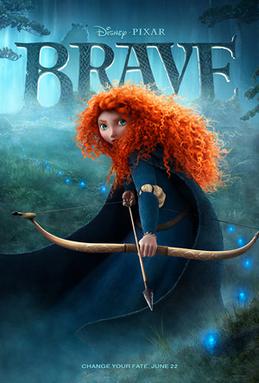
Brave tells the story of Merida, a Scottish princess who loves archery and horseback riding but is often forced indoors by her mother to practice the etiquette of being royalty. Merida dislikes this but does as she told – until one day her parents tell her it is time to be wed and three princes arrive to contest each other for her hand. Merida rebels and runs off into the woods, where she stumbles upon a witch who concocts a potion that will help Merida change her mother. Well, change her it does – right from a human being into a giant grizzly bear. Now Merida has even bigger problems on her hands than just convincing her mother not to marry her off – will she be able to hide her mother from her bear-hunting father long enough to reverse the spell?

There were a lot of things to like about Brave. Of course, as we’ve come to expect from Disney and Pixar, the animation is top-notch. As in many other Disney/Pixar movies, the movie includes a few sweet songs as sung by Merida, which are quite nice and I’d probably listen to just as regular songs without the context of a movie. Personally, hearing the Scottish accent of all the characters was a fun change of pace from the non-accent of most Hollywood casts, even when the movie is supposedly set outside of the California hills. The movie is also good at putting forth some moral lessons without being overly didactic.

Furthermore, this is a very female-centric movie, which sadly cannot actually be said about all princess movies. There is the strong mother-daughter relationship, unlike in many fairy tale-based movies where the mother is absent and/or the mother figure is evil. In fact, what we have here is rare in many Disney/Pixar movies – an entire intact family of mother, father, daughter, and two sons. (This may be a bit ironic – or something – that Disney finally releases a movie with a traditional family of two parents and 2.5 children when the traditional family is morphing into something else altogether.) One thing I really enjoyed about the movie focusing not just on Merida but also on her mother was that it gave the opportunity to show two kinds of female strength. Merida is portrayed as strong and brave in part because she is something of a tomboy, who prefers archery and traditional male hobbies. But – and this is more subtle – her mother is also portrayed as strong in a more traditional female role. She is able to subdue a room full of rowdy men with her stately and elegant appearance combined with a calming speech.

And, I really appreciate that the movie is actually an anti-romance – given the movie’s target audience of young children, I think that is quite appropriate for a change. Merida does not give up on the idea of marriage entirely or denigrate it at all, but she simply refuses to get married at a time in which she is not ready to a person who is not of her own choosing. Spoiler alert!: The film does not end with her falling for one of the three princes or meeting a fourth prince who sweeps her off her feet, but it is open-ended enough that the viewer can believe Merida will eventually fall in love and marry or that she will remain single and happy that way. I had been concerned that the movie would go the route of Aladdin where Princess Jasmine refuses all her potential suitors but then changes her mind eventually when Aladdin arrives on the scene. That’s a fine storyline also as it introduces the idea of choosing one’s own path rather than having it chosen by others, but I’m glad that this movie took it one step further to suggest that Merida might still live happily ever after even without a husband on the horizon.

Like with many other Disney/Pixar films, there is a lot of humor is the movie. I’m sure kids in particular will find the many slapstick moments hysterical, especially the antics of Merida’s two younger brothers who can’t seem to keep themselves out of trouble. But a lot of the humor comes at the expense of the male characters, and this is the only real fault I find with the movie. For the most part, the male characters are seen as little more than barbarians – they are none of them particularly intelligent, and it takes little to have them all begin fighting with one another. If they are not fighting one another, then they are all mindlessly chasing down a bear that only one character has sensed or trying to show off their physical prowess is some other way. Albeit, the king does have some better moments, and it is clear that he is loving husband and doting father. But for the most part, this movie doesn’t give the best impression of men as a whole, especially when a lot of them are put together in the same room. As a feminist, I rankle at this portrayal also – it’s a misconception that feminism believes or seeks to make women superior to men; most feminists simply wish us women to be on the same playing field as men and to stand there being treated equally and fairly, not judged to be either inferior or superior based solely on the existence of a second X chromosome. It’s harmful to everyone – but probably most especially children – to portray one sex as somehow inferior to another in any aspect.

Still, all and all, I enjoyed this movie and appreciated this twist on the traditional princess movie. For that reason, I highly recommend it for all of us who grew up on princess movies because I think we would most appreciate its subversion of the genre. Of course, I’d also recommend it for its target audience of young children but with the caveat that parents co-view with their kids and point out some of the harmful representations of male characters in addition to pointing out the helpful representations of female characters.

Sunday, September 2, 2012

Rango, the Tiny Lizard with a Lot of Gumption

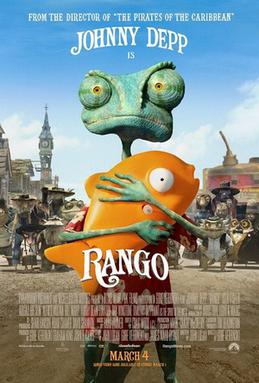
Rango is an animated film that tells the story of a little lizard who dreams up and acts out big adventures in his small glass tank. But when the moving van swerves unexpectedly on a highway through the big open country of the West, the tank flies out of the truck and shatters to pieces on the road. Our little lizard friend is abandoned and, after meeting with an armadillo on a spiritual journey to the other side of the road, he goes in quest of water to a town called Dirt. His first encounter, just outside of town, is with a girl lizard called Beans (so named because "My daddy plum loved baked beans."). Once in the town, he puts on his greatest act yet as Rango, a no-nonsense gun-slinger right out of an old Western movie. He quickly wins over the town with his tough-guy act and is appointed sheriff. But being sheriff isn't all about tough talk -- Rango has to figure out the mystery of the town's drought, stave off an impending rattlesnake attack, and track down some bank thieves. Of course, he has help along the way - including the feisty Beans and a host of humorous characters amongst the townsfolk, who are a hodgepodge of small animals.

This Nickelodeon movie came out last year and although I had wanted to see it at the time, I finally got around it to when some family from out of state was visiting. After having suggested the movie for our outdoor movie night (an annual favorite pastime), I was a little nervous at first as the movie was a bit slow going in the beginning. It picked up though and became very funny as well as action-packed and holding a mystery to be solved. Rango held the attention of both kids (of all ages) and adults alike, which probably isn't a huge surprise given that it won an Academy award for the best animated picture as well as numerous other awards. Like with many other animated features, Rango works on two levels - there's the basic storyline and slapstick jokes aimed at children while there are also a number of Easter eggs and quips that appeal only to adults. For instance, there are numerous references to classic Western movies, and I have to admit some of these probably went over my head as well as over the heads of the children and teens in our audience. However, a brief reference to Fear and Loathing in Las Vegas, in which Johnny Depp also starred, had me cracking up.

Rango boasts a considerable amount of Hollywood talent. For starters, it teams up director Gore Verbinski and actor Johnny Depp once again (as with the first three Pirates of the Caribbean), with Depp spot on as the voice of Rango. Amongst the other talented cast members are Alfred Molina, Abigail Breslin, Bill Nighy, and Ned Beatty. Several of the voice actors, including Depp, play more than one character, which can surely be no easy feat.

However, there are a few down sides to this movie. As I mentioned earlier, it started a bit slow but then picked up a great deal with additional comedy and also some adventurous moments. But to be honest, I actually got bored during some of these extended action-packed sequences. This is not a fault of Rango only; I find that as I age, I am much more interested in plot and characterization, resulting in me becoming bored with yet another long scene devoted to some sort of fight and/or chase, which will inevitably end with the good guys winning. A second problem, and one that I find more troubling, is that it's debatable whether Rango passes the Bechdel test - if it does, it's by the skin of its teeth, which isn't a great sign of a movie being female-empowering. Likewise, it has some troubling portrayals of non-white ethnicities as well. Both of these issues may be related to the fact that Rango is inspired by - and parodying - old Western movies. For instance, take a scene like the one in which Rango is leading a posse into the desert to search for the bank robbers. One member of the posse, named Wounded Bird, is very much meant to be playing the role of the mystical American Indian. I rifled at first at the idea of this character, but then these lines came out as Wounded Bird is releasing some feathers into the wind:

Rango: I see you're communicating with the great spirits.
Wounded Bird: No. I'm molting. It means I'm ready to mate.

It's incredibly clever and turns a stereotype on its head. Still, I'm not sure how much - and what exactly - young children are absorbing when they see and hear from characters such as these. There's also a framing device used in the movie, once which breaks down the fourth wall a bit, in the use of a mariachi band of owls. Again, perhaps it's a bit stereotypical, but it's also very funny as the mariachi band frequently employs dramatic irony that is quite wrong. For instance, they keep predicting Rango's demise and death at various points only to later have to shrug and say they were wrong that time. There's also this great scene:

Rango: Now... we ride!
[whip cracks; Rango stops and looks to his right, puzzled]
Rango: [the band of mariachi owls stands a ways away with their instruments, waiting; Rango shouts to them] That means we're riding now! This moment.
[another whip is heard and the owls start playing the background music; everyone is riding roadrunners in the next cut] 

All in all, I like the addition of the mariachi band, but I again wondering about what take-away children derive from their presence. And, of course, the entire West (or at least what we get to see in this film) is one giant stereotype based on old movies, with a saloon being the most crowded place in town, a main dirt road for shooting duels, and so forth and so on. Even though the rest of the world seems to be in the 21st century, the town of Dirt is stuck sometime in the 1800s or early 1900s at best.

Still, I found this movie entertaining enough to enjoy it at the time and I would not object to watching it again, especially to see if I caught more of the in-jokes and Western references a second time around.

Saturday, December 10, 2011

Movies for the Armchair Adventurer


After a friend and I had a themed movie night a while back, we decide it would be good to try another themed movie weekend. This time my friend thought up the theme of movies based on comic books/graphic novels. Once again, we had a long list of possibilities and only made it through a handful of these. Below is the list as well as descriptions/thoughts on the ones we did watch, which are indicated with an asterisk.

(Note: this is by no means an inclusive list of all the movies made based on comic books, just some of the ones we were more interested in seeing.)

Batman (1989)
Batman Begins
Batman Returns
Captain America: The First Avenger
Dick Tracy
The Dark Knight
Hanna*^
The Incredibles*
Iron Man 1 & 2
Persepolis
RED*
Salt^
Scott Pilgrim vs. the World*
Sin City*
The Spirit
Superman Returns
Tales of the Black Freighter
Teenage Ninja Mutant Turtles
V for Vendetta
Wanted
Watchmen
X2
X-Men: First Class*

^Okay, you got me, these two aren’t actually based on comic books, but they are action/adventure/sci-fi/practically superheroes so I felt I could add them to the list. Plus they helped to make up for the dearth of female leads in many of the other movies.

RED

Basic plot: When assassins come after retired CIA agent Frank Moses (Bruce Willis), he’s determined to figure out why he’s suddenly on someone’s hit list. He culls resources from some fellow retiree spies (played by Morgan Freeman, John Malkovich, and Helen Mirren) to get to the bottom of this mystery. Along for the ride is Frank’s brand-new love interest, Sarah (Mary Louise Parker), who has no idea what she’s gotten herself into by befriending the lonely Moses.

Think of just about any Bruce Willis action flick you’ve ever seen and you’ve got down about half the make-up of RED (which incidentally stands for “retired and extremely dangerous”). Bruce Willis is the biggest baddest guy in town with unlimited supplies of ammo, who always manages to stay pretty much unscathed despite an hour and half worth of brutal encounters versus sundry assailants. Fortunately, the other half of the make-up of RED is comic one-liners and scenarios, most often at the hands of Helen Mirren and Mary Louise Parker. They definitely made the movie sparkle, in my opinion. John Malkovich’s paranoid character with his conspiracy theories was also fairly amusing at times. Overall, this is an entertaining escapist film, but don’t expect much more from it than that.

X-Men: First Class

Basic plot: Newly minted professor Charles Xavier (James McAvoy) is sought out by the CIA for his knowledge of genetic mutations and begins using his ability to read minds to become a recruiter of other mutants, including his “sister” Raven (Jennifer Lawrence) and Erik Lehnsherr, later known as Magneto (Michael Fassbender). The CIA needs this class of mutants to help defeat the nefarious Sebastian Shaw (Kevin Bacon) and his gang of mutants before they cause World War III.

The X-Men franchise (both the books and movies) are interesting to me, but I’m not hardcore about them. I’ve read a couple of books here and there, and I’ve partially seen some of the prior movies, but I’m certainly no expert on the X-Men universe. There were probably tons of inside references that went over my head in watching this movie. But, I found enjoyable all the same. X-Men: First Class, while having an adventure of its own, is basically an origins movie about how these characters came to be who they are.

Most interesting to me in that respect was the back story for Magneto, who we see first as a child and then later as a comrade of Professor X although the two will later become enemies as anyone with some knowledge of the X-Men universe knows. Michael Fassbender, who is increasingly becoming an actor on my radar for his impressive talent, does an excellent job bringing this character to life. James McAvoy as Professor X is also top-notch, as I was predicting based on his past performances. Everyone else involved in the production play their roles well, but these two particularly stand out above the rest.

I’m always pleased by the X-Men franchise’s themes of evolution and what it means to be human, and this movie was no exception. There was one montage section on the mutants’ training where I didn’t like how the director chose to do sliding boxes of quickly changing scenes, but otherwise this movie was well done all around.

The Incredibles

Basic plot: After some unfortunate events, superheroes are banned from their vigilante work and must make their secret identities their only identities. Some have a harder time than others accepting this, including Mr. Incredible who toils away at an insurance firm while he, his wife, and their three children do their best to hide their secret powers from the world. So when an opportunity arises for Mr. Incredible to use his powers in a clandestine operation, he is more than happy to agree. Little does he know he’s just played himself into an old enemy’s hands and it will take all his powers – and all of his family’s super powers – to survive this latest adventure.

Because it was so late in the evening by the time we started this one, we both ended up falling asleep fairly early on. But I’ve seen this movie numerous times before, and I love it. It has the charm of other Disney-Pixar movies like Toy Story and Monsters, Inc., combining adventure, touching moments, kids’ humor, and the occasional adult audience-intended joke. In fact, this is probably one of my favorite Disney-Pixar movies, making it among the cream of the crop. (For the record, it ties with Monsters, Inc., another movie that I just love beyond words.) There are so many wonderful scenes like Helen’s visit to costume designer Edna Mode, when the Incredible family teams up for the first time on the island, or how Jack Jack’s powers become apparent. I could go on, but it’s better if you just watch the movie yourself. :)

And, yes, I realize this one isn't really based on a comic book either, but the superhero theme clearly fits and the movie ended up spawning a comic book series later, so that's good enough for me!

Hanna

Basic plot: In the wilderness of Finland, former CIA asset Erik Heller (Eric Bana) strictly trains his daughter Hanna (Saoirse Ronan) to become an assassin bent on destroying Heller’s former handler Marissa Wiegler (Cate Blanchett). When the time comes for this mission, however, things don’t go quite as planned and Hanna is left crossing countries on her own in an attempt to stay one step ahead of those trying to kill her.

This movie features three excellent actors who all brought their A game to the production. It’s a visually appealing movie, with some very interesting camera work as well as some beautiful scenic places as part of the setting. There are parts when the movie seems a bit slow for an action movie, but when the action does come it is hardcore, including thumping music (provided by The Chemical Brothers) and some funky lighting. (For the latter, you might just have to see it to know what I mean.) While it’s an overall dark movie, there’s some funny moments when Hanna goes out into the world for the first time and is baffled by things like electricity. This is further compounded when she spends some time with a vacationing family, who has some quirks of their own. (The delightful Olivia Williams plays the mother with some unique ideas.)

Beyond its action aspects, the movie also has some science fiction elements. These introduce deeper questions to be explored, although the movie does not do much to tackle this exploration itself. I also enjoyed the visual symbolism (even if it was a bit heavy-handed), such as the prominent ads for glasses and graffiti about CCTV at a time when Erik is being watched and closed in on, Marissa coming out of the big bad wolf’s mouth at the Grimm’s fairy tales amusement park, etc. Without going into any spoilers, I wasn’t thrilled with the very end of the movie, but overall I thought this was a well-done film.

Sin City

Basic plot: Based on some of the Frank Miller’s comics of the same name, this movie contains three distinct plots dealing with the criminal underbelly of Basin City. The first follows the story from The Hard Goodbye where former criminal Marv (Mickey Rourke) loses it after his one-night stand lover Goldie (Jaime King) is murdered while lying next to him and he goes on a spree to find her killer. Meanwhile, with The Big Fat Kill as a basis, Dwight (Clive Owen) and the prostitutes of Old Town have to fend off corrupt cops and the mob from trying to take over. Based on That Yellow Bastard, the final story revolves around honest cop Hartigan (Bruce Willis) and his attempts to keep safe young Nancy Callahan (Jessica Alba) from the Roark family and their twisted pastimes. (Inexplicably, this last storyline is broken up so that it bookends the movie while the other two are played out one after the other.)

When this movie first came out (which was long before I read the books), I was interested in seeing it based on the cinematography and its stellar cast. For the former, the movie retains some of its comic book feel and is filmed in black and white with spot coloring of red and yellow. For the latter, not only does it include the people listed above but also Brittany Murphy, Alexis Bledel, Rosario Dawson, Benicio Del Toro, Michael Clarke Duncan, Josh Hartnett, Elijah Wood, and even a guest appearance from Frank Miller himself.

However, one of the reasons I did not watch this movie when it first came out was that I thought it would be far too violent for me. Having read all the books later, I was even more wary of the potential blood bath, but reading the series also made me more interested to see the movie. Alas, I was right that the movie was pretty much a non-stop violence fest (albeit, the same could be said for the other movies in this post, but this one really upped the ante for gore), although I must say it did not deviate from the books in this respect. However, the black and white filming helped make the violence somewhat more palatable by being able to portray pools of blood in white rather than red – a little trick that helps the mind deal with it better. Still, seeing someone’s hand blown off or head severed is a bit much no matter how you put it, and I think it’s worse in movie form than in stylized illustrations.

Likewise, the movie did not deviate from the books when it came to portraying all the women of Sin City as scantily clad (read barely clothed) or nude, no matter how ridiculous it was for them to be so in the given situation. Again, this is somehow more acceptable in a graphic novel than when dealing with actual breathing, moving people.

To sum up as best as I can, this movie is a truthful adaptation of three books in the Sin City series, a unique work of cinematography, a bloody gory mess, and an interesting puzzle as to how so many big Hollywood names could flock to a fairly shallow movie (the promise of working with Quentin Tarantino?). There’s two more Sin City movies planned based on other books in the series, but I’m not so sure I would check them out…

Scott Pilgrim vs. the World

Basic plot: After meeting Ramona, the girl of his dreams, Scott Pilgrim (Michael Cera) learns that not only must he try to woo Ramona but he also has to fight – and defeat – her seven evil exes.

After watching a couple of heavy movies there in a row, we decided to lighten things up a little with Scott Pilgrim vs. the World. In this fantastical story, imagery is based not only on comic books but also video games. Similar to Sin City, this makes for a unique cinematographic effect. The movie is very funny, although it also gets more than a little absurd at times.

Monday, July 4, 2011

An Odd Coincidence


Just the other day I stumbled upon this video from Feminist Frequency: Women’s Stories, Movies and the Oscars.

I always find the Feminist Frequency videos interesting, not because they tell me something I don’t already know, but because of the way they present the information. Sure, I know that Hollywood is male-dominated; but when you see 50 years of “best picture” winners in a row and only a handful of female-centered ones, it really hits home.

(While this next bit seems unrelated, it’ll all come together in the end…wait and see.)

Today I picked up on a scrapbooking project I had previously started (in 2008!) If I’m scrapbooking alone, I always like to have TV or a movie on in the background, although it either has to be something I’m not terribly interested in or something I’ve seen numerous times so that I keep my concentration on the project at hand. Today, I went with tried-and-true movies as my background. On the table were Waitress, The Jane Austen Book Club, and Persuasion. Two others that I considered but ultimately nixed (and did not need in the end for I was done with my project) were Persepolis and Sense and Sensibility. These movies cover widely different locales and time periods but there is one thing they all have in common – they are all women’s stories. (See, I told you it would all come around!) I did not plan this – indeed, I did not even realize it until mid-way through Persuasion. So, if you ever find yourself frustrated with male-centered movies, you might want to try one of these on for size.

Waitress

Pregnant and living with an abusive husband, pie diner waitress Jenna dreams of winning a pie-baking contest and earning enough money to leave her husband.

- Related to my earlier post on food-related movies, this one makes you hunger for some of Jenna’s unique and interestingly-named pies. Ned’s pies at The Pie Hole, while appetizing, don’t hold a candle.
- One thing that always gets me wondering about this movie – does anyone know where it is supposed to be located? The town seems rural and the residents’ accents sound Southern, but I don’t think the locale is ever named. The only state I know they aren’t in is Connecticut, as that’s where Dr. Pomatter has relocated from at the beginning of the film.

The Jane Austen Book Club

Five women and one man deal with the ups and downs of life and love as they meet each month to discuss the six major novels of Jane Austen.

Persuasion

At age 19, Anne Eliot was talked out marrying Captain Wentworth because he had neither title nor fortune equivalent to her family’s. Eight years later, Captain Wentworth has returned from war prosperous with Anne still in love with him. But Captain Wentworth’s affections now seem to lie elsewhere.

Persepolis

This autobiographical tale, told here as an animated film, covers Marjane Satrapi’s life growing up in Tehran during the Iranian Revolution and its aftermath.

Sense and Sensibility

After their father’s death, Elinor and Marianne Dashwood are left in a precarious financial state and are forced to remove to the countryside. There, both deal with loss and love in their own way – Elinor with a practical outlook and Marianne all emotion and impulsivity.

The Feminist Frequency video notes that male-centered stories overshadow women’s stories because men dominate the movie-making process. It’s worth noting then that Waitress was directed by a woman and the other four movies are all based on books with female authors.