Showing posts with label Surrealism. Show all posts

Saturday, April 23, 2016

How Do We Measure Greatness? On Watching The Great Gatsby

It's a story everyone knows. Boy meets girl, girl rejects boy due to lack of money, boy makes lots of money and comes back looking for the girl who has since married. Even if you haven't read or seen The Great Gatsby, this very basic outline of the story is probably is familiar to you in one form or another in some other book or movie. But chances are you have read The Great Gatsby for in the nearly 100 years since Gatsby's original publication, it's become a staple in nearly every high school curriculum and several college courses as well. A popular movie in the 1970s brought the story to a wide audience as well.

But Hollywood is Hollywood and even if everyone already knows a story, that doesn't stop big movie studios from taking another stab at it. So it really shouldn't be a surprise that Warner Brothers would reboot the story for a 2013 film version of it. But on the plus side, this latest version was helmed by director Baz Luhrman, whose name should be a clue that we'd be getting something completely different this time around. When I saw the previews for this version of The Great Gatsby, the visual look and feel of the movie seemed very appealing and right up my alley, so I knew it would only be a matter of time before I saw it.

Of course, then as usual, time got away from me and I didn't see the movie. But when the movie came up as part of my book group's discussion of Z: A Novel of Zelda Fitzgerald this week, I decided it was time to finally check it out. After watching the film, these are my thoughts on it.

This latest incarnation of The Great Gatsby is indeed a visual spectacle, from Gatsby's lavish song-and-dance parties full of glitter and glam to the imposing and divergent domiciles of Gatsby and the Buchanans to the shining gleam coming off of racing cars to the bright colors of Long Island and Manhattan set against the stark gritty, gray reality of the ash heaps in between them both. Indeed, this last part hit a surreal level of hyper-reality with Long Island and Manhattan nearly jumping off the screen with their luminosity while the valley of ashes doesn't have a lick of color beyond the ever-present blue eyes of Dr. T.J. Eckleburg's billboard looming over everything as 'the eyes of God,'  and even these are faded and muted. (Up close we get a tad bit of color in the ash heaps in the form of Myrtle's all-red ensemble, a visual reminder of how she clearly doesn't fit in here .. and of course a reminder that she's 'the other woman' wearing the scarlet letter, so to speak.)

All of the visual beauty in this movie might make it seem like it's a case of style over substance, yet the movie stays largely true to the original work and, using Nick Carraway as the voice-over narrator throughout the film, makes liberal use of direct lines of text from the book. It clearly hits all the most important symbolism of the book, including the aforementioned billboard as well as the green light at the end of Daisy's dock, which almost comes off the screen with the close-up effects. In fact, it almost gets to the point where it feels like Luhrman is hitting the viewer over the head and saying, 'hey, look at the symbolism already, won't you?' In addition, the story isn't given a Hollywood happy ending but retains its original pessimism; any happiness seen in this plot is quickly fleeting.

Still, something felt a little off in this adaptation, even if I can't quite place my finger on what exactly that is. The first major issue I had was in casting Nick in a role that was more Fitzgerald than Carraway -- the framing device placed Nick in a mental institution of some sort writing away his troubles to get a grip on how he felt about that whole summer of Gatsby. I'm never a fan of when movies try to interject more of the author into a character than the author originally did. (I'm looking at you, 1999 adaptation of Mansfield Park, which tried to convert Fanny Price into Jane Austen herself.) Tobey Maguire as Nick seemed all wrong as a casting decision, and his habit of stretching out words and sentences to impossible lengths when narrating very, very quickly got old. I was holding back from shouting 'spit it out already!' at the screen.

The second thing that I found very bizarre was the use of modern-day pop songs alongside the period pieces, set, and costumes. It was one thing in Luhrman's Moulin Rouge, which was a musical and used variations of modern songs as sung by the film's characters to interject some levity to an otherwise very serious and depressing movie as well as to heighten the mood and/or atmosphere of certain scenes. But here, in a film trying to be dramatic, serious, and important while maintaining a decent amount of accuracy to the source material and time period, it just seemed wrong to be hearing Fergie in the background. Perhaps when Jay-Z is a film's producer, it becomes a prerequisite to play his and his wife's songs, regardless of the anachronism it presents; all I know is it seemed all kinds of jarring and took away from the storytelling going on in the film.

Back to the plus sides, with the exception of Maguire, the casting was superb. Everyone fit into their roles like a glove, but I think that Carey Mulligan as Daisy was the stand-out performance. I had never been a fan of the 1974 movie version of The Great Gatsby, and Mia Farrow as Daisy had been a large part of that, so I was very pleased to see Mulligan embodying Daisy in such a fantastic way. I also liked that even though it's hard with older source material like this, there were some attempts at diversity done; in particular, there's a very brief moment in a scene when Nick comments on how everything is changing as they speed past a car full of clearly wealthy African-American people with a Caucasian chauffeur. It's not much, but it's a little step in the right direction of more diversely cast movies and TV shows.

Overall, I did enjoy this movie as an entertaining break from the everyday and a new twist on a classic novel. I'm glad to have seen it at last, but it's not a movie I feel like I'd ever need to re-visit, which for me is the true test of a movie's greatness.

Monday, July 2, 2012

One Hysterically Funny Person

After my disappointing foray in to Sky Captain and the World of Tomorrow, I decided I needed something both light and surefire to please. I decided to watch Demetri Martin. Person., forgetting that I had already seen this particular Comedy Central special before. Nevertheless, it had been several years since the first time I watched this stand-up routine so some of the jokes felt new and fresh. And, the ones I already remembered were still just at funny!

For those of you who are unfamiliar with Demetri Martin, this New Jersey native is a former writer for The Daily Show with Jon Stewart and Late Night with Conan O'Brien. The comedian also had his own show on Comedy Central called Important Things with Demetri Martin, has had small roles in numerous films including Post Grad, and wrote a hilarious book called This Is A Book. His stand-up comedy style is a mix of deadpan humor, stream-of-consciousness one-liners, and occasional skits. Oftentimes, he props up his jokes with musical accompaniment and a large pad with sketch drawings. He also has a fondness for graphs and palindromes, and clearly displays his intelligence in his choice of jokes and style of humor.

While it's a relatively short special, Demetri Martin. Person. displays most of Martin's signature comedic styles, except the use of palindromes. For an outline of the general structure of the special, visit the Wikipedia page while the quotes page on IMDb gives a sense of the types of jokes you'll hear. If you prefer humor that isn't entirely crass and/or slapstick, there's a good chance you too will find Demetri Martin. Person. hilarious.

Monday, August 22, 2011

Surrealist Presentations: The Intersection of Art, Freud, and Women

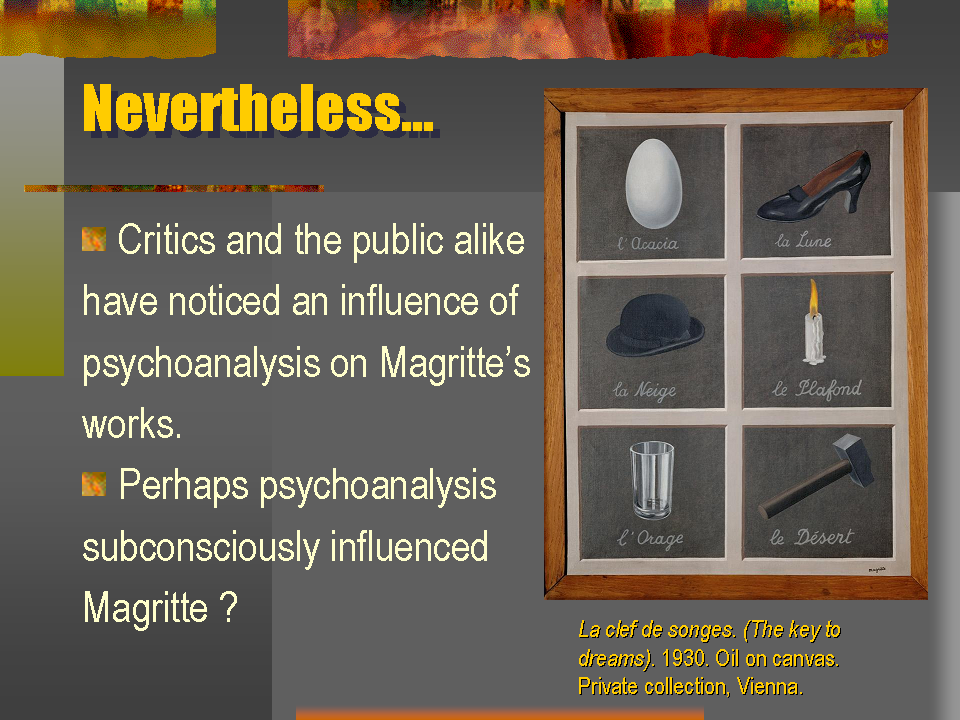
Our trip to the MoMA today and seeing some Surrealist art reminded me of some projects I did in graduate school. Directly below is a presentation based on an annotated bibliography I did as a final project. The subject matter was Freudian psychoanalysis and the Surrealist artist Magritte.

Beneath that is an earlier presentation I did on the representation of women in Surrealist art. (Magritte is included in that one as well, but so are other artists.)

You can click on any of the slides to make them larger to read the sometimes itty bitty text I used.


Sunday, August 21, 2011

“That is modern art”: MoMA and South African art

Today, a friend and I made the trek into New York City to check out the current special exhibit at the Museum of Modern Art (MoMA). I’d been interested in exploring Impressions from South Africa, 1965 to Now from the minute I heard about it, but predictably I made it in just under the wire (the exhibit closes next week). A complex look at race and power, the exhibit is made up entirely of works from MoMA’s own collections. The curator of the exhibit did a fairly good job of explaining the technical aspects of the prints, which was an added bonus. Nearly all of the artists featured were names unknown to me but I was quickly intrigued and absorbed by them all. Of particular interest were the political posters as well as the pages from Bitterkomix on display. (Here is the basic idea – with a slogan I love – of one of the former. The latter cracked me up with their satirical interplay of text and images).

The exhibit featured one artist who I know (and am appreciating more and more all the time) – William Kentridge. I had first learned of him at another trip to the MoMA (to see the excellent but incredibly crowded exhibit on Tim Burton) and then also found his works on display at the Zimmerli Art Museum and the Jewish Museum (where I went last summer for an exhibit on Curious George). I found out about his production of The Nose at the Metropolitan Opera far too late to even consider going, but that looked like an amazing treat for the eyes and ears! Check out the short clip available here to see what I mean. Unfortunately, even though Kentridge’s films had been at the MoMA in the past, they were not on display while we were there today (at least not anywhere that I noticed). While not an example of printmaking, they still would have been a fitting companion to the Impressions from South Africa exhibit.

Altogether, Impressions from South Africa, 1965 to Now wasn’t a very large exhibit but it had some real gems. If you have the time and access, I would definitely recommend checking it out!

While we were there, we also checked out another special exhibit entitled Talk to Me: Design and Communication between People and Objects. This quirky exhibit looks at the various ways humans and technology interact. One interesting piece was a video about the installation Double-Taker (Snout) at the Pittsburgh Center for Arts. Its ‘curious but shy’ motions reminded me to the movements of a cat and the concept of an emotionally interactive robot reminded me of the Kismet robot I learned about at the MIT museum last month. (Perhaps a post about my recent trip to Boston is forthcoming….) But the take-away piece from this exhibit for me was this hilarious and charming video by a group of Spanish artists: Hi, a real human interface. I challenge you to watch it and not laugh…or at least be amused!

We had a lot of time at the museum today so we also checked out some of the permanent collections, which display works by such greats as Vincent van Gogh, Pablo Picasso, Claude Monet, Jasper Johns, Jackson Pollock, Henri Matisse, Andy Warhol, Roy Lichtenstein, Paul Gauguin, Henri Rousseau, and my all-time favorite, Rene Magritte. There are also a number of Salvador Dali paintings, including his famous The Persistence of Memory. I always find Dali’s works mind-blowing, especially his Destino short for Walt Disney (beautiful!) and his dream sequence for Alfred Hitchcock’s Spellbound (so fitting to a psychological thriller that pivots around psychoanalysis).

If you can’t find your way out to the MoMA, check out the Great Museums episode about it (video starts loading immediately). It’ll give you a great overview of the history of the museum and a look at its permanent collections.


Update: I forgot to mention that we also saw this small exhibit entitled Harun Farocki: Images of War (at a Distance). It was a bit odd, and not exactly what I was expecting, but interesting nonetheless.

Further Update: I stumbled upon this blog post today featuring the art work of "the new Salvador Dali," Vladimir Kush. Beautiful!!

I also discovered that The New York Times wrote about MoMA's "Talk to Me" exhibit in this article last month.