Showing posts with label art. Show all posts

Saturday, February 21, 2015

Morven Museum's Schoolgirl Needlework Exhibit

Today I joined the Central New Jersey region of the Jane Austen Society of North America to tour the "Hail Specimen of Female Art! New Jersey Schoolgirl Needlework, 1726-1860" temporary exhibit at the Morven Museum in Princeton, NJ. Luckily one of the region's members read The New York Times review of the exhibit and suggested we visit or I would have completely missed out on this gem. To be entirely truthful, I wasn't sure exactly how much interest this exhibit would hold for me, but happily I ended up absolutely loving it. The exhibit displays embroideries in silk and wool that were completed by young, relatively wealthy girls as part of their formal education during the 18th and 19th centuries. All of the pieces reflect the work of girls from New Jersey, although in some cases the girls were sent to nearby Pennsylvania and Delaware to be taught at a prestigious girls' schools. These needlework samplers were generally meant to be displays of how privileged and talented these girls were.
“It is amazing to me, how young ladies can have patience to be so very accomplished as they all are. ... They all paint tables, cover screens, and net purses.” - Charles Bingley in Jane Austen's Pride and Prejudice. 
As we had a relatively large group and made plans some time in advance, we were able to secure a special PowerPoint presentation by two of the exhibit's co-curators as well as a semi-guided tour of the exhibit with them. The presentation helped a great deal in putting the exhibit into context. The co-curators described how there were regional differences evident in the needlework. Some counties had heavy influences from their Quaker founders, for instance. They also noted how even though there were distinct variations that could be largely attributed to one area or county, there was definitely cross-over as teachers moved from one school to another and brought their knowledge to a new set of schoolgirls. Another neat fact I learned from the presentation that I might not have gleaned readily from the exhibit was that not only did the exhibit cover more than 100 years of works, it also reflected needlework pieces from girls as young as 5 and as old as 29. Seeing the impressive needlework of 5- and 7-year-old girls was kind of mind blowing!

The needlework pieces themselves are astounding. Some show their wear while others have stood the test of time pretty well, still showing off bright colors and clearly legible text. Designs vary but are often of a similar nature: animals (particularly birds and deer), simple buildings, landscapes with a person or two, and alphabets and verses abound. Some pieces were used as a way to delineated a family tree/family historical record. Other more complicated works presented maps of the state or country. One sample contains the poem whose first line inspired the exhibit's title:
“Hail specimen of female art / The needle’s magic power to show / To canvas various hues impart / And make a mimic world to grow / A sampler then with care peruse / An emblem sage you may find there / The canvas takes what forms you choose / So education forms the mind.” - Anne Rickey
A few of the exhibit pieces also mixed media by having the needlework sent out for painting by an artist. Usually this done with silk-embroidered pieces rather than wool. After the schoolgirl completed her embroidering of the piece, then a painter would add in details or a landscape background to complete the piece. Finally, the piece would be framed, which was unusual for many of these samplers. The effect was stunning, and one of my favorite pieces in the whole exhibit was one of these samplers.

The talent and patience that went in to stitching these elaborate pieces are clearly evident. One thing I really appreciated about this exhibit is how it's elevated to the level of art something that was essentially homework and hung up only in the way that a proud parent posts an A-plus paper on the family fridge in our time. Nowadays, needlework is generally considered more in the line of a hobby than anything else. Viewing these works reminded me of all the embroideries my grandmother so lovingly made as something 'to keep her hands busy' when she had some down time, so this exhibit gave me a happy feeling of nostalgia as well as history lesson. At any rate, these pieces were certainly not items that were planned to be part of a museum exhibit originally! While museums by and large highlight the history of men (for better or worse), this exhibit gives a voice (metaphorically speaking) to a population that is traditionally in the background of history.


A companion catalog book available at the museum's gift shop provides more details about the exhibit and its historical background for those interested in learning even more. As it is, the exhibit's plaques contain more information than I could completely absorb in one relatively short visit, so this is a gallery worth re-visiting.

Speaking of re-visiting, I'd love to return to the Morven again some other time to spend additional time with the permanent collection and participate in one of their usual hourly guided tours to learn more about the history of the place. I did learn in my brief walkthrough on my own that the museum was originally a mansion whose celebrated residents include the president of the Continental Congress from 1782-1783. The building later became the state Governor's Mansion and was home to five governors. It is now a National Historic Landmark. And to think that I've driven past this place numerous, numerous times before and never once even gave it a second glance.

Another trip to the Morven Museum is definitely in my future and I hope in yours as well. The "Hail Specimen of Female Art! New Jersey Schoolgirl Needlework, 1726-1860" is only on display for roughly another month, closing on March 29, so don't delay in checking it out!

Monday, September 17, 2012

Grounds for Sculpture: The Garden State’s Garden of Art

Anyone reading this blog -- whether long-time followers or new readers -- knows that I am a big fan of art and can surmise that I also like gardens. But it’s rare that I get to combine these two interests. However, one place that can always be done is the magnificent Grounds for Sculpture in Hamilton, New Jersey. This place is a large sculpture park built on the former New Jersey Fairgrounds, which were bought and converted into this artistic space by Seward Johnson. Grounds for Sculpture was officially opened to the public as a sculpture park in 1992.

Although I’ve only been to Grounds for Sculpture only a handful of times in my life, it just so happens that three of those visits were between 2011 and 2012. It seems that every time I go, I end up gushing so much about it that I inspire another person to want to come visit it with me!

One of the things that I really like about Grounds for Sculpture is that it is not just an outdoor museum; there are others like that elsewhere, albeit Grounds for Sculpture is the nearest to me. But Grounds for Sculpture is more than that – it boasts a large collection of sculptures by Seward Johnson himself, who re-creates famous paintings in the landscape of the gardens. For instance, Monet’s Garden at Sainte-Adresse (a painting I know well for I have a copy hanging in my living room) is re-created on a grand scale here, placed before a lake. Visitors can stop by and physically plop themselves into a chair next to the seated lady and gentleman admiring the view. Elsewhere, there are re-creations of famous paintings by Manet, Rousseau, Matisse, and so on.

There’s also a fair amount of sculptures designed to appear like regular people about the park. Look out for a gardener trimming some bushes, a couple sleeping under the shade of some trees, a young girl reading on the grass, and so forth. These sculptures make you do a double-take to confirm that it’s really a piece of art and not a person.

Of course, there are also numerous other sculptures throughout the park that are not based either on other artists’ work or meant to be trompe l’oeil. These works vary from George Segal’s “Depression Bread Line” to more abstract and conceptual works. Whatever form the work takes, it is sure to be incorporated into the landscape in a most fitting way, whether that be within a bamboo forest, alongside a shady pathway, in a broad grassy area, or near the lakeside. All and all, this makes for a pleasant walking experience -- just remember to take a map with you and/or watch for some landmarks or you will find yourself lost on the property! But don’t be afraid to wander off the beaten path to find some hidden gems, like a quiet nook with a hammock for relaxing.

Some other features of Grounds for Sculpture worth mentioning are its Water Garden, peppered with still more sculptures but this time in the extra aura of mist and tinkling waterfalls; fine dining at its Rats restaurant (hearsay, as this blogger has never actually been); and its peacocks. Yes, its peacocks. Somehow these beautiful birds have taken up with art and live on the grounds. You will see them throughout the park, can buy stuffed animal versions of them in the museum shop, and can even dine at the Peacock Café on site (no peacocks served there, of course!). Be warned that at the Peacock Café, you might be hard pressed to find a seat on the outdoor patio as sculptures have their places here as well.

During my most recent visit to the grounds, we got some extra treats. The first was that the artists’ studios on the grounds were partially open to the public. One artist was unofficially giving visitors a tour of his work space. Another artist was working on a project and allowed viewers to stop in to see his progress and asks questions. This was a really exciting opportunity to see behind the scenes and get answers to any burning questions about technical details about sculpture and the artistic processes from concept to construction.

The second treat was that we found some exhibits on display in the grounds’ Domestic Arts Building, which had not been on our agenda per se. The bottom floor of the building featured the “E Pluribus Unum” exhibit of artist Willie Cole’s work, which largely focused on works made with recycled items. For instance, the thing that caught our collective eyes first was a chandelier made from plastic water bottles. There were also several sculptures that resembled cows, which took me a few moments to recognize as made up of parts of toilet bowls. When I found in the accompanying literature that this work was called “Two-Faced Bull Shitters,” I could not stifle a loud chuckle at the cleverness of this title. The top floor of the building was giving over to artist Marilyn Keating’s exhibit “Natural Curiosities.” As the name implies, many of her works focus on beauty in the natural world, including insects, animals, and plants. Several of her works were created with wood blocks, which is one of my favorite artistic mediums, if I have not mentioned that before somewhere in this blog.

Although we arrived too late in the day this last time to take advantage of this other great Grounds for Sculpture feature, on a previous visit we participated in the Tots on Tour event. This special tour is for 3- to 5-year-old children (and, of course, their accompanying adults!), who are treated to a story time, a craft time, and then a quick run of some of the park’s many art works, highlighting those that would be most exciting for children. These include a giant snake the kids could run on top of and an interactive musical sculpture. As soon as the tour began, the guide explained to the kids that if a sculpture had a green sign near it, they were allowed to touch it with care but if the sculpture had a red sign near it, they could admire it with their eyes only. The kids were thrilled to run around looking for green signs and have the opportunity of interacting with the sculptures tactically. I’ve now been to Grounds for Sculpture with young children of a variety of ages (younger than 1 year old; not quite 2 years old; age 3; age 4; and age 5) and they have all been delighted with visiting the sculpture park. All of the staff running the Tots on Tour feature were well-versed not only in art but in child development as well, making sure every part of the event was the appropriate amount of time and complexity for young ones’ attention spans.

If you are driving in or around Hamilton, no doubt you’ve noticed some of the giant sculptures scatted about the grassy areas near major roads. These are some of the greatest advertisements that could be given for Grounds of Sculpture -- pass near them, and you’ll get a sense of what it’s like to be in the sculpture park. But visit the park itself for the much grander scale of what that’s like. I’m sure you’ll enjoy it!

Sunday, July 1, 2012

A Long Day at Longwood Gardens


After having discussed this trip months in advance, a friend and I finally descended upon Longwood Gardens this weekend, in part to view the art installation “Light” currently on display there. Located in Pennsylvania’s Kennett Square, Longwood Gardens is the former estate of entrepreneur, philanthropist, and horticulture lover Pierre Samuel du Pont and his wife (and cousin) Alice Belin du Pont. Now approximately covering 1,200 acreage (with only some of that open to the public), Longwood Gardens came in to being when du Pont bought 202 acres of land from the Peirce family in order to save some centuries old trees on the property from being cut for lumber. Of interest (to me at least) is that the Peirce family had originally bought their farmland from William Penn himself. There is certainly a great deal of history behind Longwood Gardens!

After buying that initial tract of land, du Pont set about saving trees in the arboretum, participating in some “gentleman farming,” and expanding and improving the gardens, including numerous additions based on his personal interests and travels. For instance, Longwood sports a beautiful and elaborate Italian Water Garden, inspired both by du Pont’s love of water and a similar garden he saw while traveling near Florence with his wife. He also added a flowered garden walk, an enormous conservatory, and expanded the Peirce’s family home to include a library and covered courtyard, to name a few changes.

The Italian Water Garden at Longwood Gardens
After his death, Longwood Gardens were opened to the public, as stipulated and provided for by du Pont’s will. Incidentally, it is not the only du Pont estate in the Brandywine Valley open to the public; Alfred du Pont’s Nemours is in nearby Wilmington, Delaware as is Henry Francis du Pont’s Winterthur, which I have written about here before and would highly recommend. Unfortunately, I’ve not been able to find a good family tree online, so if anyone knows the exact relationship amongst these various du Ponts, I would be interested to know. My surmise is that Henry Francis and Pierre Samuel were some sort of distant cousins; they appear to share the same great-grandfather, Eleuthère Irénée du Pont, founder of the E.I. du Pont de Nemours and Company. (Both Henry Francis’s Winterthur and Pierre Samuel’s Longwood Gardens are listed in the book 1,000 Places to See Before You Die, if you need any extra motivation to visit either one or both.)

Unlike Winterthur, there are few museum-like qualities to Longwood Gardens – that is not to say it is not a great place to visit, just an explanation of what to expect. There is some history on display in the Peirce-du Pont House as well as in the ballroom near the conservatory. The ballroom houses one of the world’s largest pipe organs to be installed in a private residence as well as an exhibit on organ history. (Interestingly, although I think many of us associate organs with churches, early Christians were opposed to their use.) In the music room at the conservatory, there was also a small exhibit on the “Light” installation currently at Longwood, but more on this later. Also, throughout the estate there is often signage explaining the historic significance of particular trees, plants, structures, or garden plans. Here, as in several of the exhibits, I really appreciated the use of photographs to illustrate how particular rooms or garden areas looked when the du Ponts lived at Longwood. Comparing these with the current landscape emphasizes how well the grounds have been maintained and conserved to look as they did back in the 1920s and 30s.

Longwood may not have an extensive amount of information for the history buff, but it more than makes up for that in its natural beauty. The grounds host plants, trees, flowers, vegetables, and herbs of all kinds, making it especially interesting for botanists (amateur or professional) to explore. However, even those without any flora knowledge can enjoy just soaking in the beauty. Those interested in fauna may also be delighted with some surprise finds – at least the bird-watchers amongst us will have plenty to see! The well-laid out paths, along with a handy map, make the large estate easy enough to navigate. Visitors can enjoy strolling through and near a topiary garden, a rose arbor, a couple of lakes, and a cultivated meadow, amongst other fabulous sites. There are also numerous tree-houses to explore along with an impressive chimes tower and accompanying waterfall. For those traveling with children, there are a few child-specific areas carved out, including an outdoor children’s corner and an indoor children’s garden.

Chimes Tower

A bird "condo" above one of the garden patches

An unexpected visitor. I suspected he was there because of all the birds, but he came to sit next to me on this bench instead.

Indoors, the conservatory hosts 20 rooms of rare, exotic, or just plain interesting plants and flowers. Here visitors can view bonsai trees that have been in training for nearly 100 years, a plethora of orchid variations, and various fruit trees, ferns, roses, and so forth. (Apparently, orchids and roses were amongst Alice Belin du Pont’s favorite types of flowers, while Pierre Samuel du Pont had a fondness for nectarines.) Some rooms are filled with flora fitting a specific theme, such as the silver garden or the Mediterranean garden.

Close-up of one particular species in the orchid room. The centers struck me as looking like fanciful little people.
One patch of the "silver garden" within the conservatory

Just outside of the conservatory is the main fountain garden. A personal project of Pierre Samuel du Pont’s, this set of fountains use his hydraulic designs to jettison spouts of water up to 130 feet high while pumping 10,000 gallons of water per minute. A brief 5-minute water show is displayed here several times a day, with a more elaborate 30-minute water-and-light show occurring every evening. This show is generally accompanied by music, but as the nearby outdoor theater on the grounds was entertaining guests with The Mikado last night, our show was sans music. Nonetheless, it was a pleasant display, and many visitors of the grounds grabbed a seat or stood outside the conservatory to watch this impressive entertainment – and made their own music with the collective “oohs” and “aahs” that sprung up with each new delight.

Traversing the main fountain garden is this bridge-like structure with additional fountains (apparently not in use now though) and sculptures. Unlike nearly everything else at Longwood, this whole structure had a dilapidated air that gave it a Great Expectations-like atmosphere. We hoped that it was slated for restoration/conservation next.

In addition to all the usual charms of Longwood Gardens, part of the reason we decided to visit this particular month was to see the art installation, “Light,” by Bruce Munro. This site-specific installation is actually comprised of several different installations throughout the estate. This varies from the amusing (large “lily pads” made up of foam and recycled CDs floating in the large lake) to the enchanting (a forest walk illuminated by 20,000 glass-blown baubles encasing LED lights that were constantly changing colors) to the profound (a section of the meadow littered with 69 towers made of recycled bottles filled with water and LED lights accompanied by music, apparently inspired by a novel the artist read in which a character had synesthesia). At the exhibit in the music room, a few details of Munro’s work were on display along with professional (and amateur via visitors’ uploads) photography of his installations at Longwood. Here the curators displayed a quote in which Munro explained his work, “Light is visceral and evocative. A certain quality of light can bring you back to a moment in the past. Every season has a light that brings back distinct memories, whether staring at a twinkling Christmas tree or lying under the window on a summer afternoon watching dust motes float in the sunshine. In my work I try to capture something of these ephemeral experiences. I want to express those moments of being lost, of discovering that feeling of merging with something greater.” What a beautiful sentiment.

In the distance is the "Water Towers" installation as seen in the daylight still

The only downside to our trip was that we came fairly early in the afternoon so that we were pretty exhausted from all our walking by the evening time, just as dusk was coming. As a consequence, we didn’t see Munro’s work in all its full glory of being lit up in contrast to a dark night. However, we did see enough to appreciate it and the stunning amount of work that much have gone into it. Like others, we marveled at the fairy tale-like ambiance of the “Forest of Light” and sat meditatively listening to music at the “Water Towers.” And, our long day at the Longwood Gardens meant that we got to traverse the public property in its entirety, even doubling back to certain areas.

While I still personally preferred Winterthur as a place I would go back to multiple times, visiting Longwood Gardens was certainly an enjoyable and informative experience and I would recommend it to others!

Friday, December 30, 2011

Princeton: Where London, New Jersey, & Worlds of Play Meet

It’s been a while since my niece and I last visited a museum or other cultural institution, so when I was watching her for the day yesterday, I decided take us down to Princeton for a semi-artistic visit. When we first got there, my niece had just woken up from a nap so I decided that while she was still perking up, it was a good time to check out a couple of exhibits on campus. (Now that she’s older and more mobile – and more vocal – I wasn’t sure if she would be as good as long as she had been when we visited the Zimmerli museum over the summer.)

We headed over to Princeton University’s Firestone Library and took in our first exhibit, “Sin & the City: William Hogarth’s London.” This exhibit contained some 70 engravings from the 18th century British artist William Hogarth, along with a sampling of some contemporaries’ works. Last month, I read Charles Dickens and the Street Children of London and found out about how Hogarth was also a philanthropist who, like Dickens, used his artistic work not only to donate proceeds to the needy but also as an outlet to lambast the poor societal conditions of the time. In particular, the book talked about Hogarth’s famous work Gin Lane and how it depicted the overabundance of alcohol, even when little else was available – including clean drinking water. So walking in to the exhibit and seeing Hogarth’s work in general, and Gin Lane in particular, was certainly fitting to this recent acquisition of knowledge. Likewise, the accompanying literature from the exhibit describes Hogarth as “creat[ing] a new, moralizing role for the artist, forcing viewers not only to look but then to act on what they had seen.” The brief biography on the exhibit’s website also notes, “Hogarth’s work took on a distinctly propagandist tone, directed at the urbanization of London and the city’s problems with crime, prostitution, gambling, and alcoholism. …Hogarth strived to create works of great aesthetic beauty but also ones that would help to make London a better city for future generations.” Talk about reinforcing your learning.

I mostly brushed through looking at the prints pretty quickly without reading the majority of the accompanying information, but it appeared that the staff also included a fair amount of explanations with each piece as well as an introduction to Hogarth and 18th century London. Overall, I found this exhibit very interesting and would have spent more time examining the individual works had I been on my own or with an adult companion. The exhibit goes on until the end of January, and I would recommend it to anyone with an interest in prints, London, history, and/or satirical works. My niece’s reaction to this exhibit was mostly playing with my gloves, watching with interest two women talking to each other about the works, and looking up at the light fixtures. Hey, at least she was happy.

The second exhibit, also at the Firestone Library, was “George Segal: Sculptor as Photographer.” Best known as a sculptor, this small exhibit featured some of his lesser known works of photography, as is all implied by the exhibit’s title. The subjects of these works, at least those on display here, were often family members or friends as well as local scenery (such as the boardwalk at Asbury Park or the Keansburg amusement park). While seeing the nearby locales as they looked in the not-so-long-ago past was interesting and I’ve always loved the picture of Segal and his friend Donald Lokuta photographing each other (scroll down to the second picture), I was not overly thrilled by this exhibit. Segal’s sculpture works are far more interesting and compelling to me, most especially the ones I’ve been able to view up close both at the Zimmerli museum and at Grounds for Sculpture. I would not have recommended making the trip for this exhibit alone, although that point is now moot as the exhibit closed today. My niece’s reaction to this exhibit was … playing with my gloves. So this one was not a real winner all around.

We then moved on the lovely Cotsen Children’s Library located within the Firestone Library. Here my niece got to explore and play in the Bookscape gallery, which is a delightful space for kids to read, hang out, and use their imaginations. We both liked the tree house with its upper and lower nooks for reading and looking out on the world. Later in the day, we also visited the vast public library of Princeton, which has an entire floor just for children. The countless books and toys as well as the kid-sized furniture and giant fish tank with steps leading up to it make this a great place for young children to just hang out for a long time while they read, play, and make friends – indeed, my nephew and I have also spent a good chunk of the day here before. All in all we had a good day with some slightly out-of-the-ordinary things for the both of us.

Sunday, December 11, 2011

Walking in a Winter Wonderland at Winterthur

For the second year in the row, we decided to have a holiday-related family outing. Last year, we went to Radio City for the Christmas Spectacular and then wandered over to Rockfeller Center to check out the decorations. This year, we decided to go south instead and visited Winterthur near Wilmington, Delaware. Winterthur is a DuPont family estate, which was donated by the family to become a museum some time in the 1950s, in part for H.F. DuPont to share his collection of American decorative arts with the world outside of his family and friends. The property also boasts extensive (and I mean extensive) grounds with wilderness and gardens for visitors to explore.

For three months of the year, the estate also features a Yuletide at Winterthur tour. I was pleasantly surprised by the length and breadth of the tour and by how much the Christmas theme was incorporated throughout. The tour covered numerous rooms in the huge 175-room mansion, each decorated for Christmas based on different time periods. The tour guide provided lots of details about different traditions of decorating and gift giving over the years. For instance, a very early Christmas day featured a small tabletop tree that used cookies as ornaments, which the children were then allowed to immediately eat. A much later Christmas day included gifts after lunch, and these gifts were wrapped in the newly discovered colored cellophane. There were also displays of children's toys and games over the years, in addition to the usual displays of furniture, paintings, hand-painted wallpaper, etc. This tour was also pleasantly surprising in holding the attention of young children as they could find Christmas trees and gifts in nearly every room.

Speaking of appealing to young children, we had also spent some time on the grounds having fun at the Enchanted Woods, although mostly it was a bit too cold to spend much time outdoors. (Foiled again, as the last time I was at Winterthur, it was a warm summer day but it down-poured when we hoped to go out and explore the grounds.) Indoors, we all (and I really do mean all, adults included) had a blast in the Touch-It Room, where kids of all ages can learn about life in the past through imaginative play including dress-up clothes, pretend food, replica old-fashioned toys (like tops, cup and ball, Jacob's ladder), and various scenario areas.

Other current exhibits at the museum include "With Cunning Needle: Four Centuries of Embroidery,"which was interesting but small, and "Paint, Pattern & People: Furniture of Southeastern Pennsylvania, 1725-1850," which was more extensive but not quite as interesting. We also brushed briefly through some of the permanent collections of porcelains, furniture, and etc., which I had seen on a previous visit. We also noticed that there was an "orientation video" describing a brief history of the estates, so we stopped and watched that.

On this second visit, I once again found this place delightful and informative, and I'm hoping to one day make it out there on a pleasant spring day to see all the flowers in bloom and actually get to take a walk through the grounds.

Saturday, December 3, 2011

Happening Now: Fluxus

A few months ago I read that a new exhibit would be opening at the fabulous Zimmerli Art Museum at Rutgers. So my friend Deb and I planned to go there today and check it out. (We also took in the ongoing Venetian Masters exhibit while visiting the museum.)

With the 50th anniversary of the movement at hand, Zimmerli’s new exhibit is about Fluxus. (Side note: Since learning about the Fluxus exhibit at Zimmerli, I’ve also been seeing updates about Fluxus materials on view at the Museum of Modern Art in New York. Apparently, several area museums are celebrating 50 years of Fluxus.) My first reaction when entering the new exhibit space was a striking feeling of Fluxus being similar to Marcel Duchamp’s readymades in particular and Dadaism in general. I suppose I’m not entirely off the mark with this feeling of déjà-vu as the exhibit (both some of the works and the accompanying notes) made reference to Duchamp as somewhat inspirational. But to begin at the beginning (to paraphrase David Copperfield), I should start with a brief explanation of Fluxus and the exhibit.

According to Zimmerli’s literature, Fluxus is a movement that “focuses on the unpredictable, ordinary, and ephemeral moments of everyday life. It is difficult to define as an art movement, and is best described as a spirit, a philosophy of life, or a laboratory of ideas. Fluxus includes poetry, music, film, performance, printed matter, found objects, humor, wordplay, and unexpected juxtapositions.” Indeed, the exhibit included all manner of works, such as inventive board games (including an invitation to play chess with vegetables), paraphernalia from a Fluxus sporting event (team skis, stilts for soccer playing, art history textbook hammer throwing, and elevated shoes for sprints), photographic evidence of a Fluxus concert (in which a symphony was created based on the pattern of bullet holes left on orchestral paper after being brought to the local police driving range), and a spectacular silhouette made out of a collage of Hershey wrappers cut in different ways to create words (i.e., HERS, HEY, etc.).

As you can probably tell from this brief cataloging of works, this is not your ordinary art exhibit. The items on display are fascinating and oftentimes humorous (something missing in most art exhibits). They do beg to be interacted with, especially the games. “Happenings” have a large role in the movement, as can be evidenced by the mention above of concerts and sporting events, again making this an art movement designed for interaction and participation by many. This kind of performance art is very interesting to me. (I’m still impressed and intrigued by MoMA’s The Artist is Present piece I saw a couple of years ago.)

When the Fluxus movement began in the late 1950s, its epicenter was Rutgers University, with a handful of art and art history faculty members leading the way. With such a history, it is a fitting tribute for the movement to be highlighted in this new exhibit on the Rutgers-New Brunswick campus.

Friday, November 18, 2011

Serendipity: Meet Esao Andrews

A few weeks ago, I stumbled upon an article that led me directly to oil painter Esao Andrews. I was absolutely blown away by this artist’s work. It’s fantastic, albeit sometimes a bit creepy; it reminds me of Tim Burton’s movies in that regard and I love Tim Burton. Of all Mr. Andrews’s works, I love Megan most of all, which looks realistically three-dimensional yet also whimsical with her half-smile and finger to her face. Other favorites are Untitled (Thinker) (whether intentional or not, this is a nice nod to Rene Magritte, my favorite artist of all), The Hangover (this clever title isn’t what you’re thinking), Letting Go (this one screams Tim Burton more so than some of the others), Poppies (the emotion!), The Guarded Fairground (this, like some of his other works, reminds me of the works of Hieronymus Bosch), Don’t Wake Up the Neighbors (this is another whimsical one, which also reminds me of the movie Coraline for some reason), and Finch (something so innocent yet also so foreboding about this painting). I thoroughly enjoyed exploring the selected works on his website, and I hope you will also. In addition, Easo Andrews has a blog that you can follow – you can bet I’ll keep an eye on this and see what prints are coming down the pipe.

Sunday, October 2, 2011

Somewhat Sunny in Philadelphia

Last Sunday a friend and I trekked down to meet up with another friend and acquaintances in Philadelphia. While it may always be sunny in Philadelphia in the TV world, it was an overcast day with a 60 percent chance of rain forecast so we decided to stay indoors rather than hoofing around the city.

We began the day by taking a trip over to the Philadelphia Museum of Art, a building of such grand architecture as to make its exterior an art exhibit in itself. The museum's current big hit exhibit is titled "Rembrandt and the Face of Jesus." As you can imagine from the title, this exhibit features the many, many portraits of Jesus painted by the Dutch master Rembrandt van Rijn. This exhibit was popular with our little group and based on the huge lines, many others who were at the museum. But I have to confess, it held no appeal for me. For starters, while I can appreciate Rembrandt's work considering the time in which it came, I am but very rarely a fan of dark and shadowy works in any medium. Furthermore, after years of visiting art museums, I've seen more than my fair share of paintings based on biblical stories, which let's admit it, is a limited palate when you consider the hundreds of artists over hundreds of years painting these scenes. To further limit that to only portraits of Jesus himself, you can imagine that this exhibit was rife with redundancy. I'm sure for major fans of Rembrandt, portraits, or religious iconography, this was a great exhibit. But for me, it was enough to breeze by quickly and then say, what next?

So while the rest of our group meandered and spent a while in this exhibit, I moved on to what was a far more interesting exhibit for my tastes, "Here and Now: Prints, Drawings and Photographs by Ten Philadelphia Artists." This seemed like a particularly fitting exhibit for me to see while visiting Philadelphia as I'd be unlikely to see it anywhere else. As you can probably gather from the name, there was no particular theme tying together the works of this exhibit, but rather the locality of the artists. But while there was no overarching theme in the works, I would say that a combining element, beyond just the city where the artists work, was a feeling of weightiness to the art. The artists all tackled serious issues, such as the feelings of being an outsider due to a multiracial background. That isn't too say that these subjects were all treated with a doom-and-gloom attitude. Some of the works did have an ironic or downright funny effect despite - or perhaps because of - their serious nature. While I enjoyed nearly all the works on display, two artists and their art particularly stood out. Daniel Heyman was on hand for interviews with Abu Ghraib detainees and displayed their portraits and their stories together. These were heart-breaking to read, yet very necessary works to have to remind us of atrocities around the world. Serena Perrone's woodcuts were haunting, even surreal at times. In particular, I liked her works "Phantom Vessels and the Bastion of Memory V,""A Day in November: Impending Loss," and "In the Realm of Reverie." There is some quality about these works that I can't quite put a finger on that somehow allows them to be both childlike and innocent yet have an undercurrent of dread lurking just beneath the surface. Of course, I love woodcuts (so much so that one of my favorite books is Lynd Ward's Gods' Man, a wordless novel entirely made up of woodcuts) so you'd be hard-pressed to find an exhibit featuring woodcuts that I wouldn't like.

I then wandered up to the section of the museum dedicated to European art from 1500 to 1850. What I really enjoyed here was the broad view of the term art. Yes, there were paintings and other traditional art works, but there were also porcelains, furniture, and other everyday items. It was fun to stumble upon such objects as a baby's cradle and be able to compare something hundreds of years old to what we use today. There was even a fully furnished 17th century Dutch room, which is pretty cool to view. I barely scratched the surface of this permanent exhibit when the rest of our group was finished with the Rembrandt exhibit and we all decided to trek over to the museum's auxiliary Perelman Building.

Across the street at the Perelman Building, we took in another current exhibit, "Zaha Hadid: Form in Motion." The exhibit featured the sleek designs for furniture, a car, and even shoes by architect Zaha Hadid. As a woman in a predominantly male field who has done particularly well, Zaha Hadid seems like an interesting person and I would have liked to learn even more about her as a part of the exhibit. Indeed, the only thing we all agreed we did not like about the exhibit was that there was not more of it. It was rather small and featured only a limited number of works. However, given the amount of work that went into this exhibit (Hadid also re-designed the exhibit space to create flows and contours to complement the works featured), I understand why that would be.

By this time, the museum was closing but it was still a little early for dinner. To kill some time, we went back to my friend's apartment and were flipping channels until we landed on the reality TV series, "Sister Wives," which ended up being fuel for the fire of us discussing various things. All I'm going to say here is that the show itself was like a train wreck - you know you shouldn't keep watching but you can't peel your eyes away.

After dinner, with storm clouds still threatening, we again returned to watching the tube, but this time selected a movie. I was actually the decider in choosing Sunshine Cleaning, which no one else in the group had seen yet and I didn't mind re-watching myself. I'm always a little bit nervous about zealously suggesting something for fear it won't live up to everyone else's then-heightened expectations or that my quirky brand of humor won't appeal to others, but everyone agreed at the end that they enjoyed the movie. My one friend expressed it perfectly by saying that it was one movie where the characters actually felt "real." However, before I go too far in editorializing about the movie, I should provide a brief summary. Rose (Amy Adams) is a single mother with a child who needs special attention at school. Even working as hard as she does, cleaning houses doesn't pay enough for the school she wants her son to attend. When her boyfriend (Steve Zahn) finds out how much a crime scene clean-up crew makes, he suggests he takes her cleaning skills in a different direction. Rose enlists her slacker sister Norah (Emily Blunt) into starting a business with her, Sunshine Cleaning, to invest in this lucrative field. The film also co-stars Clifton Collins, Jr. as a helpful cleaning supply store owner who steers the sisters in the right direction as they start their business, Alan Arkin as the unreliable father of Rose and Norah, and
Mary Lynn Rajskub as the woman Norah finds herself befriending.

There are so many things I like about this movie and viewing it a second time only made that more abundantly clear. The movie had originally been recommended to me by a friend when we realized we both liked Amy Adams and Emily Blunt, and she pointed out that they starred together in Sunshine Cleaning. And, indeed, both did an excellent job in this movie (and actually look as though they could be sisters). Alan Arkin doesn't disappoint as the quirky grandfather, and young
Jason Spevack, who plays Rose's son Oscar, is absolutely adorable. Clifton Collins, Jr., who I couldn't stand as Perry Smith in Capote, redeems himself in my eyes as the subtly played Winston. Actually, I feel that most of the characterizations were understated, adding to the feeling that the characters were indeed "real." After the movie ended, we actually spent some time wondering about the pasts and futures of these characters, including their motivations, as though they were actual people we were trying to learn more about and analyze. I love that the movie provided that kind of fodder.

Likewise, while the movie is nominally a comedy (and has many funny moments, especially of the darkly humorous type that I like), it had plenty of serious undertones and opened the conversation around it up to death and dying, marriage and relationships, family relations, middle-class working families and their unique troubles, etc. The next time you're looking for an alternative to your latest run-of-the-mill Hollywood churn-out, Sunshine Cleaning fits the bill.

Wednesday, September 7, 2011

Guerrilla Warfare: Tackling Misogyny and Racism through Art

In case I’m starting to sound like a one-trick pony with my praise of Zimmerli’s programming, I’ll let it be known that the Venetian Masters wasn’t the only exhibit I took in today. (Yes, today was a rare but beautiful day where I went to work and still managed to squeeze in two art exhibits viewing.) Thanks to the Rutgers Institute for Women and Art, artwork from the Guerrilla Girls was on display at the Mason Gross gallery not terribly far from the Zimmerli Art Museum.

If you don’t know about Guerrilla Girls yet, you should definitely check them out. In 2009, I saw a (smaller) exhibit of theirs on display at the Centre Pompidou in Paris and their works instantly resonated with me. In a nutshell, Guerrilla Girls aim to combat misogyny and racism through witty and irreverent art. They’ll use anything to get their message across - banners, posters, stickers, erasers, etc. In fact, the original Guerrilla Girls has sprouted two offshoots – Guerrilla Girls on Tour! and Guerrilla Girls BroadBand – to expand their reach to theatrical performances and web-based and interactive multimedia productions. Like any good vigilantes, the Guerrilla Girls are an anonymous set of women who take on the names of dead female artists and wear gorilla masks in public to hide their identities. One (somewhat ominous) explanation of the rationale for this read: “They could be anywhere; they are everywhere.”

But what I like about Guerrilla Girls is that it’s not all just stunts and catchy visuals. Their work frequently gives the viewer a number of startling statistics such as this one:

And, it is not a static group or collection of artworks. Guerrilla Girls are constantly updating their works and tailoring them to the specific places where they are exhibiting. One interesting project (of which part of was displayed at the Rutgers’ exhibit) involved asking various groups of women what issues they wanted to see Guerrilla Girls address next. Sadly indicative of our culture and what kinds of uphill battles women have to face, the top responses were rape and domestic violence. As this might suggest, the Guerrilla Girls have long since moved from merely discussing misogyny in the art world to discussing all kinds of issues facing women from unequal pay to abortion rights to the negative impact of advertising on women’s body image.

Walking through the rooms of the exhibit was a rather remarkable experience as I began in a room with the oldest works and made my way up to the newest ones. It was both interesting and sad to see that over time most of the issues remained still the same and some of the statistics had improved only the slightest bit if at all. One set of posters dealt with the politics of George Bush and the Gulf War and I had to do a double-take before I realized they weren’t discussing George W. Bush and the war in Iraq. (Funny how we don’t seem to learn from the mistakes of the past…)

Unfortunately, today was the last day for the Guerrilla Girls exhibit at Rutgers, but undoubtedly you’ll be able to catch them somewhere around here soon. In the meantime you, like me, might be interested in checking out some of their books, such as The Guerrilla Girls’ Bedside Companion to the History of Western Art. In addition, the Institute for Women and Art provided a handy flyer at the exhibit listing some related resources at Rutgers including the Mary H. Dana Women Artists Series, the Women Artists Archives National Directory, the Feminist Art Project, and Signs: Journal of Women in Culture & Society. Happy reading!

“Peeling Off the Layers”: Venice in Art, Music, & Theater

As you could probably tell from my earlier gushing post, I really like the Zimmerli Art Museum in New Brunswick. After a summer-long hiatus, their popular Art After Hours program has returned, beginning this evening. Art After Hours is a monthly event where the museum stays open late one night and offers a wide variety of additional programming, including but not limited to film viewings, curator-led tours, classical concerts, opera scenes, and author and illustrator talks. There is sometimes (and appears to be increasingly more so) a theme that envelopes all the evening’s events.

This evening that theme was Venice. Yes, the romantic Italian city with its singing gondoliers. The impetus for this theme was undoubtedly a new exhibit featuring the works of two Venetian artists. The evening featured a curator-led tour, mandolin music accompanied by masked dancers, and a short version of Shakespeare’s play The Merchant of Venice.

"The surface of Venice is constantly metamorphosing. Painting Venice is almost like being a restorer, peeling off the layers to find the picture after picture underneath. Venice is inexhaustible because the shifting light and the drifting fog keep changing her face. In the winter, Venice is like an abandoned theater. The play is finished, but the echoes remain. When you walk in the winter fog, there seems to be no division between water and embankment. You feel that you can walk through walls, through sky, through time." - Arbit Blatas, artist

The first event of the evening was the tour of the new exhibit. However, while we waited in the lobby for everyone to arrive for the evening, a few of the masked dancers came out and danced interpretively to some recorded music. I’m not a huge fan of interpretive dance, but I liked that there was something going in the lobby while we waited. Otherwise, my restless nature gets fidgety waiting around for the curator to begin the tour, and I’m sorely tempted to go wander off into nearby exhibits but am too nervous that I’ll end up missing the tour then.

The curator-led tour was fairly brief, but I always love these given the opportunity. Generally, the curators say roughly the same things they have printed in the information about the exhibit (website summary, brochures, etc.) and have on display throughout the exhibit. Nevertheless, sometimes they add in fresh tidbits and they will answer questions that arise as they lead the tour.

How anyone can simply be on the tour and then leave feeling they have seen the whole exhibit is beyond me though. While the mandolin players started strumming, I went back to the beginning of the exhibit and went through it on my own at a much slower pace. It is certainly a different experience than simply walking through quickly on a tour with numerous other people. For instance, in the quick passing through of the tour, I thought I preferred the works of Tiepolo, the second artist featured, to the works of Canaletto. But on a second go-through, I found that I enjoyed Canaletto’s works far better.

As alluded to now twice, the new exhibit featured the works of two artists - Giovanni Antonio Canal (known as Canaletto, which is Italian for “little canal”) and Giovanni Domenico Tiepolo. Besides having the same first name and being from Venice, the two shared other similarities. Both were the sons of artists and both began their own artistic careers as painters before moving onto printmaking, specifically through etching. However, the two had very different approaches when it came to their choice of subject matter.

Canaletto practiced “vedute” – he was first a painter, and then an etcher, of the landscapes of Venice and its surrounding area. I enjoyed that his series of prints included landscapes both real and imaginary. He was gifted with the ability to clearly and accurately represent what was right before him as well as the ability to create something of his own imagining. Some of his prints fell into an in-between place where he was depicting an actual place but chose to rearrange some of the placement of objects in order to create a more scenic view.

While not one of his etchings, this painting by Canaletto gives a good idea of his typical subject matter and style.

Tiepolo, on the other hand, worked in a style known as “expressive heads.” His primary subjects were people. He etched all matter of characters in various poses indicative of their emotional state. His early works were often reproductions of his famous father’s paintings, but he would choose to focus on a minor character from a painting instead of etching the entire work. It was noted that these small-scale etchings could be used as a way of whetting the appetite for his father’s works by introducing the viewer to only a small portion of a larger painting.

Again, a painting not an etching, but this gives a view of Tiepolo's typical subject matter and style. Indeed, there was an etching on display that was very similar to this painting.

As I mentioned, at first Tiepolo’s works were the ones that struck me more. I was drawn by the idea of works that featured people and their emotional state as inferred by their expression more than a landscape of a touristy spot. But on the second time around, the level of detail in Canaletto’s works was what astounded me. The curator’s explanation of the etching process left me in awe of any one who does that kind of work by reinforcing how much effort goes into each print, but Canaletto’s skill was particularly impressive for his inclusion of such tiny details as a perched bird or a skyline receding so far into the distance that you need to be standing an inch away from the print to be able to notice it. And the beauty of his scenes left me ready to book the next flight to Venice and be swept up in its wonders! (Alas, reality would not allow that…) Tiepolo’s etchings of numerous faces, however, were surprisingly very similar on closer inspection and did not show much variety in expression after all.

In addition to the exhibit featuring the prints of both Canaletto and Tiepolo, a small nook was reserved for some other prints from the Zimmerli collection. This sampling included works from the 17th to the 20th centuries and featured artists such as Rembrandt (who was an influence on Tiepolo), Picasso, and Donald Judd. It also displayed some prints by Giovanni Battista Piranesi who also etched in the vedute style, but his landscapes were of Rome. The curator noted that there are some 100 prints of Piranesi’s in the Zimmerli’s collection, so my fingers are crossed for an exhibit featuring these!

Here is a sample of Piranesi's etchings of Rome.

When I was done exploring the exhibit in closer detail, I emerged to find that the mandolin players (whose music I could hear throughout the exhibit) were accompanied by the interpretative dancers (whose numbers had grown). Again, as I’m not a big fan of interpretative dance, I did not feel I had missed much.

After watching them wind down their performance, it was time for the brief version of The Merchant of Venice, which was acted by only two performers. This is one Shakespeare play that I actually have not read and have no knowledge of its basic story or characters. Because of this, the condensed version left me puzzled nearly the whole time trying to figure out what was going on, with the lack of such helpers as scenery, props, or even 100% distinguishable characters. The two actors valiantly portrayed all the characters by switching their outerwear (a vest, a jacket, etc.) but it was still a bit confusing as one character appeared to be shared between them. And, in several scenes, one actor was continually taking on and off the one jacket at such a rapid pace it was difficult to tell when was the end of one character’s lines and the beginning of the next character’s lines. But, the acting was well done, especially given the limitations, and I found it very funny (and fitting with the practice of Shakespeare’s time) that the male actor portrayed a woman in one scene by putting on a lacey top and speaking in a high falsetto voice. I’m now motivated to pull out my giant book of all of Shakespeare’s works to read through The Merchant of Venice and see what it’s all about.

Overall, an excellent evening of arts and entertainment was put on by the Zimmerli Art Museum. And while you might not be able to enjoy all the activities found there tonight, it’s still well worth checking out the new exhibit. Two Venetian Masters: Canaletto and Tiepolo Etchings from the Arthur Ross Foundation is on display until January 2012.

Monday, August 22, 2011

Surrealist Presentations: The Intersection of Art, Freud, and Women

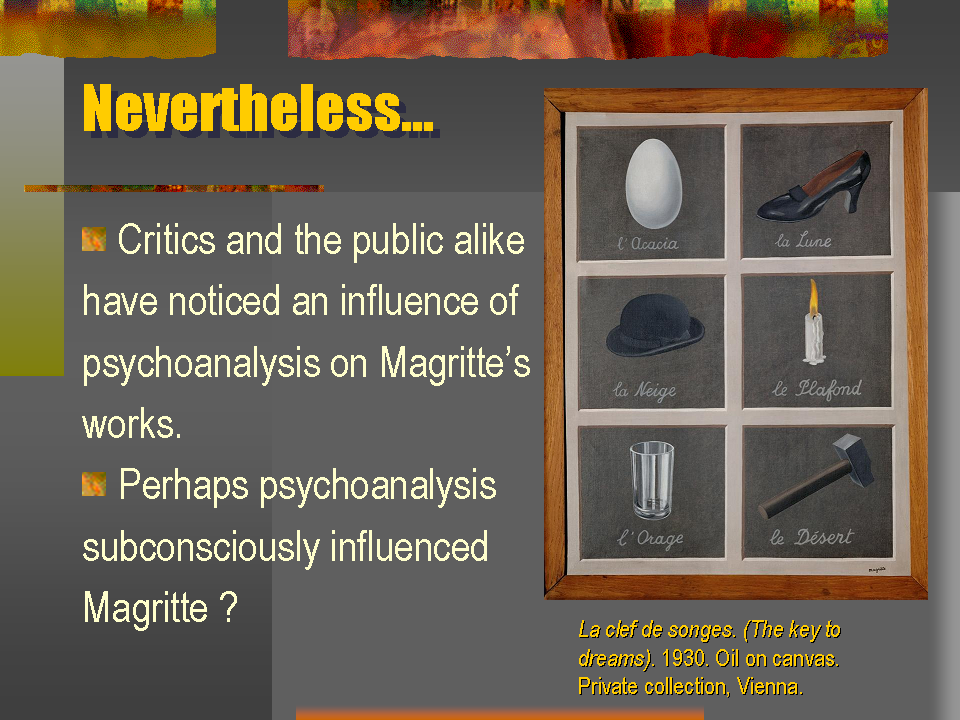
Our trip to the MoMA today and seeing some Surrealist art reminded me of some projects I did in graduate school. Directly below is a presentation based on an annotated bibliography I did as a final project. The subject matter was Freudian psychoanalysis and the Surrealist artist Magritte.

Beneath that is an earlier presentation I did on the representation of women in Surrealist art. (Magritte is included in that one as well, but so are other artists.)

You can click on any of the slides to make them larger to read the sometimes itty bitty text I used.


Sunday, August 21, 2011

“That is modern art”: MoMA and South African art

Today, a friend and I made the trek into New York City to check out the current special exhibit at the Museum of Modern Art (MoMA). I’d been interested in exploring Impressions from South Africa, 1965 to Now from the minute I heard about it, but predictably I made it in just under the wire (the exhibit closes next week). A complex look at race and power, the exhibit is made up entirely of works from MoMA’s own collections. The curator of the exhibit did a fairly good job of explaining the technical aspects of the prints, which was an added bonus. Nearly all of the artists featured were names unknown to me but I was quickly intrigued and absorbed by them all. Of particular interest were the political posters as well as the pages from Bitterkomix on display. (Here is the basic idea – with a slogan I love – of one of the former. The latter cracked me up with their satirical interplay of text and images).

The exhibit featured one artist who I know (and am appreciating more and more all the time) – William Kentridge. I had first learned of him at another trip to the MoMA (to see the excellent but incredibly crowded exhibit on Tim Burton) and then also found his works on display at the Zimmerli Art Museum and the Jewish Museum (where I went last summer for an exhibit on Curious George). I found out about his production of The Nose at the Metropolitan Opera far too late to even consider going, but that looked like an amazing treat for the eyes and ears! Check out the short clip available here to see what I mean. Unfortunately, even though Kentridge’s films had been at the MoMA in the past, they were not on display while we were there today (at least not anywhere that I noticed). While not an example of printmaking, they still would have been a fitting companion to the Impressions from South Africa exhibit.

Altogether, Impressions from South Africa, 1965 to Now wasn’t a very large exhibit but it had some real gems. If you have the time and access, I would definitely recommend checking it out!

While we were there, we also checked out another special exhibit entitled Talk to Me: Design and Communication between People and Objects. This quirky exhibit looks at the various ways humans and technology interact. One interesting piece was a video about the installation Double-Taker (Snout) at the Pittsburgh Center for Arts. Its ‘curious but shy’ motions reminded me to the movements of a cat and the concept of an emotionally interactive robot reminded me of the Kismet robot I learned about at the MIT museum last month. (Perhaps a post about my recent trip to Boston is forthcoming….) But the take-away piece from this exhibit for me was this hilarious and charming video by a group of Spanish artists: Hi, a real human interface. I challenge you to watch it and not laugh…or at least be amused!

We had a lot of time at the museum today so we also checked out some of the permanent collections, which display works by such greats as Vincent van Gogh, Pablo Picasso, Claude Monet, Jasper Johns, Jackson Pollock, Henri Matisse, Andy Warhol, Roy Lichtenstein, Paul Gauguin, Henri Rousseau, and my all-time favorite, Rene Magritte. There are also a number of Salvador Dali paintings, including his famous The Persistence of Memory. I always find Dali’s works mind-blowing, especially his Destino short for Walt Disney (beautiful!) and his dream sequence for Alfred Hitchcock’s Spellbound (so fitting to a psychological thriller that pivots around psychoanalysis).

If you can’t find your way out to the MoMA, check out the Great Museums episode about it (video starts loading immediately). It’ll give you a great overview of the history of the museum and a look at its permanent collections.


Update: I forgot to mention that we also saw this small exhibit entitled Harun Farocki: Images of War (at a Distance). It was a bit odd, and not exactly what I was expecting, but interesting nonetheless.

Further Update: I stumbled upon this blog post today featuring the art work of "the new Salvador Dali," Vladimir Kush. Beautiful!!

I also discovered that The New York Times wrote about MoMA's "Talk to Me" exhibit in this article last month.