Showing posts with label movies. Show all posts

Sunday, October 20, 2024

Favorite Quotes

This is not much of post but I realized yesterday after watching the 1986 miniseries version of A Little Princess* that I couldn't easily find the quote I have saved from it when I did a re-read many years ago. Turns out that "Favorite quotes" section of Facebook is only accessible on the desktop app these days, which makes me think it's just a matter of time before it is phased out entirely. I can't say that Blogspot will be around forever either but at least this compilation exists in two places now.  

"I improve on misquotation." - Cary Grant

"My idea of good company is the company of clever, well-informed people who have a great deal of conversation." - Jane Austen, Persuasion 

"Like music and art, love of nature is a common language that can transcend political or social boundaries." - Jimmy Carter 

"It's not where you go, it's what you look for." - Seth Godin 

"My formula for living is quite simple. I get up in the morning and I go to bed at night. In between, I occupy myself as best I can." - Cary Grant 

"I'm a cynical idealist." - F. Scott Fitzgerald, This Side of Paradise 

"My soul is too big for the rest of me." - Edna St. Vincent Millay 

"Half the lies they tell about me aren't true." - Yogi Berra 

"Life is like writing with a pen. You can cross out your past but you cannot erase it." - Anonymous 

"A single woman, with a very narrow income, must be a ridiculous, disagreeable old maid! the proper sport of boys and girls, but a single woman, of good fortune, is always respectable, and may be as sensible and pleasant as any body else." - Jane Austen, Emma 

"Patience is a weapon. Caution is a virtue." - The Singing Revolution 

"I often quote myself. I find it adds spice to the conversation." - George Bernard Shaw 

"Such men who put women down were really rather weak themselves, building themselves up by belittling women. A truly strong man would never want that." - Alexander McCall Smith, The Saturday Big Tent Wedding Party 

"The test of our progress is not whether we add more to the abundance of those who have much; it is whether we provide enough for those who have too little." - Franklin D. Roosevelt 

"Even within my own community, I can see where I have been vital sometimes as a member of the Auntie Brigade. My job is not merely to spoil and indulge my niece and nephew (though I do take that assignment to heart) but also to be a roving auntie to the world — an ambassador auntie — who is on hand wherever help is needed, in anybody's family whatsoever. There are people I've been able to help, sometimes fully supporting them for years, because I am not obliged, as a mother would be obliged, to put all my energies and resources into the full-time rearing of a child. There are a whole bunch of Little League uniforms and orthodontist's bills and college educations that I will never have to pay for, thereby freeing up resources to spread more widely across the community. In this way, I, too, foster life. There are many, many ways to foster life. And believe me, every single one of them is essential." - Elizabeth Gilbert, Committed 

"To be hopeful in bad times is not just foolishly romantic. It is based on the fact that human history is a history not only of cruelty, but also of compassion, sacrifice, courage, kindness. What we choose to emphasize in this complex history will determine our lives. If we see only the worst, it destroys our capacity to do something. If we remember those times and places—and there are so many—where people have behaved magnificently, this gives us the energy to act, and at least the possibility of sending this spinning top of a world in a different direction. And if we do act, in however small a way, we don't have to wait for some grand utopian future. The future is an infinite succession of presents, and to live now as we think human beings should live, in defiance of all that is bad around us, is itself a marvelous victory." - Howard Zinn 

"Do ya want to be a bowling pin your whole life? Just standing there perfectly content to be knocked down time and time again? Or, would you rather be the ball? I gotta tell ya being a ball feels a hell of a lot better." - Dead Like Me 

"I am a mystery wrapped in an enigma wrapped in a pita. Why the pita? That counts as another mystery." - Demetri Martin, This Is A Book 

"Work is the great reality. Beauty is the great aim." - Dublin Writers Museum 

"When good Americans die, they go to Paris.” - Thomas Gold Appleton 

" 'Try and make a clever woman of her, Lavinia; I should like her to be a clever woman.' Mrs. Penniman, at this, looked thoughtful a moment. 'My dear Austin,' she then inquired, 'do you think it is better to be clever than to be good?' 'Good for what?' asked the Doctor. 'You are good for nothing unless you are clever.' " - Henry James, Washington Square 

"If Nature has made you for a giver, your hands are born open, and so is your heart; and though there may be times when your hands are empty, your heart is always full, and you can give things out of that -- warm things, kind things, sweet things -- help and comfort and laughter -- and sometimes gay, kind laughter is the best help of all." - Frances Hodgson Burnett, A Little Princess 

"There's a fine line between mystery and just lying. When you mystify, you're alluding to the mystique that there's something worth uncovering under the heavy shroud of smoke. If all you have is cobwebs and a basement full of jelly jars with the little screws in 'em, well, everybody has that, so don't invite me over anymore." - Brian Fallon 

"If you can't fly then run, if you can't run then walk, if you can't walk then crawl, but whatever you do you have to keep moving forward." - Martin Luther King Jr.

*entertaining enough, but the 1995 film version has a special place in my heart

Monday, December 16, 2019

Turn the Record Over ... I'll See You on the Flip Side

Despite the title quoting their lyrics, this blog post actually has nothing to do with the alt-rock band The Gaslight Anthem. But the lyrics come from their song (and album) titled 45, which ties into this blog post. Specifically, I am back to reviewing some of the AFI's Top 100 movies as I make my way through the list. The following movies brought me up to 45 out of the 100 movies watched.

Before we get into the reviews though, I wanted to note that I mentioned last time that I doubted if many movies on the list actually passed the Bechdel test, which is set up as a bare minimum barometer for women's stories being included. Turns out that someone actually already did the research and calculations, and only 32 movies on the list pass. That's not just a failing grade, that's an abysmally failing grade. This is an important thing to note as I go into reviews because the further I wade into this list, the more I am noticing this huge problem. Women's stories are completely devalued by whomever chose these AFI's Top 100 movies. Unfortunately, that is what it is and here I go into reviews...

The Graduate 
(released 1967, #7 of 100)

This is one of those movies that I did kind of want to watch anyway, especially because it seems to be referenced all the time and is considered a classic. Before watching it for this little project, I read the book it's based on, in large part because I am also very slowly working on reading the books on the 1001 Books to Read Before You Die list. Overall, this movie is a pretty faithful adaptation of the book, but when the source material isn’t great, neither is the screen adaptation.

The story itself is pretty slim -- a young man graduates from college, returns home, and starts an affair with the wife of his father's business partner. It's not exactly earth-shattering nor that compelling. The movie cuts more to the point than the book (i.e., doesn't belabor things) and can be more humorous as a result. There are definitely odd camera choices though, such as an antenna crossing across someone's face, or the backs of people's heads zoomed in on too closely during the party scene. There's a decent soundtrack of Simon & Garfunkel songs, but they didn't seem to fit the scenes they were used in.

In terms of casting, I usually think you can't go wrong with Dustin Hoffman, but he was just okay here. It's definitely not his best performance but, to be fair, he was pretty young. However, he was about 30 playing a character who is in his early 20s (just graduated from college so most likely 21 or 22), and it struck me right away that he was too old to be playing that character. Meanwhile, Anne Bancroft is absolutely perfect in the role of the Mrs. Robinson; she steals every scene that she's in. Katherine Ross as Elaine Robinson was well cast as she looks like she could actually be Anne Bancroft's daughter. This Vanity Fair article provides some background into the casting process for The Graduate, and it's clear that they really did choose some of the best possible actors for the roles as the other names floated don't seem right for those characters.

Nevertheless, this really wasn't a great movie in my opinion. I can’t believe this was in the top 10 of the AFI's Top 100 list; it was okay but wasn’t anywhere near that good. Watching it for the cultural touchstone makes sense, but it could have been way further down the list.

Annie Hall
(released 1977, #31 of 100)

This is one of those movies that I probably saw before but couldn't remember if I had really watched it from beginning to end or just caught snippets of it. After watching it for this project, I'm pretty sure that I had sat down and watched it all previously. Which is fairly unfortunate given that I didn't really like it all that much and made myself watch it again.

This movie features two of my least favorite actors (Diane Keaton and Woody Allen) playing two terrible characters in what is essentially a romantic comedy -- typically not my genre of choice. In some ways, the characters remind me of Seinfeld characters in their inability to see how awful they are and always thinking other people are the problem. The movie even starts off with Alvy wondering what went wrong in his relationship with Annie when clearly he was awful pretty much 100 percent of the time. For, despite the title of the movie, it’s really Alvy’s story. Yet another male-centric story on AFI's Top 100 list. Sigh.

There are a lots of jokes in this film that really didn't age well given Woody Allen's history. For instance, Alvy and co. make "jokes" about his grandmother being raped, his friend having sex with 16-year-old twins, politicians having ethics comparable to child molesters, and his own sexual curiosity beginning at age 6. That all aside, in general, there's just way too much about Alvy's whiny need to have more and more sex while also having a variety of neuroses about sex. In addition, this movie has Alvy's friend defining VPL for the world to know, and of course it's some doofus of a guy who made that popular. Eye roll.

Honestly, many of his non-sex jokes weren't all that funny either. The situational humor is better at times, but this movie gets old kind of fast and most of the last half an hour in particular was dull. However, this film is definitely fun and interesting for having moments of breaking the fourth wall, inclusion of supertitles over the character's heads to show what they’re really thinking, out of order storytelling, split screen effects, etc. There is no soundtrack to the opening or closing credits, which was unusual (but not necessarily good or bad). This playing around with the cinematic art form is cool and the only thing that really makes the movie worth watching.

Rebel Without a Cause 
(released 1955, #59 of 100)

This is another one I was interested in seeing anyway because it seems culturally relevant; it is certainly referenced in many other pieces of pop culture. However, 15 minutes into the movie, I was already bored; there is just way too much whiny, teary teenage angst packed into those 15 minutes.

Many moments in this movie were filled with overly dramatic music to make things even more unnecessarily emotional. I'm at a point in my life where I just don't care about high school drama/stupidity, and immediately agreed with the father in the film who tries to tell Jim that he'll look back on this some day and realize it wasn't actually a big deal (until of course it escalates because Jim doesn't listen to his dad). This movie had the added non-interest for me of having a lot of machismo stunts. Bleh. So senseless.

James Dean and Sal Mineo are both good but the rest of the cast, especially the teenagers, just seem to be running through the motions. All of these actors look older than teenagers as well, which I guess is often the case but it doesn't mean I won't comment on that unfavorably. I don’t know what Natalie Wood is attempting to do in this film, but her facial expressions often seem completely off for whatever moment is happening. Although perhaps that was also due to the writing, wherein they have her running around essentially playing house at the mansion and smiling/laughing the night her boyfriend tragically died. The only character of color is a Mamie type character; it might have been less problematic to just have an all-white cast. It was the mid-50s though, so I give this movie a little bit of a pass as a result.

On the plus side, there are some interesting camera angles in scenes like the opening credits, Jim fighting with his parents after the car accident, or the climax at the observatory steps. There are also pretty landscapes in back of the high school and other places about town (mountain, cliffs, etc.). However, a handful of bucolic shots is not enough to salvage this rather disappointing movie.

***

So this grouping was all pretty discouraging, but there's still plenty more movies ahead!

Monday, September 30, 2019

Dear Reader, I Watched Them All

In this post I'll be taking a brief break from my reviews of AFI Top 100 movies to discuss some other films I saw this year. Specifically, I finally got around to watching the various screen adaptations that exist of Charlotte Bronte's famous novel Jane Eyre. Many moons ago when I was still an undergrad, I took a course on Victorian literature and read Jane Eyre (alas, with the big reveal having been already spoiled for me by a too chatty classmate; I will be kind enough to tell you all that this post will indeed contain spoilers for the plot, so proceed at your own risk). After that I meant to watch some of the movie adaptations; I even recall seeing a trailer for one of them when it was new! But me being me, this kept getting pushed off to some later date when I would 'have free time' (cue laughter here).

Fast forward to the beginning of this year when I was trying to catch up on some podcasts and listened to Can I Just Say's episodes on Jane Eyre, both the novel and some of its adaptations. Of course, I couldn't simply listen to these episodes with no context though! While I didn't re-read Jane Eyre (too little time to read all the books I want to read as it is), I did make a point to finally watch the film adaptations -- the three discussed on the podcast before listening to it and then just to round everything out, I finally finished this little 'project' of mine but watching one more, which is where I'll start my reviews, as it's freshest in my mind.

Jane Eyre (1944)

This little 'project' of mine ended with the earliest of all these adaptations, which perhaps wasn't entirely fair to save for last, but that is what happened. This wasn't my favorite of all the adaptations; indeed, I found the pacing a bit slow at times. But it was certainly a solid addition to the list of Jane Eyre films and must have been so even more when it first came out to viewers who hadn't seen many previous screen adaptations of the novel, particularly as a "talkie."

The film opens with a young Jane Eyre being interviewed by Mr. Brocklehurst concerning her so-called bad behavior. Peggy Ann Gardner was the most spirited of all the young Janes I saw and was delightful as a result. Agnes Moorhead, best known for her role as Samantha's mother on Bewitched, was absolutely fantastic as Jane's Aunt Reed. She manage to convey in a few facial expressions just how awful this character was, which was necessary for this adaptation as we don't see any of her earlier abominable treatment of Jane. Young Jane's hope of a wonderful new life at school is quickly tamped out when she arrives at the dour Lowood School. But here she makes a friend in Helen, another school child who is played by a shockingly uncredited young Elizabeth Taylor!

Jane quickly ages into a young woman and the role is taken over by Joan Fontaine; I cannot recall having seen Fontaine in any other movie before, but I was immediately struck by how much she looked and sounded like her sister, the actor Olivia de Havilland, probably best known for her role as Melanie in Gone with the Wind. The role of adult Jane is incredibly difficult because she is quiet and deferential while having a very vivid interiority; the reader of Jane Eyre knows this, but the viewer isn't always as lucky. Fontaine certainly does show at times that something else is going on in the character's mind, but other times her face is just too placid to read anything more into it. This movie does have a gimmick in which lines of the book are shown and Fontaine reads them in a voice-over, but this felt like it took the viewer further out of the narrative as opposed to deeper into it, which I think was what the screenwriters were going for with this device. (Side note: A fun fact with this movie is that one of the screenwriters was none other than Aldous Huxley, author of Brave New World.)

Jane moves on from the Lowood School to become a governess at a private estate. Her charge is the young Adele, played by Margaret O'Brien; it is my understanding that O'Brien was a popular child actor in Hollywood at the time but if this movie is any evidence, I cannot understand why. Her French accent was atrocious and the rest of her performance didn't make up the difference. The lord of the estate is Mr. Rochester, played by Orson Welles, whose interpretation of Rochester seems to be more grumpy and stern than brooding and mysterious, but it works well enough. Sadly, I don't think Fontaine and Welles had particularly good chemistry, which is such an essential part to this story. I think that is partially to blame for some of the movie seeming to drag a bit.

The estate itself, Thornfield, is presented here as a perfect setting for the more Gothic elements of this tale; the black-and-white filming and the gloomy shadows are appropriate. However, the exterior shots are all so clearly sound stages, and that takes away a bit from the effect they have. Other characters come and go at Thornfield, but the only actor who stands out is Hillary Brooke, who perfectly captures the haughtiness of Blanche Ingram.

Being as this movie is on the shorter side (only about an hour and a half), it straight up cuts out everything regarding St. John and his sisters, which is just fine with me. All in all, this is a fine-enough adaptation of the book, but it's not the one I would recommend as best.

Jane Eyre (2011)

So this is the one I recall seeing a trailer for before it came out in theaters, and then it languished on the 'I-should-watch-that-one-of-these-days' list for eight more years before I finally did. In keeping with my procrastination tendencies, it's been long enough since I watched it that my review will be perforce shorter and to the point.

This movie started in the middle (really towards the end) with a distraught Jane wandering the moors in hysterics. It then goes backwards through Jane's life from childhood up until this moment, before carrying onwards to St. John and his sisters taking her in off the moors. This device of starting somewhere in the middle can often draw viewers into a movie, but I think it's an odd choice for one based on such a well-known story. Furthermore, I really did not like that Jane was being portrayed as so hysterically emotional as that seems counter to her character; it was probably to draw more of a contrast to how dully placid she was in nearly all the rest of the film. Indeed, on the whole, I did not like Mia Wasikowska's portrayal of Jane as it seem to lack any depth for the character; she is at either extreme of being unreadable or far too passionate for how Jane acts in the novel. Again, Jane is a difficult character to be viewed on screen because so much of her personality is kept hidden to outsiders, but this portrayal seemed so off from how I pictured Jane Eyre to be.

On the flip side, Michael Fassbender was a very compelling Edward Rochester. His interpretation of the character came off as creepy -- not in a horror sense, but in the vibe you get from certain men to stay clear. That is how I feel about the character in the book so I was glad to see it on screen as well! The chemistry between the two leads was missing here as well, which is again unfortunate.

The supporting cast, including an underused Dame Judi Dench as Mrs. Fairfax, do just fine in their roles. The scenery is well done, both exterior and interior. Costumes are equally lovely. Clocking in at just about two hours, the film cuts little of the major points from the book. That all being said, that je ne sais quoi was missing from this film; I wouldn't necessarily recommend it either.

Jane Eyre (1996)

This version was directed by Franco Zeffirelli and also lived on my 'should-get-around-to-watching' list for a very long time. Incidentally, after finally watching this one, I felt there were some cinematographic similarities with the only other Zeffirelli film I've seen, namely Romeo and Juliet (1968), despite the many year gap between the two movies.

Once again, we open with Jane Eyre at her Aunt Reed's house; the young Jane is played by Anna Paquin, who seems a bit overly emotional for the role, but I'll allow it because Jane at this point is more open about her feelings. As Jane grows in to a young woman, Paquin is replaced by Charlotte Gainsbourg. She isn't my favorite Jane Eyre actor and she occasionally slips into her French accent, but I still preferred her to Mia Wasikowska.

Rochester, meanwhile, is played by William Hurt, who gives the character a little more softness and humanity than he has in the book (perhaps a little more than he deserves?). In my opinion, Hurt and Gainsbourg had the best romantic chemistry of any of the Eyre-Rochester pairings. So that's a big bonus point for this particular adaptation. The supporting actors were by-and-large well cast, particularly Joan Plowright as Mrs. Fairfax and Elle Macpherson as Blanche Ingram.

With roughly two hours of film, this movie is comparable to the 2011 version, but it somehow manages to reduce the screen time devoted to the St. John subplot. That works for me! There's lovely outdoors scenery and the interiors are not bad either, although -- credit where credit is due -- I do think the 2011 version has the loveliest interiors and costumes. In the end, this is a decent enough adaptation that I would recommend if you've read the novel and are looking for a screen version (or if you're just looking for a screen version period).

Jane Eyre (2006)

It's perhaps not 100 percent fair to compare this to the others as this is a miniseries version; whereas the others condensed the book to no more than two hours worth of film time, this one devoted four hours to getting the novel from page to screen, thus allowing it to include more scenes from the book or to explore others more deeply. For instance, this was the only one of the adaptations that managed to put in the "gypsy" scene, even if it was altered from the book.

Notably, this was the only one of these four adaptations to be directed by a woman and to have a screenplay written by a woman. And, I hadn't realized when I watched it that this adaptation actually pre-dates the 2011 film; after seeing this one, I wonder why they even bothered with making that one.

As you might guess from that last statement, this was my favorite of all the adaptations. It started out a little rough with a rather strange "red room" scene, and I was prepared to dislike it. Then when I saw Ruth Wilson -- who I knew previously only for playing a homicidal sociopath on Luther -- was playing Jane Eyre, I almost chuckled to myself, convinced this was the absolute wrong choice for the role. But Wilson soon blew me away. She was the absolute best at presenting Jane's many emotions underneath a calm exterior; I swear she even blushed in one scene, which something I have never seen any other actor do in any other movie or TV show (period drama or otherwise).

Toby Stephens, who I had never seen in anything else previously, was an excellent Rochester. Like Hurt, he toned the character's darker side down a bit so that he's not quite as terrible, but he still keeps a slightly sinister edge. (Is sinister too strong a word for Mr. Rochester? Perhaps, but it's one that keeps popping into my head when I think of him.) The romantic chemistry between Rochester and Eyre is more muted here, but their rapport is so much better; they seem like true equals and you can finally get a sense of why the two are attracted to each other.

Christina Cole is a fine actor in many a period film, so it was fun to see her here as Blanche Ingram. The rest of the supporting cast did satisfactory jobs as well. Also, interior and exterior scenery is done well on the whole, although I still find that "red room" scene a bit over the top.

If you're willing to devote the time, this is the adaptation that I think is best worth watching. Wilson cannot be beat as Eyre, and the miniseries as a whole is a good interpretation of the novel.

--

Note: When I say "I watched them all" in my title to this post, that was more for the fun of having something to follow up "Dear Reader;" this comprehensive list shows that there are many, many, many other Jane Eyre adaptations that I haven't seen. However, I think five times around with this story (the book plus the four screen adaptations) is perhaps just as much Mr. Rochester as I can handle.

Tuesday, September 3, 2019

Jackie Robinson, or The Meaning of Life the Universe and Everything

Despite the pretentious title, this blog post actually has nothing to do with baseball or The Hitchhiker's Guide to the Galaxy. But the two things both tie in with the number 42, which is a component of this entry's content.

Several months ago, I decided that I should finally hunker down and start making an effort to watch all the movies on the American Film Institute's list of "the 100 greatest American movies of all time" (hereafter referred to by me simply as "AFI's Top 100"). In the past I would occasionally give the list a once over and see how many I had seen and how many more I had NOT seen, but it didn't get much further than that. Realizing that method meant I still had seen less than half of them (a dismal 38 in total), I made it a goal to start watching them in earnest and am now up to a whopping 42 in total. Hey, progress is progress, no matter how slow it is...

Since one of my problems with the list is that for some of the movies, I cannot recall if I actually did see them in their entirety or not, I also made a decision to write up a quick review of each movie after watching it and will be posting those here, probably in batches of three or four movie reviews at a time.

Without any further ado, here are my random thoughts on the first four movies I've intentionally watched just for being on AFI's Top 100 list. (FYI, there really is no order to the way I am watching the movies from the list; it's whatever happens to be accessible at the time.)

Easy Rider
(released 1969, #88 of 100)

What a start to this project; this movie was practically unwatchable. I know it has its fans, but I am certainly not one of them, nor was my friend who watched it with me. It's as if Kenneth Anger made Fear & Loathing in Las Vegas and then amped up the trippy factor by about a thousand.

This movie opens with dullest drug deal scene ever depicted (and that’s saying a lot) before two guys embark on a road trip across America for Mardi Gras in New Orleans. Along the way, they cross paths with some unusual characters from hippies to bigots to farmers. I would have loved to hear more about the women they encounter and their lives, but this is a "bro" sort of movie so that would never happen.

The movie starts out with some rather weird cinematography choices that only get weirder as the movie progresses (and as the characters get higher from all the cocaine and other drugs they are doing). All along the "plot" is slow moving, the dialogue is mostly rather poor and uninteresting, and there is literally zero character development. On top of that all, the ending is really bizarre to the point that my friend and I were both kind of like 'was that the end? what were they even trying to say with this movie???' This may have been the movie I did the most research on after watching it, because it was absolutely puzzling to me what its purpose was or why it was on AFI's Top 100 list. While I do enjoy when I read or watch something that has so many layers that a critical analysis might help me learn more, a film should stand up well enough on its own that you don't have to see what critics are saying in order to "get it." (And quite frankly, it still doesn't seem like there was much to "get.")

The handful of highlights were good music to fill the soundtrack while the guys ride along the highways and byways, which then of course included some nice shots of American landscapes (mostly deserts but also some small towns in Louisiana). The very earnest definition of the slang version of the word "dude" (I guess it was still new enough in 1969?) was humorous. And finally, the real star of the movie was a very young Jack Nicholson, who put in a stellar performance as the day-drunk ACLU lawyer, a role fittingly quirky enough for him. I have to agree with The New York Times critic whose review of the movie at its release noted, "Nicholson is so good, in fact, that 'Easy Rider' never quite recovers from his loss." I am resigned to the fact that I will never understand why this movie is on AFI's Top 100 list.


The Third Man
(released 1950, #57 of 100)

Thankfully, AFI's Top 100 list quickly redeemed itself with this selection. This is the kind of movie that I really enjoy -- an older noir film that immediately grabs you and is compelling from start to finish.

This movie takes place in Vienna after World War II, with the main character looking into the mystery of a friend's death, supposedly an accident but surrounded by a few pesky details that just don't add up -- including the rumor of a third man at the site of the accident but not listed in the official report. There is definitely a lot of intrigue, with every character having some piece of the mystery but refusing to reveal more.

The ambiance of the film throughout is wonderful. Filmed in black and white, it plays with lighting and shadows. There are long shots, unusual angles, and other cinematography reminiscent of Citizen Kane (not surprising, considering Orson Welles was associated with both projects). The dark lighting and unusual camera angles add to the sense of unease the film is trying to portray for its main character, especially when coupled with some dialogue in untranslated German (unless you happen to understand German, it further solidifies your sense of unknowing). There are several scenes of characters running around Vienna's cobblestone streets, complete with echoey footsteps, which further adds to the mysterious tone.

But the movie isn't all seriousness at all times. There are little jokes here and there, and throughout the movie, a jaunty jazzy tune plays its soundtrack. This fun instrumental music is all played on the zither, which is an unique choice that made a distinct impact. The storyline also has a romantic subplot underneath all the mystery and intrigue. Joseph Cotton as the protagonist put in an A+ performance. Alida Valli as Anna was also excellent as were some of the supporting cast (some others of the supporting cast were a little too campy, e.g., the fellow with the dog).

Overall, this was definitely an enjoyable film and I could see why it was on the list. (A fun side note -- there is actually a small curiosity museum in Vienna dedicated specifically to this film.) Those who like film noir mysteries and/or spy-type thrillers would probably enjoy this one.


The Apartment 
(released 1960, #93 of 100)

Like The Third Man, this movie is one I'm surprised I hadn't watched before actually, given it's up my alley of movies from the late 40s to early 60s. Once the opening credits showed Billy Wilder's name, I knew I was in for a treat; there’s a reason he was referred to as "the world's greatest movie director."

The Apartment has many similarities with Wilder's other movies, including elements such as:

  • a voice-over introduction (but further narration is never heard),
  • a New York City setting,
  • a perfectly fitting instrumental soundtrack,
  • snappy dialogue,
  • black and white filming despite color being available,
  • an overall comic tone but serious at turns, and
  • issues like infidelity and suicide that can't exactly be shown on the screen (in 1960) but which are nevertheless artfully portrayed.

However, this movie has a rather different storyline from the other Wilder films I've seen in the past. A hard-working, ambitious accountant nicknamed Bud wants to succeed at his corporate life insurance job and therefore finds himself trying to curry favors with the higher-up suits. Unfortunately, the favor these men want the most from him is use of his apartment to carry on their extramarital trysts. Things only devolve further when the top boss finds out about this and wants to meet his mistress there -- a woman whom Bud has secretly had a crush on himself.

The late 50s/60s corporate culture highlighted in this film might make it of interest to fans of Mad Men, with similar explorations of gender, sex, power, and money, although with a far less serious tone. This movie has excellent performances from Jack Lemmon (indeed, he carries many scenes where it’s just him puttering around the apartment alone with no dialogue or only some mutterings to himself) as well as from Shirley MacLaine and Fred MacMurray. The happy ending feels a little tacked on / rushed, but otherwise this was an engaging watch. This wasn't my favorite movie of all time (it's not even my favorite Billy Wilder comedy; Sabrina tops that list, followed by Some Like It Hot) but it's a solid addition to AFI's Top 100 list.


Fargo 
(released 1996; #84 of 100)

This movie I went into expecting NOT to like, especially because I disliked the only other two Coen brothers' movies I had previously seen (The Big Lebowski and Intolerable Cruelty). While quirky movies hold a special place in my heart, the Coen brothers tend to operate in a zone of oddness that just isn't my cup of tea. However, this movie turned out to be weird in an acceptable sort of way for me.

The movie takes place in the dead of winter in Minnesota and North Dakota, where a car salesman with ambition pays a couple of criminals to kidnap his wife so that his wealthy father-in-law will pay the ransom. The trio assume no one will be the wiser and they will all walk away a little richer. But, of course, Murphy's law comes into play and things quickly escalate from bad to worse.

Despite the film's opening screen-cap claiming to be "based on true story," this is a work of fiction. But it is not outside the realm of possibility, which does give the film's absurdity a ring of truth. The actors in the movie -- from the leads to the supports -- are all excellent in their roles. The repartee between the two criminals, played by Steve Buscemi and Peter Stormare, is definitely a highlight of the film, along with Frances McDormand's award-winning performance as the police chief working to catch them. And, William H. Macy is almost *too* good as the slimy salesman, convincing me 100 percent to hate that character.

Despite the violence at the heart of the movie, it really isn't overly gory (especially in light of what's considered acceptable in film and television today). Also, McDormand's character is a refreshingly independent and strong woman, which had been missing in the other three films reviewed above. (The Third Man and The Apartment get points for at least featuring women more so than Easy Rider, but they're not exactly going to be held up as feminist standards. I'm not doing the statistical breakdown because that's more effort than I want to put into this project, but I wouldn't be surprised to see if a great number of the movies on AFI's Top 100 list are unable to pass the Bechdel Test.) Also, the one Asian character seen in the movie is surprisingly not just stereotype after stereotype, which is sadly saying a lot for 1996. (Unfortunately, the one American Indian character in the movie doesn't quite pass the same low bar. His character is way too much the strong, silent, proud 'native' stereotype -- his last name is even Proudfoot.)

That all being said, I cannot see this being a movie I would purposefully view again, nor do I have any interest in watching the new series of the same name. However, I do understand why it made the list, if for no other reason than that it's a movie that is often referenced in pop culture.

***

Well, that's all for now folks. Catch up with you again when I have a few more movie reviews to add.

Monday, November 26, 2018

High Society in Metropolitan

Recently the 1990 film Metropolitan came across my radar. Although it received an Academy Award nomination for best screenplay and is now part of the Criterion Collection, this movie isn't one I've heard anything about before and it was a bit difficult to track down a copy. However, it seems to have a bit of 'cult following' and has good critical and audience reviews. The movie is written and directed by Whit Stillman, who I am familiar with by and large because he wrote the screenplay for the movie Love & Friendship*, based on Jane Austen's novella Lady Susan.**

In many respects, Metropolitan feels the influence of Austen's stories.*** The film concerns itself with a handful of young men and women recently out of college or finishing up school (it was a bit unclear which) who are members of the mid- to upper classes. During winter break, they attend dances, play games, discuss letters written to each other, and sit around in living rooms expounding their thoughts on such high-brow topics as the classics of literature, class and political systems, personal fulfillment, the effects of divorce and blended families on adult children, and the meaning of romance as well as such low-brow gossip as who is sleeping with whom. There is also the obligatory 'concern' about women's 'virtue,' which felt rather out of place and bordering on sexist (if not downright there). This is definitely a "slice of life" style movie as we see only a limited timeframe and it doesn't seem that much changes for any one character in terms of big life decisions. Arguably the most character development we see is in Tom Townsend, who comes from a less rich background and meets the main group of friends rather by chance, but even he makes only incremental adjustments to his thoughts.

First after-party with interloper Tom at the far right

To get a sense of the dialogue and Stillman's wit, here are some quotes regarding the topics discussed by the characters in their various social forays:

"Broken" Families
Charlie: But that's the exception though. I mean, divorce is actually comparatively rare among standard New York social types, contrary to what people might think.
Nick: Well, usually there's something wrong though. Dead fathers are a common problem. Jane's father is dead. Very suddenly last year.
Tom: That must have been awful for her.
Nick: Yes. It was tough on him, too.
Charlie: That's different though; that doesn't mean a broken home.
Nick: Well, it's still means having your mother go out on dates.
Charlie: My point was that the common image of divorce and decadent behavior being prevalent among New York social types is not really accurate. That's more South Hampton.

Class
Nick: Oh you mean because of his title? We're supposed to be impressed by that? On the contrary, the titled aristocracy are the scum of the earth.
(later)
Sally: You always say "titled" aristocrats. What about "untitled" aristocrats?
Nick: Well, I could hardly despise them, could I? That would be self-hatred.

Literature
Audrey: What Jane Austen novels have you read?

Tom: None. I don't read novels. I prefer good literary criticism. That way you get both the novelists' ideas as well as the critics' thinking. With fiction I can never forget that none of it really happened, that it's all just made up by the author.

Personal Fulfillment
Businessman at bar: The acid test is whether you take any pleasure in responding to the question "What do you do?" I can't bear it.

Politics
Charlie: Fourierism was tried in the late nineteenth century... and it failed. Wasn't Brookfarm Fourierist? It failed.
Tom: That's debatable.
Charlie: Whether Brookfarm failed?
Tom: That it ceased to exist, I'll grant you, but whether or not it failed cannot be definitively said.
Charlie: Well, for me, ceasing to exist is - is failure. I mean, that's pretty definitive.

Tom: Well, everyone ceases to exist. Doesn't mean everyone's a failure.

Romantic Relationships
Tom: I haven't been giving you the silent treatment. I just haven't been talking to you.

Note the white debutante gowns!

In various articles posted online, people refer to this movie as a "comedy." Indeed, the rapid-fire repartee contains many witty lines as evidenced above; nevertheless, I have a difficult time classifying this movie as a comedy. Yes, there is humor in the earnest conversations and contradictory attitudes held oftentimes by the same character, but I felt an overwhelming current of hopelessness in the film. This is undercut by the lack of any resolution as well as by the distance of time -- we now know that the "downward mobility" mentioned by Charlie and almost immediately dismissed by the others is in fact a real thing. Since 1990, the U.S. economy has crashed spectacularly and we are still reeling from the effects. Perhaps those in the upper class seen here were cushioned to some degree, but the characters depicted don't seem to be among the extremely wealthy (the 1% who hold so much clout) but appear to be more of the upper middle class -- a group rapidly dwindling away to near extinction.

Concern about having enough players for bridge seems very Austen-esque

An interesting thing about the cast was that it was filled with actors just starting out in their careers. Furthermore, some quick internet searching found that many of those actors have abandoned the field altogether and pursued careers outside of film. Others have gone on to appear in TV roles and a few appeared in other films by Stillman. Apparently Metropolitan is considered the first in a loose trilogy of films by Stillman, with the other two titles being Barcelona and The Last Days of Disco. (I suspect that perhaps this is a trilogy in the way that Baz Luhrmann's Strictly Ballroom, Romeo + Juliet, and Moulin Rouge are a "trilogy," but I don't plan on watching the other two Stillman films to confirm that.) The one standout in this film (who went on play roles in the other two movies in this trilogy as well) was Chris Eigeman, who after a bit of time I recognized from his role as Jason Stiles in Gilmore Girls. This is not to say that the other cast did not perform well also, but rather that his character Nick stole the show a little more than the others. As the characters were all introduced at the same time as each other, it took a bit of time before it became clear exactly who was who and what their story was.

Other research revealed that Whit Stillman apparently completed this first film of his on a tight budget. This is rather understandable and can be seen in the final version of the movie; as I already mentioned, the cast was full of unknowns. The musical score is mostly instrumental songs in the common domain, and there is very little action. Most of the movie takes place in living rooms or ballrooms where groups of peers speak to one another. The staging of the people on screen often reminded me of plays, where dialogue is king and set pieces are a side note (although stunning when done well). Occasionally we see scenes of characters walking outdoors and some shots feature quick looks at windows or shops along the streets of New York City. However, I did keep thinking that this movie could easily work nicely as a theater piece as well.

Who is dancing with whom is also very Austen-esque

Stray Observations


  • Despite many mentions of characters' parents, we never see any besides Tom's mother. Supposedly these young adults live with their parents, but none of their parental figures seem to care about the group dropping by unexpectedly and staying until all hours of the night/morning while drinking, doing drugs, and/or stripping out of their clothes.
  • The movie does not have closed captioning options, which is a real shame. I am sure that I missed bits and pieces of dialogue as a result.
  • One article online mentioned that Stillman based the characters and social scene on his own life experiences, but I have yet to find additional verification for that; however, it would seem that at least some of the content is based on razor-sharp, first-hand scrutiny of the bourgeois class and their foibles. 

The Final Word

This movie is obviously not going to be for everyone. The action is limited and there is no concrete resolution. If you want a movie with adventure or romance, you'll get little of either here. However, if you like sharp social commentary, understated humor, and "slice of life" movies, then this film just might be your cup of tea.


*Side note: I once started a blog post for that movie after viewing it in theaters but only got as far as writing a title. Whoops.
**Second side note: Another screenwriter had previously toyed with the idea of presenting Lady Susan as play, which I saw a reading preview of at the Shakespeare Theatre of New Jersey.
***Full disclosure note: I am not the first person to argue this; a rather more scholarly criticism draws parallels between Metropolitan and Austen's novel Mansfield Park.

Saturday, April 8, 2017

Hearty Rom-Coms

Generally speaking, I'm not the hugest fan of romantic comedies ... or romantic movies ... or most of the ones that pass for "comedic" these days. But there were a couple of movies that were on my "to watch" list for quite some time that I finally got around to, which both are purportedly part of the rom-com genre.

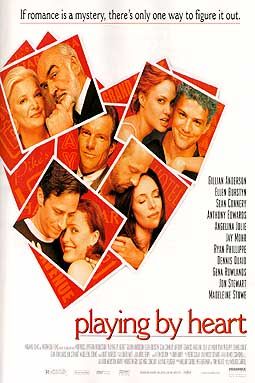
First up, a movie called Playing by the Heart. Never heard of? I'm not surprised, because it didn't seem to win much critical or box office love when it came out back in 1998. What is surprising is how so many talented actors were convinced to take part in this unexceptional film. The movie opens with a number of unconnected couples in various stages of relationships: 
- Hannah (Gena Rowlands) and Paul (Sean Connery) are an older couple facing the end of their relationship now that Paul's been diagnosed with a life-threatening tumor. One shocking revelation still remains though: An old affair that Paul had is discovered by Hannah. "Fun" note: watching how Paul tries to explain away this affair is pathetic. Second "fun" note: Paul's terminal illness no longer seems to be an issue at the tacked-on "happy" ending.
- Joan (Angelia Jolie) just got out of a terrible and ridiculous relationship but after breaking up with her boyfriend via a payphone in a club, she immediately turns upon the stranger (Ryan Phillippe) standing next to the phone and tries to pick him up. This happens repeatedly, night after night, despite his unwillingness to be in a relationship. "Fun" note: Ryan Phillippe's angsty portrayal is just him looking sullen all the time. 
- Meredith (Gillian Anderson) is a workaholic divorcee whose "meet cute" with an architect (Jon Stewart) involves a wall-sized bookcase falling over on her tiny self. "Fun" note: Jon Stewart's character is basically an asshole masquerading as a "nice guy." Yet I'm 99% sure the audience is supposed to think he really is a nice guy. Nope.
- Gracie (Madeleine Stowe) is having an affair because the "mystique" of it is so much better than her "boring" husband. "Fun" note: Shut up, Gracie. Second "fun" note: Even she seems to be have a more or less optimistic ending, despite all odds.
- Hugh (Dennis Quaid) keeps trying to tell a different sob story to whatever woman will listen to in bars across town. "Fun" note: Hugh could probably save himself a lot of grief by being more honest.
- And last but not least is the only non-romantic couple in the cast: Mark (Jay Mohr) is dying of AIDS and now has to open up to his mother (Ellen Burstyn) about his homosexuality. "Fun" note: The movie tries so hard to be open-minded and modern, but its handling of this topic feels both so preachy and so dated. 

These disparate characters and storylines eventually come together in an ending that I *think* is supposed to surprise the viewer, although it is easily predictable early enough into the movie. As you can probably gather from my sarcastic comments above, I wasn't a big fan of this movie. Almost everything about it felt contrived and/or saccharine, and the relationships depicted were all so unhealthy, yet we're clearly supposed to be happy at the ending. No thank you. And despite having such a talented cast, the performances were mostly pretty shoddy, although I can't help to think that a lot of that has to do with a corny plot and terrible dialogue. The only real standout is Ellen Burstyn as the grieving mother of a dying son, but even that is just a small part of the movie. There are a few funny moments scattered here and there in the movie, but honestly even those aren't that good.

Final word: Do yourself a favor and save your time by staying away from this title. I didn't believe Jon Stewart when he made fun of his movie career by holding this movie up as an example of wretchedness. No wonder this movie was hard to get a copy of -- it's not worth watching.

Next up was In Her Shoes, starring Cameron Diaz, Toni Collette, and Shirley MacLaine, and based on the book of the same name. Rose (Collette) and Maggie (Diaz) are two sisters who couldn't be more dissimilar -- Rose is practical and plain; Maggie is flighty and primped. When a particularly painful betrayal happens, Rose kicks Maggie out. Forced to find her way on her own, Maggie discovers a grandmother (MacLaine) the girls never knew they had.

So I read the book this movie was based on way back when and loved it. When the movie came out, I wanted to see it but for some reason I just never got around to it. Recently, I read a memoir by Jennifer Weiner (the author of In Her Shoes) and her mentioning the movie in that memoir renewed my interest in watching it. Luckily my library had a copy, so I grabbed it right up. 

It's hard to review this movie 100% fairly. It's been so long since I've read the book now that I can't accurately compare the two -- the only glaringly "wrong" thing to me was that Maggie's time in Princeton (a part which for some reason sticks out to me more than any other part of the book) is completely missing from the movie. I guess it just wouldn't have filmed as well perhaps, but I felt like it was a crucial part to her story. 

Other than that, the movie seemed to jive more or less with the overall message of the book. Somehow though -- the condensed time perhaps -- the movie lacked some of the emotional impact of the book. Although I've loved Toni Collette in many other things before (including but not limited to United States of Tara), her story seemed the most lacking in emotional "realness" -- so often, her character just burst out with something that didn't seem to mesh with anything else, or else other characters referred to changes in her emotional state that just didn't seem to be there. Mostly I chalk that up to the shortened storytelling time more than on Collette's performance, but it was still a bit disappointing. (Also, it was terribly hard to believe that her character was so insecure about being overweight when she looks like she's about a size 4.)

On the other hand, I was pleasantly surprised with Cameron Diaz's performance. It is probably biased of me, but I didn't expect much from the star of There's Something About Mary and The Sweetest Thing (two movies I wish I had never wasted my time on). However, she really embodied the role of Maggie and brought an impressive range to the character. Shirley MacLaine also did a fine job in her role as a grandmother long estranged from her grandchildren and dealing with some heavy emotional baggage of her own.

While both the book and the movie have been cast in the ghetto of "chick lit" and "rom-com," respectively, the story of In Her Shoes is so much more than your standard romantic storyline (girl meets boy, they have a falling out of some sort, girl and boy end up back together when everything is cleared up). Deep and varied issues are addressed, ranging from mental illness and death to forgiveness and acceptance. It is not necessarily a strictly "feel good" movie, although it does end on uplifting notes.

Final word: Hard to say with this one, actually. If at all possible for you to do so, I'd recommend you read the book, which was so thoroughly good. Barring that, then maybe watching the movie is a worthwhile use of your time. It's a decent choice for when you don't want something too fluffy, but you also don't want to be slammed by something unremittingly depressing with no hope whatsoever.


Sunday, February 5, 2017

Come On, Get Happy

As I've lamented before on this blog many a time, winter is my least favorite season of all. It is looong, cold, dreary, and dark. It makes me wish I was a bear who could hibernate these months away and emerge well rested for spring. But since that's just a fantasy that won't happen, I've been trying to dispel my winter blues with fun and light-hearted movies -- not my usual fare but perfect for lifting my spirits, even if just temporarily. And as I've been away from this blog for a while, I thought I would try a quick summation of those movies in this one post. (It may get a little long though...)

To try to improve my mood, I watched these three movies in recent weeks: The Answer Man, Zootopia, and The Peanuts Movie. Two kids' movies and a romantic comedy -- this is how I roll in the winter, people.

The Answer Man

This is a romantic comedy from 2009 about a hermetic best-selling author and a single mom with a recently opened small business who meet almost by happenstance and decide to start dating. Literally, the entire rationale behind me watching this movie was "Lauren Graham is in it." The description sounded okay, and I was willing to give it a try, but I was not expecting much. With that attitude going in, I was surprisingly pleased. Sure, the romance part was pretty flat, but the acting was superb, the comedy was good, and it was really more of a story about the author becoming a more social and caring human being than it was a purely romantic comedy. I'll address each of those points a little more fully below.

Jeff Daniels as author Arlen Faber was comedy gold in a multi-faceted role. Faber is a character who is struggling with a number of things -- physical pain from a bad back, a crisis of faith, a desire to be left alone by the people who want to adulate him for his best-selling religious books, and coming to terms with being needed by others and finding himself wanting to be around other people as part of their lives. Lauren Graham was predictably wonderful, presenting her usual mixture of fun-loving comedy turning to fierce drama at a moment's notice. As she herself once noted, she does seem to be typecast into the single mom role, and there were a few moments in the opening of the movie that felt like the movie was trying to give us Lorelei Gilmore with a young son instead of teenaged daughter. But then the character of Elizabeth comes into her own, and we see her more as a dedicated chiropractor, determined to help patients and see her small clinic succeed, and as a friend/love interest to Arlen.  Lou Taylor Pucci as recovering drug addict and struggling independent bookstore owner played perfectly whether in humorous or serious scenes, in either case serving to further stretch Faber's growth and development. Smaller roles were well acted and rounded out the cast of quirky characters.

As I've probably mentioned in the past, I'm not the hugest comedy fan - especially sitcoms or romantic comedies, which tend to feel very predictable and, as a consequence, dull. But that being said, I found myself laughing quite a bit with this movie. A lot of that came from Faber's unexpectedly foul-mouthed or flippant sayings, but some of it was physical and situational humor as well (like Elizabeth trying to promote her business by having her assistant dress up as a giant spine outside their office or Faber being pulled unexpectedly into a parent-teacher conference for Elizabeth's son). There's also a bit of the "awkward first date (or three)" conversational humor, which is a somewhat stereotypical romantic comedy move, but that's usually the best part of any rom-com in my opinion. 

And, finally, I enjoyed this movie more than the standard fare romantic comedy because it was much more than just that. The movie addressed Arlen's need to get outside of himself and his worries to connect with other people and care about them. Sure, that included a potential romantic partner, but it also included her son and people in the community like Kris the bookseller. Faber doesn't completely change his personality or attitude but he does become more willing to embrace other people and help them on their course through life, in turn helping himself to be more compassionate. That may sound overly sentimental, but the movie manages to stay *just* above the rim of being truly sappy. 

Like I said at the beginning of this movie review, I was surprisingly amused and entertained by this movie. And I'm surprised to find myself recommending it as well if you want something on the cheery side for your next movie pick.

Zootopia

A good number of the little kids (and grown adults for that matter) in my life had already seen this movie when it came out in theaters and loved it. I figured I'd get around to it eventually, which turned out to be a day I was still in a down mood. Zootopia tells the story of Judy Hopps, a bunny from a small rural community who can't wait to become a police officer in the big city of Zootopia, despite the nay-saying she hears from literally everyone, ranging from the local bully to her own parents. She persists in her goals anyhow, passing all the hurdles to becoming a police officer and arriving in Zootopia to learn about an ongoing missing animals case, to which she is not assigned because, again, no one believes a small rabbit can accomplish much. But through a series of unexpected circumstances, she ends up partnering with Nick, a con-man (or con-fox, as the case is) to uncover a much bigger conspiracy that anyone expected.

As you might expect from a children's animated movie, there is all kinds of humor in Zootopia, ranging from very obvious slapstick bits for kids to references clearly meant for adults. My favorite two scenes that had me laughing out loud involved a DMV office run entirely by the slowest moving sloths and an introduction to the criminal boss, "Mr. Big," who mimicked several Godfather lines. The movie definitely hit the spot in improving my bad mood, even if it didn't succeed in doing so for a terribly long time. 

But Zootopia also succeeds in presenting a number of important issues to children in a digestible form without being overly didactic. There is soooo much about not judging people by their outside appearance but instead by their personal qualities, like commitment to righting wrongs and perseverance in the face of internal and external doubts. Yes, there are times when some of this lesson is a bit heavy handed, but it's never a "hit you over the head" morality tale. 

Like we've all come to expect with a Disney movie, this one features a lot of talented actors lending their voices to various characters, including Ginnifer Goodwin as Judy, Jason Bateman as Nick, Idris Elba as the police chief, Shakira as the pop star Gazelle (giving the film its catchy theme song), and many many more. As we've all come to expect with an animated film from Disney, the success of Zootopia has inevitably led to there being talks of a possible sequel, one which ::eye roll:: many hope will lead to Judy and Nick getting together as a romantic couple. Let's just hope that any follow-up movie is of as high a caliber as this first one was. 

The Peanuts Movie

Last, and let's admit it, least, I watched the new reincarnation of Charles Schulz's characters that is The Peanuts Movie. As a bit of background, I've never been the hugest Peanuts fan, though I do generally find some of the older short movies both funny and fun to have on around the appropriate holidays. This movie, written by Schulz's son and grandson, stays true to the original characters in interesting ways, but it is sometimes perhaps a little too true to them. Bear with me as I explain.

The Peanuts Movie is largely centered around Charlie Brown's crush on the new girl at school (known simply as The Little Red-Haired Girl) and his myriad attempts to do something great to get her to notice and like him. But because it's Charlie Brown, these attempts inevitably do not turn out as planned. Throughout his many endeavors, Charlie Brown's myriad friends, including his sister Sally and his loyal dog Snoopy, strive to help him out. At the end of the school year, when Charlie Brown finally manages to just talk directly to The Little Red-Haired Girl, she says that she admires all the good qualities he demonstrated when things went wrong, including his selflessness in advancing others before himself. 

Among many of the nods to the original comics include Lucy pulling the football away from Charlie Brown at the last moment, the kite-eating tree, Marcie inexplicably calling Patty "sir," the muffled voices of all adults (voiced here in a stroke of genius by Trombone Shorty), and Snoopy's dreams of being an ace war pilot battling the Red Baron for the skies. This last one has always been a bit of an odd one in my opinion, and some parts of the movie involving these scenes went on a little too long for my liking. There's also a love interest for Snoopy here, mirroring Charlie Brown's story back in the real life part of the movie. 

Also true to the original Peanuts were the many bizarrely romantic relationships seen among schoolchildren. Perhaps because Charlie's crush is the focus on this movie, I started noticing these relationships more than I usually do. Almost all of them involve girls who nag and borderline bully boys into liking them back (e.g., Lucy and Schroeder, Sally and Linus, Peppermint Patty and Charlie Brown). Meanwhile, Charlie Brown's entire basis for liking The Little Red-Haired Girl is that she's "pretty" and she chews on her pencil like he does. He never even learns her name. She is literally "The Little Red-Haired Girl" from beginning to end of the movie. The weird relationship dynamics were kind of unsettling as an adult, and it makes me wonder what kind of message is being sent to kids when they watch this movie. I understand that attempts were being made for continuity between the past Peanuts and the present, but some of this was just a bit too much. It could be left in the past.

It was interesting for me though when I went searching for the origins of the "sir" moniker for Peppermint Patty that I found this article explaining how this character was Charles Schulz's response to second-wave feminism. He chose to make a character that defied the stereotypical feminine traits, instead opting to make Patty a fan of sports who doesn't wear skirts. So that was nice to learn; I just wish that the new creators might have found some ways to bring the female characters of The Peanuts Movie past the 1960s. 

That all being said, there were pretty funny parts to this movie as well as some charming ones. Particularly hilarious to me was Charlie Brown's quest to write the perfect book report to impress The Little Red-Haired Girl, which ends up involving a mistaken search for the book "Leo's Toy Store" by Warren Peace. There was also plenty of slapstick and physical comedy to entertain those who really enjoy that kind of comedy, like the small children who are the target audience for this movie. I really did love the ending in which The Little Red-Haired Girl pointed out all the times Charlie Brown stood up and did the right thing, even if it didn't seem beneficial to him at the time. That was definitely a high note in this movie, teaching children important lessons about how being a good person is about helping others, not just promoting yourself and your achievements.

The animation style is different from the original Peanuts films, given the many changes in technology since then. I guess it could be off-putting for some, but I didn't mind it much after a few minutes of getting used to it. The look and feel of the characters was the same, even down to Lucy being a horrible bully, which I wish was addressed more. All in all, I found this movie an amusing diversion, especially for adults who grew up loving these characters. But I would be hesitant to share it with small children without discussing the problematic parts later.

Well, those are my two cents (and perhaps a little more) on these movies. Have you seen them and have any thoughts? What do you do to keep the winter blues at bay?

Saturday, July 16, 2016

For a Good Time, Call BUtterfield 8

For some reason, within the past month of so the movie BUtterfield 8 came up a couple of times. The first time I came across it (while researching ambiance and facts for a 1960s party I was throwing), it piqued my interest a bit after I heard that Elizabeth Taylor won a Best Actress Oscar for it. The second time it came up (when reading a book that mentioned several infamous cases involving the disappearance, death, and/or murder of young women in the 1940s), I decided I really had to check it out. So I found a copy through my local library and popped it in my DVD player.

Note: This review is going to have spoilers, so beware. But, hey, you've had 50+ years to watch this movie. ;)

BUtterfield 8 starts with Gloria waking up alone in the luxurious apartment suite of Liggett, a man she met the night before. At first, she slowly and seemingly happily wanders about the apartment, admiring the fancy clothes and sundry niceties belonging to Liggett's absent wife. But when she spies a note from him asking if $250 is enough, she goes into a rage and writes "No Sale" across the ornate mirror with lipstick before storming out of the apartment with his wife's mink coat as a revenge. This beginning is veeeery slow and feels like the type that wouldn't fly with modern audiences at all who expect an explosion or a plane crash or a murder in the first scene of any movie or TV show. It's only in retrospect that the viewer actually realizes what is going on, as we are unaware in the long, dialogue-free introduction who Gloria is, where she's waking up, or why she's there. This is not the kind of draw we're used to nowadays.

Gloria then waltzes her way over to the cramped and less refined apartment belonging to her childhood friend and current struggling musician Steve, where she shows off her new coat and whines that the man dared to actually pay her, which confuses Steve -- and frankly, the audience as well at this point -- because he doesn't quite understand what she wants from these meaningless relationships she starts with men. He worries about her future, which she pooh-poohs before getting his girlfriend to come over and lend her a more appropriate outfit to go home to her mother in, as she doesn't want her mother to know who she really is and what she does with her time. The girlfriend is furious at Gloria but complies while she is present, later giving her boyfriend an ultimatum to choose between her and Gloria, to which he sighs that he can't give up on Gloria because he has such a strong bond with her and feels it is his "brotherly" duty to watch out for her. (Although it's difficult to see what exactly he's doing to help Gloria, for it seems that he is only enabling the very behaviors in Gloria that he says he worries about. Also, their "brother-sister" relationship seems to have far more sexual tension than the one between Gloria and Liggett, perhaps not unsurprising given that the actors playing Gloria and Steve - Elizabeth Taylor and Eddie Fisher, respectively - were newlyweds.)

Eventually Liggett and Gloria make up when she gets him to understand that she chooses and drops men as she pleases and she refuses to accept money or any goods from these men, no matter how wealthy they are or how much they offer her. The two then run off together for days on end without telling anyone where they are or when they'll be back -- a particularly cruel move on Gloria's part as her poor mother sits at home worrying if Gloria is alive or dead. (Liggett's wife meanwhile is safely ensconced with her sick mother and unaware of what her husband is doing back in New York anyway.) Gloria comes to believe she is in love, even though the "romance" between the two is hardly shown and it doesn't seem that they share anything beyond a sexual attraction. This is not helped by a rather wooden performance from Laurence Harvey as Liggett, who always seems rather bored by Gloria except in later scenes when he comes alive with anger. Gloria happily returns to New York and starts bearing her soul to everyone -- from discharging herself from psychiatriatic help because she is "cured" now with her newfound love to finally confessing to her mother about her past indiscretions only to let her know that is in the past now that she's found someone permanent.

However, as someone wise said, karma's a bitch. When Liggett's wife returns home and notices her mink is missing, he immediately (and correctly) suspects that Gloria stole it. A huge and public fight ensues and ends with the two parting ways. A distraught Gloria ends up at Steve's apartment again, truly bearing her soul this time when she confesses to him that she was sexually molested by her mother's boyfriend when in her early teens, a scene that transforms her from a hedonistic character to simply a hurt one. Somehow this confession awakens some sort of bizarre sympathy transference in Steve that causes him to propose to his girlfriend, at which point Gloria quietly sneaks back home to her mother. Gloria decides to start life anew and move away from New York to Boston. But early en route, she is tracked down by a now remorseful Liggett who refuses to let her go. She dashes into her car without him and drives speedily away, but Liggett is just not the kind of guy to take no for an answer. He pursues her in his own car until, in her desperation, she unwittingly drives into a construction pit, her car wretchedly tumbling over and over again with fatal results for Gloria.

Talk about an ending. There is clearly no going back and starting again for a "bad girl" in the late 50s/early 60s. But for a cheating husband? Liggett returns home to his wife and the final lines of the movie are given to him expressing hope that they'll work on their marriage. Wow. Truly, despite all the times that Gloria is referred to as a "call girl" or "high-class prostitute" by other reviewers, the Gloria depicted in the movie makes it clear she doesn't take money from men, although she is happy to flirt with or sleep with whomever she likes. Clearly she has a broken past and her current relationships are in shambles (whether it's lying to her mother, provoking the anger of her only friend's girlfriend, or getting involved with already married men), but her life is not nearly so scandalous or salacious as the movie posters would have you believe. Nevertheless, she pays the ultimate price - her very existence - for living the life of a single woman making her own decisions. For a modern audience, this is a very bitter pill to swallow. It's not surprising to learn that, according to Taylor biographer Alexander Walker, Taylor herself was opposed to doing this movie as it cast in her such a negative role, but alas was under contract with the film's studio, MGM, to make this movie whether she wanted to or not.

The film is based on a novel of the same name by John O'Hara. Never having read that title, I'm not sure how this movie lines up with the book, particularly whether or not the portrayal of Gloria is any different. I suspect that like with many movies that came out in this time period, much had to be left unsaid -- for instance, Holly Golightly's call girl status in Breakfast at Tiffany's. However, as I previously mentioned, I can't say that for certain, not having read the book. It's worth noting that the book was based partially on a real-life drama concerning the mysterious death of Starr Faithfull, which occurred nearly 30 years before this movie was released. I wonder if that contributes even more to the feeling that this movie is very dated.

Indeed, this movie's biggest criticism these days is just how very old-fashioned melodramatic it is. Contemporary audiences give it pretty low rates for being dated and too much of a soap opera. I hate to be one more voice piling on, but these critiques seem fair. This movie is worth watching for a steamy and emotional performance by Taylor, but otherwise it falls flat and rankles with modern-day conceptions of women's autonomy rather than scandalizing viewers with the idea that people have sex outside of marriage.

Saturday, April 23, 2016

How Do We Measure Greatness? On Watching The Great Gatsby

It's a story everyone knows. Boy meets girl, girl rejects boy due to lack of money, boy makes lots of money and comes back looking for the girl who has since married. Even if you haven't read or seen The Great Gatsby, this very basic outline of the story is probably is familiar to you in one form or another in some other book or movie. But chances are you have read The Great Gatsby for in the nearly 100 years since Gatsby's original publication, it's become a staple in nearly every high school curriculum and several college courses as well. A popular movie in the 1970s brought the story to a wide audience as well.

But Hollywood is Hollywood and even if everyone already knows a story, that doesn't stop big movie studios from taking another stab at it. So it really shouldn't be a surprise that Warner Brothers would reboot the story for a 2013 film version of it. But on the plus side, this latest version was helmed by director Baz Luhrman, whose name should be a clue that we'd be getting something completely different this time around. When I saw the previews for this version of The Great Gatsby, the visual look and feel of the movie seemed very appealing and right up my alley, so I knew it would only be a matter of time before I saw it.

Of course, then as usual, time got away from me and I didn't see the movie. But when the movie came up as part of my book group's discussion of Z: A Novel of Zelda Fitzgerald this week, I decided it was time to finally check it out. After watching the film, these are my thoughts on it.

This latest incarnation of The Great Gatsby is indeed a visual spectacle, from Gatsby's lavish song-and-dance parties full of glitter and glam to the imposing and divergent domiciles of Gatsby and the Buchanans to the shining gleam coming off of racing cars to the bright colors of Long Island and Manhattan set against the stark gritty, gray reality of the ash heaps in between them both. Indeed, this last part hit a surreal level of hyper-reality with Long Island and Manhattan nearly jumping off the screen with their luminosity while the valley of ashes doesn't have a lick of color beyond the ever-present blue eyes of Dr. T.J. Eckleburg's billboard looming over everything as 'the eyes of God,'  and even these are faded and muted. (Up close we get a tad bit of color in the ash heaps in the form of Myrtle's all-red ensemble, a visual reminder of how she clearly doesn't fit in here .. and of course a reminder that she's 'the other woman' wearing the scarlet letter, so to speak.)

All of the visual beauty in this movie might make it seem like it's a case of style over substance, yet the movie stays largely true to the original work and, using Nick Carraway as the voice-over narrator throughout the film, makes liberal use of direct lines of text from the book. It clearly hits all the most important symbolism of the book, including the aforementioned billboard as well as the green light at the end of Daisy's dock, which almost comes off the screen with the close-up effects. In fact, it almost gets to the point where it feels like Luhrman is hitting the viewer over the head and saying, 'hey, look at the symbolism already, won't you?' In addition, the story isn't given a Hollywood happy ending but retains its original pessimism; any happiness seen in this plot is quickly fleeting.

Still, something felt a little off in this adaptation, even if I can't quite place my finger on what exactly that is. The first major issue I had was in casting Nick in a role that was more Fitzgerald than Carraway -- the framing device placed Nick in a mental institution of some sort writing away his troubles to get a grip on how he felt about that whole summer of Gatsby. I'm never a fan of when movies try to interject more of the author into a character than the author originally did. (I'm looking at you, 1999 adaptation of Mansfield Park, which tried to convert Fanny Price into Jane Austen herself.) Tobey Maguire as Nick seemed all wrong as a casting decision, and his habit of stretching out words and sentences to impossible lengths when narrating very, very quickly got old. I was holding back from shouting 'spit it out already!' at the screen.

The second thing that I found very bizarre was the use of modern-day pop songs alongside the period pieces, set, and costumes. It was one thing in Luhrman's Moulin Rouge, which was a musical and used variations of modern songs as sung by the film's characters to interject some levity to an otherwise very serious and depressing movie as well as to heighten the mood and/or atmosphere of certain scenes. But here, in a film trying to be dramatic, serious, and important while maintaining a decent amount of accuracy to the source material and time period, it just seemed wrong to be hearing Fergie in the background. Perhaps when Jay-Z is a film's producer, it becomes a prerequisite to play his and his wife's songs, regardless of the anachronism it presents; all I know is it seemed all kinds of jarring and took away from the storytelling going on in the film.

Back to the plus sides, with the exception of Maguire, the casting was superb. Everyone fit into their roles like a glove, but I think that Carey Mulligan as Daisy was the stand-out performance. I had never been a fan of the 1974 movie version of The Great Gatsby, and Mia Farrow as Daisy had been a large part of that, so I was very pleased to see Mulligan embodying Daisy in such a fantastic way. I also liked that even though it's hard with older source material like this, there were some attempts at diversity done; in particular, there's a very brief moment in a scene when Nick comments on how everything is changing as they speed past a car full of clearly wealthy African-American people with a Caucasian chauffeur. It's not much, but it's a little step in the right direction of more diversely cast movies and TV shows.

Overall, I did enjoy this movie as an entertaining break from the everyday and a new twist on a classic novel. I'm glad to have seen it at last, but it's not a movie I feel like I'd ever need to re-visit, which for me is the true test of a movie's greatness.