Showing posts with label film. Show all posts

Monday, December 16, 2019

Turn the Record Over ... I'll See You on the Flip Side

Despite the title quoting their lyrics, this blog post actually has nothing to do with the alt-rock band The Gaslight Anthem. But the lyrics come from their song (and album) titled 45, which ties into this blog post. Specifically, I am back to reviewing some of the AFI's Top 100 movies as I make my way through the list. The following movies brought me up to 45 out of the 100 movies watched.

Before we get into the reviews though, I wanted to note that I mentioned last time that I doubted if many movies on the list actually passed the Bechdel test, which is set up as a bare minimum barometer for women's stories being included. Turns out that someone actually already did the research and calculations, and only 32 movies on the list pass. That's not just a failing grade, that's an abysmally failing grade. This is an important thing to note as I go into reviews because the further I wade into this list, the more I am noticing this huge problem. Women's stories are completely devalued by whomever chose these AFI's Top 100 movies. Unfortunately, that is what it is and here I go into reviews...

The Graduate 
(released 1967, #7 of 100)

This is one of those movies that I did kind of want to watch anyway, especially because it seems to be referenced all the time and is considered a classic. Before watching it for this little project, I read the book it's based on, in large part because I am also very slowly working on reading the books on the 1001 Books to Read Before You Die list. Overall, this movie is a pretty faithful adaptation of the book, but when the source material isn’t great, neither is the screen adaptation.

The story itself is pretty slim -- a young man graduates from college, returns home, and starts an affair with the wife of his father's business partner. It's not exactly earth-shattering nor that compelling. The movie cuts more to the point than the book (i.e., doesn't belabor things) and can be more humorous as a result. There are definitely odd camera choices though, such as an antenna crossing across someone's face, or the backs of people's heads zoomed in on too closely during the party scene. There's a decent soundtrack of Simon & Garfunkel songs, but they didn't seem to fit the scenes they were used in.

In terms of casting, I usually think you can't go wrong with Dustin Hoffman, but he was just okay here. It's definitely not his best performance but, to be fair, he was pretty young. However, he was about 30 playing a character who is in his early 20s (just graduated from college so most likely 21 or 22), and it struck me right away that he was too old to be playing that character. Meanwhile, Anne Bancroft is absolutely perfect in the role of the Mrs. Robinson; she steals every scene that she's in. Katherine Ross as Elaine Robinson was well cast as she looks like she could actually be Anne Bancroft's daughter. This Vanity Fair article provides some background into the casting process for The Graduate, and it's clear that they really did choose some of the best possible actors for the roles as the other names floated don't seem right for those characters.

Nevertheless, this really wasn't a great movie in my opinion. I can’t believe this was in the top 10 of the AFI's Top 100 list; it was okay but wasn’t anywhere near that good. Watching it for the cultural touchstone makes sense, but it could have been way further down the list.

Annie Hall
(released 1977, #31 of 100)

This is one of those movies that I probably saw before but couldn't remember if I had really watched it from beginning to end or just caught snippets of it. After watching it for this project, I'm pretty sure that I had sat down and watched it all previously. Which is fairly unfortunate given that I didn't really like it all that much and made myself watch it again.

This movie features two of my least favorite actors (Diane Keaton and Woody Allen) playing two terrible characters in what is essentially a romantic comedy -- typically not my genre of choice. In some ways, the characters remind me of Seinfeld characters in their inability to see how awful they are and always thinking other people are the problem. The movie even starts off with Alvy wondering what went wrong in his relationship with Annie when clearly he was awful pretty much 100 percent of the time. For, despite the title of the movie, it’s really Alvy’s story. Yet another male-centric story on AFI's Top 100 list. Sigh.

There are a lots of jokes in this film that really didn't age well given Woody Allen's history. For instance, Alvy and co. make "jokes" about his grandmother being raped, his friend having sex with 16-year-old twins, politicians having ethics comparable to child molesters, and his own sexual curiosity beginning at age 6. That all aside, in general, there's just way too much about Alvy's whiny need to have more and more sex while also having a variety of neuroses about sex. In addition, this movie has Alvy's friend defining VPL for the world to know, and of course it's some doofus of a guy who made that popular. Eye roll.

Honestly, many of his non-sex jokes weren't all that funny either. The situational humor is better at times, but this movie gets old kind of fast and most of the last half an hour in particular was dull. However, this film is definitely fun and interesting for having moments of breaking the fourth wall, inclusion of supertitles over the character's heads to show what they’re really thinking, out of order storytelling, split screen effects, etc. There is no soundtrack to the opening or closing credits, which was unusual (but not necessarily good or bad). This playing around with the cinematic art form is cool and the only thing that really makes the movie worth watching.

Rebel Without a Cause 
(released 1955, #59 of 100)

This is another one I was interested in seeing anyway because it seems culturally relevant; it is certainly referenced in many other pieces of pop culture. However, 15 minutes into the movie, I was already bored; there is just way too much whiny, teary teenage angst packed into those 15 minutes.

Many moments in this movie were filled with overly dramatic music to make things even more unnecessarily emotional. I'm at a point in my life where I just don't care about high school drama/stupidity, and immediately agreed with the father in the film who tries to tell Jim that he'll look back on this some day and realize it wasn't actually a big deal (until of course it escalates because Jim doesn't listen to his dad). This movie had the added non-interest for me of having a lot of machismo stunts. Bleh. So senseless.

James Dean and Sal Mineo are both good but the rest of the cast, especially the teenagers, just seem to be running through the motions. All of these actors look older than teenagers as well, which I guess is often the case but it doesn't mean I won't comment on that unfavorably. I don’t know what Natalie Wood is attempting to do in this film, but her facial expressions often seem completely off for whatever moment is happening. Although perhaps that was also due to the writing, wherein they have her running around essentially playing house at the mansion and smiling/laughing the night her boyfriend tragically died. The only character of color is a Mamie type character; it might have been less problematic to just have an all-white cast. It was the mid-50s though, so I give this movie a little bit of a pass as a result.

On the plus side, there are some interesting camera angles in scenes like the opening credits, Jim fighting with his parents after the car accident, or the climax at the observatory steps. There are also pretty landscapes in back of the high school and other places about town (mountain, cliffs, etc.). However, a handful of bucolic shots is not enough to salvage this rather disappointing movie.

***

So this grouping was all pretty discouraging, but there's still plenty more movies ahead!

Monday, September 30, 2019

Dear Reader, I Watched Them All

In this post I'll be taking a brief break from my reviews of AFI Top 100 movies to discuss some other films I saw this year. Specifically, I finally got around to watching the various screen adaptations that exist of Charlotte Bronte's famous novel Jane Eyre. Many moons ago when I was still an undergrad, I took a course on Victorian literature and read Jane Eyre (alas, with the big reveal having been already spoiled for me by a too chatty classmate; I will be kind enough to tell you all that this post will indeed contain spoilers for the plot, so proceed at your own risk). After that I meant to watch some of the movie adaptations; I even recall seeing a trailer for one of them when it was new! But me being me, this kept getting pushed off to some later date when I would 'have free time' (cue laughter here).

Fast forward to the beginning of this year when I was trying to catch up on some podcasts and listened to Can I Just Say's episodes on Jane Eyre, both the novel and some of its adaptations. Of course, I couldn't simply listen to these episodes with no context though! While I didn't re-read Jane Eyre (too little time to read all the books I want to read as it is), I did make a point to finally watch the film adaptations -- the three discussed on the podcast before listening to it and then just to round everything out, I finally finished this little 'project' of mine but watching one more, which is where I'll start my reviews, as it's freshest in my mind.

Jane Eyre (1944)

This little 'project' of mine ended with the earliest of all these adaptations, which perhaps wasn't entirely fair to save for last, but that is what happened. This wasn't my favorite of all the adaptations; indeed, I found the pacing a bit slow at times. But it was certainly a solid addition to the list of Jane Eyre films and must have been so even more when it first came out to viewers who hadn't seen many previous screen adaptations of the novel, particularly as a "talkie."

The film opens with a young Jane Eyre being interviewed by Mr. Brocklehurst concerning her so-called bad behavior. Peggy Ann Gardner was the most spirited of all the young Janes I saw and was delightful as a result. Agnes Moorhead, best known for her role as Samantha's mother on Bewitched, was absolutely fantastic as Jane's Aunt Reed. She manage to convey in a few facial expressions just how awful this character was, which was necessary for this adaptation as we don't see any of her earlier abominable treatment of Jane. Young Jane's hope of a wonderful new life at school is quickly tamped out when she arrives at the dour Lowood School. But here she makes a friend in Helen, another school child who is played by a shockingly uncredited young Elizabeth Taylor!

Jane quickly ages into a young woman and the role is taken over by Joan Fontaine; I cannot recall having seen Fontaine in any other movie before, but I was immediately struck by how much she looked and sounded like her sister, the actor Olivia de Havilland, probably best known for her role as Melanie in Gone with the Wind. The role of adult Jane is incredibly difficult because she is quiet and deferential while having a very vivid interiority; the reader of Jane Eyre knows this, but the viewer isn't always as lucky. Fontaine certainly does show at times that something else is going on in the character's mind, but other times her face is just too placid to read anything more into it. This movie does have a gimmick in which lines of the book are shown and Fontaine reads them in a voice-over, but this felt like it took the viewer further out of the narrative as opposed to deeper into it, which I think was what the screenwriters were going for with this device. (Side note: A fun fact with this movie is that one of the screenwriters was none other than Aldous Huxley, author of Brave New World.)

Jane moves on from the Lowood School to become a governess at a private estate. Her charge is the young Adele, played by Margaret O'Brien; it is my understanding that O'Brien was a popular child actor in Hollywood at the time but if this movie is any evidence, I cannot understand why. Her French accent was atrocious and the rest of her performance didn't make up the difference. The lord of the estate is Mr. Rochester, played by Orson Welles, whose interpretation of Rochester seems to be more grumpy and stern than brooding and mysterious, but it works well enough. Sadly, I don't think Fontaine and Welles had particularly good chemistry, which is such an essential part to this story. I think that is partially to blame for some of the movie seeming to drag a bit.

The estate itself, Thornfield, is presented here as a perfect setting for the more Gothic elements of this tale; the black-and-white filming and the gloomy shadows are appropriate. However, the exterior shots are all so clearly sound stages, and that takes away a bit from the effect they have. Other characters come and go at Thornfield, but the only actor who stands out is Hillary Brooke, who perfectly captures the haughtiness of Blanche Ingram.

Being as this movie is on the shorter side (only about an hour and a half), it straight up cuts out everything regarding St. John and his sisters, which is just fine with me. All in all, this is a fine-enough adaptation of the book, but it's not the one I would recommend as best.

Jane Eyre (2011)

So this is the one I recall seeing a trailer for before it came out in theaters, and then it languished on the 'I-should-watch-that-one-of-these-days' list for eight more years before I finally did. In keeping with my procrastination tendencies, it's been long enough since I watched it that my review will be perforce shorter and to the point.

This movie started in the middle (really towards the end) with a distraught Jane wandering the moors in hysterics. It then goes backwards through Jane's life from childhood up until this moment, before carrying onwards to St. John and his sisters taking her in off the moors. This device of starting somewhere in the middle can often draw viewers into a movie, but I think it's an odd choice for one based on such a well-known story. Furthermore, I really did not like that Jane was being portrayed as so hysterically emotional as that seems counter to her character; it was probably to draw more of a contrast to how dully placid she was in nearly all the rest of the film. Indeed, on the whole, I did not like Mia Wasikowska's portrayal of Jane as it seem to lack any depth for the character; she is at either extreme of being unreadable or far too passionate for how Jane acts in the novel. Again, Jane is a difficult character to be viewed on screen because so much of her personality is kept hidden to outsiders, but this portrayal seemed so off from how I pictured Jane Eyre to be.

On the flip side, Michael Fassbender was a very compelling Edward Rochester. His interpretation of the character came off as creepy -- not in a horror sense, but in the vibe you get from certain men to stay clear. That is how I feel about the character in the book so I was glad to see it on screen as well! The chemistry between the two leads was missing here as well, which is again unfortunate.

The supporting cast, including an underused Dame Judi Dench as Mrs. Fairfax, do just fine in their roles. The scenery is well done, both exterior and interior. Costumes are equally lovely. Clocking in at just about two hours, the film cuts little of the major points from the book. That all being said, that je ne sais quoi was missing from this film; I wouldn't necessarily recommend it either.

Jane Eyre (1996)

This version was directed by Franco Zeffirelli and also lived on my 'should-get-around-to-watching' list for a very long time. Incidentally, after finally watching this one, I felt there were some cinematographic similarities with the only other Zeffirelli film I've seen, namely Romeo and Juliet (1968), despite the many year gap between the two movies.

Once again, we open with Jane Eyre at her Aunt Reed's house; the young Jane is played by Anna Paquin, who seems a bit overly emotional for the role, but I'll allow it because Jane at this point is more open about her feelings. As Jane grows in to a young woman, Paquin is replaced by Charlotte Gainsbourg. She isn't my favorite Jane Eyre actor and she occasionally slips into her French accent, but I still preferred her to Mia Wasikowska.

Rochester, meanwhile, is played by William Hurt, who gives the character a little more softness and humanity than he has in the book (perhaps a little more than he deserves?). In my opinion, Hurt and Gainsbourg had the best romantic chemistry of any of the Eyre-Rochester pairings. So that's a big bonus point for this particular adaptation. The supporting actors were by-and-large well cast, particularly Joan Plowright as Mrs. Fairfax and Elle Macpherson as Blanche Ingram.

With roughly two hours of film, this movie is comparable to the 2011 version, but it somehow manages to reduce the screen time devoted to the St. John subplot. That works for me! There's lovely outdoors scenery and the interiors are not bad either, although -- credit where credit is due -- I do think the 2011 version has the loveliest interiors and costumes. In the end, this is a decent enough adaptation that I would recommend if you've read the novel and are looking for a screen version (or if you're just looking for a screen version period).

Jane Eyre (2006)

It's perhaps not 100 percent fair to compare this to the others as this is a miniseries version; whereas the others condensed the book to no more than two hours worth of film time, this one devoted four hours to getting the novel from page to screen, thus allowing it to include more scenes from the book or to explore others more deeply. For instance, this was the only one of the adaptations that managed to put in the "gypsy" scene, even if it was altered from the book.

Notably, this was the only one of these four adaptations to be directed by a woman and to have a screenplay written by a woman. And, I hadn't realized when I watched it that this adaptation actually pre-dates the 2011 film; after seeing this one, I wonder why they even bothered with making that one.

As you might guess from that last statement, this was my favorite of all the adaptations. It started out a little rough with a rather strange "red room" scene, and I was prepared to dislike it. Then when I saw Ruth Wilson -- who I knew previously only for playing a homicidal sociopath on Luther -- was playing Jane Eyre, I almost chuckled to myself, convinced this was the absolute wrong choice for the role. But Wilson soon blew me away. She was the absolute best at presenting Jane's many emotions underneath a calm exterior; I swear she even blushed in one scene, which something I have never seen any other actor do in any other movie or TV show (period drama or otherwise).

Toby Stephens, who I had never seen in anything else previously, was an excellent Rochester. Like Hurt, he toned the character's darker side down a bit so that he's not quite as terrible, but he still keeps a slightly sinister edge. (Is sinister too strong a word for Mr. Rochester? Perhaps, but it's one that keeps popping into my head when I think of him.) The romantic chemistry between Rochester and Eyre is more muted here, but their rapport is so much better; they seem like true equals and you can finally get a sense of why the two are attracted to each other.

Christina Cole is a fine actor in many a period film, so it was fun to see her here as Blanche Ingram. The rest of the supporting cast did satisfactory jobs as well. Also, interior and exterior scenery is done well on the whole, although I still find that "red room" scene a bit over the top.

If you're willing to devote the time, this is the adaptation that I think is best worth watching. Wilson cannot be beat as Eyre, and the miniseries as a whole is a good interpretation of the novel.

--

Note: When I say "I watched them all" in my title to this post, that was more for the fun of having something to follow up "Dear Reader;" this comprehensive list shows that there are many, many, many other Jane Eyre adaptations that I haven't seen. However, I think five times around with this story (the book plus the four screen adaptations) is perhaps just as much Mr. Rochester as I can handle.

Tuesday, September 3, 2019

Jackie Robinson, or The Meaning of Life the Universe and Everything

Despite the pretentious title, this blog post actually has nothing to do with baseball or The Hitchhiker's Guide to the Galaxy. But the two things both tie in with the number 42, which is a component of this entry's content.

Several months ago, I decided that I should finally hunker down and start making an effort to watch all the movies on the American Film Institute's list of "the 100 greatest American movies of all time" (hereafter referred to by me simply as "AFI's Top 100"). In the past I would occasionally give the list a once over and see how many I had seen and how many more I had NOT seen, but it didn't get much further than that. Realizing that method meant I still had seen less than half of them (a dismal 38 in total), I made it a goal to start watching them in earnest and am now up to a whopping 42 in total. Hey, progress is progress, no matter how slow it is...

Since one of my problems with the list is that for some of the movies, I cannot recall if I actually did see them in their entirety or not, I also made a decision to write up a quick review of each movie after watching it and will be posting those here, probably in batches of three or four movie reviews at a time.

Without any further ado, here are my random thoughts on the first four movies I've intentionally watched just for being on AFI's Top 100 list. (FYI, there really is no order to the way I am watching the movies from the list; it's whatever happens to be accessible at the time.)

Easy Rider
(released 1969, #88 of 100)

What a start to this project; this movie was practically unwatchable. I know it has its fans, but I am certainly not one of them, nor was my friend who watched it with me. It's as if Kenneth Anger made Fear & Loathing in Las Vegas and then amped up the trippy factor by about a thousand.

This movie opens with dullest drug deal scene ever depicted (and that’s saying a lot) before two guys embark on a road trip across America for Mardi Gras in New Orleans. Along the way, they cross paths with some unusual characters from hippies to bigots to farmers. I would have loved to hear more about the women they encounter and their lives, but this is a "bro" sort of movie so that would never happen.

The movie starts out with some rather weird cinematography choices that only get weirder as the movie progresses (and as the characters get higher from all the cocaine and other drugs they are doing). All along the "plot" is slow moving, the dialogue is mostly rather poor and uninteresting, and there is literally zero character development. On top of that all, the ending is really bizarre to the point that my friend and I were both kind of like 'was that the end? what were they even trying to say with this movie???' This may have been the movie I did the most research on after watching it, because it was absolutely puzzling to me what its purpose was or why it was on AFI's Top 100 list. While I do enjoy when I read or watch something that has so many layers that a critical analysis might help me learn more, a film should stand up well enough on its own that you don't have to see what critics are saying in order to "get it." (And quite frankly, it still doesn't seem like there was much to "get.")

The handful of highlights were good music to fill the soundtrack while the guys ride along the highways and byways, which then of course included some nice shots of American landscapes (mostly deserts but also some small towns in Louisiana). The very earnest definition of the slang version of the word "dude" (I guess it was still new enough in 1969?) was humorous. And finally, the real star of the movie was a very young Jack Nicholson, who put in a stellar performance as the day-drunk ACLU lawyer, a role fittingly quirky enough for him. I have to agree with The New York Times critic whose review of the movie at its release noted, "Nicholson is so good, in fact, that 'Easy Rider' never quite recovers from his loss." I am resigned to the fact that I will never understand why this movie is on AFI's Top 100 list.


The Third Man
(released 1950, #57 of 100)

Thankfully, AFI's Top 100 list quickly redeemed itself with this selection. This is the kind of movie that I really enjoy -- an older noir film that immediately grabs you and is compelling from start to finish.

This movie takes place in Vienna after World War II, with the main character looking into the mystery of a friend's death, supposedly an accident but surrounded by a few pesky details that just don't add up -- including the rumor of a third man at the site of the accident but not listed in the official report. There is definitely a lot of intrigue, with every character having some piece of the mystery but refusing to reveal more.

The ambiance of the film throughout is wonderful. Filmed in black and white, it plays with lighting and shadows. There are long shots, unusual angles, and other cinematography reminiscent of Citizen Kane (not surprising, considering Orson Welles was associated with both projects). The dark lighting and unusual camera angles add to the sense of unease the film is trying to portray for its main character, especially when coupled with some dialogue in untranslated German (unless you happen to understand German, it further solidifies your sense of unknowing). There are several scenes of characters running around Vienna's cobblestone streets, complete with echoey footsteps, which further adds to the mysterious tone.

But the movie isn't all seriousness at all times. There are little jokes here and there, and throughout the movie, a jaunty jazzy tune plays its soundtrack. This fun instrumental music is all played on the zither, which is an unique choice that made a distinct impact. The storyline also has a romantic subplot underneath all the mystery and intrigue. Joseph Cotton as the protagonist put in an A+ performance. Alida Valli as Anna was also excellent as were some of the supporting cast (some others of the supporting cast were a little too campy, e.g., the fellow with the dog).

Overall, this was definitely an enjoyable film and I could see why it was on the list. (A fun side note -- there is actually a small curiosity museum in Vienna dedicated specifically to this film.) Those who like film noir mysteries and/or spy-type thrillers would probably enjoy this one.


The Apartment 
(released 1960, #93 of 100)

Like The Third Man, this movie is one I'm surprised I hadn't watched before actually, given it's up my alley of movies from the late 40s to early 60s. Once the opening credits showed Billy Wilder's name, I knew I was in for a treat; there’s a reason he was referred to as "the world's greatest movie director."

The Apartment has many similarities with Wilder's other movies, including elements such as:

  • a voice-over introduction (but further narration is never heard),
  • a New York City setting,
  • a perfectly fitting instrumental soundtrack,
  • snappy dialogue,
  • black and white filming despite color being available,
  • an overall comic tone but serious at turns, and
  • issues like infidelity and suicide that can't exactly be shown on the screen (in 1960) but which are nevertheless artfully portrayed.

However, this movie has a rather different storyline from the other Wilder films I've seen in the past. A hard-working, ambitious accountant nicknamed Bud wants to succeed at his corporate life insurance job and therefore finds himself trying to curry favors with the higher-up suits. Unfortunately, the favor these men want the most from him is use of his apartment to carry on their extramarital trysts. Things only devolve further when the top boss finds out about this and wants to meet his mistress there -- a woman whom Bud has secretly had a crush on himself.

The late 50s/60s corporate culture highlighted in this film might make it of interest to fans of Mad Men, with similar explorations of gender, sex, power, and money, although with a far less serious tone. This movie has excellent performances from Jack Lemmon (indeed, he carries many scenes where it’s just him puttering around the apartment alone with no dialogue or only some mutterings to himself) as well as from Shirley MacLaine and Fred MacMurray. The happy ending feels a little tacked on / rushed, but otherwise this was an engaging watch. This wasn't my favorite movie of all time (it's not even my favorite Billy Wilder comedy; Sabrina tops that list, followed by Some Like It Hot) but it's a solid addition to AFI's Top 100 list.


Fargo 
(released 1996; #84 of 100)

This movie I went into expecting NOT to like, especially because I disliked the only other two Coen brothers' movies I had previously seen (The Big Lebowski and Intolerable Cruelty). While quirky movies hold a special place in my heart, the Coen brothers tend to operate in a zone of oddness that just isn't my cup of tea. However, this movie turned out to be weird in an acceptable sort of way for me.

The movie takes place in the dead of winter in Minnesota and North Dakota, where a car salesman with ambition pays a couple of criminals to kidnap his wife so that his wealthy father-in-law will pay the ransom. The trio assume no one will be the wiser and they will all walk away a little richer. But, of course, Murphy's law comes into play and things quickly escalate from bad to worse.

Despite the film's opening screen-cap claiming to be "based on true story," this is a work of fiction. But it is not outside the realm of possibility, which does give the film's absurdity a ring of truth. The actors in the movie -- from the leads to the supports -- are all excellent in their roles. The repartee between the two criminals, played by Steve Buscemi and Peter Stormare, is definitely a highlight of the film, along with Frances McDormand's award-winning performance as the police chief working to catch them. And, William H. Macy is almost *too* good as the slimy salesman, convincing me 100 percent to hate that character.

Despite the violence at the heart of the movie, it really isn't overly gory (especially in light of what's considered acceptable in film and television today). Also, McDormand's character is a refreshingly independent and strong woman, which had been missing in the other three films reviewed above. (The Third Man and The Apartment get points for at least featuring women more so than Easy Rider, but they're not exactly going to be held up as feminist standards. I'm not doing the statistical breakdown because that's more effort than I want to put into this project, but I wouldn't be surprised to see if a great number of the movies on AFI's Top 100 list are unable to pass the Bechdel Test.) Also, the one Asian character seen in the movie is surprisingly not just stereotype after stereotype, which is sadly saying a lot for 1996. (Unfortunately, the one American Indian character in the movie doesn't quite pass the same low bar. His character is way too much the strong, silent, proud 'native' stereotype -- his last name is even Proudfoot.)

That all being said, I cannot see this being a movie I would purposefully view again, nor do I have any interest in watching the new series of the same name. However, I do understand why it made the list, if for no other reason than that it's a movie that is often referenced in pop culture.

***

Well, that's all for now folks. Catch up with you again when I have a few more movie reviews to add.

Monday, November 26, 2018

High Society in Metropolitan

Recently the 1990 film Metropolitan came across my radar. Although it received an Academy Award nomination for best screenplay and is now part of the Criterion Collection, this movie isn't one I've heard anything about before and it was a bit difficult to track down a copy. However, it seems to have a bit of 'cult following' and has good critical and audience reviews. The movie is written and directed by Whit Stillman, who I am familiar with by and large because he wrote the screenplay for the movie Love & Friendship*, based on Jane Austen's novella Lady Susan.**

In many respects, Metropolitan feels the influence of Austen's stories.*** The film concerns itself with a handful of young men and women recently out of college or finishing up school (it was a bit unclear which) who are members of the mid- to upper classes. During winter break, they attend dances, play games, discuss letters written to each other, and sit around in living rooms expounding their thoughts on such high-brow topics as the classics of literature, class and political systems, personal fulfillment, the effects of divorce and blended families on adult children, and the meaning of romance as well as such low-brow gossip as who is sleeping with whom. There is also the obligatory 'concern' about women's 'virtue,' which felt rather out of place and bordering on sexist (if not downright there). This is definitely a "slice of life" style movie as we see only a limited timeframe and it doesn't seem that much changes for any one character in terms of big life decisions. Arguably the most character development we see is in Tom Townsend, who comes from a less rich background and meets the main group of friends rather by chance, but even he makes only incremental adjustments to his thoughts.

First after-party with interloper Tom at the far right

To get a sense of the dialogue and Stillman's wit, here are some quotes regarding the topics discussed by the characters in their various social forays:

"Broken" Families
Charlie: But that's the exception though. I mean, divorce is actually comparatively rare among standard New York social types, contrary to what people might think.
Nick: Well, usually there's something wrong though. Dead fathers are a common problem. Jane's father is dead. Very suddenly last year.
Tom: That must have been awful for her.
Nick: Yes. It was tough on him, too.
Charlie: That's different though; that doesn't mean a broken home.
Nick: Well, it's still means having your mother go out on dates.
Charlie: My point was that the common image of divorce and decadent behavior being prevalent among New York social types is not really accurate. That's more South Hampton.

Class
Nick: Oh you mean because of his title? We're supposed to be impressed by that? On the contrary, the titled aristocracy are the scum of the earth.
(later)
Sally: You always say "titled" aristocrats. What about "untitled" aristocrats?
Nick: Well, I could hardly despise them, could I? That would be self-hatred.

Literature
Audrey: What Jane Austen novels have you read?

Tom: None. I don't read novels. I prefer good literary criticism. That way you get both the novelists' ideas as well as the critics' thinking. With fiction I can never forget that none of it really happened, that it's all just made up by the author.

Personal Fulfillment
Businessman at bar: The acid test is whether you take any pleasure in responding to the question "What do you do?" I can't bear it.

Politics
Charlie: Fourierism was tried in the late nineteenth century... and it failed. Wasn't Brookfarm Fourierist? It failed.
Tom: That's debatable.
Charlie: Whether Brookfarm failed?
Tom: That it ceased to exist, I'll grant you, but whether or not it failed cannot be definitively said.
Charlie: Well, for me, ceasing to exist is - is failure. I mean, that's pretty definitive.

Tom: Well, everyone ceases to exist. Doesn't mean everyone's a failure.

Romantic Relationships
Tom: I haven't been giving you the silent treatment. I just haven't been talking to you.

Note the white debutante gowns!

In various articles posted online, people refer to this movie as a "comedy." Indeed, the rapid-fire repartee contains many witty lines as evidenced above; nevertheless, I have a difficult time classifying this movie as a comedy. Yes, there is humor in the earnest conversations and contradictory attitudes held oftentimes by the same character, but I felt an overwhelming current of hopelessness in the film. This is undercut by the lack of any resolution as well as by the distance of time -- we now know that the "downward mobility" mentioned by Charlie and almost immediately dismissed by the others is in fact a real thing. Since 1990, the U.S. economy has crashed spectacularly and we are still reeling from the effects. Perhaps those in the upper class seen here were cushioned to some degree, but the characters depicted don't seem to be among the extremely wealthy (the 1% who hold so much clout) but appear to be more of the upper middle class -- a group rapidly dwindling away to near extinction.

Concern about having enough players for bridge seems very Austen-esque

An interesting thing about the cast was that it was filled with actors just starting out in their careers. Furthermore, some quick internet searching found that many of those actors have abandoned the field altogether and pursued careers outside of film. Others have gone on to appear in TV roles and a few appeared in other films by Stillman. Apparently Metropolitan is considered the first in a loose trilogy of films by Stillman, with the other two titles being Barcelona and The Last Days of Disco. (I suspect that perhaps this is a trilogy in the way that Baz Luhrmann's Strictly Ballroom, Romeo + Juliet, and Moulin Rouge are a "trilogy," but I don't plan on watching the other two Stillman films to confirm that.) The one standout in this film (who went on play roles in the other two movies in this trilogy as well) was Chris Eigeman, who after a bit of time I recognized from his role as Jason Stiles in Gilmore Girls. This is not to say that the other cast did not perform well also, but rather that his character Nick stole the show a little more than the others. As the characters were all introduced at the same time as each other, it took a bit of time before it became clear exactly who was who and what their story was.

Other research revealed that Whit Stillman apparently completed this first film of his on a tight budget. This is rather understandable and can be seen in the final version of the movie; as I already mentioned, the cast was full of unknowns. The musical score is mostly instrumental songs in the common domain, and there is very little action. Most of the movie takes place in living rooms or ballrooms where groups of peers speak to one another. The staging of the people on screen often reminded me of plays, where dialogue is king and set pieces are a side note (although stunning when done well). Occasionally we see scenes of characters walking outdoors and some shots feature quick looks at windows or shops along the streets of New York City. However, I did keep thinking that this movie could easily work nicely as a theater piece as well.

Who is dancing with whom is also very Austen-esque

Stray Observations


  • Despite many mentions of characters' parents, we never see any besides Tom's mother. Supposedly these young adults live with their parents, but none of their parental figures seem to care about the group dropping by unexpectedly and staying until all hours of the night/morning while drinking, doing drugs, and/or stripping out of their clothes.
  • The movie does not have closed captioning options, which is a real shame. I am sure that I missed bits and pieces of dialogue as a result.
  • One article online mentioned that Stillman based the characters and social scene on his own life experiences, but I have yet to find additional verification for that; however, it would seem that at least some of the content is based on razor-sharp, first-hand scrutiny of the bourgeois class and their foibles. 

The Final Word

This movie is obviously not going to be for everyone. The action is limited and there is no concrete resolution. If you want a movie with adventure or romance, you'll get little of either here. However, if you like sharp social commentary, understated humor, and "slice of life" movies, then this film just might be your cup of tea.


*Side note: I once started a blog post for that movie after viewing it in theaters but only got as far as writing a title. Whoops.
**Second side note: Another screenwriter had previously toyed with the idea of presenting Lady Susan as play, which I saw a reading preview of at the Shakespeare Theatre of New Jersey.
***Full disclosure note: I am not the first person to argue this; a rather more scholarly criticism draws parallels between Metropolitan and Austen's novel Mansfield Park.

Saturday, April 23, 2016

How Do We Measure Greatness? On Watching The Great Gatsby

It's a story everyone knows. Boy meets girl, girl rejects boy due to lack of money, boy makes lots of money and comes back looking for the girl who has since married. Even if you haven't read or seen The Great Gatsby, this very basic outline of the story is probably is familiar to you in one form or another in some other book or movie. But chances are you have read The Great Gatsby for in the nearly 100 years since Gatsby's original publication, it's become a staple in nearly every high school curriculum and several college courses as well. A popular movie in the 1970s brought the story to a wide audience as well.

But Hollywood is Hollywood and even if everyone already knows a story, that doesn't stop big movie studios from taking another stab at it. So it really shouldn't be a surprise that Warner Brothers would reboot the story for a 2013 film version of it. But on the plus side, this latest version was helmed by director Baz Luhrman, whose name should be a clue that we'd be getting something completely different this time around. When I saw the previews for this version of The Great Gatsby, the visual look and feel of the movie seemed very appealing and right up my alley, so I knew it would only be a matter of time before I saw it.

Of course, then as usual, time got away from me and I didn't see the movie. But when the movie came up as part of my book group's discussion of Z: A Novel of Zelda Fitzgerald this week, I decided it was time to finally check it out. After watching the film, these are my thoughts on it.

This latest incarnation of The Great Gatsby is indeed a visual spectacle, from Gatsby's lavish song-and-dance parties full of glitter and glam to the imposing and divergent domiciles of Gatsby and the Buchanans to the shining gleam coming off of racing cars to the bright colors of Long Island and Manhattan set against the stark gritty, gray reality of the ash heaps in between them both. Indeed, this last part hit a surreal level of hyper-reality with Long Island and Manhattan nearly jumping off the screen with their luminosity while the valley of ashes doesn't have a lick of color beyond the ever-present blue eyes of Dr. T.J. Eckleburg's billboard looming over everything as 'the eyes of God,'  and even these are faded and muted. (Up close we get a tad bit of color in the ash heaps in the form of Myrtle's all-red ensemble, a visual reminder of how she clearly doesn't fit in here .. and of course a reminder that she's 'the other woman' wearing the scarlet letter, so to speak.)

All of the visual beauty in this movie might make it seem like it's a case of style over substance, yet the movie stays largely true to the original work and, using Nick Carraway as the voice-over narrator throughout the film, makes liberal use of direct lines of text from the book. It clearly hits all the most important symbolism of the book, including the aforementioned billboard as well as the green light at the end of Daisy's dock, which almost comes off the screen with the close-up effects. In fact, it almost gets to the point where it feels like Luhrman is hitting the viewer over the head and saying, 'hey, look at the symbolism already, won't you?' In addition, the story isn't given a Hollywood happy ending but retains its original pessimism; any happiness seen in this plot is quickly fleeting.

Still, something felt a little off in this adaptation, even if I can't quite place my finger on what exactly that is. The first major issue I had was in casting Nick in a role that was more Fitzgerald than Carraway -- the framing device placed Nick in a mental institution of some sort writing away his troubles to get a grip on how he felt about that whole summer of Gatsby. I'm never a fan of when movies try to interject more of the author into a character than the author originally did. (I'm looking at you, 1999 adaptation of Mansfield Park, which tried to convert Fanny Price into Jane Austen herself.) Tobey Maguire as Nick seemed all wrong as a casting decision, and his habit of stretching out words and sentences to impossible lengths when narrating very, very quickly got old. I was holding back from shouting 'spit it out already!' at the screen.

The second thing that I found very bizarre was the use of modern-day pop songs alongside the period pieces, set, and costumes. It was one thing in Luhrman's Moulin Rouge, which was a musical and used variations of modern songs as sung by the film's characters to interject some levity to an otherwise very serious and depressing movie as well as to heighten the mood and/or atmosphere of certain scenes. But here, in a film trying to be dramatic, serious, and important while maintaining a decent amount of accuracy to the source material and time period, it just seemed wrong to be hearing Fergie in the background. Perhaps when Jay-Z is a film's producer, it becomes a prerequisite to play his and his wife's songs, regardless of the anachronism it presents; all I know is it seemed all kinds of jarring and took away from the storytelling going on in the film.

Back to the plus sides, with the exception of Maguire, the casting was superb. Everyone fit into their roles like a glove, but I think that Carey Mulligan as Daisy was the stand-out performance. I had never been a fan of the 1974 movie version of The Great Gatsby, and Mia Farrow as Daisy had been a large part of that, so I was very pleased to see Mulligan embodying Daisy in such a fantastic way. I also liked that even though it's hard with older source material like this, there were some attempts at diversity done; in particular, there's a very brief moment in a scene when Nick comments on how everything is changing as they speed past a car full of clearly wealthy African-American people with a Caucasian chauffeur. It's not much, but it's a little step in the right direction of more diversely cast movies and TV shows.

Overall, I did enjoy this movie as an entertaining break from the everyday and a new twist on a classic novel. I'm glad to have seen it at last, but it's not a movie I feel like I'd ever need to re-visit, which for me is the true test of a movie's greatness.

Thursday, August 21, 2014

Dear Old Daddy Longlegs

It may not be super obvious based on my past posts here, but I have a penchant for old movies made in the 1950s or roughly around then. Sadly, it's an age fraught with a variety of problems around representations of women and racial minorities, but I still look on it as a golden age of film in many respects (and I'm not alone). This time period saw the heyday of iconic actors including but not limited to Audrey Hepburn, Grace Kelly, Humphrey Bogart, Lauren Bacall, Marilyn Monroe, and so many others that I love. It's also a time filled with spectacular directors such as the great Billy Wilder, whose movies are all worth watching for one reason or another. And it's also the era of the big studio musicals, movies designed to show off the various singing and dancing talents of the main stars and churned out with some regularity. Think of such classics as White Christmas, Easter Parade, and Singin' in the Rain multiplied several times a year per studio, and you've got the idea. Nowadays, musicals seem mostly relegated to the realm of children, specifically for Disney movies. There are still some musical movies for adults hitting it big today (Les Miserables being a recent example), but these tend to be few and far between, nothing like the days of old when you couldn't swing a dead cat without hitting into another musical.

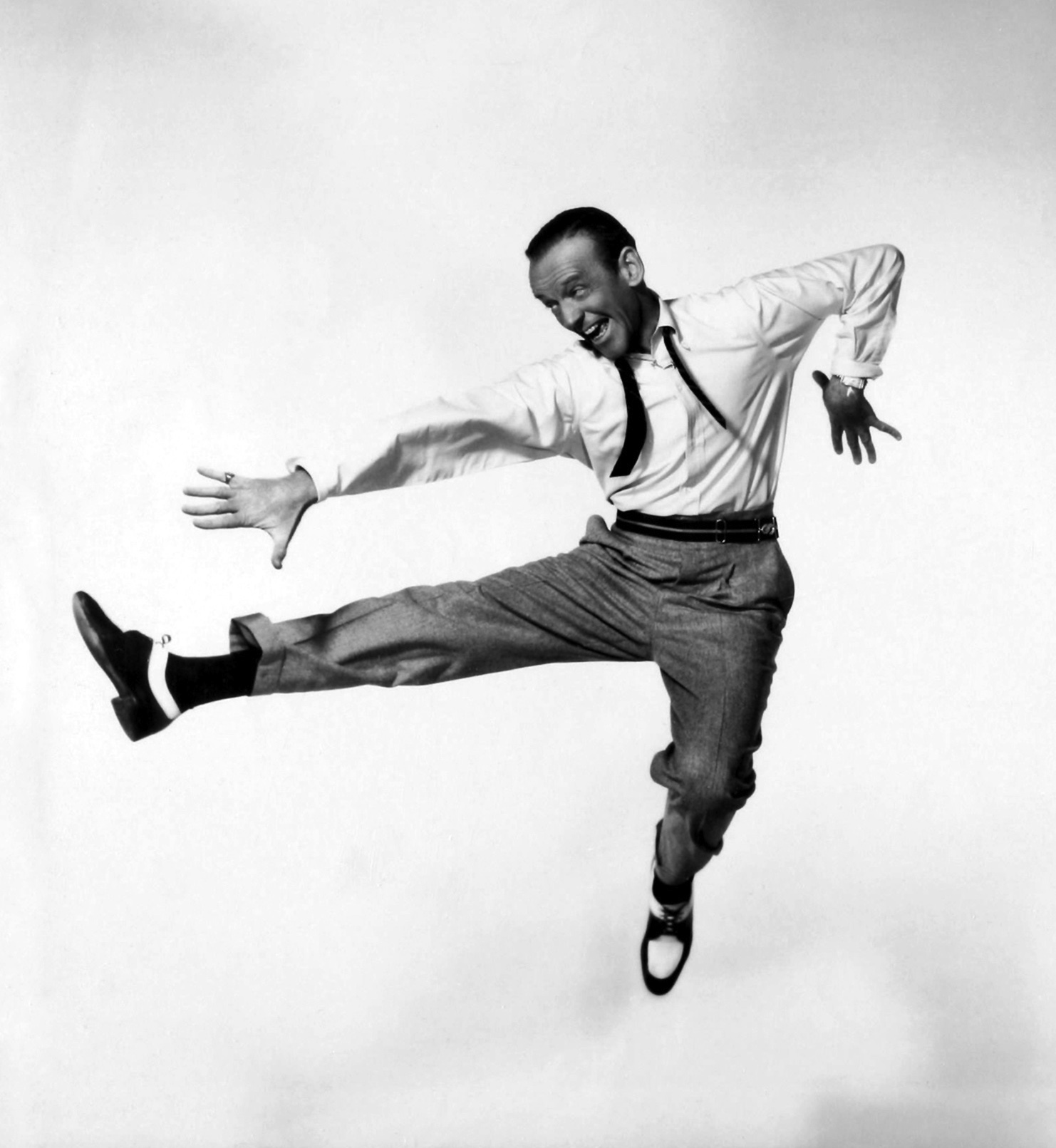
All that long introduction is to say that when Netflix recommended I watch Daddy Long Legs, a musical starring Fred Astaire that I hadn't seen yet, I jumped on the opportunity. Fred Astaire isn't a name I feel like I have to explain, but I will note that he starred in some of my favorite old movies to watch over and over again - 1957's Funny Face in which he co-starred with Audrey Hepburn (and the movie that first got me into watching older movies) and 1951's Royal Wedding where he shared the spotlight with Jane Powell, Sarah Churchill (daughter of Winston), and Peter Lawford (brother-in-law to JFK). As an interesting aside, it's worth noting the latter movie contains the famous scene of Astaire "dancing on the ceiling" because he is so in love with Churchill's character. Daddy Long Legs co-stars a young Leslie Caron, better known for her title role in 1958's Gigi as well as her breakout role in the 1951 musical An American in Paris.

Original movie poster for Daddy Long Legs
Like many of Astaire's films (and indeed 1950s musicals in general), the movie Daddy Long Legs seems to be built up around the musical numbers with the plot following as secondary, almost becoming a vehicle in place merely to hold together the singing and dancing in one handy location. This method is successful at times ... and other times, you end up with something like Daddy Long Legs. There are so many long song and dance numbers that they seem to crowd out the development of the characters into fully actualized beings who change over time in a way that at least slightly resembles realism. Meanwhile, literally years pass by in the movie without being explored in terms of characters or plot. If the movie were something scrapped together by hack screenwriters looking to expand upon some musical numbers by a big composer like Irving Berlin or George Gershwin, this would be more understandable. But there is actually a source material that the screenwriters could have used for a more fully fleshed out story. (Incidentally, the screenwriters in question were the husband-and-wife team Henry and Phoebe Ephron who wrote such classics as Desk Set and There's No Business Like Show Business. The pair also produced four daughters who turned to writing careers, including screenwriters Delia and Nora Ephron, who in turn wrote more modern romantic comedy standards such as Sleepless in Seattle and You've Got Mail.)

Daddy Long Legs is evidently based on a book published in 1912 by Jean Webster (great-niece of Mark Twain), written in the epistolary style, and designed for an audience of young women in high school and college. Hence the protagonist - Jerusha "Judy" Abbott in the novel and re-branded as Julie Andre in the movie - is a teen-aged girl entering into college at the beginning of the story. While I've never read the book, from what I can gather the novel Daddy-Long-Legs (note the hyphens in the book's title) and the movie Daddy Long Legs (sans hyphens) share a very similar plot but vary greatly in presentation and exploration of themes. As Astaire is the bigger star here, the perspective of the story of Daddy Long Legs shifts dramatically from that of Daddy-Long-Legs. Here the focus is largely on Astaire's character of Jervis Pendleton and we actually see very little from Julie, as opposed to the book being almost entirely from Judy's point of view and voice as she writes letters. Therefore, Webster's exploration of a young woman coming to age and learning about herself is nearly entirely obliterated. Apparently Webster was greatly interested in women's suffrage and chose to explore themes related to women's issues in her books - something that becomes completely irrelevant and untouched upon when the movie switches the narrative perspective to that of the middle-aged male Pendleton.

Before I get too much further ahead of myself, I'd like to take a step back and give you a brief overview of the plot of Daddy Long Legs before analyzing it in the terms of an entirely different movie's title, The Good, The Bad, and The Ugly. Daddy Long Legs opens with an irresponsible Jervis Pendleton III being far more interested in playing on his drums all day (literally) than in working for his family's company, which rakes in millions of dollars for him. Later on a trip to France, a mishap with the car leads Pendleton to an orphanage where he espies a pretty young girl working with the younger children. The matron of the orphanage explains that the 18-year-old woman, Miss Julie Andre, was herself raised in the orphanage and now has no where else to go. Although he doesn't meet her, Pendleton is struck by the grace of Julie and decides he wants to "adopt" her. When he approaches officials by this, they are shocked at the suggestion and presume that Pendleton is looking for a young mistress or some other nefarious purpose. When Pendleton says he merely wants to give her a chance at a college education in the United States (apparently there are no colleges for women in France?) and declares that he will be an anonymous donor who will not contact Miss Andre, a deal is struck. Miss Andre is packed off to a small all-girls college in Massachusetts and writes updates to her anonymous donor who she has dubbed "Daddy Long Legs" based on the orphanage children telling her that he was very tall when they caught a glimpse of his shadow retreating from the orphanage. Meanwhile, Pendleton is happy to go on living his carefree life until his business manager Griggs and his secretary Miss Prichard insist he read the letters written by Miss Andre that have been piling up in a filing cabinet. He does so and is touched by the young woman's desire to meet him, but he still remains aloof. As his niece attends the same college as Julie (and Griggs has arranged for them to be roommates), Pendleton decides to visit the school just in time for a dance, at which he woos Julie before almost immediately afterwards ditching her because of his continued concerns about appearances. Julie spends the rest of her college days ruing over her lost love of "Uncle Jervis." But eventually all's well that ends well ... Hey, I have to leave a little bit of mystery for anyone who actually wants to watch this movie after my not-so-glowing review of it. Now onwards to my interpretation of the movie's merits and demerits.

The Good

Publicity still from Daddy Long Legs
The movie succeeds best at delivering on its star quality. Astaire and Caron make for an interesting duo, with his talent lying more in tap and hers in ballet. There are a few notable sequences in Daddy Long Legs, particularly of interest for their exploration of dream-like states, which makes for a rather logical break from relative realism into a song/dance routine. (It is frequently a criticism of musicals that no one breaks out into song and dance during real-life day-to-day activities. Clearly these people never have any fun and don't "whistle while they work," so to speak. Also, I'm not sure if these people then only watch super-gritty and realistic movies and avoid all romantic comedies, superhero, science fiction, fantasy, and action movies altogether. If so, well, bully for them, but I think the rest of us prefer a little bit of entertaining escapism now and then. And some of us like that escapism to occasionally be expressed with song and dance.) These dream-like routines are a rather fascinating departure from many studio musicals and are rather avant-garde in that respect. They remind me of a musical version of Dali's dream sequence, which also seemed like an unusual - but fitting - inclusion in a classic Hollywood film. But back to the musical numbers of Daddy Long Legs. Namely, these sequences stand out amongst the pack:

- A long daydream sequence based on the fantasy musings of Andre regarding the personality of her anonymous patron. This is composed of three shorter sequences - "Texas Millionaire," a feisty tap dance sequence with a solo Astaire all fluid motion and making it look easy; "International Playboy," a brief sequence based more in the world of ballroom dance, in which Astaire dances about and with numerous amorous female partners (this is, however, the weakest part of this sequence as Astaire does very little dancing in here); and "Guardian Angel," a lengthier sequence with ballet influences featuring both Astaire and Caron together. This last one is especially interesting for introducing the stage-like scenery of storefronts, an art direction that will emerge again later in the movie as a secondary dream-like dance sequence also makes uses of stage scenery. These sets are beautifully done throughout the movie, showcasing various artistic styles with panache. Also, Caron's en pointe dancing here does the unthinkable in stealing the limelight away from Astaire for a change. As she twirls about, it is impossible not to watch her and Astaire seems to fade into the background with just a few swooshes of his own for good measure.

- The trendy new dance at Julie's college known as "Sluefoot." It starts off as a just so-so choreographed piece that turns into a thing of beauty when Astaire steps in and he and Caron end up as the only two left on the floor. Granted, it's packaged in a whole lot of cheesiness (not least of all the ending with everyone carrying the two dancers atop their shoulders), but this one also gets some bonus points for trying to make a logical insertion of a dance routine - into a college dance, of course! The Sluefoot never took off as a real dance craze and that's probably for the best, but Astaire and Caron do show off some seriously sweet steps here.

- Andre and Pendleton's somewhat accidental New York City trip leads to the introduction of the song "Something's Gotta Give," written by Johnny Mercer expressly for Fred Astaire to sing in this movie, although is now a love song standard covered by so many iconic artists. The initial blocking of the scene as Astaire sings is perhaps not the greatest, as it's always difficult in cinema to have a few minutes dedicated to just watching someone sing, but at least they try here to make it interesting. But the dance routine that follows is delightful and deceptively simple. Astaire and Caron are both so light on their feet that they appear weightless as they twirl and swirl about the hotel's balcony and out into the streets of New York. Apparently this final montage dance was never actually rehearsed, but it came out just fine nonetheless.

- The second lengthy dream sequence when Andre falls asleep to thoughts of how unhappy she is that Pendleton is traveling all over the world without her. In the first, known as "Nightmare Ballet," Caron is given a solo opportunity to show off her dancing skills in a fairly traditional ballet number, which is beautifully rendered and like a mini-trip to the ballet, giving just enough of a taste to whet the appetite for more. The second number is the "Hong Kong Cafe," a sultry and risque dance routine that is fully engaging to the eyes and ears, even if a little out of place with the rest of the movie. The final part, "Rio," is the weakest link in terms of the dance number itself, although it does illuminate Andre's state of mind and feelings regarding Pendleton even more so than the previous two segments. Part of that includes Julie dressed in the role of the sad clown Pierrot, a common trope I discussed in detail in a previous post. Apparently this three-part sequence, totaling to 12 minutes of purely dance routines, was not widely regarded as useful to the film's plotting or pace. I have to disagree as I think this part gives us more insight into Julie's mind than most of the rest of the movie! That may be a bit of hyperbole, but it certainly does lend itself to character development, which I enjoy. The surreal feel of this section of the movie is a bold move (although fitting with the other dream-like parts of the movie) that I personally loved as Surrealism is one of my favorite artistic styles. For the critics to this sequence, I'd also like to note that if watching 12 minutes of music and dance is too much for you, then maybe musicals aren't the genre for you.

- The brief sequence to the reprisal of the song "Dream" (also by Johnny Mercer) that closes out the movie. While it's a short piece with a relatively simple dance, it's again the graceful weightlessness of Astaire and Caron that steals the show.

Beyond the musical and dancing abilities of the two leads, this movie also brilliantly cast the roles of Pendleton's associates, Griggs and Miss Prichard. Played by character actors Fred Clark and Thelma Ritter respectively, these two characters breathe a little more life into the movie and serve as foils to Astaire's character. While they may seem stuffier at the movie's opening, they remind Pendleton of what it means to care for another human being. As Miss Prichard puts it (and later Griggs repeats), "a person is NOT a corporation! A person is flesh and blood ... and feelings!" It's a surprisingly modern quote as we are currently stuck in a political debate in which the idea of personhood is constantly being negotiated and corporations seemingly have it, even if they don't have flesh and blood and feelings.

The Bad

Despite actually owning copies of Gigi and An American in Paris, this is the first movie that I've seen starring Leslie Caron. I found that I'm rather surprised her name is often included in the same breath with some of Hollywood's elite classic actors, as I was disappointed with her performance. Her dancing was incredible in the finished product, as I've noted above, although rumor is that Astaire noted he had difficulty dancing with her. Her acting was only so-so at best, with her mostly wearing this placid "dumb" face (for lack of better terminology) throughout the movie. Think Kristen Stewart throughout the majority of the Twilight movies and you have the general idea. She also goes from playing the naive ingenue to throwing out saucy hints of innuendo far too quickly and then back again rapidly to innocence, although this may be a fault more of the script then of Caron's acting. At this stage in the game, it's hard to know. But what bothered me most about her was the awful accent. Perhaps the director asked her to ham up her accent, but Caron - a native Frenchwoman, mind you - has one of the worse overly dramatic nasally French accents I've ever heard. It was painful to listen to at times.

Caron's French girl is pretty much the only "other" character we see in the movie, which is jam packed solely with Caucasian characters. The movie is a product of the 1950s, so it's pretty much unsurprising that we don't see a single person of African, Latino, or Asian backgrounds, even when we enter a dream state taking place in Hong Kong. Given how badly 1950s movies could mess up depictions of racial minorities, it may end up being a good thing that Daddy Long Legs didn't even attempt to add in a character of color. The movie already struggles with troubling depictions of women, so why give it any more fodder for things we have to dismiss with a shrug and say, well, it's a product of its time? If you want to watch something with actual diversity in it, don't expect to find it here.

While most of the movie's song and dance numbers are the highlights of the film, there are some sequences that just seemed to drag to me. The first number is "History of the Beat," and it occurs early on in the film. Pendleton is right away introduced as a character who doesn't seem to have a lot of discipline and isn't particularly interested in making business decisions; he's much more fascinated with listening to music and playing the drums. Only thing is, we never again see this hobby again - sure, he dances a bunch later and sings a little because it's a musical, but it's no longer a key component of his personality that he plays the drums instead of working or that he has a large record collection. The dance routine here is in itself perfectly fine and Astaire once again shows off his amazing skills, but the song isn't that compelling. Moreover, the placement of this number early on in the movie when so little has been explained yet (and Julie hasn't even been on screen once at this point) leads to the feeling of this just being a fluff piece that does little to add to the movie. It did, however, add to my feeling of this being a dragging number. If a movie, even a musical, is going to lead early on with a song and dance number, it has to be a really compelling one that pushes the plot forward or does a lot to explain the characterization of a particular person or persons that isn't already explained through the dialogue or action. It can't just be a song that someone liked and couldn't seem to fit in elsewhere. There are a couple of other songs sung by Caron and others when her character is still in the orphanage and when she first enters college that also seem to be there for little purpose and seem to slow down the pacing of the movie.

The Ugly

While these complaints above are not exactly gold stars for the film, they are not enough to sink it either. But there is a much bigger problem with this film that is very difficult to overcome. And that's the fact that the movie's basic premise is just kind of creepy. Pendleton's age is never openly stated but Astaire was in his mid-fifties at the time this movie was filmed, and we can gather that his character is meant to be roughly his own age. Likewise, Caron was in her early 20s while making this film and is meant to play a character of college age, beginning the film at age 18 (specifically stated in the movie's dialogue) and ending roughly around age 22 (doing simple math gets us here). So we're talking about a 30-year age gap here. This kind of age gap in a romantic film can be done, and indeed has been done, without being as disquieting. In Funny Face, the movie I mentioned earlier as one of my favorite old movies, the age gap between Astaire and Hepburn is nearly 30 years as well; another of my favorite movies, Sabrina, pairs Hepburn with Humphrey Bogart, then several decades her senior. Those films manage to negotiate the age difference without giving the feeling that there are paedophiles just hanging all about old Hollywood. Many other films of this era also feature large age gaps between the male and female protagonists; indeed, this continues to be true today.

But there's something about this film that just adds such an ick factor to the romance. Pendleton being the guardian to Julie - even with it being done anonymously - definitely makes for an eerie incestuous vibe, especially when she addresses her letters to "Dear Daddy Long Legs." Her misconceptions of who her guardian is (since she has nothing to base her ideas of him on but her own imagination) add to this feeling as well. She describes an old, frail, bald man who she is going to care for when she gets out of college. Maybe this is meant to highlight that Pendleton is not as decrepit as all that and therefore it's okay for him and Julie to end up together, but for me it just lead to an ugly picture of a decade down the road when Julie is in her prime and Pendleton is ready for retirement. Given that Pendleton acts like a child most of the time and needs to have his feet held to the fire (metaphorically of course) by Griggs and Miss Prichard in order to accomplish anything, I can certainly picture an image of domestic life in which Julie is running about attending to all of Pendleton's needs and helping him to function like a normal person while she gets very little in return but his money. In essence, she is the definition of a trophy wife - young, pretty, and in this case, willing to do anything for her sponsor.

Another original movie poster

I feel like the movie does try to address the age differential in a meaningful way but in doing so, it just makes the situation worse. As one reviewer puts it, "Confronting the age problem head on, well, that's honest, but confronting the problem isn't quite the same as solving it. Fred's still old, and Leslie's still young." There just seems to be no fixing that. In fact, that Pendleton's initial attempt to "adopt" Julie is treated with disgust and disdain, with the idea that he could only want to do so for some sick purpose, ends up planting the idea in the viewer's head that Pendleton's intentions are perhaps less than honorable. After all, he has no interest in doing anything for any other child at the orphanage, though no doubt they are also in need just like Julie - or will be in the same boat as her a few years down the line. Pendleton may go on to forget completely about her for several years but once he reads her letters (again, remember these are written to a person she regards as a father figure), he finds himself fascinated by her. He has no qualms about visiting her at school under the guise of visiting his niece. Another creep factor is that Pendleton seems to have no problem - or even need to acknowledge - that his niece and his would-be lover are the same age and friends with each other. Indeed, no one else seems to be bothered by this either. It'd be one thing if there wasn't a large age gap between uncle and niece, but we've already established there's a roughly three decade difference between them.

One could argue that the disturbing factor is lessened by Julie falling in love with Pendleton unawares that he is her guardian, making the decision more hers than his, but I think that would be a weak argument. Pendleton is pretty relentless is pursuing her at the school dance, making overtures toward her under the nominal auspice of just wanting to learn more about his protegee. He even goes so far as to hire a rival boy from a local men's college so that he may employ him in another country and thus keep him far away from Julie. It's pretty hard to make an argument that Julie had much of choice but being interested in Pendleton when he put in extra effort to make sure any competition for the art of wooing was out of sight.

Eventually, Pendleton goes away after he realizes that his wooing of Julie is perhaps inappropriate. Of course, rather than address her like a fellow adult and explain the situation, he simply drops out of sight for months on end and has no contact with her as he globe trots instead, once again showing that despite his age, he really has zero maturity. Meanwhile, Julie becomes this rather annoying character who begins to sit around moping all day and collecting newspaper clippings of Pendleton's gallivants. She seems to have no plans for her future life once she graduates college (which is now an impending deadline), whether it be a job or even a place to live. Yes, the movie was made in the 1950s, based on novel written in the earliest decades of the 20th century, but one still desires a slightly more interesting female lead than this. And again, it doesn't help with the yuck factor that Pendleton returns into Julie's life just when she's at a point in which she has no where else to go and no one else to turn to as she looks to the future. One reviewer (who actually read the original source material, unlike me) notes that the creep factor can be somewhat lessened by the Judy character (here known as Julie) because of her ability to be "awesome" and purportedly hold her own against Pendleton. We see none of that here as Julie does virtually nothing to propel her own life forward, but just sits around waiting for things to happen to her. So there's absolutely nothing to offset the feeling of perverseness surrounding a love affair between a middle-aged man and his young guardian.

All of the actions taken by Pendleton, and the relative inaction from Julie, definitely leads to the overall feeling that this romance is anything but romantic. The fact that there is basically zero chemistry between Astaire and Caron doesn't help to sell it. At the time of this movie's making, Astaire had very recently lost his wife to lung cancer and had tried to back out of making this film, so that could certainly be an element at play here. Astaire reportedly went into his trailer between takes to cry, so this is obviously not him at his happiest or most cheerful, to say the least. (He was apparently also considering a retirement from musical pictures at this point in this life, but fortunately for us decided to move on from this film to co-starring with Hepburn in Funny Face just a year after this one.) It's really hard to have a successful romantic musical in which the romance is a hard sell.

While my modern sensibilities (and especially my strong feminist streak) may be influencing me here, it's worth noting that while this movie was not necessarily a flop, it was not a huge success at the time of its release either. Whether that was due to the lack of a romance that didn't leave viewers feeling kind of grossed out or another factor all together is now probably difficult to tell. The film did manage to garner three Academy Award nominations, proving once again that the Academy doesn't always know what it's doing. However, those nominations were for art direction, score, and original song, which are pretty much the highlights of this film. Nevertheless, this is one old movie that doesn't lend itself to the title "classic" at all and one that I think you're better off missing. Check out the dance sequences linked to above in "the good" section to get the highlights and save yourself from spending a full two hours on a movie not worth it.

Monday, May 26, 2014

Don't Trust Your Safety in the Hands of The Lifeguard

Memorial Day weekend is the traditional unofficial start of summer, replete with barbeques and other outdoor soirees. Having been rushing from place to place all weekend, when I woke up early this morning, I just wanted to relax and sit back to watch something unexpected. I chose The Lifeguard, a 2013 film starring Kristen Bell. When this movie initially came out, I was excited to see Bell in a feature film that wasn't a B-level comedy and thus something very different for her that might show off the fabulous dramatic acting chops all we Veronica Mars fans know she has in her. But when I heard more about the film's premise, I wasn't sure if I'd want to watch if after all. In the end, when the movie showed up on Netflix, I decided to add it to my queue and today it seemed like the best candidate for my mood.

The Lifeguard is a slow moving but engrossing film about Leigh London, an almost 30-year-old ("29 and 10 months" as her mother points out early on) Associated Press journalist living in New York City and having an affair with her supervisor. When the latter gets engaged to someone else and seems to be dismissing what Leigh considers an important story by relegating it to a lesser section, she has a bit of crisis and decides to take a leave of absence. Leigh grabs up a duffle bag and her cat Moose before returning to her parents' house in Connecticut, where she picks up right where she left off. She gets a job as a summer lifeguard at the community pool and starts socializing with her former high school chums Mel and Todd. The trio end up spending a lot of their free time hanging out with a trio of current high school students, wannabe drop-outs who join the older crew in drinking and smoking weed out in the woods. And that's when things start to heat up between Leigh and 16-year-old "Little Jason," in a situation that every viewer knows will never end well.

It's hard to know where to even begin with discussing The Lifeguard. As I mentioned above, it definitely held my attention despite being a movie without any big special effects or honestly even a huge amount of backstory (the short time frame of an hour and an half meant that a lot of the past lives of these characters was mentioned in passing only or not fully explained). There is, however, a decent amount of time invested in exploring these characters right now and trying to elucidate their complicated feelings. The Lifeguard is one of those rare pieces of art in which you can enjoy the product without actually liking a single character. For instance, Leigh is the film's main focus and she's hardly someone you can root for, especially as her actions take her down more and more twisted paths. As the movie unfolds, you learn more about Leigh's past as the perpetual "good girl" - the school valedictorian who made all the right choices and never once before questioned where she was going. You can feel a little bit of sympathy for her as she starts to unravel and wonders what's next for her life; for instance, you can really see her conflicted feelings as she tries to council Jason about staying in high school and getting a college degree as she herself is back in her high school job making barely above minimum wage after years of pushing herself to do her best in school. At the same time, however, the rushed introduction to the movie leaves you wondering what exactly caused Leigh to have this un-epiphany that left her feeling so unfocused. The story that she wrote was certainly something to bother and unnerve her, but it was hardly something to make her abandon everything on seemingly a whim. As for her relationship with her supervisor, it should hardly have come to a shock to anyone that a person who is cheating is going to eventually disappoint. Meanwhile, Leigh seemingly doesn't use any of her time in Connecticut to reflect or mature. Instead, she reverts to becoming a rebellious teen, spending her time being completely inconsiderate to her parents, working in a dead-end job, drinking and smoking in the woods, and literally hanging out with teenagers. As someone roughly the same age as Leigh and her friends, I honestly can't see the appeal of many of their actions even if I can understand some of their philosophical concerns. Things finally hit bottom in terms of the viewer's ability to empathize with Leigh when she becomes involved statutory rape. She may be lost and confused, but that doesn't make it even remotely right for her to take up a sexual relationship with a 16-year-old boy. The fact that nearly ever other character is unfazed by this turn of events may tamp down the outrage factor a bit, but no viewer is giving Leigh the person of the year award by the end of the movie.

The other characters are similarly unlikeable, if not quite at the same level. Leigh's father is the only exception to the rule in the movie; he seems like a genuinely jovial guy that anyone would like to spend time with for a friendly brunch or something. However, he's so little seen in the movie that his presence is negligible. Leigh's mother is so wrapped up in her own affairs that she can provide absolutely no anchor or guidance for Leigh as she flounders about pathetically. Again, there's a little bit of sympathy as her mother tries to explain how for years she felt like her existence was tied up with Leigh's and now is the time in her life to do something for herself, but she is so cold and harsh throughout that it's not hard to see how Leigh could turn out the way she did. Mel is a hot mess - she was apparently the one who was the antithesis of the "good girl" in high school but now she's turned her life around and seems to have all the markers of success - she's married and holds a good, steady job as the high school vice principal. But with Leigh back in her life and her own fears about not getting pregnant - or about getting pregnant and not being a good mother - rearing their ugly head, Mel backslides and becomes involved in these stupid delinquent behaviors. Her relationship with her husband seems anything but happy for the majority of the movie, and Mel just seems to be floundering as well. Todd is unhappy with his small-town life but doesn't want to take the initiative to change anything about his life, hiding behind thin excuses and choosing to forget his troubles by drowning them in alcohol and drugs. Jason and his friends are typical conflicted teenagers but are arguably more on the "bad kid" side than most; they all appear to have a lot of baggage in their lives but most of that is explored only peripherally. For example, "Big Jason," the father of the teen, refers obliquely to some rough things that happened in his son's life but doesn't expand on this at all. Big Jason, although playing but a small part in the movie, is also a character you can't get behind. He seems to pay little to no attention to his son, despite professing that the child has had major challenges to get through, and doesn't have the slightest concern about a woman nearly twice Jason's age striking up a relationship with him.

One thing I could definitely say was of interest about the movie is that it certainly makes you think. You could argue after watching this movie that the film isn't just about a generation (specifically, my generation) of unfocused and confused people - those who are adults in name and age but haven't quite figured out what that really means yet. It's also about exposing this myth that small towns are full of wholesome goodness while big cities are where the filth lives. Leigh finds something horrific in her story at the beginning of the movie (and let's not even go in the symbolism of that story, as the movie does expound on this pretty well on its own) and leaves the city, but she doesn't find solace in her hometown. There is tragedy awaiting her in the small town, and no one there seems to be completely free of baggage or fears of some sort. Everyone seems to be in some sort of crisis, whether it's the agony of being a teenager and hating everything in your life, the confusion of being a young adult who is trying to figure out where life goes next, or the disappointment of being a middle-aged person having to re-invent yourself after a big chunk of your life has changed. It's like someone was illustrating Erik Erikson's stages of psychosocial development by showing only the negative crises.

The movie can also be seen as a commentary of gender roles and inequality in so many different aspects. While a small part of the movie, the crisis that Leigh's mother seems to be having after her daughter grows up and arguably doesn't need her any more is contrasted by her father being perfectly okay with her coming or going. Motherhood is an all-encompassing identity in a way that fatherhood isn't. This is reflected in the younger generation with Mel reacting extremely - and poorly - to the theoretical idea of becoming a parent while her husband seems completely unfazed by it. There's also the relationship between Leigh and Little Jason to consider. Early on, it's hinted that Todd is gay and Mel suggests that he may be interested in one of the boys. This seems to be condoned far more than her initial suspicions of Leigh and Little Jason's attraction to one another. Combine this with Big Jason's reaction upon hearing the news, and it's really not a pretty picture. It reflects real-life courts of opinion where older men having sex with teen-aged girls are consider perverts at best and rapists at worst while older women having sex with teen-aged boys is sadly brushed off by many as a sort of great achievement for the boys. It's a scary example of cognitive dissonance in which an age differential between sexual partners is both damaging and enviable, depending on the gender reversal. It was interesting to learn that this movie was written and directed by a woman; as I've noted before and many more articulate people than I have stated, when women get a voice in the arena everyone benefits from hearing their stories. In Hollywood, this means we get more than the standard fare of "chick flicks" that are simply romantic fantasies just as much about the leading man as the woman nominally at the heart of it. We get thought-provoking stories about all kinds of things beyond just romantic relationships and true female leads - sometimes strong and independent ones who we'd love to emulate, sometimes messy and confused ones who we vow never to become like.

Some final bits and pieces about the movie include a compelling soundtrack that meshed nicely with the cinematography and the overt themes. The cinematography was overall done very well, although there were a few scenes here and there with shaky camera work. I know this is a darling technique of filmmaker to symbolize any number of things including the characters' confused and hence shaken states of mind, but it's a pet peeve that I find distracting. When it's used too much, I feel like reprimanding the cameraperson with a stern "Just focus already!" With the pool and water being used as background - and symbols - a great deal, there's also a few times where we get the water on the camera lens issue also; this is another pet peeve of mine as I feel it serves to remind you of the fourth wall and thus takes you out of the experience of the movie's actions and into the experience of being a viewer. As I mentioned earlier, the beginning with Leigh's life in New York City was a little rushed with short clips of different situations all being sliced together in rapid succession. Perhaps the argument could be made that this was to give the viewer a sense of Leigh's confusion during this time period but I think it ended up providing a very incomplete view of what was going on at this point.

With all that mind, I'd recommend The Lifeguard for people who enjoy movies that make them think and provide slice-of-life portrayals of characters who resemble real people more than stock stereotypes. If you want action and characters you can love, don't even think about checking out this movie. But if you don't mind a messy set of characters struggling with life choices, you might just get pulled in to the pool alongside The Lifeguard.