Tuesday, September 3, 2019

Jackie Robinson, or The Meaning of Life the Universe and Everything

Despite the pretentious title, this blog post actually has nothing to do with baseball or The Hitchhiker's Guide to the Galaxy. But the two things both tie in with the number 42, which is a component of this entry's content.

Several months ago, I decided that I should finally hunker down and start making an effort to watch all the movies on the American Film Institute's list of "the 100 greatest American movies of all time" (hereafter referred to by me simply as "AFI's Top 100"). In the past I would occasionally give the list a once over and see how many I had seen and how many more I had NOT seen, but it didn't get much further than that. Realizing that method meant I still had seen less than half of them (a dismal 38 in total), I made it a goal to start watching them in earnest and am now up to a whopping 42 in total. Hey, progress is progress, no matter how slow it is...

Since one of my problems with the list is that for some of the movies, I cannot recall if I actually did see them in their entirety or not, I also made a decision to write up a quick review of each movie after watching it and will be posting those here, probably in batches of three or four movie reviews at a time.

Without any further ado, here are my random thoughts on the first four movies I've intentionally watched just for being on AFI's Top 100 list. (FYI, there really is no order to the way I am watching the movies from the list; it's whatever happens to be accessible at the time.)

Easy Rider
(released 1969, #88 of 100)

What a start to this project; this movie was practically unwatchable. I know it has its fans, but I am certainly not one of them, nor was my friend who watched it with me. It's as if Kenneth Anger made Fear & Loathing in Las Vegas and then amped up the trippy factor by about a thousand.

This movie opens with dullest drug deal scene ever depicted (and that’s saying a lot) before two guys embark on a road trip across America for Mardi Gras in New Orleans. Along the way, they cross paths with some unusual characters from hippies to bigots to farmers. I would have loved to hear more about the women they encounter and their lives, but this is a "bro" sort of movie so that would never happen.

The movie starts out with some rather weird cinematography choices that only get weirder as the movie progresses (and as the characters get higher from all the cocaine and other drugs they are doing). All along the "plot" is slow moving, the dialogue is mostly rather poor and uninteresting, and there is literally zero character development. On top of that all, the ending is really bizarre to the point that my friend and I were both kind of like 'was that the end? what were they even trying to say with this movie???' This may have been the movie I did the most research on after watching it, because it was absolutely puzzling to me what its purpose was or why it was on AFI's Top 100 list. While I do enjoy when I read or watch something that has so many layers that a critical analysis might help me learn more, a film should stand up well enough on its own that you don't have to see what critics are saying in order to "get it." (And quite frankly, it still doesn't seem like there was much to "get.")

The handful of highlights were good music to fill the soundtrack while the guys ride along the highways and byways, which then of course included some nice shots of American landscapes (mostly deserts but also some small towns in Louisiana). The very earnest definition of the slang version of the word "dude" (I guess it was still new enough in 1969?) was humorous. And finally, the real star of the movie was a very young Jack Nicholson, who put in a stellar performance as the day-drunk ACLU lawyer, a role fittingly quirky enough for him. I have to agree with The New York Times critic whose review of the movie at its release noted, "Nicholson is so good, in fact, that 'Easy Rider' never quite recovers from his loss." I am resigned to the fact that I will never understand why this movie is on AFI's Top 100 list.


The Third Man
(released 1950, #57 of 100)

Thankfully, AFI's Top 100 list quickly redeemed itself with this selection. This is the kind of movie that I really enjoy -- an older noir film that immediately grabs you and is compelling from start to finish.

This movie takes place in Vienna after World War II, with the main character looking into the mystery of a friend's death, supposedly an accident but surrounded by a few pesky details that just don't add up -- including the rumor of a third man at the site of the accident but not listed in the official report. There is definitely a lot of intrigue, with every character having some piece of the mystery but refusing to reveal more.

The ambiance of the film throughout is wonderful. Filmed in black and white, it plays with lighting and shadows. There are long shots, unusual angles, and other cinematography reminiscent of Citizen Kane (not surprising, considering Orson Welles was associated with both projects). The dark lighting and unusual camera angles add to the sense of unease the film is trying to portray for its main character, especially when coupled with some dialogue in untranslated German (unless you happen to understand German, it further solidifies your sense of unknowing). There are several scenes of characters running around Vienna's cobblestone streets, complete with echoey footsteps, which further adds to the mysterious tone.

But the movie isn't all seriousness at all times. There are little jokes here and there, and throughout the movie, a jaunty jazzy tune plays its soundtrack. This fun instrumental music is all played on the zither, which is an unique choice that made a distinct impact. The storyline also has a romantic subplot underneath all the mystery and intrigue. Joseph Cotton as the protagonist put in an A+ performance. Alida Valli as Anna was also excellent as were some of the supporting cast (some others of the supporting cast were a little too campy, e.g., the fellow with the dog).

Overall, this was definitely an enjoyable film and I could see why it was on the list. (A fun side note -- there is actually a small curiosity museum in Vienna dedicated specifically to this film.) Those who like film noir mysteries and/or spy-type thrillers would probably enjoy this one.


The Apartment 
(released 1960, #93 of 100)

Like The Third Man, this movie is one I'm surprised I hadn't watched before actually, given it's up my alley of movies from the late 40s to early 60s. Once the opening credits showed Billy Wilder's name, I knew I was in for a treat; there’s a reason he was referred to as "the world's greatest movie director."

The Apartment has many similarities with Wilder's other movies, including elements such as:

  • a voice-over introduction (but further narration is never heard),
  • a New York City setting,
  • a perfectly fitting instrumental soundtrack,
  • snappy dialogue,
  • black and white filming despite color being available,
  • an overall comic tone but serious at turns, and
  • issues like infidelity and suicide that can't exactly be shown on the screen (in 1960) but which are nevertheless artfully portrayed.

However, this movie has a rather different storyline from the other Wilder films I've seen in the past. A hard-working, ambitious accountant nicknamed Bud wants to succeed at his corporate life insurance job and therefore finds himself trying to curry favors with the higher-up suits. Unfortunately, the favor these men want the most from him is use of his apartment to carry on their extramarital trysts. Things only devolve further when the top boss finds out about this and wants to meet his mistress there -- a woman whom Bud has secretly had a crush on himself.

The late 50s/60s corporate culture highlighted in this film might make it of interest to fans of Mad Men, with similar explorations of gender, sex, power, and money, although with a far less serious tone. This movie has excellent performances from Jack Lemmon (indeed, he carries many scenes where it’s just him puttering around the apartment alone with no dialogue or only some mutterings to himself) as well as from Shirley MacLaine and Fred MacMurray. The happy ending feels a little tacked on / rushed, but otherwise this was an engaging watch. This wasn't my favorite movie of all time (it's not even my favorite Billy Wilder comedy; Sabrina tops that list, followed by Some Like It Hot) but it's a solid addition to AFI's Top 100 list.


Fargo 
(released 1996; #84 of 100)

This movie I went into expecting NOT to like, especially because I disliked the only other two Coen brothers' movies I had previously seen (The Big Lebowski and Intolerable Cruelty). While quirky movies hold a special place in my heart, the Coen brothers tend to operate in a zone of oddness that just isn't my cup of tea. However, this movie turned out to be weird in an acceptable sort of way for me.

The movie takes place in the dead of winter in Minnesota and North Dakota, where a car salesman with ambition pays a couple of criminals to kidnap his wife so that his wealthy father-in-law will pay the ransom. The trio assume no one will be the wiser and they will all walk away a little richer. But, of course, Murphy's law comes into play and things quickly escalate from bad to worse.

Despite the film's opening screen-cap claiming to be "based on true story," this is a work of fiction. But it is not outside the realm of possibility, which does give the film's absurdity a ring of truth. The actors in the movie -- from the leads to the supports -- are all excellent in their roles. The repartee between the two criminals, played by Steve Buscemi and Peter Stormare, is definitely a highlight of the film, along with Frances McDormand's award-winning performance as the police chief working to catch them. And, William H. Macy is almost *too* good as the slimy salesman, convincing me 100 percent to hate that character.

Despite the violence at the heart of the movie, it really isn't overly gory (especially in light of what's considered acceptable in film and television today). Also, McDormand's character is a refreshingly independent and strong woman, which had been missing in the other three films reviewed above. (The Third Man and The Apartment get points for at least featuring women more so than Easy Rider, but they're not exactly going to be held up as feminist standards. I'm not doing the statistical breakdown because that's more effort than I want to put into this project, but I wouldn't be surprised to see if a great number of the movies on AFI's Top 100 list are unable to pass the Bechdel Test.) Also, the one Asian character seen in the movie is surprisingly not just stereotype after stereotype, which is sadly saying a lot for 1996. (Unfortunately, the one American Indian character in the movie doesn't quite pass the same low bar. His character is way too much the strong, silent, proud 'native' stereotype -- his last name is even Proudfoot.)

That all being said, I cannot see this being a movie I would purposefully view again, nor do I have any interest in watching the new series of the same name. However, I do understand why it made the list, if for no other reason than that it's a movie that is often referenced in pop culture.

***

Well, that's all for now folks. Catch up with you again when I have a few more movie reviews to add.

Thursday, December 27, 2018

Still Trying to "Read Harder"

Previously I aimed to work on Book Riot's "Read Harder" challenges, not quite reaching the 24 goals for either 2015 or 2016. (2017 was a bit of a whirlwind year apparently and I never even looked at the list, let alone attempted it.) This year, I looked at the "tasks" list very late in the game (November!!), but decided to give it a go anyhow. Granted, my reading for 2018 was already constrained by running/belonging to three book clubs and being a reader for a children's book award nominating committee, but I figured all of that reading had to help meet some of Book Riot's tasks for this year! Granted, that may not be how the makers of this challenge meant for this to work, but that's how I'm making it work this year. :)

As always, my reading tastes include children's, YA, graphic novel, and audiobook titles. (Sorry not sorry if you think any of those aren't 'really' reading.) Several books could have fit in more than one category, but I tried to contain them to one 'best fit' category. For each book, I link to my LibraryThing review of it. Inclusion of a book here does NOT mean that I necessarily liked that book, only that it met the parameters of each task.

For the final tally, 19 out of 24 isn't so bad, especially considering that I've read books that met most of the other categories in the past. I will admit to a bit of a reach with some of my titles here, but I'm okay with that.

Hope you find something good to read here!

1. A book published posthumously

2. A book of true crime
The first is a graphic 'novel' about an unsolved murder committed in the 1920s around the area of New Brunswick, New Jersey. The second is part travelogue, part true crime as it concerns a murder that took places in the 1990s among the storied homes of Savannah, Georgia. 

3. A classic of genre fiction (i.e. mystery, sci fi/fantasy, romance)
These are both mystery books written by the dame of the genre for her "Miss Marple" series.

4. A comic written and drawn by the same person
Several others fit this category but are listed in other categories already. 

5. A book set in or about one of the five BRICS countries (Brazil, Russia, India, China, or South Africa)
These two books are about a Chinese/Chinese-American family and take place in China, then the US, and then back in China again as we follow the family through the generations.

6. A book about nature

7. A western
  • Didn't make one in this year but have in the past.

8. A comic written or drawn by a person of color
This manga is written *and* drawn by Nana Yaa, who I think is of African origin (based on her name and her hand-drawn author's 'photo' in the book). 

9. A book of colonial or postcolonial literature
Book Riot's definition of postcolonial literature is pretty broad, so I think this one fits. Full disclosure: I began reading this book in 2017 but finished it in 2018, so I'm counting it here.

10. A romance novel by or about a person of color
This book is many things (YA, adventure, scifi, etc.) but at the core is the romantic feelings the protagonist has towards his best friend, an English born man of African descent. It's a bit of stretch to put here, but I'm hoping better than nothing. Romance is really not my genre.

11. A children’s classic published before 1980
The Ghost of Windy Hill was published in 1968; I'm not sure if it's really a "classic" given how it's hard to find nowadays, but my sister and I both loved it growing up. 

I went through a Sendak phase this year and read several of his books (whether he was the author and/or the illustrator) that I never read as a child. There were some titles that were actually more recent than 1980. Then going backwards from that date, Some Swell Pup originates from 1976. In the Night Kitchen was originally published in 1970; Higglety Pigglety Pop! in 1967; Alligators All AroundOne Was Johnny, and Pierre in 1962; The Sign on Rosie's Door in 1960; The Moon Jumpers in 1959; What Do You Say, Dear? in 1958; and A Hole Is to Dig in 1952. 

Katy No-Pocket is from 1973. Where the Sidewalk Ends was another childhood favorite and was originally published in 1974.

12. A celebrity memoir

13. An Oprah Book Club selection

14. A book of social science
With this title, the social science in question is political science.

15. A one-sitting book
Several others fit this category but are listed in other categories already. I chose not to include short children's books (e.g., picture books and early readers) here as that seemed self-evident. 

16. The first book in a new-to-you YA or middle grade series
The adventures continue with The Lady's Guide to Petticoats and Piracy and The Gentleman’s Guide to Getting Lucky.

17. A sci fi novel with a female protagonist by a female author
  • Didn't make one in this year but have in the past.

18. A comic that isn’t published by Marvel, DC, or Image
These are respectively published by: 
  • Graphix 
  • Dark Horse
  • Charmz/Papercutz
  • Archie Comics
  • Penny Farthing 
  • Graphix (again)
  • Dark Horse (again)
  • NBM Publishing
  • First Second
  • Boom! Box
  • Top Shelf Productions
  • Boom! Box (again)
  • Z2 Comics
  • Flying Eye Books
  • Great Beast Comics
  • Action Lab Entertainment 
  • Oni Press
  • Graphix (for the third time)
  • Dark Horse (for the third time)
  • KaBOOM!
  • Roaring Brook Press
  • Knopf Books for Young Readers
  • NBM Publishing (again)
  • Dark Horse (for the final time)
  • NBM/Papercutz
Several others fit this category but are listed in other categories already. 

19. A book of genre fiction in translation
This is a work of historical fiction in translation (from Spanish to English). 

20. A book with a cover you hate
  • There are covers that don't seem to match the book and there are covers that disappoint by whitewashing, but this seems more arbitrary than "harder." I think the challenge's architects were trying to get readers outside of their comfort zone and to actually not judge a book by its cover, but this one struck me as silly and I had no interest in doing this one.

21. A mystery by a person of color or LGBTQ+ author
  • Did not get to this one, which is particularly unfortunate because I do love mysteries.

22. An essay anthology
These are both less of an "anthology" and more a literary criticism, but I'm going to call it as a "close enough."

23. A book with a female protagonist over the age of 60

24. An assigned book you hated (or never finished)
  • Again, I wasn't thrilled with this prompt. The idea I assume is to re-visit something you didn't like originally and see how you feel about it now. I just don't have the time or interest anymore to tackle something I already disliked once. Plus, I've done this in the past when books like A Portrait of the Artist as a Young Man that showed up in both my high school and college curricula. 

Book Riot has posted the 2019 challenge, and I'm honestly not that thrilled by many of the prompts. Again, there seems to be an arbitrariness to some of them (Why is 2014 a magic date? Who cares about the number of Goodreads reviews?) that I dislike. With so many other things on my plate (book-wise and otherwise), I think I'll probably end up skipping next year's challenge.

*Began in 2018 but did not finish before year end

Monday, November 26, 2018

High Society in Metropolitan

Recently the 1990 film Metropolitan came across my radar. Although it received an Academy Award nomination for best screenplay and is now part of the Criterion Collection, this movie isn't one I've heard anything about before and it was a bit difficult to track down a copy. However, it seems to have a bit of 'cult following' and has good critical and audience reviews. The movie is written and directed by Whit Stillman, who I am familiar with by and large because he wrote the screenplay for the movie Love & Friendship*, based on Jane Austen's novella Lady Susan.**

In many respects, Metropolitan feels the influence of Austen's stories.*** The film concerns itself with a handful of young men and women recently out of college or finishing up school (it was a bit unclear which) who are members of the mid- to upper classes. During winter break, they attend dances, play games, discuss letters written to each other, and sit around in living rooms expounding their thoughts on such high-brow topics as the classics of literature, class and political systems, personal fulfillment, the effects of divorce and blended families on adult children, and the meaning of romance as well as such low-brow gossip as who is sleeping with whom. There is also the obligatory 'concern' about women's 'virtue,' which felt rather out of place and bordering on sexist (if not downright there). This is definitely a "slice of life" style movie as we see only a limited timeframe and it doesn't seem that much changes for any one character in terms of big life decisions. Arguably the most character development we see is in Tom Townsend, who comes from a less rich background and meets the main group of friends rather by chance, but even he makes only incremental adjustments to his thoughts.

First after-party with interloper Tom at the far right

To get a sense of the dialogue and Stillman's wit, here are some quotes regarding the topics discussed by the characters in their various social forays:

"Broken" Families
Charlie: But that's the exception though. I mean, divorce is actually comparatively rare among standard New York social types, contrary to what people might think.
Nick: Well, usually there's something wrong though. Dead fathers are a common problem. Jane's father is dead. Very suddenly last year.
Tom: That must have been awful for her.
Nick: Yes. It was tough on him, too.
Charlie: That's different though; that doesn't mean a broken home.
Nick: Well, it's still means having your mother go out on dates.
Charlie: My point was that the common image of divorce and decadent behavior being prevalent among New York social types is not really accurate. That's more South Hampton.

Class
Nick: Oh you mean because of his title? We're supposed to be impressed by that? On the contrary, the titled aristocracy are the scum of the earth.
(later)
Sally: You always say "titled" aristocrats. What about "untitled" aristocrats?
Nick: Well, I could hardly despise them, could I? That would be self-hatred.

Literature
Audrey: What Jane Austen novels have you read?

Tom: None. I don't read novels. I prefer good literary criticism. That way you get both the novelists' ideas as well as the critics' thinking. With fiction I can never forget that none of it really happened, that it's all just made up by the author.

Personal Fulfillment
Businessman at bar: The acid test is whether you take any pleasure in responding to the question "What do you do?" I can't bear it.

Politics
Charlie: Fourierism was tried in the late nineteenth century... and it failed. Wasn't Brookfarm Fourierist? It failed.
Tom: That's debatable.
Charlie: Whether Brookfarm failed?
Tom: That it ceased to exist, I'll grant you, but whether or not it failed cannot be definitively said.
Charlie: Well, for me, ceasing to exist is - is failure. I mean, that's pretty definitive.

Tom: Well, everyone ceases to exist. Doesn't mean everyone's a failure.

Romantic Relationships
Tom: I haven't been giving you the silent treatment. I just haven't been talking to you.

Note the white debutante gowns!

In various articles posted online, people refer to this movie as a "comedy." Indeed, the rapid-fire repartee contains many witty lines as evidenced above; nevertheless, I have a difficult time classifying this movie as a comedy. Yes, there is humor in the earnest conversations and contradictory attitudes held oftentimes by the same character, but I felt an overwhelming current of hopelessness in the film. This is undercut by the lack of any resolution as well as by the distance of time -- we now know that the "downward mobility" mentioned by Charlie and almost immediately dismissed by the others is in fact a real thing. Since 1990, the U.S. economy has crashed spectacularly and we are still reeling from the effects. Perhaps those in the upper class seen here were cushioned to some degree, but the characters depicted don't seem to be among the extremely wealthy (the 1% who hold so much clout) but appear to be more of the upper middle class -- a group rapidly dwindling away to near extinction.

Concern about having enough players for bridge seems very Austen-esque

An interesting thing about the cast was that it was filled with actors just starting out in their careers. Furthermore, some quick internet searching found that many of those actors have abandoned the field altogether and pursued careers outside of film. Others have gone on to appear in TV roles and a few appeared in other films by Stillman. Apparently Metropolitan is considered the first in a loose trilogy of films by Stillman, with the other two titles being Barcelona and The Last Days of Disco. (I suspect that perhaps this is a trilogy in the way that Baz Luhrmann's Strictly BallroomRomeo + Juliet, and Moulin Rouge are a "trilogy," but I don't plan on watching the other two Stillman films to confirm that.) The one standout in this film (who went on play roles in the other two movies in this trilogy as well) was Chris Eigeman, who after a bit of time I recognized from his role as Jason Stiles in Gilmore Girls. This is not to say that the other cast did not perform well also, but rather that his character Nick stole the show a little more than the others. As the characters were all introduced at the same time as each other, it took a bit of time before it became clear exactly who was who and what their story was.

Other research revealed that Whit Stillman apparently completed this first film of his on a tight budget. This is rather understandable and can be seen in the final version of the movie; as I already mentioned, the cast was full of unknowns. The musical score is mostly instrumental songs in the common domain, and there is very little action. Most of the movie takes place in living rooms or ballrooms where groups of peers speak to one another. The staging of the people on screen often reminded me of plays, where dialogue is king and set pieces are a side note (although stunning when done well). Occasionally we see scenes of characters walking outdoors and some shots feature quick looks at windows or shops along the streets of New York City. However, I did keep thinking that this movie could easily work nicely as a theater piece as well.

Who is dancing with whom is also very Austen-esque

Stray Observations


  • Despite many mentions of characters' parents, we never see any besides Tom's mother. Supposedly these young adults live with their parents, but none of their parental figures seem to care about the group dropping by unexpectedly and staying until all hours of the night/morning while drinking, doing drugs, and/or stripping out of their clothes.
  • The movie does not have closed captioning options, which is a real shame. I am sure that I missed bits and pieces of dialogue as a result.
  • One article online mentioned that Stillman based the characters and social scene on his own life experiences, but I have yet to find additional verification for that; however, it would seem that at least some of the content is based on razor-sharp, first-hand scrutiny of the bourgeois class and their foibles. 

The Final Word

This movie is obviously not going to be for everyone. The action is limited and there is no concrete resolution. If you want a movie with adventure or romance, you'll get little of either here. However, if you like sharp social commentary, understated humor, and "slice of life" movies, then this film just might be your cup of tea.


*Side note: I once started a blog post for that movie after viewing it in theaters but only got as far as writing a title. Whoops.
**Second side note: Another screenwriter had previously toyed with the idea of presenting Lady Susan as play, which I saw a reading preview of at the Shakespeare Theatre of New Jersey.
***Full disclosure note: I am not the first person to argue this; a rather more scholarly criticism draws parallels between Metropolitan and Austen's novel Mansfield Park.

Saturday, April 8, 2017

Hearty Rom-Coms

Generally speaking, I'm not the hugest fan of romantic comedies ... or romantic movies ... or most of the ones that pass for "comedic" these days. But there were a couple of movies that were on my "to watch" list for quite some time that I finally got around to, which both are purportedly part of the rom-com genre.

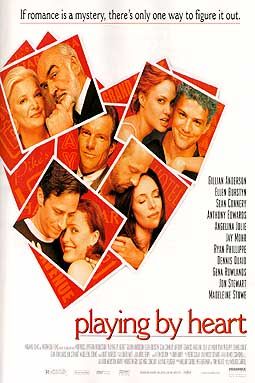
First up, a movie called Playing by the Heart. Never heard of? I'm not surprised, because it didn't seem to win much critical or box office love when it came out back in 1998. What is surprising is how so many talented actors were convinced to take part in this unexceptional film. The movie opens with a number of unconnected couples in various stages of relationships: 
- Hannah (Gena Rowlands) and Paul (Sean Connery) are an older couple facing the end of their relationship now that Paul's been diagnosed with a life-threatening tumor. One shocking revelation still remains though: An old affair that Paul had is discovered by Hannah. "Fun" note: watching how Paul tries to explain away this affair is pathetic. Second "fun" note: Paul's terminal illness no longer seems to be an issue at the tacked-on "happy" ending.
- Joan (Angelia Jolie) just got out of a terrible and ridiculous relationship but after breaking up with her boyfriend via a payphone in a club, she immediately turns upon the stranger (Ryan Phillippe) standing next to the phone and tries to pick him up. This happens repeatedly, night after night, despite his unwillingness to be in a relationship. "Fun" note: Ryan Phillippe's angsty portrayal is just him looking sullen all the time. 
- Meredith (Gillian Anderson) is a workaholic divorcee whose "meet cute" with an architect (Jon Stewart) involves a wall-sized bookcase falling over on her tiny self. "Fun" note: Jon Stewart's character is basically an asshole masquerading as a "nice guy." Yet I'm 99% sure the audience is supposed to think he really is a nice guy. Nope.
- Gracie (Madeleine Stowe) is having an affair because the "mystique" of it is so much better than her "boring" husband. "Fun" note: Shut up, Gracie. Second "fun" note: Even she seems to be have a more or less optimistic ending, despite all odds.
- Hugh (Dennis Quaid) keeps trying to tell a different sob story to whatever woman will listen to in bars across town. "Fun" note: Hugh could probably save himself a lot of grief by being more honest.
- And last but not least is the only non-romantic couple in the cast: Mark (Jay Mohr) is dying of AIDS and now has to open up to his mother (Ellen Burstyn) about his homosexuality. "Fun" note: The movie tries so hard to be open-minded and modern, but its handling of this topic feels both so preachy and so dated. 

These disparate characters and storylines eventually come together in an ending that I *think* is supposed to surprise the viewer, although it is easily predictable early enough into the movie. As you can probably gather from my sarcastic comments above, I wasn't a big fan of this movie. Almost everything about it felt contrived and/or saccharine, and the relationships depicted were all so unhealthy, yet we're clearly supposed to be happy at the ending. No thank you. And despite having such a talented cast, the performances were mostly pretty shoddy, although I can't help to think that a lot of that has to do with a corny plot and terrible dialogue. The only real standout is Ellen Burstyn as the grieving mother of a dying son, but even that is just a small part of the movie. There are a few funny moments scattered here and there in the movie, but honestly even those aren't that good.

Final word: Do yourself a favor and save your time by staying away from this title. I didn't believe Jon Stewart when he made fun of his movie career by holding this movie up as an example of wretchedness. No wonder this movie was hard to get a copy of -- it's not worth watching.

Next up was In Her Shoes, starring Cameron Diaz, Toni Collette, and Shirley MacLaine, and based on the book of the same name. Rose (Collette) and Maggie (Diaz) are two sisters who couldn't be more dissimilar -- Rose is practical and plain; Maggie is flighty and primped. When a particularly painful betrayal happens, Rose kicks Maggie out. Forced to find her way on her own, Maggie discovers a grandmother (MacLaine) the girls never knew they had.

So I read the book this movie was based on way back when and loved it. When the movie came out, I wanted to see it but for some reason I just never got around to it. Recently, I read a memoir by Jennifer Weiner (the author of In Her Shoes) and her mentioning the movie in that memoir renewed my interest in watching it. Luckily my library had a copy, so I grabbed it right up. 

It's hard to review this movie 100% fairly. It's been so long since I've read the book now that I can't accurately compare the two -- the only glaringly "wrong" thing to me was that Maggie's time in Princeton (a part which for some reason sticks out to me more than any other part of the book) is completely missing from the movie. I guess it just wouldn't have filmed as well perhaps, but I felt like it was a crucial part to her story. 

Other than that, the movie seemed to jive more or less with the overall message of the book. Somehow though -- the condensed time perhaps -- the movie lacked some of the emotional impact of the book. Although I've loved Toni Collette in many other things before (including but not limited to United States of Tara), her story seemed the most lacking in emotional "realness" -- so often, her character just burst out with something that didn't seem to mesh with anything else, or else other characters referred to changes in her emotional state that just didn't seem to be there. Mostly I chalk that up to the shortened storytelling time more than on Collette's performance, but it was still a bit disappointing. (Also, it was terribly hard to believe that her character was so insecure about being overweight when she looks like she's about a size 4.)

On the other hand, I was pleasantly surprised with Cameron Diaz's performance. It is probably biased of me, but I didn't expect much from the star of There's Something About Mary and The Sweetest Thing (two movies I wish I had never wasted my time on). However, she really embodied the role of Maggie and brought an impressive range to the character. Shirley MacLaine also did a fine job in her role as a grandmother long estranged from her grandchildren and dealing with some heavy emotional baggage of her own.

While both the book and the movie have been cast in the ghetto of "chick lit" and "rom-com," respectively, the story of In Her Shoes is so much more than your standard romantic storyline (girl meets boy, they have a falling out of some sort, girl and boy end up back together when everything is cleared up). Deep and varied issues are addressed, ranging from mental illness and death to forgiveness and acceptance. It is not necessarily a strictly "feel good" movie, although it does end on uplifting notes.

Final word: Hard to say with this one, actually. If at all possible for you to do so, I'd recommend you read the book, which was so thoroughly good. Barring that, then maybe watching the movie is a worthwhile use of your time. It's a decent choice for when you don't want something too fluffy, but you also don't want to be slammed by something unremittingly depressing with no hope whatsoever.


Sunday, February 5, 2017

Come On, Get Happy

As I've lamented before on this blog many a time, winter is my least favorite season of all. It is looong, cold, dreary, and dark. It makes me wish I was a bear who could hibernate these months away and emerge well rested for spring. But since that's just a fantasy that won't happen, I've been trying to dispel my winter blues with fun and light-hearted movies -- not my usual fare but perfect for lifting my spirits, even if just temporarily. And as I've been away from this blog for a while, I thought I would try a quick summation of those movies in this one post. (It may get a little long though...)

To try to improve my mood, I watched these three movies in recent weeks: The Answer ManZootopia, and The Peanuts Movie. Two kids' movies and a romantic comedy -- this is how I roll in the winter, people.

The Answer Man

This is a romantic comedy from 2009 about a hermetic best-selling author and a single mom with a recently opened small business who meet almost by happenstance and decide to start dating. Literally, the entire rationale behind me watching this movie was "Lauren Graham is in it." The description sounded okay, and I was willing to give it a try, but I was not expecting much. With that attitude going in, I was surprisingly pleased. Sure, the romance part was pretty flat, but the acting was superb, the comedy was good, and it was really more of a story about the author becoming a more social and caring human being than it was a purely romantic comedy. I'll address each of those points a little more fully below.

Jeff Daniels as author Arlen Faber was comedy gold in a multi-faceted role. Faber is a character who is struggling with a number of things -- physical pain from a bad back, a crisis of faith, a desire to be left alone by the people who want to adulate him for his best-selling religious books, and coming to terms with being needed by others and finding himself wanting to be around other people as part of their lives. Lauren Graham was predictably wonderful, presenting her usual mixture of fun-loving comedy turning to fierce drama at a moment's notice. As she herself once noted, she does seem to be typecast into the single mom role, and there were a few moments in the opening of the movie that felt like the movie was trying to give us Lorelei Gilmore with a young son instead of teenaged daughter. But then the character of Elizabeth comes into her own, and we see her more as a dedicated chiropractor, determined to help patients and see her small clinic succeed, and as a friend/love interest to Arlen.  Lou Taylor Pucci as recovering drug addict and struggling independent bookstore owner played perfectly whether in humorous or serious scenes, in either case serving to further stretch Faber's growth and development. Smaller roles were well acted and rounded out the cast of quirky characters.

As I've probably mentioned in the past, I'm not the hugest comedy fan - especially sitcoms or romantic comedies, which tend to feel very predictable and, as a consequence, dull. But that being said, I found myself laughing quite a bit with this movie. A lot of that came from Faber's unexpectedly foul-mouthed or flippant sayings, but some of it was physical and situational humor as well (like Elizabeth trying to promote her business by having her assistant dress up as a giant spine outside their office or Faber being pulled unexpectedly into a parent-teacher conference for Elizabeth's son). There's also a bit of the "awkward first date (or three)" conversational humor, which is a somewhat stereotypical romantic comedy move, but that's usually the best part of any rom-com in my opinion. 

And, finally, I enjoyed this movie more than the standard fare romantic comedy because it was much more than just that. The movie addressed Arlen's need to get outside of himself and his worries to connect with other people and care about them. Sure, that included a potential romantic partner, but it also included her son and people in the community like Kris the bookseller. Faber doesn't completely change his personality or attitude but he does become more willing to embrace other people and help them on their course through life, in turn helping himself to be more compassionate. That may sound overly sentimental, but the movie manages to stay *just* above the rim of being truly sappy. 

Like I said at the beginning of this movie review, I was surprisingly amused and entertained by this movie. And I'm surprised to find myself recommending it as well if you want something on the cheery side for your next movie pick.

Zootopia

A good number of the little kids (and grown adults for that matter) in my life had already seen this movie when it came out in theaters and loved it. I figured I'd get around to it eventually, which turned out to be a day I was still in a down mood. Zootopia tells the story of Judy Hopps, a bunny from a small rural community who can't wait to become a police officer in the big city of Zootopia, despite the nay-saying she hears from literally everyone, ranging from the local bully to her own parents. She persists in her goals anyhow, passing all the hurdles to becoming a police officer and arriving in Zootopia to learn about an ongoing missing animals case, to which she is not assigned because, again, no one believes a small rabbit can accomplish much. But through a series of unexpected circumstances, she ends up partnering with Nick, a con-man (or con-fox, as the case is) to uncover a much bigger conspiracy that anyone expected.

As you might expect from a children's animated movie, there is all kinds of humor in Zootopia, ranging from very obvious slapstick bits for kids to references clearly meant for adults. My favorite two scenes that had me laughing out loud involved a DMV office run entirely by the slowest moving sloths and an introduction to the criminal boss, "Mr. Big," who mimicked several Godfather lines. The movie definitely hit the spot in improving my bad mood, even if it didn't succeed in doing so for a terribly long time. 

But Zootopia also succeeds in presenting a number of important issues to children in a digestible form without being overly didactic. There is soooo much about not judging people by their outside appearance but instead by their personal qualities, like commitment to righting wrongs and perseverance in the face of internal and external doubts. Yes, there are times when some of this lesson is a bit heavy handed, but it's never a "hit you over the head" morality tale. 

Like we've all come to expect with a Disney movie, this one features a lot of talented actors lending their voices to various characters, including Ginnifer Goodwin as Judy, Jason Bateman as Nick, Idris Elba as the police chief, Shakira as the pop star Gazelle (giving the film its catchy theme song), and many many more. As we've all come to expect with an animated film from Disney, the success of Zootopia has inevitably led to there being talks of a possible sequel, one which ::eye roll:: many hope will lead to Judy and Nick getting together as a romantic couple. Let's just hope that any follow-up movie is of as high a caliber as this first one was. 

The Peanuts Movie

Last, and let's admit it, least, I watched the new reincarnation of Charles Schulz's characters that is The Peanuts Movie. As a bit of background, I've never been the hugest Peanuts fan, though I do generally find some of the older short movies both funny and fun to have on around the appropriate holidays. This movie, written by Schulz's son and grandson, stays true to the original characters in interesting ways, but it is sometimes perhaps a little too true to them. Bear with me as I explain.

The Peanuts Movie is largely centered around Charlie Brown's crush on the new girl at school (known simply as The Little Red-Haired Girl) and his myriad attempts to do something great to get her to notice and like him. But because it's Charlie Brown, these attempts inevitably do not turn out as planned. Throughout his many endeavors, Charlie Brown's myriad friends, including his sister Sally and his loyal dog Snoopy, strive to help him out. At the end of the school year, when Charlie Brown finally manages to just talk directly to The Little Red-Haired Girl, she says that she admires all the good qualities he demonstrated when things went wrong, including his selflessness in advancing others before himself. 

Among many of the nods to the original comics include Lucy pulling the football away from Charlie Brown at the last moment, the kite-eating tree, Marcie inexplicably calling Patty "sir," the muffled voices of all adults (voiced here in a stroke of genius by Trombone Shorty), and Snoopy's dreams of being an ace war pilot battling the Red Baron for the skies. This last one has always been a bit of an odd one in my opinion, and some parts of the movie involving these scenes went on a little too long for my liking. There's also a love interest for Snoopy here, mirroring Charlie Brown's story back in the real life part of the movie. 

Also true to the original Peanuts were the many bizarrely romantic relationships seen among schoolchildren. Perhaps because Charlie's crush is the focus on this movie, I started noticing these relationships more than I usually do. Almost all of them involve girls who nag and borderline bully boys into liking them back (e.g., Lucy and Schroeder, Sally and Linus, Peppermint Patty and Charlie Brown). Meanwhile, Charlie Brown's entire basis for liking The Little Red-Haired Girl is that she's "pretty" and she chews on her pencil like he does. He never even learns her name. She is literally "The Little Red-Haired Girl" from beginning to end of the movie. The weird relationship dynamics were kind of unsettling as an adult, and it makes me wonder what kind of message is being sent to kids when they watch this movie. I understand that attempts were being made for continuity between the past Peanuts and the present, but some of this was just a bit too much. It could be left in the past.

It was interesting for me though when I went searching for the origins of the "sir" moniker for Peppermint Patty that I found this article explaining how this character was Charles Schulz's response to second-wave feminism. He chose to make a character that defied the stereotypical feminine traits, instead opting to make Patty a fan of sports who doesn't wear skirts. So that was nice to learn; I just wish that the new creators might have found some ways to bring the female characters of The Peanuts Movie past the 1960s. 

That all being said, there were pretty funny parts to this movie as well as some charming ones. Particularly hilarious to me was Charlie Brown's quest to write the perfect book report to impress The Little Red-Haired Girl, which ends up involving a mistaken search for the book "Leo's Toy Store" by Warren Peace. There was also plenty of slapstick and physical comedy to entertain those who really enjoy that kind of comedy, like the small children who are the target audience for this movie. I really did love the ending in which The Little Red-Haired Girl pointed out all the times Charlie Brown stood up and did the right thing, even if it didn't seem beneficial to him at the time. That was definitely a high note in this movie, teaching children important lessons about how being a good person is about helping others, not just promoting yourself and your achievements.

The animation style is different from the original Peanuts films, given the many changes in technology since then. I guess it could be off-putting for some, but I didn't mind it much after a few minutes of getting used to it. The look and feel of the characters was the same, even down to Lucy being a horrible bully, which I wish was addressed more. All in all, I found this movie an amusing diversion, especially for adults who grew up loving these characters. But I would be hesitant to share it with small children without discussing the problematic parts later.

Well, those are my two cents (and perhaps a little more) on these movies. Have you seen them and have any thoughts? What do you do to keep the winter blues at bay?

Saturday, December 31, 2016

"Read Harder," Take Two

Last year I enjoyed taking on Book Riot's 2015 "Read Harder" challenge, nearly hitting every mark in the challenge. (See the full details of my wrangle with the challenge here.) So I was excited to see that they were doing a second year of the challenge, and decided to start right away in January this time.

Despite this early start, I ended up doing less well with hitting all the marks than I did last year. Changes in my career and personal life resulted in reduced free time for reading, a shorter commute (less time for audiobooks), and a book club responsibility that dictated some of my reading choices for me. So out of the 24 categories, I was only able to meet 16 -- more than half but not particularly great. What can I say other than there's always next year...

Here are the 24 categories from the 2016 challenge and the books (with links to my reviews) that I read for each category. For the most part, I tried not to repeat books even if they fell into multiple categories, instead picking the "best fit" category in which to place them.

Yes, once again, I stretched here and there to meet a goal, doing things like including children's literature. But again, if you don't like children's literature, I'm not sure that we can be friends. :)
1) Read a horror book
2) Read a nonfiction book about science
3) Read a collection of essays
A bit of a stretch, but I did view this memoir as more of a loose collection of essays than a strict beginning, middle, and end kind of book.

4) Read a book out loud to someone else
Perhaps not what the designers of this challenge were thinking of, but I read these books aloud several times to numerous audiences and loved throwing myself into the various voices every time! (And I also read aloud many, many, many other children's books throughout the year.)

5) Read a middle grade novel
6) Read a biography (not memoir or autobiography)
7) Read a dystopian or post-apocalyptic novel
8) Read a book originally published in the decade you were born
9) Listen to an audiobook that has won an Audie Award
10) Read a book over 500 pages long
  • The Art of Fielding by Chad Harding*
11) Read a book under 100 pages
12) Read a book by or about a person that identifies as transgender

13) Read a book that is set in the Middle East

14) Read a book that is by an author from Southeast Asia

15) Read a book of historical fiction set before 1900
16) Read the first book in a series by a person of color

17) Read a non-superhero comic that debuted in the last three years
18) Read a book that was adapted into a movie, then watch the movie. Debate which is better
  • Death Comes to Pemberley by P.D. James & Death Comes to Pemberley, starring Matthew Rhys, Anna Maxwell Martin, Matthew Goode, and Jenna Coleman [Screen version better]
  • Laura by Vera Caspary & Laura, starring Gene Tierney, Dana Andrews, Clifton Webb, and Vincent Price [Book version better]
 19) Read a nonfiction book about feminism or dealing with feminist themes

20) Read a book about religion (fiction or nonfiction)
21) Read a book about politics, in your country or another (fiction or nonfiction)

22) Read a food memoir

23) Read a play
24) Read a book with a main character that has a mental illness

I must admit I wasn't necessarily thrilled with some of the individual touch points for this year's challenge. While last year had some arguably too-broad topics (e.g., graphic novel), this year's challenge became arbitrarily too specific (e.g., non-superhero graphic novel published within the last three years). I appreciate that the challenge's designers were looking to broaden people's understanding of graphic novels beyond Batman and Superman, but the "debuted in the last three years" part was a silly addition in my opinion. What's the point of that? I read a ton of great non-superhero comics this year that I couldn't include here because they were published in 2006 or 2012 or what-have-you. Finding ones that actually fit the category were just dumb luck after picking up graphic novels I was going to read anyway, and it turns out I liked some of those ones less than the others that were slightly older.

Some other categories were also a little too specific for my liking (e.g., read the first book in a series by a person of color -- why a series? why the first book?), but overall I like the idea of pushing oneself to read books that might otherwise have passed you by because you were too busy reading the same old, same old stuff you usually do. Once again, I'll be looking forward to next year's challenge and seeing what new reads lie ahead.

*Books began, but not finished, in 2016. 

Saturday, July 16, 2016

Who Murdered Laura?

Recently I read The Feminist Press's re-issue of the mystery novel Laura by Vera Caspary. I greatly enjoyed reading the book, including the editor's afterword that discussed Caspary's life and successes. Among those successes was having her novels and screenplays adapted into Hollywood flicks, with Laura being notable on that list. I decided to track down the film version of the story and found that easy to do with it being right on Netflix for instant streaming.

Laura is the story of a young socialite who is murdered in her apartment late one night, just days before her upcoming wedding. In the wake of this event, her friends and acquaintances are shocked while her fiancé starts acting a bit suspicious. Added into the mix is a tough, street-smart detective who is determined to find Laura's murderer and won't be belittled by her society crowd. He soon finds himself obsessed with the dead woman.

The afterword of the novel primed me for the possibility of significant changes between the book and the film by noting that Caspary was appreciative of some of the changes made by Otto Preminger, the film's director, and critical of others -- to the point of getting in a shouting match with Preminger at a restaurant. With that being said though, the changes were actually not hugely dramatic in the end. Those changes include:
  • The viewer gets to see a glimpse of what Laura's life was like with the party scene that was absent in the book but added to the movie. This is undoubtedly a bonus.
  • There is a significant change in the murder weapon from novel to film, which Caspary apparently objected to greatly and lost that battle. The symbolism therefore changes, but in the end, I don't think this was a huge detractor to the story being told.
  • Lydecker is vividly described in the book as an overweight man with a van Dyck beard and a walking cane (which is most likely just an affectation). This person is transformed into a svelte, mustachioed gentleman. Classic Hollywood for you -- everyone has to be pretty, even if they are specifically described as otherwise.
Why?? At least keep the van Dyck beard, if nothing else...

  • Lydecker has a radio program rather than a column. This is quite fitting with the audio-visual medium and is thus a logical change. It also makes for a very haunting scene towards the end when we hear Lydecker's spoken essay on love voiced over a very dramatic moment.
  • Laura's aunt is less of an invalid and more of a fiancé snatcher. She seriously throws herself at Shelby way too much; it's rather disturbing how blithe she is about telling her niece that she's no good for her own fiancé who would be better off with her instead. (Side note: How strange is it to think of Vincent Price as "leading man" material instead of the king of horror??)
Unexpected but ultimately believable --
Vincent Price as old money, handsome "keeper" Shelby
The biggest change, which is the hardest to exactly point how or why it's different, is in the character of Laura herself. She seems like more a damsel in distress or naïve ingénue than the driven and successful career woman of the novel. Again, it's hard to place a finger on exactly what's wrong or different, but there's a je ne sais quoi about Gene Tierney's performance as the titular character that is just off a little. A reviewer for The New York Times back in 1944 says it best:

"Yes, you get the idea that this Laura must have been something truly wonderful. Now, at the risk of being unchivalrous, we venture to say that when the lady herself appears upon the scene via a flashback of events leading up to the tragedy, she is a disappointment. For Gene Tierney simply doesn't measure up to the word-portrait of her character. Pretty, indeed, but hardly the type of girl we had expected to meet. For Miss Tierney plays at being a brilliant and sophisticated advertising executive with the wild-eyed innocence of a college junior." (emphasis mine)

All in all, this is a solid adaptation of the novel that gets the basic story right and has a fantastic noir look to all its scenes, including the ominous black-and-white shadows present in numerous moments. Indeed, all of the lighting works to create beautiful effects. In addition, the moody atmospheric music seals the noir feel, even the romantic titular song written by Johnny Mercer for the movie. But unfortunately the characters are just a *little* wrong, which detracted somewhat from the viewing after readering the book. I'd recommend the novel over the film, unless you're the type who prefers movie watching to book reading. However, it's worth pointing out that, as always, this is just my opinion -- the novel has faded in to relative obscurity while the movie has been put on numerous "best of" lists and important histories of film.

For a Good Time, Call BUtterfield 8

For some reason, within the past month of so the movie BUtterfield 8 came up a couple of times. The first time I came across it (while researching ambiance and facts for a 1960s party I was throwing), it piqued my interest a bit after I heard that Elizabeth Taylor won a Best Actress Oscar for it. The second time it came up (when reading a book that mentioned several infamous cases involving the disappearance, death, and/or murder of young women in the 1940s), I decided I really had to check it out. So I found a copy through my local library and popped it in my DVD player.

Note: This review is going to have spoilers, so beware. But, hey, you've had 50+ years to watch this movie. ;)

BUtterfield 8 starts with Gloria waking up alone in the luxurious apartment suite of Liggett, a man she met the night before. At first, she slowly and seemingly happily wanders about the apartment, admiring the fancy clothes and sundry niceties belonging to Liggett's absent wife. But when she spies a note from him asking if $250 is enough, she goes into a rage and writes "No Sale" across the ornate mirror with lipstick before storming out of the apartment with his wife's mink coat as a revenge. This beginning is veeeery slow and feels like the type that wouldn't fly with modern audiences at all who expect an explosion or a plane crash or a murder in the first scene of any movie or TV show. It's only in retrospect that the viewer actually realizes what is going on, as we are unaware in the long, dialogue-free introduction who Gloria is, where she's waking up, or why she's there. This is not the kind of draw we're used to nowadays.

Gloria then waltzes her way over to the cramped and less refined apartment belonging to her childhood friend and current struggling musician Steve, where she shows off her new coat and whines that the man dared to actually pay her, which confuses Steve -- and frankly, the audience as well at this point -- because he doesn't quite understand what she wants from these meaningless relationships she starts with men. He worries about her future, which she pooh-poohs before getting his girlfriend to come over and lend her a more appropriate outfit to go home to her mother in, as she doesn't want her mother to know who she really is and what she does with her time. The girlfriend is furious at Gloria but complies while she is present, later giving her boyfriend an ultimatum to choose between her and Gloria, to which he sighs that he can't give up on Gloria because he has such a strong bond with her and feels it is his "brotherly" duty to watch out for her. (Although it's difficult to see what exactly he's doing to help Gloria, for it seems that he is only enabling the very behaviors in Gloria that he says he worries about. Also, their "brother-sister" relationship seems to have far more sexual tension than the one between Gloria and Liggett, perhaps not unsurprising given that the actors playing Gloria and Steve - Elizabeth Taylor and Eddie Fisher, respectively - were newlyweds.)

Eventually Liggett and Gloria make up when she gets him to understand that she chooses and drops men as she pleases and she refuses to accept money or any goods from these men, no matter how wealthy they are or how much they offer her. The two then run off together for days on end without telling anyone where they are or when they'll be back -- a particularly cruel move on Gloria's part as her poor mother sits at home worrying if Gloria is alive or dead. (Liggett's wife meanwhile is safely ensconced with her sick mother and unaware of what her husband is doing back in New York anyway.) Gloria comes to believe she is in love, even though the "romance" between the two is hardly shown and it doesn't seem that they share anything beyond a sexual attraction. This is not helped by a rather wooden performance from Laurence Harvey as Liggett, who always seems rather bored by Gloria except in later scenes when he comes alive with anger. Gloria happily returns to New York and starts bearing her soul to everyone -- from discharging herself from psychiatriatic help because she is "cured" now with her newfound love to finally confessing to her mother about her past indiscretions only to let her know that is in the past now that she's found someone permanent.

However, as someone wise said, karma's a bitch. When Liggett's wife returns home and notices her mink is missing, he immediately (and correctly) suspects that Gloria stole it. A huge and public fight ensues and ends with the two parting ways. A distraught Gloria ends up at Steve's apartment again, truly bearing her soul this time when she confesses to him that she was sexually molested by her mother's boyfriend when in her early teens, a scene that transforms her from a hedonistic character to simply a hurt one. Somehow this confession awakens some sort of bizarre sympathy transference in Steve that causes him to propose to his girlfriend, at which point Gloria quietly sneaks back home to her mother. Gloria decides to start life anew and move away from New York to Boston. But early en route, she is tracked down by a now remorseful Liggett who refuses to let her go. She dashes into her car without him and drives speedily away, but Liggett is just not the kind of guy to take no for an answer. He pursues her in his own car until, in her desperation, she unwittingly drives into a construction pit, her car wretchedly tumbling over and over again with fatal results for Gloria.

Talk about an ending. There is clearly no going back and starting again for a "bad girl" in the late 50s/early 60s. But for a cheating husband? Liggett returns home to his wife and the final lines of the movie are given to him expressing hope that they'll work on their marriage. Wow. Truly, despite all the times that Gloria is referred to as a "call girl" or "high-class prostitute" by other reviewers, the Gloria depicted in the movie makes it clear she doesn't take money from men, although she is happy to flirt with or sleep with whomever she likes. Clearly she has a broken past and her current relationships are in shambles (whether it's lying to her mother, provoking the anger of her only friend's girlfriend, or getting involved with already married men), but her life is not nearly so scandalous or salacious as the movie posters would have you believe. Nevertheless, she pays the ultimate price - her very existence - for living the life of a single woman making her own decisions. For a modern audience, this is a very bitter pill to swallow. It's not surprising to learn that, according to Taylor biographer Alexander Walker, Taylor herself was opposed to doing this movie as it cast in her such a negative role, but alas was under contract with the film's studio, MGM, to make this movie whether she wanted to or not.

The film is based on a novel of the same name by John O'Hara. Never having read that title, I'm not sure how this movie lines up with the book, particularly whether or not the portrayal of Gloria is any different. I suspect that like with many movies that came out in this time period, much had to be left unsaid -- for instance, Holly Golightly's call girl status in Breakfast at Tiffany's. However, as I previously mentioned, I can't say that for certain, not having read the book. It's worth noting that the book was based partially on a real-life drama concerning the mysterious death of Starr Faithfull, which occurred nearly 30 years before this movie was released. I wonder if that contributes even more to the feeling that this movie is very dated.

Indeed, this movie's biggest criticism these days is just how very old-fashioned melodramatic it is. Contemporary audiences give it pretty low rates for being dated and too much of a soap opera. I hate to be one more voice piling on, but these critiques seem fair. This movie is worth watching for a steamy and emotional performance by Taylor, but otherwise it falls flat and rankles with modern-day conceptions of women's autonomy rather than scandalizing viewers with the idea that people have sex outside of marriage.

Thursday, June 16, 2016

CSI: Pemberley

Please be aware of some spoilers with this review.

After being disappointed with the book Death Comes to Pemberley by P.D. James and finding it a bit tedious to get through at points, you'd think I wouldn't want to seek out the miniseries based on it, right? Wrong. Why would I do such a thing? There's a simple two-word answer: Matthew Goode. Over time and many viewings, I've come to respect this actor so much, whether he's the morally ambiguous Ozymandis (my views on his portrayal have changed since re-watching Watchmen a few times) or the sweet and charming Mr. Brooke Burgess of He Knew He Was Right. Heck, I even tried a bad romantic comedy for his sake (well, his sake and Amy Adams's sake). So I was going to check out the BBC version of Death Comes to Pemberley no matter which role he played in it, although I was glad to find that he played the dashing and devilish Wickham -- perfect casting in my opinion.


Death Comes to Pemberley the miniseries closely follows the book Death Comes to Pemberley in that all the elements of that story are presented here. However, those elements are often in a divergent order from the book, with a different character revealing certain points or with more spectacle given to a specific moment. All in all, each change from the book to the miniseries is clearly meant to heightened the suspense and drama of the storytelling -- something I wish James had done all along so that the book would have been more successful as the murder mystery it purports to be. In fact, viewing this miniseries just exemplified for me the importance of a good editor -- the intrigue and drama were there all along in Death Comes to Pemberley if only someone had the good sense to cut down on the redundancies and work on the pacing a bit more.

With the miniseries, repetition is not really an issue, even with the two different hearings/trials for Wickham. The mystery unfolds over time instead of coming in with a bang at the end; here we see the mystery woman in the woods almost immediately at the start of the story and we learn early on about Louisa's illegitimate child, for just two examples. Of course, we don't learn the significance of either of these events until much later on, with the latter giving rise to a subtle suspicion on Elizabeth's part that perhaps Darcy has not been faithful to her rather than being thought of as an issue connected to the murder right away.

Speaking of Elizabeth and Darcy, the miniseries does a much better job of portraying these characters than the book, keeping much more in line with Jane Austen's original characters. Yes, we do lose some insights into Darcy's inner thoughts, but Matthew Rhys's Darcy is the quiet, reserved Darcy of Pride and Prejudice and, while Elizabeth is perhaps not quite as spunky as the original, she's a huge improvement over the practically lifeless character of the Death Comes to Pemeberly novel. The casting of Anna Maxwell Martin as Elizabeth was genius as she is perfect as portraying a well-mannered woman who also willing and eager to speak her mind. She is also given a lot more to do than in the novel -- some critics have pointed out how the actor seems to still be playing her role from Bletchley Circle, gathering up clues and using them to solve smaller mysteries until she discovers the final reveal. I am perfectly fine with this change; indeed, I'm happy to see Elizabeth being active again instead of just a bystander. Her wit and humor is largely on the back burner, but you can get a sense that she has the capacity for it when not facing down a crisis, which is not at all the impression you get from P.D. James's Elizabeth.

The relationship between the Darcys is also far more interesting here. In the book, their love is a unshakable foundation, or so we are repeatedly told, but we hardly ever see them together. Here, there is rather a different story. There is a great deal of tension between the two, especially as they argue over various points, such as whether it is right for Georgiana to marry for affection or for position (more on this below). Darcy's insistence that his sister marry with an eye toward her family duties makes Elizabeth worry if he is doubting his own decision to marry for love instead. She also laments that her marriage to him has brought him to this horrid situation of being brother-in-law to a possible murderer and, as aforementioned, seems to question whether he has been carrying on an affair with Louisa. But all's well that ends well and, in a very un-Austen-like turn, there's even a steamy sex scene between the two. Necessary? Maybe not, but it sure beats the practically nil interactions between the couple that the reader of Death Comes to Pemberley gets.

Another bit of heightened drama in the miniseries is that the love triangle between Georgiana Darcy, Colonel Fitzwilliam, and Henry Alveston is actually more of a complicated affair, rather than a two-page possibility of an issue that is quickly dismissed. You can see the pathos as Georgiana attempts to decide between honor and romance, between following the wishes of her beloved brother and staying true to her own heart. In a particularly heartbreaking scene, she sobs openly in front of stiff servants as she struggles with trying to do what is right. Also kudos to the acting chops of Mr. James Norton, who so thoroughly inhabited the despicable, slimy rapist and kidnapper of Happy Valley that I barely recognized him here as he played the sweet and amiable Alveston.

The miniseries version of Death Comes to Pemberley also plays up the possibility of Wickham's death much more so than in the book. With a capital crime, this should have been more of a looming shadow in the book, but it really wasn't. Here, however, the gallows are frequently close at hand, forever reminding the viewer of the deadly consequences that are so near if Wickham is not acquitted. The story of the young boy hanged when Darcy and Wickham were just children is also used to more dramatic effect here, with the two being scarred by this visual at a tender age and both remembering or referencing it at times throughout the trial.

Minor characters were played to great advantage here as well. Jenna Coleman was divine as Lydia -- offsetting her perfectly ridiculous and ostentatious hysterics with a few rare moments of actual depth and sincerity of emotion that allow viewers to pity her even as they dislike her. The equally ridiculous Mrs. Bennet was also a breath of fresh air in terms of comedic effect -- having her descend on Pemberley after the tragedy of Denny's death instead of the kind and gentle Jane was no doubt more burdensome for the characters but far more fun for the viewers. Although she's on the screen but briefly, Lady Catherine is also great for moments of social satire. Louisa and her family can perhaps be a tad melodramatic at times and Mrs. Younge is too much of a viper, but overall I believe the casting was well done and the characters were well played.

Another thing done well with the miniseries was that rather than introducing this myriad of characters and their various histories right away in a compact, arguably rushed prologue, the writers went instead with the flashback route. At different points throughout the TV series, we see the characters' past meetings and interactions in these flashbacks, which allows the rich back stories to gently unfurl and give the viewers time to settle in and digest each new piece of information.

I'm not sure that I'd call this "must-see" TV, but I would definitely, without a doubt, unequivocally recommend watching this miniseries over reading the book of the same name. You'll thank me later.