Tuesday, July 3, 2012

Laila’s Birthday: A Celebration of Absurdity?

Laila’s Birthday is a 2008 film set in Palestine that follows one day in the life of Abu Laila, a former judge who now drives a taxi cab for a living. This particular day is no ordinary day though – it is the seventh birthday of his only child, his daughter Laila. All Abu Laila wants to do is put in a day’s work, pick up a present and cake for his daughter, and arrive back home by 8 pm. But fate is not on Abu Laila’s side. After starting his day off with his usual Kafka-esque exercise in absurdity by visiting the Ministry of Justice in a feeble attempt to bring his judicial nomination up sooner, Abu Laila’s day gets worse when a customer leaves behind his cell phone in the taxi cab’s backseat. In a classic turn of “no good deed goes unpunished,” Abu Laila finds himself getting into all kinds of situations, as he puts it, in his attempt to return the cell phone to its rightful owner. Will he be able to make it back home in one piece in time for Laila’s birthday?

I’m not sure now how it is that I heard about Laila’s Birthday, but somehow its existence came into my knowledge in the past few weeks. I immediately watched the trailer for the movie and decided I had to watch the whole movie. The trailer seemed to promise a film filled with absurdly comic scenarios – just the kind of situational comedy that I find particularly funny. While this is certainly true at many points, the movie is also profoundly sad at times. Consider Abu Laila’s words when he snaps at one point and yells out in helpless frustration at the helicopters overhead: “And you…! Leave us alone!!! Leave us in peace!!! Leave us our breath!!! Leave us our rest!!! We know you have planes, tanks and very smart missiles.  You are the toughest occupiers in the world!!! But we, we want to live. We want to raise our children. We want to sleep. … We just want to live. Simply that. Just that.” But the beat marches on, and wars and occupiers continue to exist the world over, ad infinitum.

As the quote above suggests, the movie is of course laden with political overtones scattered throughout. No doubt it is difficult to write and produce a film set in present-day Palestine without doing so. As Abu Laila’s drives his taxi throughout the city, we hear political news on the radio and see protestors out in the streets. Some of these political situations are particularly poignant. For instance, one couple nearly jumps out of Abu Laila’s taxi when they see a line forming because, they reason, a line must mean someone is giving away some food or other necessary items. Later, a missile drops across the street from where Abu Laila is, and the aftermath is chaotic.

On the other hand, one moment that had me chuckle aloud was when a group of men in the café, eager to condemn what a mess the occupation is making off their country, argue over whether the military officers they are watching on a newsreel are Israeli or Palestinian before someone shouts out: “It’s Iraq. And the army is American.”

Abu Laila’s politics also shine through as the movie progresses, and he refuses to bring passengers to checkpoints or take riders who are armed. He is persnickety in other ways also and, as a former judge, is a stickler for the law. He argues with one passenger about wearing a seat belt and asks another not to smoke, citing legal foundations for both requests.

As a slice of life kind of movie, we unfortunately don’t get a lot of Abu Laila’s back story, although we get enough to understand his frustration and sense of both righteous indignation and helplessness as he tries to navigate this new life he has. Another serious pitfall, in my opinion, is that the roles of Abu Laila’s wife and daughter are sidelined. Their appearances bookend the movie, but they have few lines or compelling characterizations. Instead, they function as the Victorian model of females as “the light of the home” – a home where men go to escape the hustle and bustle of the manly world of business and instead relax in the innocence of this womanly world of domesticity. This is perhaps somewhat hyperbolic in this particular situation as we are at least informed that Laila goes to school and his wife goes to work, although no further details are given about either’s daily routines.

What we do get to see a lot of, however, are city scenes as Abu Laila is out and about driving his taxi. The various landscapes show us a beautiful country (occupied territory) that has been battered by numerous problems, including military occupation and economic hardship, and is worse for the wear.

Still, despite all the chaos, the movie manages to end on a somewhat hopeful note, although its final line can also be interpreted as defeatist. I suppose how you take it all depends on whether you are glass half-empty or glass half-full kind of person (or what kind of day you’ve had). For better or worse, the feeling you leave with is that people are people everywhere, all of us with hopes and concerns that face us each day.

Laila’s Birthday was not a big blockbuster hit like all the summer movies recently out or on the horizon, but it’s certainly not a film to be missed. It is an absorbing movie, and you will be enriched by seeing it.

Monday, July 2, 2012

One Hysterically Funny Person

After my disappointing foray in to Sky Captain and the World of Tomorrow, I decided I needed something both light and surefire to please. I decided to watch Demetri Martin. Person., forgetting that I had already seen this particular Comedy Central special before. Nevertheless, it had been several years since the first time I watched this stand-up routine so some of the jokes felt new and fresh. And, the ones I already remembered were still just at funny!

For those of you who are unfamiliar with Demetri Martin, this New Jersey native is a former writer for The Daily Show with Jon Stewart and Late Night with Conan O'Brien. The comedian also had his own show on Comedy Central called Important Things with Demetri Martin, has had small roles in numerous films including Post Grad, and wrote a hilarious book called This Is A Book. His stand-up comedy style is a mix of deadpan humor, stream-of-consciousness one-liners, and occasional skits. Oftentimes, he props up his jokes with musical accompaniment and a large pad with sketch drawings. He also has a fondness for graphs and palindromes, and clearly displays his intelligence in his choice of jokes and style of humor.

While it's a relatively short special, Demetri Martin. Person. displays most of Martin's signature comedic styles, except the use of palindromes. For an outline of the general structure of the special, visit the Wikipedia page while the quotes page on IMDb gives a sense of the types of jokes you'll hear. If you prefer humor that isn't entirely crass and/or slapstick, there's a good chance you too will find Demetri Martin. Person. hilarious.

Sky Captain and the Soaring World of CGI

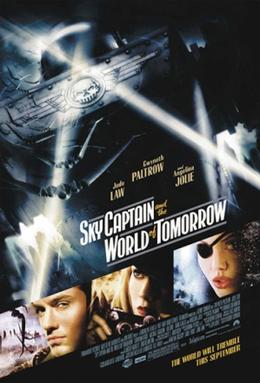
Back in 2004 a new movie was previewed that had the look of a mesh between film noir, old-time sci-fi movies, and comic books. That movie was Sky Captain and the World of Tomorrow, and I was jonesing to see it as I thought that combination of elements seemed awesome. Well, as frequently happens, I don't get around to the things I want to until much later than hoped for and anticipated. It was finally last weekend (yes, in 2012!) that I got around to watching Sky Captain and the World of Tomorrow. And, sadly, it did not live up to my expectations.

Sky Captain and the World of Tomorrow takes place in an alternate reality 1930s New York. Intrepid reporter Polly Perkins (played by Gwyneth Paltrow) is following up on a story about missing scientists when a group of gigantic robots invades the city, creating havoc. Polly decides to seek help from her daredevil ex-lover Joe Sullivan (Jude Law), also known as "Sky Captain" due to his line of work as a mercenary pilot. The two go a quest to find Dr. Totenkopf, a shadowy figure they know little about but suspect is behind both mysterious events. Along the way, they meet many adventures and call upon the help (and are called upon for help) of friends both new and old, including Franky Cook (Angelina Jolie) -- another ex-lover of Joe's and source of contention between Polly and Joe.

There are so many things wrong with Sky Captain and the World of Tomorrow that I'm not even sure where to begin. The characters lack real three-dimensionality and their back stories are weak. For instance, how and why did Joe become a pilot for hire? What kind of previous escapades had he participated in? What made him famous enough to be called upon in a pinch? How did he derive the nickname "Sky Captain"? When and how did he first meet and become involved with Polly? And so on. The movie does try somewhat in this respect, as there are numerous hints dropped about Joe and Polly's past (and Joe and Franky's past, to a lesser extent) but these are never fleshed out satisfactorily. Good characters are the most crucial part of most (if not all) movies, in my opinion, and I felt like the wonderful cast of actors assembled here was wasted by these one-dimensional characters. Polly felt like a combination of tropes - the stereotypical "girl Friday" meets Lois Lane - while Joe was any generic action film hero. Furthermore, the dialogue between these characters came across as very scripted and nothing memorable comes to mind. That is, except for the final line, which stands out because it is just plain ridiculous.

The plot is thin at best, and the ending (no spoilers) is cliched and anti-climatic. Rather than flesh out characters or plot, the nearly two-hour long movie is instead an almost non-stop action sequence. (I saw Lucasfilm scroll up during the credits, so now you are forewarned about what kind of movie this will be.) And this is not just any action -- it's almost entirely computer-generated action. Worse still, it's not even computer-generated images at its best or even mediocre as it's an absurdly unrealistic style of animation. The ridiculous robots add to the campy feel of the movie, along with the not-so-funny attempts at humor. The sepia color palette adds to the stylized look, but it is too dark a visual to sustain for nearly two hours.

Stylistic is definitely the adjective of choice for this movie. While sometimes this is novel or interesting, it does not make up for the lack of plot or interesting characters and relationships between them. As the USA Today review of the movie put it: "Sky Captain and the World of Tomorrow is all style over substance, a clever parlor trick but a dull movie." While the retro feel and the unique look of the movie is appealing for about 15 minutes or so, this appeal quickly wears off and the viewer is left debating whether or not to even bother continuing to watch the movie through to its end. (It's worth noting that I did keep continuing in the movie's favor with this debate, all the way to the grand finale, and was then regretting that I hadn't turned it off early on.) Another reviewer puts it this way:  "Imagine you are in Starbucks and you are ordering a cappuccino, but your server puts the milk in and froths it up and serves it to you, forgetting entirely to put in any coffee. It couldn't be called a 'cappuccino', but it certainly could be called SKY CAPTAIN."

On the plus side, Paltrow and Law valiantly do their best at their roles. (Jolie's role in the movie is so brief as to render me unable to really comment on her acting.) In the hands of lesser actors, this could have been a far worse movie. As I mentioned earlier, the visual style of the movie can be appealing at times and does seem to capture a lot of the 1930s nostalgia, particularly as embodied in the look of Paltrow's character. (This still does not make up for lack of plot though!) An interesting use of technology in this movie is the cameo appearance of Laurence Olivier. Yes, THE Laurence Olivier who was already long-deceased when this movie was produced. With the use of computer programming, the movie was able to generate a brief speech from Olivier based on video and audio available from his heyday. Now that's putting CGI to a good use!

Sunday, July 1, 2012

A Long Day at Longwood Gardens


After having discussed this trip months in advance, a friend and I finally descended upon Longwood Gardens this weekend, in part to view the art installation “Light” currently on display there. Located in Pennsylvania’s Kennett Square, Longwood Gardens is the former estate of entrepreneur, philanthropist, and horticulture lover Pierre Samuel du Pont and his wife (and cousin) Alice Belin du Pont. Now approximately covering 1,200 acreage (with only some of that open to the public), Longwood Gardens came in to being when du Pont bought 202 acres of land from the Peirce family in order to save some centuries old trees on the property from being cut for lumber. Of interest (to me at least) is that the Peirce family had originally bought their farmland from William Penn himself. There is certainly a great deal of history behind Longwood Gardens!

After buying that initial tract of land, du Pont set about saving trees in the arboretum, participating in some “gentleman farming,” and expanding and improving the gardens, including numerous additions based on his personal interests and travels. For instance, Longwood sports a beautiful and elaborate Italian Water Garden, inspired both by du Pont’s love of water and a similar garden he saw while traveling near Florence with his wife. He also added a flowered garden walk, an enormous conservatory, and expanded the Peirce’s family home to include a library and covered courtyard, to name a few changes.

The Italian Water Garden at Longwood Gardens
After his death, Longwood Gardens were opened to the public, as stipulated and provided for by du Pont’s will. Incidentally, it is not the only du Pont estate in the Brandywine Valley open to the public; Alfred du Pont’s Nemours is in nearby Wilmington, Delaware as is Henry Francis du Pont’s Winterthur, which I have written about here before and would highly recommend. Unfortunately, I’ve not been able to find a good family tree online, so if anyone knows the exact relationship amongst these various du Ponts, I would be interested to know. My surmise is that Henry Francis and Pierre Samuel were some sort of distant cousins; they appear to share the same great-grandfather, Eleuthère Irénée du Pont, founder of the E.I. du Pont de Nemours and Company. (Both Henry Francis’s Winterthur and Pierre Samuel’s Longwood Gardens are listed in the book 1,000 Places to See Before You Die, if you need any extra motivation to visit either one or both.)

Unlike Winterthur, there are few museum-like qualities to Longwood Gardens – that is not to say it is not a great place to visit, just an explanation of what to expect. There is some history on display in the Peirce-du Pont House as well as in the ballroom near the conservatory. The ballroom houses one of the world’s largest pipe organs to be installed in a private residence as well as an exhibit on organ history. (Interestingly, although I think many of us associate organs with churches, early Christians were opposed to their use.) In the music room at the conservatory, there was also a small exhibit on the “Light” installation currently at Longwood, but more on this later. Also, throughout the estate there is often signage explaining the historic significance of particular trees, plants, structures, or garden plans. Here, as in several of the exhibits, I really appreciated the use of photographs to illustrate how particular rooms or garden areas looked when the du Ponts lived at Longwood. Comparing these with the current landscape emphasizes how well the grounds have been maintained and conserved to look as they did back in the 1920s and 30s.

Longwood may not have an extensive amount of information for the history buff, but it more than makes up for that in its natural beauty. The grounds host plants, trees, flowers, vegetables, and herbs of all kinds, making it especially interesting for botanists (amateur or professional) to explore. However, even those without any flora knowledge can enjoy just soaking in the beauty. Those interested in fauna may also be delighted with some surprise finds – at least the bird-watchers amongst us will have plenty to see! The well-laid out paths, along with a handy map, make the large estate easy enough to navigate. Visitors can enjoy strolling through and near a topiary garden, a rose arbor, a couple of lakes, and a cultivated meadow, amongst other fabulous sites. There are also numerous tree-houses to explore along with an impressive chimes tower and accompanying waterfall. For those traveling with children, there are a few child-specific areas carved out, including an outdoor children’s corner and an indoor children’s garden.

Chimes Tower

A bird "condo" above one of the garden patches

An unexpected visitor. I suspected he was there because of all the birds, but he came to sit next to me on this bench instead.

Indoors, the conservatory hosts 20 rooms of rare, exotic, or just plain interesting plants and flowers. Here visitors can view bonsai trees that have been in training for nearly 100 years, a plethora of orchid variations, and various fruit trees, ferns, roses, and so forth. (Apparently, orchids and roses were amongst Alice Belin du Pont’s favorite types of flowers, while Pierre Samuel du Pont had a fondness for nectarines.) Some rooms are filled with flora fitting a specific theme, such as the silver garden or the Mediterranean garden.

Close-up of one particular species in the orchid room. The centers struck me as looking like fanciful little people.
One patch of the "silver garden" within the conservatory

Just outside of the conservatory is the main fountain garden. A personal project of Pierre Samuel du Pont’s, this set of fountains use his hydraulic designs to jettison spouts of water up to 130 feet high while pumping 10,000 gallons of water per minute. A brief 5-minute water show is displayed here several times a day, with a more elaborate 30-minute water-and-light show occurring every evening. This show is generally accompanied by music, but as the nearby outdoor theater on the grounds was entertaining guests with The Mikado last night, our show was sans music. Nonetheless, it was a pleasant display, and many visitors of the grounds grabbed a seat or stood outside the conservatory to watch this impressive entertainment – and made their own music with the collective “oohs” and “aahs” that sprung up with each new delight.

Traversing the main fountain garden is this bridge-like structure with additional fountains (apparently not in use now though) and sculptures. Unlike nearly everything else at Longwood, this whole structure had a dilapidated air that gave it a Great Expectations-like atmosphere. We hoped that it was slated for restoration/conservation next.

In addition to all the usual charms of Longwood Gardens, part of the reason we decided to visit this particular month was to see the art installation, “Light,” by Bruce Munro. This site-specific installation is actually comprised of several different installations throughout the estate. This varies from the amusing (large “lily pads” made up of foam and recycled CDs floating in the large lake) to the enchanting (a forest walk illuminated by 20,000 glass-blown baubles encasing LED lights that were constantly changing colors) to the profound (a section of the meadow littered with 69 towers made of recycled bottles filled with water and LED lights accompanied by music, apparently inspired by a novel the artist read in which a character had synesthesia). At the exhibit in the music room, a few details of Munro’s work were on display along with professional (and amateur via visitors’ uploads) photography of his installations at Longwood. Here the curators displayed a quote in which Munro explained his work, “Light is visceral and evocative. A certain quality of light can bring you back to a moment in the past. Every season has a light that brings back distinct memories, whether staring at a twinkling Christmas tree or lying under the window on a summer afternoon watching dust motes float in the sunshine. In my work I try to capture something of these ephemeral experiences. I want to express those moments of being lost, of discovering that feeling of merging with something greater.” What a beautiful sentiment.

In the distance is the "Water Towers" installation as seen in the daylight still

The only downside to our trip was that we came fairly early in the afternoon so that we were pretty exhausted from all our walking by the evening time, just as dusk was coming. As a consequence, we didn’t see Munro’s work in all its full glory of being lit up in contrast to a dark night. However, we did see enough to appreciate it and the stunning amount of work that much have gone into it. Like others, we marveled at the fairy tale-like ambiance of the “Forest of Light” and sat meditatively listening to music at the “Water Towers.” And, our long day at the Longwood Gardens meant that we got to traverse the public property in its entirety, even doubling back to certain areas.

While I still personally preferred Winterthur as a place I would go back to multiple times, visiting Longwood Gardens was certainly an enjoyable and informative experience and I would recommend it to others!

Saturday, June 2, 2012

A Failing Attempt at Very Small Business

In my last post, I discussed the gem of a show I found in The Librarians. After enjoying that inappropriately funny show so much, I decided to check out the briefly lived show Very Small Business for a similar dose of humor. Very Small Business is a sitcom that aired on Australian TV in 2008 for only six episodes. The series was co-written by Gary McCaffrie, Wayne Hope (one of the co-creators of The Librarians), and Robyn Butler (real-life wife of Hope and actor who played the role of Frances on The Librarians). The show stars Hope and Kym Gyngell, the actor behind Father Harris on The Librarians. 

Hope plays Don Angel, an entrepreneur behind the Worldwide Business Group, which publishes numerous newspapers and magazines that mainly serve only as space for advertisements – the type of junk you receive in the mail and almost immediately toss in the recycling bin. Don has just hired Ray Leonard (Gyngell) to be the group’s senior journalist and write editorial content that is little more than advertisement itself. Ray was formerly a journalist for big and respected newspapers but has been out of work for six years after suffering from chronic fatigue syndrome. He takes the part-time job at Worldwide Business Group even though its pay is pittance not because he needs the employment or money but because his psychologist recommends he gets out and about again to counter his depression. Meanwhile, as Don attempts to juggle all the scams he’s started in an attempt to grow his business, he is also going through a divorce and suffering physical pain due to all the stress he’s experiencing.

With so many connections to a show I had previously found entertaining, I had high expectations for Very Small Business as well. Unfortunately, these were not met. The show’s humor was just … not so funny. There were a few parts here and there that made me chuckle, but mostly I was not bemused. Don was a character that was very difficult to like in any way and his constant attempts to swindle people were not really humorous. As I mentioned in my post about The Librarians, it was sometimes a bit hard to get behind a show that featured such a mean-spirited main character, but Don made Frances looked like an angel in comparison. And, as I mentioned in that post, Frances did grow somewhat as a character over the series. When faced with problems, Don only became more of a jerk, although to be fair, this short-lived show had less opportunity for character growth. Furthermore, with its ensemble cast, The Librarians wasn’t all Frances all the time. With only Don and Ray at is core, it was hard for Very Small Business to give the viewer much more than Don and his vulgar speech, flippant attitude toward women, obsession with making money, and heartless approach to business. Ray was a far more interesting character, especially as we learned more about his past and his coming to terms with his previously estranged daughter Leslie who suddenly found Jesus. If the show focused on him rather than Don, it might have been more engaging and it seemed that his absurd life situation would have lent itself to more darkly humorous scenarios. Instead, the show decided to fall back far too often on potty humor (literally) to try to get a laugh out of its audience. It didn’t work.

A fun Easter egg in Very Small Business was an appearance from Robyn Butler in one episode as a psychologist that Don sees on recommendation from his doctor. Seeing her in a role, albeit a small one, so very different from that of Frances O’Brien on The Librarians made it all the more obvious how much transformation had gone into creating the closed-minded head librarian of the Middleton Interactive Learning Centre.

Usually I lament when TV executives don’t give shows a fair shot, but six episodes seemed to be more than enough for Very Small Business. I have to admit I even skipped through half of the fourth episode because Don’s actions and dialogue were just becoming so obnoxious. I might have stopped watching the show altogether there except that I was aware of the cameo from Robyn Butler in episode five and then became more interested in the resurgence of Ray’s story here to continue on to the sixth and final episode.

It might be that the humor used in Very Small Business works for some viewers, but I was disappointed, especially after the successfully entertaining The Librarians. Dear reader, what do you think? Have you seen Very Small Business? Did you find it funny?

Wednesday, May 30, 2012

What Happens in the Library, Stays in the Library


Some time back, Hulu recommended the show The Librarians to me and while I almost immediately added the show’s three seasons* to my queue, I only recently got around to watching them.


 The Librarians is a gem of a show, airing on Australian TV from 2007 to 2010, and featuring a host of hilarious situations. The sitcom revolves around the staff of the Middleton Interactive Learning Centre, a public library run by head librarian Frances O’Brien, “a Catholic bigot with a panic disorder.” In the first episode, Frances finds that her hand is forced into hiring Christine Grimwood as the children’s librarian, despite the fact that Christine is facing drug-related convictions – and that Christine is Frances’s ex-best friend from her youth. The library staff also includes Dawn McConnichie, a klutz who is dealing with being in a wheelchair after an accident at a staff retreat; Matthew Bytnskov, the library’s self-described “writer in residence” who is as pretentious as he is lovable; Ky Lee, the stereotypically effeminate gay man starting a new relationship; Nada al Farhouk, a devout Muslim who tries to counteract Frances’s racism by reaching out to the diverse community; Neil Slider, a mama’s boy and wannabe jockey who was convicted of stealing money from his postal job to bribe owners into letting him ride and now does his community service at the library where he crushes on Christine; and Lachie Davis, who struggles with dyslexia and doesn’t quite seem to grasp that Frances hired him only as eye candy.  

Some of the other regularly appearing cast includes:

- Terry, Frances’s hapless husband (played by Wayne Hope, the show’s co-writer, producer, and director);
- Frances and Terry’s four daughters (only ever heard off screen) who are out-of-control pranksters;
- Pearl, Frances’s cruelly strict mother now suffering from dementia;
- Nikko, Christine’s boyfriend convicted of dealing drugs;
- Paolo, Nikko and Christine’s shady lawyer; and
- Father Harris, a sounding board for Frances but also her foil as he is far more liberal and embracing of others than she is.

These characters show off Australia’s diverse background by representing a variety of ethnicities such as English, Irish, Malaysian, Welsh, etc. The characters are all quirky, more like caricatures than real people but somehow still endearing. This is except for Frances, who is maddeningly frustrating at times. Understandingly, it is part of the comedy for her to be so ridiculously rigid and frightened of anyone who seems to be “other” than her, but it is also an odd experience to follow a show centered on such an unattractive personality. However, it does seem that Frances grows over time and by the third season, she is a more bearable character. Also, the more her back story unfolds, the more you do develop some sympathy for her character and can understand how she justifies her own unhappy life choices by fixating on how she is the only one holding the “correct” beliefs and following the “right” path. And, it’s always extra entertaining to see her slip up and do something so antithetical to her own beliefs, like have a schoolgirl crush on Christine.

While the stories of the characters’ personal lives and how they interact with one another is the primary focus on the show, each season has an overarching plot revolving around the library. In the first season, it is the upcoming Book Week in which the premier will unveil a new governmental children’s literacy initiative; in the second season, it is the re-building and re-opening of the library after it burns down in a suspected arson; and in the third and final season, it is a government official’s demand that the library must turn a profit or face closure. The seasons themselves are short with only six episodes each in the first two seasons and eight in the final season, which allows for a tight story arc and little room for superfluous scenes or episodes just to fill space but without adding anything substantial.

Each episode begins with something inappropriate being shoved into the book return, with this object being related to that episode’s storyline in some way (i.e., a pig’s head from the local butcher shop stuck in the returns chute signals an episode in which there is concerns about racist attacks against Nada). In a few episodes, a framing device, such as Frances making a confession to Father Harris, is used to tell that week’s story. This serves to mix things up a bit, but I’m not sure how truly effective it always is. The show often makes uses of quick flashbacks, often from earlier in the day or week, to highlight a point or squeeze in another laugh. All in all, the show seems like a cross between the British/American sitcoms The Office mixed with the Canadian sitcom Corner Gas.

Unlike many sitcoms, The Librarians is very clever (not to say it doesn’t have its share of crass** and/or slapstick moments though), doesn’t rely on a laugh track for its audience to get its jokes, and is anything but predictable. That being said, in the third season in particular, there are moments that become perhaps too outrageous – for example, the OCD governmental minister’s fear of germs over the telephone, the converting of the library to a ShowBizz Video franchisee, and Terry’s The Oils Not Oils band stretch the limits somewhat. It’s certainly still enjoyable and funny, but it also feels like perhaps the show had hit a peak in the second season and couldn’t quite follow that up.

The acting, the directing, the sets, the costumes – everything about this show fits together well for a finished product that is entertaining. If you like quirky comedies, The Librarian is the show for you.


*What’s referred to as a “season” on American TV is called a “series” in Australia. You learn something new every day. (Incidentally, this show also taught me about long service leave. If only I lived in Australia…)
** There are clearly major differences in what is acceptable television fare in Australia versus the U.S. as the show is able to use profanities and cover adult topics without evasion.

Saturday, May 26, 2012

A Farcical Romp: Miss Pettigrew Lives for a Day


Back in 2008, a friend and I went to see the movie Miss Pettigrew Lives for a Day, based on the 1938 novel of the same name. (Fun fact: The novel was so instantly popular that Hollywood was going to make a movie version of it back in the 30s but WWII beginning put an end to that plan.) Recently, I bought a copy of the DVD as a gift and lo and behold, Amazon.com also then told me I could have access to an instant copy online for a limited time. So, I almost immediately capitalized on that gift from Amazon by watching the movie again today.

Set in the late 1930s, Miss Pettigrew Lives for a Day follows the eponymous character over two days of her life. On the first day, Miss Pettigrew, a middle-aged governess with high morals, is fired from her job and reduced to getting food from a soup kitchen and spending the night on the London streets. The next day, Miss Pettigrew tries to secure yet another governess job from an agency but is refused due to her past record. Out of desperation, she pilfers the business card of Delysia Lafosse, a woman seeking assistance, and shows up at Delysia Lafosse’s door pretending to be from the hiring agency. Of course, Miss Pettigrew has misinterpreted the situation, thinking that Delysia Lafosse is a married woman looking for a governess instead of a social-climbing young woman looking for a “social secretary” to help her manage her whirlwind lifestyle, which includes juggling her three lovers – Nick, the wealthy nightclub owner who employs Delysia as a singer and finances her flat and wardrobe; Philip, the young producer who promises to make Delysia a star on the West End stage; and Michael, the impoverished pianist who loves Delysia despite seeing through her pretenses. In spite of her moral reservations, Miss Pettigrew finds herself charmed by Delysia and in desperate need of employment, so she comes along for the ride and finds herself transformed in more ways than one throughout the day.

Miss Pettigrew Lives for a Day is a delightful comedy, similar to the kind of screwball comedies that proliferated in the 1930s-1940s but are rarely seen today. Given the movie’s setting and the timing of the original novel, this is hardly surprising but it’s still a refreshing change from what often passes as comedy in Hollywood these days. The movie’s set and costumes embody the timeframe, with the swinging big band and jazz music also providing a great touch from the era. Besides the color filming and a few more risqué scenes than we would have seen back then, this movie transports viewers right back into the silver age of cinema.

While the movie is overwhelmingly light-hearted and funny, it is not just a piece of fluff. Miss Pettigrew’s morals, though wavering at times, serve to keep everything in its proper perspective. For instance, in a rare fit of anger, she lashes out at a cocktail party by telling a fellow guest, “You people, with your green drinks and your parties and your subterfuges! You're all playing at love. One minute her, the next minute someone else, flit, flit, flit! Well, I'm not playing. Love is not a game.” She serves as a foil to Miss Lafosse by reminding her of what is important in life – the love of someone who knows her true self rather than the endless pursuit of empty fame and money. Also, the desperation of Miss Pettigrew’s situation is a recurring theme, as we are often reminded of her hunger, her lack of money or worldly possessions, and how easily she might be spending another night on the streets.

It’s not just Miss Pettigrew’s welfare that is at stake. Throughout the movie, we are given often small but constant reminders of the world at large. And that world is on the brink of another world war, even as the older set of characters is still reeling from the consequences of the first world war. To be clear, this is not a movie about the horrors or tragedies of war, but it is not all just about the frippery that appears on the surface.

The movie wraps up fairly predictably but, to be fair, most comedies do and this is something we tend to like in light-hearted films. The happy ending was perhaps a little too easily tacked on, but it leaves the viewer feeling satisfied.

Miss Pettigrew Lives for a Day also succeeds by having a great cast at its heart – Frances McDormand as Miss Pettigrew plays the transformative part with understated perfection, Amy Adams channels Marilyn Monroe as Lorelei Lee in her bubbly role of Delysia, Ciaran Hinds plays the one character with any insight into the absurdity of this lifestyle with the appropriate amount of English gentlemanliness, and Lee Pace as the lovable Michael does not fail, as usual. These actors were particularly notable, but the rest of the casting was spot on also.

In case you couldn’t tell yet, I wholeheartedly recommend this movie, especially when you’ve having a down day and need something cheery!

Awake: When Is Reality Not Reality?


Back in the fall, I wrote about two new shows that piqued my interest; this is rather unusual for me as I generally don’t get into shows until after they’ve been on for some time and I am drawn in by good buzz (often from family and friends) or because the show comes on after another one I already watch (becoming less and less of an thing as I increasingly watch shows only via the Internet and not the television set). Well, this has a particularly strange year in that regards because I began watching yet another new show from the start, this one a show that began mid-season. That show is Awake, and it is one of the best new shows I’ve seen in I don’t know how long. Unfortunately, in the time it’s taken me to write this blog post (originally intended for posting after the first few episodes aired), the show’s fate had been sealed: canceled after just 13 episodes. Having just watched the 13th and now final episode of the show, here are some of my thoughts on this amazing creation.

Awake has a fairly simple yet entirely complex premise – after a massive car accident, Detective Michael Britten’s wife Hannah dies, and Michael and his son Rex struggle to cope with this loss, with Michael being ordered by the police captain to see a psychiatrist, Dr. Evans. But when Michael goes to sleep at night, he awakes to find another life where Rex has died in the crash and Hannah is still alive. Here, not only is Michael required to see a psychiatrist, this time a Dr. Lee, but he is also transferred from working with his longtime partner Isaiah “Bird” Freeman to being partnered with rookie detective Efrem Vega. Back and forth, Detective Britten switches between these two alternate outcomes and he has absolutely no idea which one of these lives is actually reality and which is just a dream. Meanwhile, events that occur in one scenario help inform events in the other, further causing confusion as to which one is real or what on earth is actually going on here.

The concept of having two different realities based on only one difference is not entirely unique (I’m instantly reminded of the movie Sliding Doors), but it is certainly not your run-of-the-mill primetime TV idea or yet another “reality” TV show. I for one absolutely love this concept, and the execution was done well throughout Awake. While it could sometimes be a bit confusing to keep up with the changing lives and the stories in each, especially initially, the show’s creators do their best to give clues about the different lives – for instance, in order to help keep his own mind straight, Britten wears a red rubber band around his wrist when with Hannah and a green one when with Rex. (In talking about the show, people will refer to the “red world” or “red reality” versus the “green world” or “green reality” because of this. These colors are also “pushed” ala Amelie in the scenes from the corresponding lives.) Having two different psychiatrists and two different partners is purely a ploy to make the two lives more distinguishable, but it helps to ease any confusion and rounds out the cast.

It was consistently interesting to see how the two worlds would cross over so that clues from one case helped crack another case (i.e., 611 Waverly in first episode) and to see both psychiatrists react by saying this overlap is Britten’s subconscious using his “dream” to inform his real life. Obviously because of Britten’s occupation, Awake is a cop show in some regards, but it’s really more of a drama about a person, his relationships with his family and co-workers, and his increasingly tenuous grip on reality. The cases are there and they are interesting enough in their own right, although fairly predictably. But the thing that hooks you back in each week is how well Britten is going to be able to juggle these two realities, if/when he’ll find out which one is real, how he’ll react then, and so forth. Starting with the episode titled “That’s Not My Penguin,” there’s the suggestion that Britten might be schizophrenic and/or suffering from hallucinations, putting yet another spin on what is going on in the series. Throughout, there so much interesting psychology to this show that I found myself really enjoying it on multiple layers.

Early in the series (I believe in the second episode), there’s a suggestion at the end that the accident that stole the life of one member of the Britten family was not actually an accident but a corrupt cop cover-up, although few details are given at the time. This piece of dramatic irony adds another wrinkle to Awake’s fabric by planting a seed in the audience’s mind about the show’s potential and where it might go next. Other interesting angles include the suggestion in the episode “Oregon” that one of the “dreams” will be forced to fade away once/if Detective Britten moves to Oregon with his wife because there won’t be the same landscape in both to allow reality to keep informing the dream of Rex still being alive. It would have been interesting to see if the show went in that direction but I would have hated to see a new partner, psychiatrist, and so forth in Portland as the cast was already so perfect (more on that later). There was also a great hook left behind with a serial killer still on the loose being the only one besides Britten’s psychiatrists to know that he can’t tell if he’s awake or dreaming. In addition, there was sometimes the hint in the green world that a romantic relationship could grow between Michael and Tara, Rex’s tennis coach and sounding board, which would have created an interesting dynamic to see Michael struggle with feelings for someone new and moving on in the green world while still being with his wife in the red world.

The cast of Awake was absolutely perfect in two regards – both diversity and acting. It’s refreshing to see a show where there’s actually a fair amount of diversity in the casting. Unlike in other detective shows where there’s only one stock female character (i.e., Psych, Monk, etc.), here we have a wealth of women on the show including Hannah, Dr. Evans, and Captain Harper in the weekly cast as well as Tara and Rex’s girlfriend Emma in the regularly recurring cast and numerous witnesses, suspects, police staff, and an FBI agent in various other episodes. I’m impressed that there’s no falseness to these characters either – they act like real people, not like sad stereotypes of the damsel in distress or the femme fatale. Bird is played by an African-American actor, Vega by a Latino actor, and Dr. Lee by an Asian actor, so it doesn’t feel like the show just stuck one stock minority character into the cast either. I also noticed that in the background crowds there’s a decent amount of diversity, which I hadn’t realized until I saw this show that this is not the case in many crowds in other shows or even movies, which is just silly because it’s an easy way to get at least some minority characters into any production.

In terms of acting, everyone is perfect in his or her respective role. Jason Isaacs as Detective Britten is ridiculously good – there aren’t words enough to explain his performance and how top-notch it is. Wilmer Valderrama does not disappoint as always, playing his role of the “new” guy trying to get a handle of Britten’s erratic behavior with perfect understatement. Laura Innes as Captain Harper played some superb scenes in the last two episodes in particular. B.D. Wong’s role as Dr. Lee also stands out as especially compelling, but the actors playing Dr. Evans, Rex, and Bird was also all phenomenal. In the beginning, I wasn’t in love with Laura Allen as Hannah, but I think this might in part be due to the way the character was written at the start. In the first episode in particular, Hannah is almost maniac, moving from redecorating the house to talking about selling it altogether to considering going back to school to trying to convince Michael to have another child. By the second episode, she has calmed down and is dealing more with Rex’s death and next steps forward. Both the character and the actor grew on me quickly, and I came to dislike the possibility of Hannah being just a dream as much as I disliked the possibility of Rex being just a dream.

*Now, I am going to talk a little about how the season wrapped up so if you want to be spoiler-free, stop reading here.*

Somewhere in the middle of the season, I read an article that put the realization in my head that the red world is more likely to be reality because this was the one where all the clues about the conspiracy theory behind the car accident were creeping into the plot. Indeed, these were some of the only times where the viewers saw much of anything happening outside of Britten’s perspective. (There was the occasional scene with just Hannah or just Rex without Britten but these largely tied into that episode’s arc and didn’t add much more to the feeling of reality.) At the time, Rex’s role had been diminishing somewhat in the show, with Rex showing up not at all or only limitedly in a couple of episodes, such as in “Nightswimming.” But just when you think you start to have things figured out, Awake snaps another possibility your way, with the conspiracy theory starting to rear its head in the green world as well.

Still, I felt like the red world was going to be the real one up into the last couple of episodes when I didn’t know what to expect. In the end seems like green world is the real one? That, or everything up until that point was a dream with both Hannah and Rex living all along (or dead all along, with Britten finally meeting up with them both in heaven, as one theory goes). Another theory is that Britten just split again and created a third reality, in which both of them are still alive after realizing that there were no set “rules” to his dream world and he could make it whatever he wants. (I cannot take credit for this fabulous theory; I read it online and think it makes sense given the context of his talk with Dr. Evans right before this final dream/reality occurs.) In some ways, I liked that the ending was just ambiguous enough -- apparently, this was the ending to season one as intended all along, not one hastily tacked on because the show was canceled, so clearly it was meant to be ambiguous so that there were be new issues to tackle in the second season. Still, it works as a series finale, too, considering that’s all we’re going to get at this point. I would be interested to watch all of the episodes over again and see what could be gleaned a second time around and if/how everything ties in now that I sort of know the ending.

Thursday, May 24, 2012

A Dangerous Method: A Look at Jung’s Perhaps-Not-So-Dangerous World


Hello all! Once again, I’ve fallen behind on updating this post, largely from working too much followed by quickly doing too many arts and entertainment-related things to have time to write about them! I’m hoping to catch you all up shortly on what’s been going on A&E wise (because work-wise would just be dull J). To that end, here’s the first of several overdue posts, this one about the 2011 film, A Dangerous Mind, starring Michael Fassbender, Keira Knightley, and Viggo Mortensen.

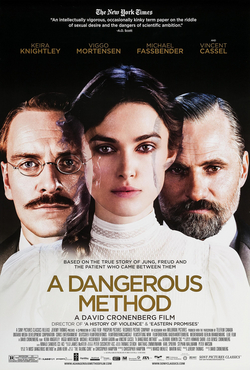
Set in the early 1900s, A Dangerous Method begins with a relatively young C.G. Jung (Fassbender) studying Sabina Spielrein (Knightley), a patient suffering from hysteria. Over time, Jung and Sabina move from the doctor-patient relationship to that of lovers. Already a relationship set up for disaster, it is further taut by Jung’s marriage with children on the way and Spielrein’s sporadic healing and studying to become a psychiatrist herself but not necessarily always embracing Jung’s methods.

Concurrent with all this drama, Jung is also developing – and struggling in – a relationship with renown psychoanalyst Sigmund Freud (Mortensen). Freud clearly wants to pass the mantle down to the younger doctor, but Jung does not buy all the emphasis Freud puts on sexuality as the base of so many psychological problems. Freud, meanwhile, begins to mistrust Jung’s interest in mysticism.

Some time back, I had seen one trailer for A Dangerous Method, didn’t think much of it either way, and then never heard anything about it again. That is, until on a recent flight home from vacation when it was an option to watch. There wasn’t anything else that sounded even remotely appealing on the plane’s menu, and the psychological aspect of this film intrigued me, having once been a psychology major.

That being said, I was a bit disappointed with the film from a psychological angle. The story between Freud and Jung did seem to be grounded in fact (i.e., Jung was indeed doubtful about Freud’s obsession with the sexual aspects of psychoanalysis and was critical of Freud for refusing to ever be analyzed himself), and I noted somewhere in the credits that the film referenced actual letters between the psychoanalysts where possible. In addition, the film is based on a play, which is in turn based on a nonfiction book, so somebody did their homework somewhere along the line. I knew nothing about Sabina before this film, despite having studied about both Freud and Jung in numerous classes, so her character was a welcome introduction, which allows me to do some more research on her on my own. However, I felt like the movie did not explain her psychological problems in depth and very much glossed over her (somewhat spotty) recovery. This included quickly brushing over Jung’s psychoanalytic methods, which had seemed to me to be at the heart of the film’s premise as I understood it going into the movie (not so much, it would appear).

Part of this may be due to the disjointed nature of the film. Frequently, several years would pass by from one scene to the next. I found this very disorienting, particularly with a character like Sabina who could go from stark raving mad in one scene to a perfectly polished young lady in the next. (It is possible that some of this may be due to the airline’s formatting and editing of the film, although I should point out I watched Sherlock Holmes: A Game of Shadows on the same airline a week earlier and didn’t note any appreciable differences between the airline’s version and the one I had seen in theaters. Also, I doubt the airline would remove any substantive scenes, although it is possible that they removed/limited some of the sex scenes from this particular title.) These jumps made it difficult to really ever feel like the movie was telling a logical story or for me as the viewer to become fully immersed in the story. That is not to say that I didn’t find the movie engrossing, it’s just that it never took away the feeling that this was a movie. Does that make sense? What I’m trying to say is that the movie was indeed riveting, but it didn’t sweep me up so fully in its world that I forgot I was watching something purposely built up to be viewed by outsiders, namely moviegoers.

It is also possible that other viewers got the exact opposite feeling – perhaps there was too much psychoanalytic history and terminology for a lay audience. (One reviewer refers to it as being full of “shop talk.”) Having studied psychology in an academic setting for more than four years and on my own for even longer, I can’t really say at this point. To me, it could have delved much further into the psychoanalytic methods used by Freud and Jung, but then again, I could see how this could alienate many viewers.

The movie ended on a peculiar note, which is about as much as I’m going to say on that so I don’t give anything away. I felt very much like I have at the end of some other quirky, independent movies (i.e., Lost in Translation) where I’m not really sure what to make of the ending or indeed anything that came before it. As I alluded to earlier, there wasn’t really an overarching story throughout that would culminate in a conclusion of some sort, so it just sort of felt more like it ended because two hours had passed. Like with many biopic or historical films, the viewer is given a brief synopsis of what happened to these characters later in life. Sabina’s life story ended so tragically as to leave a distinctly odd and futile feeling to the whole film.

A high note of the film was the superb acting by all, but particularly by Fassbender and Knightley. I’ve yet to see Fassbender disappoint in any role, and he plays the complicated Jung well and with nuance. Knightley throws her all into playing the insanity stricken young Sabina and then transforms perfectly into the studious, well-mannered older Sabina. Her Russian accent is perhaps not pitch perfect, but it suffices (and is more than either Fassbender or Mortensen put into their roles, as oddly enough they both do not attempt at an accent). The settings were sumptuous, the score is haunting and an absolutely perfect fit, and the cinematography was excellent. But none of this makes up for a plot that felt a bit watery. I might recommend A Dangerous Method to a handful of people that I think would enjoy this type of movie more than most, but I’m not leaping over the moon about it. I'm still kind of scratching my head about it, trying to figure out what to make of the film.

Saturday, March 31, 2012

Fighting for Survival: The Hunger Games


Hello blogger friends! I know it’s been some time since I’ve updated last, but I haven’t forgotten about you!! The past month or so I’ve been so caught up with work that I’ve hardly had any time to do anything arts and entertainment related, let alone have time to write about it. But I’m now back and hoping to backtrack to some of the things that have happened in the past month. I’m starting with the most recent in the hopes that it will be the most relevant.

With that, it’s time to talk about The Hunger Games! Yes, those Hunger Games that have dominated all the pop culture channels lately. I read the first book back in my YA lit course for grad school and, like most of my classmates, moved on to the second book as quickly as possible … and then sadly had to wait for the third book to be released! Once it was out, I devoured that book as well. All that being said though, I had some concerns about the books, and I was fairly apprehensive when I heard that a movie version was in the works. A movie seemed to me the worse idea for this concept – it would be too violent and too much like the reality show known as the Hunger Games that the books are criticizing.

But when the movie’s trailer came out, it seemed like it was going to be fairly good adaptation of the book. However, the trailer ended the story right at the part where Katniss is entering the arena, so my fears about all the gore to follow were still not assuaged. Soon the movie was getting all kinds of buzz (mostly good; for instance, this article with the sub-head of “Just go see it.”) and knowing that the author had been on board as a screenwriter also was a plus. So when a friend asked if I wanted to see the movie on opening weekend, I decided to go for it and hope for the best.

[Please be aware that in discussing the film, I will reveal some spoilers. If you haven’t read the books and/or seen the film yet and you want to go in without having anything given away, you’ll want to stop here and come back later.]

Overall, it was a fairly decent adaptation of a book, although our little group of movie-goers felt that if we hadn’t read the book beforehand, we might have missed out on a lot of the underlying story. Since it was such a concern of mine going in, it’s worth noting early on that the movie dealt with the violence well – it was not too gory like I feared but it still got across the idea that this was a bloodbath and not something we’d want to emulate. For instance, the opening scene in the arena was shot in quick sequences that showed there knife fights going on along with some accompanying blood, but mostly it cut from one fight to the next so quickly that you didn’t get too much up close and grisly details. (To be honest, it was better than a lot of episodes of Criminal Minds actually, and I’d like to point out to that show’s producers/writers that this movie is a perfect example of how you can get the creepy point across without being overly explicit. As much as I like that show for its characters and psychology, they can be totally over the top in the amount of blood and gore they feel the need to display. Side rant now done; proceed on to The Hunger Games review continued.)

Likewise, the movie started out with a number of quick shots, trying to tell visually and succinctly that District 12 was a poor, starving town. I think it got that point across, especially in contrast with the later scenes in the Capitol. Still, as I mentioned above, even in a two and an half hour long movie, there was still so much left out and left unsaid. For instance, Madge doesn’t give Katniss the mockingjay pin; instead it’s just some little trinket that Katniss picks up. Even though this seems like a small change, this is huge in my opinion because it changes the symbolism, and as anyone who has read all three of the books already knows, the mockingjay increasingly becomes an important symbol to Katniss and the rest of the districts. Another significant change is that when Gale says he and Katniss should make a run for it and live in the woods, it’s after they’ve seen the hovercraft but, unlike in the book, they do not see the capture of the people that the craft is chasing. For people who haven’t read the book, I would imagine they are thinking at the moment, why don’t Gale and Katniss just head for the hills then? I also didn’t think it was as obvious to non-readers that putting one’s name into the Reaping lottery multiple times meant more food or that winners of the Hunger Games not only live but are set for life then with food and shelter. It’s also unclear that Peeta’s action of throwing bread to Katniss was while she was starving to death and was the turn-around point in her life when she pulled herself together to start providing for her family. Again, this is a huge deal because, as Katniss explicitly says in the book, Peeta being a tribute along with her is probably her worse-case scenario (other than Gale being the male tribute). In fact, there was so much back story that could not be included in the movie that our whole little group felt that one entire movie could have been made of everything leading up to the arena, and the movie could ended there like the trailer did. We concluded that we would have all preferred a miniseries that would have allowed for much more detail.

When we get to the Capitol and the preparation for the games, there were again some really great visuals. There was one particularly haunting scene (an addition to the movie, not to be found in the book) where Haymitch watches a family in the Capitol – a young boy has just received a sword as a present from his parents and is chasing his sister around with it. It’s such a revealing glimpse into the mindset of the people of the Capitol for whom this death match really is just a game where they get to root for their favorites and then go home with no blood on their hands. Other great visuals include the fashion choices of the Capitol citizens, especially the nearly unrecognizable Elizabeth Banks as Effie Trinket, which really makes you think about the absurdities of what we consider beauty. Obviously we don’t consider the Capitol’s “crazy” hairstyles and fashion choices our beauty, but stepping back objectively, the plastic surgeries and every else we do to change our natural states (i.e., plucking eyebrows, shaving legs, straightening or curling hair, applying makeup, wearing heels, etc.) must look crazy and absurd to an outsider. On that note, Katniss while in District 12 looks too clean and put together for a girl on the brink of poverty who spends her days in the woods hunting animals to feed herself and her family. It would make more sense when they prepared Katniss for the games by plucking her eyebrows and washing her skin and waxing her legs if her eyebrows weren’t already perfectly tweezed and her skin already glowing and her legs already bare. Sometimes Hollywood is so obsessed with showing ideal bodies that they can’t even give a less-than-perfect “before” for their make-over roles. Not giving any voice-overs to Katniss during this time (unlike the book where we are privy to all of her thoughts), I think viewer also misses out on how this is a critique of the celebrity image. Of course, I also thought the books could have been more explicit at times with this critique because sometimes it came across more as Katniss suddenly becoming a girly girl who felt like detailing every item in her new-found wardrobe.

The time in the arena itself seems to go pretty fast. While this makes sense in many respects (time constraints particularly, but also trying to downplay some of the gore so that the movie could still attract its core YA audience with a PG-13 rating), I think it undermines the point that is like a war for the teens who go into the games. It is not a blitz that comes and ends quickly; it is a long and trying, not to mention, traumatizing event that even the winners cannot come out of unscathed, physically or emotionally. As one person in our group put it, “There was no hunger in the Hunger Games.” This was true; unlike in the book, where Katniss isn’t just battling her fellow contestants but also starvation and dehydration, the movie version has Katniss finding food and water pretty easily. If I recall correctly, in the book weeks go by within the arena whereas in the movie it seemed only like four or five days.

The ending of the movie was a bit odd to me also. It puts less of a point on the danger that Katniss and Peeta are now in and that they have to keep up the “show” if they intend to keep alive. President Snow’s comments to Katniss are by no means as threatening as they could be and, unlike in the book, Peeta and Katniss seem blissfully unaware of any trouble on the horizon and are smiling happy together instead of an angry Peeta realizing that he was being used by Katniss in the arena. While movie series are always trying to leave a hook to pull the reader into the next movie, I was surprised that this movie did not take the bait that was left there by the book of uprisings in the districts and etc. to pull viewers back for the next one. A somewhat recent Slate article wonders how the third book will play out on the big screen; I’m more concerned about how the second one will as that was the weakest link in my opinion. And this first movie surprisingly left no clues as to how that one will play out.

All and all though, I was pleased with the movie, given the limitations of transferring a story from the medium of a book to the medium of film. So much of the book is in Katniss’s head that it’s hard to really get that to film, especially when the filmmakers decide to not have any voiceovers. Jennifer Lawrence as Katniss is very good at expressing things without it being said, but still there’s much that left missing, and sometimes this leads to far too many close-ups of her face, especially in the beginning of the movie. Showing some other points of view helps to elucidate at times, especially when the gamemakers or Cesar step up to explain something. Some of the scenes between President Snow and Seneca Crane, however, just felt like too much. Considering all the parts that had to be sacrificed due to time limitations, I would have rather not had these scenes in their place. While I can no longer find where I read this, I also heard one critic rail that the movie made President Snow out to be “the” villain instead one of many complicit in this society, and I could see how these scenes would add fuel to that fire.

There were also some very emotional and touching scenes in the movie, like when Prim is called but Katniss volunteers or when Rue dies, both of which brought tears to my eyes. The young actors playing these characters were both great in their roles, as was nearly all of the rest of the actors in the movie. Woody Harrelson as Haymitch was the only exception. He was too much the caricature of the drunk in his first scene but then somehow after that he seems to have it all together. He’s really not the bitter and broken man that he is in the books – someone who has been ravaged by his time in the arena. I’ve mentioned it before but I think there can’t be too fine a point on that idea: Even when someone wins The Hunger Games, they are damaged by it. Like a solider, they suffer from PTSD and are never the same again. Again, I can’t remember where, but I recall reading that the Haymitch character was cleaned up somewhat for the movie to be more fitting for a YA audience, but I think it’s a disservice to the character and the themes of the story.

In terms of casting, I had a little concern about the diversity. No, I’m not saying that having an-all Caucasian cast was what I had in mind and having any black characters somehow ruined the movie, like a bunch of ignorant people have said. Quite the opposite – there were no Latino actors as far as I could see and there was only one character was possibly Asian. There was definitely some attempt to make sure some black actors were in the movie, but the choices seemed odd. For instance, when cutting to the scene of the uprising in District 11 after Rue’s death (one of those great moments in the movie when you get to know more than Katniss; she doesn’t find out about that uprising until the second book), we see that most of the people in the crowd there are black. It just seemed a poor choice (and fulfilling too many tired stereotypes that black people are more violent than other racial groups) to show a riot being largely conducted by black people against the dressed-all-in-white peacekeepers. Likewise, in the Capitol, it seems like the audience is largely white while the more servant-like roles (i.e., both Katniss’s and Peeta’s designers) are black, another old stereotypical movie role of the “mammy” character. It seems that the dystopian future is still stuck in a lot of old racial stereotypes. It’s not like any of us want to go live in Panem, with its yearly gruesome festival of sacrificing teenagers, but it’s not encouraging to find that even when looking forward to the future, we can’t imagine a world with a different view toward innate skin colors.
All that being said, I mostly agree with my friend who came away from the movie still feeling like she'd still recommend The Hunger Games books to many but was less sure about recommending the movie. I think I'd recommend the movie only to readers of the book, mostly for comparison purposes, but I'd tell non-readers that they absolutely had to read the book before even considering taking a trip to their local movie theater.