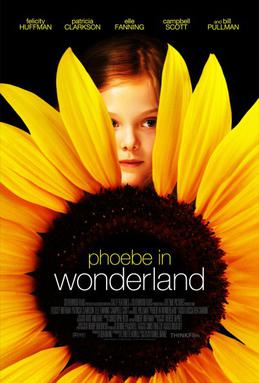
Some of you may know that I have a slight obsession with all things Alice in Wonderland, so when my cousin proposed that we watch the movie Phoebe in Wonderland, I was happy to comply. (I had been meaning to get around to it anyway, so this was as good a time as any.)
Phoebe in Wonderland is about a 9-year-old girl (the titular Phoebe) who is an outcast at her rigid, rule-bound school but feels things might change with the addition of Miss Dodger, a quirky new drama teacher who encourages everyone to sign up for the school play, Alice in Wonderland. After much debate, Phoebe signs up for auditions and wins the role of Alice. While all seems to be going well on the theater front, all is clearly not well with Phoebe at school and at home. She suffers from a severely debilitating case of OCD (her hands are raw from obsessive hand-washing and her knees are scrapped up from jumping up and down the stairs in a specific pattern instead of merely descending), she confesses she cannot help but say or do certain things, and she is having hallucinations (all of which are wrapped up in the Alice storyline in some way). Despite all this evidence, however, her mother Hillary is insistent that Phoebe is just a regular child and does not have any kind of disorder.
This film was very different from what I expected from the brief blurbs given about it. My thoughts were that the movie would be a quirky surrealistic film about a young girl's imagination. Instead, it was a dramatic look at a neurodevelopmental disorder and its effects not just on the sufferer but her family as well. Indeed, the movie belonged more to Hillary than Phoebe, even if Phoebe is the one on screen more. The movie's story arc is more about Hillary's coming to terms with the idea that her daughter is not just a typical child and finding the help she needs to cope with her disorder and still be herself. Some of the most poignant scenes in the film belong to her, such as when the psychiatrist Hillary hires first tells his diagnosis and she refuses to believe it outwardly, ranting about how doctors just want to prescribe medication instead of letting kids be kids while the tears on her distorted face indicate that on a deeper level, she knows he is right. Another powerful scene comes when her husband tries to apologize for an earlier insensitive remark and Hillary responds with a whole list of things that frustrate her, including her inability to understand what is wrong with her daughter or how to help her. Still another emotional scene occurs when Hillary goes to comfort a scared Phoebe waking up from a nightmare; Hillary notices Phoebe's battered knees and both mother and daughter cry for different reasons. There are plenty of other such scenes of Hillary's struggle with mothering a special needs child as well as her other daughter who sometimes wishes that she had another sibling that she didn't have to take care of and explain away her actions to others, despite being the younger one.
In addition to these deep scenes and themes, there are a number of other messages underlying in this movie. There's the power of art as a redemptive force, as seen in the play's ability to largely subsume Phoebe's symptoms. Likewise, theater - and especially Miss Dodger - encourages the school's children to be who they are and learn how to direct their own paths. Fitting in or rather, not fitting in, is a recurring element in the movie. It is not just Phoebe and her lack of friendships with most of her peers. There's her one and only true friend at school, Jamie, a young boy who happily plays with dolls and hopes for the role of the Queen of Hearts in the upcoming school musical. And, it's also her younger sister, who is wise beyond her years and dresses up as Karl Marx for Halloween, goes on a hunger strike when she learns their dinner was not made with cage-free poultry, and worries that at 7 years old she has not produced as much as the 6-year-old Mozart did.
There's some brilliant acting throughout the film, especially by young Elle Fanning as Phoebe and Felicity Huffman as Hillary. Miss Dodger, as played by Patricia Clarkson, was an interesting character as well, with some suspecting that she can relate so well to Phoebe because she, too, has a disorder - quite possibly she has Asperger's syndrome. In addition, the filmography is mostly well done, although there was an occasional scene that was too abrupt or seemed misplaced. Throughout, I found the dialogue to be very quiet while the music soared incredibly loudly, although this is not a problem unique to this movie alone. (It is a continual pet peeve of mine to have be continually changing the volume because filmmakers seem to think that the spoken word should be barely audible but the soundtrack should blast your eardrums off.)
All and all, this is a very interesting movie, but certainly a more serious one that I was expecting. Don't go into this one looking for some light-hearted, quirky fun -- but do go in to it to explore how difficult life could be for a child - and a family - going through the process of suffering from something unknown and finally learning - and making peace with - what this unknown factor is.
Thursday, August 23, 2012
Saturday, August 18, 2012
Examining New Jersey's History at Covenhoven House
On
a lovely, surprisingly cool August day, the Central New
Jersey chapter of the Jane Austen Society of North America
(CNJ-JASNA) met at the historic Covenhoven
House in Freehold for our bi-monthly meeting. We feasted on a potluck
lunch, complete with a surplus of sweet treats, while discussing good books
everyone was reading lately.
Afterwards,
we were treated to a docent-led tour of the house by our very own Jere, who
wore a period dress of her own design and making. We learned a rich history
about this little corner of our state, particularly its role in the
Revolutionary War. And, of course, we learned a great deal about the
Covenhovens, who after becoming flush with money when they inherited $500,
built this grand house in 1752. Being of Dutch descent, the Covenhovens
incorporated Dutch, British, and Roman (then very popular) styles into their
home's architectural design. Their lovely home consists of a large kitchen,
parlor, and downstairs guest room along with three bedrooms upstairs (only two
of which are open to the public). One of these upstairs bedrooms has a unique
aspect, but you'll have to visit to see this wonderful surprise for yourself!
Along the way, Jere explained various aspects of Georgian life in general and
particulars about the Covenhovens' lifestyle.
Bringing things back around to Jane Austen, Jere noted that the house was later owned by an American sea captain who lived there with his family. They were known to entertain and host dances, just like the ones we read about in Austen's novels. The Covenhovens were also known to entertain, but Jane was only a toddler when the Battle of Monmouth was ongoing, at which time the Covenhoven House was seized by General Clinton to become the British headquarters in the area. Again, you must visit the house to hear the story of how the feisty 80-year-old Mrs. Covenhoven fought against the British in her own way!
The
entire CNJ-JASNA group so loved our visit to the Covenhoven House that we have
resolved to spend more time visiting historical
sites in Monmouth County!
(Cross-posted to CNJ-JASNA’s blog)
Friday, July 27, 2012
Bunheads: Swirling Toward Success?
Note: This post contains
some spoilers for the first six episodes so far.
Being a huge fan of the show Gilmore Girls, I was excited when I heard Gilmore Girls writer and producer Amy Sherman-Palladino had a new show coming out. But if the name Bunheads wasn’t enough of a turn-off, the initial trailer did the show no favors. I wrote off the show before it even came out … that is, until I read some of the press about it. In particular, the Entertainment Weekly interview with Bunheads star Sutton Foster piqued my interest in what the show would have to offer, so in the end I checked out the show.
Now is a good time to give a quick summation of the first episode and, with it, the show’s premise. The pilot episode opens up with Las Vegas showgirl Michelle going to try out for a dream dance job and getting immediately rejected without even performing. Back home, her not-so-secret admirer Hubble is hanging around trying to go out with her yet again and this time she acquiesces. In her sorrow and self-pity party on not getting the part (or rather, not even getting the chance to get the part), Michelle gets drunk at dinner and agrees to marry Hubble. The next morning they come home to his quiet town of Paradise, California where Michelle finds Hubble lives with his mother Fanny, who runs the ballet studio on the property and does not take kindly to her new foisted-upon-her daughter-in-law.
To start off with, this initial premise is ridiculous. It’s quite frankly creepy. I know Las Vegas is known as the city where crazy stuff like ill-advised shotgun-type weddings occur, but if it isn’t illegal for a marriage to occur in which one party is drunk while the other is sober, it SHOULD be. That’s just not good for anyone and is to the detriment of society. I can empathizes with Michelle’s feelings of being stuck, of not ending up where you thought you would in life, in seeing dreams of getting out of a rut shot down cavalierly, but I cannot understand her reaction. When I’m feeling particularly low, I veg out and watch some TV, take short road trips out of the state to visit with family and friends, or make small changes like dying my hair for the first time. I don’t think to myself: ‘Oh, I know what will solve all my problems -- get married to some guy I hardly know and get the heck out of Dodge without even bothering to pack a suitcase or inform my job that I’m quitting.’ Absolutely not. There is no reasonable rationale here. This is not 1890 where a woman is dependent on a man to provide for her so she has to just get married already to whoever is available because she’s getting older and he’s the only viable option.
Furthermore, there are plenty of other premises that could get the show started off with Michelle being thrown in the culture shock of small town life. She could be driving home from her disastrous audition and her car breaks down in the small town and she’s stuck there for a few days while it’s being repaired and is wooed by the small town charm into staying there. OR, Michelle and Hubble could *actually* be dating and decide to get married and for whatever reason this is the first time she goes to his house, but at least he’s not a creepy semi-stalker. Or, one of Michelle’s dancer friends could wax poetically about her youth in the small town and her early days of dance at Fanny’s studio, making Michelle decide to go check out the place. Or, Michelle could apply to a job posting to teach at the dance studio. That’s just off the top of my head; there’s potentially tons of alternatives and I can’t believe that a creative genius like Amy Sherman-Palladino couldn’t come up with a premise that was less disturbing.
All that being said, the viewer can manage to somewhat get past the disturbing factor after Hubble has a few nice speeches that make him seem slightly less creepy and a little more endearing. Just as the viewer is started to acclimate to him and think it could be interesting to see the relationship between Hubble and Michelle change and grow, wham! the first episode ends with Hubble’s death. Yep, that’s right, he gets into a car accident and dies. So the whole getting married to Hubble premise is not only ridiculous, it’s also in the end completely unnecessary as the show isn’t going to explore that relationship or be about how love can grow out of a marriage of convenience. (One review I read after being shocked by the pilot episode’s ending suggested that perhaps Hubble was just in coma, which could have been a more interesting twist but alas the writers did not choose that option.)
The second episode ends with a whammy too, with Michelle and Fanny finding out that after the wedding, Hubble immediately got on the phone with his lawyer buddy and made sure to make Michelle a co-owner of everything he had. With Hubble’s death, this now means that Michelle owns Fanny’s home and business, making an already tense relationship all the more awkward and giving Michelle a reason to stay in town after the funeral. It still remains to be seen though if and how Michelle will get more involved in the ballet school besides occasionally popping by and talking to the girls in passing on her way to and from home. Episode five introduces the idea of Michelle teaching at the dance studio by having Fanny bring it up repeatedly while Michelle adamantly refuses to even consider the possibility. In this week’s episode, Fanny runs off for an impromptu vacation, forcing Michelle’s hand into teaching a weekend’s worth of classes. However, we don’t really get to see this happened; we just know that Michelle agrees to do so.
Being a huge fan of the show Gilmore Girls, I was excited when I heard Gilmore Girls writer and producer Amy Sherman-Palladino had a new show coming out. But if the name Bunheads wasn’t enough of a turn-off, the initial trailer did the show no favors. I wrote off the show before it even came out … that is, until I read some of the press about it. In particular, the Entertainment Weekly interview with Bunheads star Sutton Foster piqued my interest in what the show would have to offer, so in the end I checked out the show.
Now is a good time to give a quick summation of the first episode and, with it, the show’s premise. The pilot episode opens up with Las Vegas showgirl Michelle going to try out for a dream dance job and getting immediately rejected without even performing. Back home, her not-so-secret admirer Hubble is hanging around trying to go out with her yet again and this time she acquiesces. In her sorrow and self-pity party on not getting the part (or rather, not even getting the chance to get the part), Michelle gets drunk at dinner and agrees to marry Hubble. The next morning they come home to his quiet town of Paradise, California where Michelle finds Hubble lives with his mother Fanny, who runs the ballet studio on the property and does not take kindly to her new foisted-upon-her daughter-in-law.
To start off with, this initial premise is ridiculous. It’s quite frankly creepy. I know Las Vegas is known as the city where crazy stuff like ill-advised shotgun-type weddings occur, but if it isn’t illegal for a marriage to occur in which one party is drunk while the other is sober, it SHOULD be. That’s just not good for anyone and is to the detriment of society. I can empathizes with Michelle’s feelings of being stuck, of not ending up where you thought you would in life, in seeing dreams of getting out of a rut shot down cavalierly, but I cannot understand her reaction. When I’m feeling particularly low, I veg out and watch some TV, take short road trips out of the state to visit with family and friends, or make small changes like dying my hair for the first time. I don’t think to myself: ‘Oh, I know what will solve all my problems -- get married to some guy I hardly know and get the heck out of Dodge without even bothering to pack a suitcase or inform my job that I’m quitting.’ Absolutely not. There is no reasonable rationale here. This is not 1890 where a woman is dependent on a man to provide for her so she has to just get married already to whoever is available because she’s getting older and he’s the only viable option.
Furthermore, there are plenty of other premises that could get the show started off with Michelle being thrown in the culture shock of small town life. She could be driving home from her disastrous audition and her car breaks down in the small town and she’s stuck there for a few days while it’s being repaired and is wooed by the small town charm into staying there. OR, Michelle and Hubble could *actually* be dating and decide to get married and for whatever reason this is the first time she goes to his house, but at least he’s not a creepy semi-stalker. Or, one of Michelle’s dancer friends could wax poetically about her youth in the small town and her early days of dance at Fanny’s studio, making Michelle decide to go check out the place. Or, Michelle could apply to a job posting to teach at the dance studio. That’s just off the top of my head; there’s potentially tons of alternatives and I can’t believe that a creative genius like Amy Sherman-Palladino couldn’t come up with a premise that was less disturbing.
All that being said, the viewer can manage to somewhat get past the disturbing factor after Hubble has a few nice speeches that make him seem slightly less creepy and a little more endearing. Just as the viewer is started to acclimate to him and think it could be interesting to see the relationship between Hubble and Michelle change and grow, wham! the first episode ends with Hubble’s death. Yep, that’s right, he gets into a car accident and dies. So the whole getting married to Hubble premise is not only ridiculous, it’s also in the end completely unnecessary as the show isn’t going to explore that relationship or be about how love can grow out of a marriage of convenience. (One review I read after being shocked by the pilot episode’s ending suggested that perhaps Hubble was just in coma, which could have been a more interesting twist but alas the writers did not choose that option.)
The second episode ends with a whammy too, with Michelle and Fanny finding out that after the wedding, Hubble immediately got on the phone with his lawyer buddy and made sure to make Michelle a co-owner of everything he had. With Hubble’s death, this now means that Michelle owns Fanny’s home and business, making an already tense relationship all the more awkward and giving Michelle a reason to stay in town after the funeral. It still remains to be seen though if and how Michelle will get more involved in the ballet school besides occasionally popping by and talking to the girls in passing on her way to and from home. Episode five introduces the idea of Michelle teaching at the dance studio by having Fanny bring it up repeatedly while Michelle adamantly refuses to even consider the possibility. In this week’s episode, Fanny runs off for an impromptu vacation, forcing Michelle’s hand into teaching a weekend’s worth of classes. However, we don’t really get to see this happened; we just know that Michelle agrees to do so.
In
the comments section of early reviews, some speculated that the scene in which
Michelle and Hubble had sex upstairs during their wedding reception party was a
set up for later announcing that Michelle is pregnant, but there’s been no
evidence yet that the show is going to go in the direction; rather that fact is
just something nosy neighbors throw up in Michelle’s face, particularly when
people first meet her - ‘oh you’re the sex at the party girl’ is a refrain
repeated throughout the early episodes.
There’s
little but some inclination that the show is looking to set up a love interest
for Michelle (for instance, there was the introduction of Grant, the fellow who
lives in the private house on the hill), which is probably a good idea now that
there’s no Hubble-Michelle relationship to explore and will probably add
another level of tension to the Michelle-Fanny dynamic as I doubt Fanny would
be happy to find her daughter-in-law moving on so quickly (even if
intellectually acknowledging that there isn’t much for Michelle to move on from
as she was only married a day or two. However, Hubble is hardly ever talked about
after the second episode; even his mother and Truly, his overly devoted ex-girlfriend,
seem to have forgotten about him quickly.)
Whether
or not there’s a romance brewing for Michelle, the show is certainly interested
in exploring her options and her relationships. There have been a few moments
where Michelle contemplates what to do next and what her life is now. Besides
her tense relationship with Fanny and her chatty but ultimately superficial one
with the girls from the dance studio, Michelle and Truly have awkward
interactions that seem to be trending toward a growing friendship between the
two. With Truly being one of my favorite characters on the show, I’d love to
see more of this.
Speaking
of characters beyond the main ones, Paradise (like Stars Hollow in Gilmore Girls) is full of quirky locals
who do such odd things as refuse to put up a sign about a private road but
expect everyone to know that it’s a private road. Besides Truly, however, none
of these characters really stand out as of now. Most of them have only been
given a short scene or two to play and even these are few and far between. I
suspect that we will see more of the locals over time, but right now we have
valuable talent such as Ellen Greene (Aunt Vivian in Pushing
Daisies) and Rose Abdoo (Gypsy on Gilmore
Girls) wasted in characters that are hardly given a handful of lines.
Back
to the main characters, the four girls from the ballet school that the show is
focusing on are still not entirely fleshed out as characters, but it seems like
we are getting more and more of that with each episode. There’s Boo, the
insecure girl who worries that she doesn’t have the ballerina “look” and
secretly crushes on her friend’s brother but is also sweet and full of empathy
for those around her. Then there’s Sasha, the mean girl of the group who seems
to have it all on the surface, including the perfect ballerina look and technique
but has a less than ideal home life with parents too angry at each other to
notice anything she does. The other two girls, Melanie and Ginny, are pretty
nondescript right now, although Ginny strikes me as the fulfilling vapid
airhead trope (similar to Madeline on Gilmore
Girls, while Melanie isn’t far off from being Louise to round out the rest
of that dynamic duo). Some reviewers pointing out the similarities between Gilmore Girls and this show note that
Sasha is a stand-in for the Rory character. Here I have to disagree. Yes, the
actor looks somewhat like Alexis Bledel, but the character is completely
different. She has a lot of meanness and spite while Rory had been all sugar
and spice. Her character is more akin to Paris Geller -- she's starts off as cruel but there's hope for some redemption as the series continues. Nor do we see shades of Rory in Boo as she is too insecure and
worried to be a Rory stand-in. For the most part, the girls’ characters (the
little we have seen so far) don’t seem terribly different from the stock of any
standard show on the host network, ABC Family. If the show were only about them,
I would have cut and run already.
Although
I’ve touched on it a bit already, it’s now time to address the elephant in the
room: In many ways, Bunheads is like Gilmore Girls but not. The similarities
between the two shows include:
- Again,
we are introduced to a very small
town with a host of colorful characters and quirky scenarios. However, like with Gilmore Girls, the show suffers from a
lack of diversity despite this large cast of characters. In particular, the
main cast is pretty homogenous, as pointed
out by fellow TV show creator Shonda Rhimes.
-
The same actors are called upon to play new roles: the aforementioned Rose
Abdoo, a cameo from Biff Yeager (Tom the contractor), Gregg Henry (Mitchum
Huntzberger) has popped up repeatedly as Rico, Chris Eigeman (Jason Stiles) and
Todd Lowe (Zach) are reportedly
going to guest star in the future, and most notable of all, Kelly Bishop (Emily
Gilmore) as Fanny.
-
In many ways, Fanny is a similar character to Emily. While she may appear
slightly more carefree as a Buddhist who collects tacky oddities to clutter her
home with rather than the snooty, old money DAR member, Kelly Bishop is still
playing a woman who is very controlling and wants things done her way or the
highway and is apt to overreact and lash out at others when things don’t go as
planned as a result. The most recent episode also points out how she can be
manipulative when need be to get her plans to work out.
-
Sutton Foster as Michelle even looks a bit like Lauren Graham as Lorelei (pretty,
tall, trim, with long dark brown hair). However, she’s not the same caliber of
actor as Lauren Graham, although I feel that’s improving somewhat. The first
episode in particular felt very much like she was over-acting with her big
reactions instead of subtle ones. It reminded me of Maureen O’Hara’s memoir describing
her move from the stage to the silver screen; O’Hara noted how you act for the
back row on stage while you act for the front row on the screen.
-
There’s even one scene in an early episode where Michelle walks into a small
bar/restaurant and the proprietor, Rico, is wiping down the counter and sharing
in her woes in a very Lorelei-Luke way, except that Rico has some years on
Michelle and is already married. Also, Michelle imbibes alcohol the way Lorelei
guzzled coffee.
-
We are treated to what is now considered Amy Sherman-Palladino’s “trademark”
style of dialogue: fast-talking quips packed full of witty pop culture
references. The show even calls attention to this in the pilot when an angry
Fanny lashes out at Michelle and complains, "Oh my God, the quips, the chatter. Don't you ever just shut up?" Still,
there haven’t yet been any great memorable lines like in Gilmore Girls’ “To me, you are the teacher in the Charlie Brown
cartoon” or “Oy
with the poodles already!” or any other number of fun quips.
-
Sam Phillips is once again on the helm for musical interludes, so we hear a
very similar “la la” type score for scene transitions.
–
Likewise, Helen Pai returns as producer again, although I’m not sure that we
necessarily see her influence in such obvious ways.
-
Even the font used for the credits is the same (or if not, virtually the same)
as the one used for Gilmore Girls!
All
and all, there are enough similarities between the two shows that if anyone
other than Amy Sherman-Palladino had been involved in this show, there would
likely be cries of foul play in the copyright arena. As one
reviewer put it, it’s as though Sherman-Palladino presented this show’s
concept with the comment of: "Here is this thing everybody loved once upon a time, wrapped in a
slightly different package.” This same reviewer also summed up some of my
feelings by writing of the two shows’ similarities that “it's close enough to
be reassuring — and, on occasion, distracting.”
Of course, there are some notable differences between the two shows as well. Most obviously, dance plays a much larger part in Bunheads and we get to see at least part of a ballet or other dance routine every week, unlike in Gilmore Girls where we only occasionally caught a glimpse of classes or performances at Miss Patty's. Bunheads does not examine family relations with the same intensity as Gilmore Girls, let alone generations of familial relationships. On the other hand, body image is a recurring theme as Boo, who is by no means large but isn't the stereotypical ballerina stick figure, is constantly worried about her size and her eating habits. And while Lorelei and Rory were very driven characters who knew exactly what they wanted out of life and (merely) had to overcome obstacles to their goals, Michelle is a lost and floundering character who is still examining her life choices and wondering what to do with herself. Instead of roadblocks to try to circumnavigate, Michelle is given opportunities and possessions that she doesn't know what to do with and only add to her confusion about what to do next. In some ways, this (along with the tragedy of Hubble's untimely death) creates a show that reflects a sadder world, one in which a person with even the best of starts and educations can still end up feeling unfulfilled and confused, not to mention lonely.
It might sound like I don’t like the show, and to be honest, I’m not really sure yet how I feel about it. Yet I keep watching it each week and was disappointed the week of July 4th when it was on temporary hiatus. With each week, it seems to grow on me a little more. Like my college statistics professor repeatedly lectured, “If you can’t be with the one you love, love the one you’re with” (somehow this was math related). Without any new Gilmore Girls episodes to watch, I’ll keep settling with this show for now.
Of course, there are some notable differences between the two shows as well. Most obviously, dance plays a much larger part in Bunheads and we get to see at least part of a ballet or other dance routine every week, unlike in Gilmore Girls where we only occasionally caught a glimpse of classes or performances at Miss Patty's. Bunheads does not examine family relations with the same intensity as Gilmore Girls, let alone generations of familial relationships. On the other hand, body image is a recurring theme as Boo, who is by no means large but isn't the stereotypical ballerina stick figure, is constantly worried about her size and her eating habits. And while Lorelei and Rory were very driven characters who knew exactly what they wanted out of life and (merely) had to overcome obstacles to their goals, Michelle is a lost and floundering character who is still examining her life choices and wondering what to do with herself. Instead of roadblocks to try to circumnavigate, Michelle is given opportunities and possessions that she doesn't know what to do with and only add to her confusion about what to do next. In some ways, this (along with the tragedy of Hubble's untimely death) creates a show that reflects a sadder world, one in which a person with even the best of starts and educations can still end up feeling unfulfilled and confused, not to mention lonely.
It might sound like I don’t like the show, and to be honest, I’m not really sure yet how I feel about it. Yet I keep watching it each week and was disappointed the week of July 4th when it was on temporary hiatus. With each week, it seems to grow on me a little more. Like my college statistics professor repeatedly lectured, “If you can’t be with the one you love, love the one you’re with” (somehow this was math related). Without any new Gilmore Girls episodes to watch, I’ll keep settling with this show for now.
Thursday, July 5, 2012
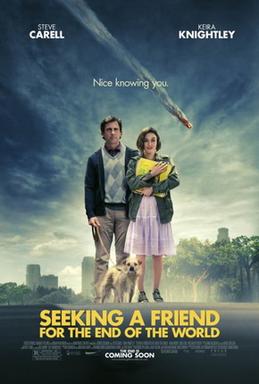
An Adventure Worthy of the Apocalypse: Seeking a Friend for the End of the World
Usually I’m far behind the curve on watching the movies I
want to see (for example, I only recently saw
a movie I wanted to see back in 2004!), so surprisingly I can actually
write about a somewhat recent release. This evening I got the pleasure of
viewing Seeking a Friend for the End of
the World while it’s still out in theaters.
Seeking a Friend for
the End of the World is set in the real-world of today across three states (New York, New Jersey, and
Delaware). There’s
only one twist – in this world, an asteroid is set to hit Earth in a few weeks
and the last hope for stopping it has just failed massively. With this news in
mind, Linda literally walks out on her husband Dodge (Steve Carell) without
another word. Not sure what to do with the rest of his days on Earth, Dodge dutifully
goes to work and then aimlessly sits about his apartment. That is, until he
finds his neighbor Penny (Keira Knightley) weeping outside his window on the
shared fire escape one night. When rioters begin taking to the streets and inciting
violence outside their apartment building, Dodge grabs his newly acquired dog,
Sorry, and Penny to escape. Once on the road, they decide to search for Dodge’s
ex-girlfriend Olivia and various adventures occur along the way.
I was intrigued by the concept of Seeking a Friend for the End of the World when I began seeing
previews for it and further enticed when Keira Knightley came on Late Night
with Jimmy Fallon to promote
the movie. I’ve generally liked Keira Knightley in the various roles she’s
played in the past, and I’ve been entertained by Steve Carell in the few movies
I’ve seen him in, so I thought this would be a good bet.
Setting a comedy amongst the despair and chaos that is the
last few weeks of humanity is a bold move, but one that pays off in my opinion.
There’s definitely a lot of humor in this movie – especially a lot of dark
humor, given the nature of the situation the characters find themselves in. People’s
reactions to the end of the world vary from the tragic (suicides) to the wild
(parties that turn into drug-induced orgies) to the survivalist (an underground
bunker outfitted with up to six months of gear). No matter what route people take
though, this movie finds a way poke fun at it and still somehow get a chuckle
out of the absurdity of the situation. The movie is also packed with some
situational comedy, running jokes, and snappy quips, all contributing to the
comedic effect. (One of my favorite quips was about how hybrid cars still need
gas to run.)
Some of the comedy also comes from the very disparate character traits of Dodge and Penny. Dodge is a straight-laced insurance salesman and a very by-the-books kind of guy in every aspect of his life, who (despite his assertion otherwise) is very sympathetic and caring towards just about every living thing around him. Penny is more of a free spirit, who "dabbles" for a living and tries to sweet talk her way out of traffic violations. She is constantly moving from relationship to relationship, suffers from hypersomnia so smokes weed to supposedly combat it, and is apparently always running late for everything. Throwing these two characters together would make any movie funny, but adding in the road trip from hell against the backdrop of the end of days is comedy gold.
While certainly amusing, these characters also felt a bit too much like typical movie tropes - the ho-hum everyman character we've seen often (i.e., Steve Carell in Dan in Real Life or Will Ferrell in Stranger than Fiction) and the quirky but ultimately charming woman who gives him a new perspective (i.e., Maggie Gyllenhaal in Stranger than Fiction or Zooey Deschanel in just about everything she's ever been in). All that needs updating is some basic facts of Everyman's background (never married, divorced, or widowed?) and swapping out one quirk for another for the vivacious lady. For Penny, her major quirks include collecting vinyl records and saving up piles of her neighbors' mail that mistakenly end up in her inbox instead of handing them over.
Some of the comedy also comes from the very disparate character traits of Dodge and Penny. Dodge is a straight-laced insurance salesman and a very by-the-books kind of guy in every aspect of his life, who (despite his assertion otherwise) is very sympathetic and caring towards just about every living thing around him. Penny is more of a free spirit, who "dabbles" for a living and tries to sweet talk her way out of traffic violations. She is constantly moving from relationship to relationship, suffers from hypersomnia so smokes weed to supposedly combat it, and is apparently always running late for everything. Throwing these two characters together would make any movie funny, but adding in the road trip from hell against the backdrop of the end of days is comedy gold.
While certainly amusing, these characters also felt a bit too much like typical movie tropes - the ho-hum everyman character we've seen often (i.e., Steve Carell in Dan in Real Life or Will Ferrell in Stranger than Fiction) and the quirky but ultimately charming woman who gives him a new perspective (i.e., Maggie Gyllenhaal in Stranger than Fiction or Zooey Deschanel in just about everything she's ever been in). All that needs updating is some basic facts of Everyman's background (never married, divorced, or widowed?) and swapping out one quirk for another for the vivacious lady. For Penny, her major quirks include collecting vinyl records and saving up piles of her neighbors' mail that mistakenly end up in her inbox instead of handing them over.
Despite all the comedic scenes, I was also surprised (and perhaps shouldn’t have
been considering the premise) to find a lot of endearing and touching moments scattered
throughout the movie, especially as the doomsday clock ticked nearer to its end.
Without being too heavy-handed or preachy, the movie definitely had moments that give the viewer pause to chew some food for thought and consider what's important in their lives. For instance, at one point, Dodge and Penny discuss what they will miss and what they will not miss about life, thereby also subtly tasking the viewers to do the same and contemplate what they would prioritize if the world were to end in a few weeks' time. In addition, there's a fair amount of romantic leanings to the plot, which for the most
part stayed away from becoming overly cheesy. In many ways, this movie defies
easy categorization because it borrows elements from so many different genres.
Indeed, Seeking a
Friend for the End of the World is not your garden variety movie. While
there were a couple of plot points that were predictable, for the most part I
found myself wondering where the movie would go next. This is usually a good
thing, as predictable movies become dull fast and I prefer to be kept on my
toes. Given the bind the writers/creators put themselves in by setting a mostly
humorous movie at the eve of the apocalypse, I kept trying to figure out how
they were going to come up with a satisfying conclusion. I’m not posting any
specific spoilers here, but I will say that the entire movie theater audience
appeared stunned at the ending.
Still, all in all, I found this movie very enjoyable and
would recommend it if you like your humor dark and your movies anything but
standard. The acting was superb, the soundtrack brilliant, and the story unique. What more could you ask for in a movie?
Tuesday, July 3, 2012
Laila’s Birthday: A Celebration of Absurdity?
Laila’s Birthday is a 2008 film set in
Palestine that follows one day in the life of Abu Laila, a former judge who now
drives a taxi cab for a living. This particular day is no ordinary day though –
it is the seventh birthday of his only child, his daughter Laila. All Abu Laila
wants to do is put in a day’s work, pick up a present and cake for his
daughter, and arrive back home by 8 pm. But fate is not on Abu Laila’s side.
After starting his day off with his usual Kafka-esque exercise in absurdity by
visiting the Ministry of Justice in a feeble attempt to bring his judicial
nomination up sooner, Abu Laila’s day gets worse when a customer leaves behind
his cell phone in the taxi cab’s backseat. In a classic turn of “no good deed goes
unpunished,” Abu Laila finds himself getting into all kinds of situations, as
he puts it, in his attempt to return the cell phone to its rightful owner. Will
he be able to make it back home in one piece in time for Laila’s birthday?
I’m not sure now how it is that I heard about Laila’s Birthday, but somehow its existence came into my
knowledge in the past few weeks. I immediately watched the trailer for the movie and
decided I had to watch the whole movie. The trailer seemed to promise a film
filled with absurdly comic scenarios – just the kind of situational comedy that
I find particularly funny. While this is certainly true at many points, the
movie is also profoundly sad at times. Consider Abu Laila’s words when he snaps
at one point and yells out in helpless frustration at the helicopters overhead:
“And you…! Leave us alone!!! Leave us in peace!!! Leave us our breath!!! Leave
us our rest!!! We know you have planes, tanks and very smart missiles. You are the toughest occupiers in the world!!!
But we, we want to live. We want to raise our children. We want to sleep. … We
just want to live. Simply that. Just that.” But the beat marches on, and wars
and occupiers continue to exist the world over, ad infinitum.
As the quote above suggests, the movie is of course laden
with political overtones scattered throughout. No doubt it is difficult to
write and produce a film set in present-day Palestine without doing so. As Abu Laila’s
drives his taxi throughout the city, we hear political news on the radio and see
protestors out in the streets. Some of these political situations are particularly
poignant. For instance, one couple nearly jumps out of Abu Laila’s taxi when
they see a line forming because, they reason, a line must mean someone is
giving away some food or other necessary items. Later, a missile drops across
the street from where Abu Laila is, and the aftermath is chaotic.
On the other hand, one moment that had me chuckle aloud was
when a group of men in the café, eager to condemn what a mess the occupation is
making off their country, argue over whether the military officers they are
watching on a newsreel are Israeli or Palestinian before someone shouts out: “It’s
Iraq. And the army is American.”
Abu Laila’s politics also shine through as the movie
progresses, and he refuses to bring passengers to checkpoints or take riders
who are armed. He is persnickety in other ways also and, as a former judge, is
a stickler for the law. He argues with one passenger about wearing a seat belt
and asks another not to smoke, citing legal foundations for both requests.
As a slice of life kind of movie, we unfortunately don’t get
a lot of Abu Laila’s back story, although we get enough to understand his
frustration and sense of both righteous indignation and helplessness as he
tries to navigate this new life he has. Another serious pitfall, in my opinion,
is that the roles of Abu Laila’s wife and daughter are sidelined. Their
appearances bookend the movie, but they have few lines or compelling characterizations.
Instead, they function as the Victorian model of females as “the light of the
home” – a home where men go to escape the hustle and bustle of the manly world of
business and instead relax in the innocence of this womanly world of
domesticity. This is perhaps somewhat hyperbolic in this particular situation
as we are at least informed that Laila goes to school and his wife goes to
work, although no further details are given about either’s daily routines.
What we do get to see a lot of, however, are city scenes as
Abu Laila is out and about driving his taxi. The various landscapes show us a
beautiful country (occupied territory) that has been battered by numerous
problems, including military occupation and economic hardship, and is worse for
the wear.
Still, despite all the chaos, the movie manages to end on a
somewhat hopeful note, although its final line can also be interpreted as
defeatist. I suppose how you take it all depends on whether you are glass
half-empty or glass half-full kind of person (or what kind of day you’ve had). For
better or worse, the feeling you leave with is that people are people
everywhere, all of us with hopes and concerns that face us each day.
Laila’s Birthday was not a big
blockbuster hit like all the summer movies recently out or on the horizon, but
it’s certainly not a film to be missed. It is an absorbing movie, and you will
be enriched by seeing it.
Monday, July 2, 2012
One Hysterically Funny Person
After my disappointing foray in to Sky Captain and the World of Tomorrow, I decided I needed something both light and surefire to please. I decided to watch Demetri Martin. Person., forgetting that I had already seen this particular Comedy Central special before. Nevertheless, it had been several years since the first time I watched this stand-up routine so some of the jokes felt new and fresh. And, the ones I already remembered were still just at funny!
For those of you who are unfamiliar with Demetri Martin, this New Jersey native is a former writer for The Daily Show with Jon Stewart and Late Night with Conan O'Brien. The comedian also had his own show on Comedy Central called Important Things with Demetri Martin, has had small roles in numerous films including Post Grad, and wrote a hilarious book called This Is A Book. His stand-up comedy style is a mix of deadpan humor, stream-of-consciousness one-liners, and occasional skits. Oftentimes, he props up his jokes with musical accompaniment and a large pad with sketch drawings. He also has a fondness for graphs and palindromes, and clearly displays his intelligence in his choice of jokes and style of humor.
While it's a relatively short special, Demetri Martin. Person. displays most of Martin's signature comedic styles, except the use of palindromes. For an outline of the general structure of the special, visit the Wikipedia page while the quotes page on IMDb gives a sense of the types of jokes you'll hear. If you prefer humor that isn't entirely crass and/or slapstick, there's a good chance you too will find Demetri Martin. Person. hilarious.
For those of you who are unfamiliar with Demetri Martin, this New Jersey native is a former writer for The Daily Show with Jon Stewart and Late Night with Conan O'Brien. The comedian also had his own show on Comedy Central called Important Things with Demetri Martin, has had small roles in numerous films including Post Grad, and wrote a hilarious book called This Is A Book. His stand-up comedy style is a mix of deadpan humor, stream-of-consciousness one-liners, and occasional skits. Oftentimes, he props up his jokes with musical accompaniment and a large pad with sketch drawings. He also has a fondness for graphs and palindromes, and clearly displays his intelligence in his choice of jokes and style of humor.
While it's a relatively short special, Demetri Martin. Person. displays most of Martin's signature comedic styles, except the use of palindromes. For an outline of the general structure of the special, visit the Wikipedia page while the quotes page on IMDb gives a sense of the types of jokes you'll hear. If you prefer humor that isn't entirely crass and/or slapstick, there's a good chance you too will find Demetri Martin. Person. hilarious.
Sky Captain and the Soaring World of CGI
Back in 2004 a new movie was previewed that had the look of a mesh between film noir, old-time sci-fi movies, and comic books. That movie was Sky Captain and the World of Tomorrow, and I was jonesing to see it as I thought that combination of elements seemed awesome. Well, as frequently happens, I don't get around to the things I want to until much later than hoped for and anticipated. It was finally last weekend (yes, in 2012!) that I got around to watching Sky Captain and the World of Tomorrow. And, sadly, it did not live up to my expectations.
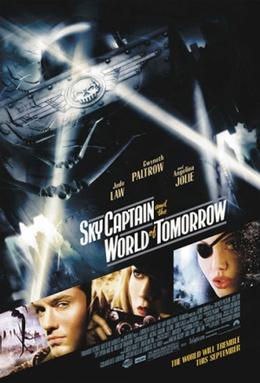
Sky Captain and the World of Tomorrow takes place in an alternate reality 1930s New York. Intrepid reporter Polly Perkins (played by Gwyneth Paltrow) is following up on a story about missing scientists when a group of gigantic robots invades the city, creating havoc. Polly decides to seek help from her daredevil ex-lover Joe Sullivan (Jude Law), also known as "Sky Captain" due to his line of work as a mercenary pilot. The two go a quest to find Dr. Totenkopf, a shadowy figure they know little about but suspect is behind both mysterious events. Along the way, they meet many adventures and call upon the help (and are called upon for help) of friends both new and old, including Franky Cook (Angelina Jolie) -- another ex-lover of Joe's and source of contention between Polly and Joe.
There are so many things wrong with Sky Captain and the World of Tomorrow that I'm not even sure where to begin. The characters lack real three-dimensionality and their back stories are weak. For instance, how and why did Joe become a pilot for hire? What kind of previous escapades had he participated in? What made him famous enough to be called upon in a pinch? How did he derive the nickname "Sky Captain"? When and how did he first meet and become involved with Polly? And so on. The movie does try somewhat in this respect, as there are numerous hints dropped about Joe and Polly's past (and Joe and Franky's past, to a lesser extent) but these are never fleshed out satisfactorily. Good characters are the most crucial part of most (if not all) movies, in my opinion, and I felt like the wonderful cast of actors assembled here was wasted by these one-dimensional characters. Polly felt like a combination of tropes - the stereotypical "girl Friday" meets Lois Lane - while Joe was any generic action film hero. Furthermore, the dialogue between these characters came across as very scripted and nothing memorable comes to mind. That is, except for the final line, which stands out because it is just plain ridiculous.
The plot is thin at best, and the ending (no spoilers) is cliched and anti-climatic. Rather than flesh out characters or plot, the nearly two-hour long movie is instead an almost non-stop action sequence. (I saw Lucasfilm scroll up during the credits, so now you are forewarned about what kind of movie this will be.) And this is not just any action -- it's almost entirely computer-generated action. Worse still, it's not even computer-generated images at its best or even mediocre as it's an absurdly unrealistic style of animation. The ridiculous robots add to the campy feel of the movie, along with the not-so-funny attempts at humor. The sepia color palette adds to the stylized look, but it is too dark a visual to sustain for nearly two hours.
Stylistic is definitely the adjective of choice for this movie. While sometimes this is novel or interesting, it does not make up for the lack of plot or interesting characters and relationships between them. As the USA Today review of the movie put it: "Sky Captain and the World of Tomorrow is all style over substance, a clever parlor trick but a dull movie." While the retro feel and the unique look of the movie is appealing for about 15 minutes or so, this appeal quickly wears off and the viewer is left debating whether or not to even bother continuing to watch the movie through to its end. (It's worth noting that I did keep continuing in the movie's favor with this debate, all the way to the grand finale, and was then regretting that I hadn't turned it off early on.) Another reviewer puts it this way: "Imagine you are in Starbucks and you are ordering a cappuccino, but your server puts the milk in and froths it up and serves it to you, forgetting entirely to put in any coffee. It couldn't be called a 'cappuccino', but it certainly could be called SKY CAPTAIN."
On the plus side, Paltrow and Law valiantly do their best at their roles. (Jolie's role in the movie is so brief as to render me unable to really comment on her acting.) In the hands of lesser actors, this could have been a far worse movie. As I mentioned earlier, the visual style of the movie can be appealing at times and does seem to capture a lot of the 1930s nostalgia, particularly as embodied in the look of Paltrow's character. (This still does not make up for lack of plot though!) An interesting use of technology in this movie is the cameo appearance of Laurence Olivier. Yes, THE Laurence Olivier who was already long-deceased when this movie was produced. With the use of computer programming, the movie was able to generate a brief speech from Olivier based on video and audio available from his heyday. Now that's putting CGI to a good use!
Sky Captain and the World of Tomorrow takes place in an alternate reality 1930s New York. Intrepid reporter Polly Perkins (played by Gwyneth Paltrow) is following up on a story about missing scientists when a group of gigantic robots invades the city, creating havoc. Polly decides to seek help from her daredevil ex-lover Joe Sullivan (Jude Law), also known as "Sky Captain" due to his line of work as a mercenary pilot. The two go a quest to find Dr. Totenkopf, a shadowy figure they know little about but suspect is behind both mysterious events. Along the way, they meet many adventures and call upon the help (and are called upon for help) of friends both new and old, including Franky Cook (Angelina Jolie) -- another ex-lover of Joe's and source of contention between Polly and Joe.
There are so many things wrong with Sky Captain and the World of Tomorrow that I'm not even sure where to begin. The characters lack real three-dimensionality and their back stories are weak. For instance, how and why did Joe become a pilot for hire? What kind of previous escapades had he participated in? What made him famous enough to be called upon in a pinch? How did he derive the nickname "Sky Captain"? When and how did he first meet and become involved with Polly? And so on. The movie does try somewhat in this respect, as there are numerous hints dropped about Joe and Polly's past (and Joe and Franky's past, to a lesser extent) but these are never fleshed out satisfactorily. Good characters are the most crucial part of most (if not all) movies, in my opinion, and I felt like the wonderful cast of actors assembled here was wasted by these one-dimensional characters. Polly felt like a combination of tropes - the stereotypical "girl Friday" meets Lois Lane - while Joe was any generic action film hero. Furthermore, the dialogue between these characters came across as very scripted and nothing memorable comes to mind. That is, except for the final line, which stands out because it is just plain ridiculous.
The plot is thin at best, and the ending (no spoilers) is cliched and anti-climatic. Rather than flesh out characters or plot, the nearly two-hour long movie is instead an almost non-stop action sequence. (I saw Lucasfilm scroll up during the credits, so now you are forewarned about what kind of movie this will be.) And this is not just any action -- it's almost entirely computer-generated action. Worse still, it's not even computer-generated images at its best or even mediocre as it's an absurdly unrealistic style of animation. The ridiculous robots add to the campy feel of the movie, along with the not-so-funny attempts at humor. The sepia color palette adds to the stylized look, but it is too dark a visual to sustain for nearly two hours.
Stylistic is definitely the adjective of choice for this movie. While sometimes this is novel or interesting, it does not make up for the lack of plot or interesting characters and relationships between them. As the USA Today review of the movie put it: "Sky Captain and the World of Tomorrow is all style over substance, a clever parlor trick but a dull movie." While the retro feel and the unique look of the movie is appealing for about 15 minutes or so, this appeal quickly wears off and the viewer is left debating whether or not to even bother continuing to watch the movie through to its end. (It's worth noting that I did keep continuing in the movie's favor with this debate, all the way to the grand finale, and was then regretting that I hadn't turned it off early on.) Another reviewer puts it this way: "Imagine you are in Starbucks and you are ordering a cappuccino, but your server puts the milk in and froths it up and serves it to you, forgetting entirely to put in any coffee. It couldn't be called a 'cappuccino', but it certainly could be called SKY CAPTAIN."
On the plus side, Paltrow and Law valiantly do their best at their roles. (Jolie's role in the movie is so brief as to render me unable to really comment on her acting.) In the hands of lesser actors, this could have been a far worse movie. As I mentioned earlier, the visual style of the movie can be appealing at times and does seem to capture a lot of the 1930s nostalgia, particularly as embodied in the look of Paltrow's character. (This still does not make up for lack of plot though!) An interesting use of technology in this movie is the cameo appearance of Laurence Olivier. Yes, THE Laurence Olivier who was already long-deceased when this movie was produced. With the use of computer programming, the movie was able to generate a brief speech from Olivier based on video and audio available from his heyday. Now that's putting CGI to a good use!
Sunday, July 1, 2012
A Long Day at Longwood Gardens
After having discussed this trip months in advance, a friend and I
finally descended upon Longwood
Gardens this weekend, in
part to view the art installation “Light” currently on display there. Located
in Pennsylvania’s Kennett Square, Longwood Gardens is the former estate of
entrepreneur, philanthropist, and horticulture lover Pierre Samuel du Pont
and his wife (and cousin) Alice Belin du Pont. Now approximately covering 1,200
acreage (with only some of that open to the public), Longwood Gardens came in
to being when du Pont bought 202 acres of land from the Peirce family in order
to save some centuries old trees on the property from being cut for lumber. Of
interest (to me at least) is that the Peirce family had originally bought their
farmland from William Penn himself. There is certainly a great deal of history
behind Longwood Gardens!
After buying that initial tract of land, du Pont set about
saving trees in the arboretum, participating in some “gentleman farming,” and
expanding and improving the gardens, including numerous additions based on his
personal interests and travels. For instance, Longwood sports a beautiful and
elaborate Italian Water Garden,
inspired both by du Pont’s love of water and a similar garden he saw while
traveling near Florence
with his wife. He also added a flowered garden walk, an enormous conservatory,
and expanded the Peirce’s family home to include a library and covered
courtyard, to name a few changes.
![]() |
| The Italian Water Garden at Longwood Gardens |
Unlike Winterthur, there are
few museum-like qualities to Longwood
Gardens – that is not to
say it is not a great place to visit, just an explanation of what to expect.
There is some history on display in the Peirce-du Pont House as well as in the
ballroom near the conservatory. The ballroom houses one of the world’s largest pipe organs
to be installed in a private residence as well as an exhibit on organ
history. (Interestingly, although I think many of us associate organs with
churches, early Christians were opposed to their use.) In the music room at the
conservatory, there was also a small exhibit on the “Light” installation
currently at Longwood, but more on this later. Also, throughout the estate
there is often signage explaining the historic significance of particular
trees, plants, structures, or garden plans. Here, as in several of the
exhibits, I really appreciated the use of photographs to illustrate how
particular rooms or garden areas looked when the du Ponts lived at Longwood.
Comparing these with the current landscape emphasizes how well the grounds have
been maintained and conserved to look as they did back in the 1920s and 30s.
Longwood may not have an extensive amount of information for
the history buff, but it more than makes up for that in its natural beauty. The
grounds host plants, trees, flowers, vegetables, and herbs of all kinds, making
it especially interesting for botanists (amateur or professional) to explore.
However, even those without any flora knowledge can enjoy just soaking in the
beauty. Those interested in fauna may also be delighted with some surprise finds
– at least the bird-watchers amongst us will have plenty to see! The well-laid
out paths, along with a handy map, make the large estate easy enough to
navigate. Visitors can enjoy strolling through and near a topiary garden, a rose
arbor, a couple of lakes, and a cultivated meadow, amongst other fabulous
sites. There are also numerous tree-houses to explore along with an impressive
chimes tower and accompanying waterfall. For those traveling with children,
there are a few child-specific areas carved out, including an outdoor
children’s corner and an indoor children’s garden.
![]() | ||
| Chimes Tower |
![]() | ||
| A bird "condo" above one of the garden patches |
![]() |
| An unexpected visitor. I suspected he was there because of all the birds, but he came to sit next to me on this bench instead. |
Indoors, the conservatory hosts 20 rooms of rare, exotic, or just plain interesting plants and flowers. Here visitors can view bonsai trees that have been in training for nearly 100 years, a plethora of orchid variations, and various fruit trees, ferns, roses, and so forth. (Apparently, orchids and roses were amongst Alice Belin du Pont’s favorite types of flowers, while Pierre Samuel du Pont had a fondness for nectarines.) Some rooms are filled with flora fitting a specific theme, such as the silver garden or the Mediterranean garden.
![]() |
| Close-up of one particular species in the orchid room. The centers struck me as looking like fanciful little people. |
![]() |
| One patch of the "silver garden" within the conservatory |
Just outside of the conservatory is the main fountain garden. A personal project of Pierre Samuel du Pont’s, this set of fountains use his hydraulic designs to jettison spouts of water up to 130 feet high while pumping 10,000 gallons of water per minute. A brief 5-minute water show is displayed here several times a day, with a more elaborate 30-minute water-and-light show occurring every evening. This show is generally accompanied by music, but as the nearby outdoor theater on the grounds was entertaining guests with The Mikado last night, our show was sans music. Nonetheless, it was a pleasant display, and many visitors of the grounds grabbed a seat or stood outside the conservatory to watch this impressive entertainment – and made their own music with the collective “oohs” and “aahs” that sprung up with each new delight.
In addition to all the usual charms of Longwood Gardens, part of the reason we decided to visit this particular month was to see the art installation, “Light,” by Bruce Munro. This site-specific installation is actually comprised of several different installations throughout the estate. This varies from the amusing (large “lily pads” made up of foam and recycled CDs floating in the large lake) to the enchanting (a forest walk illuminated by 20,000 glass-blown baubles encasing LED lights that were constantly changing colors) to the profound (a section of the meadow littered with 69 towers made of recycled bottles filled with water and LED lights accompanied by music, apparently inspired by a novel the artist read in which a character had synesthesia). At the exhibit in the music room, a few details of Munro’s work were on display along with professional (and amateur via visitors’ uploads) photography of his installations at Longwood. Here the curators displayed a quote in which Munro explained his work, “Light is visceral and evocative. A certain quality of light can bring you back to a moment in the past. Every season has a light that brings back distinct memories, whether staring at a twinkling Christmas tree or lying under the window on a summer afternoon watching dust motes float in the sunshine. In my work I try to capture something of these ephemeral experiences. I want to express those moments of being lost, of discovering that feeling of merging with something greater.” What a beautiful sentiment.
![]() |
| In the distance is the "Water Towers" installation as seen in the daylight still |
The only downside to our trip was that we came fairly early in the afternoon so that we were pretty exhausted from all our walking by the evening time, just as dusk was coming. As a consequence, we didn’t see Munro’s work in all its full glory of being lit up in contrast to a dark night. However, we did see enough to appreciate it and the stunning amount of work that much have gone into it. Like others, we marveled at the fairy tale-like ambiance of the “Forest of Light” and sat meditatively listening to music at the “Water Towers.” And, our long day at the Longwood Gardens meant that we got to traverse the public property in its entirety, even doubling back to certain areas.
While I still personally preferred Winterthur
as a place I would go back to multiple times, visiting Longwood Gardens
was certainly an enjoyable and informative experience and I would recommend it
to others!
Saturday, June 2, 2012
A Failing Attempt at Very Small Business
In my last
post, I discussed the gem of a show I found in The Librarians. After enjoying that inappropriately funny show so
much, I decided to check out the briefly lived show Very Small Business
for a similar dose of humor. Very Small
Business is a sitcom that aired on Australian TV in 2008 for only six
episodes. The series was co-written by Gary McCaffrie, Wayne Hope (one of the
co-creators of The Librarians), and
Robyn Butler (real-life wife of Hope and actor who played the role of Frances on The Librarians). The show stars Hope and
Kym Gyngell, the actor behind Father Harris on The Librarians.
Hope plays Don Angel, an entrepreneur behind the Worldwide Business Group, which publishes numerous newspapers and magazines that mainly
serve only as space for advertisements – the type of junk you receive in the
mail and almost immediately toss in the recycling bin. Don has just hired Ray
Leonard (Gyngell) to be the group’s senior journalist and write editorial
content that is little more than advertisement itself. Ray was formerly a
journalist for big and respected newspapers but has been out of work for six
years after suffering from chronic fatigue syndrome. He takes the part-time job
at Worldwide Business Group even though its pay is pittance not because he
needs the employment or money but because his psychologist recommends he gets
out and about again to counter his depression. Meanwhile, as Don attempts to
juggle all the scams he’s started in an attempt to grow his business, he is
also going through a divorce and suffering physical pain due to all the stress
he’s experiencing.
With so many connections to a show I had previously found
entertaining, I had high expectations for Very
Small Business as well. Unfortunately, these were not met. The show’s humor
was just … not so funny. There were a few parts here and there that made me
chuckle, but mostly I was not bemused. Don was a character that was very
difficult to like in any way and his constant attempts to swindle people were
not really humorous. As I mentioned in my post about The Librarians, it was sometimes a bit hard to get behind a show
that featured such a mean-spirited main character, but Don made Frances looked
like an angel in comparison. And, as I mentioned in that post, Frances did
grow somewhat as a character over the series. When faced with problems, Don
only became more of a jerk, although to be fair, this short-lived show had less
opportunity for character growth. Furthermore, with its ensemble cast, The Librarians wasn’t all Frances all the
time. With only Don and Ray at is core, it was hard for Very Small Business to give the viewer much more than Don and his
vulgar speech, flippant attitude toward women, obsession with making money, and
heartless approach to business. Ray was a far more interesting character,
especially as we learned more about his past and his coming to terms with his
previously estranged daughter Leslie who suddenly found Jesus. If the show
focused on him rather than Don, it might have been more engaging and it seemed
that his absurd life situation would have lent itself to more darkly humorous
scenarios. Instead, the show decided to fall back far too often on potty humor
(literally) to try to get a laugh out of its audience. It didn’t work.
A fun Easter egg in Very
Small Business was an appearance from Robyn Butler in one episode as a
psychologist that Don sees on recommendation from his doctor. Seeing her in a
role, albeit a small one, so very different from that of Frances O’Brien on The Librarians made it all the more
obvious how much transformation had gone into creating the closed-minded head
librarian of the Middleton Interactive Learning Centre.
Usually I lament when TV executives don’t give shows a fair
shot, but six episodes seemed to be more than enough for Very Small Business. I have to admit I even skipped through half of
the fourth episode because Don’s actions and dialogue were just becoming so
obnoxious. I might have stopped watching the show altogether there except that
I was aware of the cameo from Robyn Butler in episode five and then became more
interested in the resurgence of Ray’s story here to continue on to the sixth
and final episode.
It might be that the humor used in Very Small Business works for some viewers, but I was disappointed,
especially after the successfully entertaining The Librarians. Dear reader, what do you think? Have you seen Very Small Business? Did you find it
funny?
Wednesday, May 30, 2012
What Happens in the Library, Stays in the Library
Some time back, Hulu recommended the show The Librarians to me and while I almost immediately added the show’s three seasons* to my queue, I only recently got around to watching them.
The Librarians is
a gem of a show, airing on Australian TV from 2007 to 2010, and featuring a
host of hilarious situations. The sitcom revolves around the staff of the
Middleton Interactive Learning Centre, a public library run by head librarian
Frances O’Brien, “a Catholic bigot
with a panic disorder.” In the first episode, Frances
finds that her hand is forced into hiring Christine Grimwood as the children’s
librarian, despite the fact that Christine is facing drug-related convictions –
and that Christine is Frances’s
ex-best friend from her youth. The library staff also includes Dawn
McConnichie, a klutz who is dealing with being in a wheelchair after an
accident at a staff retreat; Matthew Bytnskov, the library’s self-described “writer
in residence” who is as pretentious as he is lovable; Ky Lee, the stereotypically
effeminate gay man starting a new relationship; Nada al Farhouk, a devout
Muslim who tries to counteract Frances’s racism by reaching out to the diverse
community; Neil Slider, a mama’s boy and wannabe jockey who was convicted of
stealing money from his postal job to bribe owners into letting him ride and
now does his community service at the library where he crushes on Christine;
and Lachie Davis, who struggles with dyslexia and doesn’t quite seem to grasp
that Frances hired him only as eye candy.
Some of the other regularly appearing cast includes:
- Terry,
Frances’s
hapless husband (played by Wayne Hope, the show’s co-writer, producer, and
director);
- Frances and Terry’s four daughters (only ever heard off
screen) who are out-of-control pranksters;
- Pearl,
Frances’s
cruelly strict mother now suffering from dementia;
- Nikko,
Christine’s boyfriend convicted of dealing drugs;
- Paolo, Nikko
and Christine’s shady lawyer; and
- Father Harris, a sounding board for Frances but
also her foil as he is far more liberal and embracing of others than she is.
These characters show off Australia’s diverse background by
representing a variety of ethnicities such as English, Irish, Malaysian, Welsh,
etc. The characters are all quirky, more like caricatures than real people but
somehow still endearing. This is except for Frances, who is maddeningly
frustrating at times. Understandingly, it is part of the comedy for her to be
so ridiculously rigid and frightened of anyone who seems to be “other” than her,
but it is also an odd experience to follow a show centered on such an
unattractive personality. However, it does seem that Frances grows over time and by the
third season, she is a more bearable character. Also, the more her back story
unfolds, the more you do develop some sympathy for her character and can
understand how she justifies her own unhappy life choices by fixating on how
she is the only one holding the “correct” beliefs and following the “right”
path. And, it’s always extra entertaining to see her slip up and do something
so antithetical to her own beliefs, like have a schoolgirl crush on Christine.
While the stories of the characters’ personal lives and how
they interact with one another is the primary focus on the show, each season
has an overarching plot revolving around the library. In the first season, it
is the upcoming Book Week in which the premier will unveil a new governmental
children’s literacy initiative; in the
second season, it is the re-building and re-opening of the library after it
burns down in a suspected arson; and in the third and final season, it is a government
official’s demand that the library must turn a profit or face closure. The
seasons themselves are short with only six episodes each in the first two
seasons and eight in the final season, which allows for a tight story arc and
little room for superfluous scenes or episodes just to fill space but without
adding anything substantial.
Each episode begins with something inappropriate being
shoved into the book return, with this object being related to that episode’s
storyline in some way (i.e., a pig’s head from the local butcher shop stuck in
the returns chute signals an episode in which there is concerns about racist
attacks against Nada). In a few episodes, a framing device, such as Frances making
a confession to Father Harris, is used to tell that week’s story. This serves
to mix things up a bit, but I’m not sure how truly effective it always is. The
show often makes uses of quick flashbacks, often from earlier in the day or
week, to highlight a point or squeeze in another laugh. All in all, the show
seems like a cross between the British/American sitcoms The Office mixed with the Canadian sitcom Corner Gas.
Unlike many sitcoms, The
Librarians is very clever (not to say it doesn’t have its share of crass**
and/or slapstick moments though), doesn’t rely on a laugh track for its
audience to get its jokes, and is anything but predictable. That being said, in
the third season in particular, there are moments that become perhaps too
outrageous – for example, the OCD governmental minister’s fear of germs over
the telephone, the converting of the library to a ShowBizz Video franchisee,
and Terry’s The Oils Not Oils band stretch the limits somewhat. It’s certainly
still enjoyable and funny, but it also feels like perhaps the show had hit a
peak in the second season and couldn’t quite
follow that up.
The acting, the directing, the sets, the costumes –
everything about this show fits together well for a finished product that is
entertaining. If you like quirky comedies, The
Librarian is the show for you.
*What’s referred to as a “season” on American TV is
called a “series” in Australia.
You learn something new every day. (Incidentally, this show also taught me
about long service
leave. If only I lived in Australia…)
** There are clearly major differences in what is
acceptable television fare in Australia
versus the U.S.
as the show is able to use profanities and cover adult topics without evasion.
Subscribe to:
Posts (Atom)