Showing posts with label farce. Show all posts

Sunday, August 30, 2015

Misallying Love Interests & Etc.

Hello, my beloved readers, if any of you are still here! I know that once again I've been neglectful in keeping up to date here, although I have so many things I'd like to share. One day...

In the spirit of trying to write about things when they're fresh in my mind, I'd like to talk briefly about a play I saw this evening. Tonight I was in the audience for the play Misalliance at the Shakespeare Theater of New Jersey. Misalliance is a drawing room comedy written by George Bernard Shaw in the first decade of the 20th century. Unlike other Shaw plays, this one isn't particularly well known and apparently doesn't see the stage often these days. Reviews for this particular production were rather mixed, and I think I get why that is.

Misalliance is a play that seems to take a while to get started, but even after it did take off some, I still found myself a little puzzled as to what exactly the plot was. There just simply isn't much of a plot. The entire play takes place in one evening in one setting - the pavilion room of a wealthy businessman in the English countryside. The characters consist of a family of four as well as the daughter's fiancée and his father, and a few unexpected guests. Some of the themes explored include the parent-child relationship, education, the class system, speech versus action, politics, and feminism. While this is all well and good, there times here and there where the play was very speech-y and it was unclear what this all was leading to -- sometimes, it would loop back around to the general themes and flow of the play while other times it would just be there to be there. It also seemed like the characters were sometimes a bit contradictory in all their long-windedness.

On the plus side, there were definitely a lot of humorous parts to the play, which is what I was hoping for and expecting. Shaw makes more than a few meta-references to plays and all their trappings that had good tongue-in-cheek quality to them. The father's penchant for pushing books at everyone was a hilarious refrain in particular. After a plane crashes in the garden outside, things got a bit farcical, but that was in a good way. The introduction of Lina, the Polish acrobat, was refreshingly funny and added some physical comedy to the play. She also elicited a lot of laughs either through her own person or through the minor plot points she put into action. In addition, Lina brought home more of the feminist theme, with a rousing speech that was the only one to elicit applause from the audience mid-scene:

Oh, your Johnny! with his marriage.  He will do the straight thing by me.  He will give me a home, a position.  He tells me I must know that my present position is not one for a nice woman.  This to me, Lina Szczepanowska!  I am an honest woman.  I earn my living.  I am a free woman.  I live in my own house.  I am a woman of the world.  I have thousands of friends. Every night crowds of people applaud me, delight in me, buy my picture, pay hard-earned money to see me.  I am strong.  I am skillful. I am brave.  I am independent.  I am unbought.  I am all that a woman ought to be; and in my family there has not been a single drunkard for four generations. And this Englishman! this linendraper! he dares to ask me to come and live with him in this rrrrrrrabbit hutch, and take my bread from his hand, and ask him for pocket money, and wear soft clothes, and be his woman! his wife!  Sooner than that, I would stoop to the lowest depths of my profession.  I would stuff lions with food and pretend to tame them.  I would deceive honest people's eyes with conjuring tricks instead of real feats of strength and skill.  I would be a clown and set bad examples of conduct to little children.  I would sink yet lower and be an actress or an opera singer, imperiling my soul by the wicked lie of pretending to be somebody else. All this I would do sooner than take my bread from the hand of a man and make him the master of my body and soul. And so you may tell your Johnny to buy an Englishwoman: he shall not buy Lina Szczepanowska; and I will not stay in the house where such dishonor is offered me.

Similar sentiments are expressed by the 20-something daughter of the family, Hypatia, who feels trapped in her upper middle-class life:
  • "I don't want to be good; and I don't want to be bad. I just don't want to be bothered about either good or bad. I want to be an active verb."
  • "I want to be; I want to do; and I'm game to suffer if it costs that.  But stick here doing nothing but being good and nice and ladylike I simply won't."
  • "Men like conventions because men made them. I didn't make them. I don't like them. I won't keep them."

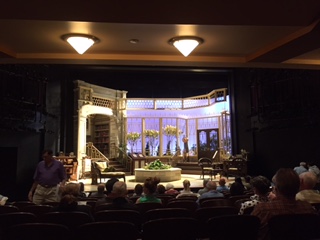
Of course, the feminist in me identified with a lot of this (but not necessarily with the way Hypatia went about her search for adventure ... although given the time period and her social situation, she really didn't have a ton of options available to her). So that specific theme as well as the humor really appealed to me. This particular production also had an absolutely beautiful and elaborately detailed set (see pictures above), excellent actors who were well cast, attractive costumes, and a lovely intimate setting in the relatively small theater. While there were some speeches that did drag and seemed a little pointless, overall I'm glad to have seen this play. Tomorrow is the last two showings of this production, so run - don't walk - to the box office to grab your tickets!

Saturday, May 26, 2012

A Farcical Romp: Miss Pettigrew Lives for a Day


Back in 2008, a friend and I went to see the movie Miss Pettigrew Lives for a Day, based on the 1938 novel of the same name. (Fun fact: The novel was so instantly popular that Hollywood was going to make a movie version of it back in the 30s but WWII beginning put an end to that plan.) Recently, I bought a copy of the DVD as a gift and lo and behold, Amazon.com also then told me I could have access to an instant copy online for a limited time. So, I almost immediately capitalized on that gift from Amazon by watching the movie again today.

Set in the late 1930s, Miss Pettigrew Lives for a Day follows the eponymous character over two days of her life. On the first day, Miss Pettigrew, a middle-aged governess with high morals, is fired from her job and reduced to getting food from a soup kitchen and spending the night on the London streets. The next day, Miss Pettigrew tries to secure yet another governess job from an agency but is refused due to her past record. Out of desperation, she pilfers the business card of Delysia Lafosse, a woman seeking assistance, and shows up at Delysia Lafosse’s door pretending to be from the hiring agency. Of course, Miss Pettigrew has misinterpreted the situation, thinking that Delysia Lafosse is a married woman looking for a governess instead of a social-climbing young woman looking for a “social secretary” to help her manage her whirlwind lifestyle, which includes juggling her three lovers – Nick, the wealthy nightclub owner who employs Delysia as a singer and finances her flat and wardrobe; Philip, the young producer who promises to make Delysia a star on the West End stage; and Michael, the impoverished pianist who loves Delysia despite seeing through her pretenses. In spite of her moral reservations, Miss Pettigrew finds herself charmed by Delysia and in desperate need of employment, so she comes along for the ride and finds herself transformed in more ways than one throughout the day.

Miss Pettigrew Lives for a Day is a delightful comedy, similar to the kind of screwball comedies that proliferated in the 1930s-1940s but are rarely seen today. Given the movie’s setting and the timing of the original novel, this is hardly surprising but it’s still a refreshing change from what often passes as comedy in Hollywood these days. The movie’s set and costumes embody the timeframe, with the swinging big band and jazz music also providing a great touch from the era. Besides the color filming and a few more risqué scenes than we would have seen back then, this movie transports viewers right back into the silver age of cinema.

While the movie is overwhelmingly light-hearted and funny, it is not just a piece of fluff. Miss Pettigrew’s morals, though wavering at times, serve to keep everything in its proper perspective. For instance, in a rare fit of anger, she lashes out at a cocktail party by telling a fellow guest, “You people, with your green drinks and your parties and your subterfuges! You're all playing at love. One minute her, the next minute someone else, flit, flit, flit! Well, I'm not playing. Love is not a game.” She serves as a foil to Miss Lafosse by reminding her of what is important in life – the love of someone who knows her true self rather than the endless pursuit of empty fame and money. Also, the desperation of Miss Pettigrew’s situation is a recurring theme, as we are often reminded of her hunger, her lack of money or worldly possessions, and how easily she might be spending another night on the streets.

It’s not just Miss Pettigrew’s welfare that is at stake. Throughout the movie, we are given often small but constant reminders of the world at large. And that world is on the brink of another world war, even as the older set of characters is still reeling from the consequences of the first world war. To be clear, this is not a movie about the horrors or tragedies of war, but it is not all just about the frippery that appears on the surface.

The movie wraps up fairly predictably but, to be fair, most comedies do and this is something we tend to like in light-hearted films. The happy ending was perhaps a little too easily tacked on, but it leaves the viewer feeling satisfied.

Miss Pettigrew Lives for a Day also succeeds by having a great cast at its heart – Frances McDormand as Miss Pettigrew plays the transformative part with understated perfection, Amy Adams channels Marilyn Monroe as Lorelei Lee in her bubbly role of Delysia, Ciaran Hinds plays the one character with any insight into the absurdity of this lifestyle with the appropriate amount of English gentlemanliness, and Lee Pace as the lovable Michael does not fail, as usual. These actors were particularly notable, but the rest of the casting was spot on also.

In case you couldn’t tell yet, I wholeheartedly recommend this movie, especially when you’ve having a down day and need something cheery!

Saturday, February 11, 2012

Fly Me to the Moon: Boeing-Boeing

My sister and I have both been watching ABC’s drama Pan Am with some interest. So when the Paper Mill Playhouse sent out a brochure of their upcoming season including a comedy set in the 1960s and involving stewardesses, we thought this might be something worth checking out. Of course, Boeing-Boeing shares basically no features with Pan Am beyond the time period and the occupation of some of the characters, but it was a highly entertaining production that I would recommend.

As you may have guessed already, I knew basically nothing about Boeing-Boeing before seeing the play, although my wise cousin did mention that the play had been around since the 1960s. Indeed, she was right, as the playbill informs me that it was written by French playwright Marc Camoletti and premiered in Paris in 1960. It was soon after adapted into English by British playwright Beverley Cross and appeared on London (1962) and New York (1965) stages. In 1965, it was made into a movie starring Tony Curtis and Jerry Lewis. According to the playbill and Wikipedia, in 1991 the play was listed in the Guinness Book of Records as the most performed French play in the world with 19 years on the French stage and seven years on the London one, amongst others. (The success of the play even resulted in Camoletti writing a sequel called Don’t Dress for Dinner, which was also produced at Paper Mill Playhouse back in the 1990s.) In 2007, Boeing-Boeing was revived in London and by 2008, it had returned to New York. And for four weeks in 2012, Boeing-Boeing is on stage at the Paper Mill Playhouse.

Paper Mill’s production of Boeing-Boeing was top notch.* The atmosphere of the theater was exactly right from the beginning, with Frank Sinatra’s “Fly Me to the Moon” playing from the speakers before the curtain rose to the playhouse’s typical pre-show “fine print” (no photography, no smoking, there will be an intermission, etc.) being announced as though it were a flight attendant’s welcoming message (‘Thank you for flying with the Paper Mill Playhouse’). The costumes, makeup, and hair styles are all perfect for transporting the viewer back in to the 1960s. The set design was magnificent, with a detailed (but not too detailed) look at Bernard’s Parisian apartment – an apartment so elegant that my sister was jonesing after Bernard’s crown molding and split-level dining/living room.

But speaking of Bernard and his Parisian apartment reminds me that I have yet to give a basic run-down of the play. So here goes:

It’s 1960 and playboy Bernard has perfected his relationship status – he is engaged. To three women. This way, he reasons to his visiting friend Robert, he will never have to endure monotony. All three women are flight attendants – American Gloria with TWA, Italian Gabriella with Alitalia, and German Gretchen with Lufthansa – so they are never in town at the same time and thus never need to know about each other. Bernard invites Robert to sit back and kick up his heels while Gloria heads out after breakfast, Gabriella flies in for lunch and out again before dinner, and Gretchen wraps up the evening. But Bernard’s perfectly timed out plans quickly go awry when the time tables are changed on him, and he needs Robert’s help – along with the help of his own long-suffering French maid Berthe – to juggle all three women and keep them out of sight of one another.

Obviously, this play is meant to be a comedy (specifically a farce***). And it is certainly is. I can’t recall the last time I was in a theater where the whole audience was uncontrollably laughing for the vast majority of the play. In fact, if I had one complaint about the play, it would be that all that laughing was bad for me, as I was recovering from an illness and every time I laughed, I ended up coughing again. C’est la vie.

Beyond the situational comedy that arose from such an absurd plot, the play also has its fair share of physical comedy, which the actors all pulled off with perfect grace. At first I was a little put off by the exaggerated, over-the-top accents of the women (including Berthe), but then I realized that this was an intentional thing to add to the comedy and I went with it. Paper Mill has been marketing the play with the tagline “Hijinks are in the air!” and that is certainly a fitting summation.

For a feel of the play, Paper Mill has released a video montage of scenes from the play. To be honest, I wasn’t thrilled with this montage on first view. I’m not sure if it’s the scenes chosen or if it’s the absence of audience laughter for the great one-liners, but seeing this video certainly was not as appealing as seeing the play. I’ve included here for some context, but I’m more inclined to say: Go out and see the play for yourself! And hurry, because the production is only ongoing for two more days (and that’s including today!).

----------

*This should be no surprise. Whether it was The Secret Garden with our aunt when we were kids, Cinderella as a birthday treat for my sister, or Steel Magnolias to satisfy our Gilmore Girls fangirl** yearnings by seeing Kelly Bishop live, my sister and I have never been disappointed with a Paper Mill Playhouse production.

**Did you know that no less an authority than Merriam-Webster Dictionary considers “fanboy” a word but not “fangirl”? I could go into a feminist diatribe here but I’ll just leave it at that. Make of it what you will…

***An audience guide provided by Paper Mill Playhouse describes farces in detail, including some history of the form. Some tidbits include, “Farce differs from standard classical comedy in one major way: it is an exaggerated, broad form of comedy based on unlikely situations and highlighted by contrived and improbable plot twists. … The driving force behind a farce is fast action, brisk dialogue, visual effects, mistaken identities and convoluted and complicated plots. … It is a comedy that exists purely for the sake of generating laughter in the audience. … Like all good farces, the play invokes laughter by the violation of social taboos, but the characters and values under attacked are eventually restored to their conventional positions.” So, all’s well that ends well, although all is well throughout in a manner of speaking because it’s all meant for a laugh.