Showing posts with label spectacle. Show all posts

Friday, November 23, 2012

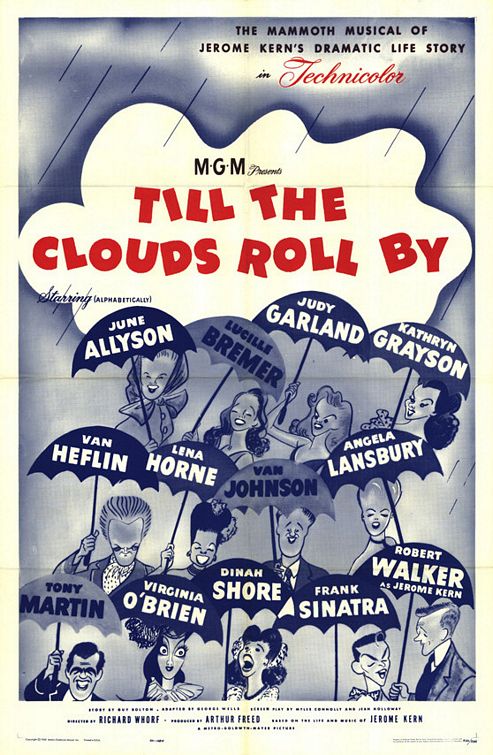
The Sweeping Symphonies of Till the Clouds Roll By

The first time I watched Till the Clouds Roll By, I was sitting in my grandparents’ kitchen with them, just enjoying a lazy Sunday afternoon/evening. I can vividly recall the smells, sights, and sounds of that day, so this movie is a bit sentimental to me as a result. When I saw that it was available on Hulu, I knew I’d have to watch again. And what better time to sit down with a feel-good, nostalgic movie than when everyone else is out there going crazy for a good deal on Black Friday? I can’t think of any.


Till the Clouds Roll By is a 1946 biopic tribute to composer Jerome Kern, who had passed away the year before this movie was released in theaters. While the movie is purportedly telling the story of Kern’s life, it also serves as a vehicle for large musical numbers, showcasing the hit songs from throughout Kern’s career. The end result is a film light on details of Kern’s life and strong on staging, costumes, swelling orchestral numbers, and so forth. I knew basically nothing about Kern before viewing this movie the first time, so I certainly did learn something from the movie about him – but then also had to verify a lot afterwards and saw how much was left out. For instance, Kern was apparently well-known for his horn-rimmed glasses yet Robert Walker as Jerome Kern is never once seen wearing a pair of any kind of spectacles; presumably the Hollywood of the 1940s would never think a leading man in glasses would be dashing enough for the audience. Some details are simply out of chronological order or slightly altered to fit the story being told in this movie, such as Hammerstein contacting Kerns about making a musical based on the book Showboat rather than the other way around as it actually happened. In real life, Kern had a daughter, but in the movie, he and his wife Eva dote only on his “niece” Sally, the child of his friend and musical arranger, Jim Hessler. The Hesslers play a huge role in this movie -- despite the fact that they never existed, although the character of Jim Hessler is supposedly based on a real-life associate of Kern’s.

The facts that Hollywood eschewed are replaced with a compelling story though and one that pulls on the viewer's heartstrings. I loved the story of how Kern becomes like family to the Hesslers and the easy repartee between him and Jim, especially in their early days as bachelor workaholics. The love story between Kern and Eva was also sweet, albeit rushed. Furthermore, the actors play the story of Kern's life well and do a convincing job of growing old and subtly changing as a result. Walker is always compelling to watch, whether he’s being charming, funny, torn, heartbroken, or feeling old and resigned, as the situation calls. The other actors in the domestic drama – Van Heflin as Jim, Dorothy Patrick as Eva, Lucille Bremer as the adult Sally, and Joan Wells as the young Sally – all play their parts perfectly as well.

But the real star power of this movie was in the music and dance, with acts that could almost be described as over the top unless you’ve happened to watch a lot of musicals from this era. The cast of Till the Clouds Roll By reads like a who’s who of Golden Age Hollywood elite, including Judy Garland, Van Johnson, June Allyson, Lena Horne, and Frank Sinatra, just to name a few. With so many heavy hitters, the producers didn’t even bother with first billing and just listed all the stars’ names alphabetically in the opening credits. While a few of the numbers in this movie were forgettable in my opinion, most of them were lavish spectacles worth viewing more than once.

For starters, Judy Garland as Marilyn Miller was one of the highlights in my book. Special guest director Vincent Minnelli (then married to Garland) was brought in to direct her musical scenes. The story goes that Garland was pregnant with her daughter Liza Minnelli at the time so when it came to staging her rendition of “Look for the Silver Lining,” Minnelli chose to put Garland behind a stage kitchen sink the whole time. Garland’s stunning voice carries the scene, even if it isn’t as action-filled as the other numbers. But despite her pregnancy, Garland is seen more active in her later musical numbers – dancing about to “Who?” and jumping onto a bareback horse in “Sunny,” with a sequence that I really, really hope is done by a stunt double. The choreography throughout the movie is excellent, but a particular favorite scene of mine is when Lucille Bremer and Van Johnson dance to “I Won’t Dance” in the Club Elite. Another one worth noting is the titular “Till the Clouds Roll By,” performed by June Allyson and Ray McDonald.

The movie both opens and ends with extended sequences acting as a review of some of Kern’s more famous songs, particularly with an emphasis on Showboat. The final song – and scene - of the movie is a young Frank Sinatra’s rendition of “Old Man River.” This choice rankles some contemporary viewers who feel that the song should be sung by an African-American man, embodying the working black man the song is meant to portray, rather than by a Caucasian-American man in spotless white tuxedo on a white pedestal. While I understand their frustration, I’d like to point out that:

1) This movie was made in 1946.

and

2) This movie was made in 1946!

The 1940s were hardly a time of racial equality in any sense of the word. Nor was Hollywood at the time a bastion of cultural sensitivity – this was the same entertainment machine that just 10 years earlier gave us Fred Astaire in black face as a “tribute” to Bill “Bojangles” Robinson. And that’s hardly an anomaly during that era. Furthermore, this movie was already filmed in such a way that Lena Horne’s solo performance could be removed when the movie was shipped out to Southern states who would refuse to air a sympathetic portrayal of an African-American woman singing on screen. It’s not pretty, but you can see why the film’s director and producers wouldn’t risk having their big finale stripped from the movie in a large number of states.

A few other points to make on this topic: 1) In the opening of the movie, “Old Man River” is also featured with African-American singer/actor Caleb Peterson singing the song, so the movie did give a small nod to the song’s origins there; 2) Italian-Americans like Sinatra were not exactly beloved at the time (another not pretty but true fact); and 3) Sinatra was a big enough name already to be a selling point, and at the end of the day, Hollywood is about making money. And, on the note about the ridiculousness of the dazzling white tuxedo and setting for this number, it's worth pointing out that this song comes at the end of a review of songs all featuring singers dressed in pure white settings. I don’t know why this is, perhaps to make some kind of point about the pure/innocent/ethereal/eternal/transcendent/pick-your-adjective quality of Kern’s works, but I do know that it would be odd if after all those numbers increasingly ascending in an “into-the-clouds” feel, the final song was done in a realistic style. One commentator makes the analysis that this whole grand finale was meant to be an ironic look at how Kern’s songs were going to be overblown and taken out of context by Hollywood and while this is an interesting theory, I just don’t think 1940s Hollywood was that was self-aware and tongue-in-cheek about itself. That’s my two cents.

All in all, my point is that you have to take a movie – or any other artistic work for that matter – as part and parcel of its time period and cultural milieu. If this movie came out today, I could understand that outrage more and would be right there with these commentators. Not just on the whitewashing of “Old Man River,” but also on the highly offensive “Cleopatterer” and some of the portrayals of women, such as Eva’s rules for what a lady can and cannot do or the fact that not a single woman in this movie ever wears pants (only skirts and dresses). These things are all a product of the times, and it is what it is. If you can take it with a grain of salt, this is a great movie from the Hollywood golden era of musicals. Fabulous performances in music, choreography, and acting will steal the show.

Sunday, February 26, 2012

Don't Try This at Home: The Peking Acrobats

For some time now, my dad has expressed an interesting in seeing Chinese acrobats. We were intending to go more than a year, but I intended up becoming quite ill the day before the performance so we were unable to go. But at last, we were able to make the trip to McCarter Theatre today and see The Peking Acrobats perform.

The Peking Acrobats consists of a troupe of 25 performers who dazzled the crowd with acrobatics, contortions, balancing acts, juggling, dancing, cycling, and so forth. As one little girl excitedly exclaimed at the performance today, seeing The Peking Acrobats is like a trip to the circus. In addition to the acrobatics the circus atmosphere was further reinforced with the live musicians that were on scene to set the tone. In addition, some of the performers played clownish roles with silly physical comedy jokes that I didn’t care for too much, but the children in the audience found hilarious. There was even one act that involved several of the performers dressed up like dragons that were more like big furry dogs, so even the animals aspects of a circus was covered despite the lack of pachyderms. (Of course, I’ve never actually been to a circus, so perhaps this performance is more like what I expect from the circus rather than what a circus is actually like.)

Considered a family event, the theater was full of all kinds of children – young and old – as everyone stared in childlike wonder at the feats displayed before them. (And the woman in front of me forgot adult manners and kept tapping on her husband’s shoulder with commentary and questions using her regular speaking voice.) I’ve never heard so many oohs and ahhs in one place before, along with astonished gasps, “wows!” and “amazing!” You’d be hard pressed to find a person in the crowd who wasn’t blown away by this performance, which received a standing ovation from a packed house. Just when the audience would think they had seen all the performers could do, the acrobats upped the ante. Think it’s amazing that a woman can balance a full wine glass on her nose? How about more than a dozen full wine glasses? How about if she stands atop a wobbly step while balancing the glasses? How about if she climbs a ladder while maintaining balance on her nose? How about if she then pulls out a ribbon for each hand and starts twirling without so much as sloshing one drop of liquid from those glasses?

Indeed, the acts on display were often so intense as to induce fear in me for the performers. In particular, one sequence required a man to continually stack chairs upon one another and then perform acrobatics from atop them all – some 20 feet in the air without a safety net and without a single person on stage with him. I was terrified he would fall and have no one there to catch him. He didn’t but still. There were a number of times I was afraid someone was going to break a bone in their attempt to entertain us all, especially considering how all of their equipment is pretty bare bones and intended to be taken apart easily. These performers showed not only bravery but extreme flexibility, strength, and stamina (the show was two hours long with only one brief intermission).

My only complaint about the performance was a subtle one that most people would not notice or be bothered by. Besides the opening and closing sequences, there were few acts that featured the male and female performers together. Instead, there would be a men’s act followed by a female’s act. That would be fine if it weren’t that the first several sequences seemed to be very disparate for the men and the women. The male acts featured thrilling, flashy acrobatics involving leaping onto poles and jumping through hoops while the female sequences involved juggling plates and expressive dances involving paper parasol twirling. Both were mesmerizing in their own right, but there seemed to be a subtext that male acrobats are daring while female ones are graceful. This was further reinforced by the men wearing brightly colored red or yellow costumes while the women were dressed in cooler blues and greens; even the music became softer when the women were on stage. As the show progressed, however, the differences between the male and female acrobatics lessened and the finale involved both set of acrobats performing virtually the same feats.

The Peking Acrobats were only at McCarter for this one night, but you might be able to catch them some other time. Or you can apparently buy a DVD of one of their performances and be wowed at home.

Sunday, January 29, 2012

We are the Champions: Medieval Times

I debated whether or not I should include this outing on this blog at it's cheesy compared to what I usually write about it, but I finally decided that this could qualify on the "and entertainment" component of the blog's mission. Today's outing was to Medieval Times, the entertainment chain that purports to bring spectators back to, you guessed it, the medieval times through a dinner feast and jousting tournament. As far as I can remember, not much has changed about the Medieval Times since I first went as a child, nor does it vary much from location to location. I guess when you have a good thing going, you stick with it. There's actually quite a bit of dinner theater to the spectacle, in that there is a whole story involving the king and his quest for peace, which is inevitably broken, but mostly it's the atmosphere and the clanking swords that we care about as viewers. There's also some fun moments where we get to see the effects of what must be months and months and months of animal training -- a falcon flying gracefully above the crowd and horses who do fancy trots and other fascinating movements. My friend and I were both seriously astounded by how magnificently these animals performed, especially given the noise and lights that came from the crowd.

Besides Americans' *entirely accurate* (read: not at all accurate) view of medieval Spain, one of the things I find most fascinating about Medieval Times is that you could easily convince me that it is actually an elaborate sociological experiment. We are all aware, at least on some level, of the psychological shortcuts that allow us to see the world in terms of "like us" and "not like us." Them against us often becomes the resulting attitude. This can be ill-applied when it comes to differences such as skin color or ethnicity, and racist attitudes prevail. We also see the "them against us" mentality in more trivial aspects of life, such as choosing a sports team to root for (although some people do get quite carried away with this as well), But Medieval Times brings this to a whole new level. The them vs. us mentality emerges simply by handing someone a colored paper crown.

See, there are several different knights in the Medieval Times tournament and to simplify matters, they are all referred to by their color (green knight, red knight, etc.). Spectators are seated in color-coded sections and given a corresponding paper crown to wear. And, amazingly, before the knights even appeared on the scene, people began getting wild fan attitudes about their knight. We were seated in the yellow section, right next to the blue section, and a bitter rivalry was soon struck up between the two colors. Blue and yellow spectators were shouting (and cursing) across to one another. And the tournament had yet to begin; likewise the knights still had not appeared, so there was absolutely nothing to base our undying fervor upon such as skill or even something trivial like looks. Right before the tournament was about to commence, our server came by and told us which knights were our allies -- all were on our side except the green knight, who we should boo. I then had to point out that we had apparently been wasting our time booing the blue knight for about half an hour, and our server replied that we could boo him, too, if we so desired. And so the bitter rivalry continued on the rest of the night.

Every time a knight came out into the arena, the crowd in his corresponding color went wild even before he started competing. Meanwhile, the poor princess, the only female character in the whole spectacle, had hardly anyone cheering for her as she had little to do but talk to the king, make a toast, and hand out roses to the winning knights. But when those same knights in turn tossed roses into their corresponding crowds, again their color's crown-wearing fans went wild. When it came down to one-on-one jousting tournaments after the all-in games, you could actually feel the crowd's enthusiasm waning when their knight wasn't amongst the two knights fighting. Seriously, it was amazing to me how quickly people could become invested in rooting for their "team" (so to speak) and thus I am convinced this is all some social experiment on racist attitudes, mob mentality, and etc.

Oh, and for the record, our yellow knight was ultimately named the champion, so clearly we had been on the winning team all along and our fervor was not without reason! ;)