Showing posts with label comedy. Show all posts

Monday, December 16, 2019

Turn the Record Over ... I'll See You on the Flip Side

Despite the title quoting their lyrics, this blog post actually has nothing to do with the alt-rock band The Gaslight Anthem. But the lyrics come from their song (and album) titled 45, which ties into this blog post. Specifically, I am back to reviewing some of the AFI's Top 100 movies as I make my way through the list. The following movies brought me up to 45 out of the 100 movies watched.

Before we get into the reviews though, I wanted to note that I mentioned last time that I doubted if many movies on the list actually passed the Bechdel test, which is set up as a bare minimum barometer for women's stories being included. Turns out that someone actually already did the research and calculations, and only 32 movies on the list pass. That's not just a failing grade, that's an abysmally failing grade. This is an important thing to note as I go into reviews because the further I wade into this list, the more I am noticing this huge problem. Women's stories are completely devalued by whomever chose these AFI's Top 100 movies. Unfortunately, that is what it is and here I go into reviews...

The Graduate 
(released 1967, #7 of 100)

This is one of those movies that I did kind of want to watch anyway, especially because it seems to be referenced all the time and is considered a classic. Before watching it for this little project, I read the book it's based on, in large part because I am also very slowly working on reading the books on the 1001 Books to Read Before You Die list. Overall, this movie is a pretty faithful adaptation of the book, but when the source material isn’t great, neither is the screen adaptation.

The story itself is pretty slim -- a young man graduates from college, returns home, and starts an affair with the wife of his father's business partner. It's not exactly earth-shattering nor that compelling. The movie cuts more to the point than the book (i.e., doesn't belabor things) and can be more humorous as a result. There are definitely odd camera choices though, such as an antenna crossing across someone's face, or the backs of people's heads zoomed in on too closely during the party scene. There's a decent soundtrack of Simon & Garfunkel songs, but they didn't seem to fit the scenes they were used in.

In terms of casting, I usually think you can't go wrong with Dustin Hoffman, but he was just okay here. It's definitely not his best performance but, to be fair, he was pretty young. However, he was about 30 playing a character who is in his early 20s (just graduated from college so most likely 21 or 22), and it struck me right away that he was too old to be playing that character. Meanwhile, Anne Bancroft is absolutely perfect in the role of the Mrs. Robinson; she steals every scene that she's in. Katherine Ross as Elaine Robinson was well cast as she looks like she could actually be Anne Bancroft's daughter. This Vanity Fair article provides some background into the casting process for The Graduate, and it's clear that they really did choose some of the best possible actors for the roles as the other names floated don't seem right for those characters.

Nevertheless, this really wasn't a great movie in my opinion. I can’t believe this was in the top 10 of the AFI's Top 100 list; it was okay but wasn’t anywhere near that good. Watching it for the cultural touchstone makes sense, but it could have been way further down the list.

Annie Hall
(released 1977, #31 of 100)

This is one of those movies that I probably saw before but couldn't remember if I had really watched it from beginning to end or just caught snippets of it. After watching it for this project, I'm pretty sure that I had sat down and watched it all previously. Which is fairly unfortunate given that I didn't really like it all that much and made myself watch it again.

This movie features two of my least favorite actors (Diane Keaton and Woody Allen) playing two terrible characters in what is essentially a romantic comedy -- typically not my genre of choice. In some ways, the characters remind me of Seinfeld characters in their inability to see how awful they are and always thinking other people are the problem. The movie even starts off with Alvy wondering what went wrong in his relationship with Annie when clearly he was awful pretty much 100 percent of the time. For, despite the title of the movie, it’s really Alvy’s story. Yet another male-centric story on AFI's Top 100 list. Sigh.

There are a lots of jokes in this film that really didn't age well given Woody Allen's history. For instance, Alvy and co. make "jokes" about his grandmother being raped, his friend having sex with 16-year-old twins, politicians having ethics comparable to child molesters, and his own sexual curiosity beginning at age 6. That all aside, in general, there's just way too much about Alvy's whiny need to have more and more sex while also having a variety of neuroses about sex. In addition, this movie has Alvy's friend defining VPL for the world to know, and of course it's some doofus of a guy who made that popular. Eye roll.

Honestly, many of his non-sex jokes weren't all that funny either. The situational humor is better at times, but this movie gets old kind of fast and most of the last half an hour in particular was dull. However, this film is definitely fun and interesting for having moments of breaking the fourth wall, inclusion of supertitles over the character's heads to show what they’re really thinking, out of order storytelling, split screen effects, etc. There is no soundtrack to the opening or closing credits, which was unusual (but not necessarily good or bad). This playing around with the cinematic art form is cool and the only thing that really makes the movie worth watching.

Rebel Without a Cause 
(released 1955, #59 of 100)

This is another one I was interested in seeing anyway because it seems culturally relevant; it is certainly referenced in many other pieces of pop culture. However, 15 minutes into the movie, I was already bored; there is just way too much whiny, teary teenage angst packed into those 15 minutes.

Many moments in this movie were filled with overly dramatic music to make things even more unnecessarily emotional. I'm at a point in my life where I just don't care about high school drama/stupidity, and immediately agreed with the father in the film who tries to tell Jim that he'll look back on this some day and realize it wasn't actually a big deal (until of course it escalates because Jim doesn't listen to his dad). This movie had the added non-interest for me of having a lot of machismo stunts. Bleh. So senseless.

James Dean and Sal Mineo are both good but the rest of the cast, especially the teenagers, just seem to be running through the motions. All of these actors look older than teenagers as well, which I guess is often the case but it doesn't mean I won't comment on that unfavorably. I don’t know what Natalie Wood is attempting to do in this film, but her facial expressions often seem completely off for whatever moment is happening. Although perhaps that was also due to the writing, wherein they have her running around essentially playing house at the mansion and smiling/laughing the night her boyfriend tragically died. The only character of color is a Mamie type character; it might have been less problematic to just have an all-white cast. It was the mid-50s though, so I give this movie a little bit of a pass as a result.

On the plus side, there are some interesting camera angles in scenes like the opening credits, Jim fighting with his parents after the car accident, or the climax at the observatory steps. There are also pretty landscapes in back of the high school and other places about town (mountain, cliffs, etc.). However, a handful of bucolic shots is not enough to salvage this rather disappointing movie.

***

So this grouping was all pretty discouraging, but there's still plenty more movies ahead!

Tuesday, September 3, 2019

Jackie Robinson, or The Meaning of Life the Universe and Everything

Despite the pretentious title, this blog post actually has nothing to do with baseball or The Hitchhiker's Guide to the Galaxy. But the two things both tie in with the number 42, which is a component of this entry's content.

Several months ago, I decided that I should finally hunker down and start making an effort to watch all the movies on the American Film Institute's list of "the 100 greatest American movies of all time" (hereafter referred to by me simply as "AFI's Top 100"). In the past I would occasionally give the list a once over and see how many I had seen and how many more I had NOT seen, but it didn't get much further than that. Realizing that method meant I still had seen less than half of them (a dismal 38 in total), I made it a goal to start watching them in earnest and am now up to a whopping 42 in total. Hey, progress is progress, no matter how slow it is...

Since one of my problems with the list is that for some of the movies, I cannot recall if I actually did see them in their entirety or not, I also made a decision to write up a quick review of each movie after watching it and will be posting those here, probably in batches of three or four movie reviews at a time.

Without any further ado, here are my random thoughts on the first four movies I've intentionally watched just for being on AFI's Top 100 list. (FYI, there really is no order to the way I am watching the movies from the list; it's whatever happens to be accessible at the time.)

Easy Rider
(released 1969, #88 of 100)

What a start to this project; this movie was practically unwatchable. I know it has its fans, but I am certainly not one of them, nor was my friend who watched it with me. It's as if Kenneth Anger made Fear & Loathing in Las Vegas and then amped up the trippy factor by about a thousand.

This movie opens with dullest drug deal scene ever depicted (and that’s saying a lot) before two guys embark on a road trip across America for Mardi Gras in New Orleans. Along the way, they cross paths with some unusual characters from hippies to bigots to farmers. I would have loved to hear more about the women they encounter and their lives, but this is a "bro" sort of movie so that would never happen.

The movie starts out with some rather weird cinematography choices that only get weirder as the movie progresses (and as the characters get higher from all the cocaine and other drugs they are doing). All along the "plot" is slow moving, the dialogue is mostly rather poor and uninteresting, and there is literally zero character development. On top of that all, the ending is really bizarre to the point that my friend and I were both kind of like 'was that the end? what were they even trying to say with this movie???' This may have been the movie I did the most research on after watching it, because it was absolutely puzzling to me what its purpose was or why it was on AFI's Top 100 list. While I do enjoy when I read or watch something that has so many layers that a critical analysis might help me learn more, a film should stand up well enough on its own that you don't have to see what critics are saying in order to "get it." (And quite frankly, it still doesn't seem like there was much to "get.")

The handful of highlights were good music to fill the soundtrack while the guys ride along the highways and byways, which then of course included some nice shots of American landscapes (mostly deserts but also some small towns in Louisiana). The very earnest definition of the slang version of the word "dude" (I guess it was still new enough in 1969?) was humorous. And finally, the real star of the movie was a very young Jack Nicholson, who put in a stellar performance as the day-drunk ACLU lawyer, a role fittingly quirky enough for him. I have to agree with The New York Times critic whose review of the movie at its release noted, "Nicholson is so good, in fact, that 'Easy Rider' never quite recovers from his loss." I am resigned to the fact that I will never understand why this movie is on AFI's Top 100 list.


The Third Man
(released 1950, #57 of 100)

Thankfully, AFI's Top 100 list quickly redeemed itself with this selection. This is the kind of movie that I really enjoy -- an older noir film that immediately grabs you and is compelling from start to finish.

This movie takes place in Vienna after World War II, with the main character looking into the mystery of a friend's death, supposedly an accident but surrounded by a few pesky details that just don't add up -- including the rumor of a third man at the site of the accident but not listed in the official report. There is definitely a lot of intrigue, with every character having some piece of the mystery but refusing to reveal more.

The ambiance of the film throughout is wonderful. Filmed in black and white, it plays with lighting and shadows. There are long shots, unusual angles, and other cinematography reminiscent of Citizen Kane (not surprising, considering Orson Welles was associated with both projects). The dark lighting and unusual camera angles add to the sense of unease the film is trying to portray for its main character, especially when coupled with some dialogue in untranslated German (unless you happen to understand German, it further solidifies your sense of unknowing). There are several scenes of characters running around Vienna's cobblestone streets, complete with echoey footsteps, which further adds to the mysterious tone.

But the movie isn't all seriousness at all times. There are little jokes here and there, and throughout the movie, a jaunty jazzy tune plays its soundtrack. This fun instrumental music is all played on the zither, which is an unique choice that made a distinct impact. The storyline also has a romantic subplot underneath all the mystery and intrigue. Joseph Cotton as the protagonist put in an A+ performance. Alida Valli as Anna was also excellent as were some of the supporting cast (some others of the supporting cast were a little too campy, e.g., the fellow with the dog).

Overall, this was definitely an enjoyable film and I could see why it was on the list. (A fun side note -- there is actually a small curiosity museum in Vienna dedicated specifically to this film.) Those who like film noir mysteries and/or spy-type thrillers would probably enjoy this one.


The Apartment 
(released 1960, #93 of 100)

Like The Third Man, this movie is one I'm surprised I hadn't watched before actually, given it's up my alley of movies from the late 40s to early 60s. Once the opening credits showed Billy Wilder's name, I knew I was in for a treat; there’s a reason he was referred to as "the world's greatest movie director."

The Apartment has many similarities with Wilder's other movies, including elements such as:

  • a voice-over introduction (but further narration is never heard),
  • a New York City setting,
  • a perfectly fitting instrumental soundtrack,
  • snappy dialogue,
  • black and white filming despite color being available,
  • an overall comic tone but serious at turns, and
  • issues like infidelity and suicide that can't exactly be shown on the screen (in 1960) but which are nevertheless artfully portrayed.

However, this movie has a rather different storyline from the other Wilder films I've seen in the past. A hard-working, ambitious accountant nicknamed Bud wants to succeed at his corporate life insurance job and therefore finds himself trying to curry favors with the higher-up suits. Unfortunately, the favor these men want the most from him is use of his apartment to carry on their extramarital trysts. Things only devolve further when the top boss finds out about this and wants to meet his mistress there -- a woman whom Bud has secretly had a crush on himself.

The late 50s/60s corporate culture highlighted in this film might make it of interest to fans of Mad Men, with similar explorations of gender, sex, power, and money, although with a far less serious tone. This movie has excellent performances from Jack Lemmon (indeed, he carries many scenes where it’s just him puttering around the apartment alone with no dialogue or only some mutterings to himself) as well as from Shirley MacLaine and Fred MacMurray. The happy ending feels a little tacked on / rushed, but otherwise this was an engaging watch. This wasn't my favorite movie of all time (it's not even my favorite Billy Wilder comedy; Sabrina tops that list, followed by Some Like It Hot) but it's a solid addition to AFI's Top 100 list.


Fargo 
(released 1996; #84 of 100)

This movie I went into expecting NOT to like, especially because I disliked the only other two Coen brothers' movies I had previously seen (The Big Lebowski and Intolerable Cruelty). While quirky movies hold a special place in my heart, the Coen brothers tend to operate in a zone of oddness that just isn't my cup of tea. However, this movie turned out to be weird in an acceptable sort of way for me.

The movie takes place in the dead of winter in Minnesota and North Dakota, where a car salesman with ambition pays a couple of criminals to kidnap his wife so that his wealthy father-in-law will pay the ransom. The trio assume no one will be the wiser and they will all walk away a little richer. But, of course, Murphy's law comes into play and things quickly escalate from bad to worse.

Despite the film's opening screen-cap claiming to be "based on true story," this is a work of fiction. But it is not outside the realm of possibility, which does give the film's absurdity a ring of truth. The actors in the movie -- from the leads to the supports -- are all excellent in their roles. The repartee between the two criminals, played by Steve Buscemi and Peter Stormare, is definitely a highlight of the film, along with Frances McDormand's award-winning performance as the police chief working to catch them. And, William H. Macy is almost *too* good as the slimy salesman, convincing me 100 percent to hate that character.

Despite the violence at the heart of the movie, it really isn't overly gory (especially in light of what's considered acceptable in film and television today). Also, McDormand's character is a refreshingly independent and strong woman, which had been missing in the other three films reviewed above. (The Third Man and The Apartment get points for at least featuring women more so than Easy Rider, but they're not exactly going to be held up as feminist standards. I'm not doing the statistical breakdown because that's more effort than I want to put into this project, but I wouldn't be surprised to see if a great number of the movies on AFI's Top 100 list are unable to pass the Bechdel Test.) Also, the one Asian character seen in the movie is surprisingly not just stereotype after stereotype, which is sadly saying a lot for 1996. (Unfortunately, the one American Indian character in the movie doesn't quite pass the same low bar. His character is way too much the strong, silent, proud 'native' stereotype -- his last name is even Proudfoot.)

That all being said, I cannot see this being a movie I would purposefully view again, nor do I have any interest in watching the new series of the same name. However, I do understand why it made the list, if for no other reason than that it's a movie that is often referenced in pop culture.

***

Well, that's all for now folks. Catch up with you again when I have a few more movie reviews to add.

Sunday, February 5, 2017

Come On, Get Happy

As I've lamented before on this blog many a time, winter is my least favorite season of all. It is looong, cold, dreary, and dark. It makes me wish I was a bear who could hibernate these months away and emerge well rested for spring. But since that's just a fantasy that won't happen, I've been trying to dispel my winter blues with fun and light-hearted movies -- not my usual fare but perfect for lifting my spirits, even if just temporarily. And as I've been away from this blog for a while, I thought I would try a quick summation of those movies in this one post. (It may get a little long though...)

To try to improve my mood, I watched these three movies in recent weeks: The Answer ManZootopia, and The Peanuts Movie. Two kids' movies and a romantic comedy -- this is how I roll in the winter, people.

The Answer Man

This is a romantic comedy from 2009 about a hermetic best-selling author and a single mom with a recently opened small business who meet almost by happenstance and decide to start dating. Literally, the entire rationale behind me watching this movie was "Lauren Graham is in it." The description sounded okay, and I was willing to give it a try, but I was not expecting much. With that attitude going in, I was surprisingly pleased. Sure, the romance part was pretty flat, but the acting was superb, the comedy was good, and it was really more of a story about the author becoming a more social and caring human being than it was a purely romantic comedy. I'll address each of those points a little more fully below.

Jeff Daniels as author Arlen Faber was comedy gold in a multi-faceted role. Faber is a character who is struggling with a number of things -- physical pain from a bad back, a crisis of faith, a desire to be left alone by the people who want to adulate him for his best-selling religious books, and coming to terms with being needed by others and finding himself wanting to be around other people as part of their lives. Lauren Graham was predictably wonderful, presenting her usual mixture of fun-loving comedy turning to fierce drama at a moment's notice. As she herself once noted, she does seem to be typecast into the single mom role, and there were a few moments in the opening of the movie that felt like the movie was trying to give us Lorelei Gilmore with a young son instead of teenaged daughter. But then the character of Elizabeth comes into her own, and we see her more as a dedicated chiropractor, determined to help patients and see her small clinic succeed, and as a friend/love interest to Arlen.  Lou Taylor Pucci as recovering drug addict and struggling independent bookstore owner played perfectly whether in humorous or serious scenes, in either case serving to further stretch Faber's growth and development. Smaller roles were well acted and rounded out the cast of quirky characters.

As I've probably mentioned in the past, I'm not the hugest comedy fan - especially sitcoms or romantic comedies, which tend to feel very predictable and, as a consequence, dull. But that being said, I found myself laughing quite a bit with this movie. A lot of that came from Faber's unexpectedly foul-mouthed or flippant sayings, but some of it was physical and situational humor as well (like Elizabeth trying to promote her business by having her assistant dress up as a giant spine outside their office or Faber being pulled unexpectedly into a parent-teacher conference for Elizabeth's son). There's also a bit of the "awkward first date (or three)" conversational humor, which is a somewhat stereotypical romantic comedy move, but that's usually the best part of any rom-com in my opinion. 

And, finally, I enjoyed this movie more than the standard fare romantic comedy because it was much more than just that. The movie addressed Arlen's need to get outside of himself and his worries to connect with other people and care about them. Sure, that included a potential romantic partner, but it also included her son and people in the community like Kris the bookseller. Faber doesn't completely change his personality or attitude but he does become more willing to embrace other people and help them on their course through life, in turn helping himself to be more compassionate. That may sound overly sentimental, but the movie manages to stay *just* above the rim of being truly sappy. 

Like I said at the beginning of this movie review, I was surprisingly amused and entertained by this movie. And I'm surprised to find myself recommending it as well if you want something on the cheery side for your next movie pick.

Zootopia

A good number of the little kids (and grown adults for that matter) in my life had already seen this movie when it came out in theaters and loved it. I figured I'd get around to it eventually, which turned out to be a day I was still in a down mood. Zootopia tells the story of Judy Hopps, a bunny from a small rural community who can't wait to become a police officer in the big city of Zootopia, despite the nay-saying she hears from literally everyone, ranging from the local bully to her own parents. She persists in her goals anyhow, passing all the hurdles to becoming a police officer and arriving in Zootopia to learn about an ongoing missing animals case, to which she is not assigned because, again, no one believes a small rabbit can accomplish much. But through a series of unexpected circumstances, she ends up partnering with Nick, a con-man (or con-fox, as the case is) to uncover a much bigger conspiracy that anyone expected.

As you might expect from a children's animated movie, there is all kinds of humor in Zootopia, ranging from very obvious slapstick bits for kids to references clearly meant for adults. My favorite two scenes that had me laughing out loud involved a DMV office run entirely by the slowest moving sloths and an introduction to the criminal boss, "Mr. Big," who mimicked several Godfather lines. The movie definitely hit the spot in improving my bad mood, even if it didn't succeed in doing so for a terribly long time. 

But Zootopia also succeeds in presenting a number of important issues to children in a digestible form without being overly didactic. There is soooo much about not judging people by their outside appearance but instead by their personal qualities, like commitment to righting wrongs and perseverance in the face of internal and external doubts. Yes, there are times when some of this lesson is a bit heavy handed, but it's never a "hit you over the head" morality tale. 

Like we've all come to expect with a Disney movie, this one features a lot of talented actors lending their voices to various characters, including Ginnifer Goodwin as Judy, Jason Bateman as Nick, Idris Elba as the police chief, Shakira as the pop star Gazelle (giving the film its catchy theme song), and many many more. As we've all come to expect with an animated film from Disney, the success of Zootopia has inevitably led to there being talks of a possible sequel, one which ::eye roll:: many hope will lead to Judy and Nick getting together as a romantic couple. Let's just hope that any follow-up movie is of as high a caliber as this first one was. 

The Peanuts Movie

Last, and let's admit it, least, I watched the new reincarnation of Charles Schulz's characters that is The Peanuts Movie. As a bit of background, I've never been the hugest Peanuts fan, though I do generally find some of the older short movies both funny and fun to have on around the appropriate holidays. This movie, written by Schulz's son and grandson, stays true to the original characters in interesting ways, but it is sometimes perhaps a little too true to them. Bear with me as I explain.

The Peanuts Movie is largely centered around Charlie Brown's crush on the new girl at school (known simply as The Little Red-Haired Girl) and his myriad attempts to do something great to get her to notice and like him. But because it's Charlie Brown, these attempts inevitably do not turn out as planned. Throughout his many endeavors, Charlie Brown's myriad friends, including his sister Sally and his loyal dog Snoopy, strive to help him out. At the end of the school year, when Charlie Brown finally manages to just talk directly to The Little Red-Haired Girl, she says that she admires all the good qualities he demonstrated when things went wrong, including his selflessness in advancing others before himself. 

Among many of the nods to the original comics include Lucy pulling the football away from Charlie Brown at the last moment, the kite-eating tree, Marcie inexplicably calling Patty "sir," the muffled voices of all adults (voiced here in a stroke of genius by Trombone Shorty), and Snoopy's dreams of being an ace war pilot battling the Red Baron for the skies. This last one has always been a bit of an odd one in my opinion, and some parts of the movie involving these scenes went on a little too long for my liking. There's also a love interest for Snoopy here, mirroring Charlie Brown's story back in the real life part of the movie. 

Also true to the original Peanuts were the many bizarrely romantic relationships seen among schoolchildren. Perhaps because Charlie's crush is the focus on this movie, I started noticing these relationships more than I usually do. Almost all of them involve girls who nag and borderline bully boys into liking them back (e.g., Lucy and Schroeder, Sally and Linus, Peppermint Patty and Charlie Brown). Meanwhile, Charlie Brown's entire basis for liking The Little Red-Haired Girl is that she's "pretty" and she chews on her pencil like he does. He never even learns her name. She is literally "The Little Red-Haired Girl" from beginning to end of the movie. The weird relationship dynamics were kind of unsettling as an adult, and it makes me wonder what kind of message is being sent to kids when they watch this movie. I understand that attempts were being made for continuity between the past Peanuts and the present, but some of this was just a bit too much. It could be left in the past.

It was interesting for me though when I went searching for the origins of the "sir" moniker for Peppermint Patty that I found this article explaining how this character was Charles Schulz's response to second-wave feminism. He chose to make a character that defied the stereotypical feminine traits, instead opting to make Patty a fan of sports who doesn't wear skirts. So that was nice to learn; I just wish that the new creators might have found some ways to bring the female characters of The Peanuts Movie past the 1960s. 

That all being said, there were pretty funny parts to this movie as well as some charming ones. Particularly hilarious to me was Charlie Brown's quest to write the perfect book report to impress The Little Red-Haired Girl, which ends up involving a mistaken search for the book "Leo's Toy Store" by Warren Peace. There was also plenty of slapstick and physical comedy to entertain those who really enjoy that kind of comedy, like the small children who are the target audience for this movie. I really did love the ending in which The Little Red-Haired Girl pointed out all the times Charlie Brown stood up and did the right thing, even if it didn't seem beneficial to him at the time. That was definitely a high note in this movie, teaching children important lessons about how being a good person is about helping others, not just promoting yourself and your achievements.

The animation style is different from the original Peanuts films, given the many changes in technology since then. I guess it could be off-putting for some, but I didn't mind it much after a few minutes of getting used to it. The look and feel of the characters was the same, even down to Lucy being a horrible bully, which I wish was addressed more. All in all, I found this movie an amusing diversion, especially for adults who grew up loving these characters. But I would be hesitant to share it with small children without discussing the problematic parts later.

Well, those are my two cents (and perhaps a little more) on these movies. Have you seen them and have any thoughts? What do you do to keep the winter blues at bay?

Sunday, August 30, 2015

Misallying Love Interests & Etc.

Hello, my beloved readers, if any of you are still here! I know that once again I've been neglectful in keeping up to date here, although I have so many things I'd like to share. One day...

In the spirit of trying to write about things when they're fresh in my mind, I'd like to talk briefly about a play I saw this evening. Tonight I was in the audience for the play Misalliance at the Shakespeare Theater of New Jersey. Misalliance is a drawing room comedy written by George Bernard Shaw in the first decade of the 20th century. Unlike other Shaw plays, this one isn't particularly well known and apparently doesn't see the stage often these days. Reviews for this particular production were rather mixed, and I think I get why that is.

Misalliance is a play that seems to take a while to get started, but even after it did take off some, I still found myself a little puzzled as to what exactly the plot was. There just simply isn't much of a plot. The entire play takes place in one evening in one setting - the pavilion room of a wealthy businessman in the English countryside. The characters consist of a family of four as well as the daughter's fiancée and his father, and a few unexpected guests. Some of the themes explored include the parent-child relationship, education, the class system, speech versus action, politics, and feminism. While this is all well and good, there times here and there where the play was very speech-y and it was unclear what this all was leading to -- sometimes, it would loop back around to the general themes and flow of the play while other times it would just be there to be there. It also seemed like the characters were sometimes a bit contradictory in all their long-windedness.

On the plus side, there were definitely a lot of humorous parts to the play, which is what I was hoping for and expecting. Shaw makes more than a few meta-references to plays and all their trappings that had good tongue-in-cheek quality to them. The father's penchant for pushing books at everyone was a hilarious refrain in particular. After a plane crashes in the garden outside, things got a bit farcical, but that was in a good way. The introduction of Lina, the Polish acrobat, was refreshingly funny and added some physical comedy to the play. She also elicited a lot of laughs either through her own person or through the minor plot points she put into action. In addition, Lina brought home more of the feminist theme, with a rousing speech that was the only one to elicit applause from the audience mid-scene:

Oh, your Johnny! with his marriage.  He will do the straight thing by me.  He will give me a home, a position.  He tells me I must know that my present position is not one for a nice woman.  This to me, Lina Szczepanowska!  I am an honest woman.  I earn my living.  I am a free woman.  I live in my own house.  I am a woman of the world.  I have thousands of friends. Every night crowds of people applaud me, delight in me, buy my picture, pay hard-earned money to see me.  I am strong.  I am skillful. I am brave.  I am independent.  I am unbought.  I am all that a woman ought to be; and in my family there has not been a single drunkard for four generations. And this Englishman! this linendraper! he dares to ask me to come and live with him in this rrrrrrrabbit hutch, and take my bread from his hand, and ask him for pocket money, and wear soft clothes, and be his woman! his wife!  Sooner than that, I would stoop to the lowest depths of my profession.  I would stuff lions with food and pretend to tame them.  I would deceive honest people's eyes with conjuring tricks instead of real feats of strength and skill.  I would be a clown and set bad examples of conduct to little children.  I would sink yet lower and be an actress or an opera singer, imperiling my soul by the wicked lie of pretending to be somebody else. All this I would do sooner than take my bread from the hand of a man and make him the master of my body and soul. And so you may tell your Johnny to buy an Englishwoman: he shall not buy Lina Szczepanowska; and I will not stay in the house where such dishonor is offered me.

Similar sentiments are expressed by the 20-something daughter of the family, Hypatia, who feels trapped in her upper middle-class life:
  • "I don't want to be good; and I don't want to be bad. I just don't want to be bothered about either good or bad. I want to be an active verb."
  • "I want to be; I want to do; and I'm game to suffer if it costs that.  But stick here doing nothing but being good and nice and ladylike I simply won't."
  • "Men like conventions because men made them. I didn't make them. I don't like them. I won't keep them."

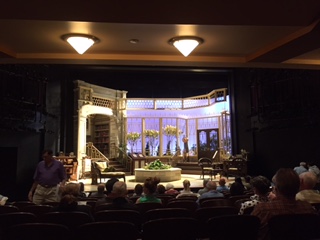
Of course, the feminist in me identified with a lot of this (but not necessarily with the way Hypatia went about her search for adventure ... although given the time period and her social situation, she really didn't have a ton of options available to her). So that specific theme as well as the humor really appealed to me. This particular production also had an absolutely beautiful and elaborately detailed set (see pictures above), excellent actors who were well cast, attractive costumes, and a lovely intimate setting in the relatively small theater. While there were some speeches that did drag and seemed a little pointless, overall I'm glad to have seen this play. Tomorrow is the last two showings of this production, so run - don't walk - to the box office to grab your tickets!

Saturday, January 10, 2015

Way Behind the Curve: Partying with the Folks from Party Down

This post comes to you rather belatedly so I apologize in advanced for any mistakes in my memory. If I get my act together more in 2015, you'll be seeing some posts that really should be written sometime over the past two years or so instead of now. I'm hoping that it's, as the saying goes, "better late than never." With that said, let's proceed in to this post proper.

Some of you may know that I was a huge fan of the cult classic TV show Veronica Mars; it remains one of my go-to shows for when I've had a bad day and/or want something familiar. So when I heard that Veronica Mars creator Rob Thomas also had a short-lived Starz TV show titled Party Down, I knew I would sooner or later need to watch this show as well. Sooner arrived when I scored an incredible Black Friday steal on both seasons of the show on DVD and proceeded to watch the show (note: this was several years ago now and hence where memory issues may arise).

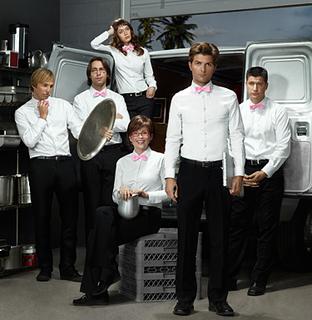
Party Down focuses on a catering business that employs a number of wannabe actors and, in one case, a burned out actor. Steering the helm - or more, accurately trying to steer the helm, is Ron, who desperately wants to do well in the food service industry after his recovery from drugs and alcohol. In addition to Rob Thomas, Party Down reunites Veronica Mars writers/producers John Enbom and Dan Etheridge on the creative team along with Paul Rudd, who once guest starred on Veronica Mars. The cast (encompassing for this purpose series regular, recurring guests, and one-time guests) also includes a veritable who's who of Veronica Mars alum: Ryan Hansen, Adam Scott, Jane Lynch, Ken Marino, Jason Dohring, Steve Guttenberg, Enrico Colantoni, Ed Begley, Ryan Devlin, and Kristen Bell herself. 


All this seems to be pointing in the direction of Party Down plus me really hitting it off, right? Wrong. Despite soldiering through both full seasons (albeit only 20 episodes in total between the two of them), I found I could not really get into Party Down. For starters, it's essentially a sitcom. Strike one. Sitcoms and I rarely do well together, as I ranted about in length in a previous post. Granted, Party Down is a somewhat atypical sitcom going to places that most network sitcoms wouldn't touch. But still, you can't really change a leopard's spots and Party Down is what it is: a sitcom. And unfortunately, Party Down's very absurdity was sometimes its downfall for me. The more ridiculous and, frankly, downright slapstick the situations became, the less invested I became. The show could occasionally make me chuckle, but more often it left me shaking my head in wonderment - and not the good kind.

The second strike against the show was its characters. In my opinion, characters make or break a show. They don't necessarily have to be identifiable and/or likable characters, but they definitely have to be interesting. The characters in Party Down were quirky, but not necessarily that interesting considering that most of them were fairly one note. And they certainly weren't likable - self-absorbed, narcissistic, downright nasty, immature, and irresponsible are more fitting adjectives to describe the majority of them. Sure, I could feel moments of sympathy certainly for Ron who is hampered down by such reckless team members. Henry, the faded out actor who is still occasionally getting recognized for his past fame as the speaker of a catchphrase in a beer ad, also could have times where he was relatable and sympathetic, although as the series progressed he seemed to be further sucked into the dysfunction of his co-workers. The rest of the characters were really a pretty dismal lot and it was difficult to root for them - or even care about them - for much of the action. And, sadly, there was little growth or change for these characters. Yes, specific events - whether big or small - did make an impact on their lives in terms of things like getting a new job or ending a relationship. But in terms of their character traits, they showed little difference from the pilot to the final episode for the most part and even less in terms of positive moves. While the characters were generally unpleasant, lots of kudos go to the actors who were all magnificent at being awful characters, totally embodying these people for the duration.

Strike three was what seems to be my usual complaint for premium cable TV shows: just because you don't have censors and can do whatever doesn't always mean you should do whatever. While Veronica Mars was smart, witty, and frequently said more with less, Party Down was foul, crude, and often gratuitous. Characters curse at the drop of a pin, nudity for no particular reason abounds, and situations occur that probably wouldn't show up on network TV (like the group catering an orgy party on one occasion and an adult entertainment party on another). I certainly don't mind shows that manage to escape from unnecessary sanitation, but I also think that the rules of good writing still apply. Simply throwing in a dick joke when you could have been clever, relevant, and funny isn't going to suffice. And I hoped for more from the creators of something so genuinely brilliant as Veronica Mars, which succeeded at being clever, relevant, and funny as well as engaging and populated with interesting, layered characters and compelling story lines. Meanwhile, Party Down had the barest of story lines, with it often feeling like there was little carryover from one seemingly self-contained episode to another. 

One thing that the writers did do an excellent job at, however, was creating a show where we looked at only one aspect of the characters' lives - their time at work - and yet managing to covering a lot of ground despite the self handicap. Granted, they did have two things going in their favor:
1) Most of us do spend a great deal of our time at work so it is something that focuses a lot of our energy as well as the place where we do end up talking about everything else going on in our lives. For better or worse, our co-workers become our de facto family members. 
2) While we don't see the cast outside of their workplace, given the nature of their catering job, we aren't stuck with the same physical set over and over again. The characters travel to different parties in a variety of locales where we get to meet new (albeit, equally dislikable) characters all the time. Still, that's not a compelling enough reason to make this show great.

In case the point wasn't obvious yet, this is not a show I would recommend, which is sad because I do really believe that this team of writers/producers/creators can do fabulous work. But this show just didn't do it for me. Part of that was undoubtedly the disappointment created by hoping for another Veronica Mars and getting something so remarkably different from it. But part of it is also because this show was never going to be my "thing." My limited research on the show found that it received some positive critical praise but had low ratings, leading to it be cancelled after two seasons. Let me know hear your thoughts about the show below. Did you watch all 20 episodes? What were your thoughts on the crew at Party Down?

Friday, February 14, 2014

The Podcast's the Thing Wherein I'll Catch a Laugh ... (Part 4)

My last few blog posts have been about my year or so long adventure in the world of comedic podcasts. I started by discussing The Thrilling Adventure Hour in the first part and ended the most recent post with the discovery of and delight in The Dead Authors Podcast. As I mentioned in the first post in this blog series, The Thrilling Adventure Hour podcast has been including a number of behind-the-scenes interviews in which they discuss things like the writing process and the history of the show. With the latter, the cast and creative team frequently mentioned Paul F. Tompkins's show/podcast as a means of introducing them to various other actors or even their current location for the live show. At first, I thought they were referencing Paul F. Tompkins's work with The Dead Authors Podcast but over time I realized they were not. I searched for other podcasts that Tompkins worked on and thus stumbled upon The Pod F. Tompkast.

The Pod F. Tompkast is one of the stranger things I've heard "on the air," so to speak, with the show being introduced as full of "comedy-type ramblings and bitlets." The podcast features comedian Paul F. Tompkins narrating in a stream-of-consciousness way and composer/musician Eban Schletter providing musical accompaniment to these ramblings. In addition to this odd introduction (which, trust me, could get really odd sometimes as Tompkins would go down the proverbial rabbit hole with his thoughts ending up in unlikely places), the show offers a handful of other segments. These consist of:
  • "A Phone Call with Jen Kirkman." During this part of the show, Tompkins literally calls his friend and fellow comedian Jen Kirkman and the two talk about random things, often Kirkman's phobias or other humorous real-life ancedotes she might have to share. Despite the concept sounding rather blasé, Kirkman's funny-because-they're-true/sad-because-they're-true stories make this segment very engaging.
  • 'Trapped in the Internet' interviews. [This segment doesn't have an actual name as far as I know of, and this is the best descriptive name I could think up.] Presumably due to scheduling conflicts, the phone calls with Jen Kirkman stopped at some point; the comedic conceit is that Kirkman got "trapped in the Internet" and neither she nor Tompkins know how to get her out. As a result, Kirkman (or sometimes the "sleepy voice of the Internet," one of the side characters on the show) sends another person to help with the situation. Of course, this person also never knows how to get Kirkman out but instead ends up sitting down for another strange conversation with Tompkins. Guests on this segment have included Paget Brewster, Justin Kirk, and Dave (Gruber) Allen, amongst others. This segment seems to be more interesting if you know of the guest/have an interest in said guest; however, most of the guests are pretty funny and/or Tompkins will come up with some silly/strange scenario to make this part as compelling as the rest.
  • "The Great Undiscovered Project." This was an ongoing story that Tompkins wrote and for which he did all the impressions. The absurd story involved a plan for a movie written/produced by Andrew Lloyd Webber and Ice-T to be directed by Garry Marshall. The movie would star Ice-T as well as John Lithgow, John C. Reilly, and the artist Mr. Brainwash. Cake Boss also played an essential role in this bit as he brought together several of the creative types and had the gift of seeing the future. Other notable Hollywood types made an occasional appearance over the course of this story. The vast majority of "The Great Undiscovered Project" was revealed through recordings of phone conversations held between various pairings of the main characters. This segment was a tad too ridiculous at times, but I always enjoyed being stunned by how well Tompkins did the many different impersonations as well as the silly factoids he invented for these real-life people (i.e., John C. Reilly's addiction to the cake decorations known as dragees or John Lithgow's favorite actor being the presidential assassin John Wilkes Booth).
  • "The Paul F. Tompkins Show." At this point, Tompkins features a clip from his live comedy show. These are often short sketches including a guest star such as Matt Gourley or Jon Hamm; some of these sketches are far more out there than others, but most will have you at least chuckling a little. One of my favorite parts from here is when Tompkins does "Advice to the Probably Dead," a bit in which he goes through letters written in to "Dear Abby" columnists (and the like) from the 1940s, 50s, and 60s. Because some of the questions (submitted most often by women in eras different from our own in many respects) are so flat-out ridiculous, Tompkins can reply with helpful advice while still being hysterically funny. Another great bit is Tompkins's "Google Voice Transcripts." Tompkins would send well-known speeches from political history or classic cinema to his Google voicemail and then read aloud what the auto-detect translator would spit out as a transcript. The resulting gibberish is absolutely ridiculous and therefore very amusing.
  • "Paul F. Tompkins Comes to Your Town." Basically at this point, there's just a listing given of Tompkins' travel schedule for comedy shows, but this is usually done in some big theatrical way with a different theme for that particular podcast. Any other plugs for Tompkins' and/or Schletter's work appear here.
The podcast wraps up with some final rambling thoughts from Tompkins, sometimes related to the stream-of-consciousness remarks at the beginning of the podcast.

One thing that I very much appreciate about Tompkins's humor is that he shows how it's possible to be incredibly funny without being crass in terms of foul language or wise-cracks that make people - either specific persons (i.e., the ever popular "my wife" jokes) or a whole class of people (i.e., an ethnic group, a misunderstood subculture, etc.) - the butt of the joke. But what do you expect from the man known as "Comedy's One True Gentleman?" Tompkins's brand of comedy can also lend itself toward the "nerd humor" of comedians like Demetri Martin. (Actually, I'm surprised that more people don't make a connection between Martin and Tompkins given that they both show a proclivity toward stream-of-consciousness comedy). This kind of humor might not be for everyone but if you're tired of comedians who get too many of their kicks from potty humor (literally and metaphorically) and want something slightly more highbrow, Paul F. Tompkins in general and this podcast in particular are a good route to go. Tompkins is also obsessed with grammar and will often stop to correct his own speech if he thinks it is not polished enough the first time around. Hearing comedians laugh at themselves is one of the things I often find the funniest in any comedy show, and so Tompkins laughing at his own inability to get a random thought out in the correct grammatical order will make me laugh as well.

The stream-of-consciousness humor with no apparent purpose/endgame in sight takes a little bit of getting used to (if I recall correctly, Tompkins himself refers to the humor on this podcast as an acquired taste); at first, I wasn't sure if I would stick with this podcast past a trial episode or two. By the time I got through all the available episodes, I was absolutely hooked and found myself missing the podcast in the months I've had without any new episodes. Sadly, despite reassurances in the last episode that Tompkins was hard at work preparing future episodes, there hasn't been an update since nearly a year ago. I'm not sure that we'll see more of The Pod F. Tompkast in the future, which is a sad end for a podcast once rated as the top comedy podcast out there by Rolling Stone.

Tuesday, February 11, 2014

The Podcast's the Thing Wherein I'll Catch a Laugh ... (Part 3)

At the end of my last post, I mentioned that The Thrilling Adventure Hour podcast had a number of cross-overs in its line-up, which I'm going to discuss here in part three of this blog entry.

War of Two Worlds

This was an ongoing collaboration between The Thrilling Adventure Hour and the podcast SuperEgo. Honestly, this was absolutely without exception, the least interesting thing put out by The Thrilling Adventure Hour. The different styles of the two podcasts means that these episodes were both written and improvised, making for a rather interesting show - in theory. In practice, they were sort of weird and incoherent, with thin plot lines and poorly drawn one-dimensional characters. I was glad when this series ended, and a bit disappointed to hear in a recent Q&A episode that members of The Thrilling Adventure Hour ensemble hope to do more collaborations with SuperEgo in the future. I for one am not looking forward to that.

This American Wife

This American Wife is a podcast that spoofs on the public radio show This American Life (although, at least regarding the cross-overs done with The Thrilling Adventure Hour, the NPR show it most seemed to parody was Fresh Air). The cross-overs done here consisted of interviews with various actors - speaking in character - from The Thrilling Adventure Hour segments. These were pretty funny, and I enjoyed hearing some more about the characters' back stories as well as their interactions with each other. If these two podcasts chose to collaborate again, I certainly wouldn't mind that. However, there was nothing so very compelling about the concept of This American Wife that made me want to go check out that series on its own.

The Dead Authors Podcast

This was less of a cross-over than it was a plug for another project from one the show's actors, that project being the ongoing improv comedy podcast known as The Dead Authors Podcast. The episode of The Dead Authors Podcast featured in The Thrilling Adventure Hour line-up was the December 2012 feature with the authors of the Gospels, which happened to be one replete with actors and guest stars from The Thrilling Adventure Hour: Paul F. Topkins, Craig Cackowski, Mark Gagliardi, Matt Gourley, and Hal Lublin. This episode was so hilarious that I ended up going back and listening to all the past issues of The Dead Authors Podcast -- and subscribing to the podcast for all future episodes.

But let me step back a moment here and explain the basic premise of the show. Like The Thrilling Adventure Hour, the podcast is a recording of a live show but unlike The Thrilling Adventure Hour, The Dead Authors Podcast is not a staged reading but a work of improvisational comedy. Paul F. Tompkins is the host of the show, and he plays it in the role of H.G. Wells, the British author known as one of the fathers of science fiction. The show's conceit is that Wells owns and operates a functional time machine, which Wells uses to go back in time and transport now-dead authors into the present where he interviews them regarding their lives and works. The author changes from month to month and is always played by a different comedian who comes up with answers to Tompkins's/Wells's interview questions on the spot. The result is always something hilarious, although there are some episodes that are even better than others. For instance, John Hodgman as Ayn Rand was one of the most hysterically funny things I've ever heard, Kristen Schaal as Tennessee Williams was also laugh-out-loud funny, and Brian Stack as Brendan Behan had me in stitches. James Adomian as Walt Whitman responding to every question in a Leaves of Grass-style rambling poem (remember, these were all invented on the spot) was another recent highlight.

So to recap, The Dead Authors Podcast is an absolutely hilarious romp through literature in a improvisational sketch matter, although of course with some historical background done in advance by the participants and Paul F. Tompkins as the interviewer. Of course, both the "author"/comedian du jour and Tompkins roll with the punches and come up with new answers/questions as that night's show progresses and goes in different directions than one might expect. I definitely recommend this podcast for fans of literary humor as it does not fail. But even if you haven't read all the authors featured on this podcast, it will still be funny and you won't be lost. In fact, with Tompkins providing some details of the author's life via his interview questions, you might even learn something in between your peals of laughter!


Speaking of Paul F. Tompkins, The Dead Authors Podcast was not the only trip down the rabbit hole I took as I delved into the world of comedic podcasts over the past year or so. But that's a story saved for the fourth and final part of this blog post ...

Monday, February 10, 2014

The Podcast's the Thing Wherein I'll Catch a Laugh ... (Part 2)

In my last post, I wrote about a podcast that I have been enjoying over the past year, which is recorded from a live monthly show called The Thrilling Adventure. Short recap: The Thrilling Adventure Hour is a humorous staged reading done in the style of old-time radio programs, complete with music and campy sound effects. The show always begins with the segment "Sparks Nevada, Marshal on Mars" and ends with the segment "Beyond Belief." The middle show varies from month to month, although it is usually one of the segments listed below.

The Adventures of Captain Laserbeam

After "Beyond Belief," this is my favorite segment from The Thrilling Adventure Hour. "Captain Laserbeam" is a goofy superhero story featuring a campy Superman/Ironman-type protagonist who is helped out by a bunch of teenagers known as the Adventurekateers. As with "Beyond Belief," the stories of "Captain Laserbeam" as not serialized in the way that "Sparks Nevada" is; nonetheless, there is some development over the years in terms of character arcs, and I think it would be wiser to start listening to this segment from the beginning rather than trying to catch on now. Captain Laserbeam gets himself in all kinds of jams involving the various villains that plague his hometown of Apex City. He ranks this villains in order and like any good superhero, his villains are all ridiculously named and themed characters of their own. My particular favorite has been the Die-brarian (along with his henchman, Papercut), as his presence is a golden opportunity for a ton of bookish-based jokes. (I should have mentioned this in my earlier post: The Thrilling Adventure Hour isn't funny just because of situational comedies or witty repartee; it's also rife with tons of intellectual/nerdy jokes.)

Like with most of the other segments on The Thrilling Adventure Hour, part of the comedy comes from establishing regular catchphrases, but then "Captain Laserbeam" takes it a step further by eventually messing with the now-familiar phrases. Unlike most of the other segments, there isn't really a duo central to "Captain Laserbeam." Captain Laserbeam is more or less on his own, with an occasional bit of information supplied by the ever-rotating cast of Adventurekateers. That means there isn't the same tension of two opposites like Sparks and Croach in "Sparks Nevada" or a symbiotic working relationship like that of Frank and Sadie in "Beyond Belief." Still, Captain Laserbeam's short adventures usually do just fine with him more or less on his own.

Over time, however, the writers ingeniously introduced a new character as a great foil to Captain Laserbeam. The ever upbeat and optimistic Captain Laserbeam found an unlikely alliance with the darker, more pessimistic vigilante known as Phillip Fathom, the deep-sea detective. In one of the behind-the-scenes interviews released on the podcast, Hal Lublin (the voice behind Phillip Fathom, as well as a variety of other characters on The Thrilling Adventure Hour) discussed his process in coming up with an appropriate sound for the deep-sea detective: Lublin noted that the writers were clearly riffing on The Batman character with Phillip Fathom, causing Lublin to contemplate which Batman portrayer he should seek to imitate. Would it be Adam West? Michael Keaton? George Clooney? No, Lublin decided Phillip Fathom should be voiced like Christian Bale as Batman. Nothing is more hilarious than hearing Phillip Fathom on stage shouting something like "My parents were murdered at sea!" in that deep, gravelly voice. In fact, one of my absolute favorite episodes of "Captain Laserbeam" is the one in which Fathom is introduced; hearing him shout "I'M NOT A GOSSIP!" cracks me up every time I hear it. I would love to hear more from Phillip Fathom in the further (and I suspect we will), and I think a spin-off of "Captain Laserbeam" with Phillip Fathom's solo adventures would be a great addition to the current rotation of segments.

One of the compelling things about Captain Laserbeam is that his mythology is not completely fixed yet, and the audience is slowly learning things about his alter ego and history, including his relationship with fellow superhero Dream Girl. Between this and the possibly of exploring Phillip Fathom's background further, there is plenty of fodder for new "Captain Laserbeam" episodes in the future.

Tales from the Black Lagoon

"Tales from the Black Lagoon" is the one anomaly in The Thrilling Adventure Hour cannon. Unlike all the other segments, it is not read live in front of an audience and it's got a much darker vibe. It's certainly still funny, but in a far less obvious way than the other segments. "Tales from the Black Lagoon" plays like a 1940s film noir with the characters all pulled from the Golden Age studio lot, although of course all with some new twist for comedic effect. We've got a cannibalistic Cary Grant, a dope-dealing Shirley Temple, an opium-using Jimmy Stewart, and so forth. This segment challenges the vocal actors in a different way than all the others - it's not just a matter of creating a new tone or accent, it's taking on a well-known personality and voice. The smooth jazzy music, the narrative structure, and the storylines all fit the noir mystery tropes; in sum, this is a great comedy version of old detective stories and very fitting with the idea of an old-time radio program. Unfortunately, this segment hasn't been on the podcast in recent years; the muted comedy may have been less popular than some of the other segments, although the likelier explanation is that the technical aspects of this one made it more difficult to execute.

Jefferson Reid, Ace American / Amelia Earhart, Fearless Flyer

These two segments are similar enough for me to feel okay with wrapping them up together. Like "Tales from the Black Lagoon," the "Jefferson Reid" segment hasn't been on in several years. In this case, it's likely because the usual actor behind Jefferson Reid was Nathan Fillion who has since been tapped to play Cactoid Jim when he's available for a show. "Jefferson Reid" and "Amelia Earhart" are both set in an alternate reality World War II, with Jefferson Reid acting as a sort of super solider and Amelia Earhart a time-traveling pilot (who did not actually disappear without trace over the Bermuda Triangle, rather hiding herself so that she could take part in clandestine operations to stop Nazi victories before they happen). These two segments are my least favorite on the show; the stories seem to be the same thing over and over again, and there's only so many times I can hear Jefferson Reid, Amelia Earhart, or one of their compatriots talk about "dirty Krauts" before I get tired of it. Basically, unlike the other segments in The Thrilling Adventure Hour, these two programs seem unoriginal. Also, despite having two female leads, "Amelia Earhart" tends to annoy me by suggesting that the two women are lesbians. Because of course two women trying to be patriotic during a world war have to be homosexual. Otherwise, they'd be home tending to their Victory gardens and adjusting their cake recipes to account for sugar rations.

The Cross-Time Adventures of Colonel Tick-Tock / The Algonquin Four

"Colonel Tick-Tock" is one of the weaker segments on the show, although it's definitely grown on me over numerous episodes. Colonel Tick-Tock is a member of the Queen's Royal Chrono Patrol, meaning that his job is to police the timeline and time travel at a moment's notice if something goes wrong (i.e., a dinosaur shows up in the modern day). "Colonel Tick-Tock" is notable for its clever use of language/wordplay around time and time travel, and sometimes for coming up with some rather ridiculous historical mash-ups. For some reason, Colonel Tick-Tock is rather effeminate and hinted at being gay, even though he is married to a woman. Another odd thing is that the Queen of England is voiced by a male actor, although that ends up being rather funny (think Jon Stewart's impression of Queen Elizabeth II).

"Colonel Tick-Tock" has earned its own spin-off in "The Algonquin Four," although as I far as I can recall, they have had only one or perhaps two solo episodes. The Algonquin Four consists of a quadruple of historical figures who have been given superhero qualities via a cosmic event: Harry Houdini has an elastic body, Woodrow Wilson can make things invisible, Robert Benchley "has dominion over flames," and Dorothy Parker is more or less the female version of The Incredible Hulk (She literally shouts "Dorothy Parker smash!!" at a moment's notice. In the behind-the-scenes interviews, Annie Savage who voices Dorothy Parker notes that the writers' helpful description of how to play this character was simply "dumber.") The four characters find themselves having to battle various enemies at times. "The Algonquin Four" is not one of my favorite segments either, but it's entertaining enough as an occasional episode.

Down in Moonshine Holler

"Moonshine Holler" is the "fairy tale" of The Thrilling Adventure Hour, but also is the most realistic (if you can actually call it that) out of the selection of segments. "Moonshine Holler" is about a rich man who met a woman at a party and found out she was the "Hobo Princess" when she left behind a fingerless glove. He immediately gave us his riches, changed his name to "Banjo Bindlestuff," and began traipsing the Depression Era-landscape in search of the "hobo paradise" named Moonshine Holler, where he hopes to be reunited with the woman he loves. On the road, Banjo finds a mentor in fellow homeless wanderer Gummy, and they navigate the world of hard luck together.

As with "Sparks Nevada" and "Beyond Belief," we have a comedy that works well because of the two leads and how they play off of each other. One of my favorite running jokes is when Gummy tells Banjo to do something like say hello or thank you, noting "It's the hobo way!!" and Banjo sighs, pointing out that it's actually "the regular people way also." Gummy (who is unbelievably voiced by Hal Lublin, the force behind Phillip Fathom) is a fan of shivving people and eating pie, although not necessarily in that order. In fact, Gummy's favorite exclamation is "Apple pie!," which somehow never fails to make me laugh.

"Moonshine Holler" also works by having a number of situational comedies arise. Most episodes follow a standard format in which Banjo and Gummy come across someone(s) who Banjo hopes either is the Hobo Princess or has information about her. Instead, this person(s) has a problem of their own, which Banjo could solve but only if he reveals his true identity as a millionaire. In the nick of time and with Gummy's encouragement, Banjo thinks up a solution that will solve the current crisis without blowing his cover. Despite being rather formulaic like this, I always find the story in "Moonshine Holler" to be hilarious. The combination of the new and interesting characters, the absurdity of yet another situation, and the funny jokes always leave each episode feeling fresh. This segment feels the most like it could have an end date though, as there is clearly a conclusion coming at some point when Banjo at last finds the Hobo Princess. Still, it's been some time since there was a "Moonshine Holler" episode released on the podcast, so I feel like there's potential for plenty more adventures in store for Banjo and Gummy.

I do have to note on "Moonshine Holler" that this is the segment that most walks the dangerous border between comedy and insult. Personally, I find it very funny because it's all meant in good, ridiculous humor and obviously no one out there currently (or during the Depression) is giving up millions to chase after a Cinderella-like character to a place that may or may not exist. Still, homelessness is a real problem and using these old stereotypes of jumping trains, making stone soup, and warming oneself by trashcan fires is not a flattering (or accurate) portrayal. I try to take it in stride and just go with the humorous aspects, but I could definitely see how some might find this offensive. It's not going to be everyone's cup of tea.

Jumbo the Elephant Saves ... [insert appropriate holiday here]

"Jumbo" is a rather sporadic segment that only appears around certain holidays. In fact, the writers have noted that it's unlikely we'll hear from Jumbo again, although there are still other holidays that could use a little elephantine cheer. Jumbo is a jazz band-playing elephant of Cuban descent living in Miami. Yes, he's an elephant from Cuba, because that makes geographical sense. However, it does mean that he pronounces his name as "Yumbo," which absolutely kills me for no good reason. It's just hilarious every time I hear it. Jumbo's main function is to tell holiday stories and talk about how he manages, against all odds, to make holidays run smoothly. There isn't too much to say about Jumbo, being as he's only been featured on two episodes, but they were very funny episodes, and I hope that he might appear for another holiday special in the future.

That covers all of the recurring segments featured on The Thrilling Adventure Hour, minus a couple of cross-over podcast episodes, which I will cover in part 3 of this (never-ending?) blog post. Stay tuned, solid citizens*!


* Don't get that reference? I suggest you crack in to those "Captain Laserbeam" episodes right away! :)

Sunday, February 9, 2014

The Podcast's the Thing Wherein I'll Catch a Laugh ... (Part 1)

As I've mentioned before, I absolutely love Paget Brewster as an actor. So much so in fact that I follow her account on Twitter because she posts funny and random things and just generally sounds so down to earth. Frequently, she would mention on Twitter a podcast that she participates in, and I wouldn't even bother to click on the link because I had given up on podcasts years earlier. (When I first got an Ipod, I was obsessed with the idea of podcasts and downloaded so many different ones, including a great too many news ones that released an episode every day, that I soon became overwhelmed with the number of unheard episodes I'd have queuing up at any given moment. So then rather than being a reasonable person who weeded out only some of the podcasts I was subscribed to, I simply deleted them all.) Eventually though, repeatedly seeing Brewster make reference to her role in the podcast compelled me to finally check out the premise of this particular podcast. When I found out that the podcast in question was The Thrilling Adventure Hour, a self-declared "new-time podcast in the style of old-time radio," I knew I'd have to check it out. Having spent a great deal of time with my grandparents when I was growing up, I had developed a love for classic movies, old-time crooners, and even Golden Age radio programs. The Thrilling Adventure Hour started as a staged reading out in Los Angeles and was eventually recorded to be shared with a listening audience throughout the country (perhaps even world?).

From that point on, I downloaded all the old episodes of The Thrilling Adventure Hour and would listen to them while doing all kinds of mundane tasks - usually housework like laundry or dishes. It's amazing how much faster and cheerfully these tedious tasks go when you're listening to something that grips your imagination and makes you laugh. The episodes are generally fairly short (about 20-30 minutes on average, with some exceptions) and come out with just the right frequency so that you are neither up to your elbows in backlog nor sitting around waiting impatiently for the next one to arrive. The monthly staged show is roughly one hour (hence the name) with three segments and some interstitial materials including advertisements for made-up products (WorkJuice Brand Coffee and Patriot Cigarettes, with the former eventually becoming an actual product). The podcast breaks each of the three segments down into its own episode, releasing them one at a time. (In the past, it occasionally had separate very brief episodes for the interstitials as well but those have not surfaced in quite some time.) The staged show always opens with the segment "Sparks Nevada, Marshal on Mars" and ends with the program "Beyond Belief." The middle show changes from month to month, although there is a limited universe of available choices at the moment (of course, the writers could keep on inventing new programs, or spin-offs of the other segments, to fill this time slot). Lately, podcast episodes have also included behind-the-scenes interviews with the show's writers, creative team, and actors as well as an ongoing Q&A session with two of the actors.

The show is written monthly by television writers Ben Acker and Ben Blacker (writers of the show Supernatural, amongst other things) with other members of the creative team including a director, composer, and live orchestra. The staged show is performed by a standard cast known as the WorkJuice Players (who all play a set role in one or two segments as well as guest spots on other segments) in addition to a variety of guest stars (some recurring). The Thrilling Adventure Hour attracts incredible talent, many of whom are well-known television actors. As the show has gotten increasingly popular, the guests have become bigger "names" in the business. The Thrilling Adventure Hour has become so popular that it's branched out to other media, including a graphic novel that tells the further stories of the characters introduced in the staged show/podcast. In this blog entry, I'd like to talk a little bit further about the main two segments of the show, "Sparks Nevada, Marshal on Mars" and "Beyond Belief." In a follow-up post, I will explore the other programs as well.

Sparks Nevada, Marshal on Mars

"Sparks Nevada" is a segment that is basically a Western-themed space opera. As the name implies, it takes place on Mars, where for some reason Earthling Sparks Nevada has been put in charge of all law enforcement. His deputy-of-sorts is a Martian named Croach the Tracker who feels he must re-pay his debt of onus to Nevada (with the onus constantly being added to or subtracted from in a balance that only Croach maintains). Each episode sees Sparks and Croach battling some new enemy of sorts, whether a literal attack by robots or something more metaphysical such as Nevada's depression when the woman he loves chooses someone else over him. "Sparks Nevada" is the most serialized of all the segments on The Thrilling Adventure Hour; therefore, this is the one that is best to start with from the beginning rather than trying to jump in now and hope to catch on to all the character arcs and in-jokes.

One of the funniest things about "Sparks Nevada" is the interaction between Sparks and Croach. Sparks is more of a "go with your guts" kind of guy while Croach tries to rationalize and reason through everything. Both have hilarious speech patterns with Sparks spluttering along and Croach coming across rather stilted. As I mentioned, there are numerous in-jokes, including oft-repeated lines and variations of them - for example, Nevada's famous catchphrase "I'm from ... Earth" and Croach constantly explaining Martian things to Sparks with "which you designate [insert English word here]." But as Marc Evan Jackson, the voice talent behind Sparks Nevada, noted in a recent Q&A session about the show, the characters in this show are more than they seem - and they are certainly growing. Jackson pointed this out particularly in the context of Croach, who can seem rather robotic, especially when the show first began, but who has come to developing a wider range of emotions.

However, the "Sparks Nevada" universe is more than just these two characters. There is a host of interesting recurring characters, including the Barkeep (who doesn't want trouble in his place), the artificial intelligence that operates Barkeep's space saloon (and does a lot of thinking on her own), Felton (an everyday citizen who is like the hypochondriac of trouble: he thinks it's there no matter what), the Red Plains Rider (potential love interest of both Sparks and Croach as well as a gunslinger in her own right), Cactoid Jim (a helpful and handsome vigilante; Sparks is often as jealous of Jim as he is grateful to him), Pemilly Stalwark (winner of the Earth's Moon's punishment soccer tournament, a riff on the very popular series The Hunger Games), Rebecca Rose Rushmore (an author of universal acclaim), not to mention all the outlaws that Nevada comes across as a matter of routine in his professional life. These outlaws and the hijinks that they cause add to the hilarity of the show; for instance, the mere entrance of Los Banditos Mutantes causes a ripple of laughter to ensue. The show is a good mix of hilarious situations caused via Nevada's work and those created by the issues in his social life. One of the funniest - and most touching - episodes of all combines both perfectly, in a musical format to boot.

Another thing that I appreciate about this program is that while Westerns as a genre (and to a lesser extent, science fiction as well) tend to be light on female characters, let alone ones that are more than just "damsels in distress" stereotypes, that is not the case here. "Sparks Nevada" may have more men than women on the show, but the female characters that are present are strong and independent. Red is a feisty character with her wits about her who seems to be faster at taking out the bad guys than Nevada is. Of course, the downside is every once in a while due to the fast pace of the show and the need to always create new tensions, Red can sometimes seem a little wishy-washy with her affections - she loves Nevada, she loves Croach, she loves Nevada, she loves Jim, she loves Nevada, she loves Jim. Sometimes it gets hard to remember from episode to episode where her affections lie. Pemilly Stalwak, as the character inspired by The Hunger Games's tough-as-nails protagonist Katniss Everdeen, is a complicated character who is physically tough and learning to become emotionally strong. Rebecca Rose Rushmore is the most stereotypical relationship-hungry woman, but she also has a steady backbone as well as a successful career of her own.

"Sparks Nevada, Marshal on Mars" is the story that started the whole production and is one of the most popular segments on the show. For that reason, the segment has spawned various spin-offs, including "Cactoid Jim, King of the Martian Frontier" about the further adventures of Cactoid Jim sans Nevada and crew, "Tales of the United Solar System Alliance" about a spaceship crew navigating the same universe and occasionally crossing into a "Sparks Nevada" episode, and most recently a segment featuring the Red Plains Rider in a solo adventure. As the show and the podcast both continue, no doubt we will see (read: hear) more growth in the characters populating the "Sparks Nevada" universe, other ridiculous antics, and perhaps additional spin-offs from the first thrilling adventure of the hour.

Beyond Belief

The Thrilling Adventure Hour always concludes with an episode of "Beyond Belief," which the creators refer to as a supernatural Nick and Nora. This segment's protagonists are the married couple Frank and Sadie Doyle, who'd gladly do nothing more than spend all their time locked up together in their Fifth Avenue penthouse apartment tossing back drink after drink. Sadly for the Doyles (but luckily for us), all manner of supernatural creatures have a knack for finding their way into Frank and Sadie's life. It probably doesn't help that Sadie's best friend is a vampire married to a werewolf and than Frank spent at least some of his orphaned childhood growing up in a church full of exorcists. Still, the Doyles have managed to encountered all types of unpleasant monsters and weird situations even when they don't bother to leave their apartment at all. Evil seeks them out. As the show continues, the "Beyond Belief" monsters have segued from ones we've all heard of such as vampires, genies, and so on to more obscure ones like a possessed gingerbread man, a Pinocchio-inspired boy trying to convince Frank and Sadie that they are his parents, etc. The show is never frightening though (nor is it meant to be) and despite usually being drunk at the time, the Doyles always manage to know exactly what to do in any given situation to eliminate the threat. They do this all while swigging back yet another drink ("clink!" being their catchphrase) and swapping turns on supplying the snappy sarcastic one-liners. The Doyles, especially Frank, also have a habit of lamenting about their desire to be alone with one another rather than actually being worried about the impending threat of whatever latest monster(s) they are facing.

Like with "Sparks Nevada," one of the most compelling things about "Beyond Belief" is the relationship between the two leads. The Doyles' love for each other and complete antipathy for just about everyone else they encounter would be horrible if you met them in real life, but here it's comedy gold. Paul F. Tompkins and Paget Brewster shine in the roles of Frank and Sadie Doyle, and their accents for these two characters are some of the most fun ones on The Thrilling Adventure. Unlike in "Sparks Nevada," these two characters are basically static and you could jump in on any random episode and probably not be missing much. (There are, however, a few episodes that make reference to an earlier one in an important way, such as the recent "Basil's Day" one.) Nevertheless, the characters and their witty repartee (not to mention whatever antics will occur with their latest nemesis) make the show interesting and compelling enough that I actually prefer this one to "Sparks Nevada" (indeed, it's my favorite segment of The Thrilling Adventure Hour, hands down). And while Frank and Sadie don't really change over the life of the show/podcast, that doesn't mean they are always the same from episode to episode. Over time, we learn more about their past lives, their friends, and their few hobbies outside of imbibing alcohol nonstop. Each episode brings a fresh new adventure full of laughs so even without a serialized nature for this segment, I still can't wait for the next one to show up in my queue. "Beyond Belief" is certainly the perfect nightcap to conclude The Thrilling Adventure Hour.

That's all for this post, readers. Stay tuned for part 2, in which I'll discuss the other segments found in The Thrilling Adventure Hour.