Showing posts with label TV. Show all posts

Sunday, October 20, 2024

Favorite Quotes

This is not much of post but I realized yesterday after watching the 1986 miniseries version of A Little Princess* that I couldn't easily find the quote I have saved from it when I did a re-read many years ago. Turns out that "Favorite quotes" section of Facebook is only accessible on the desktop app these days, which makes me think it's just a matter of time before it is phased out entirely. I can't say that Blogspot will be around forever either but at least this compilation exists in two places now.  

"I improve on misquotation." - Cary Grant

"My idea of good company is the company of clever, well-informed people who have a great deal of conversation." - Jane Austen, Persuasion 

"Like music and art, love of nature is a common language that can transcend political or social boundaries." - Jimmy Carter 

"It's not where you go, it's what you look for." - Seth Godin 

"My formula for living is quite simple. I get up in the morning and I go to bed at night. In between, I occupy myself as best I can." - Cary Grant 

"I'm a cynical idealist." - F. Scott Fitzgerald, This Side of Paradise 

"My soul is too big for the rest of me." - Edna St. Vincent Millay 

"Half the lies they tell about me aren't true." - Yogi Berra 

"Life is like writing with a pen. You can cross out your past but you cannot erase it." - Anonymous 

"A single woman, with a very narrow income, must be a ridiculous, disagreeable old maid! the proper sport of boys and girls, but a single woman, of good fortune, is always respectable, and may be as sensible and pleasant as any body else." - Jane Austen, Emma 

"Patience is a weapon. Caution is a virtue." - The Singing Revolution 

"I often quote myself. I find it adds spice to the conversation." - George Bernard Shaw 

"Such men who put women down were really rather weak themselves, building themselves up by belittling women. A truly strong man would never want that." - Alexander McCall Smith, The Saturday Big Tent Wedding Party 

"The test of our progress is not whether we add more to the abundance of those who have much; it is whether we provide enough for those who have too little." - Franklin D. Roosevelt 

"Even within my own community, I can see where I have been vital sometimes as a member of the Auntie Brigade. My job is not merely to spoil and indulge my niece and nephew (though I do take that assignment to heart) but also to be a roving auntie to the world — an ambassador auntie — who is on hand wherever help is needed, in anybody's family whatsoever. There are people I've been able to help, sometimes fully supporting them for years, because I am not obliged, as a mother would be obliged, to put all my energies and resources into the full-time rearing of a child. There are a whole bunch of Little League uniforms and orthodontist's bills and college educations that I will never have to pay for, thereby freeing up resources to spread more widely across the community. In this way, I, too, foster life. There are many, many ways to foster life. And believe me, every single one of them is essential." - Elizabeth Gilbert, Committed 

"To be hopeful in bad times is not just foolishly romantic. It is based on the fact that human history is a history not only of cruelty, but also of compassion, sacrifice, courage, kindness. What we choose to emphasize in this complex history will determine our lives. If we see only the worst, it destroys our capacity to do something. If we remember those times and places—and there are so many—where people have behaved magnificently, this gives us the energy to act, and at least the possibility of sending this spinning top of a world in a different direction. And if we do act, in however small a way, we don't have to wait for some grand utopian future. The future is an infinite succession of presents, and to live now as we think human beings should live, in defiance of all that is bad around us, is itself a marvelous victory." - Howard Zinn 

"Do ya want to be a bowling pin your whole life? Just standing there perfectly content to be knocked down time and time again? Or, would you rather be the ball? I gotta tell ya being a ball feels a hell of a lot better." - Dead Like Me 

"I am a mystery wrapped in an enigma wrapped in a pita. Why the pita? That counts as another mystery." - Demetri Martin, This Is A Book 

"Work is the great reality. Beauty is the great aim." - Dublin Writers Museum 

"When good Americans die, they go to Paris.” - Thomas Gold Appleton 

" 'Try and make a clever woman of her, Lavinia; I should like her to be a clever woman.' Mrs. Penniman, at this, looked thoughtful a moment. 'My dear Austin,' she then inquired, 'do you think it is better to be clever than to be good?' 'Good for what?' asked the Doctor. 'You are good for nothing unless you are clever.' " - Henry James, Washington Square 

"If Nature has made you for a giver, your hands are born open, and so is your heart; and though there may be times when your hands are empty, your heart is always full, and you can give things out of that -- warm things, kind things, sweet things -- help and comfort and laughter -- and sometimes gay, kind laughter is the best help of all." - Frances Hodgson Burnett, A Little Princess 

"There's a fine line between mystery and just lying. When you mystify, you're alluding to the mystique that there's something worth uncovering under the heavy shroud of smoke. If all you have is cobwebs and a basement full of jelly jars with the little screws in 'em, well, everybody has that, so don't invite me over anymore." - Brian Fallon 

"If you can't fly then run, if you can't run then walk, if you can't walk then crawl, but whatever you do you have to keep moving forward." - Martin Luther King Jr.

*entertaining enough, but the 1995 film version has a special place in my heart

Thursday, June 16, 2016

CSI: Pemberley

Please be aware of some spoilers with this review.

After being disappointed with the book Death Comes to Pemberley by P.D. James and finding it a bit tedious to get through at points, you'd think I wouldn't want to seek out the miniseries based on it, right? Wrong. Why would I do such a thing? There's a simple two-word answer: Matthew Goode. Over time and many viewings, I've come to respect this actor so much, whether he's the morally ambiguous Ozymandis (my views on his portrayal have changed since re-watching Watchmen a few times) or the sweet and charming Mr. Brooke Burgess of He Knew He Was Right. Heck, I even tried a bad romantic comedy for his sake (well, his sake and Amy Adams's sake). So I was going to check out the BBC version of Death Comes to Pemberley no matter which role he played in it, although I was glad to find that he played the dashing and devilish Wickham -- perfect casting in my opinion.


Death Comes to Pemberley the miniseries closely follows the book Death Comes to Pemberley in that all the elements of that story are presented here. However, those elements are often in a divergent order from the book, with a different character revealing certain points or with more spectacle given to a specific moment. All in all, each change from the book to the miniseries is clearly meant to heightened the suspense and drama of the storytelling -- something I wish James had done all along so that the book would have been more successful as the murder mystery it purports to be. In fact, viewing this miniseries just exemplified for me the importance of a good editor -- the intrigue and drama were there all along in Death Comes to Pemberley if only someone had the good sense to cut down on the redundancies and work on the pacing a bit more.

With the miniseries, repetition is not really an issue, even with the two different hearings/trials for Wickham. The mystery unfolds over time instead of coming in with a bang at the end; here we see the mystery woman in the woods almost immediately at the start of the story and we learn early on about Louisa's illegitimate child, for just two examples. Of course, we don't learn the significance of either of these events until much later on, with the latter giving rise to a subtle suspicion on Elizabeth's part that perhaps Darcy has not been faithful to her rather than being thought of as an issue connected to the murder right away.

Speaking of Elizabeth and Darcy, the miniseries does a much better job of portraying these characters than the book, keeping much more in line with Jane Austen's original characters. Yes, we do lose some insights into Darcy's inner thoughts, but Matthew Rhys's Darcy is the quiet, reserved Darcy of Pride and Prejudice and, while Elizabeth is perhaps not quite as spunky as the original, she's a huge improvement over the practically lifeless character of the Death Comes to Pemeberly novel. The casting of Anna Maxwell Martin as Elizabeth was genius as she is perfect as portraying a well-mannered woman who also willing and eager to speak her mind. She is also given a lot more to do than in the novel -- some critics have pointed out how the actor seems to still be playing her role from Bletchley Circle, gathering up clues and using them to solve smaller mysteries until she discovers the final reveal. I am perfectly fine with this change; indeed, I'm happy to see Elizabeth being active again instead of just a bystander. Her wit and humor is largely on the back burner, but you can get a sense that she has the capacity for it when not facing down a crisis, which is not at all the impression you get from P.D. James's Elizabeth.

The relationship between the Darcys is also far more interesting here. In the book, their love is a unshakable foundation, or so we are repeatedly told, but we hardly ever see them together. Here, there is rather a different story. There is a great deal of tension between the two, especially as they argue over various points, such as whether it is right for Georgiana to marry for affection or for position (more on this below). Darcy's insistence that his sister marry with an eye toward her family duties makes Elizabeth worry if he is doubting his own decision to marry for love instead. She also laments that her marriage to him has brought him to this horrid situation of being brother-in-law to a possible murderer and, as aforementioned, seems to question whether he has been carrying on an affair with Louisa. But all's well that ends well and, in a very un-Austen-like turn, there's even a steamy sex scene between the two. Necessary? Maybe not, but it sure beats the practically nil interactions between the couple that the reader of Death Comes to Pemberley gets.

Another bit of heightened drama in the miniseries is that the love triangle between Georgiana Darcy, Colonel Fitzwilliam, and Henry Alveston is actually more of a complicated affair, rather than a two-page possibility of an issue that is quickly dismissed. You can see the pathos as Georgiana attempts to decide between honor and romance, between following the wishes of her beloved brother and staying true to her own heart. In a particularly heartbreaking scene, she sobs openly in front of stiff servants as she struggles with trying to do what is right. Also kudos to the acting chops of Mr. James Norton, who so thoroughly inhabited the despicable, slimy rapist and kidnapper of Happy Valley that I barely recognized him here as he played the sweet and amiable Alveston.

The miniseries version of Death Comes to Pemberley also plays up the possibility of Wickham's death much more so than in the book. With a capital crime, this should have been more of a looming shadow in the book, but it really wasn't. Here, however, the gallows are frequently close at hand, forever reminding the viewer of the deadly consequences that are so near if Wickham is not acquitted. The story of the young boy hanged when Darcy and Wickham were just children is also used to more dramatic effect here, with the two being scarred by this visual at a tender age and both remembering or referencing it at times throughout the trial.

Minor characters were played to great advantage here as well. Jenna Coleman was divine as Lydia -- offsetting her perfectly ridiculous and ostentatious hysterics with a few rare moments of actual depth and sincerity of emotion that allow viewers to pity her even as they dislike her. The equally ridiculous Mrs. Bennet was also a breath of fresh air in terms of comedic effect -- having her descend on Pemberley after the tragedy of Denny's death instead of the kind and gentle Jane was no doubt more burdensome for the characters but far more fun for the viewers. Although she's on the screen but briefly, Lady Catherine is also great for moments of social satire. Louisa and her family can perhaps be a tad melodramatic at times and Mrs. Younge is too much of a viper, but overall I believe the casting was well done and the characters were well played.

Another thing done well with the miniseries was that rather than introducing this myriad of characters and their various histories right away in a compact, arguably rushed prologue, the writers went instead with the flashback route. At different points throughout the TV series, we see the characters' past meetings and interactions in these flashbacks, which allows the rich back stories to gently unfurl and give the viewers time to settle in and digest each new piece of information.

I'm not sure that I'd call this "must-see" TV, but I would definitely, without a doubt, unequivocally recommend watching this miniseries over reading the book of the same name. You'll thank me later.

Sunday, February 1, 2015

The Killing's Intensely Focused, Dark Drama

Some time ago, a member of my book club recommended the show The Killing to me, guessing that I would like it given its slower pace and psychological focus after I talked about how much I enjoyed the first season of BBC's The Fall. On her suggestion, I began watching the show and was immediately absorbed in its world.


Rather than the usual procedural TV show wherein a new case is tackled each week, The Killing's first two seasons are focused on a single mystery: the murder of 17-year-old Rosie Larsen. The daughter of a working-class family, Rosie's drowning death doesn't seem like a high-profile case but various leads soon (possibly) connect her murder to terrorism, city politics, and organized crime. As the investigation delves deeper, Rosie's death incites family tension, hate-based racial violence, and political corruption. This one case certainly has more than enough to grip the viewer for week after week with a total of 26 episodes devoted to the Larsen files.

While the case itself is plenty interesting, it's not the only thing holding the viewer's attention: that task falls on our leads. The Larsen case first appears on the desk of Sarah Linden, a veteran homicide detective who is about to retire when some of Rosie's effects show up in an empty field, and the police force must begin looking for a missing girl. Linden is joined by Stephen Holder, her soon-to-be replacement, who has just been promoted from County Narcotics to City Homicide. Holder, a former undercover cop who ended up getting hooked on meth, is willing to play hard and fast a little with the regular police rules and protocols, having no problem with roughing up a suspect or witness some or using rather indelicate language (to put it lightly) during interrogations. Detective Holder also seems to be channeling Breaking Bad's Jesse Pinkman to some degree, slumming about in hoodies and jeans, employing colorful ghettoized speech patterns, and in general belying his intelligence behind the charade of a stereotypical junkie.

Linden herself is another minefield of emotional and psychological depth. She's a single mother who is willing to do anything for her 13-year-old son Jack ... except put his well-being above her relentless pursuit of solving her latest case. In general, Linden seems to be hellbent on getting in the way of her own happiness. When the show opens, it is her last day of work before she heads down to Sonoma, where she and Jack will meet up with her fiance and presumably have a "happily ever after" life in sunny California. Rosie Larsen's murder changes her plans a little bit when her boss asks her to stay on an extra 24 hours to help Holder jump start the case. But soon it is Linden who is repeatedly missing her flights to California and choosing to stay for just a few more hours or days so that she can wrap up the case, despite her fiance's repeated protestations that there will always be another case, so she needs to learn to let go already. There are repeated hints from the fiance and others that a past case slammed Linden hard, and she suffered a huge emotional toll as a result. The unraveling of that mystery is another piece that keeps the viewer entirely absorbed in the show and wondering if Linden will get too involved in this case as well.

While Linden isn't the feminist icon that many see in The Fall's Stella Gibson, I found her to be an exceptional female lead in a crime drama. Linden's presence is so unlike characters in some TV shows where it feels like the female detective there is only to be a looker or simply to fill a quota (even though she does appear to be the only woman in the Seattle police force, though luckily not the only woman of substance on the show). She doesn't fall into traditional depictions of she's a good detective because she uses her female intuition and/or because she's more in tune with the emotions of the victims. Nor do the creators/writers swing to the other extreme and make her such a badass, almost despite her femininity (e.g., Ziva David on CBS's NCIS). Linden's characterization does fall a little bit into the stereotypical trap of she's a career woman so she doesn't have any other life, but to be honest this seems to be largely true of Holder as well. At any rate, Linden is not in any way one-dimensional nor does anything about her seem to be a reflection of her gender, any more than anything about Holder is a reflection of his gender. They come across as complex characters with complicated backstories and motivations trying to do their best in a troubling world.

Holder and Linden are both interesting characters in their own right but adding them together makes for an infinitely more compelling show. The pair in many ways seem like opposites to being with - beyond obvious physicalities (e.g., female v. male, short v. tall), Sarah is quiet and withdrawn while Holder is nonstop with the verbal diarrhea and seems to open up pretty quickly; Linden seems to initially have her life in order while Holder is a little more in flux; and so on. But these somewhat superficial details hide what the two do have in common: painful secrets in their past, abandonment issues, and feelings of inferiority and worthlessness. It's these deeper selves that allow Linden and Holder to find kindred spirits in each other, even if they butt heads often and occasionally lose sight of the trust they have in each other. In many respects, the two have a Scully and Mulder-type relationship that is endearing, with the way they look out for one another and each puts their trust fully in the other when no one else can be trusted. To go back to physicalities for a moment, they even look a little like Scully and Mulder with a short, red-headed female officer paired with a lanky male officer. And, of course, there's enough tension around the main characters to give plenty of fodder for shippers, who just can't have a man and a woman both be in a show without wanting something romantic to come out of it.

Besides the two leads, the show spends a lot of time focusing in on Rosie's family as they deal with the painful reality of losing a daughter/sister/niece. In your typical crime procedural, there's a maybe a minute or two where you get to see the family react to hearing the news of their loss. They cry, they wonder who would want to hurt their wife/child/aunt/brother/father/etc., and they provide one useful clue that the fearless crime fighters use to track down the killer. With The Killing, the Larsens are fully developed characters in their own right, who are layered with complex backstories and emotional epiphanies. While the Larsens aren't perfect, I really enjoyed getting to know all the family members and seeing how each chose to deal with their grief. This could change alternately from person to person (and day to day) from abandoning everything, expressing rage and violence, bargaining, revenge-seeking, questioning, and overcompensating trying to make everything wonderful for Rosie's younger brothers. Seeing the Larsens and how they tried to move forward with their lives from the day the teenaged Rosie disappeared was a huge part of what made The Killing's first two seasons such a success for me.

In addition to the police and the family, The Killing also spends a lot of time with the first good suspect that the police have. Rosie's body is found in the trunk of a car belonging to the mayoral campaign of Seattle City Council's president Darren Richmond. Even though it's quickly ascertained that the car was previously reported stolen, from this point on, we become intimately involved with Richmond and close members of his campaign staff. The politics of the race for Seattle's next mayor become inextricably interwoven into the fabric of the show and become one more reason to be invested in the series. These campaign characters are also given involved back stories and complex motivations, which are constantly causing the viewers to re-evaluate their opinions about them.

Although many were unhappy that the murder of Rosie Lawson was not solved by the end of the first season, I for one thought it was appropriate to extend that mystery and let the writers fully delve the deep of all those characters and the various plotlines that were presented throughout the course of the case. When the mystery was finally solved, I have to admit to being entirely shocked at finding out the identity of Rosie's killer. It was such an emotional rollercoaster all along and the ultimate reveal was like a gut punch on top of that all. A few loose ends are tied up with the remaining characters as we see everyone move forward after this traumatic murder. The show could have ended there on a high note and been a short-lived but fantastic drama.

But unfortunately, it didn't do that. Sometimes quitting while you're ahead is not understood by TV creators/writers/execs. The Killing went on for another two seasons, with each worse than the previous one. Season 3 starts out reasonably enough, with a year having past between Rosie's murder and the current events, giving Linden and Holder enough time to get a handle on their lives. Holder is in a serious relationship and doing well in the homicide department paired with a new partner. Linden has left the force and settled into a quiet job, has a new home, and is in a romantic relationship of her own. This all changes when a series of murders start occurring with links to a past homicide investigated by Linden. Of course, she has to get involved and once again becomes completely absorbed in her work to the point of losing everything she gained in the last year.

Season 3 lost a lot of the charm of the previous two seasons. The Larsens are gone as are all the members of the Richmond campaign. While this makes sense, I had been so invested in these characters and come to enjoy their part of the show so much that it was disappointing to hear nothing of them again. (We do have one brief cameo of Richmond eventually, but it would have been nice to have been given a few more Easter eggs, like a Larsen moving van in the background on the street somewhere at the very least.) This season presented new characters, but I didn't find them as compelling, complex, or interesting. For starters, there's the significant others of Linden and Holder, although Linden's would-be lover is hardly even given the time of day in terms of characterization. Holder's girlfriend is a little more involved in terms of characterization, although it's hard to see the attraction between the two of them without fully exploring her past. On the police home front, we meet Holder's new partner, the seemingly chump-like Carl Reddick who has manages to have quite the nose for investigations once his suspicions are aroused, as well as a new boss in James Skinner, who Linden apparently had an affair with years ago, although it's somewhat hard to buy the supposed chemistry between them.

Meanwhile, the original similar case that Linden had worked on had resulted in a conviction with a death row sentence, which seems a rather unlikely result to a case of spousal murder. The show spends a long time lingering on the wrongly convicted man's time in jail on the death row watch, including spiraling off to learn more about the prison wardens and their personal lives. It was interesting to see how the show could go off on these divergent storylines again and still keep the viewer gripped. However, it once again didn't work as well. While well played by Peter Sarsgaard, the character of Ray Seward, the man accused of brutally murdering his wife, was such an arrogant bastard in jail that you could only rarely sympathize with him. This may have been an effort to keep the viewer guessing as to whether his wife's death was truly part of the serial murders occurring now or not, but the end result was spending a lot of time with a character that just wasn't as compelling as those we had seen in the first two seasons. In addition, some je ne sais quoi about these long prison sequences often felt like they belonged to an entirely different show.

The serial murders are largely of young teenagers living on the streets, so we start to meet a number of homeless youth in this season, including characters with names like Bullet, Lyric, and Twitch. While it would seem like this would be a fertile ground for creating characters even more complex than those we saw in the first two seasons, this turned out not to be the case. Lyric and Twitch were largely one-note characters caught up in their personal teenaged angst dramas and occasionally remembering to be afraid of the serial killer prowling in their area. Bullet was more developed than the others and yet still somehow lacking. For myself, I think it would have been more interesting to learn more about how and why these kids ended up in the streets to begin with than in, say, needlessly having Bullet raped and seeing her react to that only briefly before acting like nothing happened.

By following the lives of these teens, the show took on an even darker underbelly of the city than that seen in the first season, introducing us to abusive/neglectful parents, drug dens, and child pornographers/rapists. While it was certainly disconcerting, there was nothing surprising about this. Youth with no support systems are taken advantage of in horrible ways; we see this play out across the globe in the real world every day. It's doesn't have the unexpected twists that the Rosie Larsen case took and it's just a reminder of how awful the world can be toward those that are considered easy prey. When the murderer was revealed for this mystery, not only was I not surprised, but I had pretty much predicted it early on in the season.

Season 4 picks up with the fallout of Linden shooting the unarmed murderer of the homeless teenagers and Holder deciding to help her cover it up. This was probably the weakest of the storylines as I just couldn't buy it. It seemed to me like they could have explained away the shooting (i.e., claimed that the murderer was in fact armed at the time) and moved on without it becoming a huge thing they needed to hide. The cover-up resulted in the two characters becoming so paranoid that they started mistrusting one another and turning their backs on each other. As the relationship between the two of them was such a vital part of the show previously, this development was incredibly frustrating. At this point, the show was becoming like the proverbial train wreck - horrible to see but somehow you just had to keep looking at it to see how it all plays out.

Even with all this going on, the creators/writers decided to also introduce yet another mystery - that of the murder of a wealthy family in which only the teenaged son survives. This story was so half-baked that it really was not only uninteresting, but it was also entirely bizarre, and yet the conclusion was so obvious that it was hardly worth calling it a mystery. This would not be a bad thing if the characters were interesting, but all of the new characters introduced were so lacking in any depth that they're wasn't anything worth noting about them. Add in that Holder and Linden were a mess, and there really wasn't anything redeemable about this season.

And, now that the show moved off of cable and on to a streaming format solely, the creators/writers decided to let lose with the language. As I've said before, I'm not a fan of when shows decide that the best way to push the envelope is to throw in a bunch of choice four-letter words. I'm not a prude, I'm not a saint, and I certainly don't have any beef with the occasional foul language. The Killing presents a dark world that is constantly full of abandonment and brutality, so it's reasonable that Linden, Holder, and others would spew out invectives some of the time. But when your finely tuned writing turns into scenes in which literally the two main characters just hurl "f--- you"s at each other, it's hard to argue that the quality of the show has improved by the lack of inhibition.

After everything shakes out with the season four cases, we get a flash forward to five years in the future, and the show ends with a tacked-on happy ending, which is so out of touch with the rest of the series that it's almost comical. Sure, it's nice to have the characters you've come to care about have a ending has some uplifting potential. But that would have been appropriate at the end of season 2 when there was more hope to spread around amongst the various characters. But by this time, so much more has gone on and happened between the lead characters that it doesn't seem in the least bit realistic, a damning charge for a show that was built on being tough, gritty, and no holds barred. It's almost like an element of magical realism being added in at the last minute.

In conclusion, watch the first two seasons of The Killing if you're interested in a tightly wound mystery packed into divergent storylines, replete with complicated, compelling, and deeply human characters. Then do yourself a favor and leave well enough alone but not wasting your time with the latter two seasons. You'll thank me later.

Saturday, January 10, 2015

Way Behind the Curve: Partying with the Folks from Party Down

This post comes to you rather belatedly so I apologize in advanced for any mistakes in my memory. If I get my act together more in 2015, you'll be seeing some posts that really should be written sometime over the past two years or so instead of now. I'm hoping that it's, as the saying goes, "better late than never." With that said, let's proceed in to this post proper.

Some of you may know that I was a huge fan of the cult classic TV show Veronica Mars; it remains one of my go-to shows for when I've had a bad day and/or want something familiar. So when I heard that Veronica Mars creator Rob Thomas also had a short-lived Starz TV show titled Party Down, I knew I would sooner or later need to watch this show as well. Sooner arrived when I scored an incredible Black Friday steal on both seasons of the show on DVD and proceeded to watch the show (note: this was several years ago now and hence where memory issues may arise).

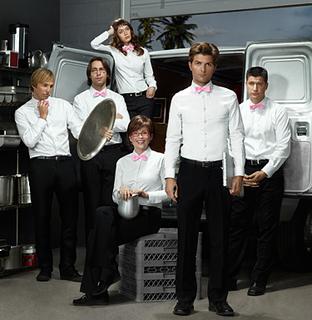
Party Down focuses on a catering business that employs a number of wannabe actors and, in one case, a burned out actor. Steering the helm - or more, accurately trying to steer the helm, is Ron, who desperately wants to do well in the food service industry after his recovery from drugs and alcohol. In addition to Rob Thomas, Party Down reunites Veronica Mars writers/producers John Enbom and Dan Etheridge on the creative team along with Paul Rudd, who once guest starred on Veronica Mars. The cast (encompassing for this purpose series regular, recurring guests, and one-time guests) also includes a veritable who's who of Veronica Mars alum: Ryan Hansen, Adam Scott, Jane Lynch, Ken Marino, Jason Dohring, Steve Guttenberg, Enrico Colantoni, Ed Begley, Ryan Devlin, and Kristen Bell herself. 


All this seems to be pointing in the direction of Party Down plus me really hitting it off, right? Wrong. Despite soldiering through both full seasons (albeit only 20 episodes in total between the two of them), I found I could not really get into Party Down. For starters, it's essentially a sitcom. Strike one. Sitcoms and I rarely do well together, as I ranted about in length in a previous post. Granted, Party Down is a somewhat atypical sitcom going to places that most network sitcoms wouldn't touch. But still, you can't really change a leopard's spots and Party Down is what it is: a sitcom. And unfortunately, Party Down's very absurdity was sometimes its downfall for me. The more ridiculous and, frankly, downright slapstick the situations became, the less invested I became. The show could occasionally make me chuckle, but more often it left me shaking my head in wonderment - and not the good kind.

The second strike against the show was its characters. In my opinion, characters make or break a show. They don't necessarily have to be identifiable and/or likable characters, but they definitely have to be interesting. The characters in Party Down were quirky, but not necessarily that interesting considering that most of them were fairly one note. And they certainly weren't likable - self-absorbed, narcissistic, downright nasty, immature, and irresponsible are more fitting adjectives to describe the majority of them. Sure, I could feel moments of sympathy certainly for Ron who is hampered down by such reckless team members. Henry, the faded out actor who is still occasionally getting recognized for his past fame as the speaker of a catchphrase in a beer ad, also could have times where he was relatable and sympathetic, although as the series progressed he seemed to be further sucked into the dysfunction of his co-workers. The rest of the characters were really a pretty dismal lot and it was difficult to root for them - or even care about them - for much of the action. And, sadly, there was little growth or change for these characters. Yes, specific events - whether big or small - did make an impact on their lives in terms of things like getting a new job or ending a relationship. But in terms of their character traits, they showed little difference from the pilot to the final episode for the most part and even less in terms of positive moves. While the characters were generally unpleasant, lots of kudos go to the actors who were all magnificent at being awful characters, totally embodying these people for the duration.

Strike three was what seems to be my usual complaint for premium cable TV shows: just because you don't have censors and can do whatever doesn't always mean you should do whatever. While Veronica Mars was smart, witty, and frequently said more with less, Party Down was foul, crude, and often gratuitous. Characters curse at the drop of a pin, nudity for no particular reason abounds, and situations occur that probably wouldn't show up on network TV (like the group catering an orgy party on one occasion and an adult entertainment party on another). I certainly don't mind shows that manage to escape from unnecessary sanitation, but I also think that the rules of good writing still apply. Simply throwing in a dick joke when you could have been clever, relevant, and funny isn't going to suffice. And I hoped for more from the creators of something so genuinely brilliant as Veronica Mars, which succeeded at being clever, relevant, and funny as well as engaging and populated with interesting, layered characters and compelling story lines. Meanwhile, Party Down had the barest of story lines, with it often feeling like there was little carryover from one seemingly self-contained episode to another. 

One thing that the writers did do an excellent job at, however, was creating a show where we looked at only one aspect of the characters' lives - their time at work - and yet managing to covering a lot of ground despite the self handicap. Granted, they did have two things going in their favor:
1) Most of us do spend a great deal of our time at work so it is something that focuses a lot of our energy as well as the place where we do end up talking about everything else going on in our lives. For better or worse, our co-workers become our de facto family members. 
2) While we don't see the cast outside of their workplace, given the nature of their catering job, we aren't stuck with the same physical set over and over again. The characters travel to different parties in a variety of locales where we get to meet new (albeit, equally dislikable) characters all the time. Still, that's not a compelling enough reason to make this show great.

In case the point wasn't obvious yet, this is not a show I would recommend, which is sad because I do really believe that this team of writers/producers/creators can do fabulous work. But this show just didn't do it for me. Part of that was undoubtedly the disappointment created by hoping for another Veronica Mars and getting something so remarkably different from it. But part of it is also because this show was never going to be my "thing." My limited research on the show found that it received some positive critical praise but had low ratings, leading to it be cancelled after two seasons. Let me know hear your thoughts about the show below. Did you watch all 20 episodes? What were your thoughts on the crew at Party Down?

Tuesday, February 18, 2014

The Feast Continues with the Characters of TV's Hannibal

With my last entry, I began to discuss the television show Hannibal created by Bryan Fuller, addressing the mood of the show as well as the basic plot with as few spoilers as I could. (Beware, however, that I am not promising this post will be spoiler free. In fact, expect spoilers if you do read this post.) Therefore, in this post it's time to move on to discussing the characters that populate Hannibal, starting with the titular character.


Dr. Hannibal Lecter

Hannibal Lecter is the eponymous character and therefore the nominal center of the show, although I personally find Will Graham the far more compelling character, at least during this first season. That being said, Dr. Lecter is certainly an interesting person and, as usual for this character, is an intriguing study in opposites. Dr. Lecter has a calm, arguably cold, exterior regardless of circumstances - probably something which serves him well in his day job as a psychiatrist. He is part of the Baltimore elite, a debonair bachelor living in a pristine house with a professional-grade kitchen (of course) and working out of a beautifully furnished office that looks more like a palatial study (think of the Beast's library in the Disney version of The Beauty and the Beast) than a workplace. Dr. Lecter is knowledgeable on many subjects, uses his words sparingly and precisely, is always impeccably dressed (down to the matching handkerchief in his suit pocket), has acquaintances amongst the upper crust, listens to classical music, and attends the opera. In fact, one of the most fascinating scenes with insight into Hannibal's mind is the one in which he weeps during the opera - this from a man who is completely stoic at the sight of a gruesome murder. Which brings us to the opposite side of this man - for all his carefully maintained exterior, he is at heart a cold and calculating murderer. When it suits his needs, he changes the style of his murders, but it is nearly always brutal and almost always for the purposes of cannibalism. And this Hannibal isn't satisfied with just feeding himself from human flesh; he loves to share his culinary masterpieces with unsuspecting guests. Whenever Hannibal makes a meal on the show, I am both impressed by the presentation of his five-star-restaurant-grade dishes and repulsed by the idea of ever eating meat again because god knows what people have been serving me under the pretense of pork loin and lamb's tongue. In all seriousness, this show has been making me consider vegetarianism more so than any other argument for it ever has.

One of the things I appreciate the most about the actor Mads Mikkelsen and his expert portrayal of Hannibal Lecter is that he isn't trying to imitate anyone else's previous version of the character. In fact, Fuller noted in an interview the exact source of Mikkelsen's Lecter: "He talked about the character ... as Satan - this fallen angel who's enamoured with mankind and had an affinity for who we are as people, but was definitely not among us - he was other. I thought that was a really cool, interesting approach, because ... not that we'd ever do anything deliberately to suggest this - but having it subtextually play as him being Lucifer felt like a really interesting kink to the series. It was slightly different than anything that's been done before and it also gives it a slightly more epic quality if you watch the show through the prism of, 'This is Satan at work, tempting someone with the apple of their psyche.'" Once I read this interview, I couldn't help seeing Mikkelsen's interpretation of Hannibal Lecter through this lens. His cold exterior doesn't just protect his secret identity as serial killer; it is who he is. He simply does not care about human life because it is something so detached from himself. Lecter is the puppet master who loves to pull the strings and watch where the marionettes go; it doesn't matter if they fall or break for he will simply change the story of the puppet theater and/or incorporate new dolls into his cast. But this interpretation of Hannibal Lecter also makes that weeping at the opera scene even more poignant - is that a moment when Lecter stops being "other" and actually feels a connection with human emotion? Or is he simply putting on his own performance for the watching Franklin and Tobias?

Dr. Lecter also seems to be finally making a human connection of some sort when he begins to admit that he is feeling a friendship for Will Graham. But, of course, because this is Dr. Lecter's twisted psyche we are talking about, his being a friend to Graham is anything but helpful. Lecter is happy to hide a serious brain condition from Will just to see what will happen if he lets it run its course and wreak havoc on Graham's mental health and life. And, of course, as we know by the end of the season, Dr. Lecter has absolutely no problem with pinning his crimes on Will Graham rather than allowing Graham to come too close to solving the mystery on his own - or perhaps he does it with the exact purpose of guiding Graham toward his secret identity. Lecter-as-Satan is interested in seeing where the chips will fall when he throws a monkey wrench in to any given situation (sorry for the mixed metaphor but it says it best), even if it means that he could be compromising his own secrets. Then again, this latter supposition may be entirely off, as we've seen Lecter throughout the first season doing whatever it takes to cover up anything that might even remotely point in his direction where crimes are involved.

Lecter-as-Satan also seems to have an unworldly quality in which he is able to discern other serial killers from thin air. Tobias follows Lecter one night and sees him murder, but Dr. Lecter seems to simply intuit from a very brief encounter with the man that Tobias is a fellow serial killer. We still don't know how Hannibal and the Minnesota Shrike relate, but something tells me that Lecter may have spotted the latter's evil tendencies in a way similar to how he determined Tobias's proclivities: He simply knew by looking at the man. I could be wrong, but it just seems like the sort of thing Dr. Lecter would do.

At any rate, I definitely appreciate Mikkelsen's approach and think it adds so much depth and personality to the character. When I first saw The Silence of the Lambs more than a decade ago, I found it psychologically terrifying. In retrospect though, Anthony Hopkins's portrayal of the cannibalistic serial killer as a creepy, bone-chilling person was perhaps over the top. It's hard to imagine Hopkins's Hannibal Lecter eluding detection from a brilliant FBI profiler when he's right in front of him. But the way Mikkelsen plays Lecter, with all his cards held close to his vest as he displays an elegant and stoic exterior, it's easy to see how even Will Graham doesn't realize one of his closest confidantes is the serial killer he's seeking. Of course, since the two actors are playing the character at very different stages in his life, perhaps it's fitting that Hopkins's Hannibal uses his crimes as taunts while Mikkelsen's Lecter instead subtly plants hints to drive people away from suspecting his role in any wrongdoing.

Will Graham

As I mentioned earlier, Will Graham is the real focal point of the show for me, especially in the earliest episodes when we were still seeing so little insight into Hannibal's actions, let alone learning any of his motivations. Hugh Dancy hasn't let me down in past roles, and he doesn't disappoint here. He completely embodies the role of a character who has so much empathy that he sometimes has difficulty distinguishing himself from the killers he profiles. The flip side of that coin is he also has a well-spring of sympathy for the victims of these crimes and therefore wants very much to help them by bringing their killers to justice. Graham also feels an inordinate amount of guilt, protectiveness, and blind idealistic faith where Abigail Hobbs is concerned. Meanwhile, he can't shake the feeling of being connected to her cannibalistic murdering father, who continues to haunt him throughout the season despite being killed by Graham in the first episode. Graham also feels a deep and sympathetic connection with murderer Georgia Madchen, which is somewhat understandable given her sad fate.

As season one progressed, the nightmares Graham had after visiting particularly blood-curdling crime scenes began to turn into waking hallucinations. Other symptoms appeared that made Graham question his own mental sanity, and Dr. Lecter's not-so-subtle hints did nothing to ease his concerns. Graham's fear of becoming mental unstable is stoked by the constant stress of a new vicious murder that he must dissect in order to find the killer, and he spirals further downward. Dancy plays all of this believably, and the viewer feels increasingly concerned for him. When the viewer begins to know more than Graham does (i.e., the brain encephalitis that Dr. Lecter hides from him), the feeling is less of concern than simply great sadness. The viewer is constantly rooting for Graham because he's the good guy of the show. It's not simply that he's the hero (albeit, a somewhat unconventional one) of the show; he's just genuinely a good guy. Graham has shown his compassion and humanity over and over again as he works the various cases of cold-blooded killing. It's heartbreaking to see him feeling so alone and repeatedly turning for help to Dr. Lecter, the one person least likely to actually provide it (although he certainly maintains a good pretense of pretending to care for Will's wellbeing).

Despite all this (or perhaps because of this), Graham's background is the one I'd most like to have fleshed out in the upcoming season. Through little hints dropped here and there, we know that Graham used to be a cop before becoming an FBI lecturer. But it had been some time since Graham had been in the field before Jack Crawford came knocking at his door. Other than that, we don't know many details of Graham's past professional life and his personal life is pretty slim on details as well. We know that he's currently single, has a plethora of stray dogs he's adopted, likes to fish, used to fix boat engines back in Louisiana as a teen, and is arguably on the autistic spectrum toward the Asperger's side. Whether he has any living family is debatable - certainly no one ever appears for him and his support system seems virtually nonexistent, which is all the more lamentable when he feels himself beginning to crack.

In addition to getting more backstory, which is my hope, I feel certain that season two will bring more forward character development for Will Graham. And he sits imprisoned for crimes he now knows were committed by Dr. Lecter, Will is going to have to prove himself as being able to convince others of his sanity and by finding the evidence to condemn Hannibal, thereby exonerating himself. Of course, I want to see Will cleared of all false charges, but I'm also a bit concerned as to where the story will go if we already see Dr. Lecter in prison this early in the game. Fuller apparently has an ambitious seven season arc planned in his mind, which will eventually - by season four, in fact - get to the source material we've already seen on the silver screen, so I trust that he knows what he's doing. In the meantime, I'm definitely curious to see where this roller coaster is going to take us next. Within a teaser video, Fuller notes that while the first season was a game of cat (Hannibal) and mouse (Will), the second season will be a game of cat and cat. I for one am interested to see how that will play out.

Jack Crawford (and to a lesser extent, Phyllis "Bella" Crawford)

Jack is the linchpin of the series in many respects for making Will Graham and Dr. Lecter come together as well as for taking Graham out of the classroom and exposing him to horrific crimes firsthand. Some time is given to developing Crawford as a character, but I think still more could be done. Crawford is clearly a sympathetic man who tells Will from the outset that he will be there for him. But when push comes to shove, he's nowhere around when Will needs him. His locker room style speech, in which he provokes Will to be a quitter but says it will haunt him, is arguably the opposite of supporting Will. In fact, by the end of season one Crawford seems to be actively working against Graham (of course, fueled with false information given by Hannibal). Given his own potential guilt in the situation as well as his position as head honcho in his department (and therefore first to be blamed by the even higher ups), it's not absurd for him to have this reaction. Nonetheless, it's disappointing to see someone who claimed to be there for Will to turn around so quickly to be against him. However, Crawford keeps his emotions far from his sleeve, so what he's feeling at this time still remains to be seen. I have hope that we'll see more of him - both physically obviously but also a deeper look into his character - in season two.

That all being said, there were two situations in season one where we really got insight into Crawford's mentality. The first came when we learned that there was some marital trouble between Jack and his wife, whom he calls Bella for her beauty. Bella reveals in a secret session with Dr. Lecter that she has terminal lung cancer but hasn't been able to tell Jack yet. Jack knows something is wrong but doesn't suspect anything close to the truth. As Crawford and Will question a serial killer's wife and she describes how his cancer caused him to drift away from the family, we see the light bulb go off for Jack. It's such a wonderful moment of acting from Laurence Fishburne - we see Crawford come to a stunning and horrifying realization, thinking through its ramifications, and then having to put on a professional face to finish up his job but not before he starts to tear up a little. This moment also highlights an important aspect of Crawford - he's a profiler himself and one who has done remarkably well for himself. This fact is often eclipsed when Will Graham arrives on a crime scene and imagines much more about the killer than anyone else there has reasoned out yet. Unfortunately, the cancer subplot is one that gets left along the wayside as the rest of the season speeds along toward its tragic conclusion. We really don't hear of Bella's cancer again let alone see her on screen. However, knowing that Crawford has this personal crises lurking in the background makes it more understandable that he is not as available to support Will as he thought he would be back when he promised Graham to be by his side should the going get tough.

The second situation that shows off Crawford's personality is when the Chesapeake Ripper case resurfaces. We learn that this was one of Crawford's cases that went cold and the killer eluded him; worse still, a young cadet who Crawford pulled out of training to work on this case was murdered by the Ripper as a result. Thus, we see Crawford struggling with his own guilt and becoming obsessed with finding the Chesapeake Ripper once and for all. The Ripper - who we know is Dr. Lecter, a man even closer to Crawford than ever - plays on the harp strings of Crawford's conscience, sending him messages of the trainee's dying words to get under his skin. It certainly does and in moments of weakness, we see Crawford having nightmares that rival Will's nighttime fears.

One last side note on Jack Crawford: as the show progressed into the winter months, Crawford began walking around more often in a trench coat and fedora-style hat. He looked the very picture of a film noir detective and also reminded me of Pushing Daisies's private eye Emerson Cod, which just made me happy. With that silly note aside, let's move on to the "lesser extent" of this part. Crawford's wife Bella is an interesting character of whom the viewer unfortunately sees little. She's a NATO worker who has been married to Jack for some time, presumably happily all that time. When she gets her cancer diagnoses, she shuts down and refuses to talk to her husband, deciding instead to confide in Dr. Lecter - albeit a psychiatrist but also one who works with her husband. But perhaps telling such a burdensome secret to a person she's only met once is less emotionally upsetting to her than talking to someone who cares for her and for whom she loves very much. I think it would be telling to see what Bella was like before her cancer diagnosis for the present Bella is very cold and is actively trying to emotionally stonewall those who love her. And here's one more Pushing Daisies connection before moving on to the next character: Bella Crawford is played by Gina Torres, who also played the role of Emerson's former love interest Lila Robinson.

Dr. Alana Bloom

Dr. Bloom is another character I'd like to see more fully developed in the coming season. Although she is member of the regular cast and shows up in most episodes, she often seems more like a vehicle to move the show in one direction or another than a character in her own right. Dr. Bloom is an FBI psychiatrist who works on cases and in the classroom, thus having a history with Will Graham previous to the pilot episode. She is the one who first recommends Dr. Lecter to Jack Crawford as someone to act as the unofficial psychiatrist to Will Graham; she also serves as a potential love interest. These two facts seem to be her biggest functions in the show, but Dr. Bloom has other important roles to play. Despite obviously respecting Dr. Lecter so much, she is not afraid to disagree with him when Jack asks for their help on a particular case. Dr. Bloom worked on the original Dr. Gideon case (more on this later), which heightens her role (and threatens her safety) in the episodes where he appears.

She is also the closest thing Will has to a friend, although he clearly feels more for her than just friendship, which is perhaps why the Dr. Alan Bloom of the books became the Dr. Alana Bloom of the TV show. As the season progresses, it's clear that she also feels more for him although she's not ready for a relationship with him (or anyone else for that matter). Although I'm not usually much of one for romances, the scene in which they kiss for the first time made me feel all gushy and "aww" for them, even if nothing came out of it. Nonetheless, I was rooting for them to get together then and I'm still hoping it's something that can come to pass later on in their lives. For a show with so much darkness and depravity, it would be nice to have some relief for that. Likewise, for characters who have such sadness around them always, the viewer wants them to have a happy ending in there somewhere, somehow.

Incidentally, there's also an earlier scene in which Dr. Lecter makes some wry comment toward Dr. Bloom and she responds that he's being just like Will by trying to "flirtatiously change the subject." As this occurs before the episode with the on-screen kiss between Dr. Bloom and Graham, it's a moment that allows you to realize that Dr. Bloom is intuitive enough to read Will's feelings for her even if she hasn't otherwise let on to this fact at this point in the series. It's also a very telling moment for Dr. Lecter and his personality. Whenever Will would make flirty comments towards Dr. Bloom, you could tell that underneath the grin he puts on as a front, he really means this stuff - perhaps he's even secretly hoping that Dr. Bloom will call his bluff and agree with him wholeheartedly. But when Dr. Lecter makes his supposedly flirtatious remark, he comes across then as more asexual than in any other moment in the show. It's as though he's simply reading a line that he thinks he should say at this moment, as though he's been studying humans from a distance and now tries - and fails - to recreate their speech patterns.

Like with Will Graham and Jack Crawford, we don't get a ton of backstory on Dr. Bloom. There's little information given on her personal life or what she does outside of the FBI. This is something I'd like to see more of in the next season, especially if she and Graham do eventually get together as a couple. Despite not a lot of depth in the source material, I give lots of props to Caroline Dhavernas for filling this role with so much passion. The scene in the series finale in which she sits in her car alone and mutely screams over and over again was one of the most poignant moments in a very emotional episode. In fact, I'm embarrassed to say that she so fully entered this character that I didn't even realize I was watching the same actor who portrayed the main character in Wonderfalls.

Abigail Hobbs

Abigail Hobbs is an incredibly complicated character who adds so much depth to the show. The daughter of a serial killer who was nearly killed by that same man, she is emotionally damaged as well as physically injured by the evil acts her father committed. It is perhaps because of this that she is so lost and willing to cling on to anyone, even Hannibal Lecter. Despite realizing that her father's last phone call came from Lecter, Abigail trusts Hannibal completely - far more than she trusts Will, who is actually the one interested in her wellbeing rather than protecting his own interests. Abigail also latches on to Dr. Bloom, but it's only to Dr. Lecter that she will confess her darkest secrets. Abigail's troubled soul really amped up the emotional impact of Hannibal, and it's sad that her character will most likely not be appearing again in the second season.

Freddie Lounds

Another complicated character, Freddie Lounds is a crime reporter working for the blog TattleCrime. In the beginning of the series, she is especially antagonistic toward Will Graham, calling him insane and writing that he can catch psychopaths because he is one himself. As the first season proceeds forward, Lounds becomes closer to Abigail and intends to help her write a book about being the daughter of an infamous serial killer. Freddie's dubious information-collecting methods and tabloid writing mean that sometimes she is hampering police investigations while other times she is actually helping out the FBI. Meanwhile, her motivations are never entirely clear: Is she doing this just for money and infamy? Or does she also believe that her actions will help to take down criminals and thus bring justice? Usually, it seems like the former but at times the latter seems to prevail. For instance, she seems more sincerely concerned with Abigail's finding closure than Dr. Lecter does. Actor Lara Jean Chorostecki does a great job with this character; the scene that she really nails on the head is when Dr. Gideon kidnaps Lounds and forces her to be his assistant as he dissects the still living Dr. Chilton. She appears cool, calm, and collected yet you can still read the fear and concern underneath the facade she puts on to make it through the situation.

An interesting thing about this character is how Hannibal creators decided once again to play with the cannon. In the original novels and movies, Freddy Lounds is a male reporter who is described as unattractive and slovenly. Here Freddie is a beautiful woman with good taste and perfect grooming. As the world of Hannibal is already very male-centric with Will and Hannibal taking up most of the screen time, it feels right to inject another woman into the story. In fact, Fuller says as much in an interview: "I wanted to have more of a [gender] balance. In the last six episodes, I was so happy with the richness of the female characters and how they were representing many different points of view of the world’s stories." It's not the 1970s anymore; women are crime reporters as often as men are and are just as determined to get to the story no matter what cost, so this was a brilliant move on Fuller's part. In an interview, Chorostecki notes how Fuller told her the newly imagined Freddie Lounds was based on Rebekah Brooks, the real-life tabloid news editor who scandalized a nation when accusations emerged that she hacked victims' voicemails to get the scoop. Chorosteck goes on to explain: "I went home after this meeting and read a great Vanity Fair article about Rebekah Brooks ... and it was a great kind of insight into who Freddie might be. She’s a younger version and I call her spirited. She’s unflappable and she ignores the rules at every point possible, if she needs to. And she’s really good at her job, so I think that’s something. She sometimes fails, but she always manages to find her way around things." Freddie Lounds is such a rich character, with a whole depth of motivations and history to explore yet, that I'm sure we'll be seeing more of her in season two as well.

Dr. Bedelia Du Maurier

Dr. Du Maurier is a new addition to the characters of the novels and thus a way to play with the cannon, keeping viewers on their toes. She is yet another complex character whose motivations are murky at best. Dr. Du Maurier serves as Dr. Lecter's own personal psychiatrist, and indeed is his very own all alone, for after being attacked by a patient, Dr. Du Maurier went into retirement. Dr. Lecter refused to take a referral for another psychiatrist and now goes to Dr. Du Maurier's house to continue his sessions as her one remaining patient. This is a mystery that continues to simmer; there is clearly a lot more going on with this backstory of the attacking patient who knew both Drs. Du Maurier and Lecter. What role Hannibal played in either orchestrating or stopping the attack (or in all likelihood, given Hannibal's nature, both) remains to be seen. The relationship here is tense: Dr. Du Maurier is clearly comfortable enough to continue seeing Lecter as a patient even in her own home but in the very first episode in which she appears, she says in no uncertain terms that they are not friends - despite Lecter noting that they are friendly. Dr. Du Maurier seems to know or at least sense that Hannibal is dangerous, but she does not seem to be concerned that he is a threat to herself. Of course, we know that Hannibal has no concern when it comes to hurting or killing someone close to him if it will suit his purposes, so Dr. Du Maurier might want to take notice.

Again, I thought it was a good move to add some more female members to the cast to help round it out. Dr. Du Maurier is a compelling character because she appears equally fragile and tough all at once, as though this attack on her both rattled and strengthened her at the same time. This seems like a very true-to-life response, although we'll have to know more of the attack details to see if this supposition of mine is correct. Dr. Du Maurier has only shown up in a handful of episodes so far, though I suspect we will see more of her as we delve into this secret shared by her and Hannibal. (Indeed, a very brief teaser for the second season has Dr. Du Maurier popping up several times.) She is expertly portrayed by Gillian Anderson, who plays Du Maurier as almost emotionless so placid is her face and calmly evenly her voice, thus hiding anything that might betray this secret history. It was actually a headline about Gillian Anderson taking on this role that first alerted me to the existence of this show and made me a bit curious to find out what it was all about, although it was discovering that Fuller was at the creative helm that made me decide to start watching it.

Beverly Katz

Perhaps the influence of CSI has been so great that no crime procedural show in the modern era can exist without someone somewhere analyzing to death every scrap of anything left behind at a crime scene. Hannibal seems to be no exception to this trend. This is all well and good, but there are already enough shows out there that do this and the introduction of the next three characters I'm about to discuss do little to add to the complexity of Hannibal's world. Beverly Katz is one of three FBI crime scene investigators who interact with Will Graham when he's on a case. She's the one who is the most interested in Graham's ability to get into the minds of serial killers, provides helpful advice to him when she can, and seems occasionally to get through his emotional barriers to act as a friend. But for the most part, she's a pretty blasé character with no real depth of her own. Nevertheless, she is a series regular, and I struggle with determining why she was considered as an essential character on the show. The times when she acts as a sounding board for Graham could just have easily been times he turned to Dr. Bloom if Beverly were not a character on the show. At times, I think she was meant to serve as the "comic relief" of the show as she frequently has a snarky comment to make at a crime scene. But generally the dark humor she spouts comes across more as a sad testimony to how hardened the crime scene investigators are to the horror they see than as something actually humorous. By the final episodes of season one when Will is spiraling further down his personal descent, this character finally felt useful for me because her former almost permanent smirk is replaced by deep-seated worry about Graham becoming mentally unstable. Portrayed by Asian-American actor Hettienne Park, Beverly also brings some much-needed racial diversity to a show that is largely populated by Caucasians.

Z and Jimmy

Tweedledum and Tweedledee here round out the trio of crime scene investigators who interact with Will regularly on cases. For some reason, despite appearing in nearly every single episode of the show thus far, these two actors are listed as "guest stars" every week rather than series regulars like Hettienne Park. Portrayed by Aaron Abrams and Scott Thompson respectively, Z and Jimmy also seem like they are there to serve as the comic relief (especially given that Scott Thompson is known more as a comedian than an actor). However, just like with Beverly Katz, I don't necessarily find them that entertaining. Take a snippet of conversation between the trio and Will as they discuss the bodies left behind by the Angel Maker serial killer:

Beverly Katz: "Death makes angels of us all and gives us wings where we had shoulders smooth as raven's claws."
Brian Zeller: Robert Frost.
Will Graham: Jim Morrison.
Beverly Katz: Even a drunk with a flair for the dramatic can convince himself he's God. Or the Lizard King.
Jimmy Price: God makes angels. Jesus was fond of fishermen. Are we talking hardcore Judeo Christian upsetting, or just upsetting in general?
Will Graham: This is a very specific upsetting.
Brian Zeller: Increased serotonin in the wounds is much higher than the free histamines, so, uh... she lived for about fifteen minutes after she was skinned.
Jimmy Price: Powder residue on the neck of the soda bottle shows Vecuronium - scotch and soda and a paralytic agent.
Brian Zeller: Kneeling in supplication at the feet of G-dash-D.
Jimmy Price: Supplication is the most common form of prayer. "Gimme, gimme, gimme."

This quick exchange is no doubt meant to be funny but it mostly came across as callous, with only Will's doubly meaningful line of "This is a very specific upsetting" reminding us that these are people who have been horribly treated both in the manner of their murder and the desecration of their bodies after death. Like I said earlier, Will is always the one to provide the context and the human compassion in every case.

But I do have to admit that the two of them finally being stunned into silence by the revelation that Will might be a serial killer within their midst made that moment even more hard hitting. If they hadn't been goofing around at previous crime scenes, their reactions wouldn't have been so priceless. Nonetheless, their roles are so limited that I didn't know Z's full name was Brian Zeller or even have any idea with Jimmy's name was at all until I looked up the show's cast. In an early episode, Z remarked something to Freddie Lounds about her using him for information, which gave the impression that we might learn more about him outside the crime scene/crime lab, but so far that has not been true. Maybe these characters will get larger roles with deeper characterizations in the future; if not, I don't see much of a point of them being around and would be fine with them slowly fading away into the background.

Dr. Abel Gideon

Portrayed by the always wonderful Eddie Izzard, Dr. Abel Gideon is a patient at a psychiatric hospital for the criminally insane, where he ended up after murdering his wife and her entire family. While there, Dr. Gideon becomes convinced that he is the Chesapeake Ripper, opening up a Pandora's box of mayhem after he kills a hospital nurse using the modus operandi of the Ripper. The real Chesapeake Ripper (aka Hannibal Lecter) can't stand by idly and let an imposter tarnish his good name so he is compelled after years of (seemingly) inactivity to kill again. Dr. Gideon is a horribly wicked character who it's just so hard to hate despite his evil acts. His genuine confusion as to whether he is the Chesapeake Ripper or not makes it abundantly clear just how mentally ill he really is. His hatred of the psychiatrists who did little to help him is perhaps understandable; his desire to brutally kill them as a result is not. His witty repartee belies his true intelligence hidden under the haze of mental illness. Izzard did wonders with this character, making him at turns laughable, pitiable, and horrifying. Although he's mostly served his purpose on this show, I wouldn't mind if Dr. Gideon popped up again on Hannibal in the future.

Dr. Frederick Chilton

Dr. Chilton is an important character in the Hannibal Lecter cannon, but here he has only shown up in a couple of episodes so far. Nonetheless, he played an instrumental role in Lecter's life by being the psychiatrist to convince Dr. Gideon that he was really the Chesapeake Ripper and thus resulting in Lecter's subsequent rampage to show the world that the real Ripper was still at large. Dr. Chilton is a very unlikeable character not only for driving a patient to believe himself to be an even worse murderer than he is, but also for antagonistically taunting Will about his ability to see through the eyes of a serial killer. Nevertheless, he doesn't deserve the fate he got of being nearly eviscerated to death at the hands of Dr. Gideon. And despite being a character so easy to dislike, I did enjoy the interactions between him, Dr. Lecter, and Dr. Bloom in which they discussed various aspects of psychotherapy and criminal psychology. I doubt that we've seen the last of Dr. Chilton in this series, so I hope than when we see him again, we'll get more of the psychological talks and less of the cruelty. After nearly being murdered, perhaps Dr. Chilton will have toned down his haughty attitude. Pushing Daisies fans will be recognize Raul Esparza, the actor who plays Dr. Chilton, as Alfredo from season one of that show. Kudos to him for displaying his acting chops with a character so very different from the sweet door-to-door salesman of homeopathic mood-enhancers with a secret hankering for Olive Snook.

Georgia Madchen

Georgia Madchen was both one of the creepiest and most pathetic of the killers to appear on the show so far. Unlike the others, she is not a serial killer but a mentally ill woman who murdered one person so viciously that Will was called in on that case. Still, she's the one who is the most spine-chilling and haunting, perhaps because of her disheveled appearance and inability to see clearly, even if in a warped way. Although she only showed up in a couple of episodes and won't appear in future ones, Georgia Madchen was such an engaging character that I feel it wouldn't be right to walk away from this post without mentioning her briefly. Georgia has a very rare psychological disorder that affects her perception. For starters, she doesn't even realize that she's still alive. Georgia also can't see the faces of others, which is what caused her to rip apart the face of her friend when she murdered her. She has been/feels abandoned by her mother and the professionals who can't find a cure for the mental illness she's had since childhood. When Will is able to see into her mind clearly and figure out her motives for killing a childhood friend, she becomes obsessed with Will and stalks him, not with the intention of hurting him but so that she can find out if she really is still alive. This ends up being her undoing as she stumbles across Dr. Lecter in the process of murdering someone in order to frame Graham. He doesn't realize - or at least not right away - that she couldn't see his face so he kills her as well, pinning that murder on Will also. Besides her rare mental illness, one of the other interesting things about Georgia Madchen is that she is played by Ellen Muth, star of Bryan Fuller's show Dead Like Me, in which she played a character also named Georgia who was actually dead.

In addition to Ellen Muth and those I've mentioned above, three other actors who made appearances in Hannibal also had roles in Fuller's past TV shows: Ellen Greene (Aunt Vivian in Pushing Daisies) made a brief appearance as one of Hannibal's socialite acquaintances, Molly Shannon (a guest star on Pushing Daisies) guest starred in an episode where she coached young children to kill their biological families (one of those episodes where the killer's motivations were never fully explained to my satisfaction), and Chelan Simmons reprised her Wonderfalls role of Gretchen Speck in episode two of the first season of Hannibal. My personal favorite crossover tidbit is that there's talk of an upcoming guest star who will play the role of an acupuncturist named "Katherine Pimms" - the pseudonym used by Chuck's character in Pushing Daisies whenever she went undercover.

All of these appearances suggest that we'll see other fan favorites from the "Fullerverse" in Hannibal's season two. Personally, I think I'd love to see Lee Pace make a guest appearance on a future episode; with his acting prowess, he'd be sure to do great in any role given to him. But then again, given that his likely choice of roles would either be serial killer or victim, I'm not sure I want to see "Ned" tainted in that way. In all likelihood though, we'll be seeing him as Fuller has already noted that he originally intended to find a place for Lee Pace in season one.

How about you, dear reader? Is this anyone you'd like to see guest star on Hannibal in the upcoming season(s)? What characters would you like to see further developed? Where do you want the plotlines to go? Pray, do tell!

Monday, February 17, 2014

A Feast for the Mind: Hannibal on the Small Screen

As some of you loyal long-time readers may recall, some time back I was on a quest to watch all the shows developed by Bryan Fuller, making my way through the charmingly surreal Pushing Daisies, the puzzlingly bizarre Dead Like Me, and the quirkily comic Wonderfalls. Having thought I had exhausted all that Fuller's creative mind had come up with so far, imagine my delight when I discovered that a new show I had heard some buzz about was another of Fuller's creations. Fuller's latest venture is in many ways starkly different from the others, although there are certainly some similarities as well.

But just what is that venture, you ask? It's none other than a television show based on everyone's favorite villain, Hannibal Lecter. The latest Hannibal delves into the mind of the psychiatrist turned cannibalistic serial killer in the years before he is caught. Hannibal begins with Jack Crawford, the head of the FBI's Behavioral Sciences unit, seeking help from Will Graham, cop-turned-instructor in profiling at the FBI academy, in catching a serial killer known as the Minnesota Shrike. Graham is highly effective because he doesn't just think through what a killer would do; he reconstructs the events of the murder casting himself in the role of the killer. He so completely identifies with the killer that the lines between him and the killer are beyond blurred - they no longer exist as Graham wholly takes on the identity of the murderer. Concerned for Graham's mental wellbeing, Crawford consults with Graham's friend and FBI psychiatrist Dr. Alana Bloom, who recommends that Will be paired up with her colleague Dr. Hannibal Lecter to keep an eye on Graham's mental health. Thus, Dr. Lecter becomes privy to the inner workings of Will Graham's mind while also learning a great deal of detail about FBI cases involving grizzly murders, usually at the hands of serial killers.

Hannibal is such a multi-layered show that it's hard to know where to begin when discussing it. One of the things I very much enjoy about the show is that it is, as the credits put it, "based on the characters" from author Thomas Harris's novel Red Dragon, rather than based on his novels themselves, which have already been treated in Hollywood movies. Because of that, Hannibal plays with the characters and plotlines of the story already well known by fans of the novels and/or movies. It does not stray from the characterizations (for instance, Hannibal Lecter is not suddenly a great guy who would never dream of killing and eating other people), but it can play around with the timing of certain events as well as add or take away interactions between Graham and Lecter as needed/desired to make new emotional impacts and plot twists. Creator Bryan Fuller speaks to this in an interview, in which he said: "I felt that there was an opportunity to tell a chapter of [Lecter's] story that hadn't been told before. We've see him incarcerated, we've seen him post-incarceration having escaped, and we saw him as a young man, but we haven't seen him as a practicing psychiatrist and a practicing cannibal. That's the most interesting part of his life and for some reason, it hadn't been the subject of any of the stories. The backstory was the only indication that we got of what he was like when he was out in the world. It just seemed like it was rich, unexplored territory - so it seemed like that was valid. ... As a fan of the books, I wanted to be true to the novels and yet be able to go to new and different places with the characters. But you have to honor the source material, you have to respect it, because… it's great!" Being such an avid fan of the original novels and movies, Fuller is clearly happy to embrace them but to also do so while adding his own dramatic flair. And while the show is in some ways trying to find a place in the canon (several interviews with cast and crew have indicated that the events in the show are occurring four or five years before Red Dragon), it is not a period piece. Fuller made the bold choice not to have this set in the late 1970s, which would be the correct time period for these events if they are occurring just before the events of Red Dragon, but has it set instead in the present day. Thus, all the conveniences of modern-day life - including and perhaps most importantly, all the fancy equipment in today's crime labs - are seen throughout the show.

This means that Hannibal's fresh new insights allow for uninitiated audiences to the Lecter cannon to be able to watch the show without feeling lost. If you've never read or seen The Silence of the Lambs, you can still watch this show from the beginning without missing any major plot points. What's especially fun (if anything about this incredibly dark show can be called fun) about that is there was almost an air of mystery to the first few episodes of the show. Viewers in the know are aware that Lecter is a cannibal, that he is the Chesapeake Ripper, and other such facts, but these points are only very vaguely hinted at in the show's introduction. It's only later that Hannibal's crimes begin to be revealed without a doubt. But before then, all bets are on. For instance, when the Minnesota Shrike was introduced in the pilot episode and Graham is the first one to deduce that he is eating his victims, my gut reaction was that this serial killer would turn out to be Dr. Lecter. I was of course wrong, although the show did allude to a connection between the actual killer and Lecter - a connection that continues to remain a bit of mystery as the show approaches its second season.

Another thing the show does very well is open a Pandora's box of mystery and mayhem with plotlines that hold significance beyond a single episode, unlike the typical cop procedural show in which each murder(s) grips the viewer for one episode only and then disappears. There is some of the latter in Hannibal, and I found it unfortunate that the larger (and certainly more important) stories sometimes crowded out the full fleshing out of other storylines. But let me step back and try to explain my meaning here a little better. As I mentioned, the first episode introduced a serial killer known as the Minnesota Shrike, who had purportedly kidnapped and murdered eight college girls in his state, although their bodies were never found. Graham's insights caught the murderer, but not before he killed his own wife and attempted to kill his daughter Abigail (who just happens to bear a remarkable resemblance to the missing girls) and not before his crimes inspire a copycat killer. In a typical procedural show, that would be the end of the story. But here, this story continues on. Both Graham and Lecter take on the role of guardian to the newly orphaned Abigail, although they each have their own motives for doing so, and she shows up several more times throughout season one. Throughout the rest of the thirteen episodes of season one, Graham is haunted by visions of a giant elk, which symbolizes the Minnesota Shrike and the disturbing antler room where he mounted his victims. The copycat killer, who we deduce almost immediately is Dr. Lecter, remains at large and thus is someone whose existence is constantly lurking in the back of Graham's and Crawford's minds. The other major ongoing plotline is the search for the Chesapeake Ripper, a serial killer who has eluded Crawford in the past and left a heavy emotional impact on him as a result of his actions. Now that Graham is on the case, there's perhaps hope of finding him at last ... but, of course, we know the Chesapeake Ripper is Dr. Lecter, and even Graham cannot imagine (at least not at this point in his life) that his confidante is the evil person for whom he is seeking. Thus, the Chesapeake Ripper is a recurrent concern for all the major characters.

Still, like I said, there are some serial killers introduced that I feel get the short treatment. For instance, the second episode introduces a pharmacist who is putting diabetic people into comas so that he can bury them alive and use them as a plant food for his mushroom garden. When he learns that Graham can get inside his mindset, he decides to do Graham a "favor" by kidnapping the then-comatose Abigail to add to his mushroom garden. When Graham stops him before he gets out of the hospital with Abigail, the pharmacist tells him that Graham is missing out on the opportunity to communicate freely with Abigail via the mushrooms. This serial killer and his very bizarre theories were never fully explained to my satisfaction. What exactly is his obsession with mushrooms? Why does he think they can help people communicate? And most importantly, if he thought Graham needed to communicate with Abigail, who was he himself trying to communicate with via his garden? It certainly didn't seem like the random patients he saw in his practice were the goal audience. This particular storyline dropped away as quickly as it appeared and seemed all along only to be a vehicle to further show off Will's prowess of getting into the serial killer's mind as well as a reminder of his deep connection with Abigail. This is only one example; there were other serial killers, such as the Angel Maker, who came along and committed horrific crimes that were never mentioned again outside of their set episode.

Speaking of such horrible things, an important disclaimer is that this show is not for the faint of heart. The crimes concocted by the serial killers here and displayed in all their gory detail make shows like Criminal Minds seem like tales for kids. As one of the actors from the show explained in an interview: "Quite frankly, I don't think that there's anything on network TV that can compare with Hannibal and I think that's really exciting. It’s very smart of NBC to be picking up a show that has so much of a cable feel to it. ... If the networks really want to keep audiences, [dark shows are] what they're going to have to cater to in a good way because it's good TV. We need more Breaking Bads, Mad Men, Walking Deads and Homelands on NBC, ABC, CBS and FOX." While I agree with her in general, there were actually times I had to put a hand out to cover up what was shown on the screen because it was just too unsettling. Over time, Graham begins to have nightmares and hallucinations regarding the things he's seen in the field, and I can certainly sympathize. Having watched a bunch of episodes in one day, I found myself that night having a hard time falling asleep with all those creepy images in my head. In Fuller's other shows Dead Like Me and Pushing Daisies where, yes, death was a thing - and with murder being the subject in the latter - the victim's bodies weren't gruesome per se. Indeed, on Pushing Daisies, the strange deaths that met these victims often gave a comic look to their corpses, allowing for the dark humor that show excelled at achieving. Here there really is little humor beyond the occasional witty line to lighten the very bleak mood of the show, although I think perhaps that's for the best as it's fitting with the show's mood.

Speaking of mood, the show's plot is enhanced by an appropriate atmosphere that covers every aspect of the show. Each episode of the show is given the French name of a course in a five-star meal, quietly reminding the viewer each week of the cannibalistic nature of one of the show's main characters while also gently evoking the elegant lifestyle he fronts. The music is subtle but always fits any given moment perfectly whether it's a light-hearted piece of classical music for a dinner party or an eerie tone for one of Will's darker moments.  Largely set in the mid-Atlantic region of the U.S. as well as Minnesota but filmed on location in Ontario, Canada, the backdrop reminds me of the early seasons of The X-Files, which were filmed in Vancouver, Canada. The landscapes are largely rural areas where it's cold, it's rainy, it's snowy, and/or it's grey. These landscapes serve to perfectly capture the bleak outlook of a show about a finely tuned but heartless serial killer matching wits with a mentally unstable but righteous FBI profiler. To quote again from one of the show's actors, she notes that "Hannibal is filmic -- there are a lot of surreal elements in it. It’s very psychologically-based. Hannibal’s tone is so different than anything I’m seeing on network television right now. ... Hannibal is very film-like with high production values and great actors." Indeed, there were a lot of times - especially with Will's crime re-constructions, nightmares, and hallucinations - when I would think to myself that the special effects were visually stunning and most of have cost a boatload to create, both in money and time. But the finished product is worth it, with a result that does indeed feel more cinematic than the usual fare on TV. The fine directing also pushes toward this finished masterpiece; several of the episodes were directed by the excellent David Slade, who also directed the pilot for NBC's one-season cop drama Awake (ah, but what a season!). And the icing on the cake with Hannibal is that the viewer is in a special place of almost omniscience throughout the show. While we don't know every single thing going on here (we are certainly kept in the dark about the characters' past lives and many of Hannibal's actions as well as his motivations), we get to see a lot more than any other single character knows at any given time (with the exception maybe of Hannibal himself, who can probably surmise a lot of what he doesn't physically see himself).

This post is a bit rambling, but I think I've covered a decent amount of the basic plotlines for newbies without giving away too much in terms of spoilers as well as discussed some of the thematic mood. As it's already a lengthy post, I've decided to break this down into a two-part post to spare you a very long read. In the next entry, I'll dig deeper into the character development and acting as those components are a huge part of what makes this show so successful.