Showing posts with label romance. Show all posts

Monday, September 30, 2019

Dear Reader, I Watched Them All

In this post I'll be taking a brief break from my reviews of AFI Top 100 movies to discuss some other films I saw this year. Specifically, I finally got around to watching the various screen adaptations that exist of Charlotte Bronte's famous novel Jane Eyre. Many moons ago when I was still an undergrad, I took a course on Victorian literature and read Jane Eyre (alas, with the big reveal having been already spoiled for me by a too chatty classmate; I will be kind enough to tell you all that this post will indeed contain spoilers for the plot, so proceed at your own risk). After that I meant to watch some of the movie adaptations; I even recall seeing a trailer for one of them when it was new! But me being me, this kept getting pushed off to some later date when I would 'have free time' (cue laughter here).

Fast forward to the beginning of this year when I was trying to catch up on some podcasts and listened to Can I Just Say's episodes on Jane Eyre, both the novel and some of its adaptations. Of course, I couldn't simply listen to these episodes with no context though! While I didn't re-read Jane Eyre (too little time to read all the books I want to read as it is), I did make a point to finally watch the film adaptations -- the three discussed on the podcast before listening to it and then just to round everything out, I finally finished this little 'project' of mine but watching one more, which is where I'll start my reviews, as it's freshest in my mind.

Jane Eyre (1944)

This little 'project' of mine ended with the earliest of all these adaptations, which perhaps wasn't entirely fair to save for last, but that is what happened. This wasn't my favorite of all the adaptations; indeed, I found the pacing a bit slow at times. But it was certainly a solid addition to the list of Jane Eyre films and must have been so even more when it first came out to viewers who hadn't seen many previous screen adaptations of the novel, particularly as a "talkie."

The film opens with a young Jane Eyre being interviewed by Mr. Brocklehurst concerning her so-called bad behavior. Peggy Ann Gardner was the most spirited of all the young Janes I saw and was delightful as a result. Agnes Moorhead, best known for her role as Samantha's mother on Bewitched, was absolutely fantastic as Jane's Aunt Reed. She manage to convey in a few facial expressions just how awful this character was, which was necessary for this adaptation as we don't see any of her earlier abominable treatment of Jane. Young Jane's hope of a wonderful new life at school is quickly tamped out when she arrives at the dour Lowood School. But here she makes a friend in Helen, another school child who is played by a shockingly uncredited young Elizabeth Taylor!

Jane quickly ages into a young woman and the role is taken over by Joan Fontaine; I cannot recall having seen Fontaine in any other movie before, but I was immediately struck by how much she looked and sounded like her sister, the actor Olivia de Havilland, probably best known for her role as Melanie in Gone with the Wind. The role of adult Jane is incredibly difficult because she is quiet and deferential while having a very vivid interiority; the reader of Jane Eyre knows this, but the viewer isn't always as lucky. Fontaine certainly does show at times that something else is going on in the character's mind, but other times her face is just too placid to read anything more into it. This movie does have a gimmick in which lines of the book are shown and Fontaine reads them in a voice-over, but this felt like it took the viewer further out of the narrative as opposed to deeper into it, which I think was what the screenwriters were going for with this device. (Side note: A fun fact with this movie is that one of the screenwriters was none other than Aldous Huxley, author of Brave New World.)

Jane moves on from the Lowood School to become a governess at a private estate. Her charge is the young Adele, played by Margaret O'Brien; it is my understanding that O'Brien was a popular child actor in Hollywood at the time but if this movie is any evidence, I cannot understand why. Her French accent was atrocious and the rest of her performance didn't make up the difference. The lord of the estate is Mr. Rochester, played by Orson Welles, whose interpretation of Rochester seems to be more grumpy and stern than brooding and mysterious, but it works well enough. Sadly, I don't think Fontaine and Welles had particularly good chemistry, which is such an essential part to this story. I think that is partially to blame for some of the movie seeming to drag a bit.

The estate itself, Thornfield, is presented here as a perfect setting for the more Gothic elements of this tale; the black-and-white filming and the gloomy shadows are appropriate. However, the exterior shots are all so clearly sound stages, and that takes away a bit from the effect they have. Other characters come and go at Thornfield, but the only actor who stands out is Hillary Brooke, who perfectly captures the haughtiness of Blanche Ingram.

Being as this movie is on the shorter side (only about an hour and a half), it straight up cuts out everything regarding St. John and his sisters, which is just fine with me. All in all, this is a fine-enough adaptation of the book, but it's not the one I would recommend as best.

Jane Eyre (2011)

So this is the one I recall seeing a trailer for before it came out in theaters, and then it languished on the 'I-should-watch-that-one-of-these-days' list for eight more years before I finally did. In keeping with my procrastination tendencies, it's been long enough since I watched it that my review will be perforce shorter and to the point.

This movie started in the middle (really towards the end) with a distraught Jane wandering the moors in hysterics. It then goes backwards through Jane's life from childhood up until this moment, before carrying onwards to St. John and his sisters taking her in off the moors. This device of starting somewhere in the middle can often draw viewers into a movie, but I think it's an odd choice for one based on such a well-known story. Furthermore, I really did not like that Jane was being portrayed as so hysterically emotional as that seems counter to her character; it was probably to draw more of a contrast to how dully placid she was in nearly all the rest of the film. Indeed, on the whole, I did not like Mia Wasikowska's portrayal of Jane as it seem to lack any depth for the character; she is at either extreme of being unreadable or far too passionate for how Jane acts in the novel. Again, Jane is a difficult character to be viewed on screen because so much of her personality is kept hidden to outsiders, but this portrayal seemed so off from how I pictured Jane Eyre to be.

On the flip side, Michael Fassbender was a very compelling Edward Rochester. His interpretation of the character came off as creepy -- not in a horror sense, but in the vibe you get from certain men to stay clear. That is how I feel about the character in the book so I was glad to see it on screen as well! The chemistry between the two leads was missing here as well, which is again unfortunate.

The supporting cast, including an underused Dame Judi Dench as Mrs. Fairfax, do just fine in their roles. The scenery is well done, both exterior and interior. Costumes are equally lovely. Clocking in at just about two hours, the film cuts little of the major points from the book. That all being said, that je ne sais quoi was missing from this film; I wouldn't necessarily recommend it either.

Jane Eyre (1996)

This version was directed by Franco Zeffirelli and also lived on my 'should-get-around-to-watching' list for a very long time. Incidentally, after finally watching this one, I felt there were some cinematographic similarities with the only other Zeffirelli film I've seen, namely Romeo and Juliet (1968), despite the many year gap between the two movies.

Once again, we open with Jane Eyre at her Aunt Reed's house; the young Jane is played by Anna Paquin, who seems a bit overly emotional for the role, but I'll allow it because Jane at this point is more open about her feelings. As Jane grows in to a young woman, Paquin is replaced by Charlotte Gainsbourg. She isn't my favorite Jane Eyre actor and she occasionally slips into her French accent, but I still preferred her to Mia Wasikowska.

Rochester, meanwhile, is played by William Hurt, who gives the character a little more softness and humanity than he has in the book (perhaps a little more than he deserves?). In my opinion, Hurt and Gainsbourg had the best romantic chemistry of any of the Eyre-Rochester pairings. So that's a big bonus point for this particular adaptation. The supporting actors were by-and-large well cast, particularly Joan Plowright as Mrs. Fairfax and Elle Macpherson as Blanche Ingram.

With roughly two hours of film, this movie is comparable to the 2011 version, but it somehow manages to reduce the screen time devoted to the St. John subplot. That works for me! There's lovely outdoors scenery and the interiors are not bad either, although -- credit where credit is due -- I do think the 2011 version has the loveliest interiors and costumes. In the end, this is a decent enough adaptation that I would recommend if you've read the novel and are looking for a screen version (or if you're just looking for a screen version period).

Jane Eyre (2006)

It's perhaps not 100 percent fair to compare this to the others as this is a miniseries version; whereas the others condensed the book to no more than two hours worth of film time, this one devoted four hours to getting the novel from page to screen, thus allowing it to include more scenes from the book or to explore others more deeply. For instance, this was the only one of the adaptations that managed to put in the "gypsy" scene, even if it was altered from the book.

Notably, this was the only one of these four adaptations to be directed by a woman and to have a screenplay written by a woman. And, I hadn't realized when I watched it that this adaptation actually pre-dates the 2011 film; after seeing this one, I wonder why they even bothered with making that one.

As you might guess from that last statement, this was my favorite of all the adaptations. It started out a little rough with a rather strange "red room" scene, and I was prepared to dislike it. Then when I saw Ruth Wilson -- who I knew previously only for playing a homicidal sociopath on Luther -- was playing Jane Eyre, I almost chuckled to myself, convinced this was the absolute wrong choice for the role. But Wilson soon blew me away. She was the absolute best at presenting Jane's many emotions underneath a calm exterior; I swear she even blushed in one scene, which something I have never seen any other actor do in any other movie or TV show (period drama or otherwise).

Toby Stephens, who I had never seen in anything else previously, was an excellent Rochester. Like Hurt, he toned the character's darker side down a bit so that he's not quite as terrible, but he still keeps a slightly sinister edge. (Is sinister too strong a word for Mr. Rochester? Perhaps, but it's one that keeps popping into my head when I think of him.) The romantic chemistry between Rochester and Eyre is more muted here, but their rapport is so much better; they seem like true equals and you can finally get a sense of why the two are attracted to each other.

Christina Cole is a fine actor in many a period film, so it was fun to see her here as Blanche Ingram. The rest of the supporting cast did satisfactory jobs as well. Also, interior and exterior scenery is done well on the whole, although I still find that "red room" scene a bit over the top.

If you're willing to devote the time, this is the adaptation that I think is best worth watching. Wilson cannot be beat as Eyre, and the miniseries as a whole is a good interpretation of the novel.

--

Note: When I say "I watched them all" in my title to this post, that was more for the fun of having something to follow up "Dear Reader;" this comprehensive list shows that there are many, many, many other Jane Eyre adaptations that I haven't seen. However, I think five times around with this story (the book plus the four screen adaptations) is perhaps just as much Mr. Rochester as I can handle.

Saturday, April 8, 2017

Hearty Rom-Coms

Generally speaking, I'm not the hugest fan of romantic comedies ... or romantic movies ... or most of the ones that pass for "comedic" these days. But there were a couple of movies that were on my "to watch" list for quite some time that I finally got around to, which both are purportedly part of the rom-com genre.

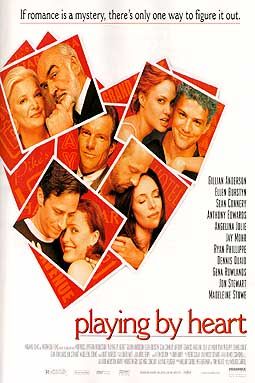
First up, a movie called Playing by the Heart. Never heard of? I'm not surprised, because it didn't seem to win much critical or box office love when it came out back in 1998. What is surprising is how so many talented actors were convinced to take part in this unexceptional film. The movie opens with a number of unconnected couples in various stages of relationships: 
- Hannah (Gena Rowlands) and Paul (Sean Connery) are an older couple facing the end of their relationship now that Paul's been diagnosed with a life-threatening tumor. One shocking revelation still remains though: An old affair that Paul had is discovered by Hannah. "Fun" note: watching how Paul tries to explain away this affair is pathetic. Second "fun" note: Paul's terminal illness no longer seems to be an issue at the tacked-on "happy" ending.
- Joan (Angelia Jolie) just got out of a terrible and ridiculous relationship but after breaking up with her boyfriend via a payphone in a club, she immediately turns upon the stranger (Ryan Phillippe) standing next to the phone and tries to pick him up. This happens repeatedly, night after night, despite his unwillingness to be in a relationship. "Fun" note: Ryan Phillippe's angsty portrayal is just him looking sullen all the time. 
- Meredith (Gillian Anderson) is a workaholic divorcee whose "meet cute" with an architect (Jon Stewart) involves a wall-sized bookcase falling over on her tiny self. "Fun" note: Jon Stewart's character is basically an asshole masquerading as a "nice guy." Yet I'm 99% sure the audience is supposed to think he really is a nice guy. Nope.
- Gracie (Madeleine Stowe) is having an affair because the "mystique" of it is so much better than her "boring" husband. "Fun" note: Shut up, Gracie. Second "fun" note: Even she seems to be have a more or less optimistic ending, despite all odds.
- Hugh (Dennis Quaid) keeps trying to tell a different sob story to whatever woman will listen to in bars across town. "Fun" note: Hugh could probably save himself a lot of grief by being more honest.
- And last but not least is the only non-romantic couple in the cast: Mark (Jay Mohr) is dying of AIDS and now has to open up to his mother (Ellen Burstyn) about his homosexuality. "Fun" note: The movie tries so hard to be open-minded and modern, but its handling of this topic feels both so preachy and so dated. 

These disparate characters and storylines eventually come together in an ending that I *think* is supposed to surprise the viewer, although it is easily predictable early enough into the movie. As you can probably gather from my sarcastic comments above, I wasn't a big fan of this movie. Almost everything about it felt contrived and/or saccharine, and the relationships depicted were all so unhealthy, yet we're clearly supposed to be happy at the ending. No thank you. And despite having such a talented cast, the performances were mostly pretty shoddy, although I can't help to think that a lot of that has to do with a corny plot and terrible dialogue. The only real standout is Ellen Burstyn as the grieving mother of a dying son, but even that is just a small part of the movie. There are a few funny moments scattered here and there in the movie, but honestly even those aren't that good.

Final word: Do yourself a favor and save your time by staying away from this title. I didn't believe Jon Stewart when he made fun of his movie career by holding this movie up as an example of wretchedness. No wonder this movie was hard to get a copy of -- it's not worth watching.

Next up was In Her Shoes, starring Cameron Diaz, Toni Collette, and Shirley MacLaine, and based on the book of the same name. Rose (Collette) and Maggie (Diaz) are two sisters who couldn't be more dissimilar -- Rose is practical and plain; Maggie is flighty and primped. When a particularly painful betrayal happens, Rose kicks Maggie out. Forced to find her way on her own, Maggie discovers a grandmother (MacLaine) the girls never knew they had.

So I read the book this movie was based on way back when and loved it. When the movie came out, I wanted to see it but for some reason I just never got around to it. Recently, I read a memoir by Jennifer Weiner (the author of In Her Shoes) and her mentioning the movie in that memoir renewed my interest in watching it. Luckily my library had a copy, so I grabbed it right up. 

It's hard to review this movie 100% fairly. It's been so long since I've read the book now that I can't accurately compare the two -- the only glaringly "wrong" thing to me was that Maggie's time in Princeton (a part which for some reason sticks out to me more than any other part of the book) is completely missing from the movie. I guess it just wouldn't have filmed as well perhaps, but I felt like it was a crucial part to her story. 

Other than that, the movie seemed to jive more or less with the overall message of the book. Somehow though -- the condensed time perhaps -- the movie lacked some of the emotional impact of the book. Although I've loved Toni Collette in many other things before (including but not limited to United States of Tara), her story seemed the most lacking in emotional "realness" -- so often, her character just burst out with something that didn't seem to mesh with anything else, or else other characters referred to changes in her emotional state that just didn't seem to be there. Mostly I chalk that up to the shortened storytelling time more than on Collette's performance, but it was still a bit disappointing. (Also, it was terribly hard to believe that her character was so insecure about being overweight when she looks like she's about a size 4.)

On the other hand, I was pleasantly surprised with Cameron Diaz's performance. It is probably biased of me, but I didn't expect much from the star of There's Something About Mary and The Sweetest Thing (two movies I wish I had never wasted my time on). However, she really embodied the role of Maggie and brought an impressive range to the character. Shirley MacLaine also did a fine job in her role as a grandmother long estranged from her grandchildren and dealing with some heavy emotional baggage of her own.

While both the book and the movie have been cast in the ghetto of "chick lit" and "rom-com," respectively, the story of In Her Shoes is so much more than your standard romantic storyline (girl meets boy, they have a falling out of some sort, girl and boy end up back together when everything is cleared up). Deep and varied issues are addressed, ranging from mental illness and death to forgiveness and acceptance. It is not necessarily a strictly "feel good" movie, although it does end on uplifting notes.

Final word: Hard to say with this one, actually. If at all possible for you to do so, I'd recommend you read the book, which was so thoroughly good. Barring that, then maybe watching the movie is a worthwhile use of your time. It's a decent choice for when you don't want something too fluffy, but you also don't want to be slammed by something unremittingly depressing with no hope whatsoever.


Sunday, February 5, 2017

Come On, Get Happy

As I've lamented before on this blog many a time, winter is my least favorite season of all. It is looong, cold, dreary, and dark. It makes me wish I was a bear who could hibernate these months away and emerge well rested for spring. But since that's just a fantasy that won't happen, I've been trying to dispel my winter blues with fun and light-hearted movies -- not my usual fare but perfect for lifting my spirits, even if just temporarily. And as I've been away from this blog for a while, I thought I would try a quick summation of those movies in this one post. (It may get a little long though...)

To try to improve my mood, I watched these three movies in recent weeks: The Answer ManZootopia, and The Peanuts Movie. Two kids' movies and a romantic comedy -- this is how I roll in the winter, people.

The Answer Man

This is a romantic comedy from 2009 about a hermetic best-selling author and a single mom with a recently opened small business who meet almost by happenstance and decide to start dating. Literally, the entire rationale behind me watching this movie was "Lauren Graham is in it." The description sounded okay, and I was willing to give it a try, but I was not expecting much. With that attitude going in, I was surprisingly pleased. Sure, the romance part was pretty flat, but the acting was superb, the comedy was good, and it was really more of a story about the author becoming a more social and caring human being than it was a purely romantic comedy. I'll address each of those points a little more fully below.

Jeff Daniels as author Arlen Faber was comedy gold in a multi-faceted role. Faber is a character who is struggling with a number of things -- physical pain from a bad back, a crisis of faith, a desire to be left alone by the people who want to adulate him for his best-selling religious books, and coming to terms with being needed by others and finding himself wanting to be around other people as part of their lives. Lauren Graham was predictably wonderful, presenting her usual mixture of fun-loving comedy turning to fierce drama at a moment's notice. As she herself once noted, she does seem to be typecast into the single mom role, and there were a few moments in the opening of the movie that felt like the movie was trying to give us Lorelei Gilmore with a young son instead of teenaged daughter. But then the character of Elizabeth comes into her own, and we see her more as a dedicated chiropractor, determined to help patients and see her small clinic succeed, and as a friend/love interest to Arlen.  Lou Taylor Pucci as recovering drug addict and struggling independent bookstore owner played perfectly whether in humorous or serious scenes, in either case serving to further stretch Faber's growth and development. Smaller roles were well acted and rounded out the cast of quirky characters.

As I've probably mentioned in the past, I'm not the hugest comedy fan - especially sitcoms or romantic comedies, which tend to feel very predictable and, as a consequence, dull. But that being said, I found myself laughing quite a bit with this movie. A lot of that came from Faber's unexpectedly foul-mouthed or flippant sayings, but some of it was physical and situational humor as well (like Elizabeth trying to promote her business by having her assistant dress up as a giant spine outside their office or Faber being pulled unexpectedly into a parent-teacher conference for Elizabeth's son). There's also a bit of the "awkward first date (or three)" conversational humor, which is a somewhat stereotypical romantic comedy move, but that's usually the best part of any rom-com in my opinion. 

And, finally, I enjoyed this movie more than the standard fare romantic comedy because it was much more than just that. The movie addressed Arlen's need to get outside of himself and his worries to connect with other people and care about them. Sure, that included a potential romantic partner, but it also included her son and people in the community like Kris the bookseller. Faber doesn't completely change his personality or attitude but he does become more willing to embrace other people and help them on their course through life, in turn helping himself to be more compassionate. That may sound overly sentimental, but the movie manages to stay *just* above the rim of being truly sappy. 

Like I said at the beginning of this movie review, I was surprisingly amused and entertained by this movie. And I'm surprised to find myself recommending it as well if you want something on the cheery side for your next movie pick.

Zootopia

A good number of the little kids (and grown adults for that matter) in my life had already seen this movie when it came out in theaters and loved it. I figured I'd get around to it eventually, which turned out to be a day I was still in a down mood. Zootopia tells the story of Judy Hopps, a bunny from a small rural community who can't wait to become a police officer in the big city of Zootopia, despite the nay-saying she hears from literally everyone, ranging from the local bully to her own parents. She persists in her goals anyhow, passing all the hurdles to becoming a police officer and arriving in Zootopia to learn about an ongoing missing animals case, to which she is not assigned because, again, no one believes a small rabbit can accomplish much. But through a series of unexpected circumstances, she ends up partnering with Nick, a con-man (or con-fox, as the case is) to uncover a much bigger conspiracy that anyone expected.

As you might expect from a children's animated movie, there is all kinds of humor in Zootopia, ranging from very obvious slapstick bits for kids to references clearly meant for adults. My favorite two scenes that had me laughing out loud involved a DMV office run entirely by the slowest moving sloths and an introduction to the criminal boss, "Mr. Big," who mimicked several Godfather lines. The movie definitely hit the spot in improving my bad mood, even if it didn't succeed in doing so for a terribly long time. 

But Zootopia also succeeds in presenting a number of important issues to children in a digestible form without being overly didactic. There is soooo much about not judging people by their outside appearance but instead by their personal qualities, like commitment to righting wrongs and perseverance in the face of internal and external doubts. Yes, there are times when some of this lesson is a bit heavy handed, but it's never a "hit you over the head" morality tale. 

Like we've all come to expect with a Disney movie, this one features a lot of talented actors lending their voices to various characters, including Ginnifer Goodwin as Judy, Jason Bateman as Nick, Idris Elba as the police chief, Shakira as the pop star Gazelle (giving the film its catchy theme song), and many many more. As we've all come to expect with an animated film from Disney, the success of Zootopia has inevitably led to there being talks of a possible sequel, one which ::eye roll:: many hope will lead to Judy and Nick getting together as a romantic couple. Let's just hope that any follow-up movie is of as high a caliber as this first one was. 

The Peanuts Movie

Last, and let's admit it, least, I watched the new reincarnation of Charles Schulz's characters that is The Peanuts Movie. As a bit of background, I've never been the hugest Peanuts fan, though I do generally find some of the older short movies both funny and fun to have on around the appropriate holidays. This movie, written by Schulz's son and grandson, stays true to the original characters in interesting ways, but it is sometimes perhaps a little too true to them. Bear with me as I explain.

The Peanuts Movie is largely centered around Charlie Brown's crush on the new girl at school (known simply as The Little Red-Haired Girl) and his myriad attempts to do something great to get her to notice and like him. But because it's Charlie Brown, these attempts inevitably do not turn out as planned. Throughout his many endeavors, Charlie Brown's myriad friends, including his sister Sally and his loyal dog Snoopy, strive to help him out. At the end of the school year, when Charlie Brown finally manages to just talk directly to The Little Red-Haired Girl, she says that she admires all the good qualities he demonstrated when things went wrong, including his selflessness in advancing others before himself. 

Among many of the nods to the original comics include Lucy pulling the football away from Charlie Brown at the last moment, the kite-eating tree, Marcie inexplicably calling Patty "sir," the muffled voices of all adults (voiced here in a stroke of genius by Trombone Shorty), and Snoopy's dreams of being an ace war pilot battling the Red Baron for the skies. This last one has always been a bit of an odd one in my opinion, and some parts of the movie involving these scenes went on a little too long for my liking. There's also a love interest for Snoopy here, mirroring Charlie Brown's story back in the real life part of the movie. 

Also true to the original Peanuts were the many bizarrely romantic relationships seen among schoolchildren. Perhaps because Charlie's crush is the focus on this movie, I started noticing these relationships more than I usually do. Almost all of them involve girls who nag and borderline bully boys into liking them back (e.g., Lucy and Schroeder, Sally and Linus, Peppermint Patty and Charlie Brown). Meanwhile, Charlie Brown's entire basis for liking The Little Red-Haired Girl is that she's "pretty" and she chews on her pencil like he does. He never even learns her name. She is literally "The Little Red-Haired Girl" from beginning to end of the movie. The weird relationship dynamics were kind of unsettling as an adult, and it makes me wonder what kind of message is being sent to kids when they watch this movie. I understand that attempts were being made for continuity between the past Peanuts and the present, but some of this was just a bit too much. It could be left in the past.

It was interesting for me though when I went searching for the origins of the "sir" moniker for Peppermint Patty that I found this article explaining how this character was Charles Schulz's response to second-wave feminism. He chose to make a character that defied the stereotypical feminine traits, instead opting to make Patty a fan of sports who doesn't wear skirts. So that was nice to learn; I just wish that the new creators might have found some ways to bring the female characters of The Peanuts Movie past the 1960s. 

That all being said, there were pretty funny parts to this movie as well as some charming ones. Particularly hilarious to me was Charlie Brown's quest to write the perfect book report to impress The Little Red-Haired Girl, which ends up involving a mistaken search for the book "Leo's Toy Store" by Warren Peace. There was also plenty of slapstick and physical comedy to entertain those who really enjoy that kind of comedy, like the small children who are the target audience for this movie. I really did love the ending in which The Little Red-Haired Girl pointed out all the times Charlie Brown stood up and did the right thing, even if it didn't seem beneficial to him at the time. That was definitely a high note in this movie, teaching children important lessons about how being a good person is about helping others, not just promoting yourself and your achievements.

The animation style is different from the original Peanuts films, given the many changes in technology since then. I guess it could be off-putting for some, but I didn't mind it much after a few minutes of getting used to it. The look and feel of the characters was the same, even down to Lucy being a horrible bully, which I wish was addressed more. All in all, I found this movie an amusing diversion, especially for adults who grew up loving these characters. But I would be hesitant to share it with small children without discussing the problematic parts later.

Well, those are my two cents (and perhaps a little more) on these movies. Have you seen them and have any thoughts? What do you do to keep the winter blues at bay?

Thursday, August 21, 2014

Dear Old Daddy Longlegs

It may not be super obvious based on my past posts here, but I have a penchant for old movies made in the 1950s or roughly around then. Sadly, it's an age fraught with a variety of problems around representations of women and racial minorities, but I still look on it as a golden age of film in many respects (and I'm not alone). This time period saw the heyday of iconic actors including but not limited to Audrey Hepburn, Grace Kelly, Humphrey Bogart, Lauren Bacall, Marilyn Monroe, and so many others that I love. It's also a time filled with spectacular directors such as the great Billy Wilder, whose movies are all worth watching for one reason or another. And it's also the era of the big studio musicals, movies designed to show off the various singing and dancing talents of the main stars and churned out with some regularity. Think of such classics as White Christmas, Easter Parade, and Singin' in the Rain multiplied several times a year per studio, and you've got the idea. Nowadays, musicals seem mostly relegated to the realm of children, specifically for Disney movies. There are still some musical movies for adults hitting it big today (Les Miserables being a recent example), but these tend to be few and far between, nothing like the days of old when you couldn't swing a dead cat without hitting into another musical.

All that long introduction is to say that when Netflix recommended I watch Daddy Long Legs, a musical starring Fred Astaire that I hadn't seen yet, I jumped on the opportunity. Fred Astaire isn't a name I feel like I have to explain, but I will note that he starred in some of my favorite old movies to watch over and over again - 1957's Funny Face in which he co-starred with Audrey Hepburn (and the movie that first got me into watching older movies) and 1951's Royal Wedding where he shared the spotlight with Jane Powell, Sarah Churchill (daughter of Winston), and Peter Lawford (brother-in-law to JFK). As an interesting aside, it's worth noting the latter movie contains the famous scene of Astaire "dancing on the ceiling" because he is so in love with Churchill's character. Daddy Long Legs co-stars a young Leslie Caron, better known for her title role in 1958's Gigi as well as her breakout role in the 1951 musical An American in Paris.

Original movie poster for Daddy Long Legs
Like many of Astaire's films (and indeed 1950s musicals in general), the movie Daddy Long Legs seems to be built up around the musical numbers with the plot following as secondary, almost becoming a vehicle in place merely to hold together the singing and dancing in one handy location. This method is successful at times ... and other times, you end up with something like Daddy Long Legs. There are so many long song and dance numbers that they seem to crowd out the development of the characters into fully actualized beings who change over time in a way that at least slightly resembles realism. Meanwhile, literally years pass by in the movie without being explored in terms of characters or plot. If the movie were something scrapped together by hack screenwriters looking to expand upon some musical numbers by a big composer like Irving Berlin or George Gershwin, this would be more understandable. But there is actually a source material that the screenwriters could have used for a more fully fleshed out story. (Incidentally, the screenwriters in question were the husband-and-wife team Henry and Phoebe Ephron who wrote such classics as Desk Set and There's No Business Like Show Business. The pair also produced four daughters who turned to writing careers, including screenwriters Delia and Nora Ephron, who in turn wrote more modern romantic comedy standards such as Sleepless in Seattle and You've Got Mail.)

Daddy Long Legs is evidently based on a book published in 1912 by Jean Webster (great-niece of Mark Twain), written in the epistolary style, and designed for an audience of young women in high school and college. Hence the protagonist - Jerusha "Judy" Abbott in the novel and re-branded as Julie Andre in the movie - is a teen-aged girl entering into college at the beginning of the story. While I've never read the book, from what I can gather the novel Daddy-Long-Legs (note the hyphens in the book's title) and the movie Daddy Long Legs (sans hyphens) share a very similar plot but vary greatly in presentation and exploration of themes. As Astaire is the bigger star here, the perspective of the story of Daddy Long Legs shifts dramatically from that of Daddy-Long-Legs. Here the focus is largely on Astaire's character of Jervis Pendleton and we actually see very little from Julie, as opposed to the book being almost entirely from Judy's point of view and voice as she writes letters. Therefore, Webster's exploration of a young woman coming to age and learning about herself is nearly entirely obliterated. Apparently Webster was greatly interested in women's suffrage and chose to explore themes related to women's issues in her books - something that becomes completely irrelevant and untouched upon when the movie switches the narrative perspective to that of the middle-aged male Pendleton.

Before I get too much further ahead of myself, I'd like to take a step back and give you a brief overview of the plot of Daddy Long Legs before analyzing it in the terms of an entirely different movie's title, The Good, The Bad, and The Ugly. Daddy Long Legs opens with an irresponsible Jervis Pendleton III being far more interested in playing on his drums all day (literally) than in working for his family's company, which rakes in millions of dollars for him. Later on a trip to France, a mishap with the car leads Pendleton to an orphanage where he espies a pretty young girl working with the younger children. The matron of the orphanage explains that the 18-year-old woman, Miss Julie Andre, was herself raised in the orphanage and now has no where else to go. Although he doesn't meet her, Pendleton is struck by the grace of Julie and decides he wants to "adopt" her. When he approaches officials by this, they are shocked at the suggestion and presume that Pendleton is looking for a young mistress or some other nefarious purpose. When Pendleton says he merely wants to give her a chance at a college education in the United States (apparently there are no colleges for women in France?) and declares that he will be an anonymous donor who will not contact Miss Andre, a deal is struck. Miss Andre is packed off to a small all-girls college in Massachusetts and writes updates to her anonymous donor who she has dubbed "Daddy Long Legs" based on the orphanage children telling her that he was very tall when they caught a glimpse of his shadow retreating from the orphanage. Meanwhile, Pendleton is happy to go on living his carefree life until his business manager Griggs and his secretary Miss Prichard insist he read the letters written by Miss Andre that have been piling up in a filing cabinet. He does so and is touched by the young woman's desire to meet him, but he still remains aloof. As his niece attends the same college as Julie (and Griggs has arranged for them to be roommates), Pendleton decides to visit the school just in time for a dance, at which he woos Julie before almost immediately afterwards ditching her because of his continued concerns about appearances. Julie spends the rest of her college days ruing over her lost love of "Uncle Jervis." But eventually all's well that ends well ... Hey, I have to leave a little bit of mystery for anyone who actually wants to watch this movie after my not-so-glowing review of it. Now onwards to my interpretation of the movie's merits and demerits.

The Good
Publicity still from Daddy Long Legs
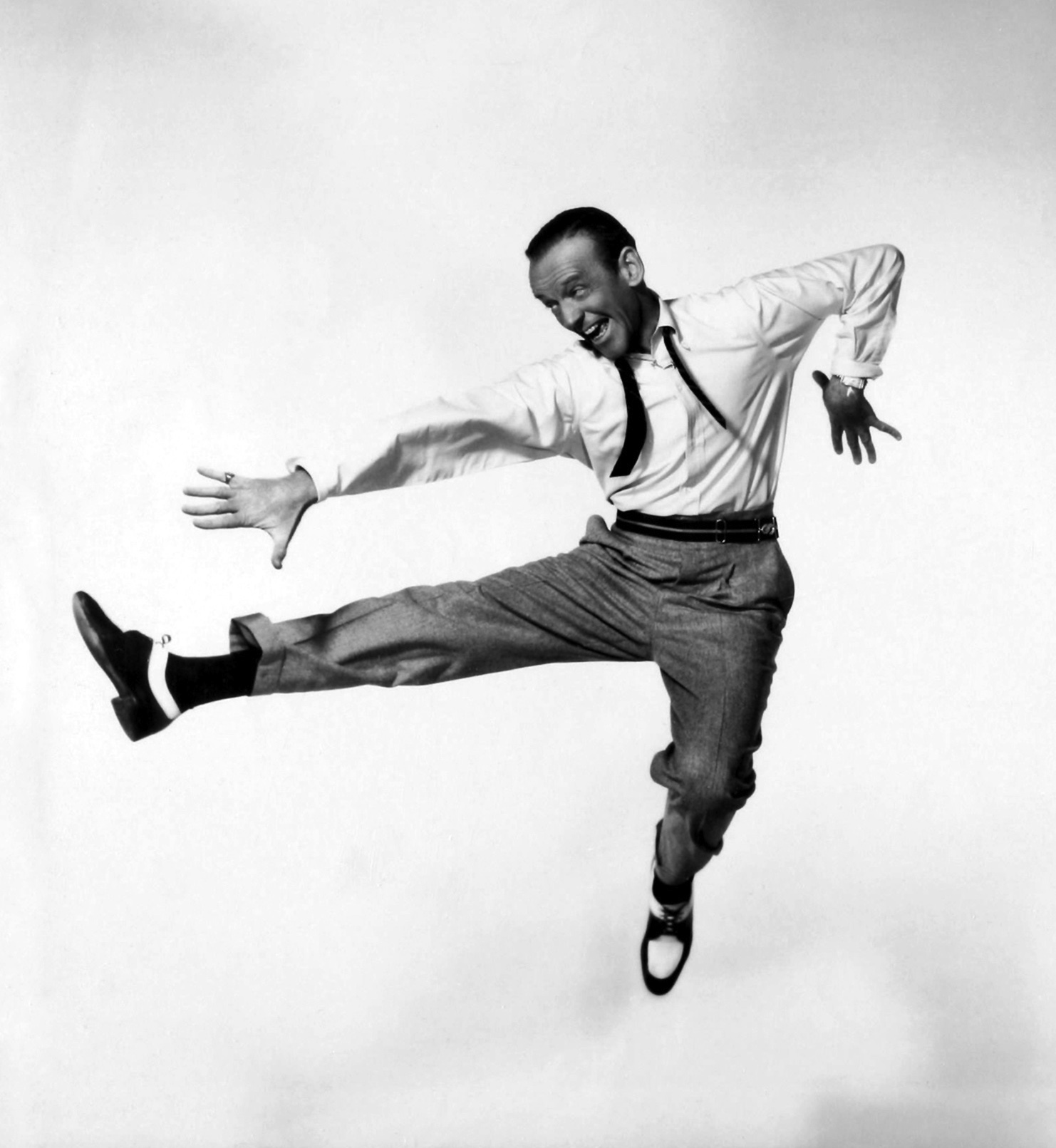
The movie succeeds best at delivering on its star quality. Astaire and Caron make for an interesting duo, with his talent lying more in tap and hers in ballet. There are a few notable sequences in Daddy Long Legs, particularly of interest for their exploration of dream-like states, which makes for a rather logical break from relative realism into a song/dance routine. (It is frequently a criticism of musicals that no one breaks out into song and dance during real-life day-to-day activities. Clearly these people never have any fun and don't "whistle while they work," so to speak. Also, I'm not sure if these people then only watch super-gritty and realistic movies and avoid all romantic comedies, superhero, science fiction, fantasy, and action movies altogether. If so, well, bully for them, but I think the rest of us prefer a little bit of entertaining escapism now and then. And some of us like that escapism to occasionally be expressed with song and dance.) These dream-like routines are a rather fascinating departure from many studio musicals and are rather avant-garde in that respect. They remind me of a musical version of Dali's dream sequence, which also seemed like an unusual - but fitting - inclusion in a classic Hollywood film. But back to the musical numbers of Daddy Long Legs. Namely, these sequences stand out amongst the pack:

- A long daydream sequence based on the fantasy musings of Andre regarding the personality of her anonymous patron. This is composed of three shorter sequences - "Texas Millionaire," a feisty tap dance sequence with a solo Astaire all fluid motion and making it look easy; "International Playboy," a brief sequence based more in the world of ballroom dance, in which Astaire dances about and with numerous amorous female partners (this is, however, the weakest part of this sequence as Astaire does very little dancing in here); and "Guardian Angel," a lengthier sequence with ballet influences featuring both Astaire and Caron together. This last one is especially interesting for introducing the stage-like scenery of storefronts, an art direction that will emerge again later in the movie as a secondary dream-like dance sequence also makes uses of stage scenery. These sets are beautifully done throughout the movie, showcasing various artistic styles with panache. Also, Caron's en pointe dancing here does the unthinkable in stealing the limelight away from Astaire for a change. As she twirls about, it is impossible not to watch her and Astaire seems to fade into the background with just a few swooshes of his own for good measure.

- The trendy new dance at Julie's college known as "Sluefoot." It starts off as a just so-so choreographed piece that turns into a thing of beauty when Astaire steps in and he and Caron end up as the only two left on the floor. Granted, it's packaged in a whole lot of cheesiness (not least of all the ending with everyone carrying the two dancers atop their shoulders), but this one also gets some bonus points for trying to make a logical insertion of a dance routine - into a college dance, of course! The Sluefoot never took off as a real dance craze and that's probably for the best, but Astaire and Caron do show off some seriously sweet steps here.

- Andre and Pendleton's somewhat accidental New York City trip leads to the introduction of the song "Something's Gotta Give," written by Johnny Mercer expressly for Fred Astaire to sing in this movie, although is now a love song standard covered by so many iconic artists. The initial blocking of the scene as Astaire sings is perhaps not the greatest, as it's always difficult in cinema to have a few minutes dedicated to just watching someone sing, but at least they try here to make it interesting. But the dance routine that follows is delightful and deceptively simple. Astaire and Caron are both so light on their feet that they appear weightless as they twirl and swirl about the hotel's balcony and out into the streets of New York. Apparently this final montage dance was never actually rehearsed, but it came out just fine nonetheless.

- The second lengthy dream sequence when Andre falls asleep to thoughts of how unhappy she is that Pendleton is traveling all over the world without her. In the first, known as "Nightmare Ballet," Caron is given a solo opportunity to show off her dancing skills in a fairly traditional ballet number, which is beautifully rendered and like a mini-trip to the ballet, giving just enough of a taste to whet the appetite for more. The second number is the "Hong Kong Cafe," a sultry and risque dance routine that is fully engaging to the eyes and ears, even if a little out of place with the rest of the movie. The final part, "Rio," is the weakest link in terms of the dance number itself, although it does illuminate Andre's state of mind and feelings regarding Pendleton even more so than the previous two segments. Part of that includes Julie dressed in the role of the sad clown Pierrot, a common trope I discussed in detail in a previous post. Apparently this three-part sequence, totaling to 12 minutes of purely dance routines, was not widely regarded as useful to the film's plotting or pace. I have to disagree as I think this part gives us more insight into Julie's mind than most of the rest of the movie! That may be a bit of hyperbole, but it certainly does lend itself to character development, which I enjoy. The surreal feel of this section of the movie is a bold move (although fitting with the other dream-like parts of the movie) that I personally loved as Surrealism is one of my favorite artistic styles. For the critics to this sequence, I'd also like to note that if watching 12 minutes of music and dance is too much for you, then maybe musicals aren't the genre for you.

- The brief sequence to the reprisal of the song "Dream" (also by Johnny Mercer) that closes out the movie. While it's a short piece with a relatively simple dance, it's again the graceful weightlessness of Astaire and Caron that steals the show.

Beyond the musical and dancing abilities of the two leads, this movie also brilliantly cast the roles of Pendleton's associates, Griggs and Miss Prichard. Played by character actors Fred Clark and Thelma Ritter respectively, these two characters breathe a little more life into the movie and serve as foils to Astaire's character. While they may seem stuffier at the movie's opening, they remind Pendleton of what it means to care for another human being. As Miss Prichard puts it (and later Griggs repeats), "a person is NOT a corporation! A person is flesh and blood ... and feelings!" It's a surprisingly modern quote as we are currently stuck in a political debate in which the idea of personhood is constantly being negotiated and corporations seemingly have it, even if they don't have flesh and blood and feelings.

The Bad

Despite actually owning copies of Gigi and An American in Paris, this is the first movie that I've seen starring Leslie Caron. I found that I'm rather surprised her name is often included in the same breath with some of Hollywood's elite classic actors, as I was disappointed with her performance. Her dancing was incredible in the finished product, as I've noted above, although rumor is that Astaire noted he had difficulty dancing with her. Her acting was only so-so at best, with her mostly wearing this placid "dumb" face (for lack of better terminology) throughout the movie. Think Kristen Stewart throughout the majority of the Twilight movies and you have the general idea. She also goes from playing the naive ingenue to throwing out saucy hints of innuendo far too quickly and then back again rapidly to innocence, although this may be a fault more of the script then of Caron's acting. At this stage in the game, it's hard to know. But what bothered me most about her was the awful accent. Perhaps the director asked her to ham up her accent, but Caron - a native Frenchwoman, mind you - has one of the worse overly dramatic nasally French accents I've ever heard. It was painful to listen to at times.

Caron's French girl is pretty much the only "other" character we see in the movie, which is jam packed solely with Caucasian characters. The movie is a product of the 1950s, so it's pretty much unsurprising that we don't see a single person of African, Latino, or Asian backgrounds, even when we enter a dream state taking place in Hong Kong. Given how badly 1950s movies could mess up depictions of racial minorities, it may end up being a good thing that Daddy Long Legs didn't even attempt to add in a character of color. The movie already struggles with troubling depictions of women, so why give it any more fodder for things we have to dismiss with a shrug and say, well, it's a product of its time? If you want to watch something with actual diversity in it, don't expect to find it here.

While most of the movie's song and dance numbers are the highlights of the film, there are some sequences that just seemed to drag to me. The first number is "History of the Beat," and it occurs early on in the film. Pendleton is right away introduced as a character who doesn't seem to have a lot of discipline and isn't particularly interested in making business decisions; he's much more fascinated with listening to music and playing the drums. Only thing is, we never again see this hobby again - sure, he dances a bunch later and sings a little because it's a musical, but it's no longer a key component of his personality that he plays the drums instead of working or that he has a large record collection. The dance routine here is in itself perfectly fine and Astaire once again shows off his amazing skills, but the song isn't that compelling. Moreover, the placement of this number early on in the movie when so little has been explained yet (and Julie hasn't even been on screen once at this point) leads to the feeling of this just being a fluff piece that does little to add to the movie. It did, however, add to my feeling of this being a dragging number. If a movie, even a musical, is going to lead early on with a song and dance number, it has to be a really compelling one that pushes the plot forward or does a lot to explain the characterization of a particular person or persons that isn't already explained through the dialogue or action. It can't just be a song that someone liked and couldn't seem to fit in elsewhere. There are a couple of other songs sung by Caron and others when her character is still in the orphanage and when she first enters college that also seem to be there for little purpose and seem to slow down the pacing of the movie.

The Ugly

While these complaints above are not exactly gold stars for the film, they are not enough to sink it either. But there is a much bigger problem with this film that is very difficult to overcome. And that's the fact that the movie's basic premise is just kind of creepy. Pendleton's age is never openly stated but Astaire was in his mid-fifties at the time this movie was filmed, and we can gather that his character is meant to be roughly his own age. Likewise, Caron was in her early 20s while making this film and is meant to play a character of college age, beginning the film at age 18 (specifically stated in the movie's dialogue) and ending roughly around age 22 (doing simple math gets us here). So we're talking about a 30-year age gap here. This kind of age gap in a romantic film can be done, and indeed has been done, without being as disquieting. In Funny Face, the movie I mentioned earlier as one of my favorite old movies, the age gap between Astaire and Hepburn is nearly 30 years as well; another of my favorite movies, Sabrina, pairs Hepburn with Humphrey Bogart, then several decades her senior. Those films manage to negotiate the age difference without giving the feeling that there are paedophiles just hanging all about old Hollywood. Many other films of this era also feature large age gaps between the male and female protagonists; indeed, this continues to be true today.

But there's something about this film that just adds such an ick factor to the romance. Pendleton being the guardian to Julie - even with it being done anonymously - definitely makes for an eerie incestuous vibe, especially when she addresses her letters to "Dear Daddy Long Legs." Her misconceptions of who her guardian is (since she has nothing to base her ideas of him on but her own imagination) add to this feeling as well. She describes an old, frail, bald man who she is going to care for when she gets out of college. Maybe this is meant to highlight that Pendleton is not as decrepit as all that and therefore it's okay for him and Julie to end up together, but for me it just lead to an ugly picture of a decade down the road when Julie is in her prime and Pendleton is ready for retirement. Given that Pendleton acts like a child most of the time and needs to have his feet held to the fire (metaphorically of course) by Griggs and Miss Prichard in order to accomplish anything, I can certainly picture an image of domestic life in which Julie is running about attending to all of Pendleton's needs and helping him to function like a normal person while she gets very little in return but his money. In essence, she is the definition of a trophy wife - young, pretty, and in this case, willing to do anything for her sponsor.

Another original movie poster

I feel like the movie does try to address the age differential in a meaningful way but in doing so, it just makes the situation worse. As one reviewer puts it, "Confronting the age problem head on, well, that's honest, but confronting the problem isn't quite the same as solving it. Fred's still old, and Leslie's still young." There just seems to be no fixing that. In fact, that Pendleton's initial attempt to "adopt" Julie is treated with disgust and disdain, with the idea that he could only want to do so for some sick purpose, ends up planting the idea in the viewer's head that Pendleton's intentions are perhaps less than honorable. After all, he has no interest in doing anything for any other child at the orphanage, though no doubt they are also in need just like Julie - or will be in the same boat as her a few years down the line. Pendleton may go on to forget completely about her for several years but once he reads her letters (again, remember these are written to a person she regards as a father figure), he finds himself fascinated by her. He has no qualms about visiting her at school under the guise of visiting his niece. Another creep factor is that Pendleton seems to have no problem - or even need to acknowledge - that his niece and his would-be lover are the same age and friends with each other. Indeed, no one else seems to be bothered by this either. It'd be one thing if there wasn't a large age gap between uncle and niece, but we've already established there's a roughly three decade difference between them.

One could argue that the disturbing factor is lessened by Julie falling in love with Pendleton unawares that he is her guardian, making the decision more hers than his, but I think that would be a weak argument. Pendleton is pretty relentless is pursuing her at the school dance, making overtures toward her under the nominal auspice of just wanting to learn more about his protegee. He even goes so far as to hire a rival boy from a local men's college so that he may employ him in another country and thus keep him far away from Julie. It's pretty hard to make an argument that Julie had much of choice but being interested in Pendleton when he put in extra effort to make sure any competition for the art of wooing was out of sight.

Eventually, Pendleton goes away after he realizes that his wooing of Julie is perhaps inappropriate. Of course, rather than address her like a fellow adult and explain the situation, he simply drops out of sight for months on end and has no contact with her as he globe trots instead, once again showing that despite his age, he really has zero maturity. Meanwhile, Julie becomes this rather annoying character who begins to sit around moping all day and collecting newspaper clippings of Pendleton's gallivants. She seems to have no plans for her future life once she graduates college (which is now an impending deadline), whether it be a job or even a place to live. Yes, the movie was made in the 1950s, based on novel written in the earliest decades of the 20th century, but one still desires a slightly more interesting female lead than this. And again, it doesn't help with the yuck factor that Pendleton returns into Julie's life just when she's at a point in which she has no where else to go and no one else to turn to as she looks to the future. One reviewer (who actually read the original source material, unlike me) notes that the creep factor can be somewhat lessened by the Judy character (here known as Julie) because of her ability to be "awesome" and purportedly hold her own against Pendleton. We see none of that here as Julie does virtually nothing to propel her own life forward, but just sits around waiting for things to happen to her. So there's absolutely nothing to offset the feeling of perverseness surrounding a love affair between a middle-aged man and his young guardian.

All of the actions taken by Pendleton, and the relative inaction from Julie, definitely leads to the overall feeling that this romance is anything but romantic. The fact that there is basically zero chemistry between Astaire and Caron doesn't help to sell it. At the time of this movie's making, Astaire had very recently lost his wife to lung cancer and had tried to back out of making this film, so that could certainly be an element at play here. Astaire reportedly went into his trailer between takes to cry, so this is obviously not him at his happiest or most cheerful, to say the least. (He was apparently also considering a retirement from musical pictures at this point in this life, but fortunately for us decided to move on from this film to co-starring with Hepburn in Funny Face just a year after this one.) It's really hard to have a successful romantic musical in which the romance is a hard sell.

While my modern sensibilities (and especially my strong feminist streak) may be influencing me here, it's worth noting that while this movie was not necessarily a flop, it was not a huge success at the time of its release either. Whether that was due to the lack of a romance that didn't leave viewers feeling kind of grossed out or another factor all together is now probably difficult to tell. The film did manage to garner three Academy Award nominations, proving once again that the Academy doesn't always know what it's doing. However, those nominations were for art direction, score, and original song, which are pretty much the highlights of this film. Nevertheless, this is one old movie that doesn't lend itself to the title "classic" at all and one that I think you're better off missing. Check out the dance sequences linked to above in "the good" section to get the highlights and save yourself from spending a full two hours on a movie not worth it.

Wednesday, February 19, 2014

Marty Quietly Steals Hearts ... and Lots of Awards

At a recent civic meeting, someone brought up the movie Marty (I forget the context) with the comment, "Everybody knows Marty," and everyone there did nod their heads in agreement. That is, everyone there except me. Not only had I never seen Marty, I had never even heard of it prior to this local meeting. Normally I would brush that off as a different generations type thing, but I actually happen to be a fan of old movies so it's surprising that I wouldn't have at least heard something about this movie in the past. Naturally then, I had to go look up this movie and when  I heard that it had won the 1955 Academy Award for Best Picture, I was even more intrigued (and additionally stunned that this movie hadn't been on my radar previously). I was delighted to find that a copy of the movie was in my library and immediately checked it out.

Marty is the story of a 34-year-old Italian-American butcher living a quiet life with his mother in the Bronx. He goes to work and then meets up a with a handful of other bachelors at their favorite watering hole. Simple enough. But everyone - from his family to his random customers at the butcher shop - is hounding him about why he isn't married yet. Even his younger brothers and sisters are already married, so what's wrong with him? Pestered with all these questions daily, Marty decides to take his married cousin's advice and go to the Stardust Ballroom to look for women. While there, he comes across Clara, a chemistry teacher whose has just been stood up by her blind date when he saw another woman he found more attractive. Marty and Clara find in each other kindred lonely spirits and have a delightful evening together.

As (mis)fortune would have it though, on that very same evening, Marty's mother Theresa visits her sister Caterina who is going through a rough patch. Caterina's daughter-in-law is beyond frustrated with her meddling and has asked Marty and his mother to take in Caterina. Theresa must break the news to her sister that she is no longer wanted as a live-in companion to her son and his family. Caterina moans about how it's so difficult to be a mother after all of your children have flown the coop and no longer need you. She plants a seed in Theresa's mind about how terrible her life will be if Marty gets married and leaves her, and thus for the first time in her life, Theresa is completely against the idea of Marty finding someone. Meanwhile, Marty's friends look down their noses at Clara because she is a "dog" - aka an unattractive woman (it doesn't seem to matter that Marty isn't particularly leading man handsome himself) - and try to convince Marty to stay away from her.

After watching Marty, I am rather surprised that it won for best picture - especially considering that it came out at the same time as several movies that have become a larger part of the popular culture and/or tackled tougher topics, such as East of Eden, Rebel Without a Cause, The Seven Year Itch, Lady and the Tramp, Picnic, The Man with the Golden Arm, and even Blackboard Jungle. Still, Marty is atypical Hollywood - especially 1950s Hollywood - so I could see how the Academy might have wanted to give a nod to something out of the ordinary. Neither of the leads are Hollywood glamorous nor are they particularly suave or charming. The story is albeit a love one, but it's a nontraditional one with a slow buildup. Indeed, this movie is far more focused on constructing characters than it is on an action-filled plot. The majority of the movie is made up of various conversations held between the characters. In fact, the whole movie takes place over only one weekend, meaning that there isn't a whole lot of time for much of anything to happen. And yet the movie shows how just a couple of days can do a lot to change one's perspective and life.

One of the things that I appreciate about the movie is that while it is ultimately about setting up a conventional marriage, it raises important questions. Marty notes in the beginning that if you're going to be spending 40 or 50 years in a marriage with someone (this being before today's staggeringly high divorce rates), that person had better be more than just a pretty face. It's certainly a smart idea, but not one that his girl-chasing friends - or those who just want to push him into marriage already - seem to be interested in considering. As I noted earlier, Marty is 34 years old at the movie's open and Clara is ::shock:: 29 years old already! While his age is perhaps less damning, she's heading dangerously close to spinsterhood. But the movie doesn't condemn either of them too much for waiting to get married beyond the expected age. What I can't stand is the final scene of the movie when Marty gets on his best friend's case, telling him he should be ashamed of himself for not being married yet when all his younger siblings have already found someone to wed. Doesn't Marty recall the hurt and rejection he felt when people said the same thing to him literally the day before?

Whether the movie intended to do this or not, for all it's talk of getting married and settling down, it doesn't paint a rosy picture of wedded bliss. Marty's cousin Tommy and his wife Virginia start out the movie miserable because of Caterina's presence in their tiny apartment and her constant nagging of how Virginia runs the household and cares for the baby. But when they drop off Caterina to live with Marty and his mother, Tommy and Virginia instantly turn on one another, fighting about everything from being a mama's boy to not preparing a decent dinner. Meanwhile, Caterina's laments about old age exceed just aches and pains - she says it's a terrible time of life because with grown children out of the house, there's no longer anyone to cook for or clean up after. With a woman's whole life expected to be wrapped up in caring for her husband and children, she has nothing left to do with herself when she's widowed and her children are married. When Clara suggests a hobby might help, her advice is pooh-poohed as though it's crazy talk; there simply is no hobby for a woman beyond cooking and cleaning. The movie may try to paint a warm and fuzzy picture with Marty and Clara meeting after years of loneliness but around the corner it promises nagging arguments and eventual despair when this so carefully crafted life no longer has meaning. It's not exactly uplifting. But that may all be me simply reading too much into this short black-and-white film about an aging bachelor. And given that Marty and Clara are going about things in slightly less traditional way (and knowing that Clara is college educated with a career of her own), perhaps they will have a much happier fate.

One thing I can definitely say is that this movie is finely acted with characters that felt realistic. Tommy turning on a dime from relieved that his mother is moving out of his home to guilt that manifests itself as anger toward his wife feels very true to life. Even though he's a side character, Tommy comes across as having complex emotions and motivations. His wife Virginia likewise shows a multitude of emotions in the few scenes in which she appears. Marty is the nominal hero and you're mostly rooting for him, even he is so socially awkward at times that he comes across saying rather rude things to Clara when he means to be complimenting. For instance, more than once he basically says she isn't pretty but that's not the most important thing for a relationship. This is not exactly the line to woo most women over. Clara is similarly nervous and shy but has her own moments of honesty and surprising spunk (i.e., when she refutes Theresa's lament that Caterina is placed in an unfair position because of Virginia). Marty's single male friends are kind of lame and borderline misogynistic, but they are sadly all too recognizable.

My absolute favorite characters in the movie had to be Theresa and Caterina. With their old world sensibilities, their complaints about old age, their personal triumphs as seen through their children's lives, their talk of who's passed away now, and their desire to feed people no matter their protest, I felt like I was eavesdropping in on conversations between my late grandmother and her sister. Indeed, the whole movie with its close-knit Italian-American multi-generational extended family living together in tiny New York apartments felt like I was given a glimpse into the early married life that my grandparents had together and always talked about when they reminisced. It made me feel happy, sad, and nostalgic all at once.

The efforts of all these fine actors did not go unnoticed by the Academy. In addition to the nomination and win for best picture, this movie was nominated for best actor (Ernest Borgnine as Marty), best supporting actor (Joe Mantell as Marty's best friend), and best supporting actress (Betsy Blair as Clara, though it's a mystery to me why she's considered supporting when she's one of the movie's leads). However, only Ernest Borgnine took home the golden statuette for his acting in this movie. The movie was also up for best cinematography, art direction/set decoration, director, and screenplay, winning the last two. Marty was also the first movie to win both the Best Picture award and the Cannes Film Festival's highest award. So this was definitely a movie that made a big splash at the time of its arrival, although I'm not sure that it continues to stand the test of time with its portrayal of old world values and gender stereotypes. However, that's just my opinion - 20 years ago it was still considered significant enough to warrant a place in the National Film Registry.

Saturday, September 21, 2013

"Great Expectations, We Had the Greatest Expectations"

For a week now, I've not been feeling particularly well so I've been spending my spare time resting as much as possible. Mostly, this has meant laying down and watching something or other that I've already seen so that I'll fall asleep sooner rather than later. But last night I was getting a little bored of just re-watching TV episodes I'd had seen once or twice already. So I scrolled through my Netflix queue looking for something to lift my spirits a little and ended up choosing the most recent TV adaptation of Charles Dickens's classic novel Great Expectations from the BBC and PBS's Masterpiece Theatre - I know, super cheery, right?

Going into viewing the 2011 version of Great Expectations, I didn't have much by way of expectations actually. Somehow, despite my love of costume dramas based on great literature (and in this case, based on a beloved book by one of my favorite authors), I hadn't really heard any buzz about this adaptation. Basically, the only reason it was on my radar at all was because I had heard that Gillian Anderson played the character of the eccentric Miss Havisham. Based on the strength of Ms. Anderson's previous acting chops alone (okay, and my love of Dickens), I decided to check this version out. Almost immediately, I was blown away on how well done this adaptation was and enjoyed this fresh look at the work. Stunning cinematography, haunting music that enhanced the ambiance, authentic settings, and excellent costuming and make-up were just the beginning of great elements brought together for this adaptation.

I'd be the first to admit that Dickens can be melodramatic at times (hey, it was the Victorian era he was writing in), and it seems that previous adaptations of Great Expectations liked to yuk this up. Instantly, the viewer sees that's not going to be the case in this version. Instead, we have a realistic view of Victorian England, the gritty underside to all those beautiful costume dramas to which we've become accustomed. The miniseries opens - as the book does - with Magwitch escaping a prison ship and coming across the young Pip on the marshes on his way back home after visiting his parents' graves in the little churchyard nearby. Dickens describes Magwitch as "A fearful man, all in coarse gray, with a great iron on his leg. A man with no hat, and with broken shoes, and with an old rag tied round his head. A man who had been soaked in water, and smothered in mud, and lamed by stones, and cut by flints, and stung by nettles, and torn by briars; who limped, and shivered, and glared, and growled; and whose teeth chattered in his head as he seized me by the chin." In past versions, Magwitch seems only frightful to a young boy like Pip and perhaps has a smudge of dirt on his face and some unkempt hair. But this Magwitch is terrifying on first sight and shocks the viewer as much as he does Pip. He is covered in mud and blood and is more than menacing (nearly savage) when he happens upon Pip along the dreary and isolated marshes, and that's when the viewer immediately knows this is going to be a different kind of adaptation. Everywhere you look, there is something realistic about the characters and settings, down to the minutest details like the peeling paint on the Gargerys' house and the constant mud holes in the lane leading up to their home. It doesn't matter if some of those attempts for realism involve grit and grime: this is the England that Dickens knew and wrote about and not all of it is pretty.

And it's not just in appearances alone that we have a different take on the classic novel - it's also in the characters. Two of the most iconic characters from Great Expectations are that of Miss Havisham and her adopted daughter Estella. Miss Havisham is perhaps best described as the melodramatic extreme of the scorned spinster. After having been jilted on her wedding day, time just stops for Miss Havisham and she never picks up her life again. When introducing this character for the first time, Dickens describes her as thus:

In an arm-chair, with an elbow resting on the table and her head leaning on that hand, sat the strangest lady I have ever seen, or shall ever see. She was dressed in rich materials,—satins, and lace, and silks,—all of white. Her shoes were white. And she had a long white veil dependent from her hair, and she had bridal flowers in her hair, but her hair was white. Some bright jewels sparkled on her neck and on her hands, and some other jewels lay sparkling on the table. Dresses, less splendid than the dress she wore, and half-packed trunks, were scattered about. She had not quite finished dressing, for she had but one shoe on,—the other was on the table near her hand,—her veil was but half arranged, her watch and chain were not put on, and some lace for her bosom lay with those trinkets, and with her handkerchief, and gloves, and some flowers, and a Prayer-Book all confusedly heaped about the looking-glass. It was not in the first few moments that I saw all these things, though I saw more of them in the first moments than might be supposed. But I saw that everything within my view which ought to be white, had been white long ago, and had lost its lustre and was faded and yellow. I saw that the bride within the bridal dress had withered like the dress, and like the flowers, and had no brightness left but the brightness of her sunken eyes. I saw that the dress had been put upon the rounded figure of a young woman, and that the figure upon which it now hung loose had shrunk to skin and bone. Once, I had been taken to see some ghastly waxwork at the Fair, representing I know not what impossible personage lying in state. Once, I had been taken to one of our old marsh churches to see a skeleton in the ashes of a rich dress that had been dug out of a vault under the church pavement. Now, waxwork and skeleton seemed to have dark eyes that moved and looked at me. I should have cried out, if I could.
...
It was then I began to understand that everything in the room had stopped, like the watch and the clock, a long time ago. I noticed that Miss Havisham put down the jewel exactly on the spot from which she had taken it up. As Estella dealt the cards, I glanced at the dressing-table again, and saw that the shoe upon it, once white, now yellow, had never been worn. I glanced down at the foot from which the shoe was absent, and saw that the silk stocking on it, once white, now yellow, had been trodden ragged. Without this arrest of everything, this standing still of all the pale decayed objects, not even the withered bridal dress on the collapsed form could have looked so like grave-clothes, or the long veil so like a shroud.
So she sat, corpse-like, as we played at cards; the frillings and trimmings on her bridal dress, looking like earthy paper. I knew nothing then of the discoveries that are occasionally made of bodies buried in ancient times, which fall to powder in the moment of being distinctly seen; but, I have often thought since, that she must have looked as if the admission of the natural light of day would have struck her to dust. 
In previous adaptations, Miss Havisham is presented almost as a quaintly eccentric woman who doesn't leave her house much and occasionally dons her would-be wedding dress but otherwise seems to hold it together. In this adaptation, Gillian Anderson plumbs much deeper psychological depths to bring to the screen a truly pathetic - and in turn, frightening - Miss Havisham. This Miss Havisham is fragile both psychologically and physically. She has a deep fear of abandonment - a self-fulfilling complex of abandonment, actually - and hungers desperately for the little companionship she has in Estella. She stands with her head tilted toward her listeners and eagerly awaits to see how her words will impact the listener: 'Am I getting the desired result or not?' she seems to worry.
Anderson as Miss Havisham
Her hair is not brushed and coming more undone and wild over time, her feet are bare and dirty, her lips are severely chapped, and her skin is unearthly in its paleness. Miss Havisham still carries herself as a lady in her posture and gait, but her mental illness manifests itself clearly - and outside of her control when she is nervous - in a self-mutilating tic of picking at her hand in the same spot until it festers. To play Miss Havisham, Anderson adjusted her voice to a breathy falsetto, which serves to reinforce the idea of her being fragile while also giving her an otherworldly eeriness. She is truly an object of pity mixed with a frightful glimpse at what mental illness can do to a person. This Miss Havisham makes you wonder what she was like before being jilted and how stable she would have been even if she had married Compeyson as she wished.

Again, the setting for Miss Havisham doesn't shy away from the grime and it's through this disturbing lens that we gain further insight into Miss Havisham's clouded state of mind. Other adaptations have shown a house that looks more or less pristine with some items related to Miss Havisham's planned wedding remaining untouched like a monument of woe. Not so here. Satis House is crumbling beneath Miss Havisham's feet, and she is doing nothing to fix it. If anything, she is actively working against its upkeep. Everything is covered in a layer of dust, nay, layers of dust. A banquet hall with a set table - complete with a three-tiered wedding cake - falls further into decay as time passes. The house, not terribly far from the damp marshes, suffers other decomposition as well, including moldy, rotten walls and moth-eaten curtains. As the years pass and Miss Havisham increasingly unravels, her mansion follows suit. In this respect, Satis House becomes a character of its own and like its mistress, it is a fascinating train wreck: you can't tear your eyes away from it, but it is terrible to behold.

With her addled mind, Miss Havisham has extrapolated from her experience with Compeyson that all men are evil and must be punished for their eventual betrayal of the women who love them. She plans to enact her revenge through Estella, the little girl she adopted for the purpose of raising up to be a heartbreaker, although her exact means of achieving this are unclear (i.e., she intends for Estella to marry well, which seems an odd means of breaking hearts and manipulating men. This is the Victorian era after all and married women have basically no rights over their husbands; far better for Estella to enter and break engagements if Miss Havisham's goal is to punish men). As such, Miss Havisham sends for Pip to become Estella's occasional playmate when they are both children for Estella to practice on and perfect her skill of making men love her. Poor Pip, an innocent young boy unused to such mind games, is completely unaware of this and his money-grubbing sister and uncle see nothing but dollar signs in the arrangement so they do not stop to consider the motives behind such a request.

With this unhealthy arrangement and upbringing by a such a sad character as Miss Havisham, Estella is generally portrayed as a cold and cruel; in fact, she says as much in the source material: "do you reproach me for being cold? ...  You should know," said Estella. "I am what you have made me." But here both actresses who play Estella (Izzy Meikle-Small as a child and Vanessa Kirby as an adult) add another dimension. This Estella is clearly damaged by her life experiences, emotionally as well as psychologically. When she says the line above, it is not merely a statement of fact as some actors deliver the line, it is also a haughty payback meant to wound Miss Havisham as well as an expression of regret. This is an Estella you can empathize with and one that allows you to see why Pip has loved her for so many years. She is someone who has no concept of how to interact naturally with other human beings, whose manipulations are perhaps just as much a product of not understanding the workings of a sane person as they are an enactment of Miss Havisham's wishes for vengeance.

This new interpretation of Estella made me start really thinking about the female characters of Great Expectations. Perhaps because this was the first full Dickens novel I ever read (after first being exposed to his arguably most famous work, the novella A Christmas Carol), it hadn't occurred to me before how unlike a typical Dickensian heroine Estella is. As much as I love Dickens, he was a product of his era and as such, his female characters - when they aren't throwaway characters of little consequence or evil villains like Madame DeFarge of A Tale of Two Cities - are mostly the Victorian stereotype of "the light of the home." Think of sweet little angel characters with no personality of their own who make a welcoming home that shelters the men in their lives from the cruel outside world, and you've got the main idea. You've got your Lucie Manettes (A Tale of Two Cities), your Agnes Wickfields (David Copperfield), even your Mrs. Micawbers (also David Copperfield), etc. Estella, however, does not fit this mold - she's a far more complex heroine and perhaps that's why she's one of the few female characters in Dickens's novels to have such appeal that even contemporary songwriters are sitting "by my bedside with papers and poetry about Estella" ("Great Expectations" by The Gaslight Anthem; the title for this blog post also comes from this song's lyrics). And, even though she clearly inflicts emotional and psychological damage on both Estella and Pip, Miss Havisham is by no means an unredeemable villain like Madame DeFarge or even Miss Murdstone from David Copperfield. As I explained above, she is at times a pitiable character and when it starts to dawn on her what monsters she has created out of her own unquenchable grief, there is nothing left to do but forgive her for her role in creating turmoil in the young people's lives.

And then there's Mrs. Joe - another complicated character. Mostly she's a character you like to hate, or at least dislike, and that's the quality most picked up in this TV adaptation. Despite being Pip's first guardian and his sister, she's always referred to in reference to her husband, as it is the lovable Joe who cares the most for Pip emotionally. But despite Mrs. Joe's "rampages" against both her husband and Pip and her frequent desire to see herself "raised up" above her station by any means possible (even if it means selling out her younger brother), she is the one who raises young Pips and cares for his physical needs. In this way, she is still a variation of the light of the home stereotype. When she is later bludgeoned and turned into a vegetable, there is nothing left but pity for her unenviable life. Meanwhile, because there apparently needs to be the obligatory light of the home stereotype from Mr. Dickens, we also have here some perfect examples of that character. We occasional hear of and see the perfectly amiable, lovely, and complete forgettable character of Clara, the fiancé of Pip's friend Herbert Pocket. Not seen in this TV adaptation (because even with a three-hour miniseries, Dickens needs to be condensed) is the character of Miss Skiffins who also exemplifies this stereotype.
 
Having thoroughly examined the female characters, now it's time to explore the men of Great Expectations. Of course, we have to start with the hero - and narrator, in the book - of our story, young Philip Pirrip, known to all simply as Pip. I absolutely loved Oscar Kennedy, the actor who played Pip as a child. He so perfectly captured Pip's many emotions from fear of the escaped convicts to enraptures with Estella. His tour de force is most likely in the scene in which he and Joe travel on special request to Miss Havisham's estate to discuss his future. Pip is all smiles as he listens to Miss Havisham's praise of his exceptionalism, expecting to be given something to make him a gentleman worthy of Estella. Instead she offers to pay for his apprenticeship to become a blacksmith like Joe. Instantly, the light goes out of Pip's eyes and the smile fades as he realizes that Miss Havisham means for him to be shamed with this proposal, that she is reminding him of his place as a tradesman. Still, Pip realizes that this is gift should be recognized as generous and one that will please Joe especially. So he holds his tongue and tries to show appreciation for Miss Havisham's deed. But it is indeed a struggle to do so, and we see this in a look he gives Miss Havisham that seems to convey that he could murder her in that moment. It is a magnificent, albeit heartbreaking, scene.

Booth as Pip
Compare this to the rather emotionless expression we see on the older Pip's face when he reacts to the news that he has a benefactor and will receive a fortune. As you might gather then, I was less endeared to Douglas Booth as the older Pip, who seemed miscast to me. Something about him - perhaps his "pretty boy" looks - did not seem fitting with the "boy from the forge," even if most of adult years on screen are part of his life after he receives a gift from an anonymous donor (who he presumes to be Miss Havisham come around on the idea that he and Estella are meant for one another) to make a gentleman of him and send him off to London. Nonetheless, there is nothing I can say that was technically wrong with Booth's performance in the final two episodes of the series in which he stars. He did a fine job of conveying all of Pip's emotions during his roller-coaster London years, which include such scenes as: embarrassment at Joe's arrival to Pip's fancy club in London; jealousy of Mr. Drummle's attention to Estella; betrayal and anger on so many occasions; and many others bundled up together over the course of a dramatic denouement.

Rounding out the male cast is Shaun Dooley as Joe, who does an excellent job portraying the long-suffering blacksmith married to a woman who is first argumentative and then severely disabled while being guardian to her rather ungrateful brother. Dooley's portrayal makes your heart say "aww, poor Joe" or "yeah, good old Joe" every time he is on screen, depending on the situation. Joe is the linchpin in Pip's life and he is undoubtedly one of the most endearing characters in Great Expectations. Another very likable character is Herbert Pocket, who becomes Pip's mentor in gentlemanly ways and closest friend in London. Herbert is ever cheerful and optimistic, with a smile on his face whether he's talking about how his family cut him off financially or an escaped convict is literally holding a knife to his throat. Herbert is played expertly by Harry Lloyd, who is apparently a direct descendent of Dickens (an interesting turn of events given that the character was most likely originally based at least in part on Dickens's son Charley).

Pip's other notable London acquaintances include his solicitor Mr. Jaggers (a slippery character of questionable morals who holds nearly all the secrets of Great Expectations close to his vest); Jaggers's chief clerk Wemmick (outwardly rough but with a kind heart); and Mr. Drummle (a cretinous son of a baronet who is attracted to Estella). And, of course, we have the two escaped convicts - Magwitch and Compeyson. Magwitch is well played by Ray Winstone, who does excellent work convincingly changing Magwitch from savagely aggressive to fatherly compassionate at a moment's notice. Compeyson's bit role is played by Paul Rhys, who perfectly embodies the stereotypical Victorian gentleman villain. I leave it up to the viewer to decide whether that it is a good thing or something irksome. Back home, we have Uncle Pumblechook who is always looking for an angle to increase his stature or wallet and Orlick, Joe's assistant at the forge who stops at nothing to bring down those who he feels threaten him - namely, Mrs. Joe and Pip. For the most part, these characters are all well cast in this adaptation, although I felt that Orlick was perhaps over the top in looking the role of a villainous character. (That being said though, I think that if he were cleaned up a little bit, he would make a really great Uriah Heep if someone were to adapt that classic Dickens novel.) Wemmick also seemed perhaps a bit older than I expected for that role and sadly, his part was so condensed in this version that we saw little of the great friendship that ended up existing between him and Pip.

Indeed, as I've mentioned already, this adaptation did take some liberties with the original text. Because in the book we are told the story through Pip's narration, we never see anything outside of his perspective. The TV adaptation is not tied to this literary device, however, and occasionally makes use of seeing things outside of Pip's limited view. More than once, we see shared moments between Miss Havisham and Estella, which further reinforces how twisted Estella's upbringing is. (However, these seemed to come at the expense of seeing more scenes between young Pip and young Estella, which was regrettable. I felt their childhood spent together was rushed over and thus the roots of Pip's unshakable obsession with Estella were not given a great foundation, to mix metaphors a bit.) A later scene shows Miss Havisham writing yet another letter to a now distant Estella asking why she is so silent only to receive at that moment a stack of returned, unopened letters. In her grief Miss Havisham screams Estella's name and in the process ruins that scene for me. As the camera panned to the outside of Satis House with us hearing Miss Havisham belting "Estella!" from inside, my mind immediately went to A Streetcar Named Desire and I was pulled out of the moment into an entirely different literary work.

Although having to condense the lengthy novel into a three-hour miniseries probably plays a part, other changes are not merely a question of eliminating some "extraneous" scenes or reducing some characters' time on screen. The fire at Satis House becomes a far more dramatic - one might even say, melodramatic - moment in this version, although it seems to be fitting with the entirety of Miss Havisham's self-absorbed and ever-grieving persona. Likewise, Magwitch and Compeyson's fights are far more extreme and gritty on screen than in the book. I think changes like these ones work well actually, but the purists will not be pleased with them. There are other times when this modern production seems to think that sexing things up a little bit will make this series more of a hit with today's audience. (I will never understand why producers and/or writers think that fans of Austen, Dickens, Gaskell, etc. will want their classic literature to become more like the sex-filled stories that already everywhere else on TV and in movies.) So here we end up with a very awkward scene in which Drummle takes Pip to a brothel and offers him a pick amongst several women of various ethnic backgrounds. (Sidebar: Drummle is far more antagonistic toward Pip in this version than I recall him being in the book. One can only presume this was to make him an even more an unlikeable character - and I do believe Dickens did not want us to like him - but perhaps this was a bit over the top at times in this production.) There's also a more touching but still out of place scene in which Estella and Pip engage in a Victorian version of skinny-dipping. The ending is rushed along much faster than the decades that drag on in the novel, but I find it difficult to think of any screen adaptation that would not try to speed along that conclusion.

Besides characters and/or events being rushed over or bypassed altogether, there is one other key thing missing from this adaptation: humor. Dickens was a master wordsmith who could write a witty remark into just about any scene (except, of course, for apparently the entirety of the novel A Tale of Two Cities) and he himself noted of Great Expectations, "You will not have to complain of the want of humour as in the Tale of Two Cities." But as most of that comedy comes from narration (although sometimes it's present in dialogue), there's little room left for it on the screen. And this adaptation seemed to like to highlight the more macabre and dark moments of the novel, creating suspense and drama to pull viewers in to the story. But this is not a problem with this adaptation only; indeed, I find it sad that anyone who only watches adaptations of Dickens's work will never know how funny he was, for it seems that none of that ever translates to the screen. Hopefully this adaptation will be intriguing enough to draw in new readers to the original novel and perhaps other works by Dickens; I know that I for one am now eager to re-read Great Expectations yet again after watching this production.