Showing posts with label biopic. Show all posts

Friday, November 23, 2012

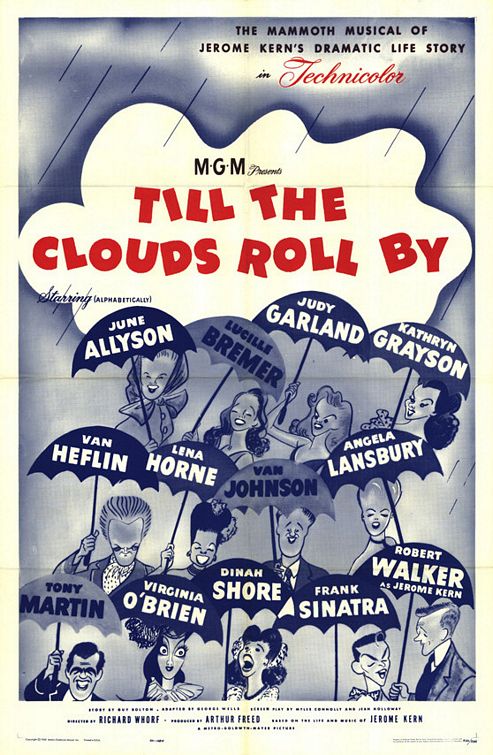
The Sweeping Symphonies of Till the Clouds Roll By

The first time I watched Till the Clouds Roll By, I was sitting in my grandparents’ kitchen with them, just enjoying a lazy Sunday afternoon/evening. I can vividly recall the smells, sights, and sounds of that day, so this movie is a bit sentimental to me as a result. When I saw that it was available on Hulu, I knew I’d have to watch again. And what better time to sit down with a feel-good, nostalgic movie than when everyone else is out there going crazy for a good deal on Black Friday? I can’t think of any.


Till the Clouds Roll By is a 1946 biopic tribute to composer Jerome Kern, who had passed away the year before this movie was released in theaters. While the movie is purportedly telling the story of Kern’s life, it also serves as a vehicle for large musical numbers, showcasing the hit songs from throughout Kern’s career. The end result is a film light on details of Kern’s life and strong on staging, costumes, swelling orchestral numbers, and so forth. I knew basically nothing about Kern before viewing this movie the first time, so I certainly did learn something from the movie about him – but then also had to verify a lot afterwards and saw how much was left out. For instance, Kern was apparently well-known for his horn-rimmed glasses yet Robert Walker as Jerome Kern is never once seen wearing a pair of any kind of spectacles; presumably the Hollywood of the 1940s would never think a leading man in glasses would be dashing enough for the audience. Some details are simply out of chronological order or slightly altered to fit the story being told in this movie, such as Hammerstein contacting Kerns about making a musical based on the book Showboat rather than the other way around as it actually happened. In real life, Kern had a daughter, but in the movie, he and his wife Eva dote only on his “niece” Sally, the child of his friend and musical arranger, Jim Hessler. The Hesslers play a huge role in this movie -- despite the fact that they never existed, although the character of Jim Hessler is supposedly based on a real-life associate of Kern’s.

The facts that Hollywood eschewed are replaced with a compelling story though and one that pulls on the viewer's heartstrings. I loved the story of how Kern becomes like family to the Hesslers and the easy repartee between him and Jim, especially in their early days as bachelor workaholics. The love story between Kern and Eva was also sweet, albeit rushed. Furthermore, the actors play the story of Kern's life well and do a convincing job of growing old and subtly changing as a result. Walker is always compelling to watch, whether he’s being charming, funny, torn, heartbroken, or feeling old and resigned, as the situation calls. The other actors in the domestic drama – Van Heflin as Jim, Dorothy Patrick as Eva, Lucille Bremer as the adult Sally, and Joan Wells as the young Sally – all play their parts perfectly as well.

But the real star power of this movie was in the music and dance, with acts that could almost be described as over the top unless you’ve happened to watch a lot of musicals from this era. The cast of Till the Clouds Roll By reads like a who’s who of Golden Age Hollywood elite, including Judy Garland, Van Johnson, June Allyson, Lena Horne, and Frank Sinatra, just to name a few. With so many heavy hitters, the producers didn’t even bother with first billing and just listed all the stars’ names alphabetically in the opening credits. While a few of the numbers in this movie were forgettable in my opinion, most of them were lavish spectacles worth viewing more than once.

For starters, Judy Garland as Marilyn Miller was one of the highlights in my book. Special guest director Vincent Minnelli (then married to Garland) was brought in to direct her musical scenes. The story goes that Garland was pregnant with her daughter Liza Minnelli at the time so when it came to staging her rendition of “Look for the Silver Lining,” Minnelli chose to put Garland behind a stage kitchen sink the whole time. Garland’s stunning voice carries the scene, even if it isn’t as action-filled as the other numbers. But despite her pregnancy, Garland is seen more active in her later musical numbers – dancing about to “Who?” and jumping onto a bareback horse in “Sunny,” with a sequence that I really, really hope is done by a stunt double. The choreography throughout the movie is excellent, but a particular favorite scene of mine is when Lucille Bremer and Van Johnson dance to “I Won’t Dance” in the Club Elite. Another one worth noting is the titular “Till the Clouds Roll By,” performed by June Allyson and Ray McDonald.

The movie both opens and ends with extended sequences acting as a review of some of Kern’s more famous songs, particularly with an emphasis on Showboat. The final song – and scene - of the movie is a young Frank Sinatra’s rendition of “Old Man River.” This choice rankles some contemporary viewers who feel that the song should be sung by an African-American man, embodying the working black man the song is meant to portray, rather than by a Caucasian-American man in spotless white tuxedo on a white pedestal. While I understand their frustration, I’d like to point out that:

1) This movie was made in 1946.

and

2) This movie was made in 1946!

The 1940s were hardly a time of racial equality in any sense of the word. Nor was Hollywood at the time a bastion of cultural sensitivity – this was the same entertainment machine that just 10 years earlier gave us Fred Astaire in black face as a “tribute” to Bill “Bojangles” Robinson. And that’s hardly an anomaly during that era. Furthermore, this movie was already filmed in such a way that Lena Horne’s solo performance could be removed when the movie was shipped out to Southern states who would refuse to air a sympathetic portrayal of an African-American woman singing on screen. It’s not pretty, but you can see why the film’s director and producers wouldn’t risk having their big finale stripped from the movie in a large number of states.

A few other points to make on this topic: 1) In the opening of the movie, “Old Man River” is also featured with African-American singer/actor Caleb Peterson singing the song, so the movie did give a small nod to the song’s origins there; 2) Italian-Americans like Sinatra were not exactly beloved at the time (another not pretty but true fact); and 3) Sinatra was a big enough name already to be a selling point, and at the end of the day, Hollywood is about making money. And, on the note about the ridiculousness of the dazzling white tuxedo and setting for this number, it's worth pointing out that this song comes at the end of a review of songs all featuring singers dressed in pure white settings. I don’t know why this is, perhaps to make some kind of point about the pure/innocent/ethereal/eternal/transcendent/pick-your-adjective quality of Kern’s works, but I do know that it would be odd if after all those numbers increasingly ascending in an “into-the-clouds” feel, the final song was done in a realistic style. One commentator makes the analysis that this whole grand finale was meant to be an ironic look at how Kern’s songs were going to be overblown and taken out of context by Hollywood and while this is an interesting theory, I just don’t think 1940s Hollywood was that was self-aware and tongue-in-cheek about itself. That’s my two cents.

All in all, my point is that you have to take a movie – or any other artistic work for that matter – as part and parcel of its time period and cultural milieu. If this movie came out today, I could understand that outrage more and would be right there with these commentators. Not just on the whitewashing of “Old Man River,” but also on the highly offensive “Cleopatterer” and some of the portrayals of women, such as Eva’s rules for what a lady can and cannot do or the fact that not a single woman in this movie ever wears pants (only skirts and dresses). These things are all a product of the times, and it is what it is. If you can take it with a grain of salt, this is a great movie from the Hollywood golden era of musicals. Fabulous performances in music, choreography, and acting will steal the show.

Thursday, May 24, 2012

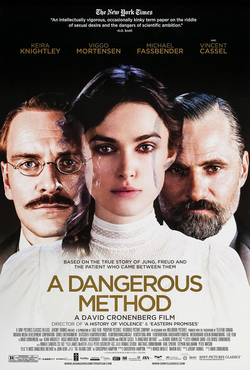
A Dangerous Method: A Look at Jung’s Perhaps-Not-So-Dangerous World


Hello all! Once again, I’ve fallen behind on updating this post, largely from working too much followed by quickly doing too many arts and entertainment-related things to have time to write about them! I’m hoping to catch you all up shortly on what’s been going on A&E wise (because work-wise would just be dull J). To that end, here’s the first of several overdue posts, this one about the 2011 film, A Dangerous Mind, starring Michael Fassbender, Keira Knightley, and Viggo Mortensen.

Set in the early 1900s, A Dangerous Method begins with a relatively young C.G. Jung (Fassbender) studying Sabina Spielrein (Knightley), a patient suffering from hysteria. Over time, Jung and Sabina move from the doctor-patient relationship to that of lovers. Already a relationship set up for disaster, it is further taut by Jung’s marriage with children on the way and Spielrein’s sporadic healing and studying to become a psychiatrist herself but not necessarily always embracing Jung’s methods.

Concurrent with all this drama, Jung is also developing – and struggling in – a relationship with renown psychoanalyst Sigmund Freud (Mortensen). Freud clearly wants to pass the mantle down to the younger doctor, but Jung does not buy all the emphasis Freud puts on sexuality as the base of so many psychological problems. Freud, meanwhile, begins to mistrust Jung’s interest in mysticism.

Some time back, I had seen one trailer for A Dangerous Method, didn’t think much of it either way, and then never heard anything about it again. That is, until on a recent flight home from vacation when it was an option to watch. There wasn’t anything else that sounded even remotely appealing on the plane’s menu, and the psychological aspect of this film intrigued me, having once been a psychology major.

That being said, I was a bit disappointed with the film from a psychological angle. The story between Freud and Jung did seem to be grounded in fact (i.e., Jung was indeed doubtful about Freud’s obsession with the sexual aspects of psychoanalysis and was critical of Freud for refusing to ever be analyzed himself), and I noted somewhere in the credits that the film referenced actual letters between the psychoanalysts where possible. In addition, the film is based on a play, which is in turn based on a nonfiction book, so somebody did their homework somewhere along the line. I knew nothing about Sabina before this film, despite having studied about both Freud and Jung in numerous classes, so her character was a welcome introduction, which allows me to do some more research on her on my own. However, I felt like the movie did not explain her psychological problems in depth and very much glossed over her (somewhat spotty) recovery. This included quickly brushing over Jung’s psychoanalytic methods, which had seemed to me to be at the heart of the film’s premise as I understood it going into the movie (not so much, it would appear).

Part of this may be due to the disjointed nature of the film. Frequently, several years would pass by from one scene to the next. I found this very disorienting, particularly with a character like Sabina who could go from stark raving mad in one scene to a perfectly polished young lady in the next. (It is possible that some of this may be due to the airline’s formatting and editing of the film, although I should point out I watched Sherlock Holmes: A Game of Shadows on the same airline a week earlier and didn’t note any appreciable differences between the airline’s version and the one I had seen in theaters. Also, I doubt the airline would remove any substantive scenes, although it is possible that they removed/limited some of the sex scenes from this particular title.) These jumps made it difficult to really ever feel like the movie was telling a logical story or for me as the viewer to become fully immersed in the story. That is not to say that I didn’t find the movie engrossing, it’s just that it never took away the feeling that this was a movie. Does that make sense? What I’m trying to say is that the movie was indeed riveting, but it didn’t sweep me up so fully in its world that I forgot I was watching something purposely built up to be viewed by outsiders, namely moviegoers.

It is also possible that other viewers got the exact opposite feeling – perhaps there was too much psychoanalytic history and terminology for a lay audience. (One reviewer refers to it as being full of “shop talk.”) Having studied psychology in an academic setting for more than four years and on my own for even longer, I can’t really say at this point. To me, it could have delved much further into the psychoanalytic methods used by Freud and Jung, but then again, I could see how this could alienate many viewers.

The movie ended on a peculiar note, which is about as much as I’m going to say on that so I don’t give anything away. I felt very much like I have at the end of some other quirky, independent movies (i.e., Lost in Translation) where I’m not really sure what to make of the ending or indeed anything that came before it. As I alluded to earlier, there wasn’t really an overarching story throughout that would culminate in a conclusion of some sort, so it just sort of felt more like it ended because two hours had passed. Like with many biopic or historical films, the viewer is given a brief synopsis of what happened to these characters later in life. Sabina’s life story ended so tragically as to leave a distinctly odd and futile feeling to the whole film.

A high note of the film was the superb acting by all, but particularly by Fassbender and Knightley. I’ve yet to see Fassbender disappoint in any role, and he plays the complicated Jung well and with nuance. Knightley throws her all into playing the insanity stricken young Sabina and then transforms perfectly into the studious, well-mannered older Sabina. Her Russian accent is perhaps not pitch perfect, but it suffices (and is more than either Fassbender or Mortensen put into their roles, as oddly enough they both do not attempt at an accent). The settings were sumptuous, the score is haunting and an absolutely perfect fit, and the cinematography was excellent. But none of this makes up for a plot that felt a bit watery. I might recommend A Dangerous Method to a handful of people that I think would enjoy this type of movie more than most, but I’m not leaping over the moon about it. I'm still kind of scratching my head about it, trying to figure out what to make of the film.

Monday, December 5, 2011

Creating a Fashion Icon: Coco Before Chanel

I only recently heard about the 2009 film Coco Before Chanel and decided to check it out, not least of all because it stars Amelie’s Audrey Tatou. This biopic of the famous fashion designer Gabrielle “Coco” Chanel looks at her early life, as perhaps implied by the title. It focuses mainly on the years in which she is the mistress first of Etienne Balsan and later Arthur “Boy” Capel, brushing over her childhood years in an orphanage and dedicating only a montage to the many, many years of her successful career. If there was one thing I did not like very much about the movie, it was that we saw so little of her actual success. However, as I already mentioned, the title of the movie should provide a clue that the movie is more about her life before coming a household name.

Due to the movie’s focus on Chanel’s years as a “kept woman,” another downside was the men’s treatment of Coco, particularly in a cringe-worthy scene in which Capel asks and receives permission to “borrow” Chanel from Balsan for a couple of days. There’s probably an element of truth-telling at work here (particularly keeping in mind the time period), but it doesn’t stop the feminist ire that boils up in me at the treatment of women as property – or worse than property, as most people aren’t willing to lend out their homes for a weekend with no questions asked. Still, throughout all this, we see Chanel becoming the person she will be. She chafes at having to ride sidesaddle, refuses to wear a corset at the sacrifice of comfort, and mocks the elaborate ornamentation on the pretentious women she sees around her.

Before seeing this movie, my entire knowledge of Chanel’s life was based on a slim picture book for children. Like with any biopic, it’s unclear how much is 100 percent true and how much is poetic license. For instance, some quick web searches tell me that Chanel had two brothers and two sisters, rather than only the one sister who is featured in the film (who, by the way, is named Adrienne – which was not the name of either of Chanel’s actual sisters). Interestingly, the movie created as many questions as it answered about Coco, including the origin of her unique nickname. In part, we are left puzzled by what’s actual true because Coco is constantly changing the story she tells – which is apparently something the real-life Chanel was known to do.

The movie also portrays Coco as witty and sarcastic, again characteristics of the actual woman. This captivating side of Coco is portrayed by the winsome Audrey Tatou who is always a delightful actor to see at work, and she even looks a bit like Chanel as an added bonus. (Tatou is also currently a spokesperson for Chanel perfumes.) All of the other players do fine jobs in their roles as well.

In addition, Coco Before Chanel is a movie well-aware of the visual aspect of the medium and contains many stunning shots. Cinematically speaking, there is never a dull moment, whether we are looking at a lush French chateau and estate, the simple and perpetual beauty of the sea, or the finery of fashion models descending a staircase. Overall, I’m not sure I would call Coco Before Chanel a “must-see” movie, but it certainly has its charms.

Sunday, December 4, 2011

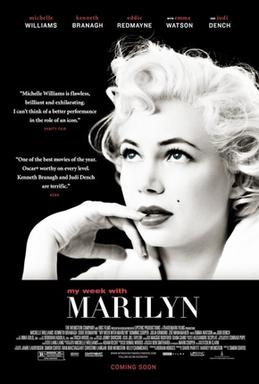
Meta-Movie: My Week with Marilyn

Anyone who’s basically ever lived anywhere but under a rock knows of the iconic actress Marilyn Monroe. But few ever got to see the real deal. My Week with Marilyn is a new film based on the diaries of Colin Clark, who was a 23-year-old newbie to the British film system when Marilyn Monroe and Laurence Olivier starred in The Prince and the Showgirl, a musical that is hardly the most memorable thing that either starred in during their respective fruitful careers. As the third assistant director, Clark was, in his own words, basically the film’s gopher. In this position, however, he finds favor and intimacy with the film’s American star. 

The movie actually covers more than one week, instead focusing on the whole period of the filming of The Prince and the Showgirl. Still, it’s a limited palette, but I’m glad that movie tackled only this time frame and didn’t try to do a broad sweeping portrait of Monroe’s entire life or career. My Week with Marilyn is based on true events (at least according to Clark’s writing), although as with any movie that purports this, I wonder just how accurate this is. (For a stellar example of how loose “based on true events” can be, check out the real story behind Saving Private Ryan some time.) For instance, I’m not 100 percent sure that I think the portrayal of Marilyn Monroe is spot-on. Williams no doubt has down the ditzy character that Marilyn played in many of her films but having her be all ‘Gee, I don’t know what he’s talking about?’ in a childish voice when not acting doesn’t seem to ring true. Luckily that side of Marilyn isn’t always the one on view throughout the movie. 

However, all in an all, I was thrilled with Michelle Williams as Marilyn Monroe, even though I was somewhat unsure about this going in. I was wary in part from not having seen Williams in enough prior films to be sure of her abilities and in part from having seen other movies based on Monroe’s life where the actresses did not look, sound, and/or act right – or even anywhere near right. Williams, on the other hand, was transformed to really look and sound like Marilyn, so much so that you could almost be fooled at times into thinking here was the real Marilyn Monroe before you. Also like Monroe, Williams lights up the screen when she’s on it and you want to look at nothing her radiance. (It’s a very different feel than her sort of ‘plain Jane’ role in The Baxter, the only other movie I’ve seen her in.)

Williams is surrounded by a cast full of a lot of Hollywood big hitters including Kenneth Branagh, Emma Watson, Julia Ormond, Dominic Cooper, and Dame Judi Dench. Excepting Kenneth Branagh who was also astoundingly good as Sir Laurence Olivier, all the other actors did fine, although not particularly noteworthy, jobs with their roles. 

Overall, My Week with Marilyn is entertaining and does not disappointing, but beyond Ms. Williams’s transformation, I wasn’t blown away. I would by no means steer anyone away from watching it, but having seen it once now, I’m good for the long haul.

As an aside, one of the previews at the theater today was for The Artist, which looks amazing and actually has the feel of an old-timey movie when so many others fall short in the respect (I’m looking at you The Aviator, for starters). It’s apparently actually a silent film, which I think is an awesome move. I will definitely be watching this one at some future point.